
Sabaton History
Published on 18 Apr 2019As the scientific masterminds of the early 1940’s discover the destructive capabilities of splitting atoms, some of them try to weaponise it. One special product is important in the creation of such a weapon: heavy water. The Norwegians have a plant that produces heavy water at Vemork. The Allies, desperate to slow down the German progress towards the development of a nuclear weapon, decide to sabotage it. The Sabaton song “Saboteurs” from the Coat Of Arms album is about the dangerous mission that is conducted by the British and Norwegians in the winter of 1940 to sabotage the Norwegian Heavy Water production for the Nazis.
Support Sabaton History on Patreon (and possibly get a special edition of The Great War): https://www.patreon.com/sabatonhistory
Check out the trailer for Sabaton’s new album ‘The Great War’ right here: https://www.youtube.com/watch?v=HCZP1…
Watch more videos on the Sabaton YouTube channel: https://www.youtube.com/user/Sabaton?…
Listen to Sabaton on Spotify: http://smarturl.it/SabatonSpotify
Official Sabaton Merchandise Shop: http://bit.ly/SabatonOfficialShopHosted by: Indy Neidell
Written by: Markus Linke and Indy Neidell
Directed by: Astrid Deinhard and Wieke Kapteijns
Produced by: Pär Sundström, Astrid Deinhard and Spartacus Olsson
Creative Producer: Joram Appel
Executive Producers: Pär Sundström, Joakim Broden, Tomas Sunmo, Indy Neidell, Astrid Deinhard, and Spartacus Olsson
Maps by: Eastory
Edited by: Iryna Dulka
Sound Editing by: Marek KaminskiEastory YouTube Channel: https://www.youtube.com/channel/UCEly…
Archive by: Reuters/Screenocean https://www.screenocean.com
Music by Sabaton.An OnLion Entertainment GmbH and Raging Beaver Publishing AB co-Production.
© Raging Beaver Publishing AB, 2019 – all rights reserved.
April 19, 2019
“Saboteurs” – Norwegian Heavy Water Sabotage – Sabaton History 011
British Ration Week Episode 2: Food for the Week
InRangeTV
Published on 21 Jan 2018What does a week’s worth of food for two people in World War Two London look like? We bought the whole week’s groceries and we will explain what the rations entailed and what we have to work with (this episode was actually filmed the day before the experiment began).
Of course, the typical British family during the war did not have a refrigerator, and the wife would have been shopping for groceries on a daily basis.
Day 2 Menu:
Breakfast: Whole Grain Pancakes, tea
Lunch: Split Pea Soup, bread
Tea: Pumpkin Spice Cookies, tea
Dinner: Spam, Vegetable Mash, aleInRange is entirely viewer supported:
https://www.patreon.com/InRangeTV
April 18, 2019
Chiang Kai-shek Plays it Like Stalin | Between 2 Wars | 1926 Part 3 of 3
TimeGhost History
Published on 17 Apr 2019In 1926 Chiang Kai-shek manages to turn the Kuomintang into his own private army, and the events are befuddling…
Join us on Patreon: https://www.patreon.com/TimeGhostHistory
Hosted by: Indy Neidell
Directed by: Astrid Deinhard
Written by: Spartacus Olsson
Produced by: Astrid Deinhard
Executive Producers: Bodo Rittenauer, Astrid Deinhard, Indy Neidell, Spartacus Olsson
Creative Producer: Joram Appel
Post Production Director: Wieke Kapteijns
Edited by: Wieke Kapteijns
Research by: Spartacus Olsson supported by Gabriel MatsakisColorized Pictures by Olga Shirnina
https://klimbim2014.wordpress.comVideo Archive by Screenocean/Reuters http://www.screenocean.com
A TimeGhost chronological documentary produced by OnLion Entertainment GmbH.
From the comments:
TimeGhost History
15 hours ago (edited)
First of all, many thanks to Gabriel Matsakis for helping out with the research for this episode! While writing about China and Chiang Kai-shek, Spartacus realised that he needed to make more than one script to explain The Northern Expedition (crucial to the developments that eventually lead to the World War in China), so we threw in another episode in 1926 to explain Chiang Kai-shek’s rise to power. In the next episode (1927 part 1) we will return to the United States and look at the economic boom and the Roaring Twenties. We will also return to China and the actual Northern Expedition in a 1927 episode after that. Enjoy the confusion that is China in the 1920s!?!
Holiday Tales: Easter!
Overly Sarcastic Productions
Published on 30 Mar 2018Happy Good Friday, everyone! Easter’s in two days, so let’s take a hot minute to see if we can figure out what exactly we’re celebrating when we pull out our egg baskets and chocolate bunnies, and why exactly we do it the way we do. Will we be able to unravel the mysteries of Easter before Jesus’s death timer hits zero? (Spoiler: no!)
PATREON: www.patreon.com/user?u=4664797
British Ration Week Episode 1: Introduction
InRangeTV
Published on 20 Jan 2018Did you know that under World War II rationing, the health of the British public improved by virtually every objective measure? Caloric intake increased, lifespan increased, and infant mortality decreased. Despite being an island nation under severe submarine blockade, the United Kingdom managed to not just provide food for its millions of inhabitants, but actually build and maintain the public trust in government rationing. How did this happen? We will explore the question all week, while Ian eats a diet of only what a typical British family would have eaten during the dark days of the Blitz.
Day 1 Menu:
Breakfast: Oatmeal Porridge, tea
Lunch: Leek & Potato Soup, bread & margarine, water
Tea: Vanilla Depression Cake, tea
Dinner: Cottage Pie, aleFor the recipes for today’s dishes – and lots of other details about the experiment – please see our data page at InRange.tv:
http://www.inrange.tv/british-rationi…
InRange is entirely viewer supported:
https://www.patreon.com/InRangeTV
April 17, 2019
Some good news in the aftermath of the Notre-Dame de Paris fire
Mark Steyn, who is not normally noted for his habit of bringing good news, actually has some good news to share as the authorities in Paris evaluate the damage to the cathedral after the fire of April 15th:
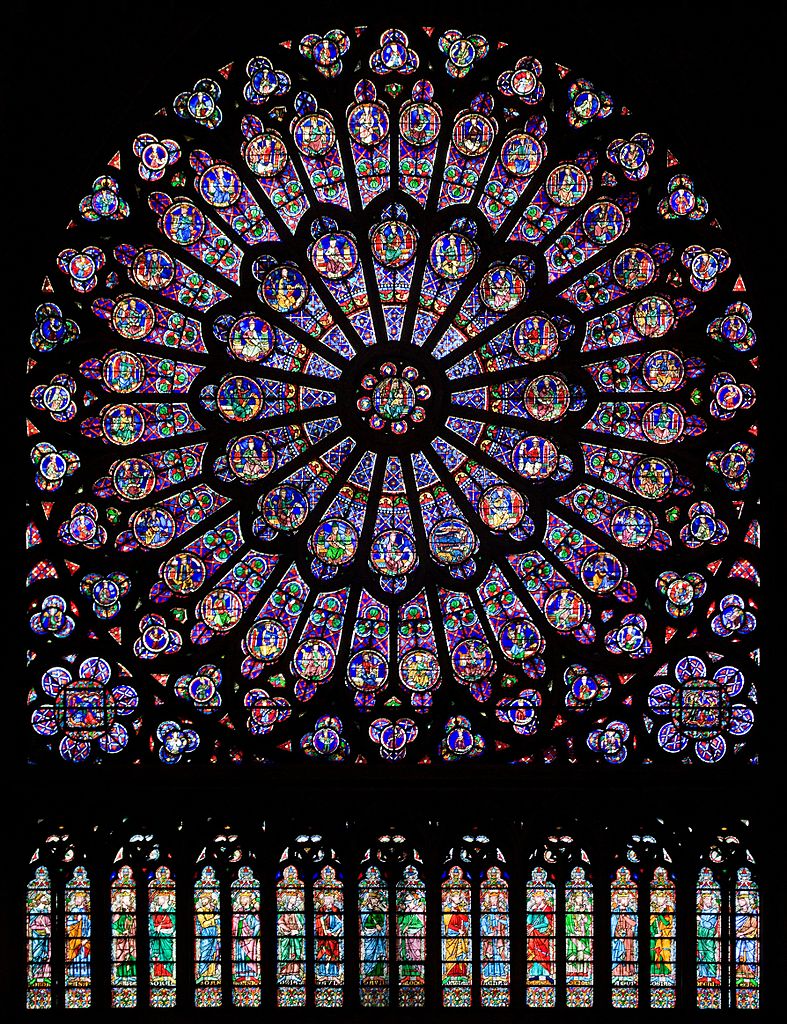
The north rose window of the Cathédrale Notre-Dame de Paris, in a photo from 22 August, 2010. This and the other two rose windows are reported to have survived the fire of 15 April, 2019.
Photo by Julie Anne Workman. License: CC-BY-SA 3.0 via Wikimedia Commons.
Twenty-four hours after Notre Dame de Paris began to burn, there is better news than we might have expected: More of the cathedral than appeared likely to has, in fact, survived intact – including the famous rose windows, among the most beautiful human creations I’ve ever seen. The “new” Notre Dame will be mostly high up and out of sight, which is just as well given that modern man prides himself on having no smidgeonette of empathy with his flawed forebears and thus the chances of historic recreation of the animating spirit of 1160 are near zero.
There is an architectural debate to be had, I suppose, about whether a reconstructed twelfth-century cathedral requires nineteeth-century appurtenances such as its spire. But the minute that starts you risk some insecure dweeb like Macron, on whose watch the thing went up in smoke, getting fanciful ideas about bequeathing to posterity some I M Pei pyramid on the top of the roof. France’s revolution, unlike America’s, was aggressively secular, and it ultimately found expression in the 1905 law on the separation of churches and the state. Since then the French state has owned the cathedral, and thus it will be Macron who ultimately decides what arises in its place.
Beyond that are the larger questions: When the iconic house of worship at the heart of French Christianity decides to mark Holy Week by going up in flames, it’s too obviously symbolic of something … but of what exactly? Two thousand churches have been vandalized in the last two years: Valérie Boyer, who represents Bouches-du-Rhône in the National Assembly, said earlier this month that “every day at least two churches are profaned” – by which she means arson, smashed statutes of Jesus and Mary, and protestors who leave human fecal matter in the shape of a cross. This is a fact of life in modern France.
As it is, there is no shortage of excitable young Mohammedans gleefully celebrating on social media. In 2017 some inept hammer-wielding nutter yelling “Allahu Akbar!” had a crack at Notre Dame, and a couple of years before that the historian Dominique Venner blew his brains out on the altar to protest same-sex marriage. I love France but, in recent years, it’s hard not to pick up on the sense that it’s coming apart – and that, when the center cannot hold, the things at that center, the obsolete embodiments of a once cohesive society, are a natural target.
In addition, the authorities’ eagerness to assure us that it was an accident at a time when such a conclusion could not possibly be known – and when their own response to the emergency was, to put it politely, somewhat dilatory – was itself enough to invite suspicion: “Sure, it might be an accident. But, even if it weren’t, they’d still tell us it was…”
So, precisely because Paris is full of people who would love to burn down Notre Dame four days before Good Friday, it seems bizarrely improbable that it should happen by accident: that a highly desirable target should be taken out by some slapdash workman leaving a cigarette butt near his combustible foam take-out box – the lunchpack of Notre Dame – and letting the dried-out twelfth-century timbers do the rest.
The Rose Window was spared! pic.twitter.com/D5NjepKzh3
— The French History Podcast (@FrenchHist) April 16, 2019
Lee Carbine: Gunmaking is not for the Faint of Heart
Forgotten Weapons
Published on 16 Apr 2019This rifle is lot #13868 at Morphy’s April 2019 auction:
https://www.forgottenweapons.com/lee-…James Paris Lee is known today as the inventor of the detachable box magazine, and the “Lee” in the “Lee Enfield” rifle system – a very significant contributor to firearms development. His first foray into the business of gun design and manufacture, however, was a rather ignominious failure.
Lee patented a single shot swinging barrel system in 1862, and hoped to win an Army contract for it. In February of 1864 he submitted a rifle version to the Army, and was promptly rejected – the Army was not interested in breechloading rifles. Lee came right back in April 1864 with a carbine pattern, and this was accepted for testing – the Army was indeed looking for breechloading cavalry carbines. It took a full year, but in April 1865 the Army came back and gave Lee a contract for 1,000 carbines at $18 each. Lee rounded up investors and capital, and created the Lee Fire Arms Company in Milwaukee to produce the guns. His first two samples were delivered in January 1866 – in .42 rimfire caliber.
At this point, there is some disagreement. Lee claims that his sample guns in .42 caliber were accepted, and thus his followup delivery of .42 caliber carbines should have been accepted. The government said that the contract specified .44 rimfire caliber, and his delivery of .42 caliber guns was unacceptable, and thus rejected. A court case would ensue, but with the rejection of the first 250 guns and the cancellation of their contract, the company had to look hard and fast for a backup plan. In March 1867 newspaper ads were placed in Milwaukee for sporting rifles and carbines from the Lee company. The parts planned for military production were used instead for civilian guns in a variety of configurations – carbines, light rifles, and heavy rifles in several barrel lengths and several calibers. By 1868 all production had ceased, and the Lee Fire Arms Company dissolved.
James Lee returned to his former profession of watchmaking, but this experience with gun manufacturing would not keep him deterred for long. By 1872 he was back working with Remington, and would go on the produce the designs that we know him for today. The lessons of this rifle? Firearms manufacturing is a risky business, not for the faint of heart. And also, sometimes you can learn from a difficult experience to do better the second time.
http://www.patreon.com/ForgottenWeapons
Cool Forgotten Weapons merch! http://shop.bbtv.com/collections/forg…
Contact:
Forgotten Weapons
PO Box 87647
Tucson, AZ 85754
Tank Chats #46 Ram Kangaroo | The Funnies | The Tank Museum
The Tank Museum
Published on 16 Feb 2018As part of the Funnies mini-series, David Fletcher takes a look at the troop-carrying Ram Kangaroo.
Towards the end of World War Two, Canadian Ram tanks were converted into Armoured Personnel Carriers called Kangaroos.
Support the work of The Tank Museum on Patreon: ► https://www.patreon.com/tankmuseum
Or donate http://tankmuseum.org/support-us/donateVisit The Tank Museum SHOP: ►https://tankmuseumshop.org/
Twitter: ► https://twitter.com/TankMuseum
Tiger Tank Blog: ► http://blog.tiger-tank.com/
Tank 100 First World War Centenary Blog: ► http://tank100.com/ #tankmuseum #tanks
April 16, 2019
World War 2 British Armour Doctrine & Tactics with David Willey of the Tank Museum at Bovington
Military History Visualized
Published on 8 Dec 2017David Willey the Curator of the Tank Museum at Bovington explains British Interwar and World War 2 Armour Doctrine and Tactics. Especially, about the Infantry and Cruiser tank “concept”. Additionally, we talk a bit about the 2nd Battle of El Alamein, Montgomery and Rommel.
QotD: Romania and the Nazi Final Solution
Last place goes to Romania, which had been anti-Semitic since the beginning of time and was genuinely excited to have Nazi orders as an excuse to carry out their own worse impulses:
In Rumania even the S.S. were taken aback, and occasionally frightened, by the horrors of old-fashioned, spontaneous pogroms on a gigantic scale; they often intervened to save Jews from sheer butchery, so that the killing could be done in what, according to them, was a civilized way.
The Romanians started their own concentration camps to supplement the Nazi’s, “more elaborate and atrocious affairs than anything we know of in Germany”, but they didn’t always need them – “deportation Rumanian style consisted in herding five thousand people into freight cars and letting them die there of suffocation while the train traveled through the countryside without plan or aim for days on end; a favorite followup to these killing operations was to expose the corpses in Jewish butcher shops.” Things became so bad that Nazi emissary Manfred von Killinger, intervened and asked them to stop and defer to German efforts. I feel like when a Nazi named Commander von Killinger is horrified by your brutality, it’s time to take a step back and evaluate whether you may have crossed a line.
Other interesting profiles include Greece (hopelessly depressing), Slovakia (very Catholic, in favor of killing Jews but got in a bunch of fights with the Nazis about ethnic Jews who had been baptized into Catholicism), Hungary (ruled by an Admiral despite being landlocked; otherwise hopelessly depressing), Belgium (deliberately left the trains unlocked so the Jews could escape!), Holland (kind of like France; the local Gentiles tried to help, but the assimilated Jews sold out the refugee Jews in the hope of placating the Nazis; the Nazis were not placated; three-quarters of Jews died), and Poland (I don’t even want to talk about how hopelessly depressing this one is).
Scott Alexander, “Book review: Eichmann in Jerusalem”, Slate Star Codex, 2017-01-30.
April 15, 2019
The Lenin Boys Go To War – Hungarian Soviet Republic I THE GREAT WAR 1919
The Great War
Published on 14 Apr 2019Like many European countries, Hungary experienced rapid political changes in the aftermath of the 1918 armistices. The Kingdom of Hungary used to rule big parts of South Eastern Europe and many peoples within its former boundaries are now gaining independence and expand their territory. The new Hungarian Republic is faced by external and internal pressures and after a coup becomes the Hungarian Soviet Republic, the 2nd Soviet State in Europe.
» SUPPORT THE CHANNEL
Patreon: https://www.patreon.com/thegreatwar
Merchandise: https://shop.spreadshirt.de/thegreatwar/» SOURCES
Böhler, Jochen. “Post War Military Action and Violence (East Central Europe,” in 1914-1918 online. International Encyclopedia of the First World War. https://encyclopedia.1914-1918-online…Borsanyi, György. The Life of a Communist Revolutionary, Bela Kun (New York: Columbia University Press, 1993).
Freud, Sigmund and Sándor Ferenczi. The Correspondence of Sigmund Freud and Sándor Ferenczi, Volume 2: 1914-1919. Eva Brabant, Ernst Falzeder, Patrizia Giampieri-Deutsch, eds. (Boston: Harvard University Press, 1993).
Gerwarth, Robert. The Vanquished. Why the First World War Failed to End, 1917-1923 (Penguin, 2017).
Gilley, Christopher. “Peasant Uprisings/Tambovshchina” in 1914-1918 online. International Encyclopedia of the First World War: https://encyclopedia.1914-1918-online…
Leidinger, Hannes. “Revolutions (Austria Hungary),” in 1914-1918 online. International Encyclopedia of the First World War https://encyclopedia.1914-1918-online…
Leonhard, Jörn. Der überforderte Frieden. Versailles und die Welt 1918-1923 (CH Beck, 2018).
Mawdsley, Evan. The Russian Civil War (New York: Pegasus Books, 2005).
Molnar, Miklos. From Bela Kun to Janos Kadar: 70 years of Hungarian Communism (New York: Berg, 1990).
Pastor, Peter. Hungary Between Wilson and Lenin (New York: Columbia University Press, 1976).
Pastor, Peter, ed. Revolutions and Interventions in Hungary and its Neighbor States, 1918-1919 (New York: Columbia University Press, 1988).
Vörös, Boldiszar. “Bela Kun,” in 1914-1918 online. International Encyclopedia of the First World War https://encyclopedia.1914-1918-online…
» SOCIAL MEDIA
Twitter: https://twitter.com/WW1_Series
Reddit: https://reddit.com/r/TheGreatWarChannel»CREDITS
Presented by: Jesse Alexander
Written by: Jesse Alexander
Director: Toni Steller & Florian Wittig
Director of Photography: Toni Steller
Sound: Toni Steller
Editing: Toni Steller
Mixing, Mastering & Sound Design: http://above-zero.com
Motion Design: Christian Graef – GRAEFX
Maps: Daniel Kogosov (https://www.patreon.com/Zalezsky)
Research by: Jesse Alexander
Fact checking: Florian Wittig
Channel Design: Alexander Clark
Original Logo: David van StepholdA Mediakraft Networks Original Channel
Contains licenced material by getty images
All rights reserved – Real Time History GmbH 2019
Canada and the Battle of the Atlantic, part 12
Editor’s Note: This series was originally published by Alex Funk on the TimeGhostArmy forums (original URL – https://community.timeghost.tv/t/canada-and-the-battle-of-the-atlantic-part-5-edited/1453).
Sources:
- Far Distant Ships, Joseph Schull, ISBN 10 0773721606 (An official operational account published in 1950, somewhat sensationalist)
[Schull’s book was published in part because the funding for the official history team had been cut and they did not feel that the RCN’s contribution to the Battle of the Atlantic should have no official recognition. It is very much an artifact of its era, and needs to be read that way. A more balanced (and weighty) history didn’t appear until the publication of No Higher Purpose and A Blue Water Navy in 2002, parts 1 and 2 of the Official Operational History of the RCN in WW2, covering 1939-1943 and 1943-1945, respectively.]- North Atlantic Run: the Royal Canadian Navy and the battle for the convoys, Marc Milner, ISBN 10 0802025447 (Written in an attempt to give a more strategic view of Canada’s contribution than Schull’s work, published 1985)
- Reader’s Digest: The Canadians At War: Volumes 1 & 2 ISBN 10 0888501617 (A compilation of articles ranging from personal stories to overviews of Canadian involvement in a particular campaign. Contains excerpts from a number of more obscure Canadian books written after the war, published 1969)
- All photos used exist in the Public Domain and are from the National Archives of Canada, unless otherwise noted in the caption.
I have inserted occasional comments in [square brackets] and links to other sources that do not appear in the original posts. A few minor edits have also been made for clarity.
Earlier parts of this series:
Part 1 — Canada’s navy before WW2
Part 2 — The Admiralty takes control
Part 3 — The professionals and the amateurs
Part 4 — 1940: The fall of France, the battle begins, and the RCN dreams of expansion
Part 5 — The RCN’s desperate need for warships
Part 6 — New ships, new challenges
Part 8 — Expansion problems: not enough men for not enough ships
Part 9 — Early-to-mid 1941, The Rocky Isle in the Ocean
Part 10 — The Newfoundland Escort Force and the Canadian corvettes
Part 12 — Staff needed, training needed, and Commodore Murray’s thankless tasks
Mid-May 1941 saw the few Canadian ships that remained in England involved in a series of training exercises off the Northern Irish coast. Two of the four-stackers and three corvettes practiced ASW, wireless, and visual signalling, under the watchful eyes of British officers. The results were less than satisfactory. The situation was described by Marc Milner in North Atlantic Run as
… a complete lack of understanding of what was expected of divisions within individual ships (the ASDIC team, depth-charge crew, gunners, and so on) and of ships operating as a group. The British found the Canadians keen, intelligent, and willing to learn. But no one, from the Captains on down, had any concept of ASW, and this caused the British great concern. … Most disturbing was the British training officer’s criticism of the corvettes’ commanding officers. He reported that they showed a great lack of initiative and relied entirely on the senior officer for instructions. “No one would possibly question their courage or endurance at sea,” the RN officer wrote, “and they are fine seamen. Their lack of technical knowledge is their greatest difficulty and possibly due to their age they are slow to learn.” The RCNR commanders of Canada’s first corvettes may also have had an understandable reluctance to jump too quickly when asked to do so by a young RN officer. None the less, Captain (D), Greenock, who took exception to the above officer’s dim view of Canadian COs, concluded bluntly that the low state of efficiency reached by these ships was “attributable directly to inexperience and perhaps the age of their commanding officers.” Captain (D), Greenock, recommended that they be replaced as soon as possible by younger, more experienced RCN or RCNR officers with escort experience.
Captain (D), Greenock, compiled these remarks for his chain of command, and included uncomplimentary extracts from the original work-ups of the Canadian corvettes to illustrate just how inefficient they really were. Their wireless communications had passed muster, and “bearings and distances of contacts were passed among them continuously and accurately”. Signal communication “was at times hopeless, and at best was barely adequate.” At the RN’s escort work-up base at Tobermory, where Spikenard and Hepatica trained in May, drawing similar comments from the training staff there.
From the record, it appears unlikely that any of these RN officers knew that the ten Canadian corvettes had been manned only to transfer the ships to RN crews, and that many of the officers and ratings were intended for other roles after arrival in British waters. As mentioned in earlier parts, the crews were far from seasoned professionals, as James Lamb explains in The Corvette Navy:
Corvette crews were young; officers and men were mostly right out of high school, and anyone over thirty found himself nicknamed “Pappy” and the oldest man in the ship. Consequently, corvette people were all junior in rank and rate, most of their upper-deck crews being ordinary seamen and with leading seamen often carrying out the jobs normally assigned petty officers, and the engine rooms filled with youngsters right out of mechanical training school. Early in the war, a corvette would be commanded by a Naval Reserve (ex-merchant navy) lieutenant with a Volunteer Reserve lieutenant as executive officer or “Jimmy the One”, and two other officers — junior lieutenants or sublieutenants — as watch-keepers. The corvettes were cobbled together, half a dozen at a time, into escort groups, led by an old destroyer usually commanded by a lieutenant or lieutenant-commander of either the RCN or, especially in the early days, the RN.
When you first joined a ship in the corvette navy, you passed from one world into another. You left behind the Big Navy, where you had done your training, the shoreside navy with all its braid and bands and bumf, and you joined an outfit that was run along the lines of a small corner-store. For corvette types were “family”; you soon got to know the characters in your own ship, and in the others of the group. There were chummy ships, whose destinies seemed always to be bound up with yours, and there were rivals, usually commanded by officers senior to your own. Months would go by, grow into years; the shoreside navy became a memory, although there were always officers and men joining ship for a trip or two before going back ashore to the other world where they were busy building careers.
For most of us, the corvettes, the frigates, the Bangors and the old four-stackers and other obsolete destroyers of the escort fleet became home.
From the inside, the RCN’s corvette crews may have been like families afloat, but the stiffer and more formal RN viewed-with-alarm the amateurs they would be depending upon for significant numbers of the convoy escorts critical to British survival. You can probably see their point. Marc Milner continues:
Operational and training authorities in Britain were clearly appalled by what they saw, and Captain (D), Greenock’s memo was not intended for purely internal consumption. The RCN’s expansion had got off to a poor start, and the foundations of a legacy of inadequacy and ineptitude were laid. No amount of hard work or improvement would shake it for some time.
As the above report made its way through channels and the ships of the Fourth Escort Group sailed to join NEF, things moved apace in Newfoundland. Commodore Murray … arrived to assume the post of Commodore Commanding Newfoundland Escort Force (CCNF) on 15 June. Murray was a native Nova Scotian with deep roots in rural Pictou County. He attended the first class of the Royal Naval College of Canada in 1912 as a boy and went on to serve in various warships of both the RN and the RCN. His first notable appointment was to the wardroom of HMS Calcutta as a young sub-lieutenant when that ship commissioned from the builder’s yards in 1919. Calcutta‘s first commanding officer was then Captain Dudley Pound, a man who was instrumental — as First Sea Lord in 1941 — in having Murray posted to St John’s. Close links with the RN not only fostered personal connections; young Canadians also adopted many of the trappings of RN officers. Murray was not spared the effects of his long exposure to the traditions and habits of the parent service. Although he did not develop a British accent, it is unlikely that many Pictonians would have recognised him as one of their own in 1939. Yet Murray never lost his playful charm and his appreciation of his background. … This rapport carried on throughout the war; ironically, his concern for “his boys” has been cited as evidence that Murray was never capable of the type of dynamic command that his positions warranted. There is some truth in this. But few major naval commands during the Second World War were comparable to those of the RCN, where tact, diplomacy, and goodwill were essential to running an organization composed almost entirely of reservists. Murray was above all a competent and confident officer, an excellent ship handler, and an able administrator.
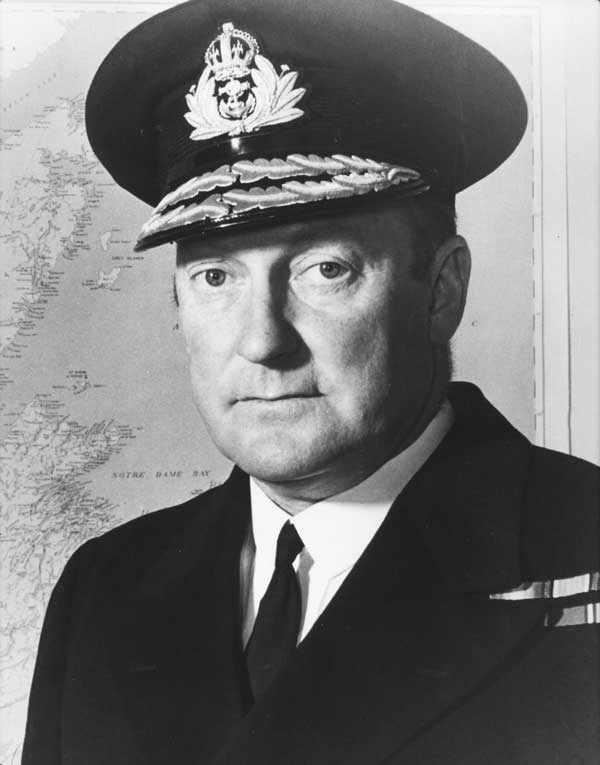
Rear Admiral Leonard W. Murray as Flag Officer, Newfoundland.
Photo via CFB Esquimalt Naval & Military Museum.
Murray’s task in Newfoundland was daunting. Not only were the facilities jury-rigged and totally inadequate; a whole administrative and support staff had to be assembled and adapted to conditions at St John’s. Perhaps because the very long-term existence of NEF — as distinct from the base itself — was an open question in the summer of 1941, the development of its staff was slow. Murray, as CCNF, was charged with overall command of naval operations off Newfoundland. But the initial staff at St John’s in May 1941 was wholly administrative, belonging to the port defence establishment. The first official record of HMCS Avalon, which appeared in the September 1941 Navy Lists, shows little more than Captain Schwerdt’s port-defence and naval-control-of-shipping staffs. Newfoundland Escort Force’s staff consisted of Murray, his chief of staff Commander R.E.S. Bidwell, RCN, and the commodore’s secretary. A more accurate indication of NEF’s supporting staff by mid-1941 was published in November. By then CCNF had added staff officers of Operations, Intelligence, and Signals and a secretary’s staff. These staffs provided the vital elements of naval operations: the processing and collecting of intelligence, handling of heavy signals traffic, and the organization and management of operational forces.
The actual administration of the escort forces themselves fell to a separate “Flotilla” staff under a “Captain (D[estroyers]).” Traditionally Captain (D) was a seagoing officer, responsible in all respects, including operational efficiency, for a flotilla of ten to twelve destroyers. Administratively the system was applicable to escort forces, but the small size of their ships and the small size of escort groups made it inappropriate for Captains (D) to go to sea. As a result the main staff of escort forces such as NEF remained ashore, while the actual seagoing duties of Captain (D) were passed to the less senior commanders of escort groups.
Captain (D) was crucial to the performance of his forces. Through a staff of specialists he monitored and was ultimately responsible for the efficacy of escort groups, individual ships, and the important warlike functions within each ship. In the early days of NEF the latter problems overwhelmed those of group coordination and the development of and adherence to a suitable tactical doctrine, for which Captain (D) was also responsible. Initially, much-needed specialists in all but a few traditional naval functions were unavailable. During 1941 Captain (D), Newfoundland, had only two specialist officers, one for gunnery and one for signals. A torpedo officer, whose duties included depth charges, was not added until 1942, while the key posts of A/S, radar, and engineering were not added until 1943. In an A/S escort force the delay in providing specialists to oversee the use of ASDIC, radar, and depth charges was serious. In the interim, St John’s-based escorts had to draw on the expertise of the base A/S and radar officers (both qualified RN officers), whose duties covered maintenance and supervision of port defences as well. Fortunately, these men found time to devote to NEF. … The RCN did what it could, but there were simply not enough qualified personnel to go around. The result was a serious deficiency in Captain (D)’s staff. In the context of a time when things were difficult all around, however, these weaknesses appear comparatively minor. Further, like the escorts themselves, Captain (D)’s initial shortfalls could be expected to diminish with time.
Theoretically at least, Captain (D) was also responsible for maintenance of existing equipment and modernization as new equipment became available. The limited facilities of St John’s made simple maintenance difficult enough, as the port was not capable of handling anything more than emergency repairs. Equipment was in very short supply, and even accommodation for extra staff was difficult or impossible to arrange. The Captain (D), Halifax, had an inspection staff for Additions and Alterations (A’s & A’s in naval parlance), so St John’s-based escorts had to turn to Halifax for anything that could not be done locally. There was nowhere within NEF’s normal operations area where new equipment could even be fitted, and a six-hundred mile trip to Halifax was hardly convenient in a changing tactical environment.
Organizationally and operationally, the NEF was a smaller version of the RN’s Western Approaches Command. The size and composition of escort groups was identical, and the NEF adopted the use of group numbers (14 through 25) following in sequence from those used by WA. NEF escort groups were more or less permanent in membership in order to foster teamwork, and as with RN groups, sailed under the command of their most senior officer (Senior Officer, Escort or SOE). This officer fulfilled the operational duties of a Captain (D) at sea.
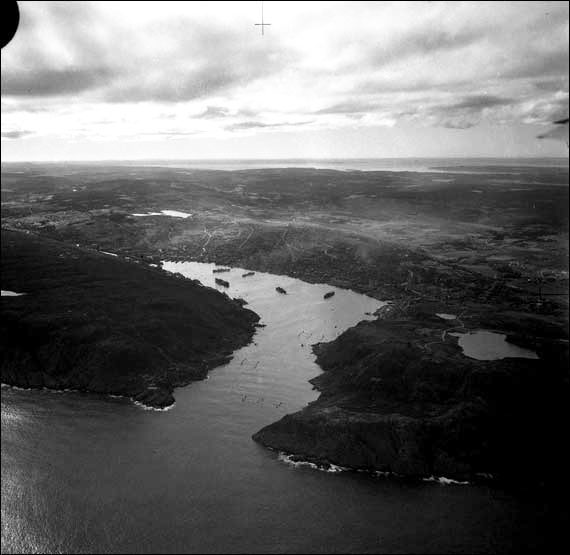
St. John’s harbour, circa 1942.
Photo from Heritage Newfoundland & Labrador (original from Library and Archives Canada MIKAN 4164991.)
Detailing tasks, issuing sailing orders, and other related duties fell to CCNF’s operational staff. It provided the link between actual naval forces and the trade and convoy organizations. The control and management of shipping was part of the bureaucratic war. The Commonwealth navies, through their trade divisions and Naval-Control-of-Shipping (NCS) organizations, rationalized and systematized the movement of merchant ships, allowing them to be defended one of two ways. On the basis of intelligence and under the indirect cover of battle fleets, shipping was routed independently along “safe” routes. This form of protection (by far the most prevalent until 1943), was predicated upon existence of British, and later Anglo-American, command of the sea. It was an effective form of defence against the surface raiders, but it would never achieve true success against U-boats, particularly as their numbers grew. The second type of naval defence of shipping was the raison d’être for NEF.
Siege of Vienna – Tunnel War – Extra History – #2
Extra Credits
Published on 13 Apr 2019The siege presses on from its initial active resistance phase to the long, routine drudgery of survival on the inside and elaborate defense building on the outside: earthworks and revelins designed by Georg Rimpler. Meanwhile, the Ottomans prepared to attack via gunpowder prepared inside mining tunnels.
Winter was coming — that’s what had doomed Suleiman when he’d tried to take Vienna back in 1529. The bitter cold. The Grand Vizier swore history would not repeat itself. Because soon, his mining tunnels would be ready.
Join us on Patreon! http://bit.ly/EHPatreon
Why Are Brits So Obsessed with Tea? – Anglophenia Ep 30
Anglophenia
Published on 3 Jun 2015Anglophenia’s Kate Arnell looks back at the moments in history that made Britain a tea-drinking nation.
QotD: De Gaulle and the BBC
Above all he loved France, or the idea of it. He saw in the defeat of 1940 a danger that his country would simply disappear, having failed to defend itself and having fled from the battle without properly drawing its sword. This was not a foolish fear. Great civilizations can and do vanish, and one of the best ways of doing so is to abandon the struggle to survive.
He must have greatly resented the fact that he owed so much to Britain. He was intelligent enough to know that Britain, a country few Frenchmen can ever fully trust, was his best hope and only refuge. He understood, as many French patriots could not, that the terrible attack on the French fleet by the British Navy at Mers-el-Kébir in 1940 was in fact necessary, in case its great ships fell into the hands of the Germans. He would have done the same himself had the position been reversed, and he knew it. It was this generosity of mind that made him great. But how he must have loathed being dependent on the British Broadcasting Corporation for his access to the French people. For it was the BBC that made him. Until he finally appeared for the tumultuous, ecstatic liberation of Paris in 1944, he was only a voice, heard fleetingly on illegal broadcasts. Almost nobody in France had the faintest idea what he looked like. But all had a certain idea of de Gaulle, the spirit of France that refused to surrender. And when they finally saw this towering, fearless figure walking calmly down the Champs-Élysées amid the snipers’ bullets, he did not disappoint them. He was, it turned out, a giant so tall that one could imagine ice forming on his upper slopes when—as so often happened—he was annoyed or impatient with his people. His great height set him apart from the beginning. He once complained, “We giants are never at ease with others … the armchairs are always too small, the tables too low, the impression one makes too strong.”
Peter Hitchens, “A Certain Idea of France”, First Things, 2019-04.


