
World War Two and Spartacus Olsson
Published 7 May 2026Early in World War II, German U-boats came dangerously close to starving Britain into submission. The Type VII submarine — especially the VIIC — became the backbone of the Kriegsmarine‘s Atlantic campaign, sinking thousands of Allied ships and threatening to win the Battle of the Atlantic.
But despite its devastating effectiveness, the U-boat war ultimately failed — and not just because of Allied countermeasures.
In this documentary, Spartacus Olsson breaks down how Adolf Hitler’s strategic miscalculations, competing naval doctrines, and direct interference undermined Germany’s most effective naval weapon. From the clandestine development of submarines after the Treaty of Versailles, through Admiral Karl Dönitz’s vision of a tonnage war, to the catastrophic losses of German submariners, this episode examines how Nazi rearmament translated into wartime reality — and failure.
Featuring detailed analysis of Type VII design, production, deployment, and combat performance, this video reveals how industrial limitations, political priorities, and technological shifts turned a war-winning weapon into a death trap.
This standalone episode complements the Death of Democracy series by showing what Hitler actually did with Germany’s rearmament- and why it fell short.
May 8, 2026
How Hitler Wasted Germany’s Deadliest Weapon – Nazi Rearmament 01 – U-Boat Type VIIC
The Strugatskys’ The Doomed City and the Soviet Experiment
Feral Historian
Published 12 Dec 2025While The Doomed City isn’t the last book Boris and Arkady Strugatsky wrote, it is arguably the end of their journey from idealism to cynicism with regards to the whole Soviet project and serves as an almost spiritual history of the period. Let’s meander through it to look at some things not covered in a literary review.
00:00 Intro
03:12 New Jobs
04:45 Aside – Facts and Theory
05:42 Laws and Mentors
09:36 The Experiment
10:50 Regime Change
13:25 Aside – Maps
15:45 Status and Power
18:22 The Ground Beneath Our Feet
(more…)
QotD: North Vietnamese intelligence failures in the Tet Offensive
Finally, a real intelligence failure on the NVA‘s part contributed to the US failure. The main reason US analysts were sure the North Vietnamese lacked the forces was because the NVA did, in fact, lack the forces. They called Tet the “general uprising”, and they were counting on widespread popular support — including, it seems, entire ARVN units defecting. That’s the only way they’d have sufficient force to knock ARVN out of the war …
… and it didn’t happen, because they, the North Vietnamese, had faulty intel.
The Americans suffered from the “intel to order” problem too, of course, which we in the civilian world call “telling the boss what he wants to hear”. But the NVA had it much worse, since that’s a much greater structural problem among Commies. Indeed, the Americans got at least one high-level defector during Tet — a lieutenant colonel I think — who only defected because the units he was supposed to command in the “general uprising” didn’t exist. They were purely paper fantasies, straight out of some commissar’s head.
And that’s what made [US Army military analyst Joseph] Hovey’s report so easy to dismiss. Hovey himself said it — it looks like they’re planning to do X, Y, and Z, but that would only make sense if they’re making a big mistake about the balance of forces. The US had pretty good intel on the ARVN and the political mood of South Vietnam. But they for some reason assumed that the NVA had basically the same information, so all of the NVA’s calls for a general uprising — which the NVA absolutely meant, and indeed were counting on — were easy for US analysts to dismiss as mere propaganda.
Severian, “Book Rec: Tet, Intelligence Failure”, Founding Questions, 2022-06-30.
May 7, 2026
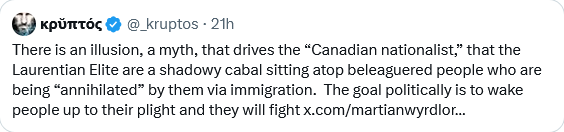
Pay no attention to the Laurentian Elite behind the curtain!
Canada before Confederation was largely run by the Family Compact, an informal oligarchy of wealthy and influential families who had a virtual monopoly on social advancement, political appointments, and the justice system. As kids we were all told in school that this all withered away and now we live in a wonderfully meritocratic society (that’s also a genocidal racist, sexist, homophobic, transphobic dystopia, but those are later lessons after the land acknowledgements). They didn’t fade away, of course, and the behind-the-scenes power brokers are still there, still wielding informal but widespread control over the government and the economy. We just call them the Laurentian Elite, so that’s totally different than the bad old Family Compact, eh?
The Laurentians very effectively keep themselves out of the public eye. Most Canadians don’t even know this class exists. So, they are in that sense a shadowy cabal.
Of course Canadians want prosperity and whatever. Everyone does. Of course they think this is the purpose of the government. Of course the government’s messaging is largely around economics.
The government’s actual activities, however, are immensely economically destructive. This is because of their religious fanaticism. Canadians believe in “peace, order, and good government”. The Laurentians believe in multiculturalism, mass immigration, gender woo, and climate change. They just lie about these things being good for the economy. It’s now obvious that they are very bad for the economy, and yet, they continue, so.
The gimmigration restrictions are a joke. The government is continuing to hand out PRs and passports like Halloween candy, and turd worlders are continuing to grab them like the black kids who think the whole basket is all just for them. It is allowing TFWs to flood the asylum system, which it uses as a back door to keep them in the country. The numbers they publish are a bullshit accounting game, but even if they’re to be believed, letting in hundreds of thousands of new PRs every year isn’t a reduction from anything but the truly insane spike in 2022-24.
The housing market is fucked, yes, but I’m skeptical this is because immigration has been “reduced”. It’s more likely that a decade of zero economic growth, rapid inflation, even more rapid asset inflation, shit jobs, and high taxes means that no one can afford the overpriced housing, so no one buys it. The shoebox condos they threw up all over Toronto are a contributing factor: no one wants to spend $500,000 on a 500 square foot condo, so no one does. Investors can’t afford to sell for less, so they sit on them. Developers look at tens of thousands of units of unsold inventory, and refuse to start new projects. Whole system is seized up because of many years of malinvestment, not because the government has meaningfully reduced the invasion.
You say that Canadians will go back to Laurentian rule once the excesses are curbed. That presumes Laurentian rule slackened for even a moment, and that the Laurentians have any intention of curbing their excesses. Neither of these are true. They are doubling down on everything. Destroying Canada — as one element in the destruction of Western civilization — is a religious imperative for them. Nor was their power ever threatened, because it is propped up by brainwashed parasitic client groups — boomers, women, immigrants — that now comprise the bulk of the country.
The “pivot” was about two weeks of campaign rhetoric, during which a fast-talking globalist banker gave the boomers a reach-around about “British and French heritage”, which dazzled the affection-starved senile coots because it was the first time they’d heard something nice about themselves in a generation. Since then there’s been no rollback in DEI. No rollback in gender woo. No rollback in net zero. No rollback in Internet censorship. To the contrary, it has been full steam ahead on every single one of their hateful programs.
No revolution? You’re probably right, although the Freedom Convoy suggests that there are possibilities. Nevertheless the most likely scenario is that Canada devolves into Argentina Del Norte, its bones picked by vultures posing as patriots, kept in power by the most mind-raped boomers on planet Earth.
I do not think this is a good thing, obviously. I love my country very much. I suppose the reason for my vehemence on this matter is that I do not see any future for Canada with the Laurentians remaining in charge. We cannot work with them. They aren’t going to change. They aren’t going to slow down. They need to be removed, prosecuted for high treason, their assets seized, their oligopolies nationalized, and many of them sent to the gallows. Absent this, Canada is doomed.
Tu-144 Concordeski – Speed, Spies and Failure
HardThrasher
Published 4 May 2026In great secrecy, in 1963 the USSR set about making aviation history with the world’s first Supersonic Transport (SST). In 1968, five months before Concorde, the Tu-144 became the first passenger jet to break the sound barrier. But it was a white elephant that crashed on multiple occasions, killed hundreds and flew for just a matter of months after over a decade of development. It was, perhaps the first of a string of failures that brought down the Soviet Union.
00:00 – 11:06 – Introduction and Background
11:07 – 23:10 – The Decision is made to build
23:10 – 35:31 – And then it got worse — how everything fell apart
35:32 – 39:10 – The En Crashening — From First Flight to Constant Crashes
39:11 – 48:49 – Enter the KGB — What role did spies play
49:22 – End – Like, Subscribe, Join the Patreon
(more…)
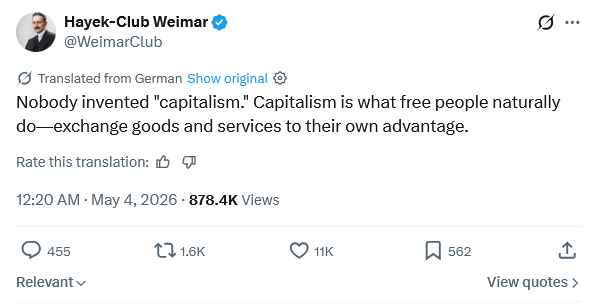
“Nobody invented capitalism”
On the social media site formerly known as Twitter, Anish Moonka responds to an auto-translated-from-German post by Hayek-Club Weimar:
There’s a clay tablet with the founding charter of a 12-partner company on it. Twelve merchants pooled 33 pounds of gold to start the firm. The contract has the partner names, the starting capital, the profit split, and the penalty for cashing out early.
The tablet is nearly 4,000 years old. It was found at a site called Kanesh, in central Turkey. Archaeologists have dug up 23,500 of these clay records there, most of them business documents: receipts, loan contracts, shipping orders, lawsuits. The houses they were stored in eventually burned. The fire baked the clay solid and preserved every record.
The merchants came from Assur, in modern-day Iraq. They loaded donkeys with tin and cloth and walked them 1,000 kilometers across mountain passes to Kanesh, roughly the distance from New York to Atlanta. Each donkey carried about 180 pounds and the trip took two to three months. They came home with silver and gold.
The company ran for twelve years under a merchant named Amur Ishtar. A third of the profits went back to the investors. Pull your share out early and the firm gave you four kilos of silver per kilo of gold, half the normal rate. Locked-up money was meant to stay locked up.
That one company was just a tiny piece. The tablets show a complete economy with partners suing each other in commercial court, husbands writing home about prices, and wives writing back complaining the husband had been gone too long. A woman named Ahatum quietly lent silver to four different men over nine years. People bought up other people’s loan documents and used them as collateral for new loans, the same thing Wall Street does today with mortgage-backed securities. One merchant got caught smuggling tin in his underwear to dodge a 10% import tax.
In 2019, four economists from Harvard, Sciences Po, Chicago, and Virginia ran the tablet numbers through a gravity model, the math economists use today to predict how much two countries will trade based on size and distance. The Bronze Age numbers matched modern trade numbers almost exactly. Trade fell off with distance at nearly the same rate it does between countries today. The paper ran in the Quarterly Journal of Economics.
There was no economic theory yet. The idea didn’t even have a name. The word “capitalism” wouldn’t be coined for another 3,800 years, and Adam Smith was 3,700 years away from writing a sentence about markets. Just a guy named Pushu-ken writing a clay tablet to his business partner about a shipment of cloth, and a woman in Assur recording who owed her how much silver. Capitalism was already there, doing its full job, almost four thousand years before anyone wrote down a theory of how it worked.
Does the REAL Odyssey Survive From the Ancient World?
MoAn Inc.
Published 17 Dec 2025This video was filmed in July of 2025. I wasn’t going to upload it due to the weird not-really-focused-but-also-kinda-focused-thing my phone camera was clearly going through, but decided I didn’t care that much because the content itself was fine x
(more…)
May 6, 2026
The Korean War Week 98: No Peace at Panmunjom – May 5, 1952
The Korean War by Indy Neidell
Published 5 May 2026At the end of last week the UN presented a peace package proposal to the Communists at the peace talks, but that package has been rejected. The only issue still left to clear up is that of POW repatriation, but that seems insurmountable, at least for the time being. In the field, there are ambushes, skirmishes, and night patrols, but still no larger scale actions, and the temperature at Koje-Do POW camp continues to rise and rise, perhaps nearing a boiling point.
00:00 Intro
01:34 Recap
02:09 The Package Rejected
03:58 Night Patrols
08:32 The Fighting
14:13 Koje-Do
15:58 Summary
16:15 Conclusion
PSS: Russia’s Silent Captive-Piston Handgun
Forgotten Weapons
Published 13 Dec 2025The PSS is a semiautomatic pistol using captive piston ammunition to achieve a comparable level of sound suppression to a .22 pistol with a good normal suppressor. It was developed to replace a couple multi-barrel derringer style captive piston pistols in Soviet use, with the semiautomatic action and (6-round) detachable magazines making it suitable for a wider variety of missions than the previous guns.
It was given the GRU catalog designation 6P28 and entered service in 1983. It fires a cylindrical steel projectile weighing 155 grains at about 620 fps, with a noise of 122 dB (1m left of the muzzle) as measured by silencer legend Phil Dater. Mechanically, the design takes its fire control system from the Makarov but uses a floating chamber system to cycle reliably with the unique ammunition. After the fall of the Soviet Union, the pistols were available for commercial export by Russian state-run export companies, although that ended in 2018. In Russian service, the PSS was replaced with the much improved PSS-2 in 2011.
(more…)
May 5, 2026
A 375 Year Old French Recipe for Pumpkin Soup
Tasting History with Max Miller
Published 11 Nov 2025Creamy pumpkin soup served in a hollowed out pumpkin
City/Region: France
Time Period: 1651This is one of the first recipes for pumpkin soup where we can be sure that the pumpkin they’re referring to is a new world pumpkin. This cookbook was written by François Pierre de la Varenne, who’s credited with leading the shift away from highly spiced medieval and renaissance foods into what we would call French haute cuisine. He was into showcasing the flavor of the key ingredient in whatever he made, and this soup does it.
The cloves, onion, and pepper are there but subtle, and the pumpkin really shines through. You can use canned pumpkin to make this soup even easier, and serving it in a hollowed out pumpkin adds some festive flair. It’s simple, delicious, and would be a great addition to any holiday or autumnal table.
Pumpkin Soup with Milk
Cut up a pumpkin and cook it as above [in water and salt], then pass it through a strainer with some milk and boil it with butter, seasoned with salt, pepper, and onion stuck [with cloves], and serve with yolks of eggs thinned [with some broth].
— Le cuisinier françois by François Pierre de la Varenne, 1651
QotD: Why China never adopted war elephants
Trautmann (2015) finds the solution in land-use patterns: China had simply converted so much of its pasture and forest to crop-land, in a densely settled city-and-agriculture land-use pattern that incorporating large numbers of elephants was not just prohibitive, but also culturally foreign. And there’s something to this, though I don’t buy it completely. Absolutely, Chinese land-use patterns would make elephants a lot more expensive to maintain than in India or even Rome. Highly productive farmland would likely have to be turned over to elephant pasture. That said, Chinese rulers had embraced the chariot and cavalry, so such things could be done, if the military or political calculus made them worth doing. But they weren’t done.
Instead, I tend to think that the same basic calculus that applied for Rome applies neatly for China – elephants fare poorly in societies with access to large numbers of disciplined infantrymen who can be trained in anti-elephant tactics. And this was certainly true of China, which had disciplined infantry to spare. Also, Han armies seem to have relied on close integration of missile weapons and polearms, meaning that they had the same sort of integrated light infantry support that the legion of the Roman Republic did. Later Chinese armies, as Trautmann briefly notes, had no problem defeating elephants in battle.
As with Rome, in China, elephants seem to have been a military solution looking for a problem to solve – and never found it. For one Chinese dynasty after another, the major military threats were either peer competitors (during periods of political fragmentation) whose disciplined infantry armies were no more vulnerable to elephants than Rome’s, or else steppe nomads. Given the tremendous logistical difficulties of operating even small armies out on the open steppe, attempting to take war elephants there would have been the height of stupidity. Elephants weren’t going to stop the Mongols – to be fair, not much stopped the Mongols (we’ll get into India, Mughals and elephants next time).
Bret Devereaux, “Collections: War Elephants, Part II: Elephants against Wolves”, A Collection of Unmitigated Pedantry, 2019-08-02.
May 4, 2026
Our genetic heritage and our culture
On Substack, Helen Dale and Lorenzo Warby look at our genetic inheritance and how it continues to shape our culture:
From Wikipedia:
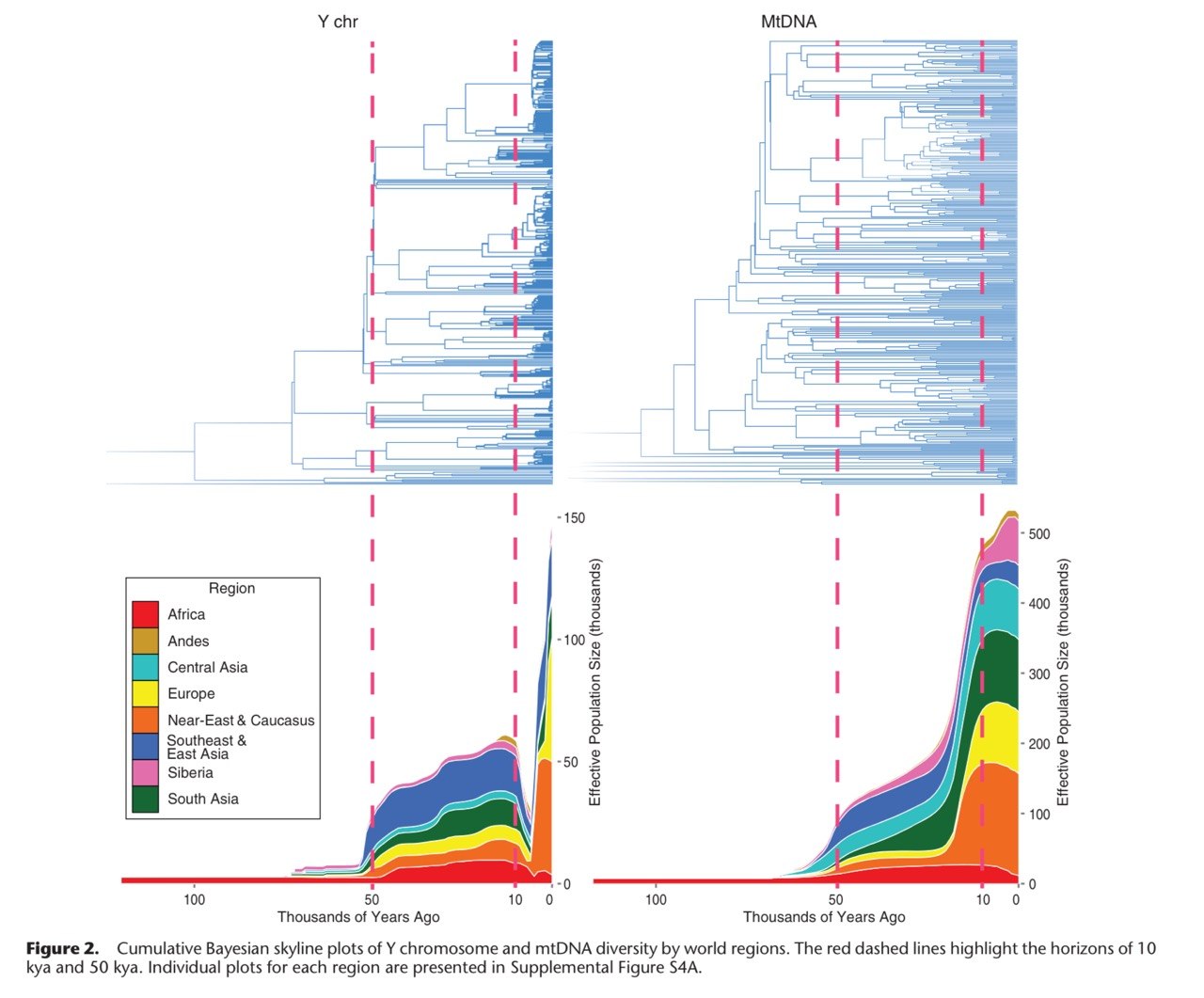
The Neolithic Y-chromosome bottleneck refers to a period around 5000 BC where the diversity in the male y-chromosome dropped precipitously across Africa, Europe and Asia, to a level equivalent to reproduction occurring with a ratio between men and women of 1:17. Discovered in 2015, the research suggests that the reason for the bottleneck may not be a reduction in the number of males, but a drastic decrease in the percentage of males with reproductive success in Neolithic agropastoralist cultures, compared to the previous hunter gatherers.
The development of farming and then animal herding greatly increased the number of humans — which continued to have evolutionary consequences for our species — and created productive assets (farms and animal herds) worth fighting over. Successful male teams (typically organised as clans) wiped out unsuccessful male teams and took their women as spoils.
Hence, there is a dramatic bottleneck in male lineages but not in female lineages. This pattern stopped with the development of chiefdoms and especially states, though not so much on the Steppes, whose states were more like super-chiefdoms and where intense competition over resources (and women) continued.1
This had consequences. A major one is that the male expression of human genes became dramatically better at forming and maintaining teams — as there was drastic selection pressure for that — but the female expression of human genes did not.
This is why young schoolboy sporting teams regularly crush adult women’s national teams in team sports such as soccer. It is not that schoolboys have the strength advantage over women associated with adult men (they are often not particularly advantaged around age 14-15). It’s simply that human males are much more likely to “get” teamwork at a visceral level.
At least some of the differences in the statistical distribution of cognitive traits between men and women comes from this genetic bottleneck’s intense selection pressure differences. This is particularly clear in social patterns. For instance, men readily form hierarchies — often using physical cues such as height to do so.
Men focus on roles, suppressing or otherwise managing their emotions to do so. They regularly test each other — hence ragging each other, making appalling jokes, etc. Such mechanisms generate trust, as they test whether you will fold under pressure, whether one can say outrageous things and still get support. Hence the popular quip:
Men insult each other but they don’t mean it. Women compliment each other but they also don’t mean it.
Men roast each other as tests because so much male interaction is about teamwork, and the roles and reliability that requires, while women typically look to emotional connection. Given that the latter requires a lot of interaction to build up trust, yes, female friendships can be quite intense, but relations between human females can also be viciously unstable and fissile.
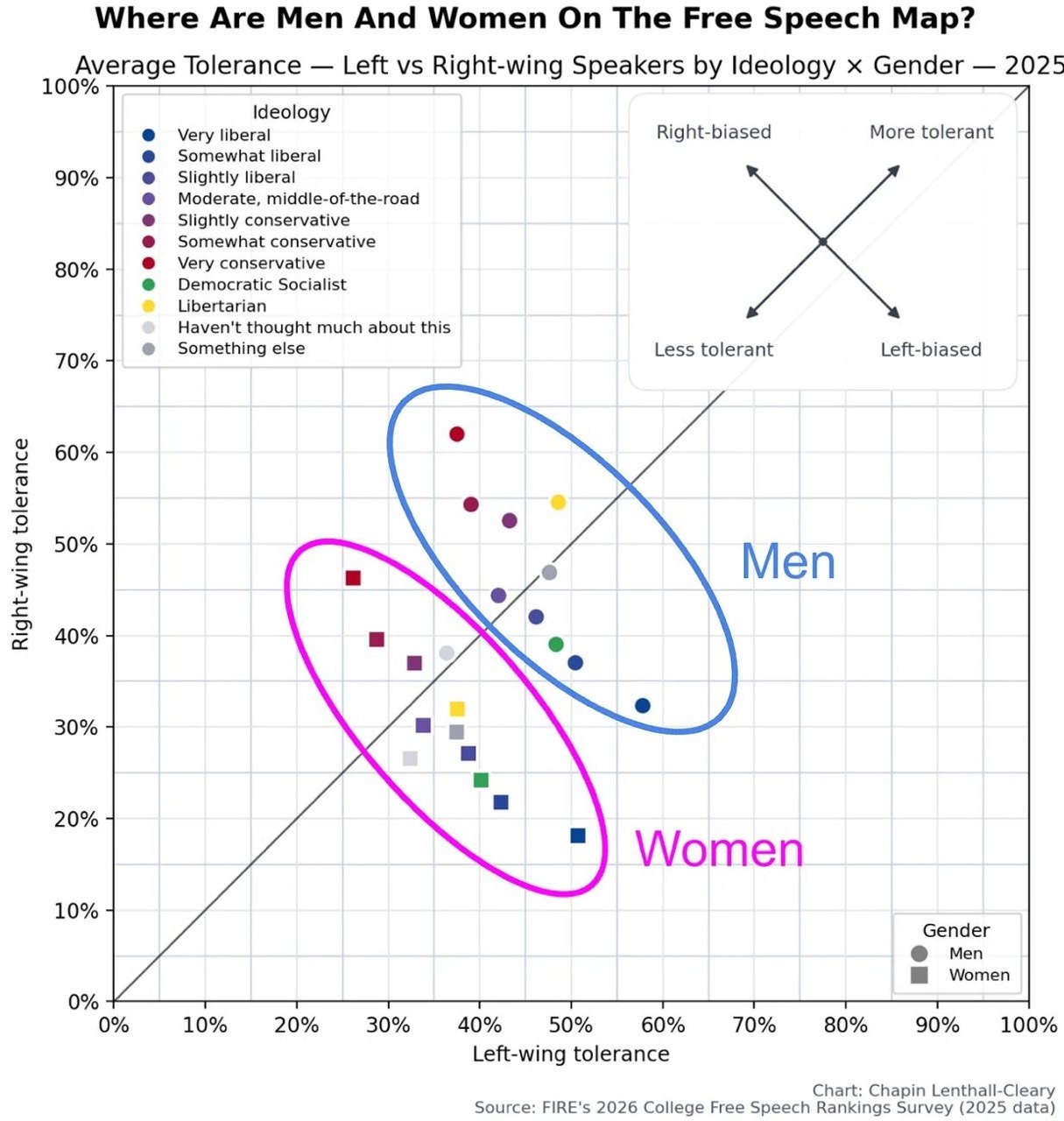
These differences have other social consequences. Men are notably more positive about free speech than women, because men often see speech as a test while women are more likely to see it as a threat. As universities have feminised, the male-female differences on free speech among students have become more pronounced. Men are systematically more tolerant of alternative points of view than are women.
Orwell’s famous comment in his novel 1984:
It was always the women, and above all the young ones, who were the most bigoted adherents of the Party, the swallowers of slogans, the amateur spies and nosers-out of unorthodoxy.
Was a great novelist doing what great novelists do: noticing.
As part of the teamwork focus, men tend to be the social solidarity sex while women are not. Women are much less likely to have friends of lower socio-economic status than are men. For women, such friends are much less likely to be worth the emotional investment. For men, they may be useful members of a future team.
As institutions, occupations and public discourse become more feminised, there has been a shift in patterns of language. A massive study of patterns of language use found a dramatic shift since the 1980s, such that:
our results suggest that over the past decades, there has been a marked shift in public interest from the collective to the individual, and from rationality toward emotion.
All this means that male-dominated institutions and spaces will be generally better, often much better, at generating and managing feedback than female-dominated spaces. When people note that feminising institutions and occupations have a strong tendency to become less functional, it is precisely because they are worse at generating and managing feedback, and at generating and maintaining trust.
- This paper attempts to explain the extreme narrowing of surviving male lineages by the adoption of patrilineal systems and polygyny. While the shift to patrilineal systems in itself does increase unequal lineage success—as does polygyny—much of the point of the shift to patrilineality was precisely that warriors who grow up together are better warrior teams.
Moreover, there is considerable evidence of violence after the shrinkage of male lineages dramatically slowed — and then reversed — with the development of chiefdoms, and especially states. These suppressed violence, but not patrilineality or polygyny. In many societies, polygyny actually intensified with the rise of states.
The bottleneck effects continued to echo down populations. The extraordinary reproductive success of particular male lineages is associated either with pastoralist violence and conquest and/or early state creation. Further, the notion that the majority of male lineages just passively accepted their reproductive exclusion flies in the face of a huge amount of evidence — especially as the examples of very successful pastoral lineages occurred in societies with notoriously high levels of violence, including as raiders, such as across the Steppes and in Ireland.
Moreover, polygyny is associated with higher rates of violence, single-spouse marriage with higher social cohesion. Nor was the creation and maintenance of states typically a peaceful process: periodic violent peaks in Chinese history, for example, were extraordinary. It was precisely the creation of a reproductively-excluded underclass that provided so much of the impetus for the banditry and mass peasant revolts that are such a feature of Chinese history. So, while patrilineality and polygyny were definitely factors in the wildly differentiated success rates of male lineages, considerable levels of violence and contestation over resources and women — that selected in favour of male teamwork — were clearly also very much in play.
Gentleman’s Relish (Patum Peperium) – Weird Stuff In A (Sort Of A) Can #142
Atomic Shrimp
Published 16 Aug 2020Here’s something I have been meaning to feature on the channel for a little while — it’s a savoury anchovy paste that has been in continuous production in England since 1828 — the Georgian Era.
For more information about this product, start here: https://en.wikipedia.org/wiki/Gentlem…
The music for the spoon segment is called “Forever Yours” by Wayne Jones – from the YouTube Audio Library
QotD: Saint Hillary
Kelly was the most relentlessly savage chronicler of the Clinton administration, and of the Clintons personally, but his opening shot was so subtle you had to squint to see what he was doing. In a long feature story that appeared in the New York Times Magazine in May of 1993 under the that’s-not-a-compliment title, “Saint Hillary”, Kelly very quietly mocked Hillary as a preening know-it-all who didn’t know much of anything. He wrote that she represented “the message of the preacher”, with a way of speaking that delivered a stream of moral lectures, as if she had the authority and the wisdom to direct others in the act of moral reconstruction. If you click on the link and read the whole story, you’ll want to watch for the transitional paragraph, the switch from mostly description to mostly derision. It begins with the words, “It is at this point that some awkward questions arise”. Next paragraph: “If it is necessary to remake society, why should Hillary Rodham Clinton get the job?”
It becomes less kind from there. Kelly described a meeting between Hillary Clinton and the progressive Jewish editor and activist Michael Lerner, who (Kelly says) offered a vision of “unintentionally hilarious Big Brotherism”. And then: “The reason Lerner’s proposals for the application of the politics of meaning focus so heavily on bureaucratic irrelevancies is the same reason Mrs. Clinton is struggling still with words”. Self-delusion, unawareness of political realities, hard-headed self-importance, unaware bumbling in an unearned sense of certainty. A moralizer, but not moral, unwise but committed to the appearance of wisdom.
Remember, this story appeared in 1993, in the opening months of the Clinton presidency. Michael Kelly was opening a political era with a dismissal, rolling his eyes at the Clinton project as it began. “Saint Hillary”, they called it. The New York Times used to publish things like this.
Chris Bray, “Saint Hillary the Bluntly Obtuse”, Tell Me How This Ends, 2026-01-30.
Update, 5 May: Welcome, Instapundit readers! Have a look around at some of my other posts you may find of interest. I send out a daily summary of posts here through my Substack – https://substack.com/@nicholasrusson that you can subscribe to if you’d like to be informed of new posts in the future.
May 3, 2026
How to Declare a Live Person Legally Dead – Death of Democracy 14 – Q2 1936
World War Two and Spartacus Olsson
Published 2 May 2026In Q2 1936, Adolf Hitler consolidated power after the Rhineland gamble, tightening the machinery of dictatorship while projecting strength abroad. As Hermann Göring took control of Germany’s economic lifelines and Heinrich Himmler centralized the police, the regime accelerated its transformation into a fully integrated police state.
Behind Olympic pageantry and propaganda triumphs like Max Schmeling’s victory, the Nazi system deepened repression. Courts enforced the Nuremberg Laws with chilling logic, reducing Jewish citizens to a state of “civil death”, while Joseph Goebbels expanded total control over media and public discourse.
At the same time, Germany’s economy bent further toward war, with dwindling foreign reserves and rising dependence on autarky. Yet domestically, resistance remained minimal as propaganda, fear, and perceived stability drove growing public support.
Globally, the quarter exposed the weakness of the League of Nations during Italy’s conquest of Abyssinia, saw Léon Blum’s rise in France, and witnessed the outbreak of the Arab Revolt in Palestine — signs of a world drifting toward instability.
This episode examines how dictatorship consolidates not just through terror, but through law, economics, and consent — and why, by mid-1936, meaningful resistance inside Germany had largely vanished.


