
World War Two
Published 16 Oct 2021The Americans win a naval victory off Guadalcanal and even manage to reinforce the Marines there with the first Army units to arrive, but as the week ends the Japanese launch a major offensive on the island. Meanwhile far across the globe, Adolf Hitler orders that all German offensive operations except those at Stalingrad and in the Caucasus cease. There is plenty to do in Stalingrad, though, because this week all hell breaks loose there.
(more…)
October 17, 2021
Stalingrad, Stalingrad, Stalingrad, No Retreat! – WW2 – 164 – October 16, 1942
Comments Off on Stalingrad, Stalingrad, Stalingrad, No Retreat! – WW2 – 164 – October 16, 1942
October 16, 2021
City Minutes: Indigenous America
Overly Sarcastic Productions
Published 15 Oct 2021As we look at four pre-Columbian American cities, I don’t know whether to be more impressed with the the architecture or the landscaping. Probably both.
More Indigenous Myths & History:
The Five Suns (https://youtu.be/dfupAlon_8k)
Quetzalcoatl (https://youtu.be/451jzIesWoU)
Huitzilopotchli (https://youtu.be/Zj-jDOjBets)
El-Dorado (https://youtu.be/UHzkGueRz3g)
Pele (https://youtu.be/q1z19p48lZU)
Hawaii (https://youtu.be/xYouQESFE2A)Teotihuacan shirt: https://www.redbubble.com/shop/ap/903…
Timestamps:
0:00 – 1:03 — Teotihuacan
1:03 – 2:04 — Tikal
2:04 – 3:00 — Tenochtitlan
3:00 – 4:08 — Cusco
4:08 – 5:20 — ConclusionSOURCES & Further Reading: The Great Cities in History by John Julius Norwich, The Great Courses lectures “The Great City of Teotihuacan” and “Tikal – Aspiring Capital of the Maya World” and “The Aztec Capital of Tenochtitlan” from lecture series Maya to Aztec: Ancient Mesoamerica Revealed by Edwin Barnhart, and “Machu Picchu and the Sacred Valley” and “The Inca – From Raiders to Empire” from lecture series The Lost Worlds of South America by Edwin Barnhart.
Our content is intended for teenage audiences and up.
PATREON: https://www.Patreon.com/OSP
PODCAST: https://overlysarcasticpodcast.transi…
DISCORD: https://discord.gg/osp
MERCH LINKS: http://rdbl.co/osp
OUR WEBSITE: https://www.OverlySarcasticProductions.com
Find us on Twitter https://www.Twitter.com/OSPYouTube
Find us on Reddit https://www.Reddit.com/r/OSP/

Comments Off on City Minutes: Indigenous America
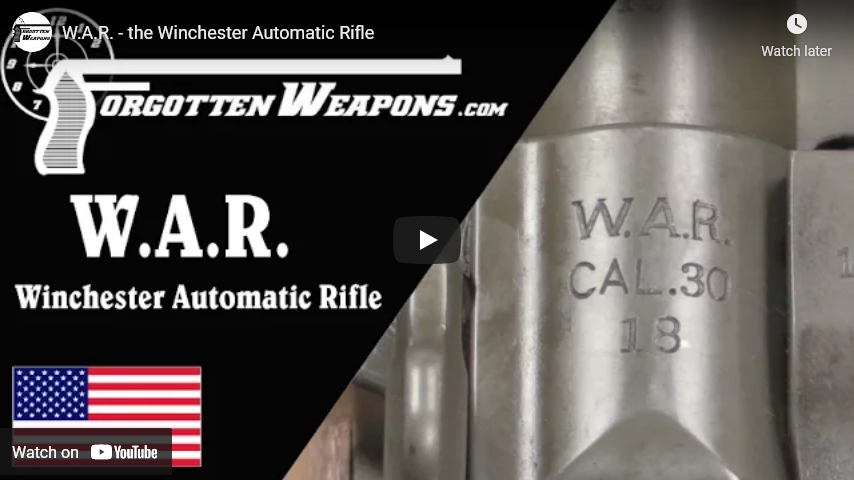
W.A.R. – the Winchester Automatic Rifle
Forgotten Weapons
Published 1 Aug 2016http://www.patreon.com/ForgottenWeapons
With the failure of the G30M and G30R to lead to any military orders (American or otherwise), the Winchester company took the advice of the Ordnance Department to scale the design up to an automatic rifle. The BAR had a number of known shortcomings in WWII, and the military was interested in replacing it. The Winchester Automatic Rifle (WAR) offered the same basic set of features with a lighter weight and lower cost.
The WAR used a 2-lug rotating bolt like the Garand’s, in combination with a Williams short stroke gas tappet action. Chambered for the standard .30-06 cartridge and using 20-round magazines, the WAR could be used as a semiautomatic rifle or in full automatic with a rate of fire of approximately 600 rpm (slightly more or less depending on whether a muzzle device was used).
The WAR passed initial Ordnance inspection with flying colors, and a contract for 10 was placed, for more extensive testing. It passed these tests well, but they took place in the summer of 1945. By the time a major contract was a real possibility, World War II had ended, and the budget for new arms development was slashed. Had the war continued, the WAR likely would have begun to replace the BAR in US military service.
Comments Off on W.A.R. – the Winchester Automatic Rifle
October 15, 2021
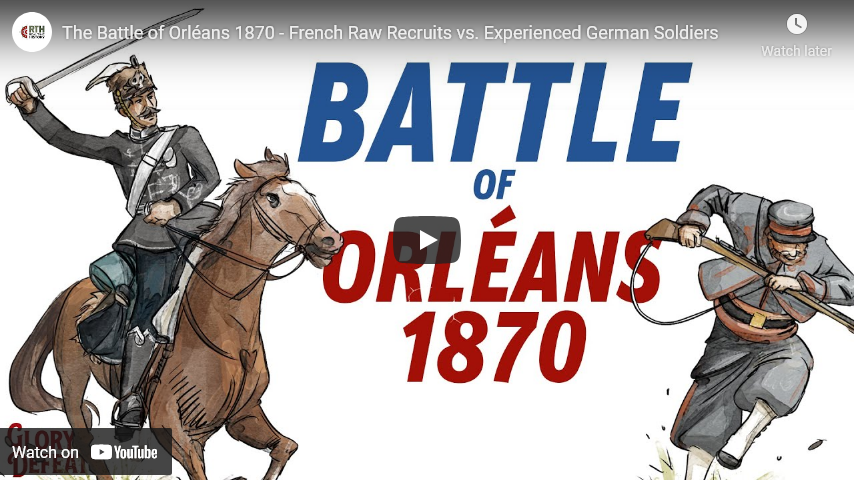
The Battle of Orléans 1870 – French Raw Recruits vs. Experienced German Soldiers
Real Time History
Published 14 Oct 2021All across France French Armies have been raised from any available troops. From international volunteers to raw teenaged recruits. How these sub-par soldiers fare against professional German soldiers is not hard to guess and we can see how that goes in the first battles for Orléans.
Special Thanks to Jonathan Ferguson from Royal Armouries. Check out their Channel: https://www.youtube.com/RoyalArmouries
» THANK YOU TO OUR CO-PRODUCERS
John Ozment
James Darcangelo
Jacob Carter Landt
Thomas Brendan
James Giliberto
Kurt Gillies
Albert B. Knapp MD
Tobias Wildenblanck
Richard L Benkin
Scott Deederly
John Belland
Adam Smith
Taylor Allen
Jim F Barlow
Rustem Sharipov» OUR PODCAST
https://realtimehistory.net/podcast – interviews with historians and background info for the show.» LITERATURE
Arand, Tobias: 1870/71. Der Deutsch-Französische Krieg erzählt in Einzelschicksalen. Hamburg 2018Milza, Pierre: L’année terrible. La guerre franco-prussienne. Septembre 1870 – mars 1871. Paris 2009
» SOURCES
Bernhardt, Sarah: Mein Doppelleben. Leipzig 1908Hérisson, Maurice Graf d’: Journal d’un officier d’ordonannce. Juillet 1870 – Février 1871. Paris 1885
Kühnhauser, Florian: Kriegs-Erinnerungen eines Soldaten des königlich bayerischen Infanterie Leibregiments. Partenkirchen 1898 (Neudruck 2012)
Meisner, Heinrich Otto (Hrsg.): Kaiser Friedrich III. Das Kriegstagebuch von 1870/71. Berlin, Leipzig 1926
N.N. (Hrsg.): Theodor Fontane. Kriegsgefangen – Erlebtes 1870. Briefe 1870/71. Berlin (Ost) 1984
» OUR STORE
Website: https://realtimehistory.net»CREDITS
Presented by: Jesse Alexander
Written by: Cathérine Pfauth, Prof. Dr. Tobias Arand, Jesse Alexander
Director: Toni Steller & Florian Wittig
Director of Photography: Toni Steller
Sound: Above Zero
Editing: Toni Steller
Motion Design: Philipp Appelt
Mixing, Mastering & Sound Design: http://above-zero.com
Maps: Battlefield Design
Research by: Cathérine Pfauth, Prof. Dr. Tobias Arand
Fact checking: Cathérine Pfauth, Prof. Dr. Tobias ArandChannel Design: Battlefield Design
Contains licensed material by getty images
All rights reserved – Real Time History GmbH 2021
Comments Off on The Battle of Orléans 1870 – French Raw Recruits vs. Experienced German Soldiers
Nazis “Restore” Law and Order – WAH 044 – October 1942, Pt. 1
World War Two
Published 14 Oct 2021Resistance against occupation starts rising in the Autumn of 1942. It faces opposition not only from the occupiers, but also from collaborators killing their own countrymen.
(more…)
Comments Off on Nazis “Restore” Law and Order – WAH 044 – October 1942, Pt. 1
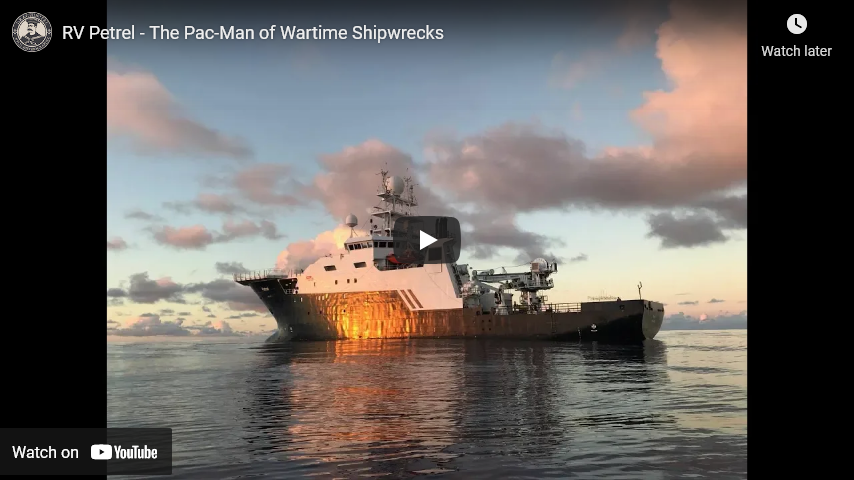
RV Petrel – The Pac-Man of Wartime Shipwrecks
Drachinifel
Published 13 Nov 2019A quick summation of the excellent work being done by the RV Petrel crew and the Paul Allen Foundation.
Want to support the channel? – https://www.patreon.com/Drachinifel
Want a shirt/mug/hoodie – https://shop.spreadshirt.com/drachini…
Want a medal? – https://www.etsy.com/uk/shop/Drachinifel
Want to talk about ships? https://discord.gg/TYu88mt
Want to get some books? www.amazon.co.uk/shop/drachinifel
Drydock Episodes in podcast format – https://soundcloud.com/user-21912004
Comments Off on RV Petrel – The Pac-Man of Wartime Shipwrecks
QotD: England and the English
When you come back to England from any foreign country, you have immediately the sensation of breathing a different air. Even in the first few minutes dozens of small things conspire to give you this feeling. The beer is bitterer, the coins are heavier, the grass is greener, the advertisements are more blatant. The crowds in the big towns, with their mild knobby faces, their bad teeth and gentle manners, are different from a European crowd. Then the vastness of England swallows you up, and you lose for a while your feeling that the whole nation has a single identifiable character. Are there really such things as nations? Are we not forty-six million individuals, all different? And the diversity of it, the chaos! The clatter of clogs in the Lancashire mill towns, the to-and-fro of the lorries on the Great North Road, the queues outside the Labour Exchanges, the rattle of pin-tables in the Soho pubs, the old maids hiking to Holy Communion through the mists of the autumn morning – all these are not only fragments, but characteristic fragments, of the English scene. How can one make a pattern out of this muddle?
But talk to foreigners, read foreign books or newspapers, and you are brought back to the same thought. Yes, there is something distinctive and recognizable in English civilization. It is a culture as individual as that of Spain. It is somehow bound up with solid breakfasts and gloomy Sundays, smoky towns and winding roads, green fields and red pillar-boxes. It has a flavour of its own. Moreover it is continuous, it stretches into the future and the past, there is something in it that persists, as in a living creature. What can the England of 1940 have in common with the England of 1840? But then, what have you in common with the child of five whose photograph your mother keeps on the mantelpiece? Nothing, except that you happen to be the same person.
And above all, it is your civilization, it is you. However much you hate it or laugh at it, you will never be happy away from it for any length of time. The suet puddings and the red pillar-boxes have entered into your soul. Good or evil, it is yours, you belong to it, and this side the grave you will never get away from the marks that it has given you.
Meanwhile England, together with the rest of the world, is changing. And like everything else it can change only in certain directions, which up to a point can be foreseen. That is not to say that the future is fixed, merely that certain alternatives are possible and others not. A seed may grow or not grow, but at any rate a turnip seed never grows into a parsnip. It is therefore of the deepest importance to try and determine what England is, before guessing what part England can play in the huge events that are happening.
George Orwell, “The Lion And The Unicorn: Socialism and the English Genius”, 1941-02-19.
Comments Off on QotD: England and the English
October 14, 2021
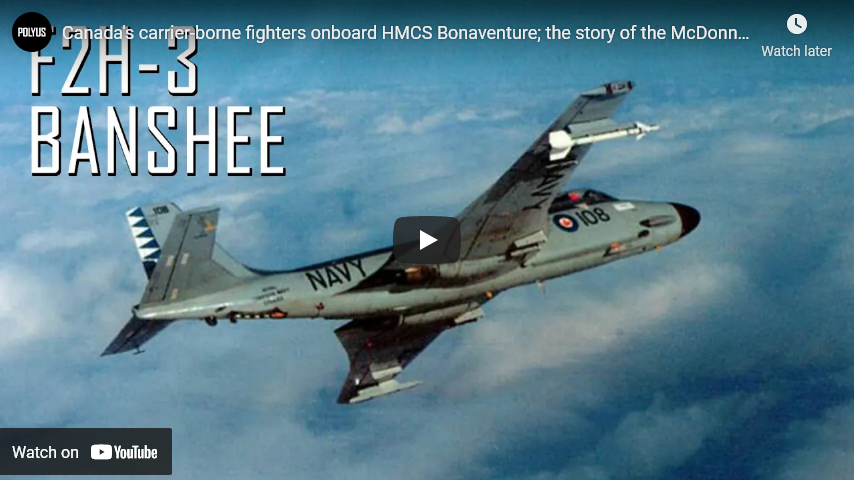
Canada’s carrier-borne fighters onboard HMCS Bonaventure; the story of the McDonnell F2H-3 Banshee
Polyus Studios
Published 2 Apr 2021Don’t forget to like the video and subscribe to my channel!
Support me on Patreon – https://www.patreon.com/polyusstudiosUp until the late 1960s the Canadian Navy operated a modern aircraft carrier. It had an angled flight deck, steam catapults, and fighter jets. The jets were comparable to land-based aircraft like the CF-100 but could pack a vicious air-to-air punch with their Sidewinder missiles. They saw a brief service aboard HMCS Bonaventure before being retired without replacement. It was the McDonnell F2H Banshee, Canada’s premiere sea-based jet fighter.
0:00 Introduction
0:29 Canadian Navy aircraft carriers 1945 to 1957
2:13 New Fighter Selection
3:34 Specifications
5:07 Comparison to the CF-100
5:50 Operational Service
8:23 Accidents and RetirementMusic:
Denmark – Portland Cello ProjectResearch Sources:
CASM-Aircraft Histories – HMCS Bonaventure CVL-22 by Robert T. Murray
McDonnell Banshee – Royal Canadian Air Force – http://www.rcaf-arc.forces.gc.ca/en/a…
Magnificent Moments by Vintage Wings of Canada – http://www.vintagewings.ca/VintageNew…
McDonnell Banshee – Shearwater Aviation Museum – http://www.shearwateraviationmuseum.n…
HMCS Bonaventure: Canada’s Last Aircraft Carrier by Kevin Patterson – http://www.sevenyearproject.com/canad…Footage Sources:
HMCS Magnificent (CVL 21) – Majestic Class Light Aircraft Carrier – Camildoc – https://youtu.be/_Zvnz06-MRc
HMCS Bonaventure (CVL 22) – Majestic Class Aircraft Carrier – Camildoc – https://youtu.be/QmFD5bijrok#Banshee #CanadianAerospace #PolyusStudios
Comments Off on Canada’s carrier-borne fighters onboard HMCS Bonaventure; the story of the McDonnell F2H-3 Banshee
Tank Chats #128 | Panzer 61 | The Tank Museum
The Tank Museum
Published 4 Jun 2021Curator David Willey examines one of Switzerland’s first indigenously designed and produced tanks, the Panzer 61, put into service during the Cold War.
(more…)
Comments Off on Tank Chats #128 | Panzer 61 | The Tank Museum
October 13, 2021
Josip Broz Tito — The “Maharaja of the Balkans”
In The Critic, Thomas Gallagher looks at the man and the myth of Yugoslavia’s communist leader, known to the world as “Tito”:
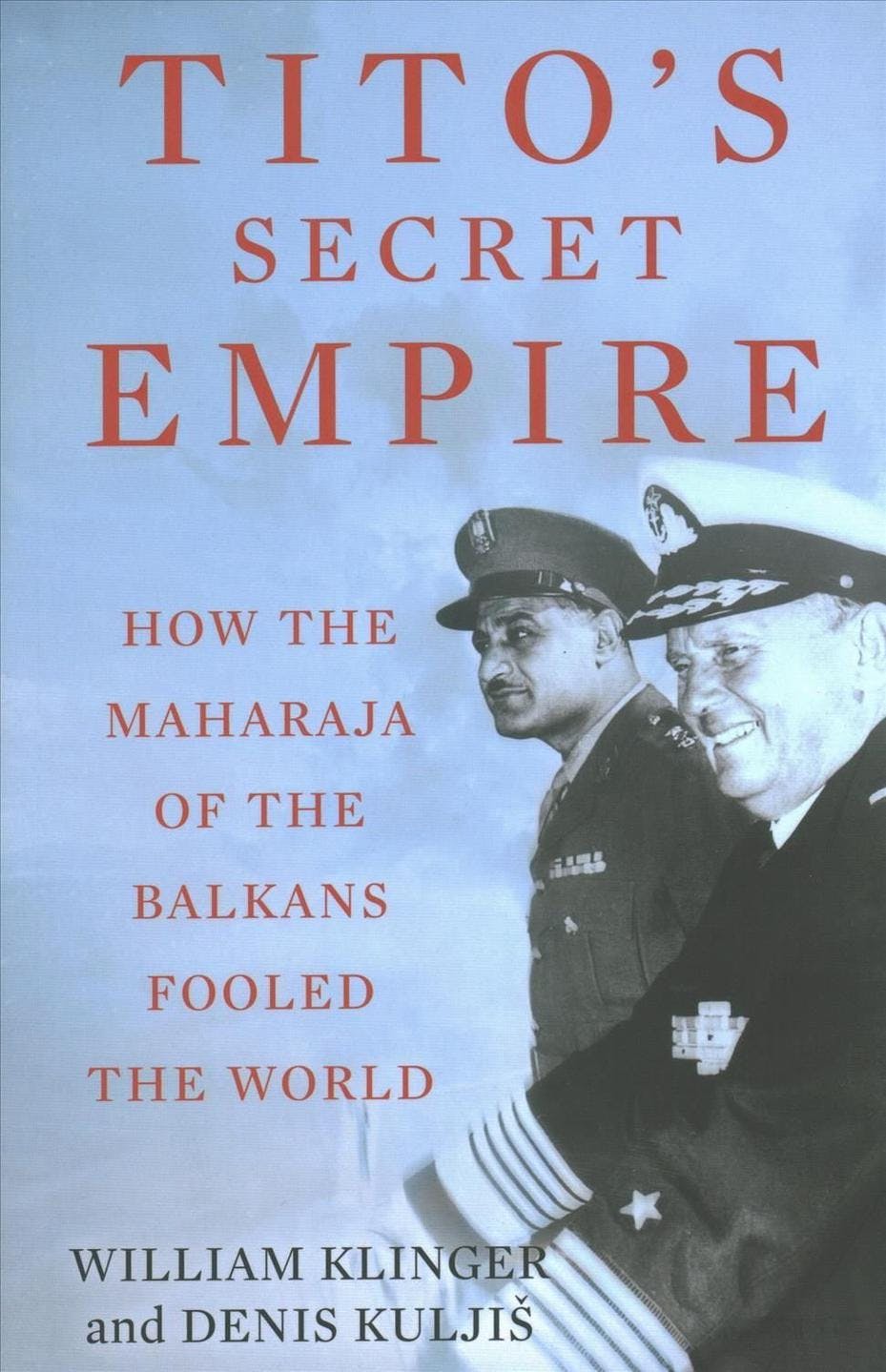
Decades after his death in 1980, Josip Broz Tito still casts a spell as a larger-than-life figure.
The legend portrays him as a famous military leader and anti-fascist guerrilla fighter who fought off the Nazis and defied Stalin. He then went on to be a champion of peace who stood up for various small nations snapping the coils of European overlordship. He was at home on imperial estates or, more often, on his secluded luxury home on the island of Brioni, with Old Masters adorning his walls and kings, emperors and fellow communist strongmen paying homage.
Despite clumsy language and hyperbole in places, as well as some avoidable errors, Tito’s Secret Empire seeks to debunk Tito’s legend and in several key respects it succeeds. The authors William Klinger and Dennis Kuljiš accord some honours to their subject.
He was a unique character well-equipped to surmount various obstacles during his 88-year life. For the British diplomat, Sir Fitzroy Maclean, he was “a fail-proof survivor”. In 1974 he was hailed by Germany’s Chancellor, Helmut Schmidt, as “the greatest of the winners of the Second World War”.
A benign image persisted, despite Tito being responsible for more acts of mass cruelty than any other European communist leader with the exception of the Soviets. He was admired as a wheeler-dealer in international affairs, from murky transactions to the most delicate undertakings in statecraft. This well-researched book deserves attention for those who wish to peer beyond the carefully cultivated image.
[…]
His 1954 state visit to then-royalist Greece, a regime which he had spent years trying to topple, was an unmistakable indication that he was placing himself at the head of a hybrid regime. Britain’s foreign secretary, Anthony Eden, had already visited him and urged the United States to prop up Tito financially. The favour was not returned. Evidence is provided that Tito played a major role in encouraging Egypt to nationalise the Suez Canal. He saw President Nasser as a kindred spirit, a populist unencumbered by ideology. Tito even more keenly sought to end French rule in Algeria, arming the rebels and offering diplomatic support.
In September 1961, he welcomed dozens of leaders from the promising new “non-aligned” bloc to a conference in Belgrade. Next year China invaded India and his soul-mate, Nehru, turned to the West for help. Thereafter, the non-aligned movement’s influence waned, as did Tito’s with it.
He increasingly became a pensioner of the Soviet Union. American ardour cooled as it became clear how reliant he was on Soviet arms and industrial licences which enabled this supposed ambassador of peace to export weapons to the Third World.
Comments Off on Josip Broz Tito — The “Maharaja of the Balkans”
A War Without Hate? – The Officers and Gentlemen of North Africa – WW2 – Gallery 05
World War Two
Published 12 Oct 2021In the history of European-style warfare, there has always been the ideal of “rules of warfare”. The horrors of the Eastern Front and the Pacific prove how hollow this ideal can be, but there is one theatre where some officers are trying to maintain it: North Africa.
(more…)
Comments Off on A War Without Hate? – The Officers and Gentlemen of North Africa – WW2 – Gallery 05
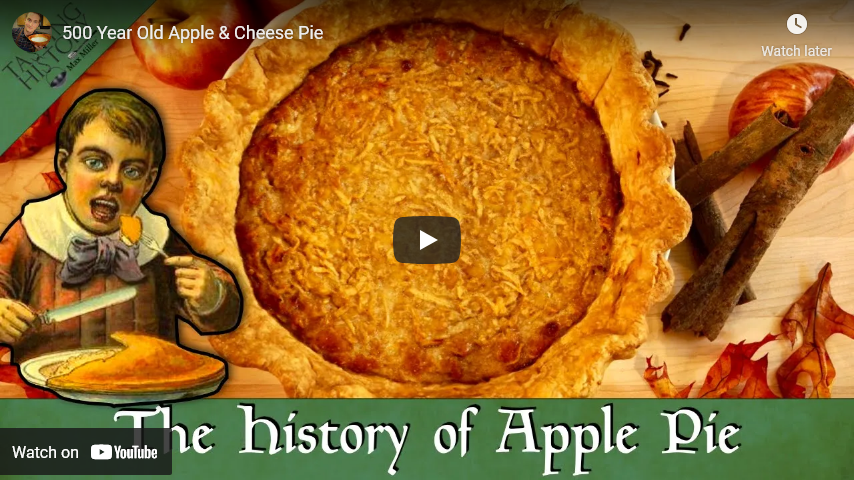
500 Year Old Apple & Cheese Pie
Tasting History with Max Miller
Published 12 Oct 2021Use my exclusive link here https://cen.yt/TradeTastingHistory4 to get your first bag from Trade Coffee for free.
Support the Channel with Patreon ► https://www.patreon.com/tastinghistory
Merch ► crowdmade.com/collections/tastinghistory
Instagram ► https://www.instagram.com/tastinghist…
Twitter ► https://twitter.com/TastingHistory1
Tiktok ► TastingHistory
Reddit ► r/TastingHistory
Discord ► https://discord.gg/d7nbEpy
Amazon Wish List ► https://amzn.to/3i0mwGtSend mail to:
Tasting History
PO Box 766
Burbank, CA 91503LINKS TO INGREDIENTS & EQUIPMENT**
Sony Alpha 7C Camera: https://amzn.to/2MQbNTK
Sigma 24-70mm f/2.8 Lens: https://amzn.to/35tjyoW
Emile Henry Pie Dish: https://amzn.to/3i5go19LINKS TO SOURCES**
Apple – A Global History by Erika Janik: https://amzn.to/3COmCui
Diary of Samuel Sewall: https://amzn.to/3AKDj9j
The Life and Repentance of Samuel Sewall by Eve LaPlante: https://amzn.to/3EUBUiU
Das Kochbuch der Sabina Welserin: http://www.daviddfriedman.com/Medieva…**Some of the links and other products that appear on this video are from companies which Tasting History will earn an affiliate commission or referral bonus. Each purchase made from these links will help to support this channel with no additional cost to you. The content in this video is accurate as of the posting date. Some of the offers mentioned may no longer be available.
Subtitles: Jose Mendoza | IG @worldagainstjose
PHOTOS
Tarte tatin: Loslazos, CC BY-SA 4.0 https://creativecommons.org/licenses/…, via Wikimedia Commons#tastinghistory #applepie
Comments Off on 500 Year Old Apple & Cheese Pie
QotD: The POW/MIA theories from the post-Vietnam War era
It routinely showed up on the “news magazine” shows, and of course there were whole series of movies about it: The Missing in Action flicks with Chuck Norris, Rambo II, I’m sure I’m forgetting a few. And though the “firsthand testimony” for this thesis was always of the “somebody knew somebody who heard from somebody that Lt. Smith suddenly disappeared from a POW camp back in 1968,” there was one seemingly strong piece of archival evidence: The seemingly disproportionate number of soldiers and airmen officially listed as “missing in action”.
And yet … c’mon, man, as a guy who dodged that war probably said back when he could still remember what century he’s living in. Why would the Vietnamese do that? All the mooted explanations — slave labor, selling captured pilots to the Russians for training purposes — didn’t pass the smell test. So a historian started digging into it, and while I read MIA: Mythmaking in America 30 years ago in college, I remember the crux of his argument:
In the war’s early days, the military used a statistic called KIA/BNR — killed in action / body not recovered. Everyone knows Lt. Smith is dead, but since his aircraft was vaporized by a SAM over Haiphong, his remains can’t be returned to his people. As Al notes, though, when a pilot was killed in action, his wife and kids got a puny condolence check from the government and kicked out of base housing. Thus the surviving pilots, acting from noble motives, started fudging. “Well … maybe Lt. Smith’s plane wasn’t vaporized. I might’ve seen a chute. It’s all very confusing; remember I was going Mach 1 at the time, dodging flak …” Mrs. Smith and the little Smiths get to keep drawing a paycheck, keep living on base housing, etc. So the official MIA list grew.
Enter Richard Nixon and that sneaky rat fuck Kissinger. Needing a way to prolong the war while concluding “peace with honor” — that is, to weasel out without seeming too weaselly — they needed a sticking point at the treaty table. The MIA issue was perfect for that. What about Lt. Smith? Of course the Vietnamese government can’t account for him; he was blown to atoms over Haiphong; but there’s his name on the missing list. Perhaps he’s in double secret prison!
And thus “the narrative” — the perfectly understandable-in-context lie that changed KIA/BNR to MIA — became “The Narrative”, that the Vietnamese were, for some unfathomable reason, still hanging on to captured American servicemen. Who knows why those inscrutable Orientals do anything, and what kind of America-hating hippie scum are you to ask questions? Don’t you want to bring our boys back home?
Severian, “Kayfabe”, Rotten Chestnuts, 2021-07-04.
Comments Off on QotD: The POW/MIA theories from the post-Vietnam War era
October 12, 2021
Richard Overy looks at the “Great Imperial War” of 1931-1945
I missed Rana Mitter‘s review of Richard Overy’s latest book when it was published in The Critic last week:
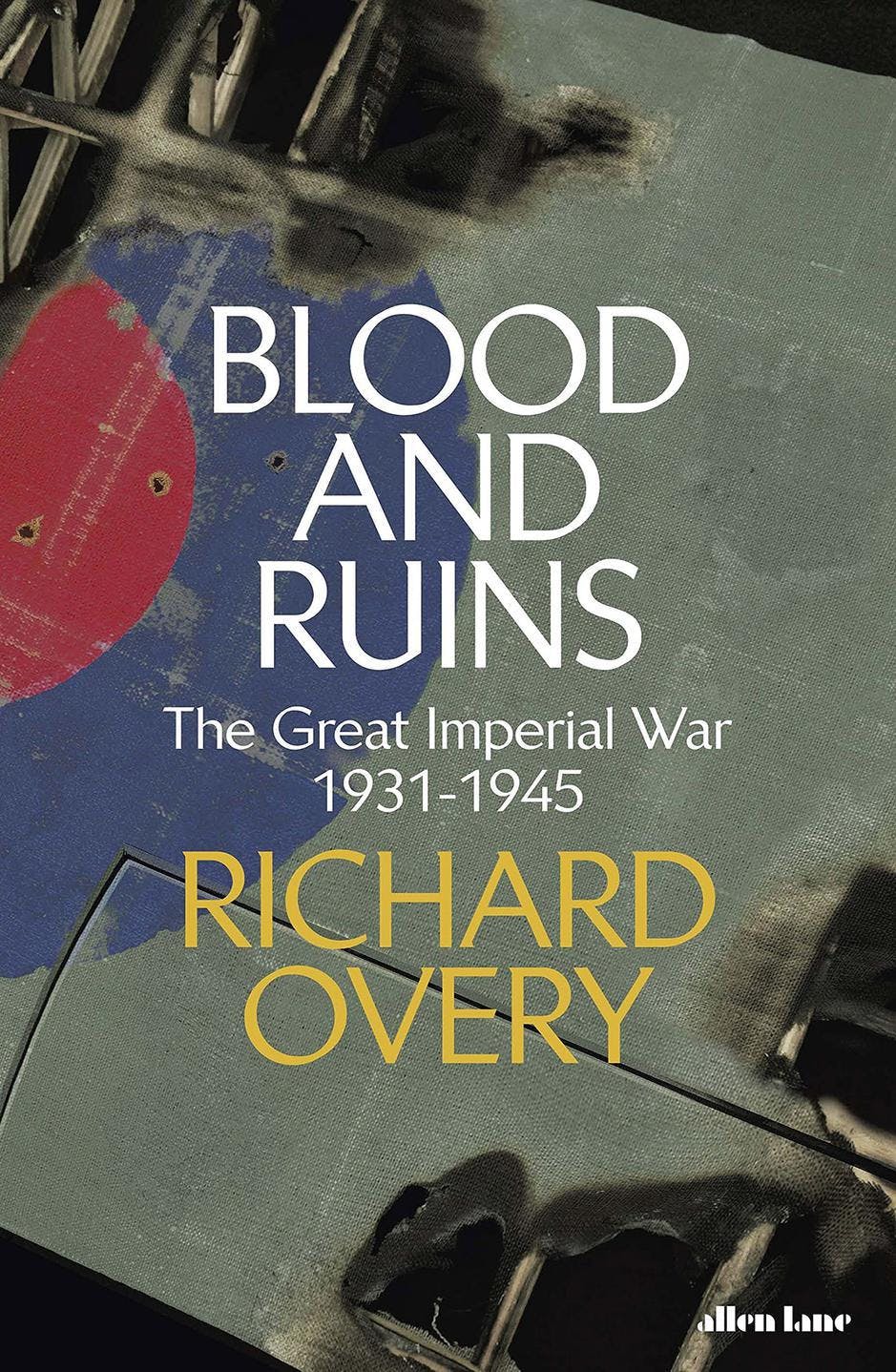
Imagine there’s no Hitler. It’s not that easy, even if you try, at least if you’re a westerner thinking about the Second World War. But for millions of Asians, those years of conflict had little to do with the horrors of Nazi invasion and genocide, and it is their experience that frames Richard Overy’s account of a seemingly familiar conflict. For most non-Europeans, the war was not a struggle for democracy, but a conflict between empires, and in this book, that imperial struggle begins not with the invasion of Poland by Germany in 1939 but the occupation of Manchuria by the Japanese in 1931.
Blood and Ruins is really two books in one. The first is perhaps the single most comprehensive account of the Second World War yet to appear in one volume. You might think that by reading extensively, you could construct a book like this one. You could not — unless you have Overy’s control over a staggering range of World War II scholarship, much of it drawn from his own decades of research on the economics of total warfare, the development of technology, from radar to aerial bombing, and the idea of the “emotional geography” of war, encompassing morale, hope, and despair. Then you’d need to go back and cover all those categories for each of the major Allied and Axis belligerents: Britain, the US, Japan, Germany, France, Italy and China among them.
The second book is an argument about what kind of conflict the Second World War really was. Overy is clear: on a global as opposed to European scale, it was not (just) a war about democracy, but about empires and their fate, although “the starting point in explaining the pursuit of territorial empire is, paradoxically, the nation.”
Overy points out what is generally lost to view when the European war is placed at the centre of the historiography: both Britain and France were undertaking an “awkward double standard” in their defence of democratic values, as their Asian and African possessions “rested on a denial of those liberties and the repression of any protest against the undemocratic nature of colonial rule”. While this argument has been made before (not least by figures such as Nehru and Gandhi in India at the time), Overy does something unusual and revealing: he compares the western empires with Japan’s justification for its own imperial project in the early twentieth century.
The book is scrupulously careful not to endorse or excuse the worldview of Tokyo’s imperialists, and gives full weight to the voices of the Chinese nationalists and communists who were bitterly opposed to Japan’s expansion on the Asian mainland. Still, the comparison of Japan’s pre-war and wartime empire to those of the western powers provides an important and original broadening of a contemporary debate.
There is ongoing public British (and to some extent French) argument about whether empire was a “good” or “bad” thing. Yet neither attackers nor defenders of the British empire tend to analyse it alongside the Japanese equivalent that lasted nearly half a century. Britain committed colonial massacres (Amritsar) and deadly repression (Mau Mau). So did Japan (the rape of Nanjing, invasion of Manchuria).
Britain’s empire also created an aspirational middle class full of cosmopolitan nationalists, and drew on ideas of loyalty to recruit its subjects to fight in world wars. All these things are also true of Japan, which like Britain was a multi-party democracy for much of its period as an overseas empire (between 1898 and 1932), and whose capital city was an intellectual hub for political activists from across Asia.
As a colony of Japan between 1895-1945, Taiwan developed a middle class that was Japanese-speaking and keen to draw on new economic opportunities brought by empire: Lee Teng-hui, the first democratically elected president of the Republic of China on Taiwan, always thought of Japanese as his mother tongue. Park Chung-hee, the American-sponsored dictator of Cold War South Korea, learned his political craft as an army officer in the Japanese Manchukuo Army that occupied Manchuria.
Comments Off on Richard Overy looks at the “Great Imperial War” of 1931-1945
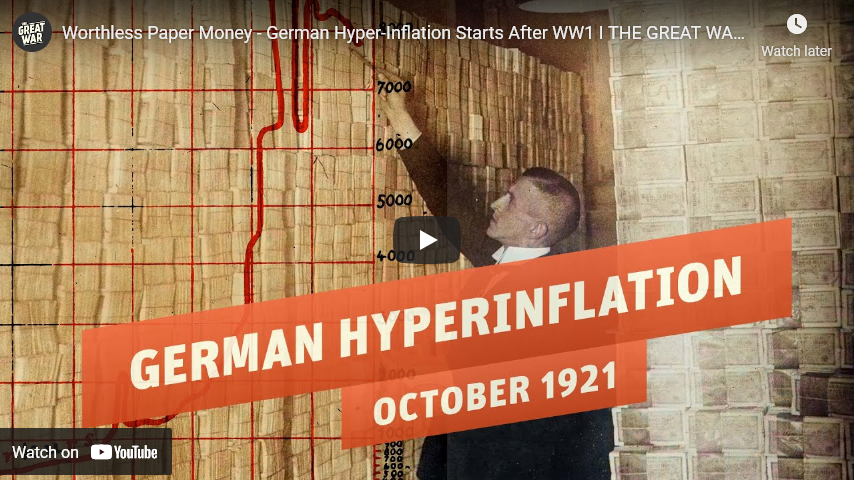
Worthless Paper Money – German Hyper-Inflation Starts After WW1 I THE GREAT WAR 1921
The Great War
Published 8 Oct 2021Sign up for Curiosity Stream and get Nebula bundled in and SAVE 26%: https://curiositystream.com/thegreatwar
The German post-WW1 economy was under pressure: the loss of territory, the war bonds issued during the war and the reparations under the Treaty of Versailles. All this lead to a downward spiral of rising inflation and living costs for German citizens.
» SUPPORT THE CHANNEL
Patreon: https://www.patreon.com/thegreatwar
Shop: https://www.realtimehistory.net» OUR PODCAST
https://realtimehistory.net/podcast – interviews with World War 1 historians and background info for the show.» BUY OUR SOURCES IN OUR AMAZON STORES
https://realtimehistory.net/amazon *
*Buying via this link supports The Great War (Affiliate-Link)» SOURCES
Feldman, Gerald: Vom Weltkrieg zur Weltwirtschaftskrise. Studien zur deutschen Wirtschafts-und Sozialgeschichte 1914-1932. 1984.Fergusson, Adam: Das Ende des Geldes. Hyperinflation und ihre Folgen für die Menschen am Beispiel der Weimarer Republik, 1975.
Grosch, Waldemar: Deutsche und polnische Propaganda während der Volksabstimmung in Oberschlesien 1919-1921. 2002.
Lewek, Peter: Arbeitslosigkeit und Arbeitslosenversicherung in der Weimarer republik 1918-1927. 1989.
Michalczyk, Andrezej: Celebrating the nation: the case of Upper Silesia after the plebiscite in 1921.
Neubach, Helmut: Die Abstimmung in Oberschlesien am 20. März 1921. 2002.
» MORE THE GREAT WAR
Website: https://realtimehistory.net
Instagram: https://instagram.com/the_great_war
Twitter: https://twitter.com/WW1_Series
Reddit: https://reddit.com/r/TheGreatWarChannel»CREDITS
Presented by: Jesse Alexander
Written by: Jesse Alexander
Director: Toni Steller & Florian Wittig
Director of Photography: Toni Steller
Sound: Toni Steller
Editing: Jose Gamez
Motion Design: Philipp Appelt
Mixing, Mastering & Sound Design: http://above-zero.com
Maps: Daniel Kogosov (https://www.patreon.com/Zalezsky)
Research by: Jesse Alexander
Fact checking: Florian WittigChannel Design: Yves Thimian
Contains licensed material by getty images
All rights reserved – Real Time History GmbH 2021
Comments Off on Worthless Paper Money – German Hyper-Inflation Starts After WW1 I THE GREAT WAR 1921


