Perhaps the most influential form of divination to arrive in the Roman world from the East was astrology. Systems for divining the will of the gods and the course of the future emerged in both Egypt and Mesopotamia c. 2000 B.C. and were thus both very ancient when Alexander the Great conquered both in the late fourth century. From there, astrology, practiced by professional experts, moved into the Greek and then Roman world, though Roman elites were often deeply ambivalent about this foreign method of divination; both Cato and Cicero express doubts (of course, the Roman practice of haruspicy was also foreign in that it was Etruscan, but this adoption had been sanctified by long use in Roman tradition and was thus mostly beyond reproach). Nevertheless, it is clear that this form of divination become common, with the writer, geographer and astronomer Ptolemy (c. 100-170 A.D.) even producing a long explication of the practice of astrology in his Tetrabiblos.
This portability is not restricted merely to divination. Herodotus’ suspicion that quite a bit of Greek religion might have come from somewhere else has merit, though Anatolia, not Egypt, appears to be the main source (see: M.L. West, The East Face of Helicon (1999); and for the person already writing this comment, yes I am aware of Bernal’s Black Athena and no I am not convinced, nor are many specialists in the field). The Romans were open about importing gods from Greece and make a clear distinction between gods worshiped in traditional Roman manner and those imported from Greece (a quite small number) and thus whose rituals followed ritus graecus – rituals in Greek fashion.
In other cases, the foreign practice was modified to fit the culture it arrived in. The Romans adopted the cult of Cybele, an Anatolian goddess, during the dark days of the Second Punic War (the Senate made that decision based on a consultation with the Sibylline books, a written source of oracular prophecy we can talk about another day). Cybele was called Magna Mater (“Great Mother”) in Rome, and it seems made some modifications to her rituals, in particular possibly limiting the role of the Galli (eunuch priests) whose rituals and style seemed decidedly “unRoman” (though I should note that the scholarship here is contested and the issue and evidence complex).
The normal technical term for this kind of religious borrowing is syncretism, and it is a sort of interweaving of religious traditions that polytheisms both ancient and modern are exceptionally capable of. It is simply not hard to add one more god or one more ritual into a religious system that already assumes the existence of innumerable gods.
Bret Devereaux, “Collections: Practical Polytheism, Part III: Polling the Gods”, A Collection of Unmitigated Pedantry, 2019-11-08.
May 23, 2022
QotD: The adoption of Astrology by the Greeks and Romans
May 22, 2022
Axis Prisoners Face French Wrath – WW2 – 195 – May 21 1943
World War Two
Published 21 May 2022The Allies have won the battle for Africa, but now they have nearly 250,000 POWs to care for, and do not have the facilities to do so. The Trident Conference continues in Washington to try and decide the direction of the Allied war effort, but they launch the Dambuster Raids this week in Germany to try and cripple German water power — and thus, industry — with a new type of bomb.
(more…)
HMCS Bras D’Or; The world’s fastest warship and the pinnacle of hydrofoil development in Canada
Polyus Studios
Published 3 Feb 2022Don’t forget to like the video and subscribe to my channel!
Support me on Patreon – https://www.patreon.com/polyusstudiosHMCS Bras D’Or was the pinnacle of over 100 years of hydrofoil development in Canada. Starting with Alexander Graham Bell and ending with the Proteus, hydrofoils held the promise of faster travel over the waves. Unfortunately the technology never found a comfortable fit in either military or civil fleets. It was designed to be an ASW hunter but by the time she was ready, the Navy was settled on using the now familiar Destroyer/Helicopter combos.
0:00 Introduction
0:29 Alexander Graham Bell and Casey Baldwin
2:28 The R-100 Massawippi
5:46 The R-103 Baddeck
7:15 The Rx
8:48 Anti-submarine warfare hydrofoil concept
12:24 FHE-400 Bras D’Or
17:23 Testing and refinement
19:25 Cancellation
20:18 Proteus
20:45 ConclusionMusic:
“Denmark” – Portland Cello Project
“Your Suggestions” – Unicorn Heads#BrasDor #CanadianAerospace #PolyusStudios

QotD: Surveying Upper Canada
You have just drawn an Ontario Township.
Now, make your grid. The line roads, north and south, should be 100 chains apart (one-and-a-quarter miles), and the east-west sideroads either the same, or different. They needn’t come out evenly; you may leave a fraction on whichever side you didn’t start from. The whole board may have to be tilted at the “front” (baseline) to parallel a lakeshore, or accommodate the “back” of the next Township down. If you’re in the mood, you might want to draw a diagonal road, right through everything.
Congratulations. You may now have a job as one of His Majesty’s surveyors in pioneer Ontario. It’s a much better job than down south of British North America, where the land is somewhat populated already, and everyone seems to have an opinion. Up here, not yet any people in the way. But there is still the difficulty of slashing through the bush. You only draw “concessions” — future roads defining blocks, to be further subdivided into future farmlots. When the people granted land move in, they will be compelled by the guvmint to actually dig those endless, straight, access roads.
This will make the roads more interesting. Where the lines meet an obstacle, you get a little run around it. Or a big one, if the obstacle continues. Intersections don’t quite meet, so you get a jog. Or, you decide to put the jog in the middle of nowhere, instead. There were at least five major surveying systems in Upper Canada (later “Ontario”), and dozens of variations on each one. The line and side roads might be 66 chains apart, or more than twice that, depending on some local magnate’s whim. Or the surveyor may have been drunk that day.
David Warren, “Esquesan”, Essays in Idleness, 2019-04-10.
May 21, 2022
Ukraine & T-72: The death of the tank? | The Tank Museum
The Tank Museum
Published 20 May 2022Tank Museum Curator David Willey explores the current conflict in Ukraine and the performance of the T-72 tank; putting it into historical context and exploring other times during the last hundred years when the death of the tank has been predicted.
Consider becoming a Patreon Supporter today: https://www.patreon.com/tankmuseum
00:00 | Intro
00:40 | Wider context
11:01 | Tanks in History
(more…)
Ed Browning’s Winchester G30 Prototypes
Forgotten Weapons
Published 25 Jul 2016http://www.patreon.com/ForgottenWeapons/
After Jonathan Edward “Ed” Browning had his 1929 rifle dropped from US military testing, he took the design back to his shop in Utah and kept working on it. By 1938 he had made enough improvements that he was ready to present the gun to Winchester, hoping they would be interested in purchasing the design. Specifically, he redesigned the receiver to move much of the bolt travel into the wrist of the stock, shortening the action. He also replaced the short recoil action with an annular gas piston. He made two sample rifles, one in military configuration and one in sporting configuration.
Winchester was looking for a self-loading rifle to market at the time, because they could see that war in Europe appeared to be imminent. They had been caught without a military rifle of their own during World War One, and did not want to be in that situation again. They thought that Ed Browning’s design showed merit, so they agreed to purchase it, and brought Browning onboard to help continue development.
With Winchester’s resources, it was possible to make the guns more professionally. Winchester designated the rifle the G30, and we have one of the examples made by Winchester in the video as well.
The tilting bolt mechanism took inspiration from John Moses Browning’s 1911 pistol, and the trigger housing bears an interesting resemblance to that of the French Berthier rifles (which may or may not be coincidental). The rifles appear to have worked reasonably well, although the annular gas piston was a hindrance which Browning apparently was unwilling to abandon. With his death in 1939, the project moved on to a new phase with David Marshall Williams taking on the job of improving it.

May 20, 2022
The Crusades: Part 7 – The Third Crusade
seangabb
Published 5 Mar 2021The Crusades are the defining event of the Middle Ages. They brought the very different civilisations of Western Europe, Byzantium and Islam into an extended period of both conflict and peaceful co-existence. Between January and March 2021, Sean Gabb explored this long encounter with his students. Here is one of his lectures. All student contributions have been removed.
(more…)
The Cold War Legend That Delivered SAUSAGES To Tanks | Forces TV
Forces News
Published 26 Apr 2018To British troops based in north Germany in the last two decades of the Cold War, he was a legend. But this was no commando or member of the special forces.
Check out our website: http://forces.net
Twitter: https://twitter.com/ForcesNews

QotD: Credentialism
The reason for this — if you want to slap an academic-sounding label on it — is “the reification of the bureaucracy”. Even if 99 out of 100 doctors, say, just want to practice medicine, there’s that last guy who makes “being a doctor” his life’s work. He joins all the associations, and because that kind of guy is basically just Trigglypuff with better hygiene and lower BMI, he quickly rises to a position of influence in every organization. He lives for the bureaucracy. Which means he’s a politician, and there it is.
If you want more examples, look no further than the original guilds, the craft associations of the Middle Ages. Any settlement big enough for actual cash money to change hands in it soon had an exquisitely class-conscious group with lots of actual, but no formal, power. Your smart tyrant co-opted the politicians from the merchant guilds, made them de facto nobility and bade them act like it — that gave you the Renaissance. Your dumb (or merely nonexistent) tyrant let the merchants’ resentments fester — that gave you the Reformation, and the whole catalog of ideological murder that followed.
Severian, “Credentialism Ruins Everything”, Rotten Chestnuts, 2019-03-22.
May 19, 2022
Feeding a Templar Knight
Tasting History with Max Miller
Published 25 Jan 2022Support the Channel with Patreon ► https://www.patreon.com/tastinghistory
Merch ► crowdmade.com/collections/tastinghistory
Instagram ► https://www.instagram.com/tastinghist…
Twitter ► https://twitter.com/TastingHistory1
Tiktok ► TastingHistory
Reddit ► r/TastingHistory
Discord ► https://discord.gg/d7nbEpy
Amazon Wish List ► https://amzn.to/3i0mwGtSend mail to:
Tasting History
PO Box 766
Burbank, CA 91503Recipe
Boar Tenderloin
Equal parts wine and water for boiling
1 thick slice of bread without crust
1 ¼ cups white wine
¼ cup red wine
1 teaspoon ginger
2 teaspoon cinnamon
½ teaspoon nutmeg
Pinch of saffron threads
2 tablespoons brown sugar
Pinch of salt
1 tablespoon red wine vinegar (optional)1. Heat olive oil in a pot then sear the boar on all sides. Remove it from the pot and boil equal parts wine and water, then add the boar back in and boil, covered, for 10-15 minutes or until fully cooked. Then let it rest.
2. To make the sauce, mix the spices and white wine. Separately, soak the bread in water for a few hours, then pour in the red wine. Strain the bread/wine into a saucepan, then press the bread through the strainer. Add the spiced wine mixture and bring to a simmer. Let simmer for 15 minutes, or until half reduced, then add the sugar and salt, and if you with, a tablespoon of red wine vinegar. Simmer until thickened.
3. Slice the boar and pour the sauce over it. Serve with roasted chestnuts.LINKS TO SOURCES**
Le Viandier de Taillevent: https://amzn.to/3FWD7FS
Le Ménagier de Paris: https://amzn.to/3fKgyt0
The Primitive Rule of the Templars by Bernard de Clairvaux: https://amzn.to/3ItxiRY
The Templars by Dan Jones: https://amzn.to/3qOIlin**Some of the links and other products that appear on this video are from companies which Tasting History will earn an affiliate commission or referral bonus. Each purchase made from these links will help to support this channel with no additional cost to you. The content in this video is accurate as of the posting date. Some of the offers mentioned may no longer be available.
Subtitles: Jose Mendoza | IG @worldagainstjose
Music: Crusade – Video Classica by Kevin MacLeod is licensed under a Creative Commons Attribution 4.0 license. https://creativecommons.org/licenses/…
Source: http://incompetech.com/music/royalty-…
Artist: http://incompetech.com/#tastinghistory #knightstemplar
From the comments:
Tasting History with Max Miller
3 days ago
Templar should be pronounced TEM-pler, but sometimes I say tem-PLAR when I read it. Don’t do what I do

May 18, 2022
Trident: The Allied Plan to Win the War – Time Ghost News Flash
World War Two
Published 17 May 2022Washington, May 1943. It was the largest Anglo-American conference of the war so far. With the Axis being defeated in North Africa, the Mediterranean, and New Guinea, the need to agree on new strategic goals arose inside the Combined Chiefs of Staff. A new course of action was to be set against Italy, Japan, and Germany to capitalize on the recent successes. But debates and old dilemmas heated up when it came to resources, manpower, and the question “where to attack next”.
(more…)
QotD: Sparta’s excellent military reputation was not matched by actual battlefield excellence
That is one of the core things we can learn from Sparta: a reputation for military excellence can often be more valuable than the excellence itself – real or imagined. A powerful army can only fight one battle at a time, but the idea of a powerful army can intimidate any number of enemies all at once. […] when Sparta was forced to turn from intimidation to force, it ran out of force with frightening speed.
Those who have been here for a while may already be wondering, “Wait, though – this is the guy who is always telling us that winning battles isn’t as important as achieving strategic objectives and who is always on about logistics and operations! What about that?” I think that actually goes a long way to explaining how an army with a modest advantage in tactics and organization ends up without a winning record. […] I want to stress something here: the horrors of Spartan society cannot be justified on the grounds they produced superior soldiers, because they quite evidently did not. Sparta’s actual military record was, in fact, depressingly average. Only the reputation was special; the men were just men.
Bret Devereaux, “Collections: This. Isn’t. Sparta. Part VI: Spartan Battle”, A Collection of Unmitigated Pedantry, 2019-09-20.
May 17, 2022
Mary Whitehouse, “The avenging angel of Middle England”
At First Things, Jonathon Van Maren considers the legacy of Mary Whitehouse, the often mocked champion of public decency and crusader against pornography and blasphemy in the media from the mid-60s onwards:
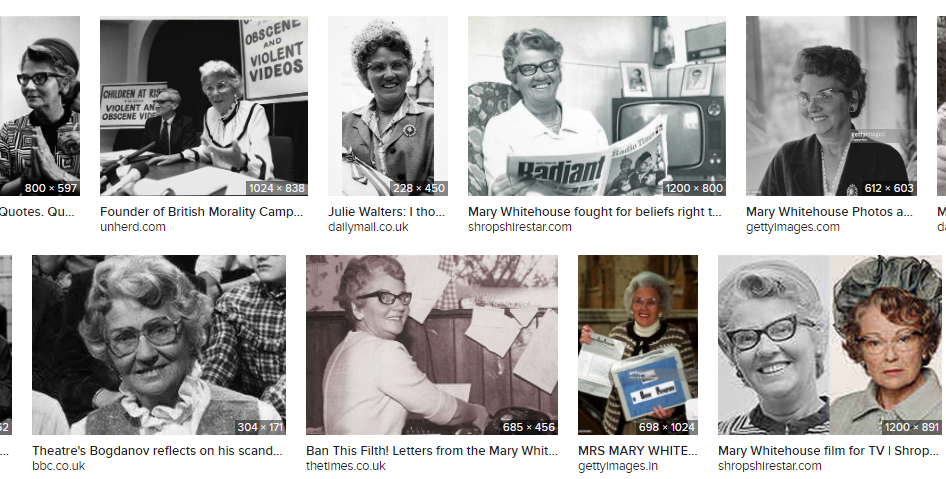
I was surprised to find few public domain images of Mary Whitehouse available, so here is a selection of thumbnails (hopefully this won’t violate any copyright restrictions)
We have reached the point where our post-Christian elites, having safely enshrined the sexual revolution in law, can afford the luxury of occasionally admitting that their opponents were right. Exhibit A is the new BBC documentary Banned! The Mary Whitehouse Story, which details the life of Great Britain’s most infamous morality campaigner. Beginning with a crusade to keep smut and blasphemy off TV in 1964, Whitehouse rallied hundreds of thousands of women (and ordinary Britons) to her campaigns against “the permissive society”, culminating in her war against the porn industry. Alas, she lost most of her battles — but her warnings proved prophetic.
Mary Whitehouse was born in Warwickshire in 1910. She first started organizing in the 1960s because she — and millions of other mothers — did not like what her children were seeing on TV. A committed traditional Christian, she watched with dismay as the country she loved began to change around her. The metropolitan elites she faced off with thought she was “a provincial Birmingham housewife”. They didn’t underestimate her for long. She hosted her first mass meeting in 1964, and her organizing skills soon highlighted the subterranean power of Britain’s women. Whitehouse tapped into the gardening associations, the mothers’ unions, and other grassroots community organizations filled with folks who cared deeply about their children and the moral fabric of their nation. She brought them together, and when she spoke, it was with the voices of legions of little people. Her nickname summed it up: “The avenging angel of Middle England”.
Whitehouse’s first major campaign was to “Clean Up TV”, and her parliamentary petition to that end garnered around 500,000 signatures. In 1971, Whitehouse began organizing against sex ed in schools, triggered by an “educational” video she saw that was filled with pornographic scenes. Whitehouse was accused of hysteria — but Banned! features a pornographer admitting that, by using sex ed, “we gradually pushed back the barriers”, much as Whitehouse warned they would. Now that they’ve won, they can admit they were lying.
Whitehouse and others appalled by attempts to corrupt their children were accused of being “horrified by sex”. In reality, they were horrified by the version of sex presented by sex educators — in much the same way an art lover would be appalled to see vandals approaching a great masterpiece with cans of spray-paint and lewd laughter. Progressives never understood this, and consequently Whitehouse has been almost entirely defined by what she fought against rather than what she fought for.
Whitehouse’s lobbying resulted in several pieces of legislation, including the 1981 Indecent Displays Act, which sought to restrain sex shops and the display of porn, as well as the 1984 Video Recordings Act, intended to limit the sale of extreme video content. Unfortunately, these acts were rendered moot by the internet. But her greatest achievement was the 1978 Protection of Children Act, which criminalized child pornography. It seems remarkable that such a law did not already exist, but in the ’70s the Paedophile Information Exchange (PIE) was operating openly in Britain; it was supported by some British elites who believed that sex with children was the natural next step in sexual liberation.
The Crusades: Part 6 — The Loss of Jerusalem
seangabb
Published 27 Feb 2021The Crusades are the defining event of the Middle Ages. They brought the very different civilisations of Western Europe, Byzantium and Islam into an extended period of both conflict and peaceful co-existence. Between January and March 2021, Sean Gabb explored this long encounter with his students. Here is one of his lectures. All student contributions have been removed.
(more…)
History of Rome in 15 Buildings 09. The Arch of Constantine
toldinstone
Published 27 Sep 2018The many statues and reliefs from older monuments integrated into the Arch of Constantine – the focus of this ninth episode of our History of Rome – advertise the continuity of traditional Roman values into the fourth century. The Arch’s inscription, however, alludes to the religious revolution set in motion by the first Christian emperor.
If you enjoyed this video, you might be interested in my book Naked Statues, Fat Gladiators, and War Elephants: Frequently Asked Questions about the Ancient Greeks and Romans. You can find a preview of the book here:
https://toldinstone.com/naked-statues…
If you’re so inclined, you can follow me elsewhere on the web:
https://www.reddit.com/r/AskHistorian…
https://www.instagram.com/toldinstone/To see the story and photo essay associated with this video, go to:
https://toldinstone.com/the-arch-of-c…