Quotulatiousness

October 3, 2025

Adding digital ID to the pocket moloch … what could possibly go wrong?

Filed under: Britain, Bureaucracy, Government, Liberty, Technology — Tags: , , , , — Nicholas @ 03:00

On Substack, Andrew Doyle explains why it’s a terrible idea to trust the government — any government — in forcing digital ID on everyone:
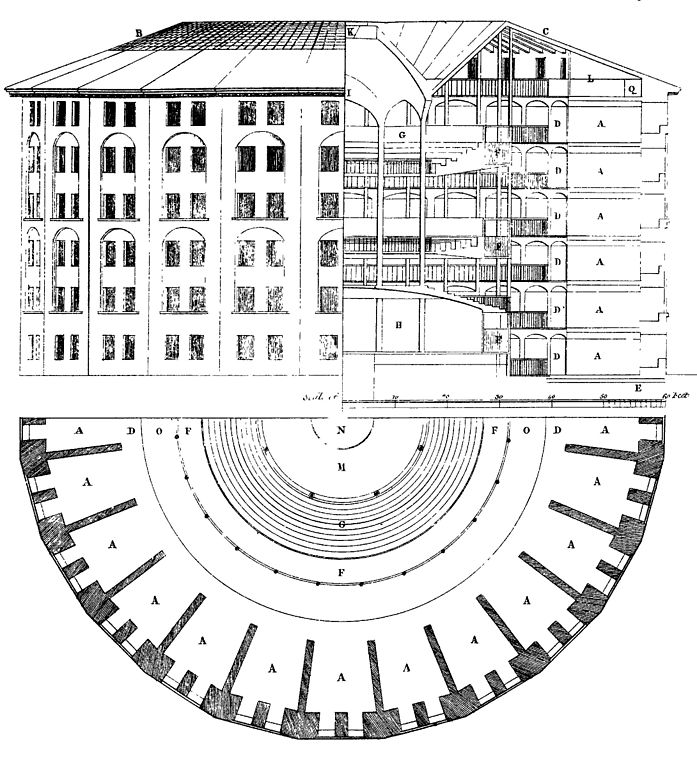
An illustration of Jeremy Bentham’s Panopticon prison.
Drawing by Willey Reveley, 1791.

During a trip to Russia in 1785, the philosopher Jeremy Bentham sketched an outline for a new prison design. The cells were arranged around the circular perimeter and, at the centre, he placed his “panopticon”: a watchtower which afforded a view of any of the cells at all times. The prisoners might not always be being observed, but they could never be sure that they weren’t.

Bentham’s design was never directly used, but the idea took hold as a symbol of state overreach and control, most famously in Michel Foucault’s Discipline and Punish (1975). Foucault was alert to the political ramifications of such a concept, and how surveillance might become an internalised experience. With Keir Starmer now pledging to introduce a digital ID system as a mandatory condition for the right to work, are we seeing the first step towards the realisation of Bentham’s vision?

I suppose we are already there. I have seen friends switch off their phones before discussing politically sensitive issues, genuinely convinced that digital eavesdropping is the norm. Many people are mistrustful of the “Alexa” voice assistant, which they are persuaded is recording their every word. While this all seems terribly conspiratorial, I’m sure most of us remember those reports a few years ago about the Pegasus spyware which had been covertly installed on the phones of journalists and government figures, turning the devices into pocket spies.

[…]

Few will be surprised to hear that public trust in political institutions has plummeted. The increasingly authoritarian tendencies of successive governments, our two-tier policing system, public manipulation as embodied in the “nudge unit”, and the corrupt prioritisation of the interests of the political class over the people they serve – perhaps best demonstrated by parliament’s flagrant efforts to overturn the Brexit vote – have all contributed to this climate of mistrust. The bizarre overreach of police during the lockdowns – in which dog walkers were publicly shamed with drone footage, and shopping trolleys were probed for “non-essential items” – has hardly helped matters.

To many of us, it is baffling that anyone at all would support the prospect of the government keeping track of our movements and holding our private details in a database. Starmer claims that the scheme will curb illegal immigration, but we are talking about criminals who already work outside the system and will doubtless continue to do so. Besides, identity cards have been a reality on the continent for years, and have done precisely nothing to resolve the problem. Employers in the UK are already legally obliged to insist on proof of immigration status from workers.

Labour’s digital ID scheme seems more about control than anything else. The possibility of fraud is also a major concern. It’s not as though the government has an unblemished track record of preventing data breaches. We all recall the massive leak of official MOD data regarding Afghans who had worked with the British government during the UK’s military campaigns. And who could forget the senior civil servant who, in 2008, left top-secret documents concerning al-Qaeda and Iraq’s security forces on a train from London Waterloo? Are we really to suppose that the creation of an all-encompassing centralised database will not leave the public open to risk from hackers and hostile foreign powers?

Tim Worstall adds that “they c’n fuck off ‘n’ all”:

So we’ve that wet dream of Tony Blair raising its ugly head again. There should be a national ID system. Actually, it’s not just Blair, T — the bureaucracy has been right pissed at the erasure of the wartime system since the 50s when it was abolished.

For there are two ways of looking at, thinking about, the whole governance thing. One is — the Blair, bureaucrats’, version — that the population are cattle, kine, to be managed. For the benefit of the bureaucracy of course — or at very least to be forced into doing what the bureaucracy thinks they — we — should be doing.

Then there’s that stout Englishman, the Anglo Saxon, version, which is that government are just the slaves we communally hire to make sure the bins get emptied. Well, OK, maybe raise a bit of tax for a Royal Navy to sink the Frenchies. But even then, not too much of that — the Civil War was, after all, triggered by Ship Money. Did the people who would not be slaughtered by the first wave of invading Frenchies — because they had the silly excuse of living 25 miles inland — have to pay the tax to run the Royal Navy to keep the Frenchies at bay or not? The King said yes — the King was right — and not for the first nor last time in British political history the guy who was right had his head cut off for being so.

Digital ID, so which version should we have? That one beloved of Froggie-type bureaucrats who view La Profonde as kine to be corralled? Or the Anglo Saxon version where we just devolve the scut work to a few slaves?

[…]

The reason this never will be proposed is that it doesn’t fit the reasons why our rulers wish to have an ID system. They’re insistent that we be their kine rather than they our. So, the Hell w’ ’em.

But it could be done. Government simply publishes an interface — an API — which says that proof of identity needs to be presented in this format. We’re done as far as whose kine is whose.

Update 4 October: From Samizdata, another illustration of just how toxic Two Tier Keir has become to British voters:

The Guardian reports:

    “Reverse Midas touch”: Starmer plan prompts collapse in support for digital IDs

    Public support for digital IDs has collapsed after Keir Starmer announced plans for their introduction, in what has been described as a symptom of the prime minister’s “reverse Midas touch”.

    Net support for digital ID cards fell from 35% in the early summer to -14% at the weekend after Starmer’s announcement, according to polling by More in Common.

    The findings suggest that the proposal has suffered considerably from its association with an unpopular government. In June, 53% of voters surveyed said they were in favour of digital ID cards for all Britons, while 19% were opposed.


October 2, 2025

The ritual humiliation of ordinary Canadians through “land acknowledgements”

Filed under: Cancon, Government, History, Politics — Tags: , , — Nicholas @ 03:00

On the social media site formerly known as Twitter, Tom Marazzo explains his objections to the ever-expanding use of “land acknowledgements”:

Let me break this down clearly so you can better understand why these mandated Land Acknowledgements are offensive to me.

They imply inherited guilt
A Land Acknowledgement usually frames the land I live and work on as “stolen”. Even if it does not say the words directly, the message is that I am benefiting from a theft. I served my country for 25 years, I have paid my taxes, raised my family responsibly, and built a life honestly. It cuts against my sense of fairness and justice to be told I must carry guilt for actions taken by people hundreds of years ago. I will not accept accountability for the past when I had no part in it.

They ignore my contribution
I have invested decades of service in the military, in my education, in my community, and in my family. These acknowledgements do not recognize those sacrifices, nor those of my ancestors who also built and defended this country. Instead, they imply my very presence is illegitimate. That denies the legitimacy of my life’s work and my family’s role in helping build this nation.

They make reconciliation into a ritual of shame
A healthy society should face the past with honesty. But what I see is not dialogue or shared responsibility. It is a scripted performance that demands I accept a label like “colonizer”, whether or not it reflects who I am. Rather than bringing people together, it divides by assigning one group permanent guilt and another permanent victimhood. That is not reconciliation. It is coerced shame.

They erase complexity
History in Canada is complicated. Many settlers and Indigenous peoples lived, worked, and fought together. There were injustices, but also cooperation, intermarriage, and shared struggles. Long before Europeans arrived, Indigenous groups also fought among themselves, sometimes brutally, with violence and cruelty toward rival tribes. No group in history is free from wrongdoing. Yet the Land Acknowledgement format reduces this reality to a one-sided story of “oppressors vs. oppressed”, which is neither fair nor accurate.

They are being mandated
Perhaps the strongest reason I find them offensive is that these acknowledgements are not voluntary. They are imposed in workplaces, schools, and public events as if they were civic duties or loyalty oaths. Refusing to participate often brings social or professional penalties. That strips away personal agency and turns what could have been a gesture of respect into a forced confession.

So my reaction is not irrational. These acknowledgements conflict with my principles of fairness, personal responsibility, and earned legitimacy. They demand I accept guilt I do not bear, while ignoring the contributions my family and I have made. They also erase the truth that no people, Indigenous or otherwise, lived without conflict or wrongdoing in the past.

The first time I encountered a “land acknowledgement” in person was at my son’s university graduation ceremony. I assumed, as the university had a major First Nations study program, that this was something only done there … but now it’s hard to find any public gathering in Canada that doesn’t have the opening cultural cringe and ritual humiliation ceremony to start the event.

October 1, 2025

“Sean Fraser, the current minister of justice and attorney general, has made two major mistakes of late”

If you’re at all interested in Canadian affairs, you should subscribe to The Line … even a free subscription will definitely provide you with some excellent non-propagandistic coverage of what is happening in the dysfunctional dominion. For instance, last weekend’s weekly post from the editors included this segment about Sean Fraser, who is perhaps the worst of Mark Carney’s cabinet (and that takes some doing):

Sean Fraser, as Minister of Immigration, Refugees & Citizenship, during day one of Collision 2023 at Enercare Centre in Toronto, Canada.
Photo by Vaughn Ridley via Wikimedia Commons

We at The Line contend that Sean Fraser, the current minister of justice and attorney general, has made two major mistakes of late.

The first was in deciding not to rescind his decision to spend more time with his friends and family when it became clear that Justin Trudeau was no longer an anchor on his electoral chances. After failing to fix Canada’s housing problem and proving himself integral to blowing apart a pan-partisan consensus on immigration that was once the envy of the world, the man had a real opportunity to leave office on a high note. But, no.

Instead, after hitching his bloated baggage to Mark Carney’s trunk, Fraser decided that Canada needed more of him.

And so, as justice minister, instead of addressing petty stuff like, oh, bail reform, or fixing prisons, or getting crime under control, he turned his attention to … Section 33 of the Charter of Rights and Freedoms. The notwithstanding clause.

You may recall that Quebec’s contentious Bill 21 — which prohibits public-service employees in positions of authority, and teachers, from wearing religious symbols while on the job — is currently before the Supreme Court of Canada. Despite numerous mixed rulings on the law, Quebec moved forward with its stance on secularism by invoking Section 33, which allows parliaments to temporarily override judicial rulings.

Section 33 was placed in the Charter for precisely this kind of situation; one in which the courts and parliament disagree about governance. As we still live in a democracy, and are still nominally governed by representatives we elect, the clause was always a bit of a compromise gesture intended to preserve parliamentary supremacy after granting the courts broad powers to basically reinterpret law according to an expansive and ever-expanding understanding of both their jurisdiction, and of the concept of “rights” writ large.

Section 33, nonetheless, has maintained a heavy odour about it, which has generally limited its application, especially outside Quebec. Among the Sean Fraser set, and the largely Liberal collection of lawyers who will insist that the Supreme Court isn’t remotely political, and how dare we entertain the thought, Section 33 was only ever intended as a symbolic right.

But as the definitely-not-political Supreme Court has edged ever deeper into the territory of override and governance, so too have provincial parliaments responded with a very not-symbolic application of the clause.

We do think there’s some blame to be placed at everyone’s door, here. But we also never really took much issue with Section 33. That’s because, at heart, we at The Line believe in, well, democracy. We believe that the people we elect should be able to decide our laws; and we believe that while the Supreme Court of Canada serves as an important check on Parliamentary power, that power doesn’t and should never override the will of the people.

And that’s basically where we part ways with Fraser and many of his — dare we say it? — Laurentian Consensus ilk. Because the unstated critique of the use of Section 33 is basically always the same: these people dislike the application of the clause because they think politics is icky, and that politicians fundamentally cannot be trusted.

In other words, these people don’t actually want a democracy.

They want a technocracy. One in which the smartest and ablest individuals (as defined by them, of course) are the ones who actually get to set the rules and guardrails for society writ large. One in which parliament really is as theatrical, symbolic and pointless as it often regards itself.

There’s an obvious illogical inconsistency here — Fraser and his colleagues are politicians. We aren’t sure if this desire to go out and limit the ability of he and his fellow parliamentarians to do the best jobs they can for the citizens reflects mere self-loathing, or a particular brand of Liberal blindspot, one that leads them to believe that they alone among politicians are exempt from anything as crass political considerations and/or motivations. Those moral failures are apparently for the other guys. But in any case, we have an elected official making the case that unelected courts should have the ability to override legislators, and that the legislators should have no recourse. However Fraser rationalizes this to himself, it’s where we are.

We think the people who have issues with Section 33 are generally not being honest with themselves in that regard; we also think that their instinctual aversion to politics (or their exemption of themselves from it) tends to make them naive. If you vest all the real power of governance in a “non-partisan” Supreme Court, what you’ll get is not a dispassionate government, but rather a heavily politicized Supreme Court. We need only look at what has happened in the U.S. over the past 30 years to see how that pans out in the long run.

Look, we at The Line don’t like Bill 21. It’s a bad law. It needlessly tramples on minority rights. But there’s a very obvious way to get that law repealed that doesn’t involve flirting with a full-blown constitutional crisis in the midst of, you know, all of the other crises going on right now.

Elect a government that will repeal that law.

That’s what democracies do.

To me, one of the most puzzling things about the Carney government’s recent actions is the overall incoherence of them. They are going ahead with one of the worst policies inherited from the Trudeau years with the “gun buyback” program that the minister responsible has openly admitted is almost completely a sop to voters in Quebec. Okay, that makes cynical sense as the Liberal vote is about as “efficient” as it possibly can be so losing just a few seats in Quebec would make it impossible for the Liberals to get re-elected. Fine. Scummy as hell, but fine. Yet the challenge to Section 33 is guaranteed to piss off far more Quebec voters — and stir up controversy across the country to boot — and you’re going to stage a pitched battle against pretty much all the provinces before the Supreme Court? Are you sure about that?

September 30, 2025

When your prime minister is addicted to photo ops

Filed under: Cancon, Government, Media, Politics — Tags: , , , , , — Nicholas @ 05:00

You might think, from my headline, that I’m referring to former prime minister Justin Trudeau — who really, really did love him some gushing media coverage accompanied by advertising-agency-quality visual effects. But it’s actually our current prime minister who has somehow managed to show even more love for the photogenic backdrop and the appealing props in media coverage:

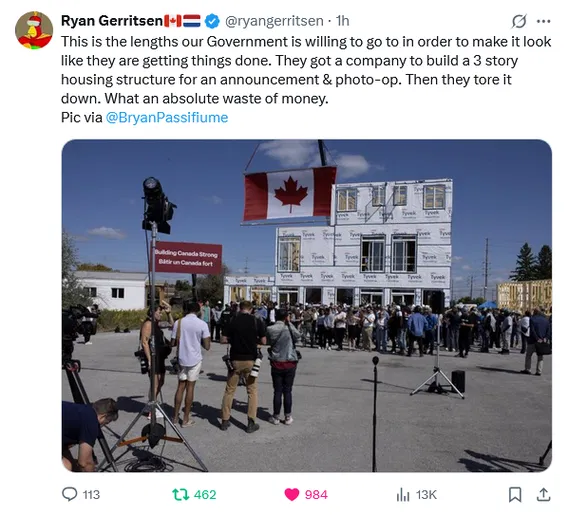
Twice in four days, Prime Minister Mark Carney scheduled official photo ops in front of environments that weren’t entirely real.

During a Sept. 19 visit to Mexico, Carney led cameras through a railyard stocked with pallets of artfully arranged sacks decorated with a maple leaf and the words “product of Canada”.

The site was the Canadian Pacific Kansas City Ferrovalle train yard, located outside Mexico City.

The yard is indeed equipped to process incoming railcars of Canadian wheat, but that’s all done in bulk. Hopper cars are positioned over large tanks to disgorge their loads, multiple tonnes at a time.

If any sacks ever enter into the equation, it’s long after Canadian producers have exited the process.

“Canadian grain farmers haven’t shipped wheat in sacks for over a century!” read a reaction by Chris Warkentin, Conservative MP for the heavily wheat-growing riding of Grande Prairie, Alta.

Sylvain Charlebois, a food scientist at Dalhousie University, wrote in a column this week that “bagged wheat is a relic of less mechanized economies”.

“We are among the most efficient bulk grain exporters in the world, shipping millions of tonnes through rail networks and ocean vessels designed for efficiency, safety, and traceability,” he wrote.

But it was a housing announcement just outside Ottawa where Carney would run into more direct accusations of being deliberately deceptive with his photo backdrop.

On Sept. 14, just before the opening of the fall session of Parliament, Carney stood in front of two under-construction homes in the Ottawa area and announced the official launch of Build Canada Homes, a new federal agency tasked with developing subdivisions of manufactured homes on federal land.

“The two sets of homes behind me were manufactured in two days, assembled on site in one,” Carney said to applause.

“We wanted to keep the townhouses open; we held back the workers from finishing it so you could see how things fit together,” he said, adding that one of the homes was being shipped “to Nunavut”.

Once the press conference was over, both homes were dismantled, and the site returned to what it had been before: A patch of fallow government land located near the Ottawa airport.

The land is a right-of-way for high-voltage power lines, which is why it currently doesn’t contain any development.

At The Rewrite, Peter Menzies congratulates Brian Passifume for being one of the only legacy media reporters to look past the literal Potemkin Village structure Carney had assembled for his photo op:

Our Orwellian theme continues but, this time, it’s to credit Brian Passifume of the Toronto Sun for his work digging into how our prime minister and his staff work to create fantasy settings for their announcements. Canadian Press and others were happy to play government propagandist by captioning a photo taken at Prime Minister Mark Carney’s Canada Builds launch by stating “Workers from Caivan Homes look on from a modular home under construction in Ottawa during Prime Minister Carney’s announcement for the new agency.”

Near as I can tell, most other media were happy to play along. Except Passifume who broke from the pack and pointed out the whole scene was, essentially, a movie set.

After one X user pointed out that the entire scene was fake, Passifume jumped in with “Dude I was there, that’s exactly what happened. It was a freshly-graded gravel lot with no utilities or services run. I was discussing this very topic with other reporters covering it — they didn’t even move the crane or remove the lifting apparatus, they just repurposed it to hold a gigantic Canadian flag.”

I expect some in the trade will say “hey, everyone does it” and no doubt that is true. But when people with power and those who crave it misrepresent reality, journalists are obliged to point that out. It doesn’t even have to be aggressive, just “Carney said in front of a set created for the announcement”.

Journalism isn’t actually that complicated. You just have to subscribe to its principles.

September 29, 2025

Powderkeg Britain

Filed under: Britain, Government, Media, Politics — Tags: , , , , , — Nicholas @ 05:00

The ever-expanding anti-immigration protests in Britain are an unmissable flashing red alert to the British government … which seems determined to ignore it and continue to plough ahead with their MOAR immigrants policies despite the anger of the public. Spaceman Spiff characterizes it as a revolt:

Multi-ethnic and multicultural societies do not function in the way homogenous nations do. People of radically different origins, culture and beliefs often trigger conflict as incompatible aptitudes, temperaments and worldviews operate within a shared territory.

Artificial situations like this do not naturally harmonize, despite the rhetoric. Instead, competition for resources emerges. Power sharing between rival groups is fantasy. Life is winner takes all.

This can be disconcerting as reality asserts itself and the cost of large-scale migration becomes obvious.

Some in Britain already understand the dangers we now face at home. Others are waking up and looking for answers as their world declines. They are the ones who will grasp at anything to reset society.

Racists and hatemongers

Critics of mass immigration in Britain are often branded as racists and hatemongers.

We see blanket condemnation from establishment figures for even mild observations about the effects of this deeply unpopular policy.

The noticers of reality are derided as far-right extremists even when they are evidently normal people exhausted with unwanted demographic change.

The approved media and political spokespersons insist those who make observations have become radicalized by extremist writers and thinkers. Little more needs to be added. The labels do much of the work; Nazi, fascist, racist.

It doesn’t matter that many who are critical of mass immigration are not extremists calling for violence. They are just normal people who notice what is happening.

One of the unfortunate things the noticers recognize is mixing distinct cultures inside a single geographical area might be dangerous. They sometimes read material based on government statistics that tells them mass immigration infers almost no benefits on the host nation while extracting potentially catastrophic costs.

To ordinary people that sounds like something worth discussing to determine if it is true.

Normal people are revolting

Western countries have endured unexpected demographic shifts in recent years.

The only acceptable view is this is always a net positive. We are told group differences do not exist except in the minds of racists. Foreigners are already very like us and any deviation from our norms are superficial or unworthy of comment.

It is therefore all the more shocking when this is proven wrong. From dress and manners to dietary habits, to the treatment of women and children, the world beyond our borders is quite alien when seen up close.

London’s vibrantly diverse bus riders

All this alienness was once elsewhere with oceans to protect us. Now it is here in our midst.

This is becoming obvious and is at odds with all we have been told. What we see does not match the harmonious melting pot we were sold.

Inevitably this encourages people to seek out information.

September 27, 2025

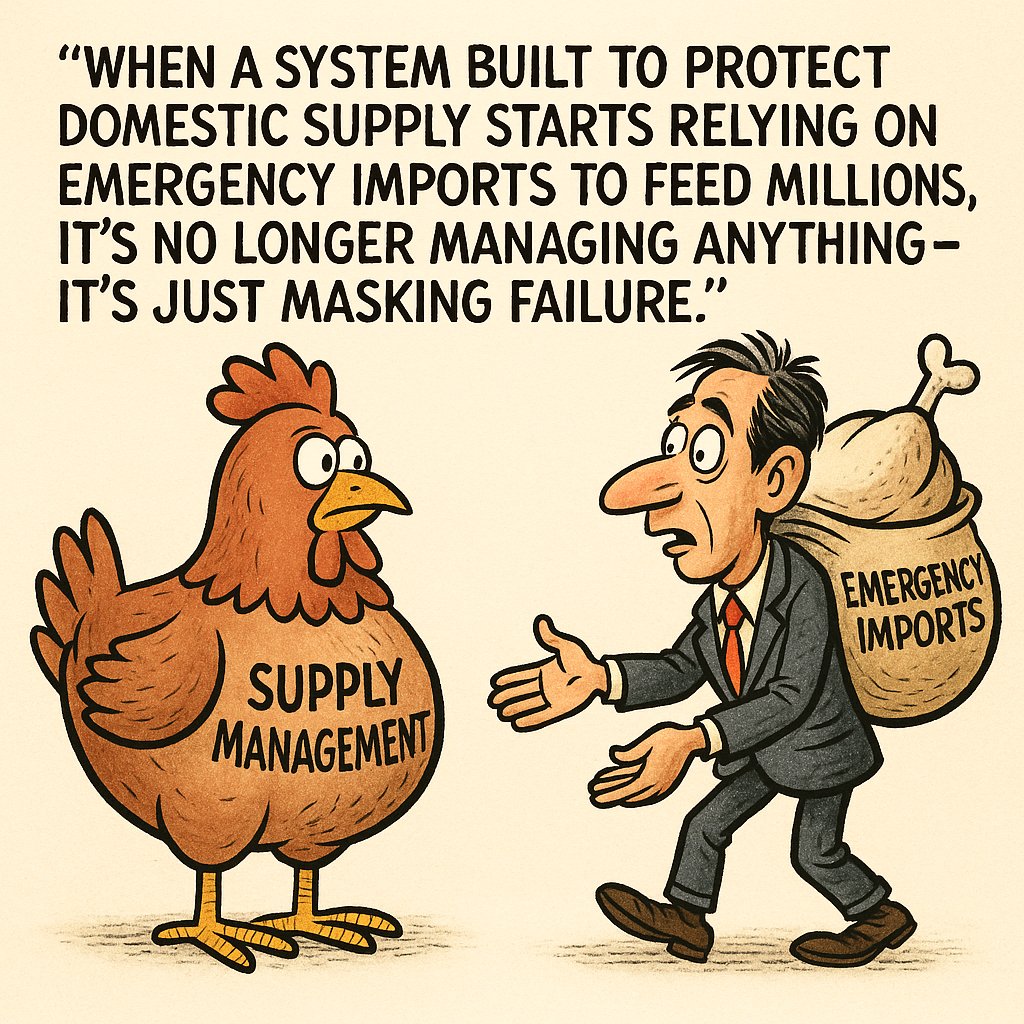
Canada’s supply management cartels benefit “an affluent few, burdening the poorest, and creating needless friction with allies and trading partners”

In Reason, J.D. Tuccille explains to an American audience why Donald Trump has been playing hardball with Canada on trade issues:

President Donald Trump justifies his enthusiasm for prohibitively high tariffs by insisting the U.S. is being “ripped off” by other countries. It’s a strange argument, since people only trade with one another if they see benefit in the deal. But the president is right to complain that other governments impose trade barriers of their own that are often every bit as burdensome as the high taxes Americans pay on imports. If foreign officials honestly wish to restore something like free trade, they should emphasize dropping their own barriers in return for lower U.S. levies. Case in point: Canada, which sends three-quarters of its exports across its southern border but imposes damaging restrictions on imports.

In a February proclamation of trade war on the world, Trump announced, “the United States will no longer tolerate being ripped off” and complained that “our trading partners keep their markets closed to U.S. exports”. The first part of that claim is silly. But the second part has a kernel of truth.

A glimpse at that truth came in June when Trump angrily posted that Canada “has just announced that they are putting a Digital Services Tax on our American Technology Companies” and, as a result, “we are hereby terminating ALL discussions on Trade with Canada”.

The threat had the desired impact. Canada rescinded the tax immediately before it was supposed to take effect. While nominally targeted at all large tech companies, in practice that meant American companies and everybody knew it, since U.S. firms dominate the industry.

But that was only the tip of the iceberg when it comes to Canada’s trade barriers. Also in June, international trade attorney Lawrence Herman, a senior fellow at Canada’s C.D. Howe Institute, bemoaned proposed legislation in the Canadian parliament that he characterized as “yet another regrettable effort to enshrine Canada’s Soviet-style supply management system in the statute books.”

He added, “the bill would prohibit any increase in imports of supply-managed goods – dairy products, eggs and poultry – under current or future trade agreements”.

The legislation about which Herman complained has since become law.

[…]

More skeptically, Fraser Institute senior fellow Fred McMahon notes, “supply management is uniquely Canadian. No other country has such a system. And for good reason. It’s odious policy, favouring an affluent few, burdening the poorest, and creating needless friction with allies and trading partners.”

McMahon elaborates that the supply management process is controlled by agricultural management boards which “employ a variety of tools, including quotas and tariffs, and a large bureaucracy to block international and interprovincial trade and deprive Canadians of choice in dairy, eggs and poultry”.

But as we’ve seen so many times over the years, it disproportionally benefits Quebec, and the Liberals desperately need those Quebec votes to stay in power, so the government would rather destroy the national economy rather than give up on our Stalinist supply management cartels.

September 26, 2025

A ministry for “Heritage” should not be funding hate publications

Filed under: Cancon, Government, Media, Politics — Tags: , , , , — Nicholas @ 04:00

I’m with Dan Knight that the government shouldn’t be funding any private networks, magazines, or newspapers, but since it does provide a lot of funds through various programs, it should at the very least strive to avoid funding open hatred toward ordinary Canadians:

Steven Guilbeault at a happier stage of his life, before joining the Liberal cabinet.

In a fiery exchange at the Standing Committee on Canadian Heritage (CHPC), Conservative MP Rachel Thomas dismantled Liberal Minister Hon. Steven Guilbeault, P.C., M.P., Minister of Canadian Identity and Culture and Minister responsible for Official Languages, over taxpayer money funneled into groups publishing hate-laced screeds and smearing everyday Canadians.

Thomas zeroed in on Cult MTL, a publication receiving federal heritage funds. She read into the record a headline published the very day after reports of Charlie Kirk’s assassination attempt: “To Hell with Charlie Kirk”.

“Minister, do you think that is wrong? Taxpayer dollars are funding this group. Will you revoke their funding?” Thomas demanded.

Guilbeault looked blindsided. He admitted he had no idea the government was bankrolling a tabloid openly celebrating political violence. His answer:

    I have not been made aware of this. I will verify with the department and report back to you. Obviously, spreading hate has no place in Canada, and if this is the case, we will make the necessary verifications and take the necessary steps.

Thomas didn’t stop there. She turned to the Canadian Anti-Hate Network, which she said has already pocketed about $1 million from Guilbeault’s department. Documents show the group paid an “investigative journalist” to hunt down so-called “far-right” targets — defining the term so broadly it included Catholics and pro-life Canadians — before seeding the stories into mainstream news outlets.

[…]

Conservative MP Rachel Thomas quoted former CBC anchor Travis Dhanraj, who launched a human rights complaint this summer […]

    To be honest, this has been the hardest period of my life. What happened at CBC really broke me.

Then she put it directly to Guilbeault:

    Have you reached out to the CEO of the CBC regarding this situation and the toxic work environment that is being accused there?

Guilbeault’s answer? Bureaucratic shrugging:

    The government role is not to get mixed into the daily operations and management of the organization. That is the purview of the organization, in this case, the public broadcaster.

Translation: $1.4 billion of your money flows into CBC every year, but the minister says he can’t pick up the phone when staff say they’re being harassed.

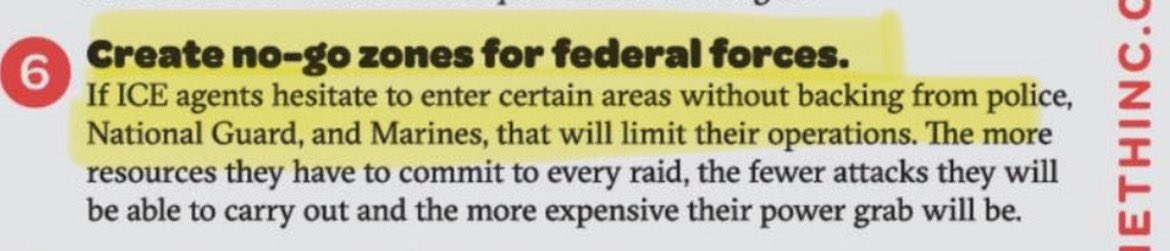
“Create no-go zones for federal forces”

Filed under: Government, Media, Politics, USA — Tags: , , , , , — Nicholas @ 03:00

On the social media site formerly known as Twitter, ESR responds to a comment about his three possible futures after the Charlie Kirk assassination (linked here):

    Mike Benz @MikeBenzCyber

    Antifa websites totally open to the public explicitly call to so utterly terrorize ICE that federal agents are physically afraid to enter a city. If the Proud Boys wrote this about the FBI how fast would every single person around that website be indicted by Merrick Garland.

“Create no-go zones for federal forces.’

In one of my previous analysis postings, I outlined three possible scenarios for the future after the assassination of Charlie Kirk.

This corresponds to scenario 3, the one where insurrection edges into a simmering civil war a la Bosnia. I caught some flak in my replies at the time from people who thought an insurrection based in urban areas isn’t practical under modern conditions.

Antifa thinks it is. It’s what they’re planning for.

One of the things I have to remind myself of occasionally is that most people know essentially nothing about Communist theory and Communist revolutionary tactics.

Antifa is running the classic Communist playbook. Make the enemy fight you where you are strong and they are weak — where you have support among the people and (when possible) cover from sympathetic local officials.

Historically that has usually meant fighting from rural areas where the reach of the government is weak. But the Russian Revolution was an exception, and the revolution Antifa is trying to fight is another. Their natural home ground is large coastal cities run by left-wing Democrats.

September 25, 2025

An unanticipated danger of AI – “classified” videos for decision-makers

Until fairly recently, even the least tech-savvy among us could distinguish AI-generated videos from the real thing … but most of the leaders and decision-makers in western governments aren’t very tech-savvy and put into high-pressure environments may be uniquely susceptible to AI manipulation:

What If I Told You … One of the biggest applications of AI for misinformation hasn’t been online but in the halls of power.

Aging boomer politicians, generals, and major figures are manipulated by showing them AI videos they can’t tell, can’t pause to look at, and certainly can’t digitally examine or geolocate …

“And as you saw Mr President.”

Pay attention. All of them reference seeing “videos” that you aren’t allowed to see, of events which they claim are public record, but appear no-where and no reporting supports …

Sean Hannity was interviewing a world leader and even said “You should show the public the video you showed me it’d really change everyone’s opinion. it changed mine” LIVE ON AIR. And the world leader said some non-committal maybe, then released nothing.

These aging politicians, media figures, corporate personalities, etc. all casually reference seeing insane videos that would CHANGE EVERYTHING and would have been immediately released to sway public opinion if they existed or would have been leaked if it would have been in poor taste to be seen directly releasing them (like gore films)

But of course they aren’t released because they’re faked and the internet would immediately piece together that they’re faked with AI, video game, and archival footage from old conflicts … But the aging 60- and 80-year-olds who run the world can’t tell.

There was a case where they challenged Greta Thunberg “Would you watch this video it’d change your mind” and she refused telling them to just release it … Then they didn’t and attacked her for not being willing to view evidence contrary to her views … in a controlled environment where she couldn’t scrutinize it or check its authenticity against anything else …

It sounds insane! But if you pay attention all of these politicians, media figures, and even influencers … People who often have ZERO security clearance or any official attachment of real trust or allegiance to the governments showing them this “classified” or “controlled” footage … Regularly reference seeing footage which does not exist in the public domain, for events which are viciously contested in which any of the footage they claim to have seen would be WORLD CHANGING news … Yet all these figures are just left out in the wind repeating “Trust me bro”s for some of the most important occurrences of the past decade.

September 24, 2025

It won’t work – the minister responsible knows it, but they’re going ahead with it anyway

The “it” in the headline is the federal government’s gun confiscation program, which they claim will reduce crime but they already know it won’t do any such thing. What it will do is take away from literally the most law-abiding, responsible citizens their legally purchased property and leave illegal guns in the hands of criminals … at an ever-increasing estimated cost to the taxpayer. In The Line, Matt Gurney covers the details:

The federal gun confiscation program […] is illogical. It won’t save lives or make the public safer. The federal government doesn’t really even expect it to work, and is only going ahead with it because they’ve been stuck with a dumb proposal the Trudeau government made almost five years ago. If they could do it all over again, they wouldn’t, but they feel like they’ve blocked themselves in and have no choice but to proceed so that they don’t anger part of their electoral coalition, mainly voters in Quebec.

That might sound like a blistering criticism of the program, the kind of thing you’ve read in any number of my columns before. It’s actually what the public safety minister thinks about it. He just didn’t know he was being tape recorded when he said so. In a 20-minute conversation Gary Anandasangaree had with a firearms owner he rents a home to, which was recorded and then leaked, the minister says all of the above things. (He has also confirmed the recording is legitimate.)

Awkward for the minister, clearly, but I actually give him credit. The minister’s comments on tape are a confession, and an admission of defeat. They’re also, hands down, the most honest thing a Liberal government official has said on the gun control file in five years. Given that the minister responsible is freely telling people the program is a bad idea he’s stuck with and that won’t work, a sensible government would probably take this opportunity to walk away from the program.

Unfortunately, that’s not what this PM has chosen. It’s full speed ahead with an idea so bad Anandasangaree wishes he’d never been saddled with it.

Let’s talk about what this program is for a second. And forgive me, there’s quite a bit of history here. During Justin Trudeau’s first term, his only majority, his government had proposed a series of fairly moderate changes to the gun control laws they had inherited from Stephen Harper. As I’ve written often since, the proposals were a mixed bag. Some were okay. Some were bad. But they more or less left the well-functioning Canadian gun control system intact. They nibbled around the edges enough so that they could tell their voters that they had gotten tougher. But they generally didn’t try to fix what wasn’t broken.

But then politics got in the way, as it always does. Trudeau lost his majority in 2019 and became ever-more dependent on voter efficiency and wedge issues. And then in 2020, there was a horrible massacre in Nova Scotia. That catastrophe had nothing to do with our gun control laws; the weapons used were brought in illegally from the United States, as is typical of guns used in gun crime. But the Trudeau government seized on the opportunity — never waste a crisis, right? — to announce that they were “banning” “assault rifles”.

A lot of quotes above. So let me explain. First of all, there really wasn’t much of a ban. Anyone who owned one of the newly banned rifles was allowed to keep them. And as for assault rifles, actual assault rifles — rifle-calibre weapons that use high-capacity detachable magazines and can fire in fully automatic mode — have been banned in Canada for decades. This isn’t a problem that we actually had. And the government tacitly admitted as much when they began fudging the words they used to describe them. In acknowledgement that there were no actual assault weapons to ban, they started talking about assault-style weapons.

“Style” is a tell. You wouldn’t take medicine-style pills, or munch on a food-style snack. Because you’d know better. Trudeau et al knew better. It didn’t stop them. They needed something to announce, and by God, they were going to announce it!

And as we’ve noted several times, the Trudeau government got addicted to the media high of making big showy announcements. So they started doing repeat announcements over a period of time, and thanks to the spinelessness of Canadian legacy media even before Trudeau started directly subsidizing them, the media sugar high got repeated as well. It didn’t take long for the lesson to be learned that making an announcement was cheaper than doing the thing that was announced, and we quickly transitioned to a world where it was the announcement that mattered, not the thing.

At Junk Economics, Bryan Moir sums up the stupidity:

You want blunt? Fine. Here it is:

Listen: politics is kabuki theater and promises are props. Here we have a government rolling out a nationwide confiscation-style buyback and calling it “voluntary” — which is like calling income tax “optional” if you want to be arrested. The minister tells citizens, in public, “it’s voluntary”, then admits in private he’ll criminalize non-compliance, will “bail you out” if it goes that far, and says the whole exercise exists because the party must keep the promise and because the Quebec caucus wants to show muscle. That’s not statesmanship. That’s PR with a warrant.

They lecture you about being “tough on guns” while refusing to be tough on the people who actually bring violence into our streets. The minister himself says if he could do it over he’d target illegal guns and put criminals in jail — not law-abiding owners. Translation: the policy is ideologically driven and politically performative, not strategically intelligent. You don’t cure gang violence — which the cops tell you comes from illegal trafficking and cross-border smuggling — by borrowing billions to buy back legally purchased rifles. That’s like throwing sandbags into a burning house and patting yourself on the back for “doing something”.

And then there’s the logistics and the cost — the ugly part they don’t want on camera. The federal pot is capped at about $742 million and the program is rolled out in fits and starts. Major police forces are already saying “no thanks”, which means the feds must either stand down, contract a patchwork of municipal services, or try to outsource enforcement. Any of those choices blows up the promise in different ways: it becomes toothless, it becomes wildly more expensive, or it becomes a federal-provincial fight that will make the Notwithstanding clause dust-ups look like backyard squabbles. Pick your disaster.

Remember the math: a capped pool of cash plus a growing list of banned models (hundreds, then thousands) equals many owners getting nothing while the bureaucracy eats up the rest on administration, contracts, security, staffing, and political “bribes” (a nicer word for handouts to get agencies to play ball). If the fund runs out — and the minister openly says “it’s capped; when it’s gone, it’s gone” — you’ll have a bunch of people stripped of legal property, out of pocket, and the state triumphant only in optics. That’s confiscation without fair market compensation; it reads like policy designed by accountants and sold by televangelists.

Worst of all: while Ottawa gamely auctions off the idea of virtue, or was that “Canadian values”, real problems pile up. Fire seasons rage, hospitals are full, kids wait for surgeries, food banks are overwhelmed and the cost of living keeps rising— and Mark and Gary are borrowing money to offer coupons for now-illegal guns. If you wanted a textbook case of political misallocation, this is it: symbolic policy delivered with symbolic money so the party can say it kept a promise, while the public pays the bill and crime networks keep smuggling.

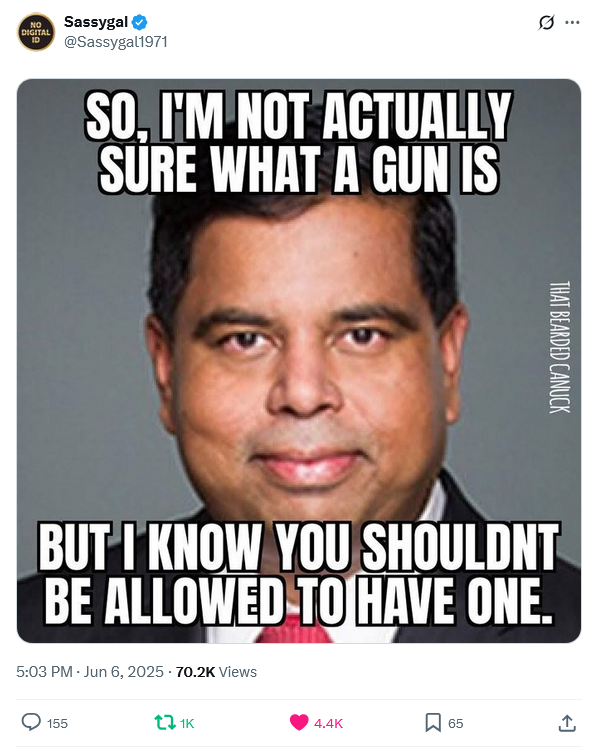
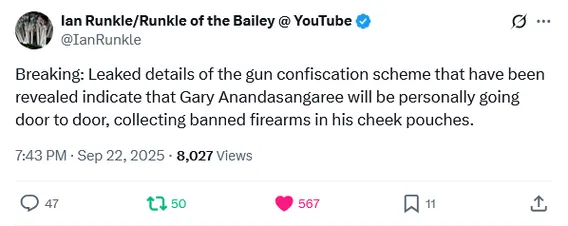
On the gun confiscation program in particular, thank goodness you can always depend on social media to find the funny side of any issue:

QotD: The political divisions of humanity

… the various divisions between human beings — communists vs. fascists vs. loyal American patriots — we have lived with all our lives are less important, less fundamental, than the basic one that Heinlein identified: “The human race divides politically into those who want people to be controlled and those who have no such desire”. Call the first group authoritarians or feudalists and the second, generic libertarians.

The first time, in the history of Western Civilization, that this became an issue, was the Renaissance/Reformation. Information suddenly came flooding, unbidden, into Europe, from North Africa, through Galileo’s telescope, out of Gutenberg’s printing press, and a dozen other undesirable, unlicensed, and deplorable sources. It must have been a nightmare for the aristocrats who considered themselves to be in charge, the kings and barons and bishops and bullies. They struggled in vain to get it back under control. They got the Church to condemn it. They intimidated and tortured its emissaries when they could. They invented universities to get a handle on it, a collar around its neck, but it was a lost cause. In just a couple of centuries (compared to the previous 500 generations), people — ordinary people; who the hell did they think they were? — came to know too much for the good of Authority.

And they soon proved it, in the American Revolution, which told 10,000 years of kings to go to hell, and the French Revolution, which cut to the chase and removed their overly-pampered heads. I have actually seen the blade. Many other revolutions followed, worldwide, and people began to learn, slowly and awkwardly, to live their own lives. The one good thing to come out of the brutal and deceitful Russian Revolution was the ultimately individualistic philosophy of refugee Ayn Rand.

Otherwise, it was a naked attempt by the authoritarians, the feudalists, to regain control of the masses that the Czar had clumsily let slip through his overly-manicured fingers. Whenever human beings have clashed over whether their lives should be controlled by others or not, it has almost certainly been a matter of who gets to be the next king, baron, bishop, commissar, etc., a battle between liberated entities and those who would restore feudalism.

L. Neil Smith, “The Deep State”, Libertarian Enterprise, 2019-04-14.

September 23, 2025

Voters didn’t have to pay attention, but now they really, really should

Filed under: Cancon, Government, Media, Politics — Tags: , , , — Nicholas @ 05:00

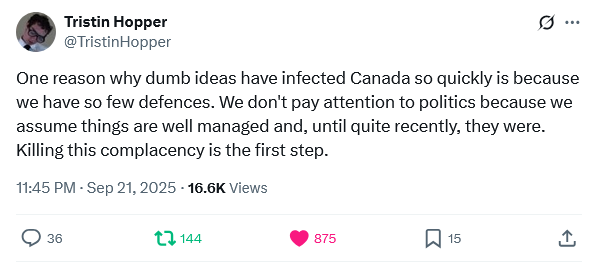
On the social media site formerly known as Twitter, Tristin Hopper posted the best explanations I’ve seen for why Canada is in the state it’s in:

Canadians took it for granted that, no matter which party was in government, the country would continue to be stable, predictable, and competent. That’s clearly wrong today, yet the voters haven’t really accepted the new situation yet. Until they start paying attention, things may not improve.

It’s not just Canada, of course, but Canada is further down the road to ruin and thanks to the governments’ conscious actions, it will probably take longer to recover (and I don’t see a Canadian Javier Milei on the horizon, more’s the pity).

At The Freeman, Will Ogilvie Vega de Seoane discusses a related issue with most forms of representative government:

We are stupid. There, I said it. I feel much better now — like I’ve finally opened up in group therapy. PhDs won’t fix it, nor will subscriptions to all the best outlets. As individuals, we simply do not have the capacity to decide what is best in public life. As voters, we don’t usually care what our representatives are up to, nor do we have the faintest idea what the best policy on agriculture, artificial intelligence, or healthcare should look like — and that’s on a good day. But we do think we know. Deep down we think we are sovereign, that democracy is “all of us”, as though the government were some noble embodiment of “the people” rather than just another collection of organized persons with private agendas.

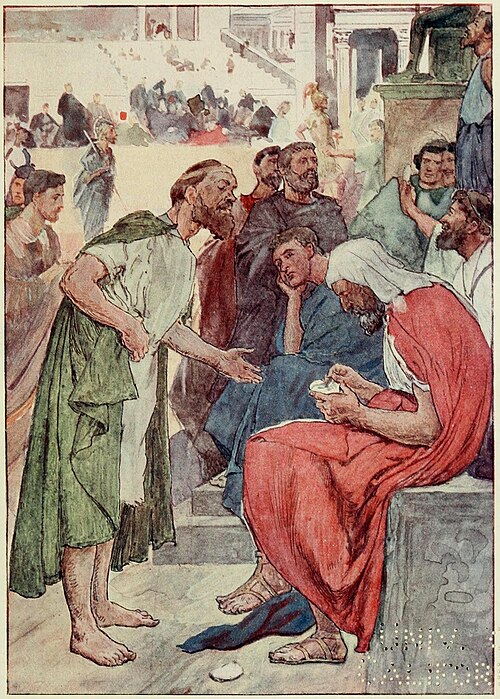
“Aristeides and the citizens” from Plutarch’s lives for boys and girls (1900).

Plutarch tells a story that I have always found marvelous. It’s about Aristeides “the Just”, one of Athens’s heroes in the Persian Wars. The Athenians, weary of kings and tyrants, invented ostracism — a mechanism to expel for ten years any citizen who got too powerful. Each voter would scratch a name onto a shard of pottery, and if more than 6,000 shards had the same name on them, the man was politely asked to take a decade-long sabbatical. Today we’d probably call it “a career break for the common good”.

Anyway, one day a farmer approached Aristeides himself — without realizing who he was — and asked him to write the name “Aristeides” on his shard. Surprised, Aristeides asked if he had ever harmed him. “No,” said the farmer, “nor do I know him by sight. But I am tired of always hearing him called ‘the Just’.” Aristeides, being annoyingly noble, wrote down his own name and handed the shard back. Later, as he left the city in exile, he prayed the opposite prayer of Achilles: that no crisis should come which would force the Athenians to remember him. On LinkedIn, Aristeides might have written: “Currently on a ten-year sabbatical generously sponsored by the people of Athens. Seeking new challenges outside the Attic peninsula #OpenToWork.”

This, in miniature, is how people vote. Not with knowledge, or vision, or even vague coherence — but out of envy, spite, boredom, or some other glorious irrationality. The Athenians had shards; we have hashtags. Instead of ostracism by pottery, we have ostracism by X: one bad joke, one leaked email, and the digital mob sends you packing. Today in Britain, people can even be jailed for their comments on social media. So much for parrhêsia, that old Athenian virtue of speaking frankly to power. We’ve managed to turn it into a crime — and worse, the canceling mob thinks it’s “speaking truth to power” when in fact it is obedience dressed as rebellion.

Modern voters aren’t any better. Some vote because the candidate owns a cute dog. Others because the candidate is endorsed by Taylor Swift. Entire campaigns have been won on promises of free cable, or by a politician smiling the right way on TikTok. In Spain, we even coined a term for it: the Charo. A Charo is usually an old lady with pink hair who parrots whatever our president says. Charos cannot resist the presidential smile. Even when the president contradicts himself, as he normally does, doing the exact opposite of what he promised, they just blush and blink as if to say: “Oh, Pedro, always misbehaving — we love you all the more for it.” They pamper their charming president and dismiss any criticism as fascist slander. Welcome to the Charocracy.

That’s a pitch-perfect description of the typical Liberal voter in Canada. Mark Carney’s Canada is clearly a maple-flavoured Charocracy.

September 22, 2025

The Liberals fervently believe that saying something is the same as doing something

One of the most irritating aspects of Justin Trudeau’s long reign of error was his evident joy in making announcements about this or that topic. It got to the point that even the pro-Liberal media started to notice that the same policy would be announced several times over a few months but no actual progress was made (except where they could start setting up a new government program … they’d hire the staff very quickly, but little or nothing would get done beyond that). Mark Carney was supposed to be a clean break from the Trudeau years — even though most of his ministers were Trudeau retreads — but Carney may actually be worse than Trudeau in that he just loves photo ops with pretty props for the cameras. As Dr. Sylvain Charlebois notes, we need a lot fewer photogenic Potemkin Villages in how our federal government operates:

In recent weeks, we have witnessed politicians lean on powerful visuals to make their case on food and trade. But these staged moments rarely serve the public interest. Worse, they often deepen food illiteracy in a country where understanding how our system works is already fragile.

Take Ontario Premier Doug Ford’s stunt. Upset with Diageo’s decision to close its bottling plant in Ontario, he theatrically dumped a bottle of Crown Royal and urged Ontarians to boycott the brand. What he didn’t mention is that the bottle in question was made in Manitoba and bottled in Quebec by unionized Canadian workers — jobs unaffected by the Ontario closure. The Windsor facility mainly serviced the U.S. market, and Diageo’s decision was years in the making. Ironically, the boycott risks punishing Canadian workers who will continue producing Crown Royal for Canadians. And for future investors, the message is chilling: why put capital into Ontario if a government will trash your brand on television for a corporate restructuring decision?

The federal stage brought us another head-scratcher. During a trade visit to Mexico, Prime Minister Mark Carney posed with bags of Canadian wheat stamped with a maple leaf. The problem? Canada doesn’t export wheat in bags. We are among the most efficient bulk grain exporters in the world, shipping millions of tonnes through rail networks and ocean vessels designed for efficiency, safety, and traceability. Bagged wheat is a relic of less mechanized economies. For Canada to present itself this way trivializes our status as a modern agri-food powerhouse. Beyond being misleading, the image suggests to global partners that our system is less advanced than it truly is — a dangerous misrepresentation for a nation that depends on reputation as much as price.

Even I didn’t realize how bad it got until the feds paid contractors to put up a fake building site for Mark Carney to pose in front of, then tore it all down:

September 20, 2025

Feds move to neuter the “notwithstanding clause” to frustrate Alberta

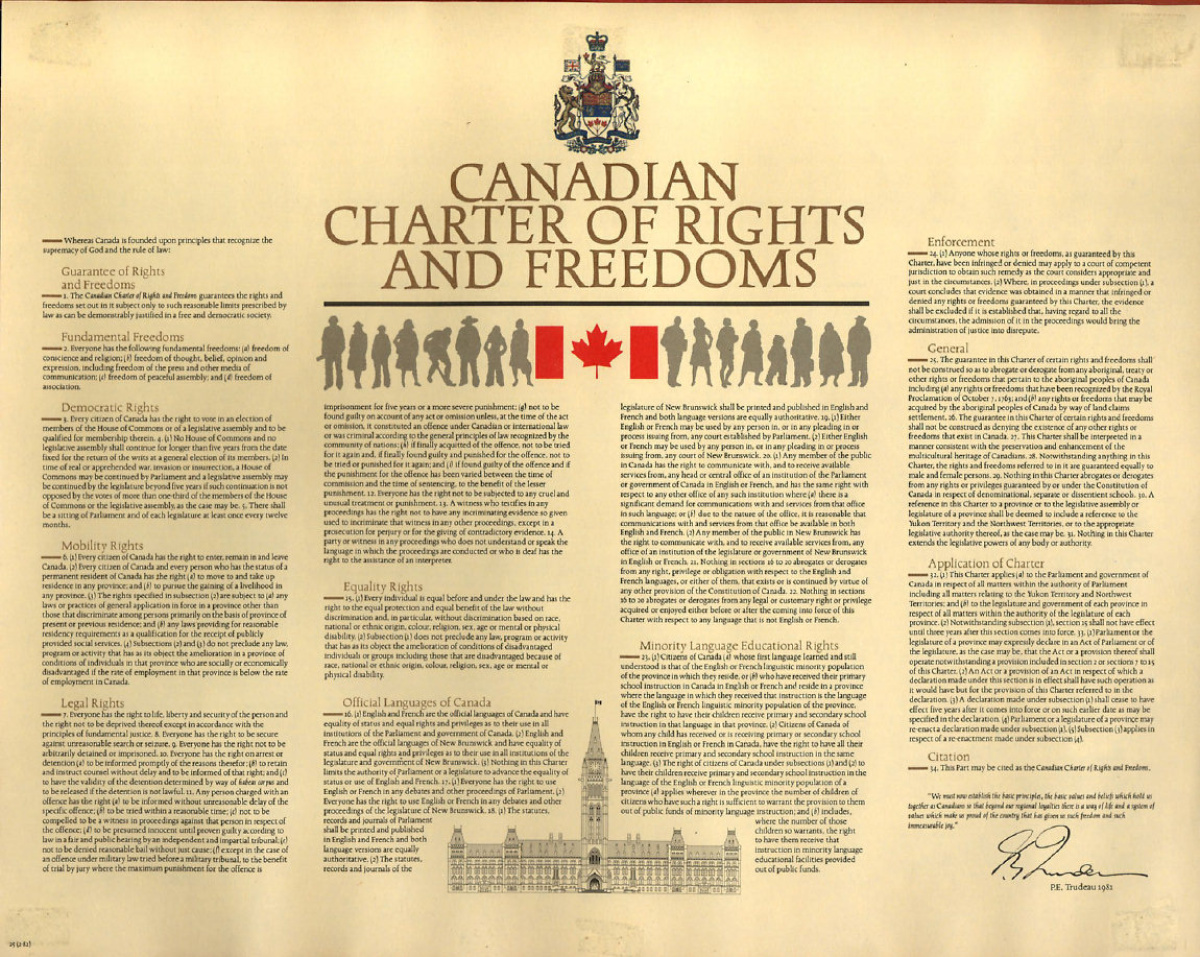
To be honest, I wasn’t a fan of the Charter of Rights and Freedoms when it was forced down our throats in 1982, on the basis that if Pierre Trudeau thought it was a good idea then it must be the opposite. All these years later, although I’m still not a huge fan, I support the provinces who now need to combat Mark Carney’s minority Liberal government’s attempt to use the Supreme Court to limit or eliminate the provinces’ use of the notwithstanding clause:

You might be hearing a lot about the notwithstanding clause these days and wondering what is going on. The fact is, the Carney government is trying to change the constitution via a Supreme Court case on Bill 21 – a heinous bill in my opinion – but not an excuse to scrap or weaken the notwithstanding clause.

We’ve been here before with this debate before and I’m still of the same position, leave the clause alone.

It was in 2018 that Ontario Premier Doug Ford was looking to use the notwithstanding clause to shrink the size of Toronto city council. He should never have had to do this, but a lower court ruled that Ford’s actions were unconstitutional.

Which is really weird because the constitution is clear, municipalities are creations of the province. A provincial government can merge municipal governments, they can even abolish them if they wish.

Eventually, a higher court overturned the very politically driven decision against Ford, but for a time, he seemed to need the notwithstanding clause, otherwise known as section 33 of the Charter of Rights and Freedoms.

I’ll never understand why some claim the notwithstanding clause is against the Charter when it is part of the Charter.

On the social media site formerly known as Twitter, Sean Speer notes the Liberals seem to be taken by surprise at the negative reactions to their plans:

I suspect that non-conservatives are a bit surprised by the magnitude of the reaction to the Carney government’s factum on the notwithstanding clause. That’s mainly because I think liberals and progressives don’t quite understand how much the past decade or two of judicial activism has come to animate Canadian conservatism. Even as a somewhat moderate conservatism, I admit to being radicalized on these issues.

The Carter decision on MAID was a key moment in this evolution. Not necessarily because of the issue per se — though a lot of us oppose it. But mainly because it was such a naked example of judicial lawmaking. The clearest case that it’s just power and politics all the way down.

After having ruled that there was no right to physician-assisted death in the Charter, just over twenty years later the Supreme Court unanimously decided there was indeed such a right.

There had been no constitutional amendment in the meantime. Parliament had considered the issue and carefully and consistently voted against it. And yet nine judges decided that the right should exist and so they created one.

If the judiciary isn’t merely protecting constitutionally-prescribed rights but manufacturing them based on the political preferences of judges themselves—if it’s in effect just politics from the bench — then we might as well have the politicians who we’ve duly elected to be making these decisions for us.

Before Carter I would have said that I was broadly supportive of S.33 as part of our constitutional order but today it’s much bigger part of my core political identity as the only check we have on judicial politicking.

The Carney government’s factum then isn’t just objectionable because it threatens to constrain the notwithstanding clause but precisely because it invites the Supreme Court to once again alter the constitution in its own image.

Brian Peckford, the last surviving signatory to the patriation of the Constitution in 1982:

Tragically, it is not surprising that we see this further emasculation of our 1982 Constitution.

It has been ongoing almost since its inception. Witness the 1985 Court Opinion twisting the meaning of the opening words: “the Supremacy of God”.

And the constant distortions ever since, accelerated during the false covid crisis.

This is The Tyranny of The Judiciary —The Destruction Of Parliamentary Democracy!

How important is Section 32 — the notwithstanding clause?

There would be no Constitution Act 1982 — no Charter of Rights and Freedoms without Section 32.

When PM Trudeau Sr. tried to unilaterally Patriate the Constitution and failed miserably because of the Provinces’ opposition before the Courts, he validated the suspicion most Premiers had about the Federal Government and its intentions during that time. The ability of the Provinces to continue democratically to initiate specific exemptions was crucial to solidify the federal nature of this country.

The Supreme Court was right in Sept 1981 in denying the Federal Government such sweeping powers.

None of the 10 First Ministers who signed the Patriation Agreement intended for this Section to be amended in any other way except by the Amending Formula that was achieved for the first time in our history in that Agreement.

The Federal Justice Minister’s action to ask the court is wrong — totally against the intent of those who authored the Patriation Agreement and defies and denigrates one of major accomplishments of 1982, The Amending Formula, a crucial part of the earlier 1981 Agreement, the foundation document, “The Patriation Agreement”.

The Canadian Press carries this:

    OTTAWA — The federal government’s request to Canada’s top court for limits on the notwithstanding clause isn’t only about Quebec’s secularism law, Justice Minister Sean Fraser said on Thursday.

    In a media statement, Fraser said he hopes the Supreme Court’s eventual decision “will shape how both federal and provincial governments may use the notwithstanding clause for years to come”.

Excuse me, Mr Fraser, this is the job, the solemn responsibility, for Canada’s Elected First Ministers and Their elected Parliaments not the Judiciary. Making law is the job of the elected, interpreting law the role of the Judiciary.

This brazen action of the Federal Government would enlarge the Judiciary power to make law — it deciding the powers of The Governments of this Nation.

Ironic in the extreme it is to ponder that Canada sought for decades to find an amending formula — self criticizing itself for not having a legitimate avenue for Constitutional Change.

Now that it has such an avenue instead of using it, it cowardly asks The Court?

Should not a majority of the Provinces have to agree — that’s what the Supreme Court said in 1981?

Hence, the Supreme Court, consistent with it predecessor views of 1981 should refrain from hearing the matter, and inform the Governments that it is they who have the power through the legitimate constitutional process present in the Constitution to make such significant change ie the powers of the Governments, adhering to Section 38, the Amending Formula.

“[V]iolent crime [in Canada] had increased by 30% over the last decade”

Filed under: Cancon, Government, Law — Tags: , , , , — Nicholas @ 04:00

A lot of Canadians are noticing how much social peace has deteriorated in and near major cities, but police and local media increasingly are not sharing full information about suspects — often to avoid accusations of racism. It’s gotten bad but as James Pew points out … it’s just getting worse and worse:

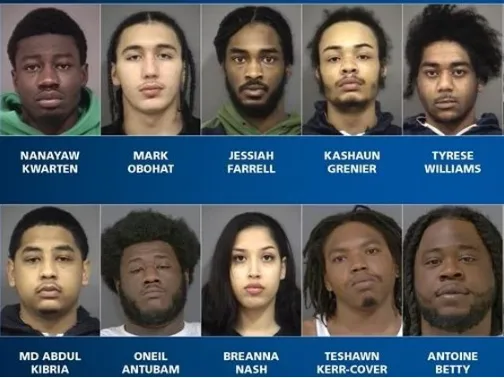
Some of the 18 people charged with violent home invasions and carjackings in the Peel Region, July 2025.

Almost every day we hear new stories of violent crime in Canada. Many of us are shocked into speechlessness. Violent youth offences, home invasions, arsons and assaults are on the rise. The rate of car jackings in the York Region increased by 523% between the years 2019 and 2024. Home invasions in Canada are now a regular occurrence. Last year, Kiernan Green did some number crunching for The Hub. He found that violent crime had increased by 30% over the last decade. And Livio Di Matteo, of the Fraser Institute found that “while Canadian homicide rates remain lower than in the U.S., the Canadian rate has increased at a higher rate since 2014”. In the blink of an eye Canada went from a safe high trust society to a dangerous low trust society. Everything is upside down.

The swarming attack and murder of 59-year old homeless man Kenneth Lee of Toronto in December of 2022 was a somewhat early indication that something was dreadfully off. Eight girls, ranging in age from 13 to 16 attacked Lee, stabbing him with knives and small scissors multiple times. He later died in hospital. Initially charged with second degree murder, ultimately all eight girls had their charges reduced and were sentenced to probation only. The Mayor at the time, John Tory, referred to the judgment as “deeply disturbing.”

So far this year there have been thirteen cases in which youth offenders were charged with homicide in the Greater Toronto Area. The most recent involves a 12-year old who has been charged with murdering a 62-year old homeless man. He had been on a release order at the time of the murder. He was also accompanied by a 20-year-old man named Isaiah Byers. The two went on a spree of unprovoked violent attacks in downtown Toronto, targeting vulnerable individuals. Five in total were attacked with a hammer.

Frustrated with the city’s catch-and-release protocol, the Toronto Police Association recently took to X and asked, “Where are the judges who make these decisions?” And further, in a written statement the TPS pointed out, “Our members are held accountable for the decisions they make and the actions they take. Why isn’t anyone else?”

The Youth Criminal Justice Act (YCJA) is currently protecting the identities of youth offenders involved in shocking levels of violence across the GTA. On July 17th, a 14-year old boy, described as a black youth, was charged with fatally stabbing a 71-year-old woman, Shahnaz Pestonji, while attempting to rob her in a grocery store parking lot. The youth admitted later on a social media livestream that he “didn’t mean to kill the old lady” and was just trying to steal her car.

On August 16th, 8-year old Jahvai Roy was shot and killed by a stray bullet while at home sleeping in his mothers bed. Many bullets were shot that night by thugs outside the Roy home in North York, but tragically one of them passed through a window of Holly Roy’s bedroom and struck Jahvai. She wrote on Facebook, “My baby was preparing for one of his best friend’s birthday celebration. He was so excited he couldn’t sleep!” A 16-year old boy has been arrested, and two others are still being sought by police on Canada-wide warrants: 17-year old Ibrahim Ibrahim of Toronto, and 18-year old Amarii Lindner of Toronto.

On August 23rd a 16-year-old girl was charged with aggravated assault and assault with a weapon after stabbing a woman in her 80s in Scarborough, Ontario. Due to the YCJA, the name of the woman, who is suffering in hospital with life-threatening injuries, was not disclosed by the media. It was reported that the teen and the victim lived in the same residence. The story seems to have vanished. After August 23rd, there are no more media reports.

« Newer PostsOlder Posts »

Powered by WordPress