
Published on 16 Feb 2017
After breaking off diplomatic relations, the tensions between the US and Germany are still strong. This week the so called Yarrowdale prisoners become pawns in the power play between the great powers. At the same time, the Russian air force is bombing targets all over the north Eastern Front and little skirmishes happen on the overall quiet Western Front.
February 17, 2017
Russian Bombing On The Eastern Front – US Prisoners of War I THE GREAT WAR Week 134
Comments Off on Russian Bombing On The Eastern Front – US Prisoners of War I THE GREAT WAR Week 134
January 22, 2017
German Jäger Corps – Russian Steamroller – Pickelhaube I OUT OF THE TRENCHES
Published on 20 Jan 2017
Indy sits in the chair of wisdom again to answer your questions about the First World War. This time we talk about the German Jäger Corps, the Pickelhaube and compare the Russian Army of WW1 to the Soviet Army of WW2.
Comments Off on German Jäger Corps – Russian Steamroller – Pickelhaube I OUT OF THE TRENCHES
January 13, 2017
No Peace For The Wicked I THE GREAT WAR Week 129
Published on 12 Jan 2017
This week 100 years ago there was talk about peace between the great warring nations. But even after millions of casualties, starving people at home and more escalation on the horizon, the situation didn’t seem bad enough for one of them to give in on their demands. At the same time, the fighting in Romania continues and the political situation in Russia becomes ever more dire.
Comments Off on No Peace For The Wicked I THE GREAT WAR Week 129
December 30, 2016
Turmoil in Russia – The Assassination of Rasputin I THE GREAT WAR Week 127
Published on 29 Dec 2016
The chaos within Russia, especially Petrograd, is getting more and more severe. In the centre of much controversy is the Tsarina herself and her trusted mystic and healer Grigori Rasputin. His influence over the Tsar and his wife are actively frowned upon and this week 100 yeas ago he is assassinated. At the same the Russians are facing the German Army on the Romanian Front.
Comments Off on Turmoil in Russia – The Assassination of Rasputin I THE GREAT WAR Week 127
December 27, 2016
Rasputin – The Man Behind The Tsarina I WHO DID WHAT IN WW1?
Published on 26 Dec 2016
Grigori Rasputin is as much a man as he is a legend. The mystic behind the Tsar and the Tsarina who apparently made no decision without consulting him. The healer that could perform miracles. The man who was killed for his influence in a time ripe for revolution.
Comments Off on Rasputin – The Man Behind The Tsarina I WHO DID WHAT IN WW1?
When New York Times articles “switch to passive voice, they are covering up a lie”
Robert Graham has a handy tip for understanding newspaper stories, the New York Times in particular:
Here’s a trick when reading New York Times articles: when they switch to passive voice, they are covering up a lie. An example is this paragraph from the above story [*]:
The Russians were also quicker to turn their attacks to political purposes. A 2007 cyberattack on Estonia, a former Soviet republic that had joined NATO, sent a message that Russia could paralyze the country without invading it. The next year cyberattacks were used during Russia’s war with Georgia.
Normally, editors would switch this to the active voice, or:
The next year, Russia used cyberattacks in their war against Georgia.
But that would be factually wrong. Yes, cyberattacks happened during the conflicts with Estonia and Georgia, but the evidence in both cases points to targets and tools going viral on social media and web forums. It was the people who conducted the attacks, not the government. Whether it was the government who encouraged the people is the big question — to which we have no answer. Since the NYTimes has no evidence pointing to the Russian government, they switch to the passive voice, hoping you’ll assume they meant the government was to blame.
It’s a clear demonstration that the NYTimes is pushing a narrative, rather than reporting just the facts allowing you to decide for yourself.
Comments Off on When New York Times articles “switch to passive voice, they are covering up a lie”
December 25, 2016
Starving For Total War – Turnip Winter 1916 I THE GREAT WAR Special
Published on 24 Dec 2016
While 1916 still looked good for the Central Powers militarily, the civilian population at home, especially in the cities, was starving to death. The British Naval Blockade, harvest failure, a desolate supply situation and the demands of the army created a situation in which the people were forced to eat turnips, a crop usually reserved for farm animals.
Comments Off on Starving For Total War – Turnip Winter 1916 I THE GREAT WAR Special
December 21, 2016
The western press has been colonized by ISIS/al Qaeda
Brendan O’Neill on the way western media have been trained to report certain events to benefit terrorist organizations:
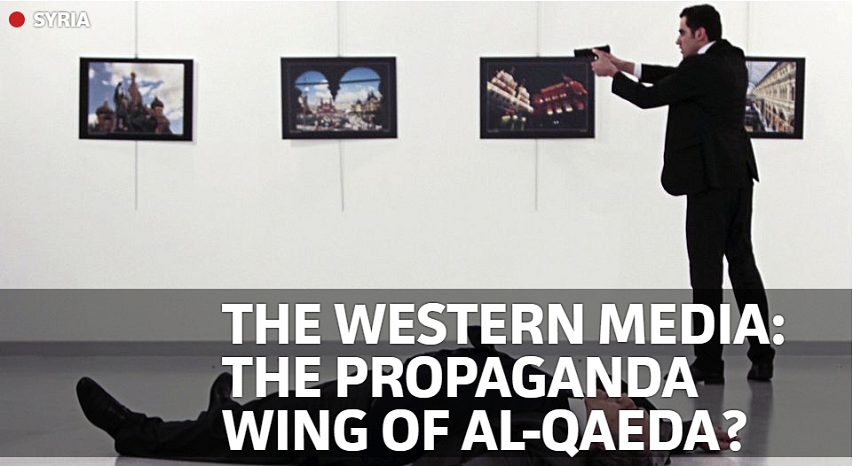
The British press is morphing into a mouthpiece for al-Qaeda. Consider its coverage of yesterday’s assassination of Andrei Karlov, the Russian ambassador to Turkey. It is borderline sympathetic. The killer’s words — or rather, certain of the killer’s words — have been turned into emotional headlines, into condemnations of Russia’s actions in Syria. That the killer’s first and loudest cry was ‘Allahu Akbar’ — the holler of the modern terrorist — has been downplayed, and in the case of at least one newspaper, the Express, completely ignored. Instead the papers upfront the killer’s other cries, about Aleppo. ‘This is for Aleppo’, says The Times. ‘Remember Aleppo’, says the Mirror’s headline, but with no quote marks, because these were not the exact words spoken by the gunman — they’re more like the Mirror’s own sympathetic echo of the killer’s sentiment.
To get a sense of how disturbing, or at least unusual, this coverage is, imagine if the 2013 murder of British soldier Lee Rigby by two Islamists had led to headlines like ‘This is for Afghanistan’ or ‘Remember Basra’ (those two knifemen, like Karlov’s killer, justified their action as a response to militarism overseas). Or if the 7/7 bombings had not given rise to front pages saying ‘Terror bombs explode across London’ or ‘BASTARDS’ but rather ‘While you kill us in Iraq, we will kill you here’. Reading the early coverage of Karlov’s killing, and noting how different it is to British press coverage of other acts of Islamist terror, one gets the impression that the media think this killing is justified, or at least understandable. ‘Remember Aleppo’: they’re saying this as much as the killer is — a perverse union of terrorist and editorial intent.
But the killer said, first, ‘Allahu Akbar’. Which perhaps suggests that his sympathy was not with Syria as such but with certain forces in Syria. Forces likely to shout ‘Allahu Akbar’ as they kill people. Islamist forces. Something peculiar has happened in British media and political circles in recent weeks. Having spent years telling us al-Qaeda-style groups are the greatest threat to our way of life, these people have lately become spectacularly uncritical about, and even weirdly supportive of, the existence and influence of al-Qaeda-style groups in Syria. The press coverage of Karlov’s killing is in keeping with the superbly reductive, highly moralised media coverage of events in Aleppo over the past fortnight, in which there are apparently only two sides: defenceless civilians and evil Russia and Assad. The militants in Aleppo, which include some grotesquely illiberal and misanthropic groups, have been airbrushed out of the coverage as surely as some reporters airbrushed away, or at least demoted to paragraph six, the Turkish assassin’s cry of ‘Allahu Akbar’.
December 18, 2016
Cheap and effective gear for infantry
Robert H. Scales is a retired major general with a few notions to help make US infantry (and marines) more effective in ground combat situations:
Those of us who have spent our lives leading soldiers and Marines in combat agree with President-elect Donald Trump on one major campaign issue: We are fed-up with the defense establishment paying for high-tech fighter-jet programs such as the F-35 that cost more than a trillion dollars when, after 15 years of ground warfare and thousands of dead soldiers and Marines, we still send these “intimate killers” into combat with inferior gear.
Take a closer look inside the Department of Defense’s weapons-buying cabal and you’ll see people mad at work cooking up still more Star Wars–type stuff — from magic electronic rail guns to plane-killing laser blasters to hypersonic space planes. All this future gear would make George Lucas proud. But this stuff is about as far out in space and time as Luke Skywalker.
Has anyone noticed that Vladimir Putin is spending his money on “little green men”? These men are infantrymen serving in Spetnaz, GRU, naval, special forces, and airborne units. They do Russia’s dirty work in Ukraine, Georgia, Crimea, and Syria. Putin’s military is poor by our standards. But Putin spends lavishly on his infantry. His “Ratnik” weapons-development program is uniquely tailored to give his infantry the cutting edge — yet inexpensive — equipment they need to succeed in close combat.
Maybe we should consider following Putin’s lead by buying affordable stuff for the guys who are doing most of the killing and dying in our contemporary wars. We need Popular Mechanics, not Star Wars. The Defense Department can order some of it on your Amazon Prime account today and skip its lugubrious and wasteful acquisition process. Here are some things to add to an infantryman’s Christmas shopping cart.
[…]
The stuff described above is on the shelf today. Most of it is made in America.
By the way, anyone with reservations about the veracity of equipping our soldiers and Marines with “cheap and quick” gear should talk to General James Mattis, the soon-to-be secretary of defense. Mattis comes from a service, the U.S. Marine Corps, known for getting the most killing power for the dollar. For as long as I’ve known him, he’s passionately advocated increasing the combat effectiveness of close-combat soldiers and Marines. I suspect, if asked, Mattis will confirm the wisdom of this Christmas list and suggest additional inexpensive ways to get superior gear into the hands of the men we send into harm’s way.
Comments Off on Cheap and effective gear for infantry
Deportations – Strikes – Evacuations I OUT OF THE TRENCHES
Published on 17 Dec 2016
Chair of Wisdom Time!
Comments Off on Deportations – Strikes – Evacuations I OUT OF THE TRENCHES
December 13, 2016
The Design of Przemyśl Fortress – Walking Through The Old Forts I THE GREAT WAR Special
Published on 12 Dec 2016
Thank you Tomasz Idzikowski for showing us Fort I and XV in great detail. Definitely check out his books if you speak Polish.
We spend several days in Przemyśl in August 2016 and took a walk through the well preserved forts around the city that you know from our show.
Comments Off on The Design of Przemyśl Fortress – Walking Through The Old Forts I THE GREAT WAR Special
December 12, 2016
Siege of Przemyśl – Summary I THE GREAT WAR Special
Published on 11 Dec 2016
This is the prologue of our episodes filmed at Przemyśl. Indy summarises all the events relevant to the two Sieges of Przemyśl and the battles in the region. In the next instalment we will dive into the details of the fort design and explore the live of the soldiers in the forts.
Comments Off on Siege of Przemyśl – Summary I THE GREAT WAR Special
December 9, 2016
The Fall of Bucharest – Political Turmoil in Russia I THE GREAT WAR Week 124
Published on 8 Dec 2016
Field Marshal August von Mackensen gets a very special present for his birthday this week: Bucharest, the Romanian capital falls to the Central Powers. The Romanians reluctantly agree to destroying their grain and oil supplies on their retreat which are the two things Germany and Austria-Hungary desperately need to continue the war. Romania’s direct ally Russia has its own problems at the moment as the political game of thrones continues in Petrograd.
Comments Off on The Fall of Bucharest – Political Turmoil in Russia I THE GREAT WAR Week 124
December 1, 2016
Rolling Stone calls out the Washington Post for shoddy journalism
Pot, I’d like to introduce you to Kettle. Kettle, please meet Pot.
However, that’s not to say that Rolling Stone is wrong about this:
Last week, a technology reporter for the Washington Post named Craig Timberg ran an incredible story. It has no analog that I can think of in modern times. Headlined “Russian propaganda effort helped spread ‘fake news’ during election, experts say,” the piece promotes the work of a shadowy group that smears some 200 alternative news outlets as either knowing or unwitting agents of a foreign power, including popular sites like Truthdig and Naked Capitalism.
The thrust of Timberg’s astonishingly lazy report is that a Russian intelligence operation of some kind was behind the publication of a “hurricane” of false news reports during the election season, in particular stories harmful to Hillary Clinton. The piece referenced those 200 websites as “routine peddlers of Russian propaganda.”
The piece relied on what it claimed were “two teams of independent researchers,” but the citing of a report by the longtime anticommunist Foreign Policy Research Institute was really window dressing.
The meat of the story relied on a report by unnamed analysts from a single mysterious “organization” called PropOrNot – we don’t know if it’s one person or, as it claims, over 30 – a “group” that seems to have been in existence for just a few months.
It was PropOrNot’s report that identified what it calls “the list” of 200 offending sites. Outlets as diverse as AntiWar.com, LewRockwell.com and the Ron Paul Institute were described as either knowingly directed by Russian intelligence, or “useful idiots” who unwittingly did the bidding of foreign masters.
Forget that the Post offered no information about the “PropOrNot” group beyond that they were “a collection of researchers with foreign policy, military and technology backgrounds.”
Forget also that the group offered zero concrete evidence of coordination with Russian intelligence agencies, even offering this remarkable disclaimer about its analytic methods:
“Please note that our criteria are behavioral. … For purposes of this definition it does not matter … whether they even knew they were echoing Russian propaganda at any particular point: If they meet these criteria, they are at the very least acting as bona-fide ‘useful idiots’ of the Russian intelligence services, and are worthy of further scrutiny.”
What this apparently means is that if you published material that meets their definition of being “useful” to the Russian state, you could be put on the “list,” and “warrant further scrutiny.”
Comments Off on Rolling Stone calls out the Washington Post for shoddy journalism
November 29, 2016
The Godfather of Modern Espionage – Sidney Reilly I WHO DID WHAT IN WW1?
Published on 28 Nov 2016
Sidney Reilly is remembered as the Ace of Spies in popular fiction and Ian Flemming read his files as inspiration for James Bond. But even the best espionage novels are nothing against the life of the real Sidney Reilly who did it all. He worked as a double agent, turned the tide of wars and changed world history more than once.
Comments Off on The Godfather of Modern Espionage – Sidney Reilly I WHO DID WHAT IN WW1?


