
Forgotten Weapons
Published 8 Sept 2015The Warner carbine was another of the weapons used in small numbers by the Union cavalry during the Civil War. It is a pivoting breechblock action built on a brass frame. These carbines were made in two batches, known as the Greene and Springfield. The first guns were chambered for a proprietary .50 Warner cartridge, which was replaced with .56 Spencer in the later versions (for compatibility with other cavalry arms).
This particular Warner shows some interesting modification to its breechblock, which has been converted to use either rimfire or centerfire ammunition. This was not an uncommon modification for .56 Spencer weapons, as the centerfire type of Spencer ammunition could be reloaded (unlike the rimfire cartridges). With this modification, the firing pin can be switched from rimfire to centerfire position fairly easily.
October 4, 2025
Warner Carbine
QotD: Roman … democracy?
Rome’s popular assemblies – for unlike most poleis, Rome has not one but four major assemblies, three of which matter – are the subject of something of a paradox in Roman political history which has in turn served as the hub around which a fairly active debate on the nature of Roman politics has rotated now for decades. The paradox is this: on the one hand, legally the Roman assemblies are sovereign. Their decisions, once rendered, are final and cannot be overridden by any other part of the res publica. That would seem to make Rome quite democratic, but to the contrary: apart from a few very notable exceptional moments, the assemblies are largely the dog that did not bark. They have vast power, but in part because of the traditional conventions of Roman politics (the mos maiorum, the “customs of the ancestors”) and in part because of how they are structured, the power of the assemblies often sleeps.
And today we’re going to look at why it is that the assemblies never roar quite so often as you’d expect and in the process begin developing the arguments of perhaps the central scholarly debate currently about the Roman Republic: how democratic was it really?
Bret Devereaux, “Collections: How to Roman Republic 101, Part II: Romans, Assemble!”, A Collection of Unmitigated Pedantry, 2023-07-28.
October 3, 2025
Adding digital ID to the pocket moloch … what could possibly go wrong?
On Substack, Andrew Doyle explains why it’s a terrible idea to trust the government — any government — in forcing digital ID on everyone:
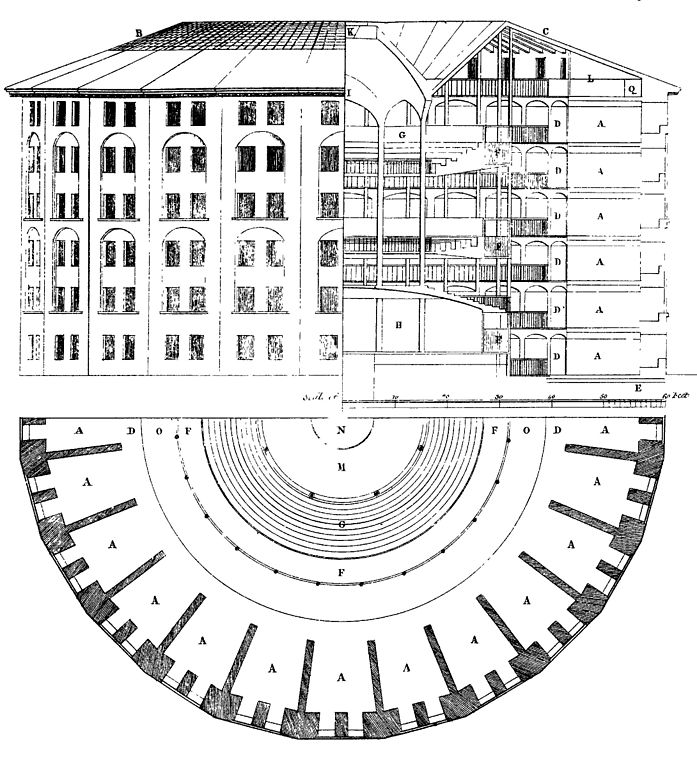
An illustration of Jeremy Bentham’s Panopticon prison.
Drawing by Willey Reveley, 1791.
During a trip to Russia in 1785, the philosopher Jeremy Bentham sketched an outline for a new prison design. The cells were arranged around the circular perimeter and, at the centre, he placed his “panopticon”: a watchtower which afforded a view of any of the cells at all times. The prisoners might not always be being observed, but they could never be sure that they weren’t.
Bentham’s design was never directly used, but the idea took hold as a symbol of state overreach and control, most famously in Michel Foucault’s Discipline and Punish (1975). Foucault was alert to the political ramifications of such a concept, and how surveillance might become an internalised experience. With Keir Starmer now pledging to introduce a digital ID system as a mandatory condition for the right to work, are we seeing the first step towards the realisation of Bentham’s vision?
I suppose we are already there. I have seen friends switch off their phones before discussing politically sensitive issues, genuinely convinced that digital eavesdropping is the norm. Many people are mistrustful of the “Alexa” voice assistant, which they are persuaded is recording their every word. While this all seems terribly conspiratorial, I’m sure most of us remember those reports a few years ago about the Pegasus spyware which had been covertly installed on the phones of journalists and government figures, turning the devices into pocket spies.
[…]
Few will be surprised to hear that public trust in political institutions has plummeted. The increasingly authoritarian tendencies of successive governments, our two-tier policing system, public manipulation as embodied in the “nudge unit”, and the corrupt prioritisation of the interests of the political class over the people they serve – perhaps best demonstrated by parliament’s flagrant efforts to overturn the Brexit vote – have all contributed to this climate of mistrust. The bizarre overreach of police during the lockdowns – in which dog walkers were publicly shamed with drone footage, and shopping trolleys were probed for “non-essential items” – has hardly helped matters.
To many of us, it is baffling that anyone at all would support the prospect of the government keeping track of our movements and holding our private details in a database. Starmer claims that the scheme will curb illegal immigration, but we are talking about criminals who already work outside the system and will doubtless continue to do so. Besides, identity cards have been a reality on the continent for years, and have done precisely nothing to resolve the problem. Employers in the UK are already legally obliged to insist on proof of immigration status from workers.
Labour’s digital ID scheme seems more about control than anything else. The possibility of fraud is also a major concern. It’s not as though the government has an unblemished track record of preventing data breaches. We all recall the massive leak of official MOD data regarding Afghans who had worked with the British government during the UK’s military campaigns. And who could forget the senior civil servant who, in 2008, left top-secret documents concerning al-Qaeda and Iraq’s security forces on a train from London Waterloo? Are we really to suppose that the creation of an all-encompassing centralised database will not leave the public open to risk from hackers and hostile foreign powers?
Tim Worstall adds that “they c’n fuck off ‘n’ all”:

So we’ve that wet dream of Tony Blair raising its ugly head again. There should be a national ID system. Actually, it’s not just Blair, T — the bureaucracy has been right pissed at the erasure of the wartime system since the 50s when it was abolished.
For there are two ways of looking at, thinking about, the whole governance thing. One is — the Blair, bureaucrats’, version — that the population are cattle, kine, to be managed. For the benefit of the bureaucracy of course — or at very least to be forced into doing what the bureaucracy thinks they — we — should be doing.
Then there’s that stout Englishman, the Anglo Saxon, version, which is that government are just the slaves we communally hire to make sure the bins get emptied. Well, OK, maybe raise a bit of tax for a Royal Navy to sink the Frenchies. But even then, not too much of that — the Civil War was, after all, triggered by Ship Money. Did the people who would not be slaughtered by the first wave of invading Frenchies — because they had the silly excuse of living 25 miles inland — have to pay the tax to run the Royal Navy to keep the Frenchies at bay or not? The King said yes — the King was right — and not for the first nor last time in British political history the guy who was right had his head cut off for being so.
Digital ID, so which version should we have? That one beloved of Froggie-type bureaucrats who view La Profonde as kine to be corralled? Or the Anglo Saxon version where we just devolve the scut work to a few slaves?
[…]
The reason this never will be proposed is that it doesn’t fit the reasons why our rulers wish to have an ID system. They’re insistent that we be their kine rather than they our. So, the Hell w’ ’em.
But it could be done. Government simply publishes an interface — an API — which says that proof of identity needs to be presented in this format. We’re done as far as whose kine is whose.
Update 4 October: From Samizdata, another illustration of just how toxic Two Tier Keir has become to British voters:
The Guardian reports:
“Reverse Midas touch”: Starmer plan prompts collapse in support for digital IDs
Public support for digital IDs has collapsed after Keir Starmer announced plans for their introduction, in what has been described as a symptom of the prime minister’s “reverse Midas touch”.
Net support for digital ID cards fell from 35% in the early summer to -14% at the weekend after Starmer’s announcement, according to polling by More in Common.
The findings suggest that the proposal has suffered considerably from its association with an unpopular government. In June, 53% of voters surveyed said they were in favour of digital ID cards for all Britons, while 19% were opposed.
October 2, 2025
How “Roman” is Times New Roman?
toldinstone
Published 24 May 2025Today’s video explores the long history of “Roman” fonts.
Chapters
0:00 Introduction
0:42 The Latin Alphabet
1:53 Rustic capitals
2:21 Uncial
2:50 Carolingian miniscule
3:32 Gothic
4:24 The Book
5:26 The first fonts
6:05 Littera Antiqua
6:46 Aldus Manutius and his successors
7:40 Times New Roman
8:07 How Roman?
October 1, 2025
The Battle of Actium – We can at least agree ships were involved!
Drachinifel
Published 12 Oct 2022Today we take a look at the battle that decided if Rome was to be a Republic or an Empire, and also examine why its incredibly hard to work out just exactly what happened between the start and the end!
Sources:
https://www.amazon.co.uk/Battle-Actiu…
https://www.amazon.co.uk/Actium-31-BC…
https://www.amazon.co.uk/War-That-Mad…
https://www.amazon.co.uk/Roman-Histor…
http://eprints.nottingham.ac.uk/10452/
(more…)
QotD: The Indian Mutiny of 1857
This is a near-perfect synecdoche for the Raj’s problems. British Army officers weren’t stupid — lots of them commented on the issue. But they were isolated. For one thing, lots of them weren’t regular army — they were attached to the East India Company army, a separate formation, and within the Company’s army were different formations with different service requirements. And the army — whichever army — was deeply isolated from the civilian administration. For one thing, India’s huge, and there were never more than about 200,000 British in the whole place. The army was mostly on the frontier; the Government hung around primarily in a few big cities: Bombay, Calcutta, the summer capital at Simla (way up in the Himalayas).
So stop me if this sounds familiar: The civilian administration didn’t really know anything about the group upon which their peace, their security, their very lives depended. Actively despised them, in fact — oh, those wogs and their silly customs. But also look at it from the bottom up: What could the civilian administration really have done, with the best will and deepest knowledge in the world? […]
What could the leadership really have done at that point? Send a select group of brahmins and imams to tour the grease factory? The rumor would be that the British set up a Potemkin factory just for them; the real factory was using cow and pig fat. Reissue the old rifle? Recall that they already changed their drill — a pretty big deal in any army; a huge deal in a mid-19th century one — and that just added to the paranoia. Anyone who has ever been on the Internet knows how these things work once they get started: Evidence of an evil conspiracy is evidence of an evil conspiracy, but no evidence of an evil conspiracy is even more evidence of an evil conspiracy!
The root cause of the Mutiny, in other words, wasn’t political or economic (despite what Karl Marx said). It wasn’t even “cultural” in a lot of senses, and you can tell by the actions of the mutineers — or, rather, the non-actions. They simply had no idea what to do. They had no leadership (though some of them tried to install one of the remaining Mughal rulers in Delhi as an expedient; there’s a great book about it). The “Mutiny” was really just generalized beefing and score-settling on a continent-wide scale. They all had grief with the British, of course, and that was a convenient rallying cry. Once the British were gone — and see above, there were never very many of them — the guys down south quickly realized they had nothing in common with the guys up north. Ditto the guys on the east coast, the west coast, the hill country, the jungles …
Again, stop me if this sounds familiar: Stuffing a bunch of alien groups together inside artificial boundaries under a capricious, purposefully out-of-touch “government” that obviously hates every single one of those alien groups more than each one of the groups hates all the others, is kind of a bad idea. With the exception, of course, of that capricious government’s goon squad, the one group they obviously favor because that group can be counted on to knock heads on all the other groups whenever the government lets them off the chain (I’m talking about the Sikhs, obviously).
It doesn’t matter, in other words, what the rifle cartridges were greased with, or if they were greased at all. In this historical timeline, the precipitating cause of the Sepoy Rebellion was “the Enfield Rifle”. In the next timeline over, it’s something else — something equally minor — but the rebellion still happens, at pretty much the same time and in pretty much the same way.
In other words: It’s not that the British were alien to their subjects. Most groups in most places have been ruled by aliens, and trust me, the brahmin caste is far, far more alien to the castes below it than the British were to all of them combined. Nor was it that the British were high-handed administrators, as incompetent as they were arrogant. They were actually pretty good administrators, all things considered — “government competence” is always one of life’s lower bars, but the Raj cleared it easily. The guys running the “princely states” that made up the majority of the “British” Raj were every bit as alien to “their” people as the British, and in general spectacularly incompetent too.
Severian, “The Ruling Caste”, Founding Questions, 2022-03-09.
September 30, 2025
How Tyrants Rise — and How to Stop Them – W2W 46
TimeGhost History
Published 28 Sept 2025Tyrants don’t just appear overnight — they rise through propaganda, fear, and control. In this episode of War 2 War, we explore how authoritarian leaders consolidated power in the 20th century, from the ruins of World War Two to the opening battles of the Cold War. How do tyrants gain control, how can you recognize the warning signs, and what can societies do to resist them? Drawing on lessons from Hitler, Stalin, and beyond, we break down the patterns of dictatorship and what history can teach us about confronting them.
(more…)
Stamm-Saurer Model 1913 Long-Recoil Prototype Rifle
Forgotten Weapons
Published 21 May 2025Hans Stamm developed a series of firearms in Switzerland in the early 1900s, and today we are looking at a second-pattern Model 1913 semiauto rifle. This was developed while Stamm was working for the Saurer company, where he headed its small arms division. Stamm’s Model 1907 straight pull rifle failed to win military adoption, and so in 1910 he began working on a quite complex long recoil system. The first prototype was finished in 1912, and by 1913 another seven examples were made.
These are sent to the Swiss and Belgian militaries for consideration, but neither are interested — and the outbreak of World War One ends possibilities for other adoption.
Previous Stamm designs:
1902 Gas-Operated Semiauto: • Stamm-Zeller 1902: A Swiss Straight-P…
1907 Straight-Pull: • Stamm-Saurer Model 1907: A New Swiss …Many thanks to the Swiss Shooting Museum in Bern for giving me access to these two very rare rifles to film for you! The museum is free to the public, and definitely worth visiting if you are in Bern — although it is closed for renovation until autumn 2025:
https://www.schuetzenmuseum.ch/en/
(more…)
September 29, 2025
Powderkeg Britain
The ever-expanding anti-immigration protests in Britain are an unmissable flashing red alert to the British government … which seems determined to ignore it and continue to plough ahead with their MOAR immigrants policies despite the anger of the public. Spaceman Spiff characterizes it as a revolt:

Multi-ethnic and multicultural societies do not function in the way homogenous nations do. People of radically different origins, culture and beliefs often trigger conflict as incompatible aptitudes, temperaments and worldviews operate within a shared territory.
Artificial situations like this do not naturally harmonize, despite the rhetoric. Instead, competition for resources emerges. Power sharing between rival groups is fantasy. Life is winner takes all.
This can be disconcerting as reality asserts itself and the cost of large-scale migration becomes obvious.
Some in Britain already understand the dangers we now face at home. Others are waking up and looking for answers as their world declines. They are the ones who will grasp at anything to reset society.
Racists and hatemongers
Critics of mass immigration in Britain are often branded as racists and hatemongers.
We see blanket condemnation from establishment figures for even mild observations about the effects of this deeply unpopular policy.
The noticers of reality are derided as far-right extremists even when they are evidently normal people exhausted with unwanted demographic change.
The approved media and political spokespersons insist those who make observations have become radicalized by extremist writers and thinkers. Little more needs to be added. The labels do much of the work; Nazi, fascist, racist.
It doesn’t matter that many who are critical of mass immigration are not extremists calling for violence. They are just normal people who notice what is happening.
One of the unfortunate things the noticers recognize is mixing distinct cultures inside a single geographical area might be dangerous. They sometimes read material based on government statistics that tells them mass immigration infers almost no benefits on the host nation while extracting potentially catastrophic costs.
To ordinary people that sounds like something worth discussing to determine if it is true.
Normal people are revolting
Western countries have endured unexpected demographic shifts in recent years.
The only acceptable view is this is always a net positive. We are told group differences do not exist except in the minds of racists. Foreigners are already very like us and any deviation from our norms are superficial or unworthy of comment.
It is therefore all the more shocking when this is proven wrong. From dress and manners to dietary habits, to the treatment of women and children, the world beyond our borders is quite alien when seen up close.
London’s vibrantly diverse bus riders
All this alienness was once elsewhere with oceans to protect us. Now it is here in our midst.
This is becoming obvious and is at odds with all we have been told. What we see does not match the harmonious melting pot we were sold.
Inevitably this encourages people to seek out information.

Bomber Command 1943 – Reap What You Sow – The Bomber War Episode 6.
HardThrasher
Published 26 Sep 2025Part 1 of a 2 Part Series covering Bomber Command in 1943 — this is the background and build up, the aircraft, the founding of pathfidner force and the mechanics behind the mass use of incendiaries
References from the video below
i Battle of the Beams, Tom Whipple, Penguin, 2003, p.209
ii The Battle of the Beams, Whipple, Penguin, 2003, p.213
iii The Bombing War, Overy, Penguin, 2012, p.345
iv The Pathfinders, Will Iredale, Penguin, 2021, p.116 and on
v The Bombing War, Overy, Penguin, 2012, p.238
vi See Caliban Rising’s excellent video on statistical deaths for Bomber Command
vii B12/36, The British Aircraft Specifications File, Meekcoms & Morgan, Air-Britain, 1994, p.228
viii The Bombing War, Overy, Penguin, 2012, p.290-91
ix The Pathfinders, Will Iredale, Penguin, 2021 p.74
x Proceedings of the Royal Air Force Historical Society, Issue No 6, Sept 1989, p.22
xi The Pathfinders, Iredale, Penguin, 2021, p.75
xii The Pathfinders, Iredale, Penguin, 2021, 2021 p.79
xiii https://en.wikipedia.org/wiki/Wilfrid… – yes, yes I know, a Wiki reference.
xiv Interview 1977 for the RAF Centre for Air Power Studies (CASPS) – • RAF CASPS Historic Interview | Group Capta…
xv Pathfinder, Goodall, 1988 pp. 102, 158, 205email – hardthrasher@gmail.com
Merch – https://hardthrasher-shop.fourthwall.com
Patreon – patreon.com/LordHardThrasher
The Galactic Empire and a (Revised) Generic Model of “Fascism”
Feral Historian
Published 29 Sept 2023While we can classify significantly different regimes as “communist” based on their key similarities, we don’t have the same taxonomy for “fascism” as a political category. The term is either used so broadly it becomes meaningless, or defined so narrowly that it’s only relevant to Mussolini’s Italian Fascism.
But we can identify three key factors that, when all are present together, result in a system we can define as “fascist” in a sense that’s both historically based and general enough to be useful for analysis. In addition to laying out a simple model defining fascism, this video also dives into some history of Fascism and National Socialism, mixed with the kind of sci-fi analysis you’ve come to expect here.
00:00 Intro
00:35 Palp, Dolf, and Communists
04:05 Old Republic vs Weimar Republic
04:55 Party and State
08:57 Three-Point “Fascist Minimum”
09:24 “Third Way” Economics
15:12 Totalitarianism
19:19 Unifying Myth
22:53 Umberto Eco
24:46 Franco
26:25 Closing Miscellany🔹 Patreon | patreon.com/FeralHistorian
🔹 Ko-Fi | ko-fi.com/feralhistorian
September 28, 2025
North Africa Episode 1: Hitler’s Hand Forced
World War Two
Published 27 Sept 2025As Italy’s war effort collapses across Greece and North Africa, Hitler is forced to intervene. This episode explains why German troops are sent to Africa in early 1941 and sets the stage for Rommel’s arrival and the birth of the Desert War. The North African campaign begins not with a plan — but with a crisis.
(more…)
S-Boats – Guide 438
Drachinifel
Published 3 May 2025The S-Boats, fast attack craft of the Kriegsmarine, are today’s subject.
(more…)
QotD: Pre-modern armies on friendly territory
But first, we need to talk about the lay of the land. As we’ve discussed, the pre-industrial countryside is not just a uniform blanket of farms; instead settlements are “nucleated” – farms cluster in villages and villages “orbit” (in a sense) towns (which may “orbit” yet larger towns), which usually administer those villages. The road and path system that the locals themselves have created will in turn connect fields to village centers, one village to the next and all of the villages to the town. This makes everything easier on our army which is also using those roads and paths to move – even if the paths are rudimentary, without modern location-finding data, armies use paths and settlements to know where they are. The main body of the army, with its large train of wagons, supplies and troops is going to generally move along major roads (which typically connect towns with other towns) but smaller detachments can move along the pathways between smaller settlements. That means what we have access to is not a vast field of possible maneuver but a spider’s web of pathways which meet and cross at settlements.
Moving through this pathway network, in friendly territory the army can lean on the likely compliance of the local population and the local administrative apparatus, which makes everything easier. Moreover, with control of the area, the army can send out messengers and riders who move faster than the army on its direction of march, making arrangements in advance for what the army needs, drawing supplies from the populace and (maybe) making arrangements to pay them either at the time or in the future. Doing so in hostile territory is much trickier as those messengers would be vulnerable and might reveal the army’s location and direction of march, things it might really rather want to conceal. So assuming the populace and local administration are “friendly”, how do we manage the complexity of getting the food and other supplies they have into the hands of the army?
The simplest method was some form of “billeting”, in use in various forms through antiquity to the early modern, though it seems particularly prominent in the Middle Ages and the first two centuries of the early modern period. Clifford Rogers (Soldiers’ Lives through History: The Middle Ages (2007), 76-78) provides a good “standard practices” overview of the process for a medieval European army. Once drawn up the army was organized into smaller units (often called “banners” because they marched behind a banner); we’ll come back to this again when we talk about marching speeds but it also matters here. Each banner would assign one of its horsemen as a “harbinger” who would ride ahead of the army (supervised by the king or commander’s marshals), ideally a full day ahead. These harbingers (because there might be quite a few of these fellows) also acted as a limited cavalry screen. They would both designate where the army would camp next (with the marshals marking out specific encampments) and make arrangements for food and housing.
In practice “arrangements” here meant frequently that the soldiers, when they arrived the following day were quartered in the homes of the local civilians, often densely packed into small towns or farming villages. If they had the means the locals might try to provide the army a market to buy food and supplies; more often the locals who had soldiers quartered on them were often expected to feed and resupply those soldiers. Notionally this was often supposed the be compensated and notionally kings issued dire warnings against soldiers taking more than they were allowed or abusing the locals. Rogers (op. cit.) is, I think, unusually sanguine in assuming these repeated regulations meant the knights and soldiers were often restrained; in an early modern or Roman context we tend to view the same sort of repeated promulgation of the same laws to mean that abuses were common despite repeated efforts by the central government to stamp them out. In practice reimbursements seem to have often been at best incomplete, where they happened at all and abuses were common.
Certainly as we see these practices more clearly in the early modern period, having soldiers quartered on your village could be economically devastating (see Parker, op. cit. 79-81); having to feed a half-dozen soldiers for a few days plus marching provisions could easily tip a small peasant household into shortage. And we should also be pretty clear-eyed here about what it would mean for a local population to have a large body of armed men (many in the hot-headed years of their youth) functionally turned loose on an unarmed civilian population and told that they could demand to be given whatever they needed; far more disciplined and better controlled armies still left a trail of theft and rape behind them as they moved. Nevertheless, this solution was simple and so for armies with very limited administrative capacity and rulers anxious to shift the burden of military activity away from their own coffers, billeting remained an attractive solution. It was still common enough in the 1700s to have been a major complaint by British colonists in North America, the bulk of whom upon achieving their independence promptly wrote an amendment in their constitution effectively banning the practice (the third amendment for the curious).
A better option for a town or city was instead to establish a market outside the town and arrange for the army to resupply and camp there and not in the town itself, with only small groups of soldiers permitted inside the walls at any given time. Needless to say, it is typically only fortified towns that really have the bargaining power to pull this off. The provision of a market for the gathering mass of crusaders outside of Constantinople in 1097 was a key diplomatic sticking point, with Alexios Komnenos I (the Byzantine Emperor) using his control over both the market and passage over the straits to Asia Minor as bargaining chips to get concessions out of the Crusaders. Likewise towns in Roman provinces seem to have fairly regularly paid exorbitant sums to avoid having armies quartered on them, as Cicero documents in his time in Cilicia (e.g. Cic. Ad Att. 5.21), sometimes in cash and other times in kind (e.g. Plut. Luc. 29.8). It speaks to how destructive billeted soldiers could be that towns that could went to extraordinary lengths to keep even friendly armies outside of the town walls.
Armies might also rely on local contractors to provide supplies, especially if they were going to operate in the region at some length. We’ve already mentioned the Army of Flanders’ pan de munición, provided by contractors. There’s also some evidence for the use of private contractors in supporting Roman armies, though the trend in current scholarship (particularly Erdkamp but also Roth op. cit.) has tended to stress the limited and often marginal role of such contractors. Given the evidence I think Erdkamp has it right here; contractors for supplies existed in the Roman world, but were fairly small supplements to a system (detailed below) that mostly ran on taxation and requisition; most of what we see in the Roman world are just normal sutlers selling luxury foods to soldiers who want to spice up their rations.
As armies grow larger and more complex in the early modern period, we see an effort to move away from destructive “billeting”, often hindered by the weak administrative apparatus of the state and limited financial resources; armies won’t move into permanent barracks on the regular in Europe until the early 1700s. One solution was to take those market towns and their lodgings and turn them from an ad hoc response to a permanent network, as Spain did along the “Spanish Road”, a network of routes taken by Spanish troops traveling overland from the Mediterranean coast in Savoy to the Low Countries during the Eighty Years War.
The way this worked was: To avoid having their reinforcements pillage their way across their own lands or alienate key friends on the way to the Eighty Years War (1568-1648) in the Low Countries, the Spanish government established a standard system for the supply of troops en route – key market towns were designated as étapes or “staples”, standard stop-over and stockpile points. These tended to be key trade towns on the roads (indeed as I understand it étape in this sense originally meant “market town”) which already had some of the infrastructure required. These étapes would then be directed in advance of a movement of troops to stockpile provisions and prepare lodgings for a specific number of advancing soldiers and paid (in theory) in advance. Householders who incurred costs (typically lodgings, sometimes food) could present receipts (billets de logement) to their local tax collector which would count against future liability.
Yet the system here is incomplete and it is striking that when given the opportunity of setting up étapes in Spain itself the crown declined, citing the cost and administrative burden of organization. The greater diplomatic difficulties and consequent stronger bargaining position of communities on the Spanish Road may have a lot to do with the different decisions. The real impetus for the structure of the étapes on the Spanish road was diplomatic: the route was a patchwork, with some territories controlled by the Spanish crown, some by the friendly German Habsburgs and others by the various small statelets of the Holy Roman Empire, any of whom if sufficiently offended might refuse Spanish reinforcements transit (the Holy Roman Emperor could shut the whole route down himself). Consequently the disruption that Spanish troops caused on the route had to be limited for the route to be sustainable at all.
States with a bit more administrative capacity, on the other hand, generally tried to avoid billeting at all, even in regularized form. We’ll see this again when talking about army movement, but control is a key concern in campaigns. Soldiers, after all, are not automatons and so keeping an army together and moving towards a single objective is difficult. Soldiers get bored, wander off, decide to steal or break things (or people) and so on. It is easier to keep an eye on soldiers if they are all in a central camp or barracks and keeping an eye on everyone in turn makes it a lot easier to ensure that everyone shows up promptly to muster in the morning with the minimum of hassle. So if a general can, he really would want to keep everyone out of towns and villages and in a regular marching camp. Doing so demands yet more discipline because of course the soldiers would rather sleep in houses than in tents, but it has substantial advantages.
But an army that can lean on the local administrative capacity can simply demand that local administrative apparatus, whatever its form, coordinate the collection and transport of supplies (over short distances) to the army, enabling the army to camp out in a field and get its grain DoorDashed to it. Thus the Romans, when in friendly territory, for instance first identify the local government – usually a town but it could also be a tribal government in non-state regions – and then requisition food from that government, transmitting their demands in advance and letting that local administration figure out the details of getting the required food to the required place. That lets Roman armies camp in their fortified camps away from civilian centers, with attendant advantages for discipline; and indeed, Roman armies typically avoid permanent or even temporary bases in towns, instead using the threat of billeting to get the supplies they needed to stay in regular camps and later permanent forts.
While the elites who run these local systems of government could provide such requisitions themselves (and might in extremis to avoid retaliation by their superiors; the Romans interpret failure to provide requested supplies as “rebellion” and respond accordingly), in practice they’re going to pass along as much of the costs as they can to the little guy. In some cases, requisition demands are so intense we hear of towns having to buy or import grain to meet the demands of passing armies; Athens had to do this in 171 during the Third Macedonian War to avoid the wrath of Rome (Liv. 43.6.1-4). Caesar likewise relied heavily on food supplies contributed by either allied or recently defeated communities in Gaul (Caesar, BG 1.16, 1.23, 1.40, 1.37, 2.3, 3.7, 5.20, 6.44; he does this a lot) to supplement regular foraging operations. Those sources of supply in turn influence his campaigning, as Caesar is forced to move where the grain is in order to resupply (e.g. Caes. BG 1.23). And I want to be clear even these systems of requisition could mean real hardship on a population as a large army could easily eat all of the surplus grain in a province and then some.
The exact structure of that requisition could vary; in some cases it was a extraordinary tax (which is to say, it was just seized), but in many cases it was organized as a forced sale (often at below market prices) or even rebated against future tax obligations. In the Roman Empire we know that in many provinces, initially ad hoc systems of food requisition from conquered or “allied” (read: subordinated) communities were first regularized so that the demands were set at a steady amount, then monetized as military operations moved further away, until eventually being formalized as a taxation system. Thus the primary Roman tax system of the imperial period grew not out of the tax system the Romans had in Italy (which was mostly dismantled in the second century as the tremendous wealth of the provinces made it unnecessary) but as a regularization of systems of requisition and extortion meant to support armies. The Romans also took advantage of the Mediterranean (where naval transport could break the tyranny of the wagon equation) to ship food from one theater to another (so long as operations were fairly close to coastal ports); this was in the Republic coordinated by the Senate which could direct Roman officials (typically governors of some sort) or non-Italian allies in one region to obtain supplies by whatever means and send them another active military theater (Plb. 1.52.5-8, Liv. 25.15.4-5, 27.3.9, 31.19.2-4, 32.27.2, 36.3-4), in some cases even establishing transit depots which could support operations in a large naval theater (e.g. Chios, Liv. 37.27.1). In particular, grain taxed in Sicily was frequently redirected to support Roman military operations across the Mediterranean.
All of this of course assumes that the army enjoys either the use of the local administrative system or the compliance of the local population. But of course in enemy territory – which is where your army wants to go – you cannot rely on that.
Bret Devereaux, “Collections: Logistics, How Did They Do It, Part II: Foraging”, A Collection of Unmitigated Pedantry, 2022-07-29.
September 27, 2025
NATO – the alliance of paper tigers?
In UnHerd, Edward Luttwak suggests that despite President Trump calling the Russians “paper tigers”, the non-US members of the NATO alliance could more appropriately be described that way:
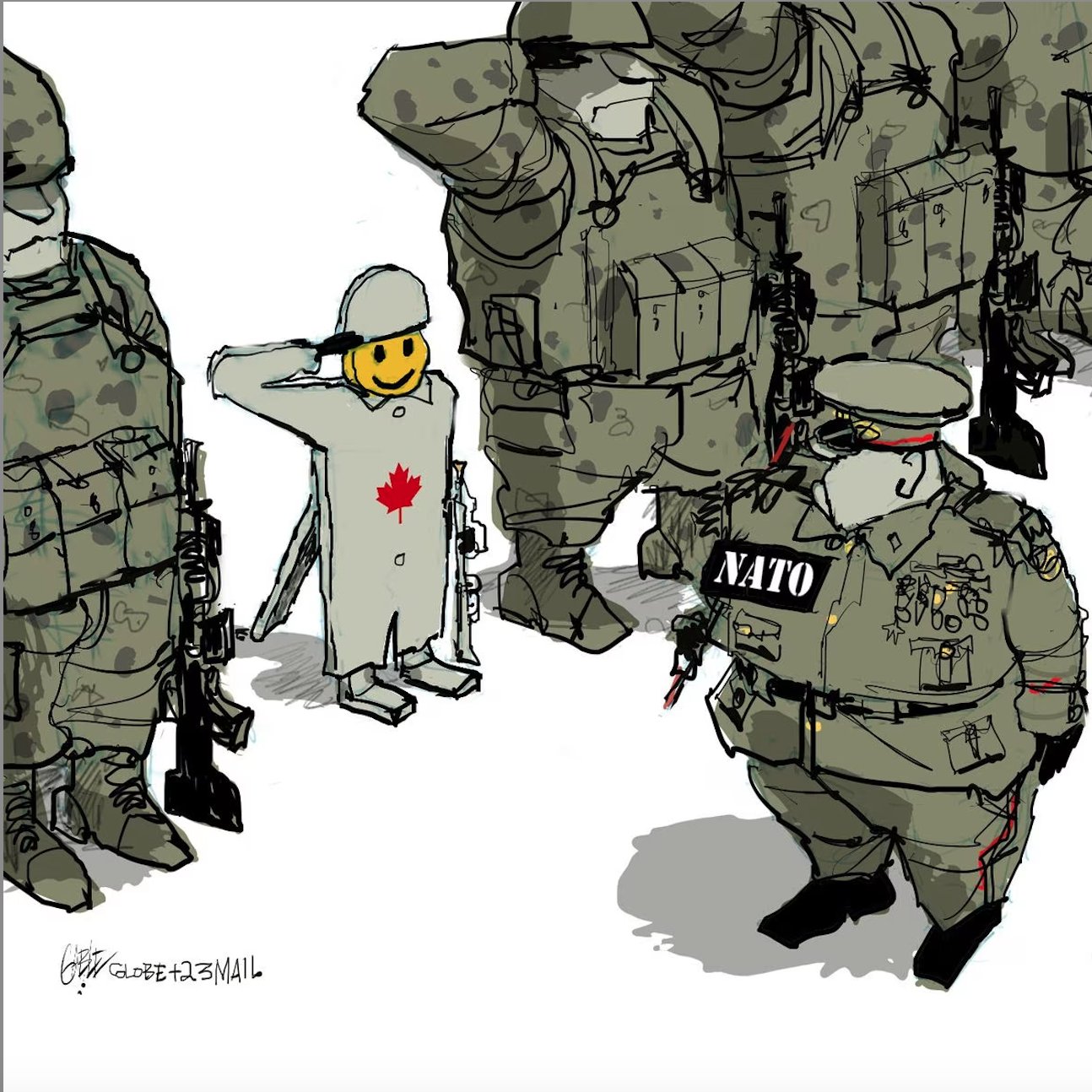
It’s been an open secret for decades that Canada’s NATO contributions are more rhetoric than reality, but it’s true of many of the European NATO allies, too.
… simply raising defence spending will not turn Europe’s states into genuinely effective military powers. For one thing, the GDP criterion is much too vague to mean much. Finland, for instance, spends only 2.4% of its GDP on defence and yet can mobilise some 250,000 determined soldiers. Other Nato members, which spend much more than the Finns, obtain far less for their money.
Moreover, focusing on GDP instead of force requirements — so many battalions, artillery regiments, fighter squadrons — is nothing but an invitation to cheat, an opportunity lustily taken up across the continent. The latest Spanish submarine, for instance, is not imported for €1 billion or so from Thyssen-Krupp, which supplies navies around the world with competent, well-proven submarines. Instead, it was proudly designed and built at the Navantia state-owned Spanish shipyard: for €3.8 billion, roughly the cost of a much bigger French nuclear-powered submarine. As a feeble justification for that absurdly high cost, Spain’s defence minister cited a supposedly advanced air-recirculation system — so greatly advanced, in fact, that it is not actually ready, and will not be installed even in the submarine’s next iteration.
Soon, though, Italy will outdo Spain’s platinum submarine: by including a new bridge to Sicily, set to cost some €13.5 billion, into its 2% of GDP Nato spending quota. The government’s excuse is that some 3,000 Italian troops may need to cross the Strait of Messina were the Italian army ever to be fully mobilised. But it would be much cheaper to fly them individually, each trooper in his own luxurious private jet. Even without the bridge, meanwhile, Italy’s cheating on the 2% target is bad enough. Most notably, much of the Italian Navy’s spending goes towards warships made by Italy’s state-owned Fincantieri shipyard. But there is not enough money for the fuel and maintenance expenses to operate more than half of them, meaning another industrial subsidy is camouflaged as defence spending. All the while, Italy refuses to increase its defence budget beyond the very modest target of 2% — which it has yet to meet.
As for Germany, three and half years since the start of the Ukraine war, with ever more ambitious rearmament plans loudly promised, the total number of personnel in uniform has actually slightly decreased. And, aside from beginning a multi-billion euro purchase on an Israeli missile-defence system, nothing much has happened. Despite its high demand in Ukraine, even the battle tank, that German specialty, is being produced in very, very small numbers: so low that the annual output could be lost in a morning of combat. In May 2023, indeed, a meagre 18 Leopard tanks were ordered to replace older models lost in Ukraine. The expected delivery date? Between 2025 and 2026! Then, in July, Germany purchased a further 105 advanced Leopard 2A8s. That is the number needed to equip a single brigade, the German force stationed in Lithuania — and they are expected to arrive in 2030!
The sad truth, then, is that Germany has yet to start working in earnest to correct the extreme neglect inflicted on its armed forces during the long Merkel premiership, when she kept saying that “even if we had the money we would not know how to spend it”. All the while, German helicopters lacked rotors and tanks lacked engines. The exceedingly slow recovery of the German army is especially frustrating because Nato is not actually short of air or naval forces. What it lacks are ground forces, soldiers more simply, or rather soldiers actually willing to fight. Having added Estonia, Latvia and Lithuania to the alliance, tiny countries with outsized defence needs, the alliance faces a severe troop deficit across the entire Baltic sector. The troops so far sent by Nato allies, such as visiting Alpini battalions from Italy, cannot improve the maths.
Update, 30 September: Welcome, Instapundit readers! Please do have a look around at some of my other posts you may find of interest. I send out a daily summary of posts here through my Substack – https://substack.com/@nicholasrusson that you can subscribe to if you’d like to be informed of new posts in the future.


