World War Two
Published 22 Mar 2025Today Indy and Sparty answer your questions about the Italian invasion of Greece, Hitler and Mussolini’s relationship and the different types of fascism!
(more…)
March 24, 2025
How Greece Humiliated Mussolini’s Army – WW2 Fireside Chat
The Concorde of the English Channel – Hoverspeed
Ruairidh MacVeigh
Published 23 Nov 2024Hello all! 😀
In something a little different from cars, trains and planes, we take a look at what has often been considered the Concorde moment for cross-channel ferry operations, the introduction of routine hovercraft services between Britain and France by the Hoverlloyd and Seaspeed companies, and later the Hoverspeed firm following their merger.
Hoverspeed was a truly exceptional mixture of speed and technological prowess, skirting across the surface of the English Channel and reducing journey times to but a fraction of what they were aboard regular ferry boats, but due to increasing costs, a fragile business case, and the arrival of the Channel Tunnel, Hoverspeed, much like Concorde, is now but a fading memory of a bygone era for international travel.
Chapters:
0:00 – Preamble
0:44 – Rise of the Hovercraft
3:04 – Tapping an Untapped Market
7:15 – Into Service
10:33 – Heyday of the Hovercraft
13:05 – Fragile Foundations
17:21 – Coming to the End
21:55 – Conclusion
(more…)
March 23, 2025
Rigged Votes and Terror: Stalin’s Takeover Tactics! – W2W 014 – 1947 Q2
TimeGhost History
Published 21 Mar 2025By 1947, Stalin’s Soviet Union has begun to firmly grip Eastern Europe, reshaping nations through rigged elections, terror tactics, and propaganda. From Poland to Bulgaria, countries are forced into Moscow’s orbit, crushing opposition and extinguishing democratic freedoms. As Truman declares a doctrine to contain communism, the stage is set for decades of Cold War confrontation.
(more…)
How To Invade France
HardThrasher
Published 2 Feb 2023For more than 1,000 years British people have studied how to invade France, here then are the fruits of that wisdom.
1. Be German
2. Head for Sedan
March 22, 2025
How One Movie Drove Hitler’s Men Crazy – Rise of Hitler 12, December 1930
World War Two
Published 20 Mar 2025December 1930 plunges Germany deeper into chaos. Nazis and Communists join forces against Chancellor Brüning’s emergency decrees, while a shocking court decision boosts Hitler’s power. Violent riots erupt over the film All Quiet on the Western Front, and police uncover a terrifying communist bomb plot aimed at sparking civil war. With extremism rising, is Weimar democracy heading for disaster?
(more…)
March 21, 2025
The Shocking Dress That Sparked Global Outrage! – W2W 13 – 1947 Q3
TimeGhost History
Published 19 Mar 2025In 1947, Christian Dior stunned the world by introducing his controversial “New Look”. With luxurious dresses and ultra-feminine silhouettes, Dior’s designs ignited fierce debates about gender roles, societal values, and post-war extravagance. While some saw his collection as a welcome return to elegance, others viewed it as an insult during times of austerity. Was Dior celebrating beauty or setting women’s progress back decades?
(more…)
QotD: Gordon Brown and the “Gillian Duffy affair”
The Gillian Duffy affair, the start of this People’s Decade, was fascinating on many levels. Fundamentally, it revealed the schism in values and language that separated the elites from ordinary people. To the professional middle classes who by that point — after 13 years of New Labour government — had conquered the Labour Party, people like Mrs Duffy were virtually an alien species, and places like Rochdale were almost another planet. Indeed, one small but striking thing that happened in the Duffy / Brown fallout was a correction published in the Guardian. One of that newspaper’s initial reports on the Duffy affair had said that Rochdale was “a few hundred miles” from London. Readers wrote in to point out that it is only 170 miles from London. To the chattering classes, it was clear that Rochdale was as faraway and as foreign as Italy or Germany. More so, in fact.
The linguistic chasm between Duffy and Brown spoke volumes about Labour’s turn away from its traditional working-class base. Yes, there was the word “bigot”, but, strikingly, that wasn’t the word that most offended Mrs Duffy. No, she was most horrified by Brown’s description of her as “that woman”. “The thing that upset me was the way he said ‘that woman'”, she said. “I come from the north and when you say ‘that woman’, it’s really not very nice. Why couldn’t he have just said ‘that lady’?”
One reason Brown probably didn’t say “lady” is because in the starched, aloof, technocratic world New Labour inhabited, and helped to create, the word “lady” had all but been banned as archaic and offensive in the early 2000s. Since the millennium, various public-sector bodies had made moves to prevent people from saying lady to refer to a woman. One college advised against using the word lady, as it is “no longer appropriate in the new century”. An NHS Trust instructed its workers that “lady” is “not universally accepted” and should thus be avoided. In saying “that woman”, Brown was unquestionably being dismissive — “that piece of trash” is what he really meant — but he was also speaking in the clipped, watchful, PC tones of an elite that might have only been 170 miles from Rochdale (take note, Guardian) but which was in another world entirely in terms of values, outlook, culture and language.
“I’m not ‘that woman'”, said Duffy, and in many ways this became the rebellious cry of the People’s Decade. She was pushing back against the elite’s denigration of her. Against its denigration of her identity (as a lady), of her right to express herself publicly (“it’s just ridiculous”, as Brown said of that very public encounter), and most importantly of her concerns, in particular on the issue of immigration and its relationship to the welfare state.
The Brown-Duffy stand-off at the start of the People’s Decade exposed the colossal clash of values that existed between the new political oligarchy represented by Brown, Blair and other New Labour / New Conservative machine politicians and the working-class heartlands of the country. To Duffy and millions of other people, the relationship between welfare and nationhood was of critical importance. That is fundamentally what she collared Brown about. There are “too many people now who are not vulnerable but they can claim [welfare]”, she said, before asking about immigration. Her suggestion, her focus on the issue of health, education and welfare and the question of who has access to these things and why, was a statement about citizenship, and about the role of welfare as a benefit of citizenship. But to Brown, as to virtually the entire political class, it was just bigotry. Concern about community, nationhood and the impact of immigration is just xenophobic Little Englandism in the minds of the new elites. This was the key achievement of 13 years of New Labour’s censorious, technocratic and highly middle-class rule — the reduction of fealty to the nation to a species of bigotry.
Brendan O’Neill, “The People’s Decade”, Spiked, 2019-12-27.
March 20, 2025
Oh, goodie … the ever-bouncing F-35 fighter decision is back in play
My initial reaction on seeing Alex McColl’s headline was to immediately reject the notion of the Royal Canadian Air Force operating two completely different fighter aircraft, both for cost and for personnel reasons: the RCAF is already underfunded and short on trained aircraft technicians for a single fighter (the CF-18 Hornet), never mind two even higher-tech replacements. But on reading the article, I’m open to further investigation of the idea:

“F-35 Lightning II completes Edwards testing” by MultiplyLeadership is licensed under CC BY 2.0
Canada’s new Prime Minister Mark Carney didn’t waste any time standing up to Donald Trump’s illegal trade war. Within hours of being sworn in, Bill Blair — who was minister of national defence under Justin Trudeau and remains in the role under Carney — went on CBC’s Power & Politics to deliver a bombshell: Canada is going to re-examine our plan to purchase 88 American F-35A fighter jets.
This was in response to a question about if Canada would emulate Portugal, which announced that it was reconsidering a planned purchase of American F-35 jets: “We are also examining other alternatives, whether we need all of those fighter jets to be F-35s or if there might be alternatives. The prime minister has asked me to go and examine those things and have discussions with other sources particularly where there may be opportunities to assemble those fighter jets in Canada, to properly support them and maintain them in Canada, and again we’re looking at how do we make investments in defence which also benefits Canadian workers, Canadian industry and supports a strong Canadian economy.”
When asked about a partial cut to the F-35 order, Blair responded: “The direction I’ve been given by the prime minister is go and look at all of our options to make sure that we make the right decision for Canada.” He noted that this didn’t mean the government planned to outright cancel the F-35 contract.
[…]
With the first 16 F-35s already on order, and the first four already in production on the assembly line in Texas, it’s likely too late to cancel the F-35 order without significant penalties.
Saab JAS-39 Gripen of the Czech Air Force taking off from AFB Čáslav.
Photo by Milan Nykodym via Wikimedia Commons.This opens the door to a mixed fleet that includes a smaller number of expensive F-35A fighter-bombers and a larger number of affordable Gripen-E fighters. All of Canada’s G7 allies fly a mixed fleet of fighter jets today, some have 3 or more types. While it wouldn’t be easy, it is possible for a serious nation to fly a mixed fleet. Before the CF-18, Canada had 3 different types of armed fighter jets in service. The RCAF wanted to replace them all with expensive F-15 Eagles, but Pierre Trudeau made them settle for the cheaper F/A-18 Hornet. His government ordered 138 CF-18s, but that fleet shrank over time as a cost saving measure. The big cut happened during the CF-18 modernization under the Harper Government, when the hornet fleet shrank from 120 to 80 jets.
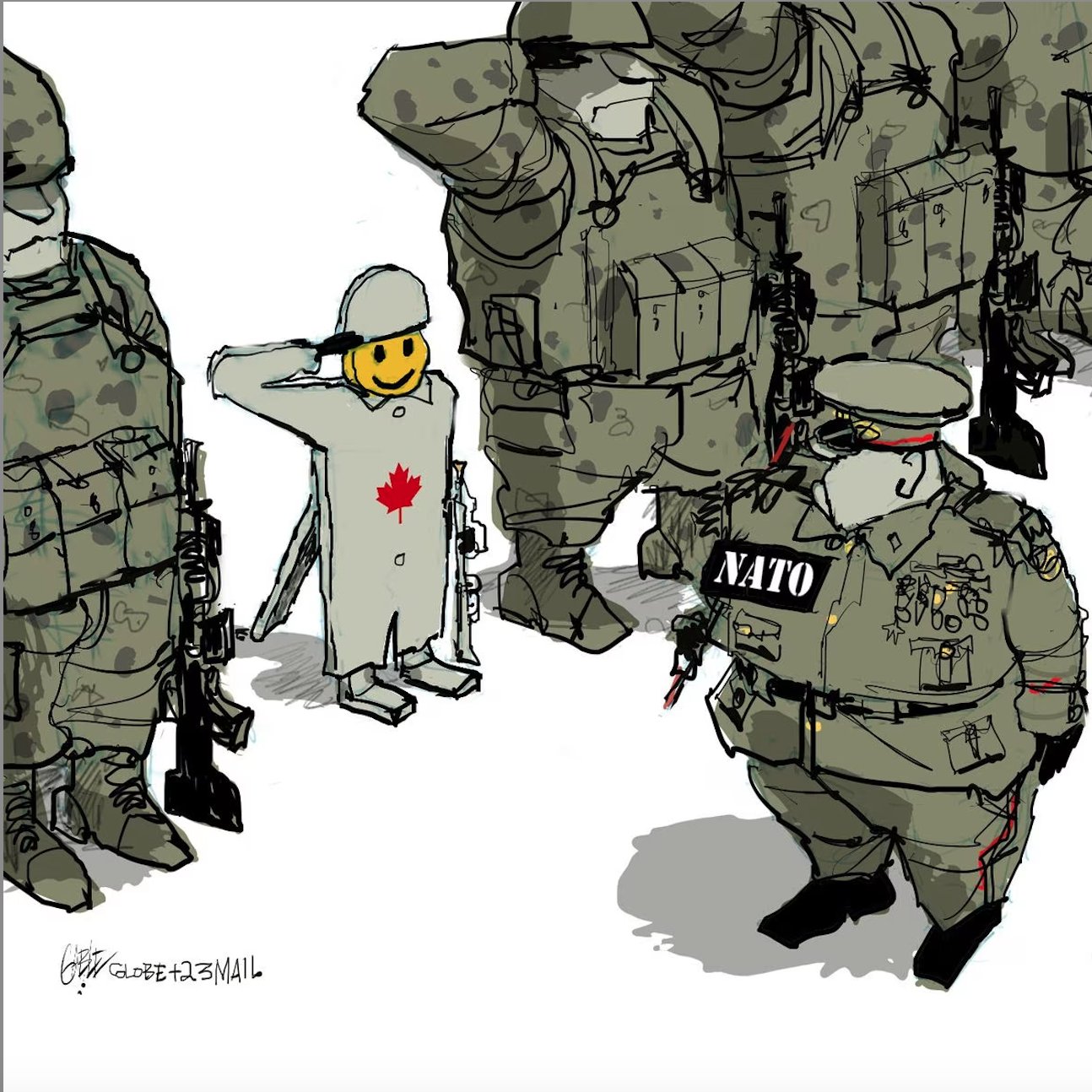
Living up to our commitments to our NATO allies is about more than just spending 2 percent of GDP, it also means living up to our mission requirements. Keeping our word means showing up, and 88 F-35As was never going to be enough jets for us to meet our commitments to NORAD and NATO at the same time. To do that, we need at least 120 jets. Reevaluating our options does not mean starting from scratch. To paraphrase minister Blair: A great deal of work was done during the FFCP evaluation. Two jets met the requirements: the expensive American F-35, and the Swedish Gripen-E with an offer to make them in Canada. Let’s just buy them both.
The first step is easy: Have Saab and IMP refresh their FFCP submission with new delivery deadlines and place an order for 88 Gripen-E jets. The second is to announce that we’re reducing the F-35 order down to 65 jets – the number that the Harper government planned to sole source but never ordered. Finally, we put our elbows up and announce that the F-35 order would be cut by 5 jets for every week the Trump administration maintains their threats of illegal tariffs, down to a minimum of 40 jets.
The F-35A has a total cost of ownership about double that of the Gripen-E, so we could afford to add two Gripens for every F-35 cancelled. A mixed fleet of about 120 Gripen-Es and 45 F-35As would help us get to 2% of GDP while reliably pulling our weight on NORAD and NATO missions.
The REAL Cause of the Revolutionary War
Atun-Shei Films
Published 15 Mar 2025What caused the American Revolution? Let’s dive beneath the surface-level understanding of British tyranny and unjust taxation and try to understand the long-term social, political, and economic forces which set the stage for our War of Independence.
00:00 Introduction
03:00 1. The World Turned Upside Down
13:50 2. The Paradox of American Liberalism
28:34 3. The Rage Militaire
38:12 Conclusion / Credits
(more…)
Everyday Life in the Roman Empire – Demography, Income, Life Expectancy
seangabb
Published 12 Sept 2024Part seven in a series on Everyday Life in the Roman Empire, this lecture discusses demography and life chances during the Imperial period. Here is what it covers:
Introduction – 00:00:00
Our Statistical Civilisation – 00:00:24
Ancient “Statistics” – 00:08:05
How Many Roman Citizens? – 00:18:04
Population of the Empire – 00:21:36
City Populations – 00:27:45
Average Incomes – 00:36:27
Life Expectancy – 00:35:37
Country Life – 00:52:06
Population of Rome – 00:54:39
Feeding Rome – 00:57:40
Roman Water Supply – 01:00:44
Bathing and Sanitation – 01:04:16
Hygienic Value – 01:04:16
Bibliography – 01:06:17
(more…)
March 19, 2025
QotD: The purpose of fortification
… before we get into the design of point defenses, we should talk about what these are for. Generally, fixed point defenses of this sort in the pre-modern world are meant to control the countryside around them (which is where most of the production is). This is typically done through two mechanisms (and most of point defenses will perform both): first by housing the administrative center which organizes production in the surrounding agricultural hinterland (and thus can extract revenue from it) and second by creating a base for a raiding force which can at least effectively prohibit anyone else from efficiently extracting revenue or supplies from the countryside. Consequently if we imagine the extractive apparatus of power as a sort of canvas stretched over the countryside, these fortified administrative centers are the nails that hold that canvas in place; to take and hold the land, you must take and hold the forts.
In the former case, the fortified center contains three interlinked things: the local market (where the sale of agricultural goods and the purchase by farmers of non-agricultural goods can be taxed and controlled), a seat of government that wields some customary power to tax the countryside through either political or religious authority and finally the residences of the large landholders who own that land and thus collect rents on it (and all of these things might also come with significant amounts of moveable wealth and an interest in protecting that too). For a raiding force, the concentration of moveable property (money, valuables, stored agricultural goods) this creates a tempting target, while for a power attempting to conquer the region the settlement conveniently already contains all of the administrative apparatus they need to extract revenue out of the area; if they destroyed such a center, they’d end up having to recreate it just to administer the place effectively.
In the latter case, the presence of a fortified center with even a modest military force makes effective exploitation of the countryside for supplies or revenue by an opposing force almost impossible; it can thus deny the territory to an enemy since pre-industrial agrarian armies have to gather their food locally. We have actually already discussed this function of point defenses before: the presence of a potent raiding force (typically cavalry) within allows the defender to strike at either enemy supply lines (should the fortress be bypassed) or foraging operations (should the army stay in the area without laying siege) functionally forcing the attacker to lay siege and take the fortress in order to exploit the area or move past it.
In both cases, the great advantage of the point defense is that while it can, through its administration and raiding threat, “command” the surrounding hinterland, the defender only needs to defend the core settlement to do that. Of course an attacker unable or unwilling to besiege the core settlement could content themselves with raiding the villages and farms outside of the walls, but such actions don’t accomplish the normal goal of offensive warfare (gaining control of and extracting revenue from the countryside) and peasants are, as we’ve noted, often canny survivors; brief raids tend to have ephemeral effects such that actually achieving lasting damage often requires sustained and substantial effort.
All of which is to say that even from abstract strategic reasoning, focusing considerable resources on such fortifications is a wise response to the threat of raids or invasion, even before we consider the interests of the people actually living in the fortified point (or close enough to flee to it) who might well place a higher premium on their own safety (and their own stuff!) than an abstract strategic planner would. The only real exception to this were situations when a polity was so powerful that it could be confident in its ability to nearly always win pitched battles and so prohibit any potential enemy from getting to the point of laying siege in the first place. Such periods of dominance are themselves remarkably rare. The Romans might be said to have maintained that level of dominance for a while, but as we’ve seen they didn’t abandon fortifications either.
Bret Devereaux, “Collections: Fortification, Part III: Castling”, A Collection of Unmitigated Pedantry, 2021-12-10.
March 18, 2025
Ancient Roman Cheesecake – Savillum
Tasting History with Max Miller
Published 5 Nov 2024Ancient Roman cheesecake drizzled with honey and sprinkled with poppy seeds
City/Region: Rome
Time Period: 2nd Century BCAncient Romans took their feasting very seriously. If you had the money, a feast could be made up of several courses, starting with hors d’oeuvres and aperitifs and ending with sweet dishes. These dessert-type foods were sweetened with fruit or honey, like this cheesecake.
This savillum is very dense, and also quite flavorful and tasty. With the amount of honey I used, it’s not as sweet as a modern cheesecake, but you can see how it has evolved over the last two thousand years. What type of cheese you use will make a big difference in the flavor of your cheesecake. I used ricotta, and my cheesecake was smooth and mild with a prominent honey flavor, but if you choose a stronger flavored cheese, I think it’ll be the main note coming through.
Make the savillum this way. Take half a pound of flour and two and a half pounds of cheese, and mix together as for the libum. Add 1/4 pound of honey and 1 egg. Grease an earthenware dish with oil. When you have mixed the ingredients well, pour into the dish and cover it with an earthenware lid. See that you cook it well in the middle, where it is thickest. When it is cooked, remove the dish, coat with honey, sprinkle with poppy seeds, and put it back beneath the lid for a short while, then remove from the fire. Serve it in the dish with a spoon.
— De Agri Cultura by Marcus Porcius Cato, 2nd Century BC
March 17, 2025
My Big Fat Greek Civil War – W2W 12 – 1947 Q2
TimeGhost History
Published 16 Mar 2025As Europe emerges from WWII, Greece plunges into chaos. Political polarization, revenge killings, and failed diplomacy ignite a bitter civil war, turning former allies into deadly foes. From communist partisans regrouping in the mountains, to royalists asserting brutal dominance, the battle lines are drawn. Could Greece become the first major flashpoint in the Cold War, threatening peace across the Balkans and beyond?
(more…)
German politicians are willing to literally bankrupt the country to keep the AfD out of power
eugyppius is clearly no fan of Friedrich Merz, the CDU leader and presumptive next Chancellor of Germany, but even he seems boggled at how much Merz is willing to concede to his ideological enemies to get himself into that position:
Let us summarise, briefly, what has happened so far:
- The CDU are the party of fiscal responsibility. His Triviality the Pigeon Chancellor Friedrich Merz presented himself throughout the campaign as an unusual fan of Germany’s constitutionally-anchored debt brake. He told everybody that he could not imagine ever borrowing in excess of 0.35% of annual GDP, so interested was he in limiting the tax burden of future generations.
- All of the while, Merz and his advisers were scheming in secret about how they might overhaul the debt brake, firstly because they could not give the slightest shit about the tax burdens of future generations, and secondly because they spent the months since November 2023 observing what happens when a government that has no ideas is also deprived of money. “I have no ideas,” Merz said to himself during this time. “What happens if like Olaf Scholz I also end up with no money?”
- Exactly two weeks ago, U.S. President Donald J. Trump and Ukrainian President Vladimir Zelensky had a verbal spat in the Oval Office. This spat put the fear of God into the Eurocrat establishment, for whom the Ukraine war has become a sacred and essentially religious cause. Merz capitalised on the panic to unveil his massive debt spending plan. He and his would-be coalition partners, the Social Democrats, announced that they wished to spend 500 billion Euros of debt on “infrastructure” and untold hundreds of billions of debt on defence. This would entail adjustments to the debt brake, in the same way setting your house on fire would entail adjustments to your living arrangements.
- This massive spending package will require a constitutional amendment, which can only be achieved with a two-thirds vote of the Bundestag. In the newly elected Bundestag, Die Linke and AfD will be in a position to block this amendment and Merz will be stuck with the debt brake. Thus Merz wants to break the debt brake in the final days of the old Bundestag – a strategy that has put him in the amazing position of groveling before the election’s biggest losers. Specifically, Merz has spent the past few days feverishly negotiating with the Green Party, who will not even have any role in his government, just to get them to sign off on his insane spending plans.
I wrote a lot here and on Twitter about the election nightmare scenario I called the “Kenyapocalypse” – a hypothetical in which the Greens and the Social Democrats would each be too weak to give the Union parties a majority on their own, such that Friedrich Merz would be forced to negotiate a coalition deal with both of them at once. In the end, Kenyapocalypse did not happen; the CDU avoided it by a razor’s breadth. Merz, however, turns out to be such a monumental retard that he has managed to recreate a simulacrum of Kenyapocalypse for himself. The man has been on his knees kissing not only Social Democrat but also Green ass for days. He has been begging the Greens to sign onto his debt plan, and the Greens have finally agreed, in return for the following concessions:
- The “defence” funding that will be exempt from the debt brake is to be defined as widely as possible. All kinds of things will count as debt brake-exempt “defence” spending now, probably including various climate nonsense.
- The 500 billion-Euro “infrastructure” debt is to include 100 billion Euros specifically earmarked for the “Climate and Transformation Fund” – the central financial instrument of the energy transition. This is basically infinity windmill money, you might as well set it on fire. Beyond this specific allocation, any projects that contribute to making Germany “climate neutral by 2045” will also be eligible for the 500 billion-Euro exception. This whole thing will be a massive wad of debt for Green nonsense and I would like to take this moment to laugh at everyone who told me how happy I should be that Merz was trying to fix Germany’s bridges with this debt bullshit. Nothing of the sort is going to happen.
- You will note that the explicit goal of achieving “climate neutrality” by 2045 is slated to be among the very few positive political points anchored in the German constitution. “Climate neutrality” is a more expansive concept than mere “carbon neutrality”, or net zero. It describes a utopian state of affairs in which human actions have no influence on the climate whatsoever.
These are prizes the Greens could not achieve even at the height of their influence, in the 2021 elections. Strictly speaking, the entire traffic light coalition fell apart over a matter of 3 billion Euros. Now the Greens are getting 100 billion Euros for free, all because Merz is determined to become Chancellor whatever the cost.
How to Make Irish Shepherd’s Pie | Food Wishes
Food Wishes
Published 5 Mar 2012Learn how to make an Irish Shepherd’s Pie! This recipe is a lovely alternative to the much more common corned beef and cabbage recipe that you may have been planning for dinner. Take things to the next level with some nice Irish cheddar.
St. Patrick’s Day Special: Irish Shepherd’s Pie (the real one, not the stuff they eat in cottages)
I know I may have used a few atypical ingredients in this, but as far as I’m concerned, the only two things that are mandatory to make a “real” Shepherd’s Pie are potatoes and lamb. While the ground beef version is also very delicious, it’s not considered a “Shepherd’s Pie”, since shepherds raise sheep, not cows.
The real mystery is why the beef version is called “Cottage Pie”, and not “Cowboy Pie”, or “Rancher’s Pie”. When I think about cattle, many things come to mind, but cottages aren’t one of them. Okay, now that we have all those search keywords inserted, we can moooo’ve on.
By the way, I know it’s something of a Food Wishes tradition that I do a cheap, culturally insensitive joke about Irish-Americans drinking too much in our St. Patrick’s Day video, but this year I decided not to do any. In fairness, I know hundreds of Irish people, and several of them have no drinking problem whatsoever, so it just didn’t seem inappropriate.
Anyway, as I say in the video, this would make a lovely alternative to the much more common corned beef and cabbage that you may have been planning for dinner. Also, I really hope you find some nice Irish cheddar. I used one called “Dubliner” by Kerrygold, which can be found in most large grocery stores.
If you’re curious about beverage pairings, may I go out on a limb and suggest a nice Guinness, or other Irish beer … just hold the green food coloring, please. Erin go bragh, and as always, enjoy!
(more…)