
Legally Armed America
Published on 31 Dec 2017The FN FAL is one of the greatest battle rifles ever made. Politics caused the U.S. to pass on it while nearly every other NATO country in the world recognized its superiority. And the 7.62 NATO is one of the greatest battle rounds ever made. But we needed an intermediate round. Here’s the story.
* Be sure to join the web’s ONLY 100% pro-gun social community, Gun District at GunDistrict.com. It’s much like Facebook, but without the discrimination against gun owners.
January 29, 2018
How the U.S. got shafted out of the FN FAL
Comments Off on How the U.S. got shafted out of the FN FAL
QotD: Churchill’s drinking habits
In the not so distant past around the sodden precincts of Westminster you were as likely to spot a yeti as a sober politician. The level of drinking that went on among MPs and their leeches for most of the last century was prodigious and was by and large expected. It was, as Ben Wright describes in his breezy, anecdote-rich and instructive survey of booze and politics, part of a culture which was tolerated and, to a degree, encouraged.
It was not without justification, for instance, that Adolf Hitler, who might have been a nicer fellow had he not been a teetotaller, described Winston Churchill as an “insane drunkard”, a “garrulous drunkard”, and “whisky-happy”.
If Order, Order! has a star it is undoubtedly Churchill who rarely let a day go by able to pass a breathalyser test. On occasion he would have a glass of wine at breakfast followed by a liquid lunch which invariably included Champagne and brandy. At tea-time he would progress to whisky. Then he would wash down dinner with more Champagne and brandy after which he had at least another whisky. According to one loyal aide who may have been sight impaired he was never the worse for wear for this intake and he “never felt the slightest ill-effects in the morning”.
Alan Taylor, “Lush tales of our political classes’ drinking exploits”, The National, 2016-06-20.
Comments Off on QotD: Churchill’s drinking habits
January 28, 2018
Day 13 Cuban Missile Crisis – The End to End All Things and Almost Everything
TimeGhost
Published on 21 Dec 2017On Sunday, 28 October, 1962 the Cuban Missile Crisis is supposed to end, but there are still two nuclear armed Soviet submarines in the waters around the island hunted by the US Navy. And what about Fidel Castro?
Comments Off on Day 13 Cuban Missile Crisis – The End to End All Things and Almost Everything
Trenches At 10,000 Feet – Fighting On Mt. Lagazuoi I THE GREAT WAR On The Road [4K]
The Great War
Published on 27 Jan 2018Check out the Open Air Museum: http://bit.ly/LagazuoiMuseum
Join a very cold Indy as he explores the Italian and Austro-Hungarian positions on Mount Lagazuoi and finds out how they were built and operated during the Great War. A special thanks to Stefano Illing for guiding us through this incredible place.
Comments Off on Trenches At 10,000 Feet – Fighting On Mt. Lagazuoi I THE GREAT WAR On The Road [4K]
Sexual Enlightenment – Defining what is Normal l HISTORY OF SEX
IT’S HISTORY
Published on 28 Sep 2015With Sexual Enlightenment came radical changes to the perception of sex in society. This episode on sex in modernity covers discussions held in salon culture, debating and defining ideas of what sexual liberty meant. Public figures like Anne Lister openly addressed homosexual relations and the first sex researchers took up on the topic.
Comments Off on Sexual Enlightenment – Defining what is Normal l HISTORY OF SEX
January 27, 2018
Day 12 Cuban Missile Crisis – Black Saturday, nuclear war on autopilot…
TimeGhost
Published on 7 Dec 2017On October 27, 1962 a deal to resolve the Cuban Missile Crisis is ever so close, but then almost everything that can go wrong, goes wrong. Political confusion between the leaders, lost and shot down airplanes, errant nuclear armed submarines and exhaustion takes its toll. For those immediately involved it will go down in memory as the Black Saturday.
Comments Off on Day 12 Cuban Missile Crisis – Black Saturday, nuclear war on autopilot…
January 26, 2018
Civil War in Finland and the Ukraine I THE GREAT WAR Week 183
The Great War
Published on 25 Jan 2018This week in the Great War, two more wars start – the Finnish Civil War and the Ukrainian War of Independence. Meanwhile, David Lloyd George pulls some strings in France, even as Ludendorff settles on a target for Germany’s upcoming Spring Offensive.
Comments Off on Civil War in Finland and the Ukraine I THE GREAT WAR Week 183
Day 11 Cuban Missile Crisis – Will President Kennedy invade Cuba after all?
TimeGhost
Published on 30 Nov 2017On 26 October 1962, USSR Premier Nikita Khrushchev is preparing to offer the US an olive branch. Meanwhile US President John F Kennedy continue to plan an invasion of Cuba. While the politicians make new plans, their previous military plans take on a life of their own
Comments Off on Day 11 Cuban Missile Crisis – Will President Kennedy invade Cuba after all?
Tank Chats #21 Mark V
Tank Museum
Published on 27 May 2016Although similar in appearance to earlier models the Mark V was a much better tank, more powerful and easier to drive.
It was equipped with a new engine and steering system which meant that one man could handle all the controls, compared with four in the Mark IV.
Commanded by a young officer named Whittenbury the Museum’s Mark V tank, seen in this video, took part in the Battle of Amiens and its young commander was awarded the Military Cross.
Comments Off on Tank Chats #21 Mark V
QotD: Britain’s boozy parliamentarians
It is Wright’s contention [in his book Order! Order!] that alcohol has as many benefits as it does drawbacks. Not only does it help loosen ties and tongues it also boosts confidence and dilutes stress. Most prime ministers drank, many to excess. Herbert Asquith went by the nickname “Squiffy Asquith” and regularly appeared in the Commons three sheets to the wind. Margaret Thatcher did her best to promote the whisky industry, the uncapping of a bottle of Bell’s marking the end of the working day. She believed that whisky rather than gin was good for you because “it will give you energy”, which I fear could be a hard fact to prove scientifically.
Tony Blair, whose reign ushered in an era of 24-hour drinking, thought his relatively modest drinking was getting out of control because he calculated it exceeded the government’s weekly recommended limit. This did not impress Dr John Reid, Bellshill’s finest, who once drank like a navvy. “Where I come from,” Reid told GMTV, “a gin and tonic, two glasses of wine, you wouldn’t give that to a budgie.” Blair, of course, did not have to look further than next door to find an explanation why his consumption increased over the years. Gordon Brown, his nemesis, was fond of Champagne – Möet & Chandon no less – which he did not nurse but washed down in a gulp. “He was like the cookie monster,” recalled one aide. “Down in one, whoosh!” Drinking is of course one of those areas in which we Scots have long punched above our weight and Wright’s pages are replete with examples of intoxicated Jocks carousing nights away and causing mayhem. Former Labour leader John Smith was one such. Occasionally I encountered him on the overnight train that carried Scottish MPs home from Westminster on a Thursday night. Known as “the sleeper of death”, it was a mobile pub that never closed until it reached Waverley, whereupon politicians were disgorged red-eyed and pie-eyed among bemused early morning commuters.
Alan Taylor, “Lush tales of our political classes’ drinking exploits”, The National, 2016-06-20.
Comments Off on QotD: Britain’s boozy parliamentarians
January 25, 2018
Day 10 Cuban Missile Crisis – Showdown at the U.N. Corral
TimeGhost
Published on 27 Nov 2017On October 25, 1962 while the US Navy are looking for something to do in the Caribbean, both USSR Chairman Khrushchev and US President Kennedy are questioning the success of their actions. Meanwhile US Ambassador to the UN Adlai Stevenson is about to face off with USSR Ambassador to the UN, Valerian Zorin in a historic showdown at the United Nations headquarters in New York.
Comments Off on Day 10 Cuban Missile Crisis – Showdown at the U.N. Corral
Looking deeper than just England, Scotland, Wales and Northern Ireland
H/T to @GarethSoye for posting this one (originally from Brilliant Maps):
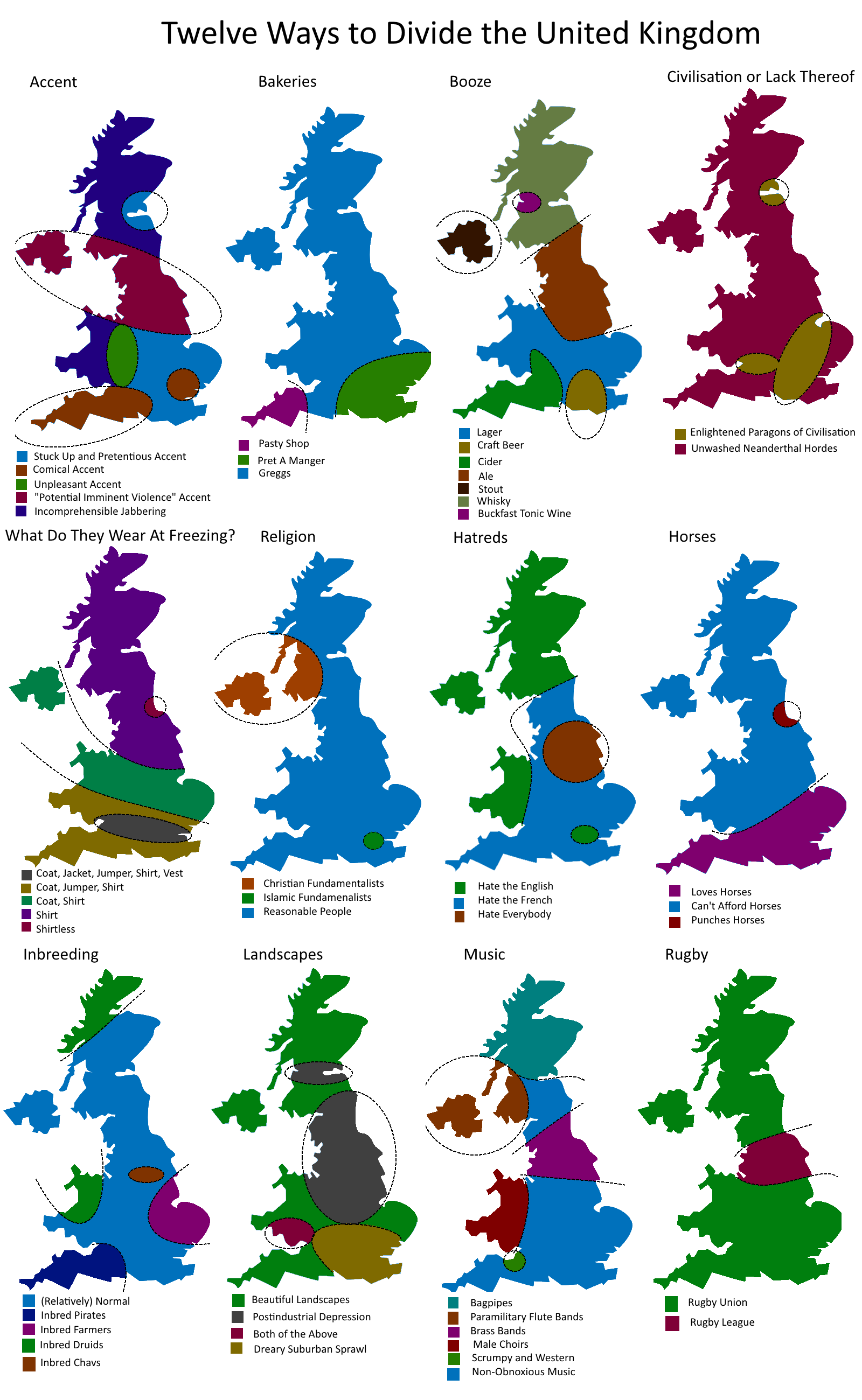
[Click to see full-sized image]
Comments Off on Looking deeper than just England, Scotland, Wales and Northern Ireland
January 24, 2018
Day 9 Cuban Missile Crisis – Blockade starts and low altitude flybys over Cuba
TimeGhost
Published on 23 Nov 2017On October 24, 1962 the US led blockade on Cuba goes into effect, but it’s not the be the showdown that it looks like! In the same time the US Navy starts flying RF8 Crusader reconnaissance jets 400 feet over the missile sites on Cuba, to see what’s really going on. As the jets roar over the heads of the Cuban and Soviet soldiers, the crisis deepens.
Comments Off on Day 9 Cuban Missile Crisis – Blockade starts and low altitude flybys over Cuba
Peter Jackson to bring modern digital technology to bear on IWM film footage of the Great War
Elizabeth sent me a link to this Daily Mail article on Peter Jackson’s new project:
When you think of First World War footage, chances are you conjure up grainy images of soldiers and jumpy footage of the trenches.
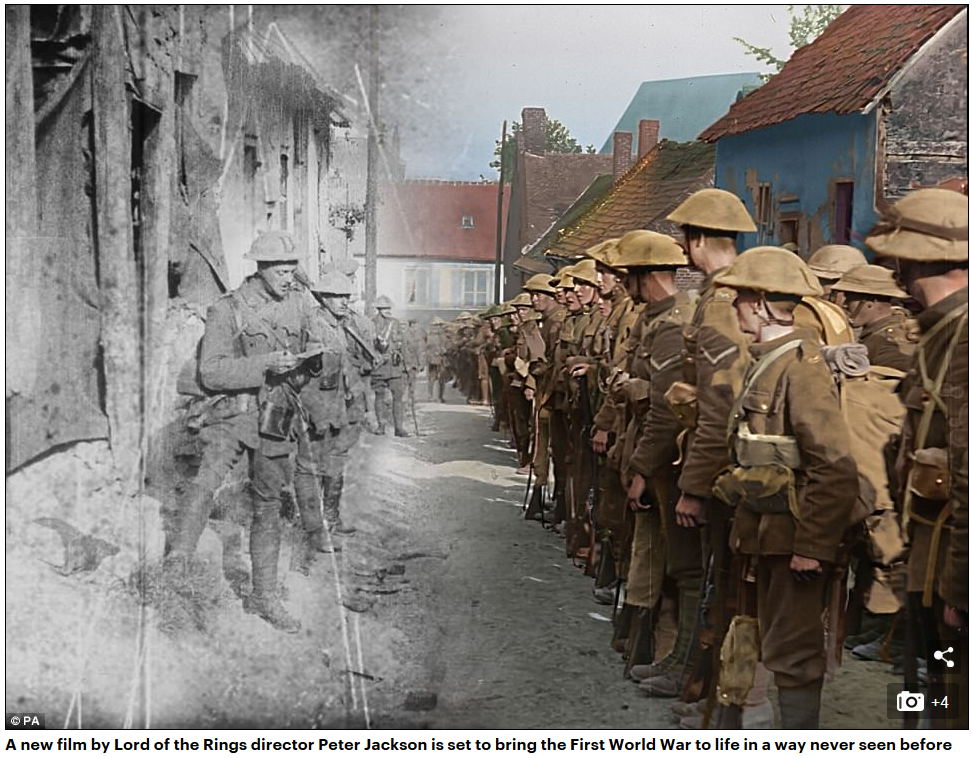
But a new 3D film by Lord of the Rings director Peter Jackson is set to bring the conflict to life in a way never seen before.
The Oscar-winner has restored and colourised 100-year-old footage from the Imperial War Museum’s vast archive, and early photos suggest the results will be remarkable.
One comparison shot shows the dramatic transformation from poor quality black-and-white scenes to clear colour images, while another shows the radically sharpened faces of our troops.
Jackson said he hoped the film, which will premiere at the BFI London Film Festival before airing on BBC1 later this year, will help audiences better connect ‘with the events on screen’.
Explaining the painstaking process of restoring the footage, he said: ‘We started to do some experiments and I was honestly stunned by the results we were getting. We all know what First World War footage looks like.
‘It’s sped up, it’s fast, like Charlie Chaplin, grainy, jumpy, scratchy, and it immediately blocks you from actually connecting with the events on screen.
Comments Off on Peter Jackson to bring modern digital technology to bear on IWM film footage of the Great War


