
What would be the impact of such a policy?
We cannot know exactly, because we would struggle to find a real-world example of it in a comparable country. But we could think of it as, effectively, a 100% marginal tax rate on incomes above £100,000. We could then look at the empirical literature on how responsive top earners are to tax incentives, and extrapolate from that.
We know from previous studies that the behaviour of top earners is quite sensitive to tax changes. Last year, the Institute for Fiscal Studies (IFS) tried to model the impact of a proposal to increase the tax burden on the top 5% of earners. In this case, the proposal was to lower the threshold for the 45% additional rate of income tax from £150,000 to £80,000 per annum, and to introduce an “additional additional rate” of 50% for incomes above £125,000.
If nobody changed their behaviour, such a policy would increase tax revenue by just over £9 billion per annum. But people would, of course, change their behaviour. Some top earners would switch to less demanding positions, some would retire earlier, some would reduce working hours, some would engage in more proactive tax planning (i.e. legal tax avoidance), some would simply emigrate, and so on.
We know for certain that responses of that kind exist. But we cannot exactly quantify them. So the IFS came up with a range of plausible outcomes rather than one definite number. It turns out that at the most optimistic end of the spectrum, behavioural changes would still knock over a third off the potential additional tax revenue, reducing it from over £9 billion to under £6 billion. At the most pessimistic end of the spectrum, the policy would fail to raise any additional tax revenue – it would, in fact, reduce revenue by almost £1 billion. (Stop smirking, Dr Laffer.)
If a tax rate of 50% can be predicted to trigger such strong behavioural responses, you can guess how much damage an implicit rate of 100% would do.
Kristian Niemietz, “The public love it, so what’s wrong with the idea of a maximum wage?”, Institute of Economic Affairs, 2020-10-14.
July 28, 2026
QotD: Projecting the effect of a maximum wage law
July 27, 2026
The shambolic Fifth Crusade, or “Waiting for Fredot”
In The Critic, Anatoly Grablevsky reviews a new book on one of the less well-known attempts to wrest control of the Holy Land from the Islamic conquerors:
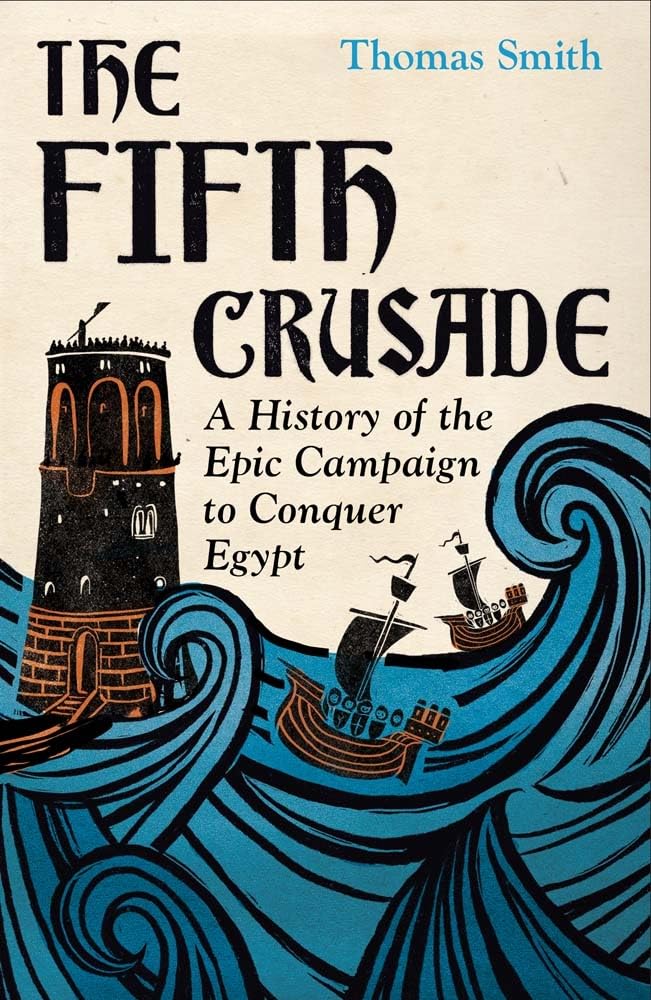
By the early 13th century, the military and geopolitical situation of the Crusader Kingdom of Jerusalem was dire. After the Third Crusade (1189-92) had failed to retake Jerusalem, the Frankish realm in the Holy Land was reduced to a thin coastal strip centred on the heavily fortified city of Acre. The rest of the Near East was in the hands of the Ayyubids, the successors of Saladin.
In response to Ayyubid encroachment, in 1213 Pope Innocent III called for a new holy war to reinforce the Kingdom of Jerusalem and reclaim the Holy City for Christendom. The bulk of the expedition was recruited in the Holy Roman Empire, whose young emperor, Frederick II, the wonder of the world himself, ostentatiously took up the cross. He was, however, in no hurry to join his countrymen in the east.
Learning from their bitter past experiences, this time around the Crusaders adopted a novel strategy. Instead of focusing their efforts on the Holy Land, the Christians targeted Egypt, the political and economic heartland of the Ayyubids.
The Crusader army’s first port of call was the coastal city of Damietta, which, after a lengthy siege, fell in 1219. This was a major victory for Christendom: Crusaders had not captured a city of Damietta’s size, wealth and strategic importance since the fall of Jerusalem in 1099.
The Ayyubid Sultan Al-Kamil, under pressure from Mongol attacks at the rear, now offered attractive peace terms that included the return of Jerusalem to the Christians. The Crusaders, overconfident and under orders from the absentee emperor, rebuffed Al-Kamil and instead decided to march on the Ayyubid capital of Cairo.
Here, the crusade took a shambolic turn. The Christians wasted precious months awaiting the arrival of Frederick II, but the emperor never bothered to show up (Smith might have called his book “Waiting for Fredot”). By the time the Crusaders finally began the march south, Al-Kamil had gathered his strength, and the Franks were quickly outmanoeuvred by the Sultan, who used his superior knowledge of the Nile’s flooding patterns to trap them against the river.
The Crusaders reacted by launching an all-out assault on their substantial wine provisions so that, when the Muslims attacked, the Christian army disintegrated in a drunken rout.
In the ensuing peace deal, Al-Kamil regained Damietta, in return for giving safe passage back to Europe to the Christian survivors.
Timeō Danaōs et dōna ferentēs
The tag in my chosen headline means roughly “beware of Greeks bearing gifts”, which anyone who has read anything about the Trojan War can understand. A huge problem for modern translators of works like The Iliad and The Odyssey is that there’s a double layer of cultural change built in before you start: the Mycenaean Greek culture of the Bronze Age — the setting of the Trojan War — is significantly different from the Greek culture of the classic era — when the oral tales were first written down (and attributed to Homer).
Classic Greek culture is often misunderstood by modern audiences through the most prominent survivals of that time: especially Greek philosophy, as the philosophers we think of as most representative of Athenian and the wider Greek culture were actually a fairly small and relatively powerless subculture at odds with the mainstream of their times.
All that said, going from a translation to an on-screen interpretation requires a lot of picking and choosing of elements to highlight and others to leave unrepresented or actively suppressed. In the most recent film of Odysseus and his extended return journey from Troy to Ithaca, director Christopher Nolan chose to portray Odysseus as a modern man in ways that may suit today’s audiences, but don’t accurately portray the Homeric interpretation or the times in which it is set:
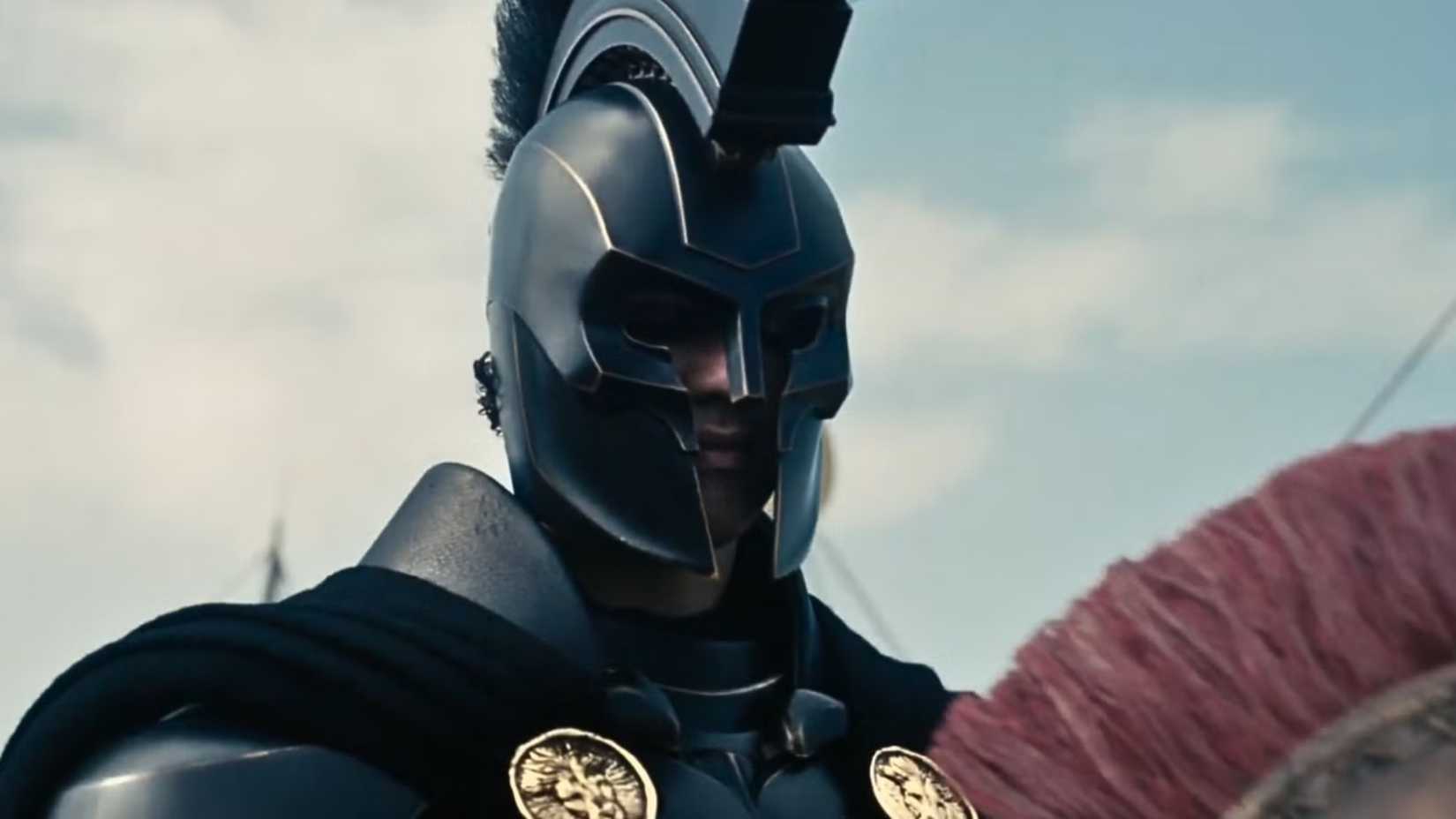
Some viewers have described Nolan’s version of Odysseus as suffering from post-traumatic stress disorder. But moral injury is the more accurate term. It overlaps with PTSD, but it’s not the same thing. Moral injury occurs when a person commits, witnesses, or fails to prevent an act that violates his moral convictions. In war, moral injury can arise when a person does something that violates his own ideals, loyalties, or sense of right and wrong. The result is lasting guilt. A combat veteran comes to see himself as corrupt, unworthy, or beyond forgiveness.
In the film, Odysseus describes his guilt over the violence he witnessed during the sack of Troy. He is conscience-stricken about his Trojan Horse gambit. Odysseus took an object that appeared to be a gift of peace and used it as a weapon of deception. His stratagem allowed the Greeks to enter Troy, destroy the city, and slaughter its people.
But the Trojan Horse is Odysseus’s crowning achievement. Homer’s Odysseus is a wily trickster, and a trickster would not be tormented by the fact that his trick succeeded.
During his journey, he repeatedly deceives his own men for what he believes is the greater good, and these acts clearly trouble him. The war itself is remembered as grim and pointless. Men are drafted rather than rushing eagerly toward glory.
This is not Homer’s moral universe. In the poem, the Greeks rape, rob, enslave, and pillage without displaying anything like modern guilt. We can tolerate this when reading an ancient text. It is harder to tolerate when those acts are placed directly before us on a movie screen.
This may explain Nolan’s decision. Had he shown the violence of the original story without softening it, would the audience still have been able to sympathize with Odysseus?
Consider what happens to the enslaved women accused of consorting with the suitors after Odysseus returns home. Odysseus orders them to be killed, and Telemachus hangs them. Homer does not present the scene as morally complicated. Their punishment is part of restoring order.
Modern films sometimes allow their heroes to inhabit moral worlds very different from our own. Robert Eggers’s 2022 film The Northman asks us to sympathize with Viking characters who obey codes that most moviegoers today would find reprehensible. But The Northman was a mid-budget film. Nolan made a summer blockbuster that cost hundreds of millions of dollars. A blockbuster can’t afford to depict a hero from whom audiences recoil. Eggers could let his Viking be a Viking. Nolan needs his Greek warrior to be one of us.
Yet such individuals lived in societies that existed before Christian morality reshaped the Western understanding of guilt, mercy, and the value of every human life. The moral injury that afflicts Nolan’s Odysseus belongs more naturally to the AD world than the BC one.
In the film, Odysseus grieves for the men he lost and appears to blame himself for their deaths. But Homer presents that suffering as the result of pride, fate, divine anger, and human foolishness. The original story does not depict Odysseus as a man tormented by the fear that he has violated his own moral code.
The difference is clear in the episode of the lotus-eaters. In Nolan’s film, Odysseus eats the lotus because he seeks mental relief, a kind of ancient Greek version of using psychedelics to treat combat trauma. In the poem, Odysseus does the opposite. He refuses to eat the lotus and orders his men away from it.
The Total Erasure of Carthage | Part Four
The Rest Is History
Published 12 Feb 2026Three decades after the defeat of Hannibal, how had the Roman Empire managed to conquer vast swathes of the known world? Why did the predatory eyes of this terrifying behemoth turn once more to Carthage? And, could this mighty city defy the odds and repel Rome one last time …?
Join Tom and Dominic as they reach the climactic, final phase of the Punic Wars; the greatest military struggle of all ancient history.
(more…)
July 26, 2026
Woodworking workbenches – the earliest artistic representation
On his Substack, Christopher Schwarz recounts a visit to the historical remains of the town of Herculaneum under the volcano that erupted in 79 AD, killing many thousands, but preserving a lot of the Roman town under many metres of volcanic ash:
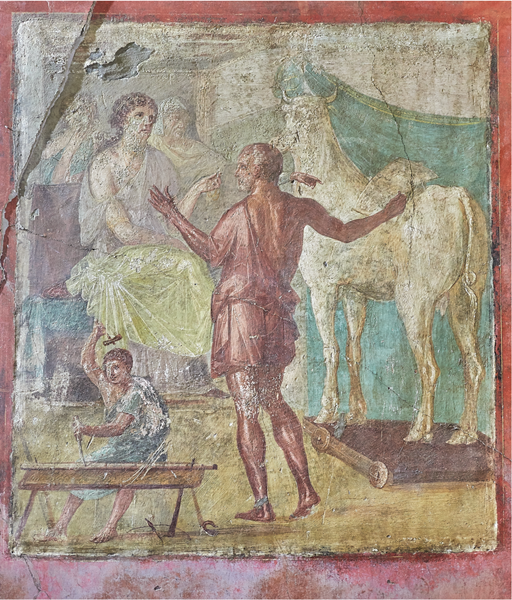
The beginning. In the House of the Vetti, this dining room fresco is perhaps the earliest depiction of a workbench in the West. (Photo by Narayan Nayar)
The journey to the summit of Mount Vesuvius has all the romance of visiting an unlicensed reptile farm. It begins in Ercolano, Italy, a touristy village in the shadow of the volcano and home to Herculaneum, one of the towns buried by Vesuvius’s eruption in 79 C.E.
As Narayan Nayar (the photographer for the journey) and I stepped off the train from Naples we were assaulted by young, attractive Italians. Their job: Bait tourists to nearby restaurants. We glanced around and saw only one escape route from the train station’s cul-de-sac. So, we plowed through the crowd of eager human fishing lures.
We emerged from the other side a bit relieved. Then we realized we’d scurried past the bus company that was supposed to drive us up the volcano. We turned around and dove back into the swarm of too-perky people in order to catch our bus.
The twisty-turny bus ride ended 660 feet below the volcano’s summit, and we then climbed a steep trail to the volcano’s rim. The top resembles a gravel pit where one of Frank Herbert’s worms might emerge. There’s no deep hole for tossing human sacrifices – throw a virgin into Vesuvius and she’s only going to get skinned knees and a sunburn. I looked around the volcano and promptly excused the early settlers of the area for building their homes at the base of Vesuvius. The only evidence you’re on a volcano (besides the little gift shops) is the occasional tiny plume of gas and the odd rocks below your feet.
I picked up a few rocks. For rocks, they were young – likely the result of the 1944 eruption, which destroyed several villages. I looked out from our 4,200-foot perch at the buildings in every direction below, which are built on top of villages that were covered in ash from earlier eruptions. It’s a grim scene if you think about it too much – 600,000 people now live in the so-called “red zone” for a future eruption.
And yet, as I fondled the rocks in my hand I felt only gratitude for this deadly, fire-breathing mountain.
The Earliest Workbenches
The recorded history of woodworking begins with the Egyptians. But the recorded history of workbenches begins (for now) with Vesuvius. Its massive eruption in 79 C.E. buried Pompeii, Herculaneum and other sites, preserving frescoes, buildings, pottery, human remains and even wooden furniture.
At Pompeii, the ash blanketed a fresco showing a low, four-legged workbench being used for mortising by a man in Greek attire. At nearby Herculaneum, the eruption preserved a fresco showing “erotes” – what we might call “buck nekkid cupids” – sawing a board at an eight-legged low workbench. It features a holdfast and other holdfast holes. This fresco has since been destroyed, but we have engravings that were made soon after its discovery (more on both the frescoes’ stories is ahead).
These two images are the earliest representations of workbenches of which I’m aware. And they launched my interest in exploring knee-high workbenches and how to use them to build furniture, boats, storage containers and wagon wheels.
The conventional wisdom is that these low benches were used in former times for simple work and were replaced by superior modern benches, which are thigh-high or taller. But the more I studied low benches, the more I found that they never disappeared. They are still in use. Additionally, these low benches can be used for complex work, including steam bending compound shapes and lutherie.
The low bench is more than a thick plank of wood with legs. It’s also a collection of simple jigs and appliances that allow you to do remarkable work while sitting comfortably on an easy-to-build platform. For centuries, these simple jigs remained hidden in plain sight in paintings and drawings in museums. And their appliances have been proven to work, both at my low benches and by the modern craftsmen who still use them.
How to Provoke a War – Death of Democracy 25 – Q1 1939
World War Two
Published 25 Jul 2026By March 1939, appeasement has failed.
Hitler’s Germany has moved from threats and persecution inside the Reich to the destruction of Czechoslovakia, the seizure of Memel, and renewed pressure on Poland. No shots have yet been fired between the great powers — but Europe is now locked on a course toward war.
In this episode of Death of Democracy, Spartacus Olsson reports from Berlin at the end of Q1 1939: the “Israel” and “Sara” decree, Schacht’s dismissal, Göring’s Central Office for Jewish Emigration, Hitler’s genocidal Reichstag threat, the launch of Bismarck, the coerced occupation of Prague, the Memel ultimatum, and Britain’s guarantee to Poland.
This is the moment when the Munich illusion collapses. Hitler is no longer pretending to unite Germans. He is dismantling states.
The Alchemy of Finance by George Soros
Handre discusses the book George Soros wrote (or had written) after he gained a huge sum of money by speculating against the Bank of England in the 1990s:
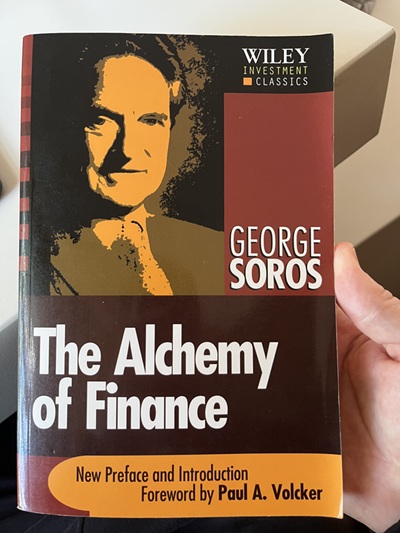
George Soros made a billion dollars betting against the Bank of England in September 1992, and then he wrote a book explaining that markets are fundamentally irrational. Notice the tension there.
The Alchemy of Finance, published in 1987, gives you Soros’s theory of reflexivity. The idea runs like this: participants in a market do not observe prices from the outside. They shape the reality they are trying to measure. Their biased expectations feed into prices, prices feed back into expectations, and the whole thing spirals away from any “equilibrium”. Soros presents this as a devastating blow to the neoclassical economists who model markets as tidy machines grinding toward a single clearing price.
He is right, but misses one fundamental point. The equilibrium fetish deserves a beating. Ludwig von Mises and Friedrich Hayek spent decades explaining that the market is a process, not a photograph, and that no equation captures the discovery going on inside it. Prices carry dispersed knowledge. Entrepreneurs guess, act, and get corrected by profit and loss. Soros rediscovered a slice of this in his trading room, and called it “alchemy”.
But, Soros treats his “far from equilibrium” boom-bust sequences as proof that free markets are inherently unstable and require an adult (usually a central bank, sometimes Soros himself) to supervise them. He points at the credit bubbles of the 1980s and sees capitalism failing. He never asks who prints the credit.
The Federal Reserve does. Cheap money floods in, entrepreneurs misread the artificially low interest rates as real savings, and they pile into projects that cannot pay off. That is the boom. The bust arrives when reality collects its debt. Soros describes the symptom with real skill and misses the pathogen entirely.
So the man who broke sterling by exploiting a currency that politicians pegged at a lie somehow concludes that governments need more discretion, not less. The 1992 pound was a government price-fix collapsing, exactly as Mises predicted such fixes always do.
The reflexivity part is spot on, but send the bill for the bubbles to the people with the printing press.
The Ancient Greeks 03 – Enter the Persians 5 – Earth and Water: The Logic of Empire
seangabb
Published 16 Feb 2026Why does Persia turn west? In this lecture we examine Persian strategic thinking after the suppression of the Ionian Revolt. We analyse the demand for “earth and water”, the meaning of submission in Persian political culture, and the diplomatic crisis that follows.
Most Greek states comply. Athens and Sparta do not. We also explore the Persian expedition of 492 BC under Mardonius and the calculated preparation for renewed intervention.
July 25, 2026
The last few hundred years of Anglo-German relations
The history of Britain and Germany has certainly had some peaks and valleys since the first “German” king was crowned in London in 1714. Prussia and Britain managed to team up most memorably in 1815 to defeat Napoleon in the Waterloo campaign, but things got much less clear after the Franco-Prussian War that heralded the rise of a unified German state. As long as Prince Bismarck was the guiding hand behind German ambitions, Britain could look at Germany as a relatively reliable continental ally. After the accession of Kaiser Wilhelm II, however, things got rockier quickly. Bismarck got sidelined soon afterwards and the Kaiser decided that the one thing he really, really wanted was to build a navy to rival the British Royal Navy. That, in my opinion, more than anything else pushed Britain into exploring other diplomatic channels and eventually deciding to ally (in all but name) with France. The cover of Jan Rüger’s Great Powers shows the future conflict zone that ensured Britain would view Germany as a threat and not a potentially valuable ally:
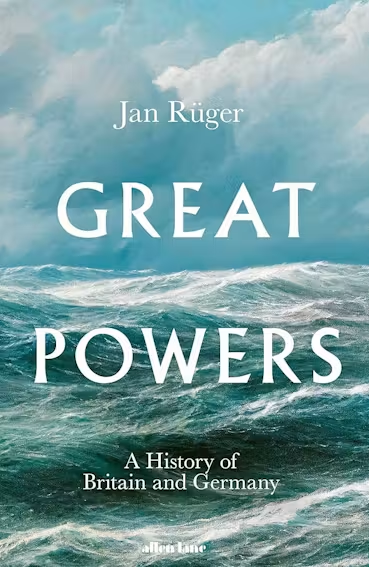
As an explicit criticism of the nonsense of great powers rising and falling as if “a timeless truth”, that offered for example by Paul Kennedy, Graham Allison, and Brendan Simms, Rüger, Professor of History at Birkbeck, emphasises the role of individuals and contingencies. His is a book that emphasises human agency, and at every level from that of nations to individuals.
[…]
For the period on which I am a specialist (and Rüger is not), the eighteenth century, there is a degree of nonsense. For example, George I did not have a “reliably anti-French stance” contributing to British “nation-building”. Instead, there was alliance with France from 1716 to 1731, the deployment of French troops into “Germany” to protect Hanover against Prussia and Austria was sought in 1727 (George II was similarly concerned in 1729), and so on. Nor were British interests successfully ringfenced to protect against their use for Hanoverian ends. Any detailed consideration of British foreign policy, or, indeed, the despatch of warships to the Baltic would suggest otherwise. Nor is Rüger correct to suggest that “at the heart of Britain’s national interest” was Britain choosing both Continental interventionism and trans-oceanic policies. Walpole’s determination to keep Britain out of European war, notably in 1733-35, and the beneficial consequences that flowed from this, demonstrates the contrary; as, indeed, did the earlier non-engagement, as in the Thirty Years’ War or against France in 1675-78. Rüger’s Whiggishness draws on a failure to understand the range of views in and on the eighteenth century.
From a German perspective, I would scarcely describe this book as a Bavarian or a Swabian viewpoint. Nor is there sufficient engagement with the extent to which Germany for long in Britain meant the Empire and thus included Austria. That only really ceased in the nineteenth century. Thus, there is on the part of Rüger a degree of anticipation that is misleading. Prussia takes far too central a position too early. This is linked to his misleading account of Prussia as a great power by the end of the Seven Years’ War. Not so, it was more significant by then than Bavaria and Saxony both of which had had their search for status crippled by defeat. However, Prussia also had had its vulnerability amply displayed, notably so to Russia. Furthermore, in terms of “reach”, Prussia in 1763 in no way matched Austria, Britain, France or Russia. Instead, it only became a great power as a result of developments from the 1860s. 1871 still seems to be the lens through which most Germans view their history. That includes Rüger, and is misleading.
So, lots to the good, particularly (but not only) for the post-1871 period; but with significant weaknesses, and notably so for the eighteenth century.
July 24, 2026
Did This Meal Kill Mozart?
Tasting History with Max Miller
Published 27 Jan 2026Sliced pork loin with a rye bread crumb and cinnamon crust
City/Region: Vienna
Time Period: 1742Mozart is one of my favorite composers of all time. When he fell ill and died in 1791 at the age of 35, rumors flew about what caused his death. Speculation continues to this day. Was it poison from a jealous rival or the Freemasons? Was it one of many possible illnesses? We don’t know for sure, but one theory is that it was trichinosis from undercooked pork, and we do know that he ate pork 44 days before he became sick.
This recipe from a Viennese cookbook in 1742 is for mutton loin, but it says that you can use the recipe for pork or venison as well. While boiling meat is not the most delicious way to prepare it, the crust that you prepare after it’s boiled is delicious. It’s slightly sweet with a hint of cinnamon and a very nice crunch, so if you’re not worried about sticking to the historical recipe exactly, try the crust on some pork chops (cooked however you like) or a roasted pork loin.
No. 239 — Mutton Loin
Take from a mutton the loin, as large as it can be, and dress it as one does a venison loin. Boil it in water, wine, and vinegar with bay leaves, onion, rosemary, and strips of lemon peel until it is quite tender. When it is cooked, arrange it on a casserole dish and pour melted butter over it. Take grated dark bread, mix it with cinnamon and sugar, sprinkle this over the loin, pour more butter over it, and put it into the oven, so that it becomes nicely brown, turning it once or twice. Make a good broth, pour it underneath, and serve it warm at the table.
— Nützliches Koch-Buch (The Useful Cookbook) by Johann Holzmayer (1742 edition)
July 23, 2026
QotD: The development of the Main Battle Tank (MBT) and Infantry Fighting Vehicle (IFV)
The result is the modern “main battle tank” (MBT), typically between 45 and 75 tons, with a single powerful direct-fire cannon as its primary armament. That’s not to say design differences between militaries drop away; there are still decisions to be made: the level of emphasis between speed, armor and firepower for instance. Another major decision is whether a tank is designed with a three-person turret (one of whom is a dedicated loader) or a two-person turret with an autoloader (that is, a machine that does the loading for you). It used to be that now I’d have to go on about why going autoloaders aren’t simply obviously the best but given the live demonstrations of some of the drawbacks of Soviet/Russian carousel autoloaders going on right now [in Ukraine] I’ll just say that both options have advantages and drawbacks and move on. So there is variety within the idea of an MBT, but by and large most countries field just one type of MBT (or one family of MBTs for countries which can’t afford to retire older systems) and that covers their tank needs.
But of course nothing could easy so just as tanks were getting easier to keep track of, APCs get much more complicated. Even before they were fully enclosed, APCs had generally carried some kind of defensive weapon (usually a heavy machine gun), but you weren’t supposed to fight with it if you could avoid it. Beginning in the 1950s, designers – first in West Germany – began experimenting with the idea that an APC could be armed to not merely deliver the infantry (“dismounts”) but to actually fight when they got there. The thing is, there are a lot of situations where an infantry formation might want more firepower but where a tank would be overkill: armored vehicles lighter than tanks, or enemies with lighter fortifications, for instance. West Germany pioneered the idea by putting a 20mm autocannon on their APC, the Schützenpanzer Lang HS.30, enabling it to put out some meaningful firepower, albeit much less than a tank.
The USSR cottoned on to the idea and liked it, resulting in the Soviet BMP-1 and the subsequent BMP family of what we call “infantry fighting vehicles” (IFV). Initially resistant to the idea (American doctrine was that APCs move troops and should not fight if they could help it), the United States, noticing the effectiveness of these sorts of platforms, got into the act with the Bradley Fighting Vehicle (these days the M2 Bradley). And IFVs, especially the Bradley, look like tanks. And indeed, they are sometimes called on to do the kind of armored reconnaissance and infantry support jobs that in a previous era would have gone to a light tank.
But they are also notably not tanks in several key ways. The primary job of an IFV is to move infantry and support them against lighter targets; some IFVs do maintain some kind of anti-tank capability, but it tends to be more limited (e.g. the Bradley’s pair of TOW AT missiles). The requirement that an IFV needs to be fairly fast but also needs to fit a bunch of dismounts means they can’t carry the firepower or the armor of a tank, often using lighter aluminum armor rather than steel or heavy composites. Finally, the tendency is for IFVs to mount lighter primarily armaments – again, space and weight concerns – like the Bradley’s 25mm M242 Bushmaster chain gun. The BMP-3 is probably the most heavily armed IFV out there with a low-velocity 100mm rifled gun and a 30mm autocannon, which is still a far cry from the firepower of the high-velocity 125mm main gun of a contemporary T-80 or the 120mm high velocity gun of a M1A1 Abrams. Instead, most IFVs would rely on anti-tank missile systems to engage tanks (although IFV autocannons can cause a tank serious problems if they can engage the rear or side armor, which is thinner).
Note that the IFV did not mean the end of the APC just as the APC didn’t bring the end of soft-skinned troop transports. In the US military, the Bradley serves alongside lighter-but-still-IFV Strykers, the venerable M113 APC along with soft-skinned HMMWV (Humvees; to be in theory replaced with the Oshkosh L-ATV) and trucks of various kinds and uses. Likewise, the Russian army has its BMPs (which are IFVs), and BTRs (which are APCs) as well as soft-skinned vehicles – or at least it did until, I am now being told, they were all towed away by Ukrainian farmers. The real Iron Harvest.
The final category worth noting here are variations on the concept of the MRAP (Mine-Resistant, Ambush-Protected): infantry transport vehicles designed to resist the sort of dangers one encounters in counter-insurgency operations, mostly mines, IEDs and small-arms ambushes. In essence, these vehicles are a purpose-built version of the up-armored Humvees designed to operate in a very particular combat environment (insurgencies and particularly urban insurgencies). These sort of vehicles have gotten more visibility in the United States because many of them have been shifted into the hands of law enforcement, where their utility is questionable, to say the least.
Bret Devereaux, “Collections: When is a ‘Tank’ Not a Tank?”, A Collection of Unmitigated Pedantry, 2022-05-06.
July 22, 2026
Andy Burnham’s “Manchesterism” at the national level
In The Critic, Shimeon Lee looks at Andy Burnham’s time as Mayor of Greater Manchester and what his record there says about how he will try to run Britain from No. 10:
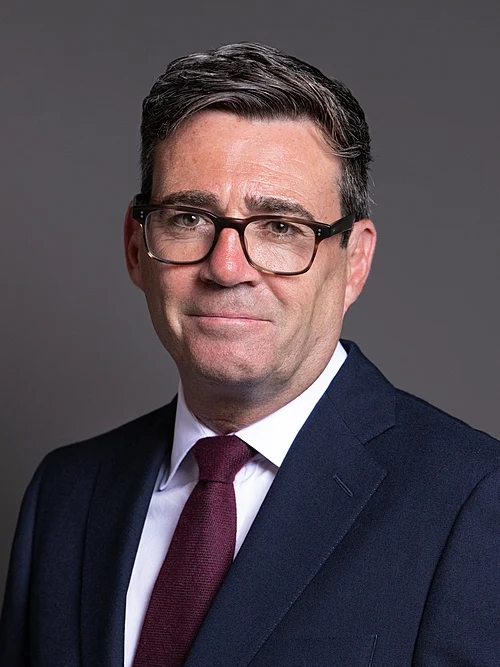
Prime Minister Andy Burnham’s official MP portrait, July 2026.
© House of Commons via Wikimedia Commons.
Andy Burnham is now Prime Minister, and the country soon to discover what “Manchesterism” means when applied to the British state. Burnham’s nine years as mayor, alongside his earlier national record, offer a clear guide to the instincts he is likely to bring to No.10: a willingness to raise taxes, expand the state and prioritise policies that sound good but ultimately deliver poor value for money.
It is revealing that after being elected mayor in 2017, one of Burnham’s first acts was to impose a new charge on households in Greater Manchester. The new mayoral precept was initially set at £8 for the average band D property, funding the mayoral operation, including Burnham’s £110,000 salary. As so often happens with new charges, it did not remain modest for long. The charge more than doubled the following year, rising again in 2020-21, 2022-23, 2025-26 and 2026-27. By the time Burnham resigned to contest the Makerfield by-election, it had risen to £61.75, nearly eight times the original amount in less than a decade.
As residents paid more, the mayor built an increasingly elaborate network of advisers, commissioners and panels funded by taxpayers. These included a young person’s advisor paid £500 per day, a transport commissioner and an active travel commissioner each paid £650 per day, and an LGBTQ+ advisor paid £177 per day. He also established seven equality panels facilitated by “culturally appropriate organisations” which cost £392,435 a year. Taxpayers can only speculate how much larger that ecosystem could become when he takes control of Whitehall.
The mayoral precept was not the only tax rise implemented by Burnham. As mayor, he raised every tax under his control. The band D police precept rose from £162.30 when he entered office to £285.30 by the time he left, a 76 per cent increase. At the same time, the fire precept increased from £59.95 to £92.20, a 54 per cent increase. Both increases substantially outstripped cumulative inflation of 37.5 per cent during that period.
Even that understates his tax-raising ambition, as it only includes the charges he managed to implement. In 2019, Burnham proposed a clean air zone for Greater Manchester which would impose a daily charge on commercial vehicles that did not comply with environmental standards: £7.50 per day for taxis, £10 per day on vans and £60 per day on buses, coaches and heavy goods vehicles. These would have added thousands of pounds a year to local businesses’ costs.
The Ancient Greeks 03 – Enter the Persians 4 – The Ionian Revolt and the Fatal Intervention
seangabb
Published 16 Feb 2026The Persian Wars begin not in Athens, but in Miletus. In this lecture we explore the failed Naxos expedition, Aristagoras’ desperate gamble, and the outbreak of the Ionian Revolt in 499 BC. We examine Aristagoras’ appeals to Sparta and Athens, Herodotus’ famous scene before Cleomenes, and the fateful decision of Athens to send twenty ships.
We also analyse the burning of Sardis, Darius’ calculated response, and the suppression of Ionia. This is not yet a world war — but it is the moment when Athens introduces itself to empire.
July 21, 2026
Exit Starmer, enter Burnham
Britain swapped out Prime Ministers on Monday, pushing Sir Keir Starmer out to the curb and installing former Greater Manchester mayor Andy Burnham in Number 10 Downing Street. In The Critic, Robert Hutton reports on the day’s events:
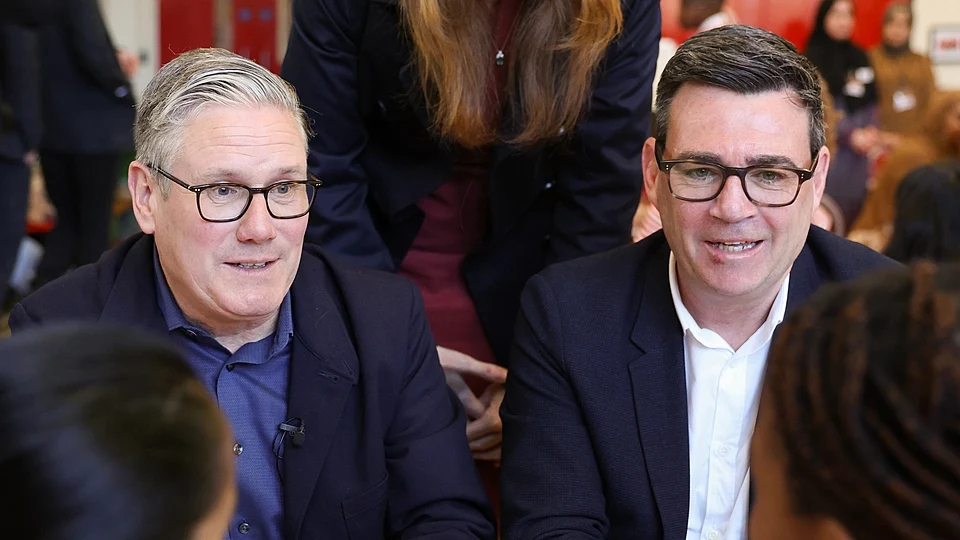
Then-Prime Minister Sir Keir Starmer visiting Holy Trinity Church of England Primary School in Manchester on 13 April 2026 with Andy Burnham, Mayor of Greater Manchester.
Picture by Lauren Hurley / No 10 Downing Street via Wikimedia Commons.
As Keir Starmer walked out of Number 10 for the last time, he was greeted by a huge cheering crowd. Wow, this guy is popular! He should consider running for office. “My work is done”, he told us, offering possibly the most misguided example of marking your own homework since George W Bush declared “Mission Accomplished” six weeks after invading Iraq. Although we shouldn’t be harsh: Liz Truss listed leading the nation in mourning the late Queen as her big achievement in office.
Starmer’s, as he pointed out yet again, was winning the election. The list of things done since then was slightly more vague. But again, Boris Johnson’s departing speech claimed credit for a high-speed train line to Manchester and a number of hospitals that still do not, as such, exist. At least Starmer could truthfully say that he was leaving “with a smile”. Was he also, as he claimed, going “with good grace”? Well, unlike Johnson, he managed to get through the speech without attacking the people who forced him out.
It wasn’t entirely cheery. His wife Victoria was wearing black, and Rachel Reeves was crying, once again. The departing prime minister warned us not to succumb to division and to “unite different people under our common flag”. Although he completely failed to help that happen while he was in office, and showed little interest in trying.
With that, he was off to Buckingham Palace, where the band was playing a medley of Bon Jovi songs. Shot through the heart, and only himself to blame, he gave Labour a bad name.
But if Starmer was going out in a blaze of inglory, the rest of us were only halfway there. While the King conducted his exit interview in the Palace’s Chinese Dining Room (imagine having a different space to eat every takeaway) we had to hold on, ready or not, through the hour in which we were without a prime minister and living, as it were, on a prayer.
Andy Burnham had put on a suit for the day, a concession to the soft southern ways of the monarch. We half-expected him to leap out of the car in Downing Street and rip off the whole ensemble, Full Monty-style, to reveal black jeans and a T-shirt underneath. Perhaps he felt that would be taking his personal branding too far.
A fresh crowd of Labour types had gathered, looking more convincingly happy than the ones who had stood behind the last guy. They included the incoming prime minister’s mum, and the youngest person present: Liverpool Mayor Steve Rotheram’s 10-week-old grandson, currently scheduled to become the King’s 49th prime minister, in about 2038.
Not everyone is as excited as Burnham’s Labour Party supporters:
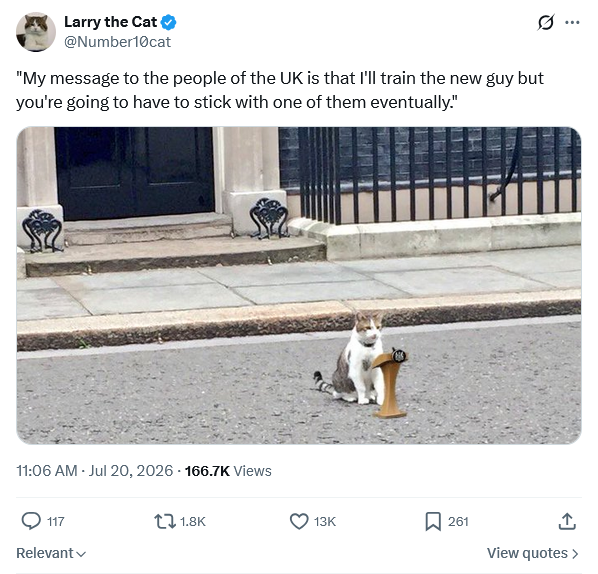
In Spiked, Brendan O’Neill bids an unfond farewell to Two-Tier Keir:
Sir Keir Starmer: the PM who did nothing about the sense of doom pervading Britain, but he did ban “doomscrolling“. The man who did zilch to mend our fraying social fabric, but he did stop kids from perusing its consequences on TikTok. The man who failed – catastrophically – to alleviate that bleak feeling many of us have that Britain is broken, but he did cover the next generation’s eyes to just how broken we are.
Starmer should be remembered for his social-media ban for under-16s, that mad, illiberal law, due to come into force in spring next year, that promises to liberate youth from the angst-inducing “doomscrolling” inflicted on them by Big Tech’s wily algorithms. Not because it’s a “landmark” policy, as he claims. And not because it will be effective – kids will find a workaround. No, it’s because leaving intact the social conditions of doom while tweaking the machine so that fewer people can ‘scroll’ those conditions is Starmerism summed up: a regime of hollow theatricality, devoted more to managing the optics of crisis than mustering up the competence to avert it.
Starmer is a man without a legacy. He promised competence over charisma and delivered neither. His was a phantom premiership: government without governing. You could ask a hundred Brits to name a policy he enacted and I reckon five, at best, could do so. Even his vanishingly small number of apologists usually only squawk about what he didn’t do. He didn’t drag us into the Iran-US War. He didn’t follow through on his promise to cut the winter-fuel allowance for pensioners. He didn’t murder anyone. A man so staggeringly insubstantial that even his fans prefer his inertia to his initiative.
For me, the terrifying nothingness of Starmerism is best summed up in the fact that he recently said his “proudest achievement” was scrapping the two-child benefit cap, the Tory-introduced measure that meant families could only claim additional welfare payments for their first two kids. But Starmer opposed cutting that cap. For ages. In fact, in July 2024, he withdrew the whip from seven Labour MPs who voted to scrap it. It was only under pressure from his parliamentary colleagues that he relented. What can you even say about a man whose “proudest achievement” is a course of action foisted on him by others? That’s Sir Keir: the political weathervane who mistook a gust of wind for his own internal moral compass.
Frederick the Great’s 1741 book, The Anti-Machiavel
At SteynOnline, Tal Bachman continues his look at all things Machiavelli, including Prussian king Frederick the Great’s polemic against the author of The Prince:
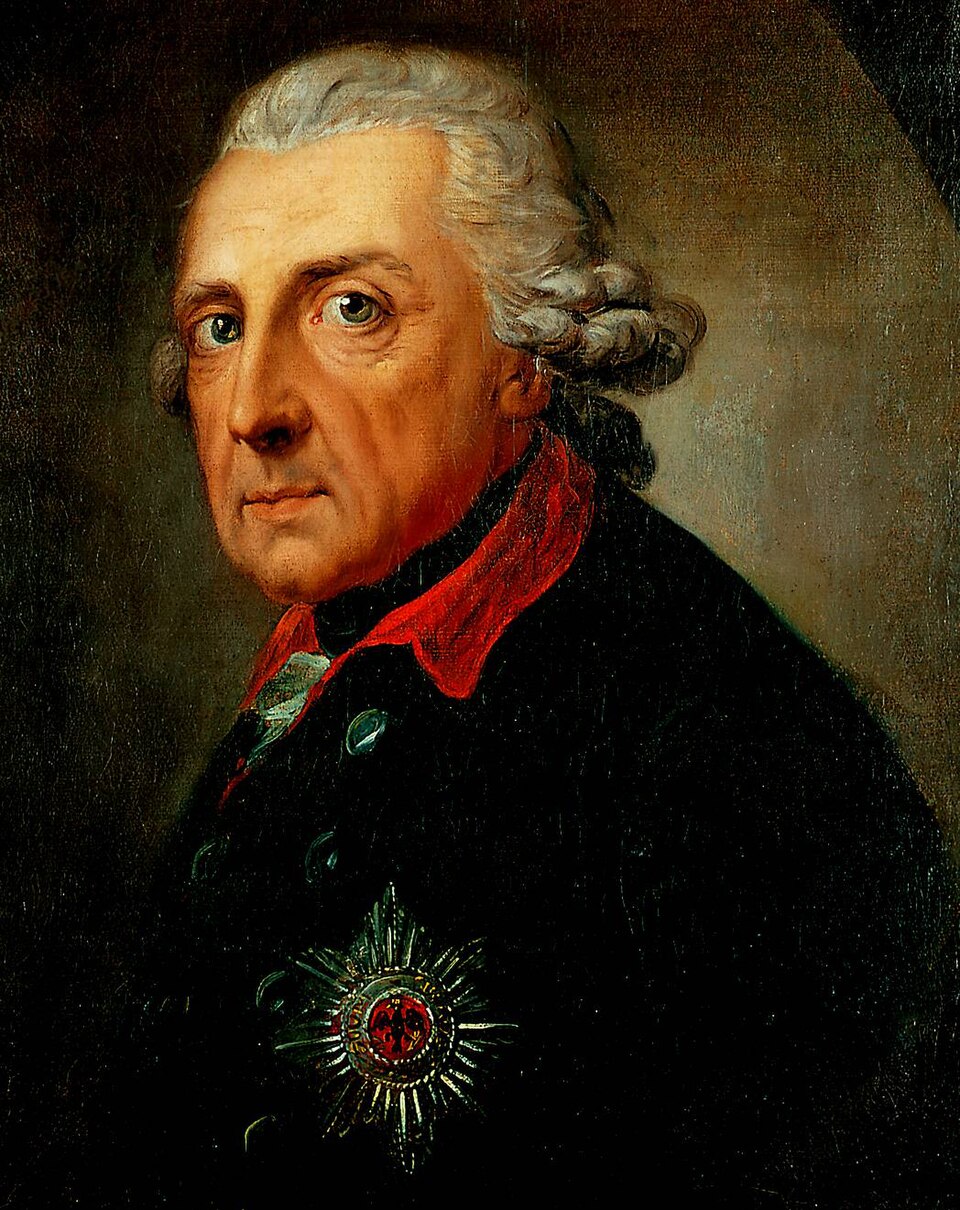
Frederick the Great, 1781
Oil portrait by Anton Graff (1736-1813) in the Sanssouci Palace collection via Wikimedia Commons.
Maybe Machiavelli’s teachings have no relevance in any remotely civilized political system. Maybe they’re far worse than irrelevant: maybe they’re all entirely evil (as they appear), and in addition, would prove the ruin of both the people and their ruler.
This was, as it happens, the view espoused by one important ruler: the Prussian king Frederick the Great. In his 1741 book, The Anti-Machiavel, he claims Machiavelli’s book is “one of the most dangerous that ever appeared in the world”, in that the political crimes it encourages would impose “a lasting misery upon whole nations”. Truly great rulers, says Frederick, aren’t the avaricious, amoral, self-serving, shape-shifting demons that Machiavelli describes. Rather, they are those “whose business it is to administer justice, and to set examples of justice to their subjects; and who, by their magnanimity, mercy, and goodness, ought to be the living images of Deity”. Thus, Frederick sees his rebuttal as “a defense of humanity against a monster who would destroy it”; it is “an antidote to poison”.
Frederick ruled Prussia for nearly 50 years. Most historians rate him a success. On the face of things, he seems like the kind of critic who knows what he’s talking about.
But Machiavelli would say, not so fast. What did Frederick do almost immediately after assuming power? Without any provocation, he launched a war to seize the large, prosperous, populous province of Silesia (now in southwestern Poland) from the Habsburg Monarchy. And he did so on a convoluted, centuries-old dynastic claim which sounded as unconvincing to his contemporaries as it does to us now. In the three Silesian wars which followed (the third turning into the Seven Years War), well over a million soldiers died fighting. Millions more wound up maimed, psychologically scarred, or otherwise ruined. Of course, millions of non-combatants also suffered: wives lost husbands, mothers and fathers lost sons, children lost fathers and uncles and brothers. Those non-combatants also suffered displacement, terror, deprivation, and injury. Over two decades, Frederick’s wars — particularly the Seven Years War — convulsed Europe. Frederick gained 30% more territory and 50% more citizens, but the cost was losing 10% of the Prussian population to combat or disease (the modern equivalent of 35 million Americans, 6 million English, or 3 million Australians). The point is: if his actions are anything to go by, Frederick didn’t oppose Machiavellian power moves as much as he professed, if at all. Machiavelli might even argue that in taking pains to proclaim his opposition to Machiavelli even as his wars of acquisition injured and killed millions, he was doing exactly what Machiavelli had advised: seeming to be good even as he was doing whatever the hell he wanted, for his own purposes. Most people will buy the act anyway, says Machiavelli, so why not?
This brings me back to Machiavelli’s claims about how rulers do in fact act, and how they must act to avoid ruin. And that in turn brings me back to the original wording of The Prince, and what real-world credibility Machiavelli might have as a political commentator.
As it happens, Machiavelli was no armchair quarterback. Even if he hadn’t spent nearly fifteen years at the highest levels of Florentine government (which he did), he might well have qualified as a political expert just by virtue of growing up in the tumultuous time and place he did. Between the jockeying Italian states, the myriad (and ever-changing) foreign alliances and enemies and designs, the political influence of the papacy, and Florence’s own internal politics, Machiavelli’s home city furnished more than enough lessons in how the political world could, and often did, operate.


