
The Annales school is a style of historical thinking that emerged in France in the early 1900s; at least for pre-modernists, the dominating figures here tend to be Marc Bloch and Fernand Braudel. It got its name because of its close association with Annales d’Historie Economique et Sociale. Fundamentally, what sets the Annales approach apart is first its focus and then the methods that focus demands.
The big shift in focus for the Annales school was an interest in charting the experience of society below the level of elites (though the elites are not abandoned either), what is sometimes termed “history from below”, as distinct from traditional elite-centered “great man” history or the more deterministic Marxist models of history at the time. You can see the political implications, of course, in the very early 1900s, of declaring the common man worthy of study; this is generally a history from the left but not the extreme left. That focus in turn demanded new approaches because it turned the focus of social history towards people who by and large do not write to us.
In reaching for that experience, Annales scholars tended to frame their thinking in terms of la longue durée (“the long run”); history was composed of three parts: événements (“events”), conjonctures (“circumstances”) and finally la longue durée itself. Often in English this gets rendered as a distinction between “events” (kings, wars, politics, crises) and “structures” (economics, social thought and at a deeper level climate, ecology, and geography). What Annales scholars tended to argue was that those structures were often more important than the events that traditional historians studied: the farmer’s life was far more shaped by very long-term factors like the local ecology, the organization of his farming village, the economic structure of the region and so on. And then the idea goes, that by charting those structures, you can figure things out about the lives of those farmers even if you don’t have many – or any – of those farmers writing to you.
Important to this was the idea of enduring patterns of thought within a society, what Bloch termed mentalités (“mentalities”, like longue durée, this is a technical term usually used in French to make that fact clear). Mentalités – Bloch’s original example was the idea that kings had a holy healing touch, but this could be almost any kind of social construct or pattern of ideas (indeed, one critique of it is that the notion of mentalités is broad and ill-defined) – can last a long time and can inform or constrain the actions of many actors within a society; think of how successive generations of kings can have their decisions shaped or constrained by their societies view – their own view – of kingship. That view of kingship might be more impactful than any one king and so pervasive that even a king would struggle to change it.
So how does this influence my work? I tend to be very much a “history from below” kind of historian, interested in charting the experience of regular farmers, soldiers, weavers and so on. The distinction between the long-term structures that shape life and the short-term events that populate our history is very valuable to think with, especially for identifying when an event alters a structure, because those tend to be very important events indeed. And I think a keen attention to the way people thought about things in the past and how those mentalités can be different than ours is very important.
That said, the Annales stress on mentalités has in some ways been overtaken by more data-driven historical methods on the one hand or a strong emphasis on local or individual experience (“microhistory”) on the other. Mentalités tend to be very big picture, asking how, say, “the French” thought about something over a period of decades or centuries and seeking to know how that shaped their experience. But archaeology, demographics or economic data can reveal patterns of behavior which might not correspond to the mentalités that show up in written texts; this is fundamentally the interaction that informs the “revenge of the archaeologists” in the study of the ancient economy, for instance. On the other hand, not everyone in that big group thinks the same and a microhistory of an individual or a single village might reveal telling local variations not captured in massive-scale structures.
Fortunately, historians do not need to be doctrinaire in our use of theory, we don’t have to pick one and stick to it. Different projects also lend themselves to different approaches. I think the Annales school offers a lot of really useful tools to have my historian’s toolbox, but they sit alongside military theory, archaeological material culture studies methods, philological approaches, a smattering of economic and demographic tools, etc.
Bret Devereaux, “Referenda ad Senatum: January 13, 2023: Roman Traditionalism, Ancient Dates and Imperial Spies”, A Collection of Unmitigated Pedantry, 2023-01-13.
July 13, 2023
QotD: The Annales school of history
July 12, 2023
“[E]lite colleges are machines for laundering privilege”
Scott Alexander ponders the reasons our elite universities operate as they do:

Harvard University Memorial Church.
Photo by Crimson400 via Wikimedia Commons.
We could think of “the best college” as a self-fulfilling prophecy; for whatever reason, one college has gotten a reputation as the one whose signal is most valuable. Everyone naturally tries to get in there; if they fail, they go to the college with the next-best reputation, and so on. The system is stable; the “best” college will keep its reputation (since it gets the best students) and the best students will always want to go to the best college. If, as Matt’s son suggests, all the Ivies started accepting the worst students instead, an Ivy degree would soon become a signal that you’re bad, and employers would stop respecting it.
I heard a fascinating variation of this hypothesis from Matt Christman of Chapo Trap House: elite colleges are machines for laundering privilege.
That is: Harvard accepts (let’s say) 75% smart/talented people, and 25% rich/powerful people. This is a good deal for both sides. The smart people get to network with elites, which is the first step to becoming elite themselves. And the rich people get mixed in so thoroughly with a pool of smart/talented people that everyone assumes they must be smart/talented themselves. After all, they have a degree from Harvard!
The most blatant form of this obfuscation: suppose you own a very successful family business. You can leave your son your fortune, you can leave him the business, you can leave him your mansion, but you can’t (directly) leave him an aura of having deserved all these things. What you can do is make a $10 million donation to Harvard in exchange for them accepting your son. Your son gets a Harvard degree, a universally-recognized sign of being a highly meritorious person. Then when you leave him the business, everyone will agree he deserves it. Who said anything about nepotism? Leaving a Harvard graduate in control of your business is an excellent decision!
This happens a little, but I think it mostly isn’t this obvious. More often the transactions are for abstract goods: prestige, associations, favors. The Maharaja of Whereverstan sends his daughter to Harvard so that she appears meritorious. In exchange, Harvard gets the credibility boost of being the place the Maharaja of Whereverstan sent his daughter. And Harvard’s other students get the advantage of networking with the Princess Of Whereverstan. Twenty years later, when one of them is an oil executive and Whereverstan is handing out oil contracts, she puts in a word with her old college buddy the Princess and gets the deal. It’s obvious what the oil executive has gotten out of this, but what does the Princess get? I think she gets the right to say she went to Harvard, an honor which is known to go mostly to the meritorious.
People ask why Harvard admissions can still be bribed or influenced by the rich or well-connected. This is the wrong question: the right question is why they ever give spots based on merit at all. The answer is: otherwise the scheme wouldn’t work. The point of a money-laundering operation is to take in both fairly-earned and dirty money, then mix them together so thoroughly that nobody can tell which is which. Likewise, the point of a privilege-laundering operation is to take in both fairly-earned and dirty privilege, then stamp both with a Harvard degree. “Fairly-earned privilege” means all the brilliant talented ambitious youngsters admitted on the basis of their SAT scores and grades and impressive accomplishments; “dirty privilege” means the kids of various old-money aristocrats, foreign potentates, and ordinary super-rich people. Colleges mix them together, with advantages for both groups.
Is this good or bad? It’s good insofar as it provides a justification for making some elite positions dependent on merit and accessible to anyone, but bad insofar as it helps defend and obfuscate the ones that aren’t. It’s good if you think it’s good for all the elites (meritocratic and otherwise) to know each other and be on the same page; it’s bad if you don’t want them to be (maybe because it helps them oppress people more efficiently).
I expect that without such a system the elites would do their own thing without any concession to merit whatsoever – so maybe it beats the alternative.
July 10, 2023
“De-banking” is the financial world’s version of cancelling someone
At the Free Life blog, Alan Bickley considers the recently reported rash of prominent (and not-so-prominent) critics of the British government being refused service by their banks and further refused permission to open new accounts with any other chartered bank. Being “cancelled” by social media companies is bad, but being “de-banked” in a modern economy is worse than being declared a “non-person” by a totalitarian regime:

“The bank of England. London.”by Demetrio Neri_1959 is licensed under CC BY-NC-SA 2.0


In the past month, we have heard that various rich and well-connected people have had their bank accounts closed, seemingly because of their dissident political opinions. The same has happened to other people who are much poorer and without connections. Twenty years ago, the same happened to the British National Party. There is a simple libertarian response to this.
No one has the right to coerced association with anyone else. If someone comes to me and asks me to provide him with services, I have an absolute right to say yes or no. If I am uncharitable enough to dislike the colour of his face or what he does in bed, so much the worse. I may lose valuable business. But it is my time, and it is my choice. If anyone starts a whine about the horrors of discrimination, he should be ignored. We have an absolute right to discriminate against others for any reason whatever.
This being said, the position becomes less clear when state power of some kind is involved. Banks in this country require a licence from the State to operate. This protects them from open competition. It also gives them access to services and information from the State that are not given to other persons or businesses. If a bank finds itself in serious financial difficulties, it has at least a greater chance than other large businesses of being saved by the State – by a coordination of support by others or by direct financial help. The State has also made it illegal for many transactions to be made in cash. If I try to buy a car with £20,000 in cash, the car dealership is obliged to refuse my business, or to make so many enquiries that accepting my business is too much trouble. In effect, anyone who wants to spend more than a few thousand pounds in cash is obliged by various actual and shadow laws to use a bank account.
So we have privileged corporations and an effective legal obligation for people to do business with them. This entirely changes the libertarian indifference to commercial discrimination. The banks are a privileged oligopoly. The banks compete for custom among a public that is free to choose one bank rather than another, but that is compelled to choose some bank. For this reason, since the relevant laws will not be repealed, it is legitimate to demand another law to offset some of the effects of the others. Banks should be legally obliged to accept the business of any person or group of persons without question. Limitations on what services are provided must be justified on the grounds of previous financial misconduct as reasonably defined. For example, it should be permitted for a bank to refuse an overdraft to someone who is or has recently been bankrupt, or whose spending habits are obviously reckless. Perhaps it should be permitted for a bank to refuse to lend money for purposes it regards as scandalous as well as commercially unviable. Therefore, a representative of the White Persons’ Supremacy Foundation, or the Vladimir Putin Appreciation Society, should be able to walk into any bank and open an account – with no questions asked. If an account is refused, there should be a legal obligation on the bank to provide a full explanation of the refusal. If the refusal is not made on valid commercial grounds, there should be a right of appeal before a tribunal which does not award costs, and this tribunal should have the power to grant punitive damages against any bank found to be discriminating on any grounds but the validly commercial.
The refusal of banking services is only the beginning of a new and sophisticated totalitarianism. What the banks can do can also be done by supermarkets, by Internet service providers, by hotel chains, by airlines and railway companies, and by utility providers. There is indeed a good case for insisting on a law forbidding any organisation that has the privilege of limited liability from any but obviously commercial discrimination.
June 28, 2023
How to Fund a War: Lend Lease, Billion Dollar Gift, and Aid to Britain
OTD Military History
Published 27 Jun 2023Programs like Lend Lease, Mutual Aid, and the Billion Dollar Gift were support from Canada and the United States that helped Britain with war supplies and material in the darkest days of World War 2.
(more…)
June 25, 2023
Workers will be forced to stop working to salve the consciences of university-educated elite wankers
Brendan O’Neill on the Climate Goblin’s latest stunt in Sweden:

Picture the daughter of an opera singer preventing working-class men from doing their jobs. A young woman so well-connected that she probably has presidents on speed-dial physically blocking truck drivers from doing what they do. A child of privilege gathering with her similarly comfortable pals to stop working people from working.
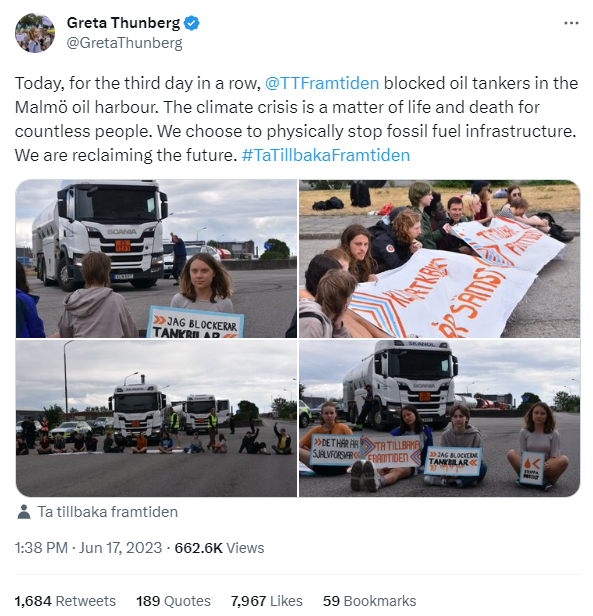
Well, shorn of all the fact-lite bluster about “saving the planet”, that’s exactly what Greta Thunberg’s latest eco-stunt adds up to. The pint-sized prophetess of doom is back in the headlines. This time for getting arrested in Malmo harbour in Sweden, where she and other members of the End is Nigh cult have been holding a sit-down protest to stop oil tankers from leaving and delivering their life-giving cargo to the good people of Sweden and beyond.
The photographs from this temper tantrum disguised as a political protest tell a fascinating tale of the classism and narcissism in green politics. In the middle of the road are the smug-looking youths. One has green hair. Others sport beanie hats. None has ever driven a truck, clearly. Their banners speak of defending Earth from man’s evil burning of the toxic sludge of oil. And in the background are the supposed agents of this evil – the truckers; working men idly standing by their tankers while the world’s media get shots of Greta looking sad for Gaia.
What an apt snapshot of the hierarchy of virtue in what passes for radical politics today. Working-class people reduced to background actors, non-player characters, in a drama feverishly focussed on the jumped-up angst of the privileged. Working men as mere backdrop to the eco-neuroses of the comfortably off. In the moral universe fashioned by eco-influencers and their legion fawners in the political and media elites, the irrational fears of the upper-middle class carry more weight than the living standards of the working class.
It’s a story we see repeated across every act of eco-agitation today. In the UK, the plummy activists of Just Stop Oil, all called Poppy or Edred, block roads and prevent builders, scaffolders, deliverymen, mums and others from carrying out their essential work. The fightback of working men against this imperious imposition on their right to earn a living – witness scaffolders pushing eco-irritants out of the road – has been heartening to see. As a worker at Smithfield meat market in London put it a few years back when Extinction Rebellion types stormed in to speak up for animal rights or something, why should I allow this “happy-clappy mob” to stop me from being “able to pay my bills”?
June 15, 2023
Thursday tab-clearing
A few items that I didn’t feel required a full post of their own, but might be of interest:
- Justin Trudeau’s government is clearly interested in moving to a Central Bank Digital Currency (CBDC), but “Canadians are not at peace with the idea of cash vanishing into thin air, with a consistent 80 per cent of respondents having no plans to go cashless“
- There’s an ongoing shortage of Adderall in the United States … and the Drug Enforcement Agency (DEA) is behind it.
- Alasdair Beckett-King explains what’s wrong with every time travel movie – https://youtu.be/zI0aBzA2K9s
- The man who visited Lenin’s Soviet Union and said “I have been over into the future, and it works.”
- Kim du Toit isn’t a believer in the official inflation statistics: “When the history of this era comes to be written, one of the most egregious falsehoods to be exposed will be the ‘official’ inflation rate.”
- Random meme of the day:

June 14, 2023
Wednesday web-droppings
A few items that I didn’t feel required a full post of their own, but might be of interest:
- “Teacher, leave them kids alone!” – Middle schoolers staged a revolt on the day they were told to wear rainbow colors to celebrate pride. They wore red, white, and blue, and said their pronouns were “U.S.A.” Woke faculty is freaking out.
- Sir Humphrey answers the question “Is the Royal Navy still a truly ‘blue water navy’?“
- Brendan O’Neill is nostalgic for a long-distant past before everyone started sounding like off-brand Unabomber disciples.
- Tim Harford on “Giffen goods“
- Random meme of the day:

June 12, 2023
QotD: Cities in the pre-modern era
I find myself interested in pre-modern economies and militaries in roughly equal measure (in part because both are such crucial elements of state or societal success or failure). One of the reasons is that they are so interconnected: how military force is raised, supplied, maintained and projected is deeply dependent on how the underlying economy (which supplies the men, food, weapons and money) is structured and organized. And military institution and activities often play an important role in shaping economic structures in turn. So even if you are just here for the clashing of swords, remember: every sword must be forged, and every swordsman must be fed.
(Additional aside: I am assuming a west-of-the-Indus set of cereals: grain, barley and millet chiefly. Specifically, I am not going to bring in rice cultivation – the irrigation demands and density of rice farming changes a lot (the same is also true, in the opposite direction, to agriculture based around sorghum or yams). Most (western) fantasy and historic dramas are not set in rice-planting regions (and many East Asian works seem to have a much better grasp on where rice fields go and need no correction), so I’m going to leave rice out for now. I’m honestly not qualified to speak on it anyway – it is too different from my own area of research focus, which is on a Mediterranean agricultural mix (wheat, barely, olives, grapes), and I haven’t had the chance to read up on it sufficiently).
Lonely Cities
There’s a certain look that castles and cities in either historical dramas or fantasy settings set in the ancient or medieval world seem to have: the great walls of the city or castle rise up, majestically, from a vast, empty sea of grassland. […] These “lonely cities” are everywhere in fantasy and historical drama. I think we all know something is off here: cities and other large population centers do not simply pop up in the middle of open fields of grass, generally speaking. So if this shouldn’t all be grassland, what should be here? Who should be here?
What is a City For?
I think we need to start by thinking about why pre-modern towns and cities exist and what their economic role is. I’ll keep this relatively brief for now, because this is a topic I’m sure we’ll return to in the future. As modern people, we are used to the main roles cities play in the modern world, some of which are shared by pre-modern cities, and some of which are not. Modern cities are huge production centers, containing in them both the majority of the labor and the majority of the productive power of a society; this is very much not true of pre-modern cities – most people and most production still takes place in the countryside, because most people are farmers and most production is agricultural. Production happens in pre-modern cities, but it comes nowhere close to dominating the economy.
The role of infrastructure is also different. We are also used to cities as the center-point lynch-pins of infrastructure networks – roads, rail, sea routes, fiber-optic cable, etc. That isn’t false when applied to pre-modern cities, but it is much less true, if just because modern infrastructure is so much more powerful than its pre-modern precursors. Modern infrastructure is also a lot more exclusive: a man with a cart might visit a village where the road does not go, but a train or a truck cannot. The Phoenician traders of the early iron age could pull their trade ships up on the beach in places where there was no port; do not try this with a modern container ship. Infrastructure is largely a result of cities, not their original purpose or cause.
So what are the core functions of a pre-modern city? I see five key functions:
- Administrative Center. This is probably the oldest purpose cities have served: as a focal point for political and religious authorities. With limited communications technology, it makes sense to keep that leadership in one place, creating a hub of people who control a disproportionate amount of resources, which leads to
- Defensive/Military Center. Once you have all of those important people and resources (read: stockpiled food) in one place, it makes sense to focus defenses on that point. It also makes sense to keep – or form up – the army where most of the resources and leaders are. People, in turn, tend to want to live close to the defenses, which leads to
- Market Center. Putting a lot of people and resources in one place makes the city a natural point for trade – the more buyers and sellers in one place, the more likely you are to find the buyer or seller you want. As a market, the city experiences “network” effects: each person living there makes the city more attractive for others. Still, it is important to note: the town is a market hub for the countryside, where most people still live. Which only now leads to
- Production Center. But not big industrial production like modern cities. Instead it is the small, niche production – the sort of things you only buy once-in-a-while or only the rich buy – that get focused into cities. Blacksmiths making tools, producers of fine-ware and goods for export, that sort of thing. These products and producers need big markets or deep pockets to make end meet. The majority of the core needs of most people (things like food, shelter and clothes) are still produced by the peasants, for the peasants, where they live, in the country. Still, you want to produce goods made for sale rather than personal use near the market, and maybe sell them abroad, which leads to
- Infrastructure Center. With so much goods and communications moving to and from the city, it starts making sense for the state to build dedicated transit infrastructure (roads, ports, artificial harbors). This infrastructure almost always begins as administrative/military infrastructure, but still gets used to economic ends. Nevertheless, this comes relatively late – things like the Persian Royal Road (6th/5th century BC) and the earliest Roman roads (late 4th century BC) come late in most urban development.
Of course, all of these functions depend, in part, on the city as a concentration of people. but what I want to stress – before we move on to our main topic – is that in all of these functions the pre-modern city effectively serves the countryside, because that is still where most people are and where most production (and the most important production – food) is. The administration in the city is administering the countryside – usually by gathering and redistributing surplus agricultural production (from the countryside!). The defenses in the city are meant to defend the production of the countryside and the people of the countryside (when they flee to it). The people using the market – at least until the city grows very large – are mostly coming in from the country (this is why most medieval and ancient markets are only open on certain days – for the Romans, this was the “ninth day”, the Nundinae – customers have to transit into town, so you want everyone there on the same day).
(An aside: I have framed this as the city serving the economic needs of the countryside, but it is equally valid to see the city as the exploiter of the countryside. The narrative above can easily be read as one in which the religious, political and military elite use their power to violently extract surplus agricultural production, which in turn gives rise to a city that is essentially a parasite (this is Max Weber’s model for a “consumer city”) that contributes little but siphons off the production of the countryside. The study of ancient and medieval cities is still very much embroiled in a debate between those who see cities as filling a valuable economic function and those who see them as fundamentally exploitative and rent-seeking; I fall among the former, but the latter do have some very valid points about how harshly and exploitatively cities (and city elites) could treat their hinterlands.)
Consequently, the place and role of almost every kind of population center (city, town or castle-town) is dictated by how it relates to the countryside around it (the city’s hinterland; the Greeks called this the city’s khora (χώρα)).
Bret Devereaux, “Collections: The Lonely City, Part I: The Ideal City”, A Collection of Unmitigated Pedantry, 2019-07-12.
June 11, 2023
Minimum alcohol pricing fails utterly in reducing “problem” drinking, but it’s aces for padding the state’s coffers
Christopher Snowden counts coup on Scotland’s utterly failed “minimum pricing model” for alcohol which has cost Scots additional hundreds of millions of pounds for no discernable improvement in any measurable:

This study was published yesterday and got no attention whatsoever from the media despite it being written by a team in Sheffield who used to get blanket coverage for their every pronouncement. What changed? Well, they used to produce models showing that minimum alcohol pricing would work and now they’ve produced a study showing that their model didn’t work.
The results above suggest the introduction of MUP in Scotland did not lead to a decline in the proportion of adult drinkers consuming alcohol at harmful levels. It also did not lead to any change in the types of alcoholic beverage consumed by this group, their drinking patterns, the extent to which they consumed alcohol while on their own or the prevalence of harmful drinking in key subgroups.
Oof! So much for the “exquisitely targeted” policy of minimum pricing being an “almost perfect alcohol policy because it targets cheap booze bought by very heavy drinkers“.
After building your entire reputation on modelling minimum pricing, it must have been painful for them to write this …
… the lack of evidence for a decline in the prevalence of harmful drinking arising from MUP is contrary to model-based evidence that informed the introduction of the policy.
Hey-ho. I guess the model was garbage, as I said from the start. Never mind. It’s only cost drinkers in Scotland a few hundred million pounds. Will the Supreme Court be taking another look at that court case that was won off the back of an incorrect model?
The lack of change in the prevalence of harmful drinking may arise for several reasons. First, people drinking at harmful levels may be less responsive to price changes than lighter drinkers.
You don’t say! If only someone had mentioned this earlier!
Previous qualitative research and studies of purchasing behaviour among people with alcohol dependence (i.e. a group that comprises approximately 20% of those drinking harmfully in the United Kingdom and thus 1% of the overall population) supports this view. However, the very large price increases imposed by MUP on people drinking harmfully, their inability to switch to cheaper products and clear evidence of successful policy implementation and compliance, mean their price responsiveness would need to be extremely low to negate any impact on consumption.
But it is extremely low! I explained this over a decade ago when I took the model to task for making the plainly daft assumption that heavy drinkers are more price sensitive than moderate drinkers. I wrote:
“The model assumes that minimum pricing will have more effect on the consumption patterns of heavy drinkers than on moderate drinkers because heavy drinkers are more price-sensitive. This is a convenient belief since it is heavy drinkers who cause and suffer the most alcohol-related harm, but can we really assume that someone with an alcohol dependency is more likely to be deterred by price rises than a more casual consumer? The SAPM model says that they are, and yet there is ample evidence to support the common sense view that heavy drinkers and alcoholics are less price-sensitive than the general population (eg. Gallet, 2007; Wagenaar, 2009). Indeed, research has shown that price elasticity for the heaviest drinkers is ‘not significantly different from zero’ — they will, in other words, purchase alcohol at almost any cost.”
You don’t need an encyclopaedic knowledge of the price elasticity literature to work this out. For most people, it falls under the umbrella of the bleeding obvious. Here we are 11 years later and the penny still hasn’t quite dropped at Sheffield, but we’re getting closer.
Ask Ian: Why So Few Reproduction Historic Guns?
Forgotten Weapons
Published 22 Feb 2023From Paul on Patreon:
“I’ve always thought there were a lot of older guns that deserve to be reproduced, many of which could be really simple to manufacture. PSA is planning the release of their StG44 repro which is exciting. But why don’t we see this sort of thing more often. I suppose not everyone in the firearms community is going to want this sort of thing, but I think there are a lot of guns that would sell well enough to justify their reproduction.”Fundamentally, we don’t see more reproduction firearms because they are actually a lot harder and more expensive to make than people would think, and the market for them is smaller than people would think. Re-engineering old firearms for new production is a really substantial project, and the original data required rarely exists. The guns must be cheap enough and reliable enough to attract modern buyers, which will often require compromises on authenticity — which immediately reduces the already-small pool of potential buyers.
(more…)
June 9, 2023
Putting an end to “stakeholder” capitalism
The Streetwise Professor explains what “stakeholder capitalism” is and why it needs to be staked through the heart to save western economies:

A graphic from Wikipedia showing typical internal and external stakeholders.
At its root, stakeholder capitalism represents a rejection – and usually an explicit one – of shareholder wealth maximization as the sole objective and duty of a corporation’s management. Instead, managers are empowered and encouraged to pursue a variety of agendas that do not promote and are usually inimical to maximizing value to shareholders. These agendas are usually broadly social in nature intended to benefit various non-shareholder groups, some of which may be very narrow (transsexuals) or others which may be all encompassing (all inhabitants of planet earth, human and non-human).
This system, such as it is, founders on two very fundamental problems: the Knowledge Problem and Agency problems.
The Knowledge Problem is that no single agent possesses the information required to achieve any goal – even if universally accepted. For example, even if reducing the risk of global temperature increases was broadly agreed upon as a goal, the information required to determine how to do so efficiently is vast as to be unknowable. What are the benefits of a reduction in global temperature by X degrees? The whole panic about global warming stems from its alleged impact on every aspect of life on earth – who can possibly understand anything so complex? And there are trade-offs: reducing temperature involves cost. The cost varies by the mix of measures adopted – the number of components of the mix is also vast, and evaluating costs is again beyond the capabilities of any human, no matter how smart, how informed, and how lavishly equipped with computational power. (Daron Acemoğlu, take heed).
[…]
Agency problems exist when due to information asymmetries or other considerations, agents may act in their own interests and to the detriment of the interests of their principals. In a simple example, the owner of a QuickieMart may not be able to monitor whether his late-shift employee is sufficiently diligent in preventing shoplifting, or exerts appropriate effort in cleaning the restrooms and so on. In the corporate world, the agency problem is one of incentives. The executives of a corporation with myriad shareholders may have considerable freedom to pursue their own interests using the shareholders’ money because any individual shareholder has little incentive to monitor and police the manager: other shareholders benefit from, and thus can free ride on, any individual’s efforts. So managers can, and often do, get away with extravagant waste of the resources owned by others placed in their control.
This agency problem is one of the costs of public corporations with diffuse ownership: this form of organization survives because the benefits of diversification (i.e., better allocation of risk) outweigh these costs. But agency costs exist, and increasing the scope of managerial discretion to, say, saving the world or achieving social justice inevitably increases these costs: with such increased scope, executives have more ways to waste shareholder wealth – and may even get rewarded for it through, say, glowing publicity and other non-pecuniary rewards (like ego gratification – “Look! I’m saving the world! Aren’t I wonderful?”)
H/T to Tim Worstall for the link.
June 8, 2023
1954: The END of RATIONING
BBC Archive
Published 5 Mar 2023“The ration book has done its job. It’s been a long job. Indeed, children up to school-leaving age have never known life without the ration book.”
On the fourth of July, the rationing of meat in Britain came to an end, the final step in dismantling Britain’s whole wartime system of food distribution. After fourteen long years, Britons can at last tear up their ration books.
Richard Baker looks back at some of the key moments in the story of rationing and de-rationing.
Originally broadcast 5 July, 1954.
June 2, 2023
The idiocy of trying to portray political systems on a single spectrum
Lawrence W. Reed explains why trying to illustrate the similarities and differences of political systems using only a single axis conceals more than it reveals, especially for students:
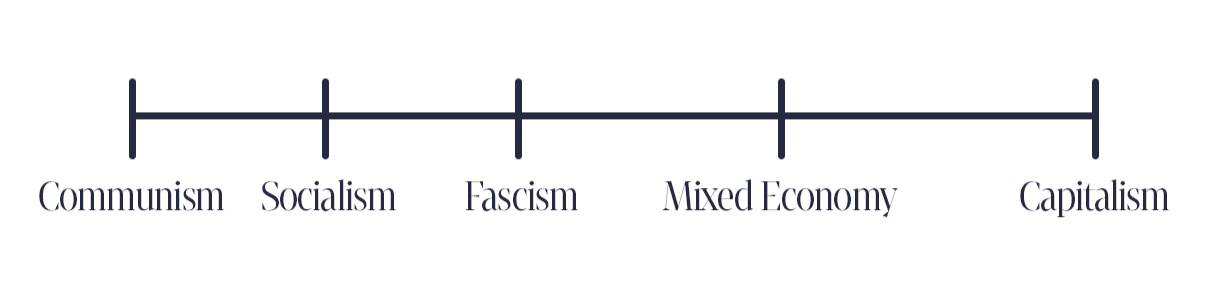
In classes on Government and Political Science, with few exceptions, students in both high school and college are taught that the so-called “political spectrum” (or “political/economic” spectrum) looks like this: Communism and Socialism reside on the Left, Capitalism and Fascism dwell on the Right. Various mixtures of those things lie somewhere in between:
This is not only false and misleading, it is also idiocy. Toss it into the trash bin and demand a refund from the teacher who presented it as fact, or as any kind of insightful educational tool.
At the very least, a spectrum that looks like that should raise some tough questions. Why should socialists and fascists be depicted as virtual opposites when they share so much in common — from their fundamental, intellectual principles to their methods of implementation? If a political spectrum is supposed to illustrate a range of relationships between the individual and the State, or the very size and scope of the State, then why are systems of Big State/Small Individuals present at both ends of it?
On any other topic, the two ends of a spectrum would depict opposites.
[…]
My contention is that if Communism, Socialism, Fascism and Capitalism all appear on the same range line, it is terribly misleading and utterly useless to place the first two on the left and the second two on the right. The placement that makes the most sense is this one:
The perspective represented in this sketch immediately arouses dispute because its implications are quite different from what students are typically taught. The inevitable objections include these three:
1. Communism and fascism cannot be close together because communists and fascists fought each other bitterly. Hitler attacked Stalin, for example!
This objection is equivalent to claiming, “Al Capone and Bugs Moran hated and fought each other so they can’t both be considered gangsters”. Or, “Since Argentina and Brazil compete so fiercely in football, both teams cannot be composed of footballers”.
Both communism and fascism demonstrate in actual practice an extremely low regard for the lives and rights of their subject peoples. Why should anyone expect their practitioners to be nice to each other, especially when they are rivals for territory and influence on the world stage?
We should remember that Hitler and Stalin were allies before they were enemies. They secretly agreed to carve up Poland in August 1939, leading directly to World War II. The fact that Hitler turned on Stalin two years later is nothing more than proof of the proverb, “There’s no honor among thieves”. Thieves are still thieves even if they steal from each other.
2. Under communism as Karl Marx defined it, government “withers away”. So it cannot be aligned closely with socialism because socialism involves lots of government.
Marx’s conception of communism is worse than purely hypothetical. It is sheer lunacy. The idea that the absolutist despots of the all-powerful “proletarian dictatorship” would one day simply walk away from power has no precedent to point to and no logic behind it. Even as a prophecy, it strains credulity to the breaking point.
Communism in the sketch above appears where it does because in actual practice, it is just a little more radical than the worst socialism. It is the difference between the murderous, totalitarian Khmer Rouge of Cambodia and, say, the socialism of Castro’s Cuba.
3. Communism and Fascism are radically different because in focus, one is internationalist and the other is nationalist (as in Hitler’s “national socialism”).
Big deal. Again, chocolate and vanilla are two different flavors of ice cream, but they’re both ice cream. Was it any consolation to the French or the Norwegians or the Poles that Hitler was a national socialist instead of an international socialist? Did it make any difference to the Ethiopians that Mussolini was an Italian nationalist instead of a Soviet internationalist?
Endless confusion persists in political analysis because of the false dichotomy the conventional spectrum (Sketch 1) suggests. People are taught to think that fascists Mussolini and Hitler were polar opposites of communists Lenin, Stalin, and Mao. In fact, however, they were all peas in the same collectivist pod. They all claimed to be socialists. They all sought to concentrate power in the State and to glorify the State. They all stomped on individuals who wanted nothing more than to pursue their own ambitions in peaceful commerce. They all denigrated private property, either by outright seizure or regulating it to serve the purposes of the State.

May 31, 2023
The War Against The Patriarchy, updated
Janice Fiamengo responds to a recent Joel Kotkin op-ed in the National Post discussing the “war of the sexes” and the long, long string of victories chalked up by the “weaker sex”:

The war between the sexes has ended, and rather than a co-operative future that could benefit all, it has turned out to be more like a lopsided win for the female side.
So begins Joel Kotkin’s National Post op/ed “Women have won the ‘war between the sexes’, but at what cost?” It is a welcome but disappointing analysis that starts with a show of defiance and ends in quiet desperation. Of course, it’s good to find anyone in a major newspaper willing to cast a less-than-adulatory eye on “The Future [that] is Female” or to write sympathetically about men, and Kotkin, a prolific author on cities and technocracy, proves his good faith on the strength of that opening statement alone. Aside from the wishful thinking of believing feminism to be winding down (was #MeToo a prelude to ceasefire?) or ever having envisioned a co-operative future (he should take a look at Kate Millett’s incendiary “Theory of Sexual Politics“), Kotkin is to be commended for daring to name as a war the decades of post-1960s activism, in which all the decisive victories have been claimed by feminists against men.
Kotkin, however, isn’t able to continue in the take-no-prisoners style he chose for his opening salvo. He is prevented, either by his own prudence, his lack of deep knowledge, or the paper’s editorial insistence, from targeting feminist ideology and policies in the rest of the article. In fact, the article doesn’t name a single piece of debilitating feminist legislation or even make one reference to the many expressions of anti-male contempt that are now deeply embedded in our public culture. The result is a curiously disembodied discussion in which serious social problems linked to male decline are pointed to without any attempt made to say exactly how they came about or how they might be reversed.
“The crux of the problem,” Kotkin tells us to start off, “lies in the fact that as women rise, men seem to be falling.” Here we see him start to draw back from the attack, as if afraid to say what he really thinks. His phrasing makes male decline sound like a natural phenomenon, an illustration of the primordial principle of Yin and Yang. Or perhaps it is simply that men, with their allegedly fragile egos and hegemonic masculinity, haven’t been able to compete against all that female ability, once dammed up by the patriarchy, now finally being let loose on the world (though always with calls for more to be done to assist women).
[…]
Kotkin refers to men “left behind” in the economy, but he keeps mum about the decades of affirmative action in higher education and hiring (detailed by Paul Nathanson and Katherine Young in Legalizing Misandry, pp. 81-124) as well as draconian sexual harassment legislation that have made work life unrewarding and often punitive for men.
He stresses the loss of sexual amity and of willingness to marry, but avoids discussing the nightmare of family law that has made marriage or even cohabitation perilous for many men.
The sins of omission do not end there. Perhaps working on the assumption — not without basis — that any discussion of social problems will need to focus on women at least as much as on men, Kotkin proceeds to backtrack on his earlier claim about women’s victory in the sex war, outlining instead a downbeat portrait of women’s troubles. Citing research by Jonathan Haidt, he tells us that adolescent girls have been severely affected by depression and self-harm, that many young women, without reliable men to support them, have had to fend for themselves in a difficult economic climate, and that single mothers, left with few options, are unable to offer stability to their children. It looks as if the decline of men mentioned early in the article has mainly hurt women and their children.
What Kotkin neglects to mention — surely deliberately — is that adolescent boys commit suicide at 4 X the rate of girls, resolving their depression decisively enough that Haidt seems not to have felt the need to account for them; that women are the ones who choose divorce in approximately 70% of cases; and that divorced fathers are too often denied a real role in their children’s lives while being burdened past endurance by exorbitant support payments. In other words, for every sad woman held up for our concern, there is a plurality of equally sad men rendered invisible in the conventional reporting. The staggering statistics on male suicide provide a stark illustration of Kotkin’s initial contention about the casualties of the sex war — yet he leaves these aside, choosing instead to voice the now-obligatory concern about the trans threat to women’s sports.
Perhaps most importantly, Kotkin suggests through his word choice that the data he cites are simply “trends”, occurrences that came about through economic and demographic factors independent of the sex war initially evoked. But they aren’t. They flow directly from a feminist vision in which the family — explicitly understood by feminist leaders to be a source of abuse and oppression — must be transformed and women liberated from reliance on the fathers of their children. Under this vision, a more just and equitable world will be ushered in by women’s superior leadership once they are freed from their unpaid labor in the home and the many sexist barriers that hold them back. That freedom must be aided, according to conventional wisdom, through abundant contraception, unfettered abortion, collectivized child care, no-fault divorce, programs and propaganda to urge men to do more housework, and non-stop encouragement to women — in movies, sit-coms, advertising, articles, and government equity programs — to give up on their men.
May 29, 2023
“I’m starting to think that Just Stop Oil is a Big Oil plant”
Tom Slater on the amazing tone-deafness of the Just Stop Oil “activists”:
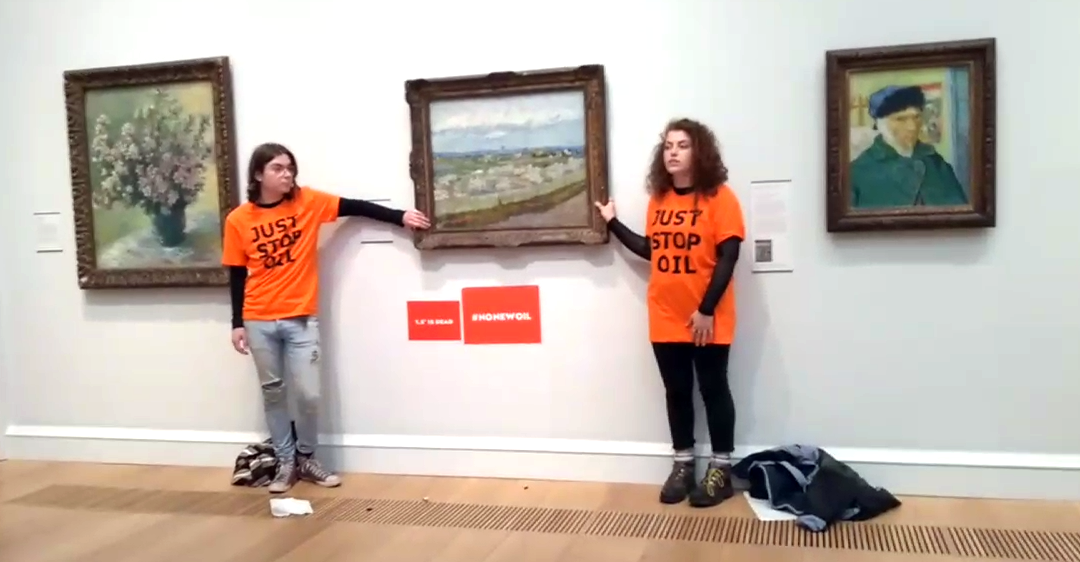
“Just Stop Oil Courtauld Gallery 30062022” by Just Stop Oil is licensed under CC BY-SA 4.0 

 .
.
I’m starting to think that Just Stop Oil is a Big Oil plant. What else could explain these campaigners’ phenomenal ability to turn the public against them and confirm their critics’ worst prejudices. Namely, that this environmental activism / amdram troupe is stuffed with upper-middle-class irritants who couldn’t give a damn about working-class people. Surely, this has got to be on purpose?
Take their recent “slow marches” through London, aimed at bringing traffic to a standstill. The whole point of these stunts seems to be to force cab drivers, delivery men and builders to sit in traffic so that these protesters can preach their miserable little gospel. And as Edred Whittingham‘s (don’t laugh) deranged antics at the Crucible recently showed us, you now can’t even escape these bourgeois millenarians during your leisure time.
That this new generation of environmentalists are almost uniformly posh is an established empirical fact. An academic survey of those involved in Extinction Rebellion – the mothership organisation from which Just Stop Oil and Insulate Britain were spawned – found, to the surprise of precisely no one, that they were overwhelmingly middle class, highly educated and from the south. A full 85 per cent of them have some form of university degree.
So what we have here is the comfortably off classes – those with sufficient free time to glue themselves to roads on a Wednesday mid-morning – forcing their weird hangups on everyone else. Time and again, when they are criticised for making people’s lives a misery, they offer only patronising lectures. “We’re so sorry that we have to disrupt the lives of ordinary people”, said Just Stop Oil’s Eben Lazarus (I know) to Vice last year, but “hopefully people will see, further down the line, that the disruption we’re causing is microscopic compared to the disruption that we’re going to face because of the climate crisis”. Translation: we know better, you cretins.
No wonder that so many now respond to these cunning stunts with instant, visceral fury. First there was the Battle of Canning Town in 2019, when east-London commuters pulled two Extinction Rebellion people down from the top of a Tube train. And as police have failed to deal with these protests – they now seem to escort rather than stop these “slow marches” – motorists have increasingly decided to take matters into their own hands. Several clips of workers clashing – sometimes physically – with Just Stop Oil activists have gone viral in the past week alone, including one of a man shoving JSOers on Blackfriars Bridge, before promptly being arrested.


