Quotulatiousness

April 8, 2025

Free trade, the once-and-future left wing cause

Let’s join Tim Worstall on a brief trip into economic history, when free trade was a pet issue for the left (because it helped the poor and the working class) and protectionism was the position of the right (because it helped the wealthy and the aristocracy):

The people who suffer here are the consumers in the US. The people who benefit are the capitalists in the US. Which is why free trade always has been a left wing position. True, many lefties in recent decades have somewhat strayed from the one true path but given that it’s Trump imposing them some seem to be coming back. Although how much of that is about TDS and how much about reality is still unknown.

We’ve also got that little point about what happened last time around:

That all started with eggs. There’s fuss about eggs in the US at present. My, how history echoes, eh?

There’s only the one logical, moral or ethical position to have upon trade. As I’ve pointed out before with my model trade treaty:

Note that this applies to all ideas about tariffs — with the one exception of national security where we are indeed willing to give up direct economic benefit in order to keep the French at bay. To tariffs for industrial policy, tariffs for Green, tariffs for trade wars, tariffs as revenue raisers, tariffs, see?

We should remind ourselves that the opposition to Adam Smith and his ideas came from the conservatives. Cobden and the Manchester Liberals were the left wing betes noires of their day. The Guardian was actually set up as a newspaper to push their ideas including that dread free trade.

We did actually get free trade too, in 1846. Which, not by coincidence, is when the Engels Pause stopped happening. Which was, itself, the observation by Karl’s buddy that while the British economy had grown lots — industrialisation, capitalism, etc. — the living standards of the base people hadn’t, not very much. Of course, he was missing a bit — that ability to have a change of cotton underwear even for skivvies (aha, skivvies for skivvies even …) would only feel like an advance to those who had, previously, had to wear woollen knickers. This changed, living standards for the oiks began to rise, strongly, once we had free trade.

Now, there are a few of us still keepers of that sacred flame. But just to lay out the basic argument.

Average wages in an economy are determined by average productivity in that economy. Trade doesn’t, therefore, change wages — not nominal wages that is. Trade does change which jobs are done. That working out of comparative advantage means that we’ll do the things we’re — relative to our own abilities — less bad at and therefore are more productive at. Trade increases domestic productivity and thereby, in the second iteration, raises wages.

Trade also — obviously — gives us access to those things that J Foreigner is more productive at than we are — those things that are cheaper if Foreign, J, does them. This raises real wages again because we get more for our money. We’re better off. This is true whatever the tariffs our own exports face.

Finally, trade doesn’t affect the number of jobs in an economy — that’s determined by the balance of fiscal and monetary policy.

So, who benefits from trade restrictions? Well, the people who lose out from free trade are the domestic capitalists. Pre-1846 it was the still near feudal landlords in fact. What killed those grand aristocratic fortunes was not war nor tax — pace Piketty et al — it was free trade which destroyed agricultural rents.

The same is true today. The people who benefit from tariffs are the domestic capitalists who get to charge higher prices, make larger profits, as a result. The people who lose are all consumers plus, over time, all domestic workers as well. Tariffs increase the capitalist expropriation of the wages of the workers that is.

Tariffs are a right wing, neo-feudal, impoverishment of the people. Free trade is the ultimate leftypolicy to beat back the capitalists.

Mark Carney explained how he viewed the world in his book Values

It’s worth considering what Mark Carney wrote about his beliefs before becoming prime minister and how he’s campaigning right now:

For those who haven’t had the misfortune of parsing through Mark Carney’s Values, it reads like a sermon from a high priest of globalism — polished, preachy, and packed with ideas that should send shivers down the spine of anyone who cares about Canada’s economy, especially Western energy producers.

Writing as the former Bank of Canada governor and a darling of the Liberal elite, Carney pitches a vision of “sustainable finance”, net-zero absolutism, and heavy-handed regulation. To the National Citizens Coalition, it’s clear: this isn’t a roadmap to prosperity, it’s a wrecking ball aimed at the heart of Canada’s resource sector and the West’s economic lifeline.

Start with Carney’s obsession with “revaluing value”. In Values, he argues markets should prioritize climate goals over profit, pushing financial institutions to choke funding for oil and gas.

For Alberta and Saskatchewan, where energy employs tens of thousands and pumps billions into the economy, this is a death knell dressed up as virtue.

Western producers aren’t just businesses; they’re the backbone of communities, powering schools, hospitals, and homes. Carney’s disdain for fossil fuels ignores their role in keeping Canada competitive while our allies and adversaries keep drilling. His plan? Starve the sector, stranding assets and jobs, all to appease international green lobbyists in European nations with nationalized economies on the road to being as disastrous as Canada’s.

Then there’s his love affair with regulation. Values champions policies just like Bill C-69 — the “No More Pipelines Bill” — which Carney has refused to repeal. He sees it as a tool to enforce his net-zero utopia, but for the West, it’s a padlock on progress. Pipelines that could carry Canadian oil to global markets sit stalled, leaving producers at the mercy of low prices, foreign competitors, and now, tariff threats.

Carney’s mental framework both then and now doesn’t just stop projects, it signals to investors that Canada’s energy sector is a no-go zone. The result? Capital flees, jobs vanish, and the West pays the price for the lofty ideals of a London and Manhattan banker, who spends only part of his time in Canada — specifically, Ontario and Quebec.

Dan Knight on Carney’s swing through some British Columbia ridings this week:

A mock campaign sign for the Liberals spotted on social media.

Mark Carney rolled into Victoria this week with the swagger of a man who’s never missed a wine-and-cheese reception in his life and delivered what the Liberal brain trust likely considers a “bold vision” for Canada. But peel back the banker buzzwords and Churchill cosplay, and what you really got was a cringeworthy display of delusion, detachment, and recycled globalist dogma.

He opened his mouth and immediately signaled his marching orders: “clean energy”. Not once. Not twice. It was practically every other sentence. Because when you’re out of ideas, just say “green transition” on repeat and hope nobody checks the receipts.

He’s not just pushing the same failed Liberal climate ideology — he’s doubling down on it.

Carney promised to turn Canada into a “clean energy superpower” — without explaining how, exactly, we get there when his party has spent years shutting down oil and gas, blocking pipelines, and handing our resource wealth to the Americans.

This wasn’t new policy. It was the same Liberal fantasy that has already gutted Alberta, choked investment, and driven electricity prices through the roof — just ask Europe how that’s going. And when it comes to reopening auto plants or restoring manufacturing jobs? Nothing. Not a plan, not a word, not a clue.

And don’t worry — when Trump’s tariffs hit our industries, Carney says we’ll respond with “retaliatory tariffs”. Sounds tough, until you remember who actually pays those. Working Canadians. Line workers. Parts manufacturers. People trying to keep the lights on while Ottawa plays global economic chicken.

Carney’s big idea for recovery? Just keep handing money to the Liberal-connected elite.

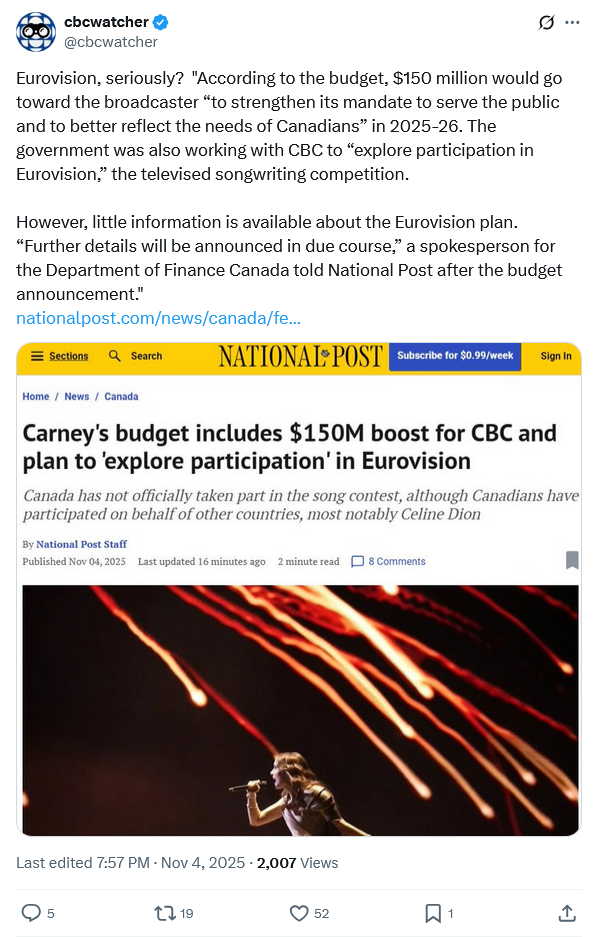
He promised to “give back” — and by that, he means pouring another $180 million into the CBC, the same taxpayer-funded mouthpiece that’s been running interference for the Liberals for nearly a decade. This comes after ArriveCAN, the $60 million QR code boondoggle funneled through Liberal contractors, and countless other slush funds masquerading as “public service”.

While the working class is bracing for a made-in-Ottawa recession, Carney’s pledging more green slogans, more centralized control, and more taxpayer money to keep the illusion alive.

April 5, 2025

Liberals spike the football after eliminating the consumer portion of the carbon tax

Among the items in this week’s “Bullshit Bulletin” from The Line is a thoroughly earned drubbing for the federal Liberals who took full credit for eliminating a particularly unpopular tax … that they spent the last several years justifying for “putting more money in Canadians’ pockets”:

Your Line editors are fans of loopholes. And we’re glad that when we laid out the ground rules for the Bullshit Bulletin last week, we made room for things that would technically pass a lie detector test, but are still too egregiously bullshitty to not be called out.

Mona Fortier, Liberal party whip, former cabinet minister and current candidate in Ottawa-Vanier-Gloucester, step up and collect your prize. You’re the first stop in our second bullshit bullet of this campaign. To be clear, Fortier is accepting this award on behalf of the entire Liberal party. The absolutely breathtaking hypocrisy of watching these guys campaign on the dismantling of the carbon tax is something to behold.

If you missed it, the zeroing out of the “consumer-facing” carbon tax took effect this week, at midnight on April 1. This resulted in an immediate drop in the price of gas at many stations across the country. This genuinely did make the news. Your Line editors heard local radio stories about it as they were out and about on their various errands this week. Many of those stories, but not all, made a point of noting that the price drop was directly related to the carbon tax coming off the price of a litre of gas.

And that’s where Fortier steps in. She was quick to take to social media with a video of herself at a gas pump, celebrating how her government had made the lives of Canadians more affordable.

Couple of things.

First, your Line editors have some history of noting the absurdity of politicians posing at gas pumps. Our favourite is still the Conservative who clearly did not have a car and simply posed awkwardly by a pump. But in general, these photo ops are really stupid. And we’re sure they’re demeaning and embarrassing for the people involved. Add this to the long and growing list of why we would never, ever agree to subject ourselves to the humiliation of a life in politics.

But we can’t help but note the chutzpah — or the bullshit, more plainly — of the Liberals touting lowering the price of gas, when that drop is explained by them removing the tax they chose to put on gas, and then spent years insisting was necessary to prevent, literally, the destruction of the planet. We guess we can take our kids on vacation without “letting the planet burn” now. Thanks, Carney!

And we just don’t mean that this is hypocritical in the abstract. Fortier herself, not all that long ago, was loud and proud about how the carbon tax was helping low-income Canadians by giving them more in rebates than they were paying in tax.

Keen-eyed observers might note that there is less than a year between those tweets.

What else can we call this bullshit? We can gussy it up a bit. We can call it hypocritical bullshit or shameless bullshit — but fundamentally, it’s bullshit. The Liberals taking credit for removing the carbon tax makes about as much sense as them taking credit for rescuing a man from drowning whom they beat senseless and threw over the side of a yacht. The entire thing reminds us of the Hot Dog Man sketch — an obviously guilty party insisting, despite the evident disbelief of everyone else, that they aren’t responsible for the problem. Except this is actually worse — they’re claiming they fixed the problem, while studiously ignoring any question of where it came from.

Only in politics would someone actually seek to claim any credit for reversing a cost that they had willingly inflicted on people, despite howls of protest, for years, all while insisting the pain was necessary, and even worth it, because of the rebate. And only in Canada would we have very little expectation that the voters would actually hold those people accountable for their, wait for it, bullshit.

April 3, 2025

Election 2025 – Candidates overboard, biological clocks ticking, and Trump tariff letdown

Filed under: Cancon, Economics, Media, Politics — Tags: , , , , , — Nicholas @ 03:00

One of the recent events in the federal election campaign — the Liberals finally getting rid of their toxic candidate in Markham-Unionville — has been reciprocated by the Conservatives dumping their candidate in a southwestern Ontario riding and another in the Montreal area. While the Liberals dragged their feet for several days, the Conservatives have been much faster to pull the ejection handle for their bozo eruptions (some might say too fast), but Poilievre absolutely did not want the kind of media circus that Carney enabled over the Chiang scandal.

The Liberals have been doing what they can to gin up angst and outrage over a recent Pierre Poilievre comment that they’re trying to portray as being somehow misogynistic and insensitive. In The Line, Melanie Paradis says that it’s nothing of the sort and instead it highlights a genuine concern for young Canadian women and their partners:

I just turned 40. I have two beautiful children — three-and-a-half years old and eight months — and I want a third.

That statement raises eyebrows. After all, I run a successful business. I work more than full-time. I live in the same economy as you. And yet — I want another baby. Not because I’m reckless. Because I love being a mom. Because I believe in investing in the future. Because I want to.

And in today’s Canada, that feels like a radical act.

This election, the conversation is dominated by Trump’s tariffs, and understandably so. But as we analyze different sectors that will be impacted by tariffs, and develop policy prescriptions for the hundreds of thousands of jobs that could be lost, where are the policies for the millions of young Canadians pausing their hopes and plans for children because of so much uncertainty? The untold story of Trump’s tariffs and threats is that the quiet collapse of Canada’s birth rate will only worsen. Nothing kills the mood or your hormonal balance quite like Trump.

Of course, the second Pierre Poilievre mentioned this, the Liberals couldn’t resist twisting it into a tired attack line about reproductive rights.

On Monday, Poilievre said, “We will not forget that 36-year-old couple whose biological clock is running out faster than they can afford to buy a home.” This is a statement rooted in the biological and economic realities of being 30-something and trying to conceive. Yet the Liberals are tripping over themselves to condemn Poilievre for somehow insulting women.

What a total misread. Poilievre is the only politician in this campaign who is speaking openly and clearly about a real issue that is radicalizing young Canadians: it has become far, far too hard to start and support a family in this country, and that is obviously a burden that lands entirely on the young. Given the demographics of the average Liberal voter, I can get why this would be below the radar for the party, but I’m begging them, and setting politics aside when I do, to stop viewing this as a moment to launch a political attack on your rival and instead ask if this is actually a national issue that we should be talking about more, not less. Even if the politician happens to be a man.

To my Liberal friends: You are punching down on hurting people when you dismiss this issue, and since this might matter to you more, you’re hurting your electoral chances, too. Your party has a blindspot here, and the issue is too important to become a partisan football. Like, my dudes, for all your stupid rhetoric about The Handmaid’s Tale, have you read the damn book? It starts with a fertility crisis and birth rate collapse. If you don’t want the red capes, maybe we should get out in front of the issue?

The latest round of Trumpian tariffs let Canada off easier than other American allies and trading partners in President Trump’s “Liberation Day” announcement:

While the rest of the world was trying to determine the length and breadth of the shaft, Trump waved around a cardboard chart that named their country and the percentage tariff hike they could expect to be hit with.

Top of the list was China, which will see a 34 per cent increase in the tariffs on its exports to the U.S. (on top of the previous 20 per cent). Japan will be hit with a 24 per cent increase and the European Union with 20 per cent.

But half of the chart was hidden behind Trump’s podium, so it took a while to figure that Canada was not on the list.

It was only after the Rose Garden press conference concluded that it became apparent that Canada is exempt, or at least the exports to the U.S. covered by the Canada-U.S.-Mexico trade agreement are not impacted (and they account for more than 90 per cent, according to RBC Economics).

However, the previously announced 25 per cent tariffs on autos, and on steel and aluminum from Canada remain in place.

The broad-based exemption is good news but the crisis facing the Canadian economy remains dire. As has been pointed out by many industry insiders, no auto plant in Canada can survive 25 per cent tariffs for an extended period at a time when their profit margins are less than 10 per cent.

March 30, 2025

Dies the Fire and the Founder Effect

Filed under: Books, Economics, USA — Tags: , , , , , , , — Nicholas @ 02:00

Feral Historian
Published 15 Nov 2024

The first book in S.M. Stirling’s Emberverse series, Dies The Fire yanks modern technology out of the world and sets the stage for a multi-faceted exploration of how distinct cultures emerge from small isolated groups and the profound effect individuals can have the societies that coalesce around them.

00:00 Intro
01:28 Founders
03:37 Desperation
04:51 Flawed Assumptions
07:05 Composites and Rhymes
(more…)

March 29, 2025

Carney, our unelected PM, announces the end of our generations-long bilateral relationship with the US

Filed under: Cancon, Economics, Government, Media, Politics, USA — Tags: , , , , — Nicholas @ 03:00

As many folks on Twit-, er, I mean X have pointed out, Mark Carney is just a caretaker PM, not having ever been elected to the position, so it’s more than a bit breathtaking that he’s making announcements like this without any mandate from the voters:

Later, we get to vote on whether he made it to the podium

The last Liberal leader promised real change too. Apparently this one uses a different definition.

“It is clear that the United States is no longer a reliable partner,” Mark Carney said after a cabinet meeting on Thursday. “It is possible that with comprehensive negotiations we will be able to restore some trust. But there will be no turning back.”

Uh, sir, you’re sounding kind of categorical —

“The next government — and all that follow — will have a fundamentally different relationship with the United States,” Carney said.

So if I understand correctly, what you’re saying is —

“Coming to terms with this sobering reality is the first step in taking necessary actions to defend our nation,” Carney said. “But it’s only the first step.”

In a career that now stretches back to before many of my readers were born, I’ve covered speeches like this before, of course. Maybe five. Well, two. No, strike that, this was new.

“Over the coming weeks, months, and years we must fundamentally reimagine our economy,” the rookie leader of the Liberal Party of Canada said.

Well, you know, “fundamentally” can mean a lot of things —

“The old relationship we had with the United States, based on deepening integration of our economies and tight security and military cooperation is over.”

Oh, so you mean fundamentally.

In French, a language that fits this Savile Row man like a hand-carved barrel — it covers the essentials while leaving the odd splinter — Carney did a version of the Doug Ford thing where he asked for a strong mandate to undertake negotiations. Unlike Ford he put no real effort into selling it. Was he being overconfident? Not at all, he said, as every man ever has in response to that question. He still needs to “win every vote,” he insisted.

But it “would be better” to have a large mandate “to have a large, comprehensive negotiation, the most important in our life.” Here he didn’t pause, really, so much as consider the ramifications of what he was saying while the words were still coming out.

“Especially in my life. When I was born the Auto Pact was created.” Which sounds grandiose, sure, but to be fair I believe Carney, who was born in Fort Smith in 1965, was merely asserting correlation, not causality. “And now it’s over.”

Wait, what? The AUTO PACT is over? That’s like saying it’s time to shut the ski operation at Whistler down, if Whistler contributed 11.5% to Canada’s manufacturing GDP. “It’s very serious, this situation,” he concluded, mildly.

Later, some of the early reaction to Carney’s remarks seemed to me to skip too lightly over the plain meaning of the Prime Minister’s words. And yes, it feels odd to call him the Prime Minister. We haven’t yet had a vote on the matter, although I’m told one will be held shortly. But the people in the cabinet room were people Carney had appointed, and the Parliamentary Protective Service let them in, so I guess in a rough-and-ready way, he really is — Anyway. It’s possible Carney’s words meant nothing. Or that he’ll be forced to eat them later. Or that, it being election season, he’ll never get a chance to implement them. In the latter case, the Carney Tariff Scrum of March 2025 would become an item of wonk trivia, like Kim Campbell’s genuinely impressive government reorganization of 1993.

March 26, 2025

Rich country foreign aid – threat or menace?

Filed under: Africa, Bureaucracy, Economics, Government, USA — Tags: , , — Nicholas @ 03:00

John H. Cochrane on the benefits and harms that aid from rich countries has done to the poor recipient nations around the world:

At half the dinners I go to, someone says, well, yes, a lot of the USAID money was mis-spent, but what about the poor starving children in Africa? If you are in that situation, this is the article for you.

This article is about about the centerpiece of aid: “development” aid, designed to boost economic growth, not about the politicized “nonprofits” that USAID was supporting and their bloated staffs, funneling aid money to political advocacy and employment, promoting American self-loathing around the world, and so forth.

    Development spending accounts for almost three-quarters of all aid.

And the enterprise is a colossal failure.

    The capital of Malawi, one of the world’s poorest countries, runs on aid. A city built in the 1970s by the World Bank, Lilongwe’s straight streets are filled with charities, development agencies and government offices. Informal villages house cooks and cleaners for foreign officials; the entrance to each is marked with the flag of its national sponsor.

The money is small compared to advanced country GDP, but huge compared to poor country government resources […]

The results of such spending are no better in Malawi than in the US — even if it’s free to the recipient. Add the preference of aid advocates for “sustainable” or “appropriate” and “green” technology, including these days hostility to GMO foods, and social or environmental wrappers, “climate justice” and so on, indeed even the hostility to capitalism, “consumerism” and growth itself and it’s not a surprise this is a rathole. (Again, it’s cheap from our perspective. The problem is that it’s wholly ineffective. If money really could jump start growth, that would be great.)

One of the central conundrums of aid is that it can destroy local industry. Sending food, for example, seems like a no-brainer of mercy. And in a war, crop failure, or other catastrophe it is. But sending food on a regular basis bankrupts local farmers.

Central idea 1: Imagine just how happy the US might be if China decided in its mercy to tax Chinese citizens, buy crops at overvalued prices (which incidentally pleases Chinese farmers), and send bags of rice to the US for free, marked “gift of the CCP”, thereby bankrupting US rice farmers. Or if it decided to send us really cheap electric vehicles to help us speed towards net zero, thereby undermining our own state-supported EV business. Well, you know exactly how our government feels about this sort of thing! And this is exactly what aid does.

Now, a good free market economist welcomes subsidized imports, and a push to leave agriculture and move to export-oriented manufacturing or other higher value industries. But Malawi doesn’t have other higher value industries, and exporting anything to the advanced economies is getting harder and harder. Extending the old proverb, send a man a fish a day forever, and he forgets how to fish.

The article opened my eyes (some more) to the delicate intertwining of economics and politics. We really don’t live in a free market world in the US (note our executives rushing to change ideology and please the new team in Washington), and even less so in poor countries.

    Western aid officials often want to prevent local politicians, who control crucial industries, from profiting as a result of their projects, meaning they select obscure sectors for tax breaks, credit and subsidies. With few investors willing to stump up capital, and little interest from local politicians, the businesses duly flop.

Here is a conundrum for you. Without 10% off the top for the big guy, businesses will flounder.

March 23, 2025

Tariffs versus income taxes – pick your poison

Walter Block on the pros and cons (from the government’s point of view) of income taxes and tariffs:

Every fiber of my economic being cries out against tariffs. If they are so good, why doesn’t each state in the US have one against the products of all of the other 49? That is, Ohio could “protect” its industries against the incursions from Arizona. This is obviously silly. One of the important reasons America is so prosperous is that we have a gigantic, internal, free trade area.

Donald Trump supports them on the ground that the McKinley administration was prosperous, and relied upon tariffs. But this is to commit the post hoc ergo propter hoc logical fallacy: that since A precedes B, A must be the cause of B. No, America did indeed become rich during this epoch, but that was in spite of tariffs, not due to their benign influence. If you are looking for a historical episode to shed light on this matter, the Smoot-Hawley Tariff of 1930 will do far better: it greatly worsened an already bad recession, plunging our economy into a deep depression.

Our President also claims that the US is victimized by a negative balance of trade: we buy more from Canada and other countries than they purchase from us. However, I have a horrid balance of trade with McDonald’s and Wal-Mart. I acquire several hundreds of dollars’ worth of their products every year, and neither has yet seen fit to reciprocate with any of my economic services (hint, hint!). On the other hand, I have a very strong positive balance of trade with my employer, Loyola University New Orleans. They pay me a decent salary; apart from a few lunches in their cafeteria, my expenditures to them fill their coffers to a zero degree. Should anyone worry about this sort of thing? Of course not. Ditto for international trade. If Country A buys more from B than it sells to it, money will flow from the former to the latter, reducing prices in the former and raising them in the latter, until matters balance out.

Everyone realizes the foolishness of tariffs when it comes to absolute advantage. No Canadian objects to the importation of bananas from Costa Rica. Producing this tropical product in the frozen North would be financially prohibitive (gigantic hothouses). Ditto for maple syrup in the country to the south. The only way they could produce this item would be to place maple trees in gigantic refrigerators. Ludicrous and prohibitively expensive.

But when it comes to comparative advantage, all too many people are out to lunch insofar as the teachings of Economics 101 are concerned. They fear that other countries might be more efficient than we are; with free trade, they would produce everything, we, nothing, and we would all starve to death from massive unemployment.

QotD: Herbert Hoover as president

Herbert Hoover spent his entire presidency miserable.

First, he has no doubt that the economy is going to crash. It’s been too good for too long. He frantically tries to cool down the market, begs moneylenders to stop lending and bankers to stop banking. It doesn’t work, and the Federal Reserve is less concerned than he is. So he sits back and waits glumly for the other shoe to drop.

Second, he hates politics. Somehow he had thought that if he was the President, he would be above politics and everyone would have to listen to him. The exact opposite proves true. His special session of Congress comes up with the worst, most politically venal tariff bill imaginable. Each representative declares there should be low tariffs on everything except the products produced in his own district, then compromises by agreeing to high tariffs on everything with good lobbyists. The Senate declares that the House of Representatives is corrupt nincompoops and sends the bill back in disgust. Hoover has no idea how to solve this problem except to ask the House to do some kind of rational economically-correct calculation about optimal tariffs, which the House finds hilarious. “Opposed to the House bill and divided against itself, the Senate ran out the remaining seven weeks [of the special session] in a debauch of taunts, accusations, recriminations, and procedural argument.” The public blames Hoover, pretty fairly – a more experienced president would have known how to shepherd his party to a palatable compromise.

Also, there are crime waves, prison riots, bootlegging, and a heat wave during which Washington DC is basically uninhabitable. Also, at one point the White House is literally on fire.

… and then the market finally crashes. Hoover is among the first to call it a Depression instead of a Panic – he thinks the new term might make people panic less. But in fact, people aren’t panicking. They assume Hoover has everything in hand.

At first he does. He gathers the heads of Ford, Du Pont, Standard Oil, General Electric, General Motors, and Sears Roebuck and pressures them to say publicly they won’t fire people. He gathers the AFL and all the union heads and pressures them to say publicly they won’t strike. He enacts sweeping tax cuts, and the Fed enacts sweeping rate cuts. Everyone is bedazzled […] Six months later, employment is back to its usual levels, the stock market is approaching its 1929 level, and Democrats are fuming because they expect Hoover’s popularity to make him unbeatable in the midterms. I got confused at this point in the book – did I accidentally get a biography from an alternate timeline with a shorter, milder Great Depression? No – this would be the pattern throughout the administration. Hoover would take some brilliant and decisive action. Economists would praise him. The economy would start to look better. Everyone would declare the problem solved – especially Hoover, sensitive both to his own reputation and to the importance of keeping economic optimism high. Then the recovery would stall, or reverse, or something else would go wrong.

People are still debating what made the Great Depression so long and hard. Whyte’s theory, insofar as he has one at all, is “one thing after another”. Every time the economy started to go up (thanks to Hoover), there was another shock. Most of them involved Europe – Germany threatening to default on its debts, Britain going off the gold standard. A few involved the US – the Federal Reserve made some really bad calls. The one thing Whyte is really sure about is that his idol Herbert Hoover was totally blameless.

He argues that Hoover’s bank relief plan could have stopped the Depression in its tracks – but that Congressional Democrats intent on sabotaging Hoover forced the plan to publicize the names of the banks applying. The Democrats hoped to catch Hoover propping up his plutocrat friends – but the change actually had the effect of making banks scared to apply for funding and panicking the customers of banks that were known to have applied. He argues that the “Hoover Holiday” – a plan to grant debt relief to Germany, taking some pressure off the clusterf**k that was Europe – was a masterstroke, but that France sabotaged it in the interests of bleeding a few more pennies from its arch-rival. International trade might have sparked a recovery – except that Congress finally passed the Hawley-Smoot Tariff, the end result of the corruption-plagued tariff negotiations, just in time to choke it off.

Whyte saves his barbs for the real villain: FDR. If the book is to be believed, Hoover actually had things pretty much under control by 1932. Employment was rising, the stock market was heading back up. FDR and his fellow Democrats worked to tear everything back down so he could win the election and take complete credit for the recovery. The wrecking campaign entered high gear after FDR won in 1932; he was terrified that the economy might get better before he took office, and used his President-Elect status to hint that he was going to do all sorts of awful things. The economy got skittish again and obediently declined, allowing him to get inaugurated at the precise lowest point and gain the credit for recovery he so ardently desired.

Scott Alexander, “Book Review: Hoover”, Slate Star Codex, 2020-03-17.

March 21, 2025

Star Trek: Jobs, Money, and Replicators

Filed under: Bureaucracy, Economics, Media, USA — Tags: , , , , , , — Nicholas @ 02:00

Feral Historian
Published 14 Jun 2024

So the Federation doesn’t use money and magic walls give you anything you ask for. What kind of economy are we really looking at here, and is some approximation of this possible without first having those replicators?

First we have to talk about what money is, what a job is (vs just being employed) and a little historical detour into modern efforts at Universal Basic Income. All of which lead to a very hypothetical look at how we might be able to build a rough approximation of a Star Trek economy in the near-term future.

This is all analysis and thought-experiment. I’m not necessarily endorsing any of these ideas, just bouncing things around for consideration.

00:00 Intro
01:00 Qualitatively Distinct Model
02:27 The Triple Revolution
05:00 Jobs ≠ Employment
06:32 Universal Basic Income
11:35 Federation Credit
13:45 Impacts of Currency
15:16 Can We Really Do This?
(more…)

March 20, 2025

Oh, goodie … the ever-bouncing F-35 fighter decision is back in play

Filed under: Cancon, Economics, Europe, Military, Politics, USA, Weapons — Tags: , , , , , , — Nicholas @ 05:00

My initial reaction on seeing Alex McColl’s headline was to immediately reject the notion of the Royal Canadian Air Force operating two completely different fighter aircraft, both for cost and for personnel reasons: the RCAF is already underfunded and short on trained aircraft technicians for a single fighter (the CF-18 Hornet), never mind two even higher-tech replacements. But on reading the article, I’m open to further investigation of the idea:

“F-35 Lightning II completes Edwards testing” by MultiplyLeadership is licensed under CC BY 2.0

Canada’s new Prime Minister Mark Carney didn’t waste any time standing up to Donald Trump’s illegal trade war. Within hours of being sworn in, Bill Blair — who was minister of national defence under Justin Trudeau and remains in the role under Carney — went on CBC’s Power & Politics to deliver a bombshell: Canada is going to re-examine our plan to purchase 88 American F-35A fighter jets.

This was in response to a question about if Canada would emulate Portugal, which announced that it was reconsidering a planned purchase of American F-35 jets: “We are also examining other alternatives, whether we need all of those fighter jets to be F-35s or if there might be alternatives. The prime minister has asked me to go and examine those things and have discussions with other sources particularly where there may be opportunities to assemble those fighter jets in Canada, to properly support them and maintain them in Canada, and again we’re looking at how do we make investments in defence which also benefits Canadian workers, Canadian industry and supports a strong Canadian economy.”

When asked about a partial cut to the F-35 order, Blair responded: “The direction I’ve been given by the prime minister is go and look at all of our options to make sure that we make the right decision for Canada.” He noted that this didn’t mean the government planned to outright cancel the F-35 contract.

[…]

With the first 16 F-35s already on order, and the first four already in production on the assembly line in Texas, it’s likely too late to cancel the F-35 order without significant penalties.

Saab JAS-39 Gripen of the Czech Air Force taking off from AFB Čáslav.
Photo by Milan Nykodym via Wikimedia Commons.

This opens the door to a mixed fleet that includes a smaller number of expensive F-35A fighter-bombers and a larger number of affordable Gripen-E fighters. All of Canada’s G7 allies fly a mixed fleet of fighter jets today, some have 3 or more types. While it wouldn’t be easy, it is possible for a serious nation to fly a mixed fleet. Before the CF-18, Canada had 3 different types of armed fighter jets in service. The RCAF wanted to replace them all with expensive F-15 Eagles, but Pierre Trudeau made them settle for the cheaper F/A-18 Hornet. His government ordered 138 CF-18s, but that fleet shrank over time as a cost saving measure. The big cut happened during the CF-18 modernization under the Harper Government, when the hornet fleet shrank from 120 to 80 jets.

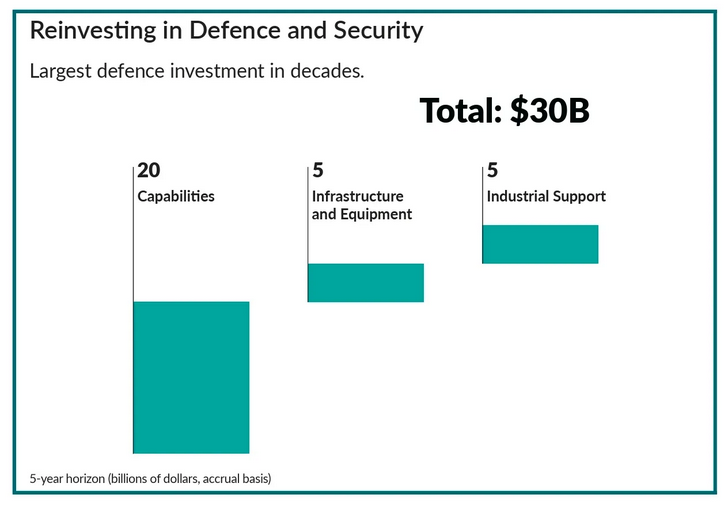
Living up to our commitments to our NATO allies is about more than just spending 2 percent of GDP, it also means living up to our mission requirements. Keeping our word means showing up, and 88 F-35As was never going to be enough jets for us to meet our commitments to NORAD and NATO at the same time. To do that, we need at least 120 jets. Reevaluating our options does not mean starting from scratch. To paraphrase minister Blair: A great deal of work was done during the FFCP evaluation. Two jets met the requirements: the expensive American F-35, and the Swedish Gripen-E with an offer to make them in Canada. Let’s just buy them both.

The first step is easy: Have Saab and IMP refresh their FFCP submission with new delivery deadlines and place an order for 88 Gripen-E jets. The second is to announce that we’re reducing the F-35 order down to 65 jets – the number that the Harper government planned to sole source but never ordered. Finally, we put our elbows up and announce that the F-35 order would be cut by 5 jets for every week the Trump administration maintains their threats of illegal tariffs, down to a minimum of 40 jets.

The F-35A has a total cost of ownership about double that of the Gripen-E, so we could afford to add two Gripens for every F-35 cancelled. A mixed fleet of about 120 Gripen-Es and 45 F-35As would help us get to 2% of GDP while reliably pulling our weight on NORAD and NATO missions.

Everyday Life in the Roman Empire – Demography, Income, Life Expectancy

seangabb
Published 12 Sept 2024

Part seven in a series on Everyday Life in the Roman Empire, this lecture discusses demography and life chances during the Imperial period. Here is what it covers:

Introduction – 00:00:00
Our Statistical Civilisation – 00:00:24
Ancient “Statistics” – 00:08:05
How Many Roman Citizens? – 00:18:04
Population of the Empire – 00:21:36
City Populations – 00:27:45
Average Incomes – 00:36:27
Life Expectancy – 00:35:37
Country Life – 00:52:06
Population of Rome – 00:54:39
Feeding Rome – 00:57:40
Roman Water Supply – 01:00:44
Bathing and Sanitation – 01:04:16
Hygienic Value – 01:04:16
Bibliography – 01:06:17
(more…)

March 19, 2025

Solving the “Spotify problem”

Filed under: Business, Economics, Media, Technology — Tags: , , , — Nicholas @ 03:00

Sadly, as Tim Worstall explains, it probably can’t be done:

It’s that time of year for the ritual complaints about Spotify. Woes, musicians can’t get any money.

The reason for this is that we out here, the Great Unwashed, value recorded music at something just above toss. Therefore musicians get paid, on average, just above toss. And there we have it, there’s the whole and the complete of the thing.

    Spotify is trumpeting big paydays for artists – but only a tiny fraction of them are actually thriving

Yep.

    $10bn is a hefty number, but it needs to be closely examined. This money, around two-thirds of its total income, is what Spotify has paid through to record labels and music publishers. Spotify cannot be held responsible for egregious label and publisher contracts, but it needs reiterating that only a portion of that $10bn will make its way to the people who wrote and recorded the music.

    The company also says this $10bn is “more than any single retailer has ever paid in a year” and is “10x the contribution of the largest record store at the height of the CD era”. That may be true, but it says less about Spotify’s benevolence and more about how streaming’s market share has mostly consolidated into the hands of four global heavyweights – Spotify, Apple, YouTube and Amazon.

Only one part of that has any relevance. The $10 billion and the 2/3rds.

Obviously there are costs to running a company. To running the servers which hold near all of all recorded music. Of being able to get that out onto the internet.

The $10 billion (OK, 15) is about what people think music is worth to them.

[…]

The reason your really important socially relevant indie band is touring the upper peninsula, still after all these years, the bogs are your changing room and the only rider you’ve been able to achieve is access to tap water, is that the general public values your output at some fraction above toss. Therefore you earn that fraction above toss.

Really, that’s it. It’s not capitalism it’s general public indifference. Really, folk just don’t care.

QotD: The purpose of fortification

Filed under: Economics, Europe, History, Military, Quotations — Tags: , , — Nicholas @ 01:00

… before we get into the design of point defenses, we should talk about what these are for. Generally, fixed point defenses of this sort in the pre-modern world are meant to control the countryside around them (which is where most of the production is). This is typically done through two mechanisms (and most of point defenses will perform both): first by housing the administrative center which organizes production in the surrounding agricultural hinterland (and thus can extract revenue from it) and second by creating a base for a raiding force which can at least effectively prohibit anyone else from efficiently extracting revenue or supplies from the countryside. Consequently if we imagine the extractive apparatus of power as a sort of canvas stretched over the countryside, these fortified administrative centers are the nails that hold that canvas in place; to take and hold the land, you must take and hold the forts.

In the former case, the fortified center contains three interlinked things: the local market (where the sale of agricultural goods and the purchase by farmers of non-agricultural goods can be taxed and controlled), a seat of government that wields some customary power to tax the countryside through either political or religious authority and finally the residences of the large landholders who own that land and thus collect rents on it (and all of these things might also come with significant amounts of moveable wealth and an interest in protecting that too). For a raiding force, the concentration of moveable property (money, valuables, stored agricultural goods) this creates a tempting target, while for a power attempting to conquer the region the settlement conveniently already contains all of the administrative apparatus they need to extract revenue out of the area; if they destroyed such a center, they’d end up having to recreate it just to administer the place effectively.

In the latter case, the presence of a fortified center with even a modest military force makes effective exploitation of the countryside for supplies or revenue by an opposing force almost impossible; it can thus deny the territory to an enemy since pre-industrial agrarian armies have to gather their food locally. We have actually already discussed this function of point defenses before: the presence of a potent raiding force (typically cavalry) within allows the defender to strike at either enemy supply lines (should the fortress be bypassed) or foraging operations (should the army stay in the area without laying siege) functionally forcing the attacker to lay siege and take the fortress in order to exploit the area or move past it.

In both cases, the great advantage of the point defense is that while it can, through its administration and raiding threat, “command” the surrounding hinterland, the defender only needs to defend the core settlement to do that. Of course an attacker unable or unwilling to besiege the core settlement could content themselves with raiding the villages and farms outside of the walls, but such actions don’t accomplish the normal goal of offensive warfare (gaining control of and extracting revenue from the countryside) and peasants are, as we’ve noted, often canny survivors; brief raids tend to have ephemeral effects such that actually achieving lasting damage often requires sustained and substantial effort.

All of which is to say that even from abstract strategic reasoning, focusing considerable resources on such fortifications is a wise response to the threat of raids or invasion, even before we consider the interests of the people actually living in the fortified point (or close enough to flee to it) who might well place a higher premium on their own safety (and their own stuff!) than an abstract strategic planner would. The only real exception to this were situations when a polity was so powerful that it could be confident in its ability to nearly always win pitched battles and so prohibit any potential enemy from getting to the point of laying siege in the first place. Such periods of dominance are themselves remarkably rare. The Romans might be said to have maintained that level of dominance for a while, but as we’ve seen they didn’t abandon fortifications either.

Bret Devereaux, “Collections: Fortification, Part III: Castling”, A Collection of Unmitigated Pedantry, 2021-12-10.

March 18, 2025

QotD: Lester Thurow and the other cheerleaders for “Industrial Policy” in the 1980s

Filed under: Economics, Japan, Politics, Quotations, USA — Tags: , , , — Nicholas @ 01:00

The late Lester Thurow was quite popular in the 1980s and 1990s for his incessant warnings that America was losing at the game of trade with other countries. Most ominous, Thurow (and others) warned, was our failure to compete effectively against the clever Japanese who, unlike us naive and complacent Americans, had the foresight to practice industrial policy, including the use of tariffs targeted skillfully and with precision. Trade, you see, said Thurow (and others) is indeed a contest in which the gains of the “winners” are the losses of the “losers”. Denials of this alleged reality come only from those who are bewitched by free-market ideology or blinded by economic orthodoxy.

And so – advised Thurow (and others) – we Americans really should step up our game by taking many production and consumption decisions out of the hands of short-sighted and selfish entrepreneurs, businesses, investors, and consumers and putting these decisions into the hands of the Potomac-residing wise and genius-filled faithful stewards of Americans’ interest.

Sound familiar? It should. While some of the details from decades ago of the news-making proponents of protectionism and industrial policy differ from the details harped on by today’s proponents of protectionism and industrial policy, the essence of the hostility to free trade and free markets of decades ago is, in most – maybe all – essential respects identical to the hostility that reigns today.

Markets in which prices, profits, and losses guide the decisions of producers and consumers were then – as they are today – asserted to be stupid, akin to a drunk donkey, while government officials (from the correct party, of course) alone have the knowledge, capacity, willpower, and power to allocate resources efficiently and in the national interest.

Nothing much changes but the names. Three or four decades ago protectionism and industrial policy in the name of the national interest was peddled by people with names such as Lester Thurow, Barry Bluestone, and Felix Rohatyn. Today protectionism and industrial policy in the name of the national interest is peddled by people with different names.

Don Boudreaux, “Quotation of the Day…”, Café Hayek, 2020-03-12.

« Newer PostsOlder Posts »

Powered by WordPress