
I hesitate to recommend academic books to anyone, but I’ll make an exception for James C. Scott’s Seeing Like a State. Subtitled “how certain schemes to improve the human condition have failed”, it’s the best long-form exposition I know of, that explains how process and outcome first deform, then negate each other.
[…]
In brief, Scott argues that the process of making a society “legible” to government officials obscures social reality, to the point where the government’s maps and charts and graphs take on a life of their own. It’s recursive, such that those well-intentioned schemes end up first measuring, then manipulating, the wrong thing in the wrong way, to the point that the social “problem” the process was supposed to address drops out entirely — all you have, at the end, is powerpoint girls critiquing spreadsheet boys because their spreadsheets don’t have enough animation, and vice versa.
Scott doesn’t use the Domesday Book as an example (IIRC from a graduate school class 20-odd years ago, anyway), but it’s one we’re probably all familiar with. The first thing William the Conqueror needed to know is: what, exactly, have I conquered? So he sent out the high-medieval version of spreadsheet boys to take a comprehensive survey of the kingdom. Turns out the Duke of Earl’s demense runs from this creek to that rock. He has five underlings, and their domains run from etc.
The point of all this, of course, was so that Billy C. could call the Duke of Earl on the carpet, point to the spreadsheet, and say “You owe me a cow, three chickens, and two months in the saddle as back taxes.” It worked great, except when — as, it seems, is inevitable — the high-medieval equivalent of the spreadsheet boys did the high-medieval version of “ctrl-c”; just copying and pasting the information over. Eventually the tax situation got way out of whack, as it did for most every pre-modern government running a similar system — one of the reasons declining Chinese dynasties had such fiscal problems, for instance, is that the tax surveys only got updated every two centuries or so, such that a major provincial lord was still only paying 20 silver pieces in taxes, when he should’ve been paying 20,000 (and his peasants were all paying 20 when all they could afford was 2).
In other words: unless the spreadsheet boys periodically go out and check that the numbers on their spreadsheets actually correspond in some systematic, more-or-less representative way to some underlying social reality, government policy is being set by make-believe.
Severian, “The Finger is Not the Moon”, Rotten Chestnuts, 2021-09-14.
December 1, 2024
QotD: Recording and codifying the land that William conquered
November 30, 2024
It’s not just your imagination, the Canadian government is much bigger and much less efficient now
At The Audit, David Clinton shows that the Canadian federal government has gone through significant growth in staff at the same time as just about everything it does is now being done slower and less effectively1 than it was ten or twenty years ago:

Change is normal. The world around us isn’t sitting still and that’s got to have an impact on what’s needed by Canada and Canadians. So we can expect a government’s size and shape to evolve over time, but we’d certainly prefer that the changes were rational.
So let’s take a few minutes to understand how the size, cost, shape, and mandates of our government have been changing over the past few years.
Public service employment
Governments provide a set of services that don’t change dramatically from year to year. Sure, as the population grows they’ll need to process more passport applications and oversee the movement of greater numbers of international travellers across our borders. But task complexity shouldn’t increase faster than the population itself.
Therefore you would expect that the public service should grow in proportion to the overall population. Well, that’s not really true. Due mostly to digital automation, Canada’s private sector labour productivity rose steadily between around 1990 and 2014 and has maintained its peak level ever since. So in fact, since we can now do more with fewer people, you’d really expect public sector employment not to keep pace with rising population levels.
However, the actual proportion of federal employees to Canada’s total population has been growing noticeably over the past six years. Because of the scale I chose for its y-axis, the graph below does exaggerate the changes a bit, but you can see how the federal workforce grew from around 0.72% of the total population in 2017 to 0.9% in 2023. That means about one out of every 59 employed Canadians now works for the federal government.
Which means that – worker-for-worker – Canada’s public service is significantly less productive than it was ten years ago. And the growth in absolute numbers from 257,034 workers in 2015 to 357,247 in 2023 can be accurately characterized as bloat. Unforgivable bloat.
Departmental employment
Since 2011, by my count (and based on Treasury Board data), 11 new federal departments or agencies have come into existence and 18 have been shuffled off to wherever it is old bureaucracies go when they die. In some cases, the change represents nothing more than a technical realignment. The move from the Canadian Polar Commission to Polar Knowledge Canada is probably one such example.
I’m mildly curious to know how much such changes cost, even in terms of simple details like outsourcing designs for a new letterhead and getting IT to set up (and secure) a new website and email domain. I’m sure those don’t come for free.
It’s noteworthy that 11 of those 18 shutdowns took place in 2015 and 2016. That suggests they were the result of the incoming Liberal government’s policy implementations. Nevertheless, those changes don’t explain the scope of civil service employment growth since 2015.

1. I’m sure you’re all completely sick of me saying it, so I’ve relegated it to a footnote: the more the government tries to do, the less well it does everything.
The mission of DOGE
One of Donald Trump’s more interesting announcements shortly after winning the federal election early in November was that he was going to give Elon Musk and Vivek Ramaswamy a formal position to do to the US government’s vast array of bureaucratic organizations what Javier Milei did to Argentina’s bloated national government. Here, scraped from the social media platform formerly known as Twitter, is Devon Eriksen‘s thoughts on how to go about pruning back the “fourth branch” of government:

Since the framers of the Constitution created a federal government with three branches, not four, there are no Constitutional checks on the emergent fourth branch.
Currently, the fourth branch is in many ways the most powerful, and certainly the most destructive, arm of the government.
– It has the privilege of targeting individual citizens on its own initiative, which is forbidden to the three other branches.
– It can interfere their lives in any way it wishes by making a “ruling”.
– The only recourse against a “ruling” is to take the bureaucracy in question to court.
– But the process is the punishment, because this takes months if not years and costs tens if not hundreds of thousands of dollars.
– Until recently, courts have deferred to bureaucrats as a matter of legal precedent. Now they merely do so as a matter of practice.
– But should the bureaucracy lose anyway, the only punishment the court inflicts is that they are told they have to stop doing that specific thing.
– Any fines or legal costs imposed on them punish the taxpayer, not the agent or even the agency.
– And the next, closely related, thing the bureaucracy thinks of to do is once again fair game, until the courts are once again brought in, at further cost, to tell it to stop.
All of this creates a Red Queen Effect.
Citizens must establish their own organizations, and raise donations to engage in constant lawfare, just to retain the rights they haven’t lost yet. And they must win every time to maintain the status quo.
Bureaucrats, on the other hand, can fight endless legal battles using money taken from their victims by the IRS, at no cost to themselves. Any victory they claim, they may keep permanently, while any loss may be refought endlessly simply by a slight variance of the attack.
Obviously, if this system is not changed, all power will accrue to the bureaucracy over time. They will constitute a totalitarian authority over every aspect of the life of every citizen.
This is why the name “DOGE” (Department of Government Efficiency) is a serious mistake.
Look, Elon, I like a joke as much as the next guy, and I do think irreverence is a load-bearing component of checking the bureaucracy, because a false aura of gravitas is one of their defenses against public outrage.
But words mean things.
When you create a check on the bureaucracy and call it the department of government efficiency, you focus the attention, and the correction, on the fact that the bureaucracy is stomping on people’s lives and businesses inefficiently, not on the fact that they are doing so at all.
But the name isn’t my decision. The power of the vote isn’t that granular. I can only elect an administration, not protect it from tactical errors by weighing in on individual policy decisions.
Unless someone with direct power happens to read this.
So, regardless of the name, here’s how an organization might be set up to effectively check federal bureaucracies.
1. DOGE must be responsive, not merely proactive.
Being proactive sounds better in the abstract, but it is much easier for a federal agency to gin up some numbers to fight a periodic overall audit, than it is to fight an investigation of a specific case.
2. DOGE must have direct oversight.
If it must take agencies to court, it is merely a proxy for the citizens whose money is being wasted, and whose rights are being trampled.
Imagine the level of inefficiency, waste, and delay, if your process for addressing bureaucratic abuse simply results in one part of the federal government pursuing an expensive court case against another.
Instead, DOGE must have the power to simply make a ruling, via its own investigation hearing process, which is binding on federal agencies.
Any appeals to the court system must be allowed to trigger their own DOGE investigation (for wasting taxpayer fighting a ruling).
3. DOGE must have the power to punish the agent, not just the agency.
“You have to stop that now” is not a deterrent. Neither is fining the agency, because such fines are paid by the American taxpayer.
DOGE must follow Saul Alinsky’s 11th rule: target individuals, not institutions.
Why?
Because agencies are agencies. They consist of agents.
An agent is someone who acts on behalf of a principal — someone whose interests the agent is supposed to represent.
When the agent is incentivized so that his interests diverge from those of the principal, he will be increasingly likely to act in his own interest, not the principal’s.
This is the Principal-Agent Problem.
An agency is a construct, a theoretical entity. What Vonnegut would call a “granfalloon”.
Agencies do not act, they do not make decisions, they do not have incentives they respond to. Any appearance to the contrary is an emergent property created by the aggregate action of agents.
Every decision, whether we admit it or not, has a name attached to it, not a department. It is that person who responds to incentives.
Agents will favor their own incentives over those of their principal (the American people) unless a counter incentive is present for that specific person.
For this reason, DOGE should, must, have the power to discipline individual employees of the federal agencies it oversees.
This doesn’t just mean insignificant letters of reprimand in a file. It means fines against personal assets, firing, or even filing criminal charges. No qualified immunity.
Yes, you read that right. DOGE must be able to fire other agencies’ staff. I recommend that anyone fired by DOGE be permanently illegible for any federal government job, excluding only elected positions.
4. DOGE investigations must be triggerable by citizen complaints.
This is self-explanatory. It gives DOGE the practical capability to redress individual injustices, and it crowdsources your discovery problem.
Establish a hotline.
5. DOGE must have sufficient power to protect and reward whistleblowers, and punish those who retaliate against them.
6. Bureaucrats must be held responsible for outcomes, not just for following procedure.
Often, procedure is the problem. The precedent must be established, and clearly enforced, that because agents have agency, agents are responsible for using their discretion to ensure efficient, just, and sane outcomes, not just for doing whatever departmental policy allows.
7. DOGE must have an adversarial relationship with the bureaucracies is oversees.
This eliminates the phenomenon of “we investigated ourselves and found no wrongdoing”.
Following the previous recommendation is almost sure to make this happen.
The point is not for DOGE to address every instance of waste or wrongdoing, it is to make bureaucrats act responsibly because they fear an investigation.
In essence, I am imagining DOGE (or some superior name that better reflects the mission) as an entity with a license to treat bureaucrats the way bureaucrats currently treat citizens.
November 29, 2024
Dr. Jay Bhattacharya nominated as Director of the US National Institutes of Health
From the point of view of the establishment, the barbarians are well and truly inside the gates, as President-elect Donald Trump has nominated Stanford epidemiologist Dr. Jay Bhattacharya as the next director of the National Institutes of Health:

Dr. Jay Bhattacharya, Donald Trump’s nominee as Director of the National Health Institutes.
Photo by Taleed Brown, 2020, via Wikimedia Commons.
Four years ago, Jay Bhattacharya was ostracized by his colleagues at Stanford and censored on social media platforms thanks to a campaign against him by the public-health establishment. The director of the National Institutes of Health, Francis Collins, sent an email to another NIH official, Anthony Fauci, urging a “quick and devastating published takedown” of Bhattacharya and his fellow “fringe epidemiologists”.
Bhattacharya is far from the fringe today. Donald Trump nominated him this week for Collins’s old job, director of the NIH. Assuming the Senate confirms him, it will be a major victory for science and academic freedom — and a serious threat to the universities that suppressed scientific debate and promoted disastrous policies during the pandemic, causing public trust in science to plummet. Academic researchers and administrators have mostly refused to acknowledge their mistakes, much less make amends, but Bhattacharya promised yesterday to “reform American scientific institutions so that they are worthy of trust again”.
As NIH director, he would wield a potent tool to induce reform: money. Stanford and more than a dozen other universities each get more than $500 million annually in grants from the NIH, the world’s largest funder of biomedical research. The NIH grants support not only researchers but also their universities’ bureaucracies, which collect a hefty surcharge to cover supposed overhead costs. The federal largesse has helped finance the administrative bloat at universities, including the expansion of diversity, equity, and inclusion bureaucracies under the Biden administration, which took into account a university’s commitment to DEI principles when deciding whether to award grants from the NIH and other agencies.
Those priorities are about to change. Trump has vowed to rescind immediately Biden’s executive order directing federal agencies to promote DEI. During his first term, Trump threatened to issue an executive order barring universities from receiving federal funds if they suppressed free speech. He didn’t issue that order, but whether or not he does so in his next term, the NIH director will already have the power to consider a university’s commitment to academic freedom in deciding whether or not to award funds.
“For science to thrive and progress, we must be open-minded and allow vigorous and passionate debate,” says Martin Kulldorff, a former professor of medicine at Harvard. “Why should taxpayers subsidize universities that don’t allow that?” Kulldorff, an eminent epidemiologist, lost his job at Harvard after he became an early and outspoken critic of pandemic policies. In 2020, he joined with Bhattacharya and Sunetra Gupta, an epidemiologist at Oxford, to write the Great Barrington Declaration, a critique of lockdowns that was signed by tens of thousands of scientists and physicians.
Bhattacharya, who has a Ph.D. in economics as well as an M.D. from Stanford, hung on to his job as professor of health policy at the latter’s medical school, but his views were taboo on campus. After he and colleagues did a field study at the start of the pandemic showing that the Covid fatality rate was much lower than the doomsday number used to justify lockdowns, they were vilified by academics and journalists, and Stanford subjected them to a two-month inquiry by an outside legal firm. (They were vindicated by the inquiry and also by subsequent research confirming their findings.)
QotD: Why nothing gets done in the Current Year
Having pumped billions of dollars into building the next generation of computer chip factories in the US, the Biden administration is facing new pressure over the health and safety risks those facilities could pose. Environmental reviews for the new projects need to be more thorough, advocates say. They lack transparency around what kinds of toxic substances factory workers might handle, and plans to keep hazardous waste like forever chemicals from leaching into the environment have been vague.
A coalition of influential labor unions and environmental groups, including the Sierra Club, have since submitted comments to the Department of Commerce on draft environmental assessments, saying that the assessments fall short. The coalition’s comments flag lists of potential issues at several projects in Arizona and Idaho, including how opaque the safety measures that manufacturers will take to protect both workers and nearby residents are.
This is not a serious complaint. This is actually the national association of environmental studies writers spotting a gravy train passing by and desiring to dip their ladle in. And that’s all it is too. But it’s also that excellent example of why fuck all ever gets built. We’ve an entire — and politically powerful — class that makes their living producing the hundred tonne reports that accompany building anything. And they’re not going to allow anything to be built unless they get paid for writing hundred tonne reports. And, to complete the circle, if every activity requires a hundred tonne report then fuck all will ever get done.
There was, back a time, a law passed about blood minerals. The law said anyone who might use them must write to all suppliers to ask if they do. Then those said anyones must tell consumers whether they do. This cost $4 billion just in the first year. From what I’ve heard — and might take the trouble to prove one day — the bloke who led the campaign for the law requiring the letters now runs a very profitable consultancy advising large corporates on how to write the letters. $4 billion spent by society so that one bloke can gain a minor summer place in the Hamptons. This doesn’t make us richer as a whole, it’s pissing the wealth of the nation up the wall.
Carthage, it’s the only solution. The biggest problem who is who the hell would buy our nice new stock of enslaved environmental bureaucrats? Razing, salt, ploughs, these are easy but who’s mad enough to offer a positive price for the last part of the process?
Tim Worstall, “Why Fuck All Ever Gets Done In This Modern World”, It’s all obvious or trivial except …, 2024-08-28.
November 28, 2024
How is Argentina doing after a year under Javier Milei?
I don’t normally follow South American news all that closely, as despite being in the same hemisphere, little that happens there has much importance to us here in Canada or the United States. The election of Argentinian President Javier Milei, however, has made Argentina a much more interesting place to watch as Milei valiantly attempts to turn the economy around from its near-century-long decline. Here, Dan Mitchell provides his assessment of Milei’s efforts so far:
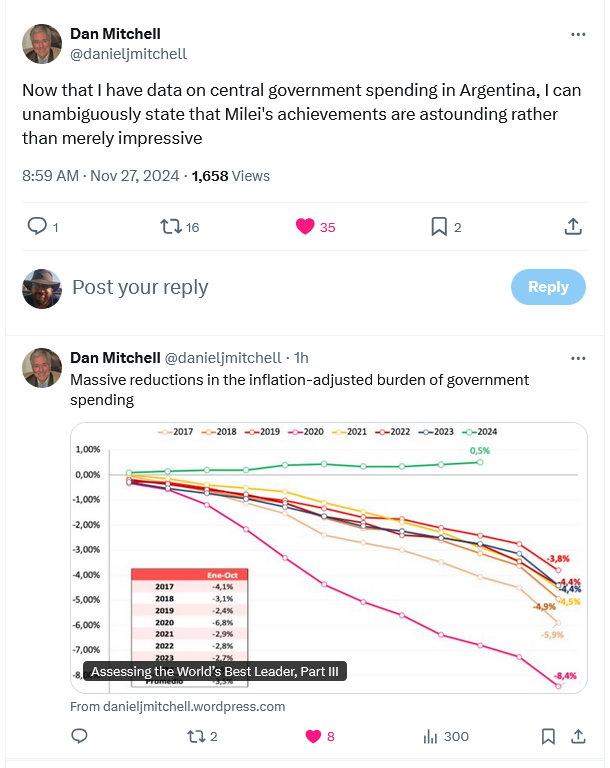
… let’s focus today on Milei’s goal of maximizing economic liberty.
The bad news is that if he wants Argentina to become the new Hong Kong, Milei has a long journey. According to Economic Freedom of the World, Argentina ranked a lowly #159 out of 165 nations in 2022.
As you can see from the EFW rankings, Milei’s country gets especially bad scores for Sound Money, Trade and Regulation (dead last for Sound Money and in the bottom-10 percent of the world for the other two categories!).
The good news is that you don’t have to be libertarian Nirvana (or even Liberland) to make a big jump in the rankings.
You don’t even need to be Hong Kong (which used to be very good with scores above 9 but has now declined to 8.58 thanks to Beijing’s intervention).
Heck, almost every country in the western world has experienced a significant decline in economic liberty this century.
Milei actually could put Argentina in first place today merely by achieving the same level of economic liberty (8.67) that the United States had in 2004.
For what it’s worth, I think it would take several years of good reforms to climb that high.
That being said, dramatic improvements are nonetheless possible in a very short period. Here’s my back-of-the-envelope estimate of where Argentina could be by the end of next year.

November 27, 2024
Scolianormativity
At FEE, Michael Strong defines the neologism and provides evidence that it has been a long-term harm to children forced into the Prussian-originated school regimentation regime:

Scolianormative (adj.): The assumption that behaviors defined by institutionalized schooling are “normal”. An assumption that became pervasive in industrialized societies in which institutionalized schooling became the norm that resulted in marginalizing and harming millions of children. Once society began to question scolianormativity, gradually people began to realize that the norms set by institutionalized schooling were perfectly arbitrary. It turned out that it was not necessary to harm children. The institutions that led to such widespread harms were dismantled, and humanity transcended the terrible century of institutionalized schooling.
The conventional educational model, government-enforced and subsidized, is based on 13 years of schooling consisting of state-defined curriculum standards and exams leading to a high school diploma.
Young human beings are judged as either “normal” or not based on the extent to which they are “on track” with respect to grade level exams and test scores. Students who are not making the expected progress may be diagnosed with learning differences (formerly known as disabilities). Students who can’t sit still adequately may be diagnosed with ADD/ADHD. Students who find the experience soul-killing may be diagnosed with depression or anxiety. Students who can’t stand to be told what to do all day may be diagnosed with Oppositional Defiant Disorder (ODD). Students who score higher on certain tests are labeled “gifted”.
Massive amounts of research and institutional authority have been invested in these and other diagnoses. When a child is not progressing appropriately in the system, the child is often sent to specialists who then perform the diagnosis. When appropriate, then the child is given some combination of medication, accommodations, and/or sent to a special program for children with “special needs”.
Many well-intentioned people regard this system as life-saving for the children who might otherwise have “not had their needs met” in the absence of such a diagnosis and intervention. And this is no doubt often true, but our fixation on scolianormativity blinds us to the fact that an entirely different perspective might actually result in better lives for more children.
How could one possibly deny mountains of evidence on behalf of such a life-saving system?
Scolianormativity
The Prussian school model, a state-led model devoted to nationalism, is only about two hundred years old. For much of its first century it was limited to a few hours per day, for a few months per year, for a few years of schooling. It has only gradually grown to encompass most of a child’s waking hours for nine months a year from ages 5 to 18. Indeed, in the U.S., it was only in the 1950s that a majority of children graduated from high school (though laws requiring compulsory attendance through age 16 had been passed in the late 19th and early 20th century). In addition, for most of its first century, it was far more flexible than it has become in its second. The increasing standardization and bureaucratization of childhood is a remarkably recent phenomenon in historical terms.
In his book Seeing Like a State, the political scientist James C. Scott documents how governments work to create societies that are “legible”, that can be perceived and managed by the state to suit the needs of the state’s bureaucrats and political leaders. Public schools are one of the most pervasive of all state institutions. The structure of public schooling has grown to suit the needs of the state bureaucrats who monitor it.
November 26, 2024
Crony Capitalist Canada – “Conservative Leader Pierre Poilievre … has vowed to protect Big Dairy just like every other party leader”
In the National Post, Chris Selley discusses the latest attempt to further protect the outrageous profits our dairy companies make by overcharging Canadians for milk, butter, cheese, and other dairy products:

That unelected senators should not overrule the will of the House of Commons has always struck me as a rule most Canadians could agree on, whatever they think ought to happen with Canada’s upper chamber. Senators can propose amendments to bad bills, rake ministers over the coals at committee, call witnesses the House wasn’t interested in for whatever reason, raise red flags that haven’t yet been raised, all to the good. But gutting a bill, as the Senate has done with proposed legislation that would protect supply management in Canadian dairy, poultry and eggs even more than it’s already protected, is not kosher.
Not all violations of this policy are equally appalling, however. When the House of Commons is clearly not operating for the benefit of Canadians, when its focus demonstrably isn’t the public good but rather coddling and currying favour with special interests, it behooves the Senate to intervene as strenuously as possible while still at the end of the day respecting the lower chamber’s democratic legitimacy.
Coddling and currying favour is exactly what C-282, a private member’s bill from Bloc Québécois Luc Thériault, does: It proposes to make it illegal for a future government to lower the tariff rate for foreign products in supply-managed industries. You could call it the “no to cheaper groceries act.” Some senators wish to neuter it, such that it wouldn’t apply to any existing trade deals or deals already in negotiation. Bloc Leader Yves-François Blanchet had originally demanded the bill passed as one condition of keeping the Liberals afloat (although his deadline to do so has passed).
Fifty-one MPs of 338 opposed the pricey-groceries act at third reading. I would have said “only 51” except that’s a shocking number: 49 Conservatives and two Liberals, Nathaniel Erskine-Smith and Chandra Arya. It’s almost reason for hope … except of course that Conservative Leader Pierre Poilievre voted for it, and has vowed to protect Big Dairy just like every other party leader. It goes without saying that Prime Minister Justin Trudeau not only supported it, but has come out against the Senate’s amendments.
“We will not accept any bill that minimizes or eliminates the House’s obligation to protect supply management in any future trade agreement,” Trudeau reassured Blanchet in the House on Wednesday. ” No matter what the Senate does, the will of the House is clear.”
I mean, what elected politician in Ottawa gives a shit about Canadians being gouged on grocery staples every week? They’d rather get the support of the milk, poultry and egg crony capitalists than help ordinary Canadians, and they’re terrified of being portrayed as anti-Quebec in an election year. Spineless cowards, the lot of them.
November 8, 2024
“The Science™, that thing we’re supposed to believe in and obey – is distinctly and increasingly political”
President-elect Donald Trump has a vast array of options to tackle in the traditional first hundred days of his administration. Chris Bray says that one of the very first of these should be the depoliticization of the federal science agencies:
Donald Trump has spoken very clearly about his day-one determination to end the mutilation of children in the service of gender ideology, but let’s look for the roots of that poison tree. Via Billboard Chris, here’s a sample descriptive section from a National Institutes of Health grant given to a pediatric gender physician in Los Angeles, and read this carefully to find the most important sentence:
Dr. Johanna Olson-Kennedy has worked to push gender hormone treatment down to eight year-olds, with research funding from the federal government. Now, big finish: the dates on the NIH grant that Billboard Chris highlighted:
This is a project — gender hormones for eight year-olds — that operated with federal funding during the first Trump administration. Policy expressed in words meets policy expressed in cash. This is what matters, year after year, through Republican and Democratic administrations alike (click to enlarge):
The money, the money, and the money. What you fund is what you’re doing. It may not seem like a big target, but the politicization of federal science funding is a root cause of institutional decay and pathological narrative-making, and cutting the money pipeline to politicized science is the policy action that will matter for decades. Remaking the funding pipeline for federal science grants is a day one priority, because the money will shape policy far more than any declaration of intent.
The problem is everywhere: the NIH, the NSF, NASA, NOAA, and so on. SpaceX is catching rockets; NASA is funding this: “21-EEJ21-0020 ASSESSMENT OF THE GULF COAST ENVIRONMENTAL JUSTICE LANDSCAPE FOR EQUITY.”
And this: “EXPLORING SYNERGISTIC OPPORTUNITIES BETWEEN CHARLOTTE-AREA ENVIRONMENTAL JUSTICE INITIATIVES AND NASA EARTH SCIENCE INFORMATION.”
Pick a federal science grant website and spend some time exploring it. Here’s the National Science Foundation’s funding opportunities page. Sample grant program: “Growing Research Compliance Support and Service Infrastructure for Nationally Transformative Equity and Diversity”.
Today’s funded program for transformative science equity and environmental justice is tomorrow’s new policy measures. This is the pipeline to programs. What you fund today is what you’re going to do in five years.



November 1, 2024
Canada – 30 protectionist marketing boards wrapped in a flag
In The Line, Greg Quinn points out just how blatantly hypocritical Canada’s politicians and diplomats are in any discussion with other nations when the subject turns to free trade:
Let me say this upfront, and clearly: when it comes to international trade, Canada is protectionist to an astonishing degree whilst at the same time claiming it is a supporter of global free trade. It wants every other country to open up (and complains when they don’t, or when they stand their ground) whilst ensuring access to the Canadian market is more difficult. This is a result of federal policy, inter-provincial restrictions, and vested interests. And it is flagrantly hypocritical.
When it comes to dairy, beef and the mutual recognition of professional qualifications, for example, Canada’s claim to openness is simply a lie. Agricultural groups and businesses dominate and control the local landscape and attempts to either overcome that (or bring external companies in) have failed on many occasions over the years. This could well get worse if the Liberals agree to what the Bloc Québécois has demanded — even more dairy protections — in a desperate attempt to remain in power for a little while longer.
Some of these issues are well known to Canadians — particularly the domestic ones, or the ones that touch on national unity frictions. But I’m not sure Canadians understand how this is perceived globally, including by Canada’s allies. Readers may recall that there was a mild furore a while back when the U.K. dared to pause trade negotiations as Canada refused to move on access for British cheese. There were accusations of the U.K. not playing fair and such like.
It’s bad enough that we “protect” Canadians from lower-priced foreign food, but we even manage to maintain inter-provincial trade barriers that directly harm all Canadian consumers:
Then we have interprovincial trade barriers. According to the Business Council of Alberta in a 2021 report, these barriers are tantamount to a 6.9 per cent tariff on Canadian goods. They also noted that removal of these could boost Canada’s GDP by some 3.8 per cent (or C$80 billion), increase average wages by some C$1,800 per person, and increase government revenues for social programming by some 4.4 per cent.These barriers hinder internal trade between the provinces, including the work of those companies that import goods from other countries.
A freer market, at home or globally, would not solve all the issues that exist with prices, but it would certainly increase competition and give consumers more choice. What exists at the minute is a pretense of choice.
Opening up the Canadian market would certainly benefit other countries, including my own United Kingdom, and there would be some impact on local business and producers. This is true, and acknowledged. But opening itself up to more global trade and dismantling internal trade barriers — and these are things all the politicians insist they like the sound of in theory — would be a win-win for Canadian consumers and Canadian society as a whole. Some big companies and carefully coddled special interests would be upset, but they aren’t supposed to be the ones making decisions in a democracy, or in a free market.
“[H]er plan will mean the obliteration of your savings, the end of banks and even the destruction of ‘money as we know it'”
It’s astonishing how many highly placed bureaucrats, NGO functionaries, and the very, very wealthy are super gung-ho for reducing the rest of us to the status (and living conditions) of medieval serfs:



This week, VW announced plans to cut tens of thousands of jobs and to close three factories. That is a very big deal, because they have never closed a single German factory before. I try to avoid economic topics, but this story is so much bigger than economics. As Daniel Gräber wrote in Cicero last month, “the VW crisis has become a symbol for the decline of our entire country“.
The Green leftoid establishment are eagerly blaming management for these failures, which is on the one hand not entirely wrong, but on the other hand not nearly an absolution. The German state of Lower Saxony holds a 20% stake in Volkswagen, and so they also manage the company. Recently, in a fit of virtue, they placed a Green politician – Julia Willie Hamburg – on its supervisory board. Hamburg does not even own a car and has used her position to argue that Volkswagen should regard itself not as an automobile manufacturer but as a “mobility services provider” and shift its focus away from “individual transport”.
The absurdly named Julia Willie Hamburg is merely symptomatic of a broader phenomenon. Germany has succumbed to political forces that have nothing but indifference and disdain for the industries that have made us prosperous. Our sitting Economics Minister, Robert Habeck, gave an interview to taz in 2011 in which he said that “fewer cars will not lead to less economic growth, but to new industries”, and attacked “the old growth theory, based on gross domestic product“. And behind Green politicians like Habeck are even more radical forces, like Ulrike Herrmann, the editor of taz, for many years a member of the Green Party and also an open advocate of wide-scale deindustrialisation. Because I am going to quote Herrmann saying some very crazy things, you need to know that she is in no way a fringe figure. She appears regularly on all the respectable evening talkshows and every politically informed person in the Federal Republic knows who she is.
Herrmann has outlined her political views in various books like The End of Capitalism: Why Growth and Climate Protection Are Not Compatible – and How We Will Live in the Future. From these monographs, we learn that Herrmann sees climatism as a means of imposing a centrally planned economy in which we will own nothing and be happy. Happily, Herrmann also talks a lot, and in her various speeches and interviews she states her vision for decarbonising Germany in very radical terms. I am grateful to this twitter user for highlighting typical remarks that Herrmann delivered in April of this year before a sympathetic audience of climate lunatics.
There, Herrmann elaborated on her vision for a future economy in which all major goods would have to be rationed:
Talking about rationing: It’s clear that if we shrink economically, we won’t have to be as poor as the British were in 1939; rather, we’d have to be as rich as the West Germans were in 1978. That is a huge difference, because we can take advantage of all the growth of the post-war period and the entire economic miracle.
The central elements of the economy would have to be rationed. First of all, living space, because cement emits endless amounts of CO2. Actually, new construction would have to be banned outright and living space rationed to 50 square metres per capita. That should actually be enough for everyone. Then meat would have to be rationed, because meat production emits enormous amounts of CO2. You don’t have to become a vegetarian, but you’ll have to eat a lot less meat.
Then train travel has to be rationed. So this idea, which many people also have – “so okay then I don’t have a car but then I always travel on the Intercity Express trains” – that won’t work either, because of course air resistance increases with speed. Yes, it’s all totally insane. Trains won’t be allowed to travel faster than 100 kilometres per hour, but you can still travel around locally quite a lot. This is all in my book, okay? But I didn’t expand on it there because I didn’t want to scare all the readers.
At this point Herrmann begins to cackle manically, ecstatic at the thought that millions of Germans will be stuck riding rationed kilometres on slow local public transit.

October 27, 2024
Whittier College as a small-scale model of the decline of higher education
At Postcards From Barsoom, John Carter returns to the state of higher education in the west, this time looking at the plight of Whittier College which appears to be well along in a death spiral:

Whittier College’s most famous graduate, Richard M. Nixon, 1 June 1972.
Official portrait via Wikimedia Commons.
While I like to jump around subject matter here, in order to keep myself – and you – from getting bored, one topic that I return to regularly (as a dog returns to his vomit, as a sow returns to her mire) is the ongoing polycrisis in higher ed. You may have noticed, as I just wrote about this a week ago. Academia Is Women’s Work created a bit of a buzz. It seems to have struck a nerve with a lot of people, both with those who have observed the same things that I’ve noticed, and who had the same “ah-hah!” moment that I did once the phenomenon of male flight was connected to the myriad symptoms of academic decay that we all know so well; and with those (mainly women, naturally) who reacted with sputtering outrage – misogynist! incel! – when my Xitter thread on the subject went viral and broke containment in the basedosphere. Despite quite a few hostile eyeballs on the thread, the only thing they could find to correct was a grammatical typo (*its!) in the opening tweet.
When writing about the DIEvory Tower I usually keep it very general, as the problems are systemic, affecting the entire sector, and the view from orbit avoids giving the impression that the issues are specific to any one institution. But a couple of stories recently came to my attention which are simply too perfect not to share with you. Each of them provides a sort of holographic totality of the academic polycrisis, illustrating all of the afflictions in specific, personalized detail.
[…]
The title of this article really says it all: “Plunging enrollment, financial woes, trustee exodus. Whittier College confronts crisis“. It’s a bit out of date now – it was published about a year and a half ago – but the subject matter remains timeless. It has everything: infrastructural decay, forced diversity, incompetent and corrupt administration, a terrified faculty, accusations of racism, collapsing enrolment, angry alumni, reduced donations, budgetary problems. It’s all there.
Whittier College is a small liberal arts school in California, founded in the 19th century by abolitionist Quakers, and known mainly for being President Richard Nixon’s alma mater. It has seen better days:
[T]he once-bustling quad is often all but empty these days, students say, and inside the Wanberg Hall dormitory, carpets smell musty, the Wi-Fi is spotty, and 25 students share two restrooms with toilets that frequently break down and take ages to fix. The eerie quiet outside and fetid bathrooms inside are signs of the turmoil roiling one of California’s oldest liberal arts colleges.
Imagine spending $49,000 a year to use fetid bathrooms.
Enrolment and revenue have both collapsed over a very short timespan:
Since 2018, enrollment has plummeted by about 35%, from 1,853 students to about 1,200, according to college figures. Annual revenue has plunged by 29% over roughly the same period, audited financial statements show. … This term, faculty report the number of undergraduates is just 1,027.
The athletics programs are being sacrificed:
Partly to save money, Whittier cut football and three other sports programs last year.
One of the other teams that got shut down was lacrosse, which is a very white sport. Sheer coincidence, probably. “Partly to save money,” though, huh.
The president of Whittier College is one Linda Oubré. Oubré has an MBA from Harvard Business School, previously served as a dean at College of Business at San Francisco State University, has worked as a consultant, was president of a teeth-whitening spa, and is also – and this surely the most important line item on her curriculum vitae – professionally qualified as a black woman. Given these impeccable credentials, it will be no surprise to learn that Whittier’s problems commenced immediately upon Oubré taking the helm.
[…]
Oubré is very concerned about people doing racisms:
For a decade, more than half of Whittier’s undergraduates have been people of color. But in an hour-long talk at a South by Southwest education conference earlier this month, Oubré told attendees she encountered attitudes at Whittier such as, “‘We can’t have too many Hispanics,’ whatever, fill in the blank, ‘because the white kids won’t be comfortable’.”
It seems very unlikely that any of the faculty at a contemporary liberal arts college would have dared to suggest that the potential discomfort of white students was something to be avoided – yes, I’m saying that I think Oubré just made that up – but it’s revealing that she thinks that saying that people saying that the white kids might be uncomfortable with too much diversity is an own. The white kids are supposed to be uncomfortable! Also: a greater-than-fifty-percent non-white student body, in a country that is (for now) majority white, is apparently an insufficient level of diversity. Sufficient diversity is zero white people. But we already knew that.
October 2, 2024
Duelling reports on how Javier Milei’s Argentinian “shock therapy” is working
At Astral Codex Ten, Scott Alexander tries to find something approaching the truth between the pantingly enthusiastic libertarian reports and the angrily negative progressive reports:
How is Javier Milei, the new-ish libertarian president of Argentina doing?
According to right-wing sources, he’s doing amazing, inflation is vanquished, and Argentina is on the road to First World status.
According to left-wing sources, he’s devastating the country, inflation has ballooned, and Argentina is mired in unprecedented dire poverty.
I was confused enough to investigate further. Going through various topics in more depth:
1: Government Surplus
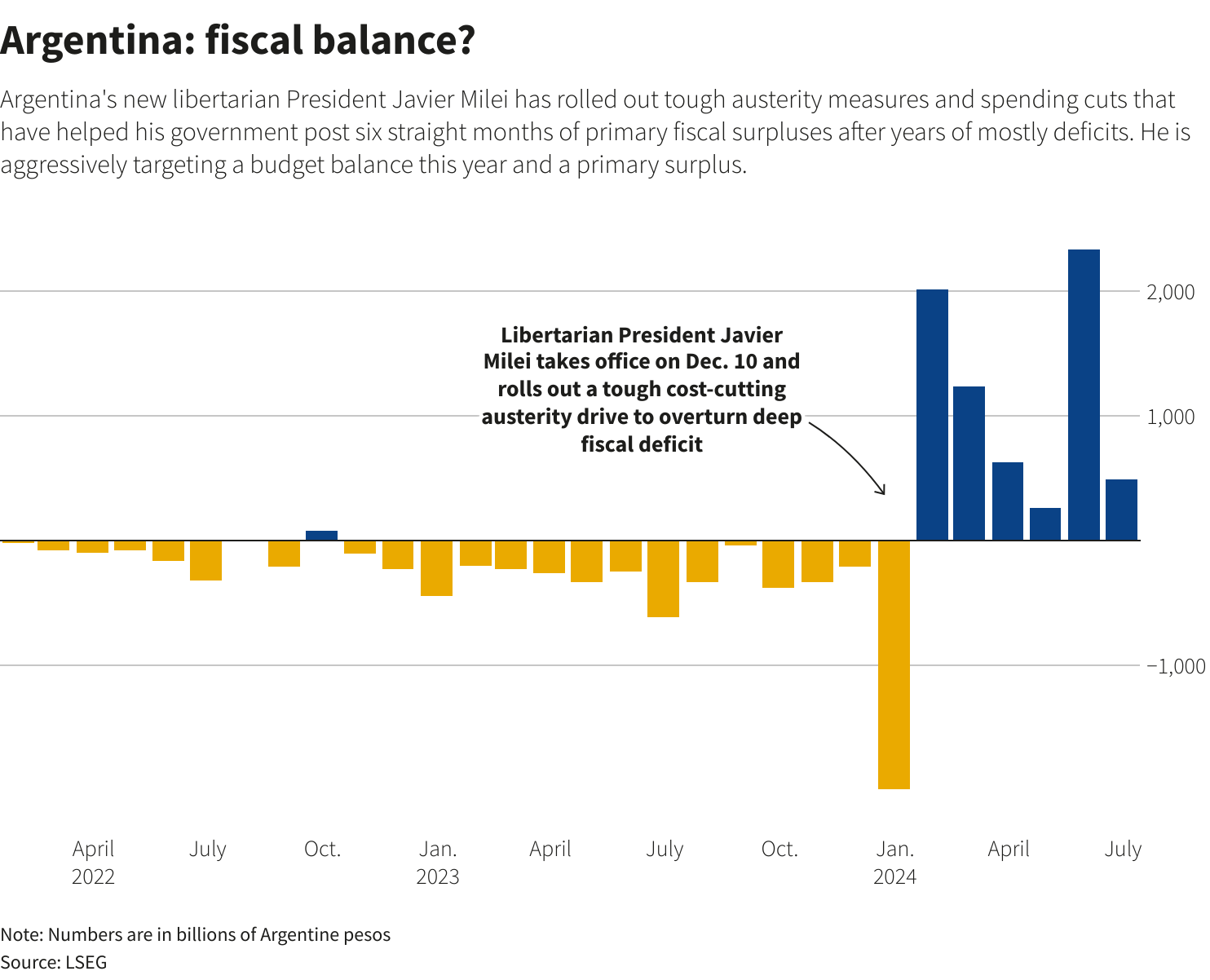
When Milei was elected, Argentina went from constant deficits to almost unprecedented government surplus, and has continued to run a surplus for the past six months.
This wasn’t fancy macroeconomic magic. Milei just cut government spending:
- He eliminated 9 of 18 government ministries, including the Ministry of Culture and the Ministry of Women, Gender, and Diversity.
- He laid off 24,000 government workers (and hopes to increase that to 70,000).
- He cut fuel subsidies (paywalled link)
- He may have cut (or at least not increased, which given inflation levels is an effective cut) funding for universities, which now complain they have no electricity and are giving classes in the dark.
- He has changed the way inflation affects pensions in what was realistically a large budget cut.
- Et cetera.
This source says he cut the size of government by about 30% overall. Unsurprisingly, this eliminated the Argentine deficit.
[…]
6: Overall
When Javier Milei took office, he promised to do shock therapy that would short-term plunge Argentina into a recession, but long-term end its economic woes.
He has fulfilled his campaign promise to plunge Argentina into a recession. Whether this will long-term end its economic woes remains to be seen.
I think he gets credit for some purely political victories (completing the budget cuts he said he would complete), for decreasing inflation, and for improving the housing market. But in the end, history will judge him for whether his shock therapy eventually bears fruit. I don’t think that judgment can be made yet, and I don’t see many economists eager to go out on a limb and say that there are strong signs that his particular brand of shock therapy will definitely work/fail.
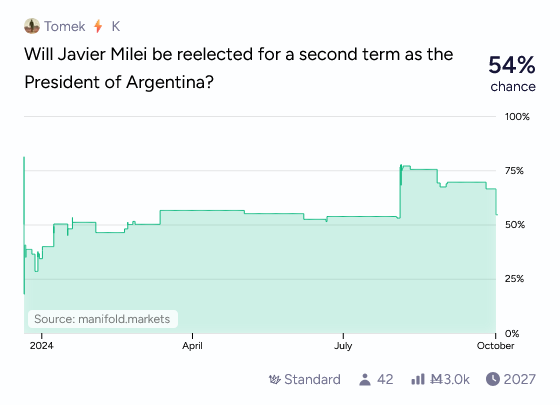
There are disappointingly few Milei prediction markets, probably because it’s hard to operationalize “he makes the economy good”. This multi-pronged mega-market has few traders, and weakly predicts a mix of good and bad things, maybe leaning a little good. But here is a more specific one:
… which compared to Argentina’s historical GDP growth rate seems — no, sorry, Argentina’s historical GDP growth rate is too weird to draw any conclusions.
And maybe the most important test:

September 29, 2024
The “Foundations” essay could apply equally to Canada’s doldrums as it does to Britain
Earlier this week, I linked to the “Foundations” essay by Ben Southwood, Samuel Hughes, and Sam Bowman and it struck me that so much of what they discuss about Britain’s stagnation applied at least as well to Canada. In the National Post, John Ivison concurs:

The “Foundations” essay pointed to moribund GDP per capita growth, among other data points, to make the argument that Britain is standing still economically. (Britain’s economy grew 0.7 per cent a year between 2002 and 2022, Canada’s increased 0.6 per cent a year in the same period, while U.S. output swelled 1.16 per cent a year.)
In relative terms, both countries are getting poorer: in 2002, Canada’s GDP per person was 81 per cent of the U.S.; in 2022, it was 72 per cent. The same figures for the U.K. against the U.S. are 78 per cent in 2002 and, 70 per cent in 2022.
The reason for Britain’s stagnation, the authors argue, is that it has effectively banned investment in transportation, energy and housing — “the foundations it needs to grow.”
Sound familiar?
“The most important economic fact about modern Britain is that it is difficult to build almost anything, anywhere. This prevents investment, increases energy costs and makes it harder for productive economic clusters to expand,” the authors write, saying the result is lower productivity, incomes and tax revenues.
They argued that Britain needs a program of reform with the scale and ambition of the liberalization of the 1980s that focused on cutting taxes, curbing union power and privatizing state-run industries.
“This time we must focus on making it easier to invest in homes, labs, railways, roads, bridges, interconnectors and nuclear reactors,” they write.
That’s a difficult proposition for politicians who are able to resist anything except the temptation to use resources for immediate electoral gratification, rather than investing for a time after they have left office.
Both Canada and Britain are laggards when it comes to investment in infrastructure. While China spent more than five per cent of its GDP on roads, bridges and other infrastructure in 2021, Canada invested just 0.5 per cent (down from 1.3 per cent in 2010) and the U.K. 0.9 per cent.
But the lack of dynamism is not simply political expediency. Rather, it is motivated by an indifference, even a hostility, toward building critical infrastructure.
The Foundations report noted that Britain has not built a reservoir for 30 years, yet faces chronic water shortages in the east of England. Its environmental agency has blocked new development on the basis that it could only be supplied with water by draining environmentally valuable chalk streams. The result is that England’s innovation hub, Cambridge, is barred from expanding, which threatens to strangle the country’s life-sciences industry.
Similar impulses are at work in Canada. Federal Environment Minister Steven Guilbeault said in February that Ottawa would stop investing in new road infrastructure — a position he later clarified to say meant the federal government would not fund large projects like a highway tunnel connecting Quebec City and Levis, Que.
That same sentiment is reflected in the federal Liberal government’s Impact Assessment Act, passed in 2019, which slowed the pace and increased the cost of major project approvals.
On the housing front, a generation of activists emerged who were intent on preventing urban sprawl yet were also opposed to building mid-rise buildings of the kind that eased housing pressures in continental Europe. Constraints on approval are a major contributor to the 3.5-million-unit housing gap because supply has not kept pace with demand.
The consequence of Canada’s regulatory sclerosis is what business veteran Paul Deegan and former clerk of the Privy Council Kevin Lynch in an FP Comment article earlier this year referred to as “an insidious stealth tax on Canadian jobs and growth“.
Taking each of the “foundations” in turn, the depth of the problem becomes clearer — but so do the solutions.
September 24, 2024
British stagnation – “at some point it becomes impossible to grow when investment is banned”
Ed West reviews a new essay by Ben Southwood, Samuel Hughes, and Sam Bowman which tries to identify the underlying reasons for British economic stagnation:
The theme running through the essay is that the British system makes it very hard to invest and extremely expensive and legally difficult to build, making housing and energy costs prohibitive.
While we all know we have fallen in status, “most popular explanations for this are misguided. The Labour manifesto blamed slow British growth on a lack of “strategy” from the Government, by which it means not enough targeted investment winner picking, and too much inequality. Some economists say that the UK’s economic model of private capital ownership is flawed, and that limits on state capital expenditure are the fundamental problem. They also point to more state spending as the solution, but ignore that this investment would face the same barriers and high costs that existing infrastructure projects face, and that deters private investment.”
The problem is that “all of these explanations take the biggest obstacles to growth for granted: at some point it becomes impossible to grow when investment is banned”.
Even before the Russian invasion of Ukraine, the industrial price of energy had tripled in under 20 years. Per capita electricity generation in Britain is only two-thirds that of France, and a third of the US, making us closer to developing countries like Brazil and South Africa than other G7 states. Transport projects are absurdly expensive, mired by planning rules, and all of this helps explain why annual real wages for the median full-time worker are 6.9 per cent lower than in 2008.
In one of the most notorious examples, the authors note that “the planning documentation for the Lower Thames Crossing, a proposed tunnel under the Thames connecting Kent and Essex, runs to 360,000 pages, and the application process alone has cost £297 million. That is more than twice as much as it cost in Norway to actually build the longest road tunnel in the world.”
Britain’s political elites have failed, they argue, because they do not understand the problems, so “they tinker ineffectually, mesmerised by the uncomprehended disaster rising up before them”.
Even “before the pandemic, Americans were 34 percent richer than us in terms of GDP per capita adjusted for purchasing power, and 17 percent more productive per hour … The gap has only widened since then: productivity growth between 2019 and 2023 was 7.6 percent in the United States, and 1.5 percent in Britain … the French and Germans are 15 percent and 18 percent more productive than us respectively.” The gap continues to widen, and on current trends, Poland will be richer than the United Kingdom by the end of the decade.
Britain began to fall behind after the War, but after decades of relative stagnation, its GDP per capita had converged with the US, Germany and France in the 1980s, and our relative wealth peaked in the early Blair years. (Personally, I wonder if one reason for the great Oasis nostalgia is simply that we were rich back then.) If Britain had continued growing in line with its 1979-2008 trends, average income today would be £41,800 instead of £33,500 — a huge difference.
France is the most natural comparison point to Britain, a country “notoriously heavily regulated and dominated by labour unions”. This is sometimes comical to British sensibilities, so that “French workers have been known to strike by kidnapping their chief executives – a practice that the public there reportedly supports – and strikes are so common that French unions have designed special barbecues that fit in tram tracks so they can grill sausages while they march.” Only in France.
It is also heavily taxed, especially in the realm of employment, and yet despite this, French workers are significantly more productive. The reason is that France “does a good job building the things that Britain blocks: housing, infrastructure and energy supply”.
With a slightly smaller population, France has 37 million homes compared to our 30 million. “Those homes are newer, and are more concentrated in the places people want to live: its prosperous cities and holiday regions. The overall geographic extent of Paris’s metropolitan area roughly tripled between 1945 and today, whereas London’s has grown only a few percent.” One quality-of-life indicator is that “800,000 British families have second homes compared to 3.4 million French families“.
They also do transport far better, with 29 tram networks compared to seven in Britain, and six underground metro systems against our three. “Since 1980, France has opened 1,740 miles of high speed rail, compared to just 67 miles in Britain. France has nearly 12,000 kilometres of motorways versus around 4,000 kilometres here … In the last 25 years alone, the French built more miles of motorway than the entire UK motorway network. They are even allowed to drive around 10 miles per hour faster on them.”


