I’m not much of a fan fiction reader, but I was quite amused at this crossover between George MacDonald Fraser’s Flashman series and George R.R. Martin’s Game of Thrones:
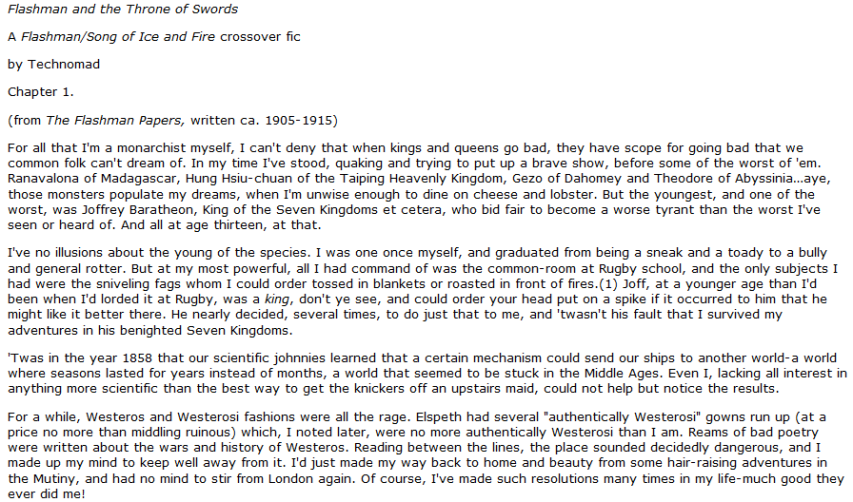

I’m not much of a fan fiction reader, but I was quite amused at this crossover between George MacDonald Fraser’s Flashman series and George R.R. Martin’s Game of Thrones:
Myron Magnet is quite enthusiastic about Founders’ Son: A Life of Abraham Lincoln by Richard Brookhiser:
Unlike those mega-biographies that bury their subject’s chief accomplishments under 900 pages of undigested detail, Richard Brookhiser’s compact, profound, and utterly absorbing new life of Abraham Lincoln, Founders’ Son, leaps straight to the heart of the matter. With searchlight intensity, it dazzlingly illuminates the great president’s evolving views of slavery and the extraordinary speeches in which he unfolded that vision, molding the American mind on the central conflict in American history and resolving, at heroic and tragic cost to the nation and himself, the contradiction that the Founding Fathers themselves could not resolve.
[…]
Lincoln did not start out an abolitionist. As early as 1837, he showed ambivalence on the subject. When the Illinois legislature voted to condemn abolition societies as unnecessarily provocative that year, legislator Lincoln and a colleague voted yes but entered a protest, declaring for the record “that the institution of slavery is founded on both injustice and bad policy.” Even so, as a campaigner for Whig candidate William Henry Harrison in the election of 1840, Lincoln, in a debate with Martin Van Buren supporter Stephen Douglas, “was not above slyly trafficking in prejudice,” Brookhiser notes, attacking Van Buren for supporting voting rights for New York State’s free blacks. But as his congressional term drew to an end in 1849, he proposed (unsuccessfully) a plan for ending slavery in the District of Columbia, and the next year, when the three-decade-long era of trying to find a compromise on the issue of slavery came to a climax with the Compromise of 1850, Lincoln knew that the choice between slavery and abolition was inevitable for the nation—and he knew that he would stand against slavery. “When the time comes my mind is made up,” he told a friend, “for I believe the slavery question can never be successfully compromised.”
The time came soon enough, with the infamous Kansas-Nebraska Act of 1854. In effect, the act repealed the 1820 Missouri Compromise, which, in admitting Missouri as a slave state, had barred slavery from the rest of the Louisiana Territory lying north of the 36° 30’ parallel. By the terms of the new act, however, settlers pouring into the vast, hitherto empty territories of Kansas and Nebraska, which mostly lay north of the 1820 line, could choose whether to admit or bar slavery by “popular sovereignty,” the term used by Democratic senate leader Stephen Douglas, who boasted of having “passed the Kansas-Nebraska Act myself. . . . I had the authority and power of a dictator throughout the whole controversy.”
Though what we call the Lincoln-Douglas debates occurred in their Illinois senatorial contest of 1858, the “six years from 1854 to 1860 were one long Lincoln-Douglas debate,” writes Brookhiser, as Douglas went around the state defending the act and an indignant Lincoln pursued him, rebutting his emollient arguments in a string of immortal speeches. In Peoria in October 1854, Lincoln condemned Douglas for reopening an already scabbed-over wound. “Every inch of territory we owned already had a definite settlement of the slavery question,” he observed; but thanks to Douglas, “here we are in the midst of a new slavery agitation.” Douglas wants the people of the territories to decide? Fine. But who the people are “depends on whether a Negro is not or is a man.” If he is, then isn’t it “a total destruction of self-government, to say that he too shall not govern himself?” When a white man “governs himself, and also governs another man, that is more than self-government — that is despotism.”
Lincoln appealed to the authority of his beloved Founding Fathers — a subject Brookhiser, biographer of several of them, knows better than most. These great men found slavery already existing in the colonies, and to forge a new nation that the slave states would agree to join, they had to accept the evil out of necessity, not principle. They clearly knew that it was wrong, as is evident in the 1787 Northwest Ordinance, by which the Continental Congress strove to prevent slavery’s spread to unsettled territories; in the Declaration of Independence—“the sheet anchor of American republicanism,” said Lincoln, “that teaches me that ‘all men are created equal,’” including blacks, who are emphatically men; and in the Constitution itself, which accepted slavery so reluctantly that it wouldn’t even name it, Lincoln noted, “just as an afflicted man hides away a wen or cancer, which he dares not cut out at once, lest he bleed to death.” So let’s not go beyond where the Founders felt themselves forced to go. Let’s not metastasize slavery further.
Charles Stross tells a sad tale of woe about his “Laundry” series of SF/Occult novels:
There’s some kind of bizarre curse hanging over my Laundry Files series. Or maybe it’s a deeper underlying problem with writing fiction set in the very near future (or past): I’m not sure which. All I’m sure is that that for the past decade, reality has been out to get me: and I’m fed up.
My first intimation came a long time ago — in 2001. I’d just finished writing The Atrocity Archive and it was being edited for serial publication in issues 7-9 of the Scottish SF magazine Spectrum SF (which folded a couple of issues later, in 2003). It was late September, and I found myself reading a terse email from the editor, Paul Fraser: “Charlie, about your story — do you think you can possibly find some new bad guys for Chapter 4? Because you’ve just been overtaken by current events …”
In Chapter 4 of The Atrocity Archive Bob learns from Angleton who the middle eastern bad guys who kidnapped Mo, intending to use her sacrifice to open a gateway to somewhere bad, really were … and when I originally wrote the story, in 1999-2000, they were a relatively obscure bunch of anti-American zealots who’d blown up the USS Stark and an embassy in Africa. I know this may boggle the imagination of younger or more forgetful readers, but Al Quaida and Osama bin Laden had not at that time hijacked any airliners, much less etched themselves into the pages of world history: they were not, at that time, the Emmanuel Goldstein of the New World Order.
The Guardian‘s Catherine Shoard on the reception Gérard Depardieu received from a “conservative” Russian politician:
Gérard Depardieu’s move to Russia had the effect of making the actor repent sexual activities conducted in Europe, a conservative Kremlin politician has said.
Reacting to the publication of Ça s’est fait comme ça, Depardieu’s memoir in which he discusses stints of employment as a grave robber and a male prostitute, Vitaly Milonov expressed sympathy for the actor.
“It wasn’t easy for him in France,” he told Russian newspaper MK. “There, society is corrupted and doesn’t have any moral principles.”
“I view Gérard’s book as sort of repentance, confession of old sins. Now that he breathed in the purifying air of Mordovia, all that filth left him. He sincerely repents what he was forced to do in his youth in France. He wants to live in a new way, without all that filth.”
Cory Doctorow’s latest book, Information Doesn’t Want to Be Free, briefly reviewed by Ian Steadman in New Statesman:
“Information wants to be free” is a rallying cry for many of those who fight against legal restrictions on the internet. The phrase was coined by the tech writer Stewart Brand in 1984 and referred to the way the web reduces many of the costs of producing and disseminating data to near zero. “Free” in this phrase has also come to mean “freedom”, because the internet makes it easy to avoid censorship.
Doctorow is challenging both interpretations – not because he doesn’t agree with them but because he thinks a crucial premise has been lost. “Information doesn’t want to be free,” he writes, “people want to be free.”
The first two-thirds of the book discusses ways in which artists are penalised by the internet’s present regulatory system. He criticises digital rights management (DRM) technology, which limits the platforms digital files can play on; not only does it mean we don’t “own” the files we pay for, but when a company that supports a file goes bust, the culture locked up in their DRM can be lost for ever. Doctorow describes this as “a library burning in slow motion”.
Many companies such as Apple sell devices that block you from downloading non-approved apps. “That is sold to creators as an anti-piracy measure,” Doctorow tells me when we speak on the phone. “But the most practical application has been to allow Apple to exert market power that it would never have had in any other world.”
This links to the final third of the book, which explores how systems for protecting copyrighted material can also be used for censorship.
In Reason, Jesse Walker tracks down the creator of an urban legend, only to discover that it was him:
During Banned Books Week last month, you may have heard that some busybodies banned Green Eggs and Ham because they thought the story was kinda gay. Metro reported that this happened “briefly in the 1990s because of supposed homosexual innuendos.” A Minnesota radio station said the book was targeted for its “homosexual theme.” Feministe announced that it had been challenged in California for, “No shit, ‘homosexual seduction’ on the part of Sam.” Many other outlets have related the same story, not just last month but in years past. In 2013, Dr. Seuss’ classic even made its way into the Oberlin Public Library’s banned books display. “Inside the bright orange book,” a local paper reported, a “slip explains that it was once thought to have ‘homosexual seduction,’ because Sam tried to seduce his friend.”
None of these reports say where or when this purported prohibition took place, other than those vague references to California and the ’90s. A Lexis-Nexis search turned up nothing. I asked the American Library Association, which sponsors Banned Books Week and keeps track of such things, if they were aware of such an effort; they told me it wasn’t in their database. Metro said it got its info from a book called Seuss Facts, which as far as I can tell does not exist — though a Facebook feed by that name did mention the alleged ban without citing a source. I got in touch with some of the other reporters and bloggers who had repeated the story. None of them were certain where it came from. After I contacted BuzzFeed‘s Spencer Althouse, who included Green Eggs in a banned-books list last year, he concluded that the story was “a terrible, terrible rumor” and added a correction to his article. I’m open to the possibility that there’s a real event here that I haven’t been able to track down, but that seems extremely doubtful.
Besides, I’m pretty sure I know where this began. It’s my fault. Sorry. My bad.
Among those currently imagining our possible futures, one of the most persuasive is the novelist William Gibson, who, having evolved quite a bit past the man who wrote Neuromancer in 1984, can hardly be said to be imagining futures at all, with his most recent novels constituting, in his words, “speculative fiction of the very recent past,” more oriented toward social situations than technological situations. With the possible exception of David Foster Wallace, no novelist of whom I am aware has ever written with such freshness and imagination on the subject of advertising and marketing, which is a big part of what Wallace called “the texture of the world I live in.” Nor has any novelist quite so precisely identified what is sinister in our world of ubiquitous sales pitches: that something whose entire purpose is to be at the center of our attention still manages to be somehow covert. The marketing mentality is an invasive species; earnest young people now speak entirely seriously about their “personal brands” at the same time they complain about the commodification of this or that. Gibson understands the strangeness of our times, and my own mental shorthand for the odd little details one sometimes encounters, particularly in urban life, when one identifies something that is entirely ordinary and yet feels as if it were not in its right time and place, is “Feeling like I’m living in a William Gibson novel.”
Kevin D. Williamson, “Futures Trading: We are no longer thinking about the future because we believe we are there”, National Review, 2014-10-01.
Rob Lyons charts the way our governments and healthcare experts got onboard the anti-fat dietary express, to our long-lasting dietary harm:
… in recent years, the advice to eat a low-fat diet has increasingly been called into question. Despite cutting down on fatty foods, the populations of many Western countries have become fatter. If heart-disease mortality has maintained a steady decline, cases of type-2 diabetes have shot up in recent years. Maybe these changes were in spite of the advice to avoid fat. Maybe they were caused by that advice.
The most notable figure in providing the intellectual ammunition to challenge existing health advice has been the US science writer, Gary Taubes. His 2007 book, Good Calories, Bad Calories, became a bestseller, despite containing long discussions on some fairly complex issues to do with biochemistry, nutrition and medicine. The book’s success triggered a heated debate about what really makes us fat and causes chronic disease.
The move to first discussing and then actively encouraging a low-fat diet was largely due to the work of Dr. Ancel Keys, who is to the low-fat diet movement what Karl Marx is to Communism. His energy, drive, and political savvy helped get the US government and the majority of health experts onboard and pushing his advice. A significant problem with this is that Keys’ advocacy was not statistically backed by even his own data. He drew strong conclusions from tiny, unrepresentative samples, yet managed to persuade most doubters that he was right. A more statistically rigorous analysis might well show that the obesity crisis has actually been driven by the crusading health advisors who have been pushing the low-fat diet all this time … or, as I termed it, “our Woody Allen moment“.
Rob Lyons discussed this with Nina Teicholz, author of the book The Big Fat Surprise:
Once the politically astute Keys had packed the nutrition committee of the AHA and got its backing for the advice to avoid saturated fat, the war on meat and dairy could begin. But a major turning point came in 1977 when the Senate Select Committee on Nutrition, led by Democratic senator George McGovern, held hearings on the issue. The result was a set of guidelines, Dietary Goals for the United States [PDF], which promoted the consumption of ‘complex’ carbohydrates, and reductions in the consumption of fat in general and saturated fat in particular.
By 1980, this report had been worked up into government-backed guidelines — around the same time that obesity appears to have taken off in the US. The McGovern Report inspired all the familiar diet advice around the world that we’ve had ever since, and led to major changes in what food manufacturers offered. Out went fat, though unsaturated fat and hydrogenated oils were deemed less bad than saturated fat, so vegetable oils and margarines became more popular. In came more carbohydrate and more sugar, to give those cardboard-like low-fat ‘treats’ some modicum of flavour.
Yet two recent reviews of the evidence around saturated fat — one led by Ronald Krauss, the other by Rajiv Chowdhury — suggest that saturated fat is not the villain it has been painted as. (The latter paper, in particular, sparked outrage.) As for fat in general, Teicholz tells me: ‘There was no effort until very late in the game to provide evidence for the low-fat diet. It was just assumed that that was reasonable because of the caloric benefit you would see from restricting fat.’
Teicholz also debunks the wonderful reputation of the Mediterranean Diet (“a rose-tinted version of reality tailored to the anti-meat prejudices of American researchers”), points out the role of the olive oil industry in pushing the diet (“Swooning researchers were literally wined and dined into going along with promoting the benefits of olive oil”), and points out that we can’t even blame most of the obesity problem on “Big Food”:
Which leads us to an important third point made by Teicholz: that the blame for our current dietary problems cannot solely, or even mainly, be placed at the door of big food corporations. Teicholz writes about how she discovered that ‘the mistakes of nutrition science could not be primarily pinned on the nefarious interests of Big Food. The source of our misguided dietary advice was in some ways more disturbing, since it seems to have been driven by experts at some of our most trusted institutions working towards what they believed to be the public good.’ Once public-health bureaucracies enshrined the dogma that fat is bad for us, ‘the normally self-correcting mechanism of science, which involves constantly challenging one’s own beliefs, was disabled’.
The war on dietary fat is a terrifying example of what happens when politics and bureaucracy mixes with science: provisional conclusions become laws of nature; resources are piled into the official position, creating material as well as intellectual reasons to continue to support it; and any criticism is suppressed or dismissed. As the war on sugar gets into full swing, a reading of The Big Fat Surprise might provide some much-needed humility.
In Maclean’s, Patricia Treble reviews a new book by Jonathan Beckman, called How to Ruin a Queen: Marie Antoinette and the Diamond Necklace Affair:
Three years before revolutionaries toppled Louis XVI and his Austrian-born wife, Marie Antoinette, France was mesmerized with a different tumult. Cardinal Louis de Rohan, scion of one of the nation’s grandest families, was in court, accused of stealing a famously expensive necklace from jewellers who’d created it. He claimed he’d acted at the behest of the queen, who then reneged on paying for the gaudy 2,800-carat piece. The resultant scandal solidified Marie Antoinette’s reputation for unbounded extravagance.
Yet, as Jonathan Beckman, explains in a masterful new account of the diamond necklace affair, nothing is as it appeared. There are fake royals, forged letters and disappearing gems as well as kidnappings, trysts and even a duel involving poisoned pigs. If the tale was fictional, it would be dismissed as an overwrought fantasy, yet in Beckman’s hands, its machinations unfold as an audacious caper that will enthrall readers much as the original events captivated Europe.
Published on 26 Aug 2014
“Just this whole process of going through the baby boom’s history, I began to realize what a nicer society — kinder, more decent society — that we live in today than the society when I was a kid,” says P.J. O’Rourke, best-selling author of Holidays in Hell, Parliament of Whores, and many other titles.
O’Rourke sat down with Reason‘s Nick Gillespie at Freedom Fest 2014 in Las Vegas to discuss his new book, The Baby Boom: How it Got That Way and It Wasn’t My Fault and I’ll Never Do it Again. As the father of three kids born between 1997 and 2004, he also lays down some thoughts about millennials, noting that they live in a much nicer, more tolerant world than the one in which he grew up. “I don’t think my 10-year old boy has ever been in a fist fight,” says O’Rourke, who was born in 1947. “I mean there might be a little scuffling but I don’t think he’s has ever had that kind of violent confrontation that was simply part of the package when I was a kid.”
He also feels that the internet “fragments information” in a way that destroys the sweep of history, at least at first. “You end up with mosaic information,” he says. “Now, I think over time the kids put these mosaics together but I don’t think the internet itself lends itself to the sweep of history.”
The interview also includes a tour of O’Rourke’s long and varied career in journalism, from his humble beginnings writing for an underground alt-weekly to his time as editor of National Lampoon and his incredible work as a foreign correspondent for Rolling Stone to his current position as columnist at the Daily Beast.
A prominent libertarian, O’Rourke also discusses the difficulties in selling a political philosophy devoted to taking power away from politicians.
“If libertarianism were easy to explain and if it weren’t so easy to exaggerate the effects of libertarianism — people walking around with ‘Legalize Heroin!’ buttons and so on — I think it would’ve been done already,” says O’Rourke. “But the problem is, of course, is that libertarianism isn’t political. It’s anti-political, really. It wants to take things out of the political arena.”
To clarify, Terry Teachout is talking about a new omnibus edition of H.L. Mencken’s Happy Days, Newspaper Days, and Heathen Days (which I’ll certainly be adding to my various bookstore wish lists):
It happened that I hadn’t looked at any of the Days books since The Skeptic, my Mencken biography, was published in 2002. Nor had I looked at The Skeptic since I last wrote about Mencken. That was four years ago, in a New Criterion essay about the Library of America’s two-volume collection of his Prejudices essays in which I suggested that
Mencken might possibly be a young person’s writer, one who excites the unfinished mind but has less to offer those who have seen more of life. Certainly those who look to literature for a portrait of the human animal that is rich in chiaroscuro will not find it in the Prejudices … If a great essayist is one who succeeds in getting his personality onto the page, then H.L. Mencken qualifies in spades. The problem is that his personality grows more predictable with closer acquaintance, just as the tricks of his prose style grow more familiar. Like most journalists, he is best consumed not in the bulk of a twelve-hundred-page boxed set but in small and carefully chosen doses.
Hence it was a very pleasant surprise to return to the Days books after a long absence and find my original judgment on them to be confirmed anew. I described Happy Days as “one of [Mencken]’s most completely realized achievements … a masterpiece of pure style” in The Skeptic, and went on to say that Newspaper Days was “at least as good … It, too, is a not-so-minor masterpiece of affectionate reminiscence, one that in a better-regulated world would be recognized as a modern classic.”
It is a most extraordinary thing, but I never read a patent medicine advertisement without being impelled to the conclusion that I am suffering from the particular disease therein dealt with in its most virulent form. The diagnosis seems in every case to correspond exactly with all the sensations that I have ever felt.
I remember going to the British Museum one day to read up the treatment for some slight ailment of which I had a touch — hay fever, I fancy it was. I got down the book, and read all I came to read; and then, in an unthinking moment, I idly turned the leaves, and began to indolently study diseases, generally. I forget which was the first distemper I plunged into — some fearful, devastating scourge, I know — and, before I had glanced half down the list of “premonitory symptoms,” it was borne in upon me that I had fairly got it.
I sat for awhile, frozen with horror; and then, in the listlessness of despair, I again turned over the pages. I came to typhoid fever — read the symptoms — discovered that I had typhoid fever, must have had it for months without knowing it — wondered what else I had got; turned up St. Vitus’s Dance — found, as I expected, that I had that too, — began to get interested in my case, and determined to sift it to the bottom, and so started alphabetically — read up ague, and learnt that I was sickening for it, and that the acute stage would commence in about another fortnight. Bright’s disease, I was relieved to find, I had only in a modified form, and, so far as that was concerned, I might live for years. Cholera I had, with severe complications; and diphtheria I seemed to have been born with. I plodded conscientiously through the twenty-six letters, and the only malady I could conclude I had not got was housemaid’s knee.
I felt rather hurt about this at first; it seemed somehow to be a sort of slight. Why hadn’t I got housemaid’s knee? Why this invidious reservation? After a while, however, less grasping feelings prevailed. I reflected that I had every other known malady in the pharmacology, and I grew less selfish, and determined to do without housemaid’s knee. Gout, in its most malignant stage, it would appear, had seized me without my being aware of it; and zymosis I had evidently been suffering with from boyhood. There were no more diseases after zymosis, so I concluded there was nothing else the matter with me.
I sat and pondered. I thought what an interesting case I must be from a medical point of view, what an acquisition I should be to a class! Students would have no need to “walk the hospitals,” if they had me. I was a hospital in myself. All they need do would be to walk round me, and, after that, take their diploma.
Then I wondered how long I had to live. I tried to examine myself. I felt my pulse. I could not at first feel any pulse at all. Then, all of a sudden, it seemed to start off. I pulled out my watch and timed it. I made it a hundred and forty-seven to the minute. I tried to feel my heart. I could not feel my heart. It had stopped beating. I have since been induced to come to the opinion that it must have been there all the time, and must have been beating, but I cannot account for it. I patted myself all over my front, from what I call my waist up to my head, and I went a bit round each side, and a little way up the back. But I could not feel or hear anything. I tried to look at my tongue. I stuck it out as far as ever it would go, and I shut one eye, and tried to examine it with the other. I could only see the tip, and the only thing that I could gain from that was to feel more certain than before that I had scarlet fever.
I had walked into that reading-room a happy, healthy man. I crawled out a decrepit wreck.
Jerome K. Jerome, Three Men in a Boat (to say nothing of the dog), 1889.
Another short work from the “Laundry” series by Charles Stross:
All bureaucracies obey certain iron laws, and one of the oldest is this: get your seasonal leave booked early, lest you be trampled in the rush.
I broke the rule this year, and now I’m paying the price. It’s not my fault I failed to book my Christmas leave in time — I was in hospital and heavily sedated. But the ruthless cut and thrust of office politics makes no allowance for those who fall in the line of battle: “You should have foreseen your hospitalization and planned around it” said the memo from HR when I complained. They’re quite right, and I’ve made a note to book in advance next time I’m about to be abducted by murderous cultists or enemy spies.
I briefly considered pulling an extended sickie, but Brenda from Admin has a heart of gold; she pointed out that if I volunteered as Night Duty Officer over the seasonal period I could not only claim triple pay and time off in lieu, I’d also be working three grades above my assigned role. For purposes of gaining experience points in the fast-track promotion game they’ve steering me onto, that’s hard to beat. So here I am, in the office on Christmas Eve, playing bureaucratic Pokémon as the chilly rain drums on the roof.
(Oh, you wondered what Mo thinks of this? She’s off visiting her ditz of a mum down in Glastonbury. After last time we agreed it would be a good idea if I kept a low profile. Christmas: the one time of year when you can’t avoid the nuts in your family muesli. But I digress.)
Harvard University Press is putting all 520 volumes of the Loeb Classical Library online beginning in September:
When James Loeb designed his soon-to-be-launched series of Greek and Roman texts at the turn of the twentieth century, he envisioned the production of volumes that could easily fit in readers’ coat pockets. A century later, that compact format is still one of the collection’s hallmarks. Beginning in September, however, the iconic books will be far handier than Loeb had hoped: users of the Loeb Classical Library (LCL) will have the entire collection at their fingertips. After five years of dedicated work on the part of the library’s trustees and Harvard University Press (HUP), which has overseen LCL since its creator’s death in 1933, the more than 520 volumes of literature that make up the series will be accessible online. Besides allowing users to browse the digitized volumes, which retain the unique side-by-side view of the original text and its English translation, the Digital Loeb Classical Library will enable readers to search for words and phrases across the entire corpus, to annotate content, to share notes and reading lists with others, and to create their own libraries using personal workspaces.
LCL managing editor Michael Sullivan, whose position was created earlier this year to supervise the virtual library, said that the digitization project is “a major leap forward in the history of the Loeb.” According to HUP executive editor-at-large Sharmila Sen, the launch of the digital LCL marks “a moment of rebirth” for the historic collection. She explained that in the years preceding the library’s 2011 centenary, the trustees and HUP administrators began to think about how to make the LCL “relevant to the twenty-first century.” Even though online databases of Greek and Latin literature have existed for years, said the library’s general editor, Jeffrey Henderson, a classics professor at Boston University, the digital Loeb will be unprecedented in its accessibility and scope: for the first time, readers without knowledge of Greek and Latin will be able to explore a vast range of the classical literary heritage online through high-quality, modern translations. He added that the project, which cost the LCL foundation more than $1 million, will serve as a model for the digitization of other HUP series, noting, “It’s strange that the oldest literature becomes the model for the digital age.”
Consolidating a vast literary corpus involving two different alphabets into an interconnected, elegant, and easy-to-use website required much behind-the-scenes work, Sen said. Designing the software for the digital library and transferring the data have concluded, she noted, but the project overseers view the current product — which will be available by subscription to institutions and individuals — as only a 1.0 version. The website will be a dynamic workspace, Henderson pointed out, adding that user feedback will help the editors increase its functionality.
H/T to Colby Cosh for the link.
I’m quite a fan of the “Laundry” series of SF/horror stories by Charles Stross. I thought I’d read all of them (well, all that have been released, anyway), but a discussion thread on the Lois McMaster Bujold mailing list alerted me that I hadn’t read “Down on the Farm“, which is available for free on the Tor.com website:
Ah, the joy of summer: here in the south-east of England it’s the season of mosquitoes, sunburn, and water shortages. I’m a city boy, so you can add stifling pollution to the list as a million outwardly mobile families start their Chelsea tractors and race to their holiday camps. And that’s before we consider the hellish environs of the Tube (far more literally hellish than anyone realizes, unless they’ve looked at a Transport for London journey planner and recognized the recondite geometry underlying the superimposed sigils of the underground map).
But I digress…
One morning, my deputy head of department wanders into my office. It’s a cramped office, and I’m busy practicing my Frisbee throw with a stack of beer mats and a dart-board decorated with various cabinet ministers. “Bob,” Andy pauses to pluck a moist cardboard square out of the air as I sit up, guiltily: “a job’s just come up that you might like to look at—I think it’s right up your street.”
The first law of Bureaucracy is, show no curiosity outside your cubicle. It’s like the first rule of every army that’s ever bashed a square: never volunteer.
If you ask questions (or volunteer) it will be taken as a sign of inactivity, and the devil, in the person of your line manager (or your sergeant) will find a task for your idle hands. What’s more, you’d better believe it’ll be less appealing than whatever you were doing before (creatively idling, for instance), because inactivity is a crime against organization and must be punished. It goes double here in the Laundry, that branch of the British secret state tasked with defending the realm from the scum of the multiverse, using the tools of applied computational demonology: volunteer for the wrong job and you can end up with soul-sucking horrors from beyond spacetime using your brain for a midnight snack. But I don’t think I could get away with feigning overwork right now, and besides: he’s packaged it up as a mystery. Andy knows how to bait my hook, damn it.



Powered by WordPress