When was the moment you first realized you’re a cold-hearted sumbitch? For me, it was sometime in my late childhood — early high school, thereabouts — when for whatever reason I became aware of the Giant Panda. I forget the occasion — I think one of the few captive pairs was going to have cubs — but we were treated to a massive media blitz about these gentle giants. And look: they’re cute and all, but the upshot of so many of those stories was that these things are critically endangered, not least because it takes tremendous effort to get them to breed.
Not just “breed in captivity”, mind you. Breed in general. Apparently panda lovin’ is like nerds on date night — the conditions must be perfect, it’s incredibly awkward, it takes massive effort, and even the tiniest misstep can throw the whole thing off forever. Your average MGTOW gets more poony than your average panda … all of which prompted in me the very uncharitable thought: Are you sure God doesn’t want it to be dead?
Which — black pill incoming — is pretty much what I feel about the human race right now.
Take a gander at this. The “aki no kure” guy has a lot of issues, no doubt, but when he’s on he’s a very useful read. If for no other reason than that he keeps up with the Kids These Days, and I just can’t, y’all, I just can’t. And here’s why:
Well, if Zoomers never leave the home (something they all make self-deprecating jokes about), then you *are* watching their daily lives as they sit in a chair in front of a computer set-up. Their whole lives are online and virtual, not IRL. Their daily activities are not going to the store and running into neighbors who they share funny stories with, it’s scrolling their timeline and engaging with its content. So you are watching them go through all sorts of daily activities — checking their subreddit, uploading pictures to Instagram, clapping back to haters on Twitter, reacting to other streamers’ video clips, sending text messages, and so on and so forth. And the other characters in their online lives are also entirely online — other accounts who they interact with, although every once in awhile they make an IRL guest appearance.
That right there is my definition of hell. Seriously, if that’s “life” in the Worker’s Paradise, I’m punching out. But: That’s what so many people, not just “Zoomers”, seem to want. See “Every single thing about the Holocough, 2020-present”. If that’s what Western Civ has come to, then let me complete my transformation into the goofiest hippie on campus circa 1992: “Hey hey, ho ho, Western Civ has got to go.”
Severian, “Giant Pandas”, Founding Questions, 2022-03-28.
October 31, 2025
October 29, 2025
The Korean War Week 71: The Panmunjom Peace Talks! – October 28, 1951
The Korean War by Indy Neidell
Published 28 Oct 2025Big news! The peace talks resume after over two months hiatus, now in a village called Panmunjom. Also, UN Commander Matt Ridgway also gives a rare press conference, and he implies that for all his talk about punishment and prevention, those pilots who violated neutral zone air space and killed civilians receive at best a slap on the wrist. Speaking of civilians, a Marine operation is launched to deprive the enemy of civilian dwellings during the coming winter — Operation Houseburner.
Chapters
00:00 Intro
00:41 Recap
01:00 Panmunjom
03:27 Peace Talks Begin
08:35 The Neutral Zone
10:03 Ridgway’s Press Conference
11:42 Houseburner
12:22 Summary
12:30 Conclusion
(more…)
October 25, 2025
Foreign interference? In our elections? Say it ain’t so …
Oh, but it is, fellow Canadians, and it’s going to continue because our government can’t or won’t lift a finger to stop it:
The cover of the NSICOP special report on foreign interference (PDF – https://nsicop-cpsnr.ca/reports/rp-2024-06-03/special-report-foreign-interference.pdf )
[Vancouver-East MP Jenny Kwan]’s recent comments, which correctly noted the incredible hardship that Canadians targeted by foreign regimes endure, typically with no help from an apathetic Canadian government, are important and deserve amplification — we must all hammer home just how vicious a foreign influence campaign can be for those on the receiving end, and how little help they can normally expect from Canadian officials.
But mystifying? I wish.
A recap of the timeline is useful: The Liberals were “actively considering” such a registry as early as 2021. Late the next year, the magnificent Marco Mendicino, living embodiment of Trudeau-era ministerial excellence, was talking about launching a consultation, to see if it was an idea worth pursuing. A few months later, Justin Trudeau himself said that Mendicino would be “moving forward” to study “various proposals” in the coming weeks.
And then, well. You know. Nothing happened. In short order the government had the foreign interference scandal blow up in its face. A public inquiry was eventually called, after a long, drawn out process of increasingly pathetic attempts to dodge the issue. The initial report by Justice Hogue was released in May of 2024, and that month, the House unanimously passed Bill C-70, the Countering Foreign Interference Act. This gave the government the legal tools to establish the registry, a process they said would take about a year. That year ran out five months ago, and at that point … the office wasn’t even operating yet, even just in preparation for eventually going live. The Carney government then said they’d appoint a commissioner by September of this year. This would mark the beginning of the registry’s work.
It’s now late October, with nary a new-fangled commissioner to be found.
The Hill Times article places Kwan’s comments, and the government’s overall lackadaisical effort on this front, in the specific context of the Carney government’s efforts to offset our lopsided reliance on trade with the United States by improving relations with China and India. These are not countries with which we have lately been swapping friendship bracelets, and a foreign influence registry would largely — not exclusively, but largely — be intended to address their interference. “I am constantly worried about [foreign interference], but that doesn’t mean I’m not also worried about affordability issues for Canadians; I can do both,” Kwan is quoted as telling The Hill Times. “The Carney government needs to be able to walk and chew gum at the same time; they need to address both with the level of seriousness and attention they require.”
Later in the article, Dan Stanton, a former senior CSIS official and current national security expert at the University of Ottawa, adds that the Carney government has likely postponed any further announcements on the registry to avoid complicating ongoing talks with the Asian giants.
Well, yeah. That’s pretty clearly an issue. Kwan and Stanton have the government about dead to rights on that one. You can see the proof of that everywhere — Foreign Affairs Minister Anita Anand’s recent trip to India and China, after which she called China a “strategic partner”, is a pretty clear signal. The latest blowup in U.S.-Canada relations, with Trump cancelling all trade negotiations with Canada because (or so he claims) Ontario ran anti-tariff ads on U.S. TV, will only increase the desire in Ottawa to realign our economy toward literally anyone else but the Americans.
October 24, 2025
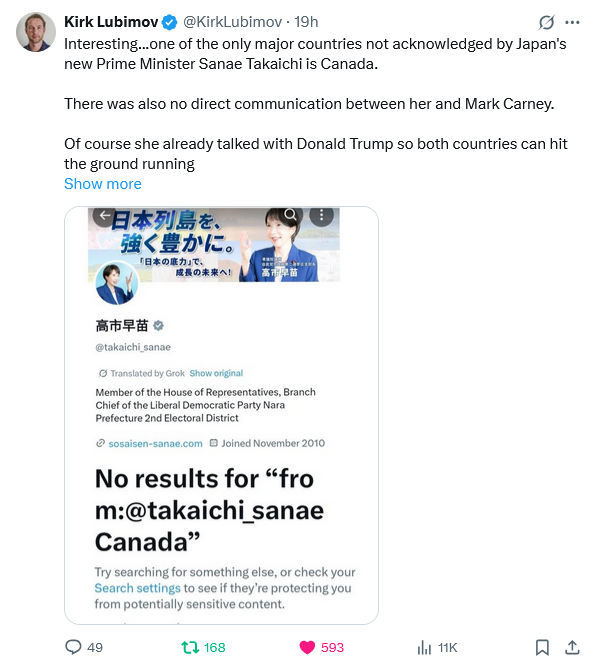
Sanae Takaichi, Japan’s Thatcher?
In UnHerd, Christopher Harding profiles the new Prime Minister of Japan, Sanae Takaichi, the first female PM who was elected to office on the 21st:

Sanae Takaichi, new Prime Minister of Japan, 21 October, 2025
Photo by the Cabinet Public Affairs Office via Wikimedia Commons.
As a teenager, Sanae Takaichi no doubt riled her parents now and again with her love of motorbikes and heavy metal. Today, poised to become Japan’s first female prime minister at the age of 64, she is polarising a nation. Some credit “Japan’s Iron Lady” with the steely resolve required to tackle the country’s domestic problems and stand up to China. Others lament the apparent fact that to succeed as a woman in Japanese politics you have to adopt the worst instincts of the men, from policies that prop up the patriarchy — men only on the imperial throne, compulsory shared surnames for married couples — to a nativist ultranationalism.
While Takaichi’s premiership will represent a milestone for modern Japan, it’s important in Japanese politics not to place too much weight on the frontman — or woman. The reality is more like one of those bands where the bassist writes the songs but, disliking the limelight, hires a series of relatively disposable vocalists to present them to the public. Alongside machinations in her own party, the LDP, where senior background figures largely decide who gets the premiership and how long they keep it, Takaichi’s fortunes may come to depend on how she deals with two intertwined issues: the economy and immigration.
First, the economy. People in Japan, and the young in particular, are furious about a combination of high taxes, low wage-growth, rising inflation and insecure job prospects. Japanese governments of the past 30 years have struggled with some or all of these problems, trying and largely failing to find solutions against the backdrop of a national debt that has now ballooned to an extraordinary 235% of GDP.
One of the reasons why Japan’s economic problems have been so intractable in recent years is the country’s rapidly declining population — now shrinking by almost a million people every year. Nearly a third of Japanese people are over the age of 65 and after years of hard graft, they expect to be looked after in old age. But that takes money and it takes carers. Japan is short on both. Nursing has long been in crisis, with just one applicant now for every four jobs advertised.
Back in the 2010s, the hope was that “care bots” might see to the needs of the elderly and infirm, freeing up younger people to increase productivity in the wider economy. But the widespread deployment of humanoid caregivers is not expected until well into the 2030s, if ever, in part because of the level of mechanical precision combined with advanced AI required of a robot designed to look after humans. Even robots that simply provide companionship have turned out to be prohibitively expensive and to require a self-defeating level of human oversight: charging them, fixing them, getting them from A to B.
Update, 26 October:
October 23, 2025
QotD: The importance of ancestor veneration to pre-Christian cultures
And like in China, what develops out of this is an entire domestic religion, or rather a million distinct domestic religions, each with its own secret rites. In China there were numerous attempts over the millennia to standardize a notion of “correct ritual”, none of which really succeeded, until the one-two punch of communism and capitalism swept away that entire cultural universe. But for thousands of years, every family (defined as a male lineage) maintained its own doctrine, its own historical records, its own gods and hymns and holy sites. It’s this fact that makes marriage so momentous. The book has a wonderfully romantic passage about this:
Two families live side by side; but they have different gods. In one, a young daughter takes a part, from her infancy, in the religion of her father; she invokes his sacred fire; every day she offers it libations. She surrounds it with flowers and garlands on festal days. She asks its protection, and returns thanks for its favors. This paternal fire is her god. Let a young man of the neighboring family ask her in marriage, and something more is at stake than to pass from one house to the other.
She must abandon the paternal fire, and henceforth invoke that of the husband. She must abandon her religion, practice other rites, and pronounce other prayers. She must give up the god of her infancy, and put herself under the protection of a god whom she knows not. Let her not hope to remain faithful to the one while honoring the other; for in this religion it is an immutable principle that the same person cannot invoke two sacred fires or two series of ancestors. “From the hour of marriage,” says one of the ancients, “the wife has no longer anything in common with the religion of her fathers; she sacrifices at the hearth of her husband.”
Marriage is, therefore, a grave step for the young girl, and not less grave for the husband; for this religion requires that one shall have been born near the sacred fire, in order to have the right to sacrifice to it. And yet he is now about to bring a stranger to this hearth; with her he will perform the mysterious ceremonies of his worship; he will reveal the rites and formulas which are the patrimony of his family. There is nothing more precious than this heritage; these gods, these rites, these hymns which he has received from his fathers, are what protect him in this life, and promise him riches, happiness, and virtue. And yet, instead of keeping to himself this tutelary power, as the savage keeps his idol or his amulet, he is going to admit a woman to share it with him.
Naturally this reminded me of the Serbs. Whereas most practitioners of traditional Christianity have individual patron saints, Serbs de-emphasize this and instead have shared patrons for their entire “clan” (defined as a male lineage). Instead of the name day celebrations common across Eastern Europe, they instead have an annual slava, a religious feast commemorating the family patron, shared by the entire male lineage. Only men may perform the ritual of the slava, unmarried women share in the slava of their father. Upon marriage, a woman loses the heavenly patronage of her father’s clan, and adopts that of her husband, and henceforward participates in their rituals instead. It’s … eerily similar to the story Fustel de Coulanges tells. Can this really be a coincidence, or have the Serbs managed to hold onto an ancient proto-Indo-European practice?1 I tend towards the latter explanation, since that would be the most Serbian thing ever.
But I’m more interested in what all this means for us today, because with the exception of maybe a few aristocratic families, this highly self-conscious effort to build familial culture and maintain familial distinctiveness is almost totally absent in the Western world. But it’s not that hard! I said before that the patrilineal domestic worship of ancient China was annihilated in the 20th century, but perhaps that isn’t quite as true as it might at first appear. I know plenty of Chinese people with the ability to return to their ancestral village and consult a book that records the names and deeds of their male-lineage ancestors going back thousands of years. These aren’t aristocrats,2 these are normal people, because this is just what normal people do. And I also know Chinese people named according to generation poems written centuries ago, which is a level of connection with and submission to the authority of one’s ancestors that seems completely at odds with the otherwise quite deracinated and atomized nature of contemporary Chinese society.
Perhaps this is why I have an instinctive negative reaction when I encounter married couples who don’t share a name. I don’t much care whether it’s the wife who takes the husband’s name or the husband who takes the wife’s, or even both of them switching to something they just made up (yeah, I’m a lib).3 But it just seems obvious to me on a pre-rational level that a husband and a wife are a team of secret agents, a conspiracy of two against the world, the cofounders of a tiny nation, the leaders of an insurrection. Members of secret societies need codenames and special handshakes and passwords and stuff, keeping separate names feels like the opposite — a timorous refusal to go all-in.
And yet, literally the entire architecture of modern culture and society4 is designed to brainwash us into valuing our individual “autonomy” too much to discover the joy that comes from pushing all your chips into the pot. Is there any hope of being able to swim upstream on this one? What tricks can we steal from weak-chinned Habsburgs and the Chinese urban bourgeoisie?
Jane: I have a friend whose great-grandmother was one of four sisters, and to this day their descendants (five generations’ worth by now!) get together every year for a reunion with scavenger hunts and other competitions color-coded by which branch they’re from. Ever since I heard this story, one of my goals as a mother has been to make the kind of family where my grandchildren’s grandchildren will actually know each other, so I’ve thought a lot about how to do that.
On an individual level, you can get pretty far just by caring. People — children especially, but people more generally — long to know who they are and where they came from. In a world where they don’t get much of that, it doesn’t take many stories about family history and trips “home” to inculcate a sense a “fromness”: some place, some people.5 Our kids have this, I think, and it’s almost entirely a function of (1) their one great-grandparent who really cared and (2) the ancestral village of that branch of the family, which they’ve grown up visiting every year. Nothing builds familial distinctiveness like praying at the graves of your ancestors! But that doesn’t scale, because we’re a Nation of Immigrants(TM) and we mostly don’t have ancestral villages. (The closest I get is Brooklyn, a borough I have never even visited.) And even for the fraction of Americans whose ancestors were here before 1790 (or 1850, or whatever point you choose as the moment just before urbanization and technological innovation began to really dislocate us), the connection to people and place grows yearly more strained.
For the highly mobile professional-managerial class, moving for that new job, it’s even worse. You and I live where we live not because we like it particularly, or because we have roots here, but because it’s what made sense for work. And though we sometimes idly talk about moving somewhere with better weather and more landscape (not even a prettier landscape, just, you know, more), I don’t think any of the places we’d consider have a sufficiently diverse economic base that I’d bet on them being able to support four households worth of our children and grandchildren. We often think of living in your hometown in order to stay connected to your family as a sacrifice that children make — hanging out a shingle in the third largest town in Nebraska rather than heading to New York for Biglaw or something like that — but I increasingly see giving your children a hometown they can reasonably stay in as a sacrifice that we can make as parents.
Fustel de Coulanges has this beautiful, poetic passage about the relationship between the individual and the family:
To form an idea of inheritance among the ancients, we must not figure to ourselves a fortune which passes from the hands of one to those of another. The fortune is immovable, like the hearth, and the tomb to which it is attached. It is the man who passes away. It is the man who, as the family unrolls its generations, arrives at his house appointed to continue the worship, and to take care of the domain.
I love this as a metaphor. It’s generational thinking on steroids: it’s not just “plant trees for your grandchildren to enjoy”, it’s “don’t sell the timberland to pay your bills because it’s your grandchildren’s patrimony”. And there’s something to it, especially when the woods are inherited, because it’s your duty to pass along what was passed down to you. You should be bound by the past, you should be part of something greater than yourself, because the “authentic you” is an incoherent half-formed ball of mutually contradictory desires and lizard-brain instinct. It’s the job of your family and your culture (but I repeat myself) to mold “you” into something real, like the medieval bestiaries though mother bears did to their cubs. But take it literally, as Fustel de Coulanges insists the ancients did, and it feels too much like playing Crusader Kings for me to be entirely comfortable. Yeah, this time my player heir is lazy and gluttonous, but his son looks like he’s shaping up okay, maybe we’ll go after Mecklenburg in thirty years or so. The actual individual is basically incidental to the process. And the entire ancient city is built of this!
The book describes how several families (and it’s worth noting that this includes their slaves and clients; the family here is the gens, which only aristocrats have) come together to form a φρᾱτρῐ́ᾱ or curia, modeled exactly after the family worship with a heroic ancestor, sacred hearth, and cult festivals. Then later several phratries form a tribe, again with a god and rites and patterns of initiation, and then the tribes found a city, each nested intact within the next level up, so that the city isn’t just a conglomeration of people living in the same place, it’s a cult of initiates who are called citizens. And, as in the family, the individual is really only notable as the part of this vast diachronic entity that’s currently capable of walking around and performing the rites. The ancient citizen is the complete opposite of the autonomous, actualized agent our society valorizes, which makes it a useful corrective to our excesses. That image of the family unrolling, of the living man as the one tiny part that’s presently above ground, is something we deracinated moderns would do well to guard in our hearts. But that doesn’t make it true.
Almost by accident, in showing us what inheritance and family meant for the ancient world, Fustel de Coulanges illustrates why Christianity is such a revolutionary doctrine. For the ancients, the son and heir is the one who will next hold the priesthood in the cult of his sacred ancestor. In Christ, we are each adopted into sonship, each made the heir of the Creator of all things, “no more a servant, but a son; and if a son, then an heir of God through Christ”.
Jane and John Psmith, “JOINT REVIEW: The Ancient City, by Numa Denis Fustel de Coulanges”, Mr. and Mrs. Psmith’s Bookshelf, 2023-02-20.
- Speaking of ancient proto-Indo-European practices, his descriptions of the earliest Greek and Roman marriage ceremonies are also fascinating. They incorporate a stylized version of something very reminiscent of Central Asian bride kidnapping! I like to think this is also a holdover of some unfathomably old custom, rather than convergent evolution.
- IMO China never really regained a true aristocracy after Mongol rule and the upheavals preceding the establishment of the Ming dynasty.
- The trouble with hyphenation is, what do you do the following generation? I know people are bad at thinking about the future, but come on, you just have to imagine this happening one more time. In fact, the brutally patrilineal Greeks and Romans and Chinese were more advanced than us in recognizing a simple truth about exponential growth. Your ancestors grow like 2^N, which means their contribution gets diluted like 1/(2^N), unless you pick an arbitrary rule and stick with it.
- With the exception of the Crazy Rich Asians movie. Maybe the Chinese taking over Hollywood will slowly purge the toxins from our society. Lol. Lmao.
- Sometimes, as with the Habsburgs, it becomes cringe.
October 22, 2025
The Korean War Week 70: Casualties Rise For The Chinese – October 21, 1951
The Korean War by Indy Neidell
Published 21 Oct 2025The UN forces launch Operation Polecharge, hoping to complete Operation Commando, but they have worries away from the field, since UN pilots have violated the neutral zone and killed two young Korean boys, causing an outcry. If that weren’t enough, a new Soviet atomic bomb test has the entire world on edge.
Chapters
00:00 Intro
00:56 Recap
01:12 Operation Polecharge
02:37 Chinese Tactics
05:15 9th Corps Attacks
07:10 Unit Integration
10:04 B-29s Shot Down
11:06 The Mutual Security Act
12:47 Neutral Zone Violation
14:11 Summary
14:29 Conclusion
15:56 Call to Action
(more…)
October 19, 2025
QotD: The Indian Civil Service
I think about The Ruling Caste often when I think about the turds in the Apparat. Looked at from the outside, the ICS were apparatchiks, too. Indeed, even more so than actual apparatchiks, since “apparatchik” means something like “expert without portfolio” and while the ICS had two broad “tracks” (if I recall correctly), “civil” and “legal”, in practice most every ICS man was supposed to be able to do pretty much everything, including (again IIRC) assume military command of local forces if necessary.
Given that there were never more than 200K Britons in the Raj at any one time, how could it be otherwise?
And the ICS was as fully ideologized as the Soviet (or AINO) Apparat. The French gave us the lovely phrase mission civilisatrice, but that’s what the ICS was doing, too. Lord Macauley was the big mover behind the English Education Act of 1835, which explicitly designed to
form a class who may be interpreters between us and the millions whom we govern – a class of persons Indian in blood and colour, but English in tastes, in opinions, in morals and in intellect. To that class we may leave it to refine the vernacular dialects of the country, to enrich those dialects with terms of science borrowed from the Western nomenclature, and to render them by degrees fit vehicles for conveying knowledge to the great mass of the population.
There were two huge differences between the ICS and the Apparat, though, that really come out reading Gilmour’s book. First, and actually least important, was the obvious fact that English education was superior. Macauley really gave “native” literature both barrels — nobody condescends like an Englishman — but he wasn’t wrong. In 1835 you could take the “scientific” literature of every other race on the planet combined and get … the Iron Age? Maybe? 200K Britons could dominate 750 million Indians because
whatever happens, we have got
the Maxim gun, and they have not.Or “steam power” or “replaceable parts” or “calculus” or what have you. Season to taste.
The second — and far, far more important — difference between the ICS and the Apparat, though, was that the ICS was in general composed of decent people. In a very real sense, all imperialism is “cultural imperialism”. Rome became an empire by whomping all its enemies, but it stayed an empire by giving its enemies a great deal. Life was simply better — orders of magnitude better — inside the Empire than outside.
And the reason for this is simple, so simple that you need many years of long and hideously expensive training, by highly skilled and fanatically motivated indoctrinators, to miss it. Macauley, Caesar, Confucius, anyone who wrote anything on barbarian management at any point, anywhere in the world, well into the 20th century, said basically the same thing: Our material culture is the result of our cultural culture.
You can learn to operate our stuff. Obviously so — with only 200K Britons throughout the Subcontinent, the Raj was quite obviously run by Indians. And they did a bang-up job, too, such that India at independence had the real potential to become a first world country (note to folks getting ready to break away from a globe-spanning empire: Never elect a lunatic socialist yoga dude as your first prime minister. He’ll go full retard and set you back 50 years … and he’ll be shooting for 500). You might even learn how to maintain our stuff, maybe even build a few cheap knockoff copies of our stuff.
But it’ll never be more than that — shitty knockoff copies, gruesomely expensive, and available only to the elite — unless you embrace as much of the culture that created the stuff as you can stand. The English themselves are a great example: They were blue-assed savages when Caesar found them, but they got with the program, and look how well that worked out. Ditto the Gauls (“Our ancestors, the Gauls!”) and all the rest.
It’s the culture, stupids. The culture of the ICS was English culture — “play up, play up, and play the game!” sounds like baloney to jaded Postmodern ears, but listen:
The sand of the desert is sodden red,—
Red with the wreck of a square that broke; —
The Gatling’s jammed and the Colonel dead,
And the regiment blind with dust and smoke.
The river of death has brimmed his banks,
And England’s far, and Honour a name,
But the voice of a schoolboy rallies the ranks:
“Play up! play up! and play the game!”As poetry it’s shit, but if that doesn’t make you want to get up out of your chair and take a swing at somebody, then you, sir, have no hair on your scrotum, and will never know a woman’s touch (trannies don’t count).
They really believed that, those Eton schoolboys out there East of Suez. Or, at least, they behaved as if they did, and everything else flowed from that behavior. Recall that it was a coin flip, going East of Suez — chances are you wouldn’t be coming back, or if you did, it would be as a malarial ruin. But they went anyway, though England’s far and Honour a name, because that’s just what they did. Even at their worst — and their worst was very bad; Gilmour pulls no punches — you can’t help but admire them a little, the arrogant bastards. Their convictions were sometimes awful, but they had the courage of them … and courage is magnificent.
Severian, “Ruling Caste II”, Founding Questions, 2022-03-10.
October 16, 2025
The hereditary aristocrats of the People’s Republic of China
To many western liberals, an aristocratic system is a disparaged and vestigial remnant of the distant past. An echo of the “bad old days” of anti-meritocratic wealth and privilege enjoyed by the lucky descendants of ancient conquerors and oppressors. Yet among the most well-connected and powerful people in China can only be described as “princelings”, as they are literally the children and grandchildren of the leaders of the Communist Party, especially those who took part in the “Long March”:
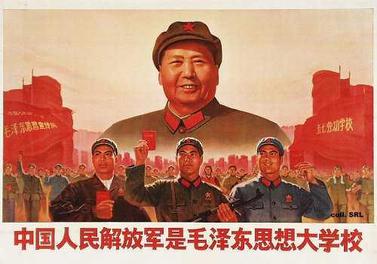
“The Chinese People’s Liberation Army is the great school of Mao Zedong Thought”, 1969.
A poster from the Cultural Revolution, featuring an image of Chairman Mao, published by the government of the People’s Republic of China.
Image via Wikimedia Commons.
In 1926, five years after becoming one of the founders of the Chinese Communist Party (CCP), Mao Zedong listed China’s enemies as “the warlords, the bureaucrats, the comprador class [businessmen dealing with foreign interests] and the reactionary section of the intelligentsia attached to them”. It is ironic that Mao would eventually create a new aristocracy, often referred to as the “princelings” (taizidang), every bit as hierarchical as that against which he had previously railed.
Perversely, when Mao Zedong came to power in China in 1949, there were not many structures of authority left to destroy. In the period of warlordism that succeeded the overthrow of the Qing dynasty by Sun Yat-sen in 2011 and ended with the consolidation of nationalist (Kuomintang) power by Chiang Kai-shek in 1936, the aristocracy of imperial China had been swept away. So too the Mandarin class, the Chinese bureaucrats selected by civil service examination, a system that started with the Sui dynasty in AD 581. As for the Chinese aristocracy, its last vestiges ended with the abolition in 1935 of the Dukedom of Yansheng which belonged to the descendants of Confucius.
So, in terms of social hierarchies, Mao inherited a clean sheet when he established the People’s Republic of China on October 1, 1949. The CCP leadership soon proved that, in the immortal words of George Orwell in his novel Animal Farm, “all animals are equal, but some animals are more equal than others”. In Beijing, Mao and China’s CCP leaders took residence in the palatial compounds located in Zhongnanhai, a waterside park established by the Yuan dynasty in the 13th century.
There is not even equality within the “red aristocracy”. Gradations are as clear-cut as if there were princes, dukes or marquises. The highest rank is accredited to the offspring of those CCP leaders who participated in the Long March. This iconic fighting retreat to a remote plateau in Shaanxi province followed the defeat of the Red Army in October 1934.
It is perhaps difficult for people in the West to understand the scale of Chinese veneration for the individuals who completed the Long March. With the possible exception of the migratory treks along the Oregon Trail, there is no comparable event in American or European history. Throughout their lives, leaders of the Long March enjoyed unparalleled prestige; it was a prestige that passed down to their children – hence the princelings.
The creation of the red aristocracy started with Mao himself. Within a few years of the establishment of the People’s Republic of China, Mao became a de facto emperor. On occasions he even referred to himself as such. He certainly lived the life of an emperor. At his commodious palace in Zhongnanhai, Mao surrounded himself with a harem of dancing girls who would occupy his bed and his swimming pool. In time-honoured fashion, China’s head of security and intelligence, Kang Sheng, procured girls for Mao as well as thousands of volumes of pornography.
[…]
My own experience of the princeling world confirmed that in China, despite its vast population a very small group of families form a governing nexus that has power far beyond its numbers. It is a group that seem to be getting stronger. The princeling proportion of the CCP central committee rose from 6 per cent in 1982 to 9 per cent in 2012. When I spoke to a princeling friend about the politburo standing committee that was elected in 2012, she told me that she personally knew five of its seven members; to her great delight three of them were princelings. It was through her that I met Deng Xiaoping’s daughters and spent a “country house” weekend with them and her princeling pals.
Here it became clear that, while most of the princelings I met were reformists in the Deng mode, there are also factions that are hard-line Maoists, like the one led by Xi Jinping. At the moment it appears that the reformist princelings have gained the upper hand. More light on Xi Jinping’s future and the outcome of this princeling tug of war may be shed at the Fourth Plenum of the 20th CCP Congress starting on October 20.
October 15, 2025
The Korean War Week 69: Conquered … But At What Cost? – October 14, 1951
The Korean War by Indy Neidell
Published 14 Oct 2025The Battle of Heartbreak Ridge ends with victory for the UN forces, though the casualty count is alarmingly high for both sides. One must wonder, is that sustainable? It’s a week of action, as Operation Commando continues further west. The Commonwealth Division takes Maryang-San, but taking it and holding it are two different things. A 9th Corps offensive kicks off as well, slowly grinding forward. There’s a breakthrough away from the battlefield, as both sides finally agree on a site for any future peace talks- Panmunjom.
Chapters
00:00 Intro
00:29 Recap
00:47 Operation Commando
03:01 Heartbreak Ridge Ends
07:44 Comparing the Two Ridges
10:25 9th Corps Attacks
11:24 The Belgians
12:17 Panmunjom
13:19 Summary
13:39 Conclusion
October 8, 2025
The Korean War Week 68: Aussies Take the Lead In Operation Commando – October 7, 1951
The Korean War by Indy Neidell
Published 7 Oct 2025Omar Bradley, Chairman of the Joint Chiefs, arrives in Korea to see the war for himself. At the same time, UN forces launch new offensives — Operation Touchdown at Heartbreak Ridge and Operation Commando to the west. Both promise heavy fighting, but can they finally break the stalemate?
#KoreanWar #HeartbreakRidge #OperationCommando #OmarBradley
Chapters
00:00 Intro
00:54 Recap
01:16 Bradley and Bohlen
02:17 Operation Touchdown
05:07 Heartbreak Ridge
08:44 Operation Commando
11:20 The Cavalry Attacks
14:49 The Commonwealth Division
16:03 Summary
16:18 Conclusion
(more…)
October 1, 2025
The Korean War Week 67: Ridgway Questions Truman’s Resolve – September 30, 1951
The Korean War by Indy Neidell
Published 30 Sep 2025There’s worry and chaos in Washington when UN Commander Matt Ridgway indicates that there is one order that if given from above, he will not obey. That order concerns the possible resumption of peace talks with the Communists at Kaesong. Meanwhile in the field, the bloody Battle of Heartbreak Ridge continues, though US 2nd Division has a new commander who has new plans for how to bring about victory.
Chapters
00:00 Hook
00:53 Recap
01:07 Heartbreak Ridge
04:04 Replacement Troops
06:30 Operation Commando
09:25 Ridgway Refuses
12:52 Summary
13:11 Conclusion
(more…)
QotD: The Indian Mutiny of 1857
This is a near-perfect synecdoche for the Raj’s problems. British Army officers weren’t stupid — lots of them commented on the issue. But they were isolated. For one thing, lots of them weren’t regular army — they were attached to the East India Company army, a separate formation, and within the Company’s army were different formations with different service requirements. And the army — whichever army — was deeply isolated from the civilian administration. For one thing, India’s huge, and there were never more than about 200,000 British in the whole place. The army was mostly on the frontier; the Government hung around primarily in a few big cities: Bombay, Calcutta, the summer capital at Simla (way up in the Himalayas).
So stop me if this sounds familiar: The civilian administration didn’t really know anything about the group upon which their peace, their security, their very lives depended. Actively despised them, in fact — oh, those wogs and their silly customs. But also look at it from the bottom up: What could the civilian administration really have done, with the best will and deepest knowledge in the world? […]
What could the leadership really have done at that point? Send a select group of brahmins and imams to tour the grease factory? The rumor would be that the British set up a Potemkin factory just for them; the real factory was using cow and pig fat. Reissue the old rifle? Recall that they already changed their drill — a pretty big deal in any army; a huge deal in a mid-19th century one — and that just added to the paranoia. Anyone who has ever been on the Internet knows how these things work once they get started: Evidence of an evil conspiracy is evidence of an evil conspiracy, but no evidence of an evil conspiracy is even more evidence of an evil conspiracy!
The root cause of the Mutiny, in other words, wasn’t political or economic (despite what Karl Marx said). It wasn’t even “cultural” in a lot of senses, and you can tell by the actions of the mutineers — or, rather, the non-actions. They simply had no idea what to do. They had no leadership (though some of them tried to install one of the remaining Mughal rulers in Delhi as an expedient; there’s a great book about it). The “Mutiny” was really just generalized beefing and score-settling on a continent-wide scale. They all had grief with the British, of course, and that was a convenient rallying cry. Once the British were gone — and see above, there were never very many of them — the guys down south quickly realized they had nothing in common with the guys up north. Ditto the guys on the east coast, the west coast, the hill country, the jungles …
Again, stop me if this sounds familiar: Stuffing a bunch of alien groups together inside artificial boundaries under a capricious, purposefully out-of-touch “government” that obviously hates every single one of those alien groups more than each one of the groups hates all the others, is kind of a bad idea. With the exception, of course, of that capricious government’s goon squad, the one group they obviously favor because that group can be counted on to knock heads on all the other groups whenever the government lets them off the chain (I’m talking about the Sikhs, obviously).
It doesn’t matter, in other words, what the rifle cartridges were greased with, or if they were greased at all. In this historical timeline, the precipitating cause of the Sepoy Rebellion was “the Enfield Rifle”. In the next timeline over, it’s something else — something equally minor — but the rebellion still happens, at pretty much the same time and in pretty much the same way.
In other words: It’s not that the British were alien to their subjects. Most groups in most places have been ruled by aliens, and trust me, the brahmin caste is far, far more alien to the castes below it than the British were to all of them combined. Nor was it that the British were high-handed administrators, as incompetent as they were arrogant. They were actually pretty good administrators, all things considered — “government competence” is always one of life’s lower bars, but the Raj cleared it easily. The guys running the “princely states” that made up the majority of the “British” Raj were every bit as alien to “their” people as the British, and in general spectacularly incompetent too.
Severian, “The Ruling Caste”, Founding Questions, 2022-03-09.
September 24, 2025
The Korean War Week 66: The Hell of Heartbreak Ridge – September 23, 1951
The Korean War by Indy Neidell
Published 23 Sep 2025The Korean War reaches one of its bloodiest battles as UN forces clash with North Korean defenders on Heartbreak Ridge. The US 2nd Division suffers heavy losses, with entire companies wiped out to the last man. At the same time, the Marines introduce a revolutionary new tactic in modern warfare — transporting troops via helicopter right to the front lines during battle. Meanwhile, UN Commander Matt Ridgway refuses to resume peace talks in Kaesong, sparking further tension with the Communist side. As the battle rages, the question remains: can there be peace in Korea, or only more heartbreak?
Chapters
00:00 Hook
00:43 Recap
01:14 Heartbreak Ridge
04:02 To The Last Man
06:06 What Ridgway Wants
08:00 Effects of the Treaty
10:13 New Strategy
11:29 Supply by Helicopter
12:31 Summary
12:45 Conclusion
15:34 Call to Action
(more…)
September 22, 2025
Dien Bien Phu: The Battle that Ended French Indochina – W2W 45
TimeGhost History
Published 21 Sept 2025The First Indochina War reaches its climax at Dien Bien Phu. In late 1953 the French parachute into the valley, build a fortress under Christian de Castries, and plan to smash the Viet Minh with artillery and air power. Võ Nguyên Giáp answers with a siege: anti-air guns on the surrounding hills, trenches creeping forward, and relentless assaults on strongpoints Beatrice, Gabrielle, and Isabelle.
After weeks of bombardment and failed resupply, the fortress collapses in May 1954. At Geneva, the great powers draw the ceasefire lines: Vietnam is divided (North–South), and the Indochina War ends.
#DienBienPhu #IndochinaWar #Vietnam #ColdWar #Geneva1954 #VoNguyenGiap #FrenchIndochina
(more…)
September 20, 2025
BC Ferries, federal financing and Chinese shipyards
As you may have heard, at the same time that Canadian politicians of all parties were thumping the tub about buying Canadian, British Columbia’s provincially owned ferry corporation decided to buy new ships from China … and the federal government not only gave the deal their blessing, they added in a billion dollar underwriting guarantee to boot:

In Ottawa they call it “arm’s-length”. Out in the real world, people call it duck-and-cover. At Meeting No. 6 of the House of Commons transport committee, MPs confronted a simple, damning timeline: Transport Canada’s top non-partisan official was warned six weeks before the public announcement that BC Ferries would award a four-ship contract to a Chinese state-owned yard. Yet the former transport minister, Chrystia Freeland, told Parliament she was “shocked”. Those two facts do not coexist in nature. One is true, or the other is.
There’s an even bigger betrayal hiding in plain sight. In the last election, this Liberal government campaigned on a Canada-first message — jobs here, supply chains here, steel here. And then, when it actually mattered, they watched a billion-dollar ferry order sail to a PRC state yard with no Canadian-content requirement attached to the federal financing. So much for “Canada first”. Turns out it was “Canada … eventually”, after the press release.
Conservatives put the revelation on the record and asked the only question that matters in a democracy: what did the minister know and when did she know it? The documents they cite don’t suggest confusion; they suggest choreography — ministerial staff emailing the Prime Minister’s Office on how to manage the announcement rather than stop the deal that offshored Canadian work to a Chinese state firm.
Follow the money and it gets worse. A federal Crown lender — the Canada Infrastructure Bank — underwrote $1 billion for BC Ferries and attached no Canadian-content requirement to the financing. In plain English: taxpayers took the risk, Beijing got the jobs. The paper trail presented to MPs is smothered in black ink — hundreds of pages of redactions — with one stray breadcrumb: a partially visible BC Hydro analysis suggesting roughly half a billion dollars in B.C. terminal upgrades to make the “green” ferry plan work. You’re not supposed to see that. You almost didn’t.
How did the government side respond? With a jurisdictional shrug. We’re told, over and over, that BC Ferries is a provincial, arm’s-length corporation; the feds didn’t pick the yard, don’t run the procurement, and therefore shouldn’t be blamed. That line is convenient, and in a technical sense it’s tidy. But it wilts under heat. The federal lender is still federal. The money is still public. If “arm’s-length” means “no accountability”, it’s not a governance model — it’s a get-out-of-jail-free card.
The fallback argument is economic fatalism: no Canadian shipyards bid, we’re told; building here would have taken longer and cost “billions” more. Maybe that’s true, maybe it isn’t — but it’s the sort of claim that demands evidence, not condescension. Because the last time Canadians heard this script, the same political class promised that global supply chains were efficient, cheap and safe. Then reality happened. If domestic capacity is too weak to compete, that’s not an argument for outsourcing permanently; it’s an indictment of the people who let that capacity atrophy. And if you swear “Canada first” on the campaign trail, you don’t bankroll “China first” from the Treasury bench.