Quotulatiousness

November 8, 2025

All cultures are not equal, especially when it comes to crimes like rape

Filed under: Law, Media, Politics, USA — Tags: , , , , , , — Nicholas @ 05:00

On the social media site formerly known as Twitter, Dr. Sydney Watson responds to a post on feminists blaming all men for the actions of some men from other cultures:

    Jessica Pin @jess_ann_pin

    It bothers me so much when some feminists act like men are just as misogynist and violent everywhere.

    That’s not true. Men from some cultures are absolutely worse than others.

    I’m not saying there is a genetic difference. But there are definitely cultural differences, and we need to be careful about who we let in.

    [Full sized images in the linked post]

I don’t know how to explain this succinctly —

But, ages ago I watched this series about prisons around the world. There were a few episodes that focused on prisons in African countries – how the prisons ran, what people were charged with etc.

What stood out to me was that over 50% of the male prisoners were there for some sort of sex crime – rape, sexual assault, child sexual abuse etc.

What was even worse was that, when asked about why they committed these crimes, a lot of the men said things about how they were “teaching the woman a lesson” or raping her was some sort of “punishment.”

And I couldn’t help but think, “well, that checks out. Given how these men from these places come to Western countries and rape women.”

People might not like hearing that, and the less evolved among us chalk it up to “racism” (lol) but if someone comes from a culture that views rape as a form of punishment for unruly women, then why would that viewpoint suddenly change when their feet hit British/Swedish/Canadian soil?

If, culturally, you view women as barely people, why on earth would you suddenly start because you’re in a new place?

Point being – it’s utterly mad to put women and girls at risk because people don’t want to admit that some cultures are horrible. I’m tried of pretending that all cultures are equal when they’re so obviously not.

Update, 10 November: Welcome, Instapundit readers! Please do have a look around at some of my other posts you may find of interest. I send out a daily summary of posts here through my Substackhttps://substack.com/@nicholasrusson that you can subscribe to if you’d like to be informed of new posts in the future.

Think Before You Post | How the UK fell to a sinister new form of censorship

spiked
Published 27 Oct 2025

“Think before you post.” Those were the words screamed out by government social-media accounts, threatening to lock up people for “hate speech”, as riots swept the United Kingdom in the summer of 2024. To those who hadn’t been paying attention, it offered a stark insight into a supposedly liberal, democratic nation that had come to police speech as much as, sometimes even more so, than actual violence. Inciting racial hatred, inciting religious hatred, “grossly offensive” online communications – over the past 60 years or so, Britain has written one new speech crime after another into its statute books. And it has led to a situation in which at least 30 people a day are now arrested in England and Wales for social-media posts. This is a documentary about some of those speech criminals. What we found out was even more chilling than the headlines would have you believe. Featuring: Maxie Allen, Rosalind Levine, Toby Young, Allison Pearson, Luke Gittos and Jamie Michael.

The Boomers didn’t do it, but they could have reversed it

Filed under: Government, History, Media, Politics, USA — Tags: , , , , , — Nicholas @ 03:00

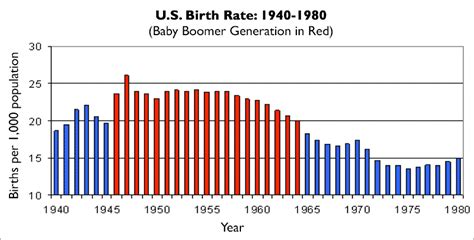
On the social media site formerly known as Twitter, John Carter takes the entire Baby Boom generation out to the woodshed for a well-deserved talking-to:

    toking-the-abacus @_toking

    It’s amazing how catastrophically bad the current job market is in the US. No one wants to train anyone. They want 5-10 years experience in skills that you don’t get unless someone mentors you in a more junior role. Then you have rampant visa abuse.

Boomers mostly got paid to get trained on the job for their jobs.

Then they turned around and demanded college for everything. At a steep markup.

Then they rugpulled all the college grads by hiring foreigners to do the jobs people went into debt learning how to do.


Whole lotta incensed geriatrics in the replies saying “That wasn’t boomers, that was Griggs v Duke Power! Those judges were silent generation!”

Yes. And that was 1970. 55 years ago.

That’s kind of the point.

You were the largest generation in history, boomers. You could have reversed that insane decision. You could have ended the crazy practice of disparate impact. You could have ended the systemic bigotry of affirmative action, which discriminated not only against you, but against your own sons and, now, your grandsons. You could have used your institutional and electoral power to block DEI.

You could have done a lot of things.

But you didn’t.

At most you grumbled some, but not too loudly, because after all dad fought in the big war and you didn’t want to do a Hitler. A lot of you supported all of it wholeheartedly, because John Lennon had an imagination and MLK had a dream and remember Woodstock, man. Some of you profited from it handsomely. As a generation, as a group, whether by action or inaction, you entrenched it in every aspect of law and institutional culture.

You participated, each in your own way, in redesigning our entire society around women’s feelings, black self esteem, and sabotaging the minds, bodies, spirits, and lives of your white sons.

Don’t run from your part in this.

I’m not saying this to be mean.

I’m saying this because we fucking need you.

We need your votes, because as a direct result of the immigration policies of the last half century – which, again, yes, have their origin with Greatest and Silents, but whose most severe consequences unfolded on YOUR watch – we are absolutely, 100% screwed if we don’t deport an absolutely incredible, historically unprecedented number of people in a very short period of time. If that doesn’t happen it’s game over for America and, frankly, Western civilization. For now, for as long as you’re still breathing and capable of casting a ballot, whites are a bare majority. When you’re gone we’re outnumbered, the third world swallows the first, and it’s over.

We need you to confront the consequences of your actions and your complacency, to really feel what its done to your descendants, and to be filled with rage at the way you were misled by evil and selfish men, and an implacable determination to spend what remains to you of your lives doing whatever you can to reverse enough of the damage you allowed to be done to salvage something from this crumbling wreck of a society.

That is why we bully you.

Because we need you to see.

History Summarized: Greece… TWO (it’s in Italy)

Overly Sarcastic Productions
Published 4 Jul 2025

From the Olympians who brought you “Greece” and “The Other Side of Greece” comes the bold, innovative, and way shinier “GREECE TWO”.

SOURCES & Further Reading:
The Greeks: A Global History by Roderick Beaton
Ancient Greece: The Definitive Visual History produced by DK & Smithsonian
The Complete Greek Temples by Tony Spawforth
Ancient Cities Brought To Life by Jean-Claude Golvin
“From Sicily to Syria – The Growth of Trade and Colonization” from Ancient Greek Civilization by Jeremy McInerney
“Magna Graecia: Taras and Syracuse” and “Cyrene, Leptis Magna, and Ancient Libya” from Great Tours: Ancient Cities of the Mediterranean by Darius Arya
Sicily: An Island at the Crossroads of History by John Julius Norwich
“The Greeks: An Illustrated History” by Diane Harris Cline for National Geographic

QotD: Singing in church

Filed under: Media, Politics, Quotations, Religion, USA — Tags: , , — Nicholas @ 01:00

So, this is oriented toward, primarily, Father Erik and Father Tim, who are certainly free to disagree with me, but anyone who attends mass regularly might find it of use. I also do not know if what I see in my church is normal, but suspect it is.

Note: I used to have a good singing voice, not quite commercial quality, IMHO, no, but quite good nonetheless. I loved to sing. I still do, the songs I can still handle, too.

Almost nobody sings reliably in my church. Oh, they can, but they generally do not. The exceptions are hymns everybody knows the tunes to, some of the responsorials, ditto, and, notably, last 4 July, “America the Beautiful”. And, at Christmas, the traditional Christmas songs.

So why those and not the others. Well, the typical hymn in the typical modern church was penned by a couple of nuns from the Order of the Discalced Sisters of Sappho, or priests from the Gay Jesuit Alliance, and printed in the hymnal largely as an exercise in flattery.

Okay, that’s not really true … or not entirely anyway. No, the real problem is that, and I cannot emphasize this enough, NOBODY KNOWS THE BLOODY TUNES, SO OF FREAKING COURSE THEY DON’T SING, WHILE THEY CHANGE THE HYMNS SO OFTEN — WEEKLY, AS A MATTER OF FACT — THAT NOBODY EVER HAS THE CHANCE TO LEARN THE TUNES.

So I propose the following: Pick five hymns — among my recommendations, “The Battle Hymn of the Republic”, “We Gather Together”, “Amazing Grace”, “How Great Thou Art”, “Abide with Me”; but I’m not a fanatic about it — and use only those five for however long it takes for 75% of the congregation to sing all of them. Then change ONE and keep at that until 75% will sing that. And keep doing that until you have a repertoire of 20-25 songs everybody knows and most everybody will sing.

“Make a joyful sound unto the Lord” and see if your parish doesn’t grow and if your parishioners aren’t a lot happier in mass.

Tom Kratman, The social media site formerly known as Twitter, 2025-07-03.

November 7, 2025

Milei – “If we don’t have [power], then the left will have it”

Filed under: Americas, Economics, Government — Tags: , , , , — Nicholas @ 05:00

In Without Diminishment, Geoff Russ discusses Javier Milei’s recent podcast appearance and his demonstration that unlike a lot of theoretical libertarians, he understands the dynamics of political power:

    There are many liberals, libertarians and anarcho-capitalists who are really useless because all they do is criticise, let’s say, those of us who want to lead the world toward the ideas of freedom. And what they don’t realise is that power is a zero-sum game, and if we don’t have it, then the left will have it. Therefore, if you level your harshest criticism at those in your own ranks, you end up being subservient.

Have truer words ever been spoken by an English-speaking politician?

Argentine President Javier Milei’s words on the Lex Fridman podcast were a blunt reminder of something that many conservatives, particularly those in Canada, have chosen to forget.

Politics is the pursuit of political power and the chance to use it before your opponents can. Debates can be won, superb essays published, and quotes recycled from deceased politicians. Without power, however, it all amounts to nothing more than a glorified brainstorming session.

The thoughtful ideas and proposals go to waste if they lie stagnant in perpetual bickering opposition.

On October 26, Milei won a resounding victory in the legislative elections. His party, Liberty Advances, gained forty-two seats and smashed the hard-left Peronists who have dominated Argentina’s politics for more than half a century.

Milei is a fanatical believer in libertarian ideas, and has never pretended to be a moderate or incrementalist. He famously brandishes a chainsaw to represent his willingness to destroy the broken socialist status quo of Argentina.

Javier Milei at CPAC in National Harbor, Maryland 20 February, 2025.
Photo by Gage Skidmore via Wikimedia Commons.

The rise of Milei has been a cultural battle for the soul of the country, and he is not shy about it. Milei leads a fresh, winning anti-Peronist coalition of forgotten and angry Argentines who want permanent, radical change.

It may be tempting to view Milei’s success as a pure affirmation of the appeal of libertarian ideology, but he is hardly Argentina’s first advocate of economic freedom. He succeeds because he is the opposite of a polite, centre-right reformer. Milei unapologetically embraces his place as a culture warrior seeking to remake the nation.

One of his targets is the institutional decadence and incompetence of the Peronist political machine. By swearing to snuff it out, Milei swept through traditional Peronist strongholds, whose voters had never considered voting for the formerly toothless Argentine opposition.

In Reason, Peter Suderman considers some of the lessons North Americans can learn from Milei’s stunning election victory:

To understand why Democrats overperformed in this week’s elections, look to Argentina.

Last month, Argentinian president Javier Milei won an unexpectedly large electoral affirmation, as his party significantly outperformed expectations by more than doubling its congressional representation in what was widely seen as a referendum on his agenda.

Over the past two years, Milei, the world’s most libertarian national leader, has slashed spending, cut red tape, and made his top priority restoring economic order and prosperity to a country that has long been a socialist basket case. Critics warned that his policies would be destructive, destabilizing, and unpopular. But not only did he deliver the country’s first balanced budget in over a decade, he oversaw a radical decline in inflation — from 200 percent when he entered office down to 32 percent last month.

Despite warnings that the country would reject Milei’s brand of austerity, the country responded with a strong vindication of his policies. In a post-election analysis, The New York Times noted that Milei’s message was that only he offered a “path for a country that has undergone years of runaway inflation under high-spending populist governments”. The report pointed to Milei’s economic record to explain his party’s win: “Many Argentines had grown tired of prices swinging wildly from day to day and of a ruling class they considered to be corrupt and irresponsible”.

The same report said Milei’s outsized victory was “unexpected”. But perhaps it shouldn’t have been, because economic stability and low inflation are what voters the world over clearly want.

When voters swept President Donald Trump into office for the second time last fall, large majorities of his voters gave the economy poor marks and said their own family finances had worsened over the years. Under President Joe Biden, the American economy had been wracked by the biggest surge in inflation in forty years. American voters punished the party that was in power when that happened.

This was true all over the world. After the pandemic, inflation skyrocketed globally, and in election after election, voters rejected ruling parties.

Inflation and economic instability have long been political losers: Look at Ronald Reagan’s victory over Jimmy Carter in 1980, and his ensuing near-sweep of states in 1984 after taming a decade of out of control price hikes. The post-pandemic years have further reinforced this lesson.

Update: Undoctrination looks at Milei’s time in office so far.

Undoctrination
Published 6 Nov 2025

Javier Milei just pulled off the impossible … again.

In Argentina”s 2025 “midterm” elections, Milei’s 4-year-old party, La Libertad Avanza, went from a tiny minority to the largest party in the lower house, ending socialist dominance in Congress. The election was widely viewed as a referendum on Milei’s shock therapy plan for Argentina. The results are in: Argentines want more freedom.

In this video we cover:
How Milei slashed inflation from 211% to 31.8% in just 2 years
The 34,000 government jobs cut, 10 agencies eliminated, and 672 deregulations that freed the economy during Milei’s first year in office
How the Buenos Aires rental market exploded after lifting controls
How Peronists lost their veto-proof majority — and what it means for the future

And we feature expert analysis from Marcos Falcone, Policy Analyst, Center for Global Liberal and Prosperity.

“BookTok on its own sounds innocent enough”

Filed under: Books, Health, Media — Tags: , , , , , , — Nicholas @ 04:00

I’ve seen occasional references to BookTok on other platforms but as it seemed to be as female-coded as an online community can be, I’d never bothered to pay close attention to it. If Zoomertea is to be believed, it’s a weird and disturbing space for the unprepared to visit:

Image from “The Female Gooner Epidemic” at Zoomertea

If you’re smart enough to have never downloaded TikTok, then you’ve probably never heard of BookTok and the resulting epidemic of female gooners (a term borrowed from porn culture to describe obsessive arousal and fixation). BookTok on its own sounds innocent enough, women rediscovering the joys of reading, romanticising cozy nights in, or even joining a book club. In theory, what could be more wholesome? However, the reality is more concerning. It turns out the bookish girls have traded the likes of Pride and Prejudice for highly pornographic dark fantasy erotica, stories that make Fifty Shades of Grey seem tame.

Women have always enjoyed a flair for romance. Once it was the slow burn longing of Romeo & Juliet or Wuthering Heights – the stories weren’t explicit, yet still roused deep, passionate feelings. By the 2000s, romance had evolved into “chick lit” – breezy novels about friendship, love and self-discovery. Books like Bridget Jones and the Devil Wears Prada swapped tragic love for witty realism, capturing the struggles of modern women navigating careers, dating, and independence. It seems like in all aspects of modern culture, people have been pushing for the “reliability factor” – they wanted to see themselves in the characters and storylines. But somewhere along the way, the realism and reliability factor lost its appeal.

During the pandemic, while the virus spread and the world stayed home, TikTok spread too, surpassing 2 billion downloads by mid-2020. With endless free time, people picked up new hobbies: some tried Chloe Ting’s “Get Abs in 2 Weeks” workouts, others turned to BookTok and rediscovered their love for literature. Booktok isn’t just for explicit romantasy novels, however it’s become synonymous with women who obsessively consume dark romance. On BookTok, desire isn’t intimate anymore; it’s performed.

While Fifty Shades of Grey, a book very explicitly about sex, came almost ten years before BookTok, it wasn’t exposed to the algorithmic amplification loop we see today. Although its release did shock readers and spark feminist critiques about patriarchal relationships and sexual themes, it still felt more like a dirty secret. Its eroticism was discussed privately, even sheepishly. It was a book club secret, not a TikTok performance. Now, even the most unassuming women are flocking to BookTok and demanding books with a maximum “spice rating”, without an ounce of shame. But how did this happen?

Somewhere between the isolation and scrolling, the lines between fantasy and reality began to blur. The algorithm on TikTok can be very dangerous for enforcing unhealthy habits on its users. When a woman watches or likes just one “spicy book” video, even just out of curiosity, TikTok interprets it as interest in similar content. Without the user’s knowledge, suddenly their ForYou page is filled with similar videos, “books with a max spice rating”, “extreme taboo book recommendations” or “Top five dark romance recs”. The more they see, the more they engage, the more the algo pushes darker more extreme content. Essentially, the algorithm learns: You like desire, here’s more. Louder. Darker

Crossing the floor in Parliament

Filed under: Cancon, Media, Politics — Tags: , , , , — Nicholas @ 03:00

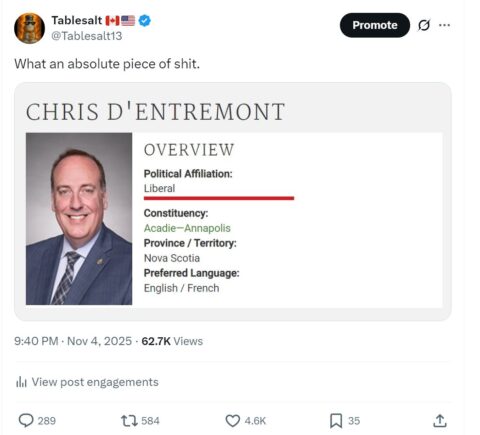
It’s not an everyday thing, but I saw someone mention on social media that there had been over 300 floor-crossings since Confederation. The latest Member of Parliament to switch parties … to literally walk across the floor in Parliament to join Carney’s Liberal party is Nova Scotia’s Chris d’Entremont:

The speculation in Ottawa about floor crossers is getting silly, some of the names being pushed don’t make any sense. Which makes me think that this is really an attempt by the Liberals to try and destabilize the Conservatives.

Sorry, that would be “destablise” in Mark Carney’s new English but more on that shortly.

We have seen Liberals push name after name including Chris d’Entremont who did cross, but others who have said they have no interest in crossing. That was the case for Dominique Vien the Conservative MP from Quebec’s south shore who had to post a video after jerks like me published her name following weeks of speculation.

If you don’t speak French, let me summarize, or sumarise in Carney English. She says that she’s heard the rumours that she would be leaving the Conservative caucus to sit as a Liberal or an independent, but that’s not true. She states clearly that she is and will remain a Conservative and that she doesn’t like Mark Carney’s budget.

Meanwhile, Joël Godin, the MP for Portneuf—Jacques-Cartier a riding northwest of Quebec City, who has been named as a possible floor crosser declined to answer questions entering caucus on Wednesday. Does that mean he’s ready to cross or not just putting up with the BS?

Conservative insiders tell me that he won’t be changing teams anytime soon.

The rumour mill is insane, with Liberals pushing the idea that all kinds of Conservatives are looking to jump ship. I’ve had several Liberals tell me that Michael Chong has been looking to cross the floor, an idea that is so ridiculous that I didn’t even call Chong to ask him because anyone floating that doesn’t know the man or conservative politics.

After I mentioned that on 580 CFRA in Ottawa, Chong called me to assure me that he wasn’t crossing to the Liberals. Michael, I never doubted you.

It’s doubtful that other names Liberals are pushing will come to fruition.

What is clear is that Carney and the Liberals are reaching out to Conservative MPs and making them offers to switch parties. Are they making illegal offers? I’d really like to know what has been put forward.

Is a “comfy landing” being offered for those that will cross? It wouldn’t be the first time that kind of thing has been offered.

As to the particular motivations for d’Entremont decamping to the Liberal benches, discussions on the social media site formerly known as Twitter indicate that he just barely got elected this time around, that he’d been fired by Pierre Poilievre as Deputy Speaker, and he decided he had a better chance of getting back into Parliament as a Liberal in the next election. Quinn Patrick reports that the Liberals had been trying to get d’Entremont to join them for quite some time:

Industry Minister Mélanie Joly said the Liberals had been courting former Conservative MP Chris d’Entremont behind the scenes for five years before he ultimately crossed the aisle.

“We’ve been trying to recruit him for a long time,” Joly told reporters in French on Parliament Hill on Wednesday. “Finally, he saw the light.”

D’Entremont had served as a Conservative MP for six years, after first being elected in the 2019 election.

As several people pointed out, that conveniently meant he’s qualified for the platinum-plated MP pension plan … but I’m sure that’s not why he switched parties.

Liberal MP Kody Blois, who also represents a riding in Nova Scotia, confirmed that he and d’Entremont had been speaking “for a long time about the ways in which we can collaborate.”

“It’s great to see Mr. d’Entremont join. If there’s other members of Parliament feeling the same way, again, I think we’re always welcome to those conversations,” said Blois.

While Blois didn’t explicitly say he had been attempting to enlist d’Entremont, he said the Liberals are a big-tent party with room to accept more “moderate” conservatives.

When asked if the Carney government was actively trying to recruit more MPs, Blois said that “wouldn’t be a conversation I’m going to have right here in front of the media.”

The former Conservative MP met with Prime Minister Mark Carney at a post-budget media conference on Wednesday, saying he didn’t believe his values as a “red Tory” were being “represented.”

“I didn’t find I was represented there … my ideals of an easterner, of a red Tory and quite honestly of trying to find ways to find solutions and help the community rather than trying to oppose everything that’s happening,” said d’Entremont.

He also alluded to the possibility of other Conservative MPs “in the same boat” but stopped short of naming anyone specific, saying he would let them share their stories “if the time comes.”

However, he has been the only one to cross the aisle thus far.

Conservatives and their supporters have accused d’Entremont of betraying his constituents and his values in pursuit of his own ambitions.

The Flavians – Vespasian, Titus and Domitian – The Conquered and the Proud 18

Filed under: Europe, History — Tags: , , , , , , — Nicholas @ 02:00

Adrian Goldsworthy. Historian and Novelist
Published 2 Jul 2025

Today we look at the death of Nero, then briefly cover the civil war that followed — the Year of Four Emperors — before dealing with the Flavian dynasty (AD 70-96) — Vespasian and his sons Titus and Domitian. How did their regime differ from that of the Julio-Claudians and what was going on in the wider empire?

QotD: The Boomer career path

Filed under: Humour, Media, Politics, Quotations, USA — Tags: , , , , , — Nicholas @ 01:00

I don’t know how many times I have to explain this: Boomers were all given free TVs to watch Howdy Doody who all transmitted them the secret code to grow their hair long after they watched the Beatles on Ed Sullivan, after which they went to college and took over the Dean’s Office. To get rid of them the Dean gave them free drugs and directions to Woodstock where they had sex in the mud to get Vietnam deferments.

After that they got bored and became Glam rockers, and then switched to Disco because it had a better beat. They used all their free money from Disco record deals to buy cocaine and Malibu real estate at $3 per acre. In 1980 they decided there was even more money in selling cocaine, so they all moved to Miami and drove around shooting machine guns from their Lamborghini Countachs to Giorgio Morodo synth music.

After Reagan’s re-election the Boomers decided greed was good and they all moved to NY where they became serial killer investment bankers and collected up all the Andy Warhol originals. That’s when all of their real estate holdings made them billionaires which they leveraged to get in on the bottom floor of the Internet bubble in the 90s while taking designer drugs.

Today those same Boomers are all driving around to orgies at The Villages in $500k luxury golf carts waving giant Trump flags, laughing it up while lighting doobies with their Social Security cash and executing Howdy Doody’s Final Plan: the secret Boomer Immortality Pill that will allow them to keep their money away from Millennials and Zoomers FOREVER

David Burge, The social media site formerly known as Twitter, 2025-07-30.

November 6, 2025

Mamdanimentum – NYC gets its very own Justin Trudeau clone

Filed under: Media, Politics, USA — Tags: , , , , — Nicholas @ 05:00

It’s been decades since I last visited New York City, so I don’t know if they really deserve what they’ve just voted for, but I guess we’ll all get to find out over the next few years. On the City Journal substack, Reihan Salam weighs in on the newly elected mayor and what to watch for:

New York State Assemblymember Zohran Mamdani photographed in Assembly District 36, 10 February 2024.
Photo by Kara McCurdy via Wikimedia Commons.

A year ago, not even the most perfervid Astoria leftist would have thought that Zohran Mamdani would soon be elected mayor of New York City. Back then, it was easier to imagine Eric Adams coasting to reelection on the strength of declining crime, or state attorney general Tish James, who came close to running for mayor in 2021, swooping in to unite a fractious Democratic coalition. With Adams badly damaged by a federal indictment and James anxious about what a mayoral bid would mean for her ongoing battle with President Donald Trump, however, the path was seemingly clear for Andrew Cuomo to make a dramatic comeback.

Though it was no secret that Cuomo had real weaknesses, thanks to his polarizing tenure as governor, his name recognition and formidable fundraising machine were enough to freeze out other serious contenders. As a result, the Democratic mayoral field was so bereft of talent that Mamdani — an obscure, hard-left state assemblymember with no legislative or professional accomplishments to speak of — was able to cut through, buoyed by surging anti-Israel sentiment and a series of half-baked pseudo-solutions to the city’s very real affordability crisis.

From one vantage point, then, Mamdani is best understood as an accidental mayor. If federal prosecutors had declined to prosecute Adams, if James had jumped in and Cuomo had stayed out, if Hamas had surrendered its hostages a few months sooner, if moderates and conservatives had consolidated behind a single candidate in the general election, or if any of a number of other possibilities had obtained — the outcome of New York City’s 2025 mayoral race would have been quite different.

In another sense, however, Mamdani’s victory represents the culmination of New York’s larger leftward turn. The shift started in 2018 with the dissolution, at Cuomo’s behest, of the state’s Independent Democratic Conference, an eight-member coalition of centrist Democratic senators who caucused with the Republicans. Their subsequent replacement heralded a broader takeover of Albany by progressives who — again, with Cuomo’s assent — passed a series of ideologically inflected bills: bail reform, the “most aggressive climate change legislation in the nation“, and a major overhaul of tenant protection statutes, to name only a few.

The Mamdani revolution was led by downwardly mobile elites — children of the professional class struggling to make ends meet and entranced by the promises of frozen rent and fare-free buses. They were fired by the same ideas that animated those Albany progressives: that some New Yorkers have been handed the short straw, that soak-the-rich policies can correct these imbalances, and that New York’s private sector was resilient enough to sustain a further ratcheting up of punitive taxation and regulation.

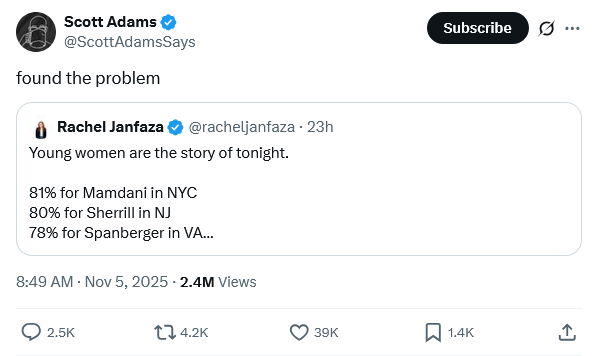
The voters of NYC are not the same demographic distribution as of old … among other things, the Jewish population has shrunk while the Muslim population has grown to nearly the same over the last 25 years, although Jewish women probably voted more similarly to women generally in this election:

Lines of Fire: Operation Market Garden Part 1 of 2 – WW2 in Animated Maps

TimeGhost Cartographic
Published 5 Nov, 2025

September, 1944. Soviet forces push ever westwards, slicing their way through Poland en route to Berlin. In the west, the Allies have made great strides after the invasion of Normandy, but now face a winter of relative stagnation as supply issues threaten to undercut their momentum. At this time, British Field Marshal Bernard Montgomery believes has a plan to carve a corridor through occupied Netherlands and get his forces into Germany within days, striking at the heart of the German war economy, and maybe, just maybe, ending this war before 1945 dawns. In Part 1 of 2, we look over the plan, the forces involved, and the colossal effort required to make Monty’s vision a reality.

00:00 Intro
01:12 Background
04:40 Planning
07:07 Disposition of Forces
09:05 Geographic Overview
11:30 Conclusion
(more…)

Reactions to Tuesday’s budget announcement

Mark Carney’s government finally got around to releasing their 2025 budget and lots of folks have thoughts and concerns about what is in it and what isn’t in it. After all, it could be the best possible budget, but it would still not satisfy all concerns … and nobody is pretending that this is anything close to “best possible” territory. Sylvain Charlebois says that the budget ignores the food insecurity issues and grocery prices for ordinary Canadians:
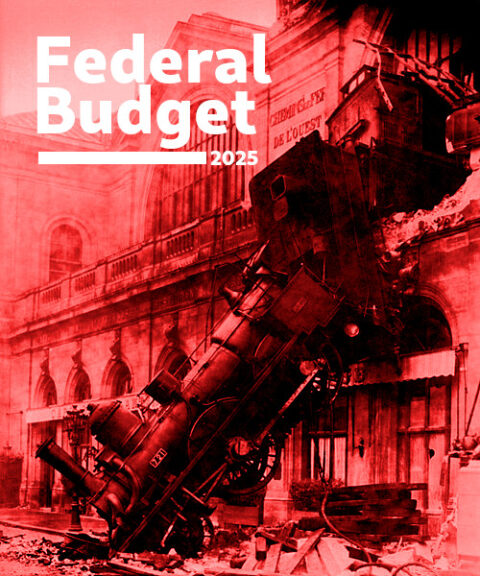
Graphic stolen from Small Dead Animals.

For a government that often talks about food affordability and insecurity, Budget 2025 offers surprisingly little that directly addresses either. There’s no bold food strategy, no affordability roadmap, and no new incentives for domestic food production. Yet, in between the lines, Ottawa has quietly set the stage for some indirect relief — not through grocery subsidies or consumer-facing policies, but through infrastructure, trade, and administrative reforms that could make the food system work a little more efficiently.

The largest signal comes from the government’s $115 billion infrastructure plan, one of its so-called “generational investments”. The new Trade Diversification Corridors Fund aims to modernize ports, railways, and airports — all chronic weak points in Canada’s food supply chain. When bottlenecks ease, goods move faster, and perishable products arrive fresher and cheaper. While no one in Ottawa framed this as a food-price measure, logistics efficiency has long been one of the most effective — and least visible — forms of price control.

[…]

Still, the absence of a broader vision for food affordability stands out. After years of grocery price volatility and public debate about “greedflation”, Canadians might have expected a more direct focus on food resilience — investments in innovation, local processing, or retail transparency. Instead, the government seems to have opted for a quieter, systemic approach: strengthen the arteries of trade and logistics, and trust that efficiency will trickle down to the dinner table.

The budget forecasts a $78.3 billion deficit for the 2025-26 fiscal year, which is significantly higher than notorious spendthrift Justin Trudeau’s last budget number. This adds to an already staggering $1.27 trillion debt load, which is nearly double what it was just before the pandemic. In the lead-up to the budget release Mark Carney had hinted at major sacrifices to be made, and while there wasn’t a lot in the document directly corresponding to sacrifice, the need to service that long-term debt will do the job quite adequately.

In the National Post, John Robson says that the budget is “elbows up, IQs down”:

Since I was last propelled years ago into the purgatory known as “the lockup”, where journalists spend budget day, have either process or contents improved? No. Instead they now insert a false stolen-land “acknowledgement” before even getting to the same old same old labeled bold and new. Which is especially troubling at this supposedly critical juncture.

The document is the familiar brick, 406 paper pages and 493 digitally with no explanation for the discrepancy and no excuse for the length. (Or for being called “Canada Strong” with an inexplicable picture of a ship.) Especially as the Finance Minister gabbled “This is a budget that talks to everyday Canadians,” and its purpose is to state plainly how much the government intends to spend, where it hopes to get the money and how far short it already knows it will fall, you shouldn’t have to wade through 248 pages of sludge to find out.

As P.J. O’Rourke said, “beyond a certain point, complexity is fraud”. Though we “privileged” insiders search “Summary Statement of Transactions” and voila, submerged on p. 249 (all references digital) is a $78.3 billion deficit next year if all goes well, and the national debt increasing $80.5 billion so it already didn’t.

Much commentary, and special-interest attention, focuses on trivial fiddles. But what matters is that Leviathan is in hock up to its horns, with interest payments projected at $55.6 billion next year, soaring to $76.1 billion by 2029-30. If the Lord is willing and the creek don’t rise, both forlorn hopes. NDP MP Leah Gazan, who would jail you for “downplaying” residential schools, snarled about not supporting an “austerity budget” but she won’t get the chance.

Some may bleat that times are tough. Indeed the finance minister’s campaign-speech “Foreword, Budget” gasses “The world is changing, profoundly and in real time; we are no longer living in an era of calm, but of significant change”.

The projected deficits are clearly hallucinatory, as the Liberals never seem to get deficit spending to go down, running deficits every year since 2015:

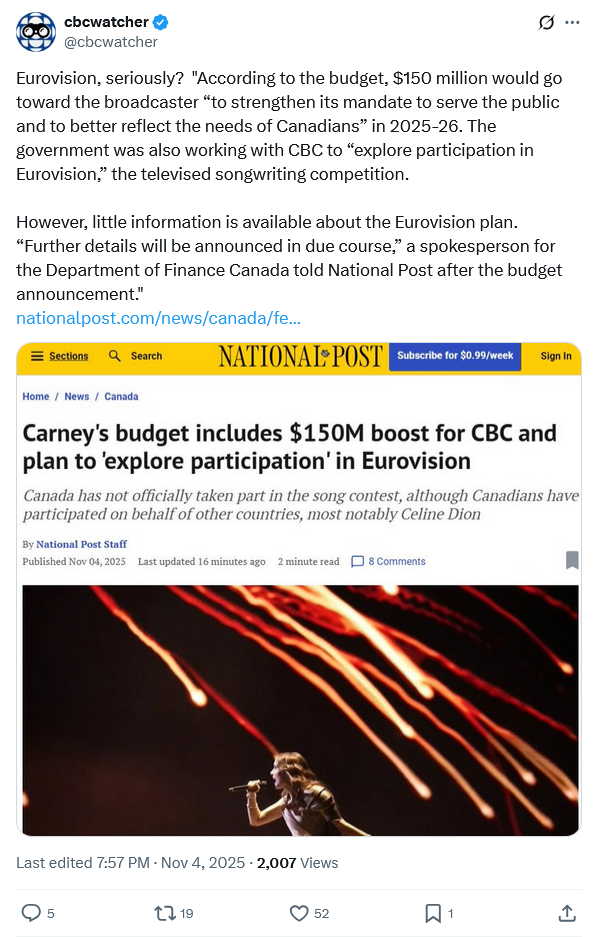
However, on the ludicrous side, the feds want to spend money to “investigate” Canada taking part in the freaking Eurovision contest:
On the slightly less ludicrous side, Noah considers the military aspects of the budget:

Budget 2025 outlines the government’s generational investment to quote, “defend Canada’s people and values, secure its sovereignty, and position the nation as a strong, reliable partner to its allies“. This starts by initiating a process of rebuilding, rearming, and reinvesting in the DND, CCG, and CAF to provide everyone with the necessary tools and equipment to protect sovereignty and bolster security.

Budget 2025 starts by outlining the government’s previous commitment to accelerate investments to meet NATO’s 2 per cent defence-spending target this year, which is five years ahead of schedule.

Budget 2025 goes a step further by setting Canada on a path to meet NATO’s 5 per cent Defence Investment Pledge by 2035. This will be broken down into two categories, 3.5 per cent of GDP by 2035 in core military needs, including supporting the CAF, modernising equipment and technology, and building up defence industries, and 1.5 per cent on security-related infrastructure and investments.

This reinvestment in defence and security is the largest in decades, totaling $30 billion over a five-year horizon on an accrual basis. This funding is allocated across three main pillars: $20 billion for capabilities, $5 billion for infrastructure and equipment, and $5 billion for industrial support.

On a cash basis, Budget 2025 proposes to provide $81.8 billion over five years, starting in 2025-26, to rebuild, rearm, and reinvest in the CAF. This figure includes over $9 billion in 2025-26 that was previously announced in June 2025. This is the funding previously set out for Canada to reach the 2 per cent NATO target.

Key investments from this $81.8 billion fund include $20.4 billion over five years to recruit and retain a strong fighting force, which incorporates the previously announced updates to pay and support for CAF health care.

An additional $19.0 billion over five years is allocated to repair and sustain CAF capabilities and invest in defence infrastructure, including the expansion of ammunition and training infrastructure. Upgrades to digital infrastructure for the Department of National Defence, CAF, and the Communications Security Establishment, particularly for cyber defence, are funded with $10.5 billion over five years.

Finally, $17.9 billion over five years is designated to expand Canada’s military capabilities, with investments in logistics, utility, and armoured vehicles, as well as counter-drone, long-range precision strike capabilities, and domestic ammunition production.

This is a serious chunk of change, although sadly, and as you will see, we don’t get a major breakdown of what this looks like. What we are left with are general piles of money, which isn’t always a bad thing. It’s also expected. The budget is set for a timeline before many critical capabilities will be delivered, so they won’t be included. Almost everything comes after 2030.

Galand de Guerre Model 1872: Too Good for the Military

Filed under: France, History, Military, Weapons — Tags: , , , — Nicholas @ 02:00

Forgotten Weapons
Published 23 Jun 2025

Charles François Galand is best known for his simultaneous-extraction Model 1868, but he also developed a very good solid-frame revolver. This was specifically for the French 1871 military trials, which specifically required a solid frame. The Galand was chambered for 12mm Galand (with its distinctive very thick rim), held 6 rounds, operated in either single or double action, required no tools to disassemble, and had very simple but durable lockwork. The gun was very good, and was a very tight competitor for the other trials finalist, the Chamelot-Delvigne. Ultimately, it lost out because it was the more expensive of the two options.

For more information on the Model 1873 Chamelot-Delvigne that won the French trials, I suggest the C&Rsenal video on that model:
History of WWI Primer 061: French and Ital…
(more…)

QotD: The Reformation

[W]e can thank Henry VIII (really Thomas Cromwell, I suppose, and Thomas Wolsey, and ironically Saint Thomas More) for giving us a good look at how Church administration actually functioned in the late Middle Ages. England was by far the best-governed major polity in Europe, even before the famous “Tudor revolution in government“. Lots of paperwork in Merrie Olde, and so Henry VIII’s little cock-driven temper tantrum gives us a priceless picture of how the Reformation went down.

It’s easy to get lost in this stuff — I had a long bit about Cardinal Wolsey, Thomas Cromwell, the Supplication Against the Ordinaries, the Annates Bill, and so on here — but the upshot is, pulling the Church down in England revealed the massive scale of its corruption. I want to say that the Annates Bill alone doubled the King’s revenue, and the dissolution of the monasteries (well underway in Cardinal Wolsey’s time, incidentally) unlocked unimaginable wealth. But it also fatally undermined the regime, because now an attack on the existing Church structure was also an attack on the King … and vice versa.

What you got, in short, was a total social conflagration. The “Reformation” wasn’t really about theology. Nothing Luther said was particularly new. Jan Huss and John Wyclif said basically the same things 100 years earlier; hell, St. Augustine said them 1000 years before. There’s still an irreconcilable “Protestant” strain in Catholicism now — Cornelius Jansen was just a Catholic Luther, and in a lot of ways a much better one; he was declared a heretic because reasons, and “because reasons” was good enough in Jansen’s time (the very nastiest phase of the Thirty Years’ War), but since he’s just quoting St. Augustine …

The point is, the undeniable rottenness of the Catholic Church made it a convenient whipping boy for any conceivable beef against society as a whole. Because it wasn’t just the Church that was too decadent, depraved, and corrupt to go on — it was the entirety of Late Medieval society. Again, stop me if this sounds familiar, but Late Medieval society looks a lot like spoiled, histrionic children playing dress up. They look like kings, and they act like kings (popes, bishops, etc.), but it’s obvious it’s just an act — they know they’re supposed to do these things (put on tournaments, hold jubilees, preach sermons, fight wars, etc.) but they have no idea why.

Severian, “Reformation”, Founding Questions, 2022-03-07.

« Newer PostsOlder Posts »

Powered by WordPress