Quotulatiousness

November 11, 2025

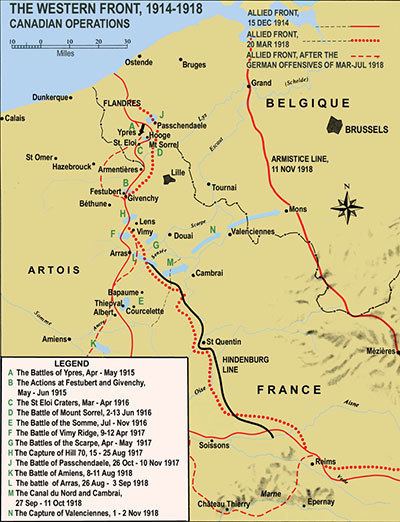
Four battles of the Canadian Corps

Following on from part one (excerpted here), The Black Horse outlines four major battles that the Canadians fought on the western front during the First World War:
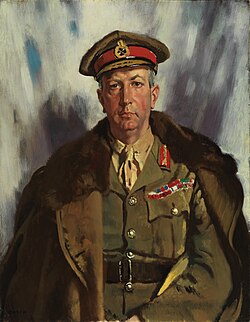
Sir Arthur Currie
Portrait by William Orpen, 1919.

The first part of the series was a political biography of Currie; the second part attempts to tell the story of the Canadian Corps at war through somewhat detailed account of four important battles. The piece is only partly biographical, it partly tells the story of Currie’s war, and partly tells the story the Canadian men who fought for the British Empire in the Great War. It’s a story of incredible martial prowess, but the careful reader will also observe a story of warring duties placed upon the leader of a colonial army; duty to his men, duty to the political leadership of his colonial people and the future of that nation, duty to the objectives of the imperial power on whose behalf he fought, and finally duty to glorious Victory. Currie ended his life understood by those with eyes to see as a great warrior and a military genius; but disliked by his men and hated by the leadership of his people because he prioritized the needs to the Empire and of Victory; but after the war the Empire was of limited service to Currie and to the Canadian people. I leave to the reader, to history, and to God, to decide the value of Victory.

[…]

2nd Battle of Ypres

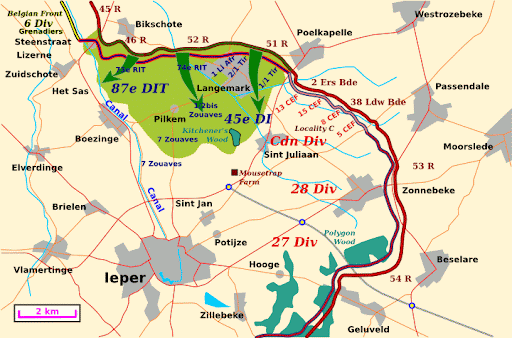
In the spring of 1915 the early dynamic advances of the German army were a distant memory faded behind the great defeat at the First Battle of the Marne. Through the winter both sides had dug in; and many German troops were redeployed to the Russian front. German chemists Walther Nernst and Fritz Haber brought forward the idea of using heavier-than-air Chlorine gas, carried on the wind, to overcome the mathematical impossibility of conventional attack. On April 22, 1915, Albrecht of Württemberg led 7 German divisions to attack 8 Allied divisions, including the 1st Canadian Division under the command of Sir Edwin Alfred Hervey Alderson. The attack began with the release of 168 tons of chlorine gas at about 1700h along a 4 mile stretch of the front around Langemark.

[…]

Vimy Ridge

For a year and a half after Ypres, Currie & the Canadian Corps continued to fight desperate engagements along the Western front with no clear strategic conclusion. After heavy losses and a lot of hard-learned lessons at the Somme from Sept 1915-Sept 1916, the Canadian Corps and Currie with them had become both hardened by bitter experience, and desperate to find better ways to prosecute the war. In September 1915 he was recorded to have said “I did not care what happened to me, but to my men, to their wives, their mothers, their children and to Canada I owed a duty which I wanted to fulfill to the very best of my ability”. Later that year as the division struggled with desertion, he ordered the execution of a deserter despite a three hour plea for clemency by the divisional cleric. The decision restored discipline, but haunted Currie’s dreams long afterwards.

In May 1916 Julian Byng took command of the Canadian Corps, replacing Sir Edwin Alderson. In the fall of that year, after heavy losses in a series of engagements at the Somme, Byng was given the opportunity to reorganize and refit the Canadian Corps; he looked to Currie as a key partner in the effort. They replaced the ineffective Ross Rifle with the Lee Enfield, reorganized the platoon structure to include heavy weapons within each platoon [machine guns, mortars, etc.], and implemented new training and tactics like rehearsals for advances, and the “creeping barrage”, carefully coordinated intended to keep artillery shells landing slightly ahead of advancing men.

[…]

Hill 70

After Vimy, Julian Byng was promoted. Currie was promoted in turn to lead the Canadian Corps. He would lead the Corps that he and Byng had made into one of the most effective fighting forces on any side of the conflict and lead it to bloody victory again and again. There is perhaps no better example of the mastery of the Canadian Corps, from top to bottom, than the battle of Hill 70. “Hill 70 was as close to a perfect battle as was ever fought on the Western Front” wrote historian Tim Cook.

[…]

The Hundred Days Offensive & the Pursuit to Mons

As the winter of 1917-18 passed, a new set of highly political decisions concerning whether and how to reorganize the Canadian Corps for the next round of fighting were taken. As noted in part one, Currie opted to split up the newly formed 5th division to reinforce the four divisions of the Canadian Corps and triple the size of the field engineering element. The decision optimized the Canadian Corps as an attacking force; and when they returned to the front that’s exactly how they would be used. Between August 8th and November 11th, 1918, the Canadian Corps fought nine major battles advancing 86 miles, and suffering 45,835 casualties [The force that began the offensive was ~100,000]. By comparison, the substantially larger American Expeditionary Force, over this same period, advanced only 34 miles while capturing only half the number of prisoners, suffering roughly twice the casualties per German division defeated.
How not to solve your housing affordability crisis

Filed under: Economics, Government, USA — Tags: , , , , , , — Nicholas @ 04:00

On the social media site formerly known as Twitter, Devon Eriksen explains why allowing fifty-year mortgages are not the solution that financial journalists seem to think they are:

    Wendy O @CryptoWendyO

    I don’t think a 50 year mortgage is bad.
    It gives everyone more flexibility financially
    You can pay a mortgage off early
    Not sure how else to lower home costs in 2025

Buyers: “How much will this house cost me?”

Sellers: “What’s your budget?”

Buyers: “Well, it was 500K, but with these new fifty year mortgages, I think it could stretch to million.”

Sellers: “I have an astonishing coincidence to report.”

Look, I don’t know exactly who’s retarded enough to need to hear this, but if you throw money at something, you get more of it.

Which means that if you subsidize demand, you get more demand.

And if you have the same supply, and more demand, price goes up.

This is how the federal Stafford Loan program made college a gateway to permanent debt slavery. Subsidize demand, price goes up.

The reason people don’t understand this is that most people are only smart enough to think about individuals, not populations.

They think if you have more money, you can buy more things, as if things come from the item store in a Japanese console RPG, where the store always has infinity stuff to sell you, and infinity money to buy your loot.

People who are capable of thinking about large groups quickly realize that money is just a way of distributing things.

Like, there’s a limited supply of things, and you’re just choosing who gets them. Having more money doesn’t make more things.

Except … it should, shouldn’t it?

Eventually?

Like, if apples get super expensive, because somebody invented a new kind of apple that’s so delicious that everyone wants them, then the price of those apples goes up, so more people start growing them.

So why doesn’t that work with houses and colleges?

Why don’t the super-inflated prices of those things inspire profit-minded people to make more?

It’s almost as if there were some sort of gatekeeper, whose permission you needed to make a house or a university.

But that’s impossible, because this is a totally capitalist country, so you can just do things, right?

Ian Runkle/Runkle of the Bailey chimes in:

Okay, let’s talk about 50 year mortgages.

First, let’s talk about what sets the price in a market where there’s more demand than supply. It’s set by what people can afford to pay, which means the payment/month.

What that means in practical terms is that the total price isn’t the limiter. It’s the monthly payment.

So, if X house is going for a price that has a 2500/month payment, the market is going to land total prices on a 2500/month payment.

So, increasing the mortgage terms makes things more affordable for about six months before the market adjusts. After that, it stops making it more affordable.

But “affordable” here doesn’t mean inexpensive. In fact, quite the opposite. Extending from a 30 year to a 50 year mortgage is likely to double the cost of credit.

But that’s before the prices adjust upward to “eat” the supposed affordability gains.

This doesn’t make houses more affordable, it makes them more expensive by far.

In memoriam

Filed under: Britain, History, Military, WW1, WW2 — Tags: , , — Nicholas @ 03:00

A simple recognition of some of our family members who served in the First and Second World Wars:

The Great War

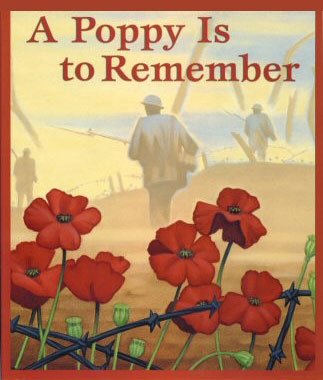
  • A Poppy is to RememberPrivate William Penman, Scots Guards, died 16 May, 1915 at Le Touret, age 25
    (Elizabeth’s great uncle)
  • Private Archibald Turner Mulholland, Argyll & Sutherland Highlanders, mortally wounded 25 September, 1915 at Loos, age 27
    (Elizabeth’s great uncle)
  • Private David Buller, Highland Light Infantry, died 21 October, 1915 at Loos, age 35
    (Elizabeth’s great grandfather)
  • Private Harold Edgar Brand, East Yorkshire Regiment. died 4 June, 1917 at Tournai.
    (My first cousin, three times removed)
  • Private Walter Porteous, Durham Light Infantry, died 4 October, 1917 at Passchendaele, age 18
    (my great uncle, who had married the day before he left for the front and never returned)
  • Corporal John Mulholland, Argyll & Sutherland Highlanders, wounded 2 September, 1914 (shortly before the First Battle of the Aisne), wounded again 29 June, 1918, lived through the war.
    (Elizabeth’s great uncle)
  • John Eleazar (“Ellar”) Thornton, (ranks and dates of service unknown, served in the Royal Garrison Artillery, the East Surrey Regiment, and the Essex Regiment (dates of service unknown, but he likely joined the RGA in 1899). Put on the “Z” list after the war — recall list. He died in an asylum in 1943.
    (my grandfather’s eldest brother)
  • Henry (Harry) Thornton, (uncertain) Lancashire Fusiliers. (We are not sure it is him as there were no identifying family or birth date listed. Rejected for further service.)
    (my grandfather’s second older brother)

The Second World War

  • Flying Officer Richard Porteous, Royal Air Force, survived the defeat in Malaya, was evacuated to India and lived through the war.
    (my great uncle)
  • Able Seaman John Penman, Royal Navy, served in the Defensively Equipped Merchant fleet on the Atlantic convoys, the Murmansk Run (we know he spent a winter in Russia at some point during the war) and other convoy routes, was involved in firefighting and rescue efforts during the Bombay Docks explosion in 1944, lived through the war.
    (Elizabeth’s father. We received his Arctic Star medal in July, 2024.)
  • Private Archie Black (commissioned after the war and retired as a Major), Gordon Highlanders, captured during the fall of Singapore (aged 15) and survived a Japanese POW camp (he had begun to write an autobiography shortly before he died)
    (Elizabeth’s uncle)
  • Elizabeth Buller, “Lumberjill” in the Women’s Timber Corps, an offshoot of the Women’s Land Army in Scotland through the war.
    (Elizabeth’s mother)
  • Trooper Leslie Taplan Russon, 3rd Royal Tank Regiment, died at Tobruk, 19 December, 1942 (aged 23).
    Leslie was my father’s first cousin, once removed (and therefore my first cousin, twice removed).
  • Flight Sergeant Kenneth Alexander Porteous, Royal Air Force, air gunner in a Lancaster bomber of 15 Squadron, Bomber Command. Died when his plane was shot down at Wormlitz 10 miles northeast of the target during a raid on Magdeburg, 21 January 1944 (aged 28).
    Kenneth was my first cousin, twice removed.
  • Reginald Thornton, rank and branch of service unknown, hospitalized during the war with shellshock and was never discharged back into civilian life. He died in York in 1986.
    (my grandfather’s youngest brother)

My maternal grandfather, Matthew Kendrew Thornton, was in a reserved occupation during the war as a plater working at Smith’s Docks in Middlesbrough. The original design for the famous Flower-class corvettes came from Smith’s Docks and 16 of the 196 built in the UK during the war (more were built in Canada). My great-grandmother was an enthusiastic ARP warden through the war (she reportedly enjoyed enforcing blackout compliance in the neighbourhood using the rattle and whistle that came with the job).

For the curious, the Commonwealth War Graves Commission the Royal British Legion, and the Library and Archives Canada WW1 and WW2 records site provide search engines you can use to look up your family name. The RBL’s Every One Remembered site shows you everyone who died in the Great War in British or Empire service (Canadians, Australians, New Zealanders, South Africans and other Imperial countries). The CWGC site also includes those who died in the Second World War. Library and Archives Canada allows searches of the Canadian Expeditionary Force and the Royal Newfoundland Regiment for all who served during WW1, and including those who volunteered for the CEF but were not accepted.

In Flanders fields the poppies blow
Between the crosses row on row,
That mark our place; and in the sky
The larks, still bravely singing, fly
Scarce heard amid the guns below.

We are the Dead. Short days ago
We lived, felt dawn, saw sunset glow,
Loved and were loved, and now we lie
In Flanders fields.

Take up our quarrel with the foe:
To you from failing hands we throw
The torch; be yours to hold it high.
If ye break faith with us who die
We shall not sleep, though poppies grow
In Flanders fields.

Lieutenant Colonel John McCrae, MD Canadian Army Medical Corps (1872-1918)

Here is Mark Knopfler’s wonderful song “Remembrance Day” from his Get Lucky album, set to a slideshow of British and Canadian images from World War I through to more recent conflicts put together by Bob Oldfield:

Vimy Ridge: Canada’s Finest Hour | History Traveler Episode 386

Filed under: Britain, Cancon, France, Germany, History, Military, WW1 — Tags: , , — Nicholas @ 02:00

The History Underground
Published 20 Oct 2024

Battle of Arras: Part 2

When it comes to the legendary actions of the Canadian soldiers in WWI, Vimy Ridge looms large above all of the others. This is where the four division of the Canadian Corps would fight side by side for the first time in The Great War. In this episode, we’re walking the ground on the left flank of the Canadian line, looking at the memorial and showing a few things that typically get overlooked in the Vimy Ridge area.

For more on the Battle of Arras, check out The Old Front Line Podcast with Paul Reed & his YouTube channel, ‪@OldFrontLine‬.

This episode was produced in partnership with The Gettysburg Museum of History. See how you can support history education & artifact preservation by visiting their website & store at https://www.gettysburgmuseumofhistory…

Map animations by @SandervkHistory

QotD: Moltke the Younger and the Schlieffen Plan

Filed under: France, Germany, History, Military, Quotations, Russia, WW1 — Tags: , , , , , — Nicholas @ 01:00

Helmuth von Moltke the Younger is a difficult character to uncover, but one essential to understanding the panoply of forces that produced WWI.1 Moltke died in 1916, providing him little opportunity to defend his tenure. His widow had intended to publish an exculpatory collection of evidence of the chaos of German war planning before 1914. However, by then it was 1919, and the documents were deemed harmful to Germany’s attempt to avoid the blame for the war and so not published. This would prove fateful; the documents would be destroyed in World War II.

Moltke therefore proved an ideal scapegoat for the “Schlieffen School”. For the Schlieffen School (mostly officers trained by Schlieffen), the Schlieffen Plan was a true recipe for victory bungled by incompetent execution. However, recent scholarship has shown a more nuanced picture. While Schlieffen did not fully approve of his successor, Moltke was a faithful student of Schlieffen’s concepts. The modifications he made to the plan were not because of a difference in opinion, but of circumstance. Following Schlieffen’s retirement, the French army became more aggressive, necessitating a stronger defense of the Rhine. Likewise, Russian strength and mobilization speed increased, necessitating a greater force allocated to the East. Moltke was also more realistic about the logistical limitations of the all-important right wing of the German offensive. While Schlieffen (allegedly with his dying breath) insisted “keep the right wing strong”, there were simply only so many divisions that could practically advance there. Moltke did his best to adapt the Schlieffen Plan to these changing circumstances, though with mounting fear that the strength of the Entente had placed victory beyond Germany’s strength.

Despite awareness of the long odds, officers continued to press for preventative war in succeeding European crises.3 The term “preventative war” did not mean “preempting the attack of hostile powers” but rather to initiate a war while the strategic balance was most favorable for Germany. While, as mentioned, they had their doubts about the surety of victory, they believed the odds would only get worse. The Schlieffen Plan had been designed for a one-front war against France (in 1905, the year of Schlieffen’s retirement, Russia was in the throes of revolution). Though adapted in later years, the plan remained tenable only so long as Germany had the chance to defeat France before Russian mobilization was completed. As the Russian army expanded and its rail system modernized, the General Staff saw the Schlieffen Plan nearing its expiration date.

The General Staff saw no alternative to Schlieffen’s concept because of its axiomatic focus on total victory. The kind of limited victory that the Elder Moltke had settled for in his later war plans had never entered the vocabulary of the General Staff. As such, the General Staff pressed strongly for war (which it believed was inevitable) to break out before the balance of power swung further against Germany.

The only alternative to this would have been to frankly state the perilous situation in which Germany stood militarily and admit that total military victory was out of reach and German diplomacy would need to be reoriented around this fact. Not only would this course of action been antithetical to the proud traditions of the officer corps, but it would also have been viewed as unacceptably political. What’s more, the Kaiser would have likely viewed such behavior as cowardly if not outright insubordinate. Once again, the Kaiser’s power over personnel decisions meant uncomfortable topics were not broached for fear of instant dismissal.

It is not entirely unjust to accuse German leaders of cowardice or careerism in avoiding these conversations. However, they — like so many who serve under capricious or incompetent heads of state — justified their silence and continued service under the logic of harm reduction. If they resigned (or clashed with the Kaiser leading to their dismissal) they knew they would be replaced by someone more compliant. The Kaiser’s power over personnel meant they understood clearly that they had no leverage.

The Chiefs of the General Staff, for all their influence, were incentivized to focus on the areas of their exclusive responsibility. Nevertheless, the younger Moltke was not passive in his efforts for war. He resumed contact with the Austro-Hungarian General Staff, assuring it of German support should Austria choose war in a crisis. As aforementioned, when crises came to Europe (some instigated by the German foreign ministry) he pressed the chancellor and Kaiser for a preventative war. Both, to their credit, while willing to risk war, would not choose it.

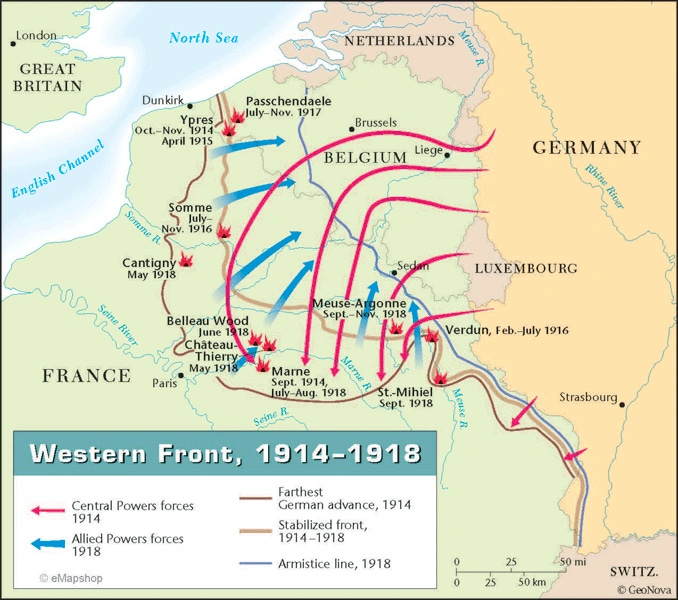
Perhaps most decisively, Moltke and his deputy, Erich von Ludendorff,4 made the decision to hinge the operational plan on an attack on the Belgian city of Liège (hosting a critical rail juncture) before the neutral country could mobilize.5 This modification was made because Moltke desired to avoid violating Dutch neutrality (as Schlieffen had called for). He wisely understood Germany could afford no more enemies and that invading the Netherlands would mean increasing the distance the German right wing would have to cover to gain the French flank, decreasing the odds of success. What’s more, Moltke hoped that Dutch neutrality would allow it to act as a “windpipe” in the event of a long war and a British blockade. However, avoiding Dutch territory complicated German logistics, necessitating the swift seizure of Liège to allow the offensive to meet its strict timetables.

This was a strictly operational decision, made on technical grounds. As such, neither the chancellor nor the Kaiser were informed of this detail of the plan (operational plans were kept strictly secret, with the prior year’s being systematically burned). However, as perceptive readers may have noticed, the need for a coup de main against a neutral country before it mobilized severely limited German strategic flexibility. There was only one deployment plan for war in the West (and only one at all after 1913). In a crisis, Germany was therefore bound to attack before the Belgians manned Liège’s fortifications. Yet this all-important point-of-no-return was unknown to the Kaiser, chancellor, and foreign minister. The General Staff had effectively stripped the Kaiser and civilian leaders of their “right to be wrong”.

Thus, the General Staff had drastically increased the likelihood of war in that the point-of-no-return was kept obscured from those who would be responsible for bring Germany to the brink. As would occur in 1914 during the July Crisis, the Kaiser and his minister could not understand why Moltke was pressing so strongly for war. As historian Annika Mombauer puts it, “Only Moltke knew that every hour counted”.6 The General Staff had — intentionally or not — engineered a situation in which political leadership would have to choose war or abandon its only operational plan. While political leadership was reticent to take this step (especially without the details of the plan) contributing to Moltke’s nervous breakdown, the General Staff ultimately got the war it so desired at the next crisis Germany found itself in. If the coup de main on Liège had been devised as a ploy to force political leadership to engage in a preventative war, it had succeeded.

Ultimately, the predominance of the military over German policy — both foreign and domestic — created an environment in which civilian leaders like Bethmann Hollweg were sidelined, and aggressive military strategies took precedence. This imbalance of prestige, coupled with the narrow, fatalistic worldview of military leaders, contributed to Germany’s march toward war, with little room to acknowledge alternative diplomatic or strategic approaches.

Kiran Pfitzner and Secretary of Defense Rock, “The Kaiser and His Men: Civil-Military Relations in Wilhelmine Germany”, Dead Carl and You, 2024-10-02.


  1. Helmuth von Moltke the Elder was his uncle.
  2. Mombauer, Moltke, 109.
  3. Better known for other work.
  4. Mombauer, 96.
  5. Mombauer, 219.
  6. Rosinski, “Scharnhorst to Schlieffen”, 99.

Powered by WordPress