
Anthony Watts refutes the media claims of climate change driving a large group of unrelated issues into a “meta-crisis” that — as these things always seem to do — requires co-ordinated central control of all human activity (the answer always, always seems to be an all-powerful world government, doesn’t it?).
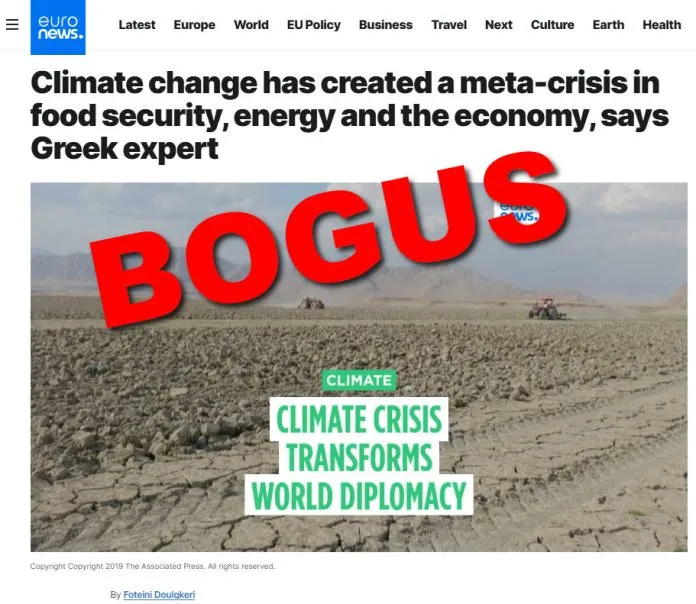
Image from Watts Up With That
Euronews claims climate change has evolved into a “meta-crisis” threatening food security, energy supplies, economies, water resources, and international security. This is misleading because the article largely substitutes predictions and assertions for measurements of what is actually happening. The data show global crop production and yields reaching record levels, deaths from extreme weather collapsing over the long term, and many of today’s energy and economic problems arising from political choices and geopolitical conflicts rather than changes in climate.
Euronews builds its case primarily around an interview with Emmanuella Doussis, UNESCO Chair on Climate Diplomacy at the University of Athens. Doussis declares climate change an economic, social, political, and geopolitical problem, linking it to competition for resources, migration, water shortages, food insecurity, and the energy transition.
Those are sweeping claims. Curiously, Euronews provides remarkably little observational evidence demonstrating that climate change is actually causing the worldwide “meta-crisis” its headline announces.
Perhaps the most obvious contradiction concerns food.
Doussis predicts, “We will face a very large, serious problem with food security.” But predictions about what might happen cannot erase what is happening.
Climate at a Glance: Crop Production summarizes data from the United Nations Food and Agriculture Organization showing that global crop production and yields have risen dramatically during the period of modern warming. Its latest summary reports that the 2023 and 2024 global crop years produced the two highest global crop yields per acre on record.
Climate Realism has documented the same trend repeatedly. Global production of staple crops has increased substantially, and yields have repeatedly set records during recent decades. Even where individual crops suffer poor regional seasons because of drought, floods, pests, or other causes, that is not evidence of a deteriorating global food supply.
There are good reasons for this improvement. Agricultural technology, irrigation, fertilizers, improved crop varieties, mechanization, and better pest control have transformed farming. Modest warming can also lengthen growing seasons and reduce damaging frost events in some regions, while additional atmospheric carbon dioxide generally stimulates plant growth and improves water-use efficiency.
None of this means weather cannot damage crops. It always has. It means that portraying climate change as presently creating a global food-security crisis conflicts with the direction of observed agricultural production.


