Quotulatiousness

March 22, 2014

Turkish Twitter users work to circumvent the government’s ban

Filed under: Europe, Government, Media — Tags: , , , — Nicholas @ 10:00

In the Guardian, Constanze Letsch reports from Istanbul as users of Twitter actively flout the government’s peevish ban of the online service:

Turkish users of Twitter, including the country’s president, have flouted a block on the social media platform by using text messaging services or disguising the location of their computers to continue posting messages on the site.

In what many Twitter users in Turkey called a “digital coup”, Telecom regulators enforced four court orders to restrict access to Twitter on Thursday night, just hours after the prime minister, Recep Tayyip Erdogan, vowed to “eradicate” the microblogging platform in an election speech.

The disruption followed previous government threats to clamp down on the social media and caused widespread outrage inside and outside Turkey. In a first reaction to the ban, Neelie Kroes, vice-president of the European commission, tweeted: “The Twitter ban in #Turkey is groundless, pointless, cowardly. Turkish people and intl community will see this as censorship. It is.”

Štefan Füle, EU commissioner for Enlargement and European Neighbourhood Policy, said in a statement: “The ban on the social platform Twitter.com in Turkey raises grave concerns and casts doubt on Turkey’s stated commitment to European values and standards.”

The hashtag #TwitterisblockedinTurkey quickly rose to the top trending term globally. According to social media agency We Are Social the number of tweets sent from Turkey went up 138% following the ban.

January 11, 2014

Do you tweet a lot? You might just be a narcissist

Filed under: Media — Tags: , , , — Nicholas @ 11:11

I’m not sure this even rises to the level of “bleeding obvious”, but Tom Jacobs connects the dots to make the point that narcissists on Twitter send frequent tweets:

Spotting a narcissist can be tricky, but newly published research suggests a tell-tale marker: Note how often he or she tweets.

“Narcissism does appear to be a primary driver for the desire for (Twitter) followers, which in turn drives tweets,” writes a research team led by Shaun Davenport of High Point University.

It reports in the journal Computers in Human Behavior that study participants with narcissistic tendencies tended to tweet more often than others, as well as to post more Facebook status updates.

Comparing the two social media platforms, the researchers found a generational divide, noting that “narcissistic college students prefer to post content on Twitter, while narcissistic adults prefer to post content on Facebook.”

This appears to reflect a difference in Facebook usage between millennials and members of earlier generations, with millennials’ posting of status updates being more routine and less likely to reflect narcissistic motives.

H/T to David Warren, who makes the obvious point:

December 4, 2013

The essential unseriousness of the Chong parliamentary reform debate

Filed under: Cancon, Humour, Politics — Tags: , — Nicholas @ 17:04

October 5, 2013

The future of post-IPO Twitter from the user perspective

Filed under: Business, Technology — Tags: , , — Nicholas @ 08:40

In Maclean’s, Jesse Brown looks at the ominous signs of change for Twitter’s users in a post-IPO world:

As a private company, Twitter prioritized the user’s experience. I would go so far to say that providing an excellent user experience was the whole point of Twitter’s existence.

I didn’t get Twitter, at first. It seemed like just a stripped-down, feature-limited version of Facebook’s News Feed. Of course, that was the whole idea. By constraining users to 140 characters of text and a few buttons for sharing, “favoriting” or replying, and by eliminating the concept of mutually accepted friendship as a requirement for network growth, Twitter provided a simple, lightweight, super-charged information machine. The initial absence of pictures and video helped it move lightly across the slower phones of the time, and the arbitrary, spartan limitation on tweet length was a stroke of brilliance, forcing brevity upon its users to prevent blabbermouths and spammers from clogging up everybody’s feeds.

[…]

They will soon be under intense pressure to bring that number up, and in preparation, Twitter is moving away from sponsored tweets and sponsored trends, investing heavily in slick, complicated new ad products like Twitter Amplify, which embeds video clips into tweets with unskippable pre-roll ads. I can’t imagine any Twitter user saying “what this service really needs is some TV commercials!”

And whereas once Twitter played nicely with other apps, welcoming other companies (like Canada’s HootSuite) to build new apps that plug into Twitter and build on its network, they’ve since been frustrating developers with increasingly restrictive changes to its API, the interface it provides to outsiders. Last year, for example, Twitter put a cap on the number of users a third-party app could support. Now, if your Twitter-based service gets too popular, you’ll have to ask Twitter for permission to grow.

September 7, 2013

The online life of the professional athlete

Filed under: Business, Humour, Media, Sports — Tags: , , , — Nicholas @ 08:25

Chris Kluwe has a bit of experience as both a professional athlete and as a social media guru. Here’s some advice from him on how other professionals should handle their Twitter feeds:

When you’re a professional athlete on social media, there are certain unspoken rules (I lied, some of them are spoken in media meetings) you’re expected to abide by. The team (or company, really) wants you to be engaging, because that draws interest and boosts ticket/jersey sales, but it’s best if you’re only engaging on innocuous subjects. Teams really like it when you tweet “Rise and grind” each morning, or “gr8 day wth my tmmates, gettin that work in,” or “TEAM PROMOTIONAL ACTIVITY GOES HERE” — because it’s seen as the pinnacle of wit, you’re interacting with fans, and above all, it’s comfortably inoffensive (except, perhaps, to those with a dislike of the redundant and an appreciation of spelling and grammar, but no one really cares about those people, amirite?). Michael Jordan’s famous quote holds even more true today than it did in the ’90s:

“Republicans buy sneakers, too.”

You see, we’re in the business of selling you entertainment! We’re also in the business of selling you everything that goes along with entertainment, like sneakers, and jerseys, and sweatsuits, and mini-helmets, and commemorative plates, and cars, and alcohol… well, you get the idea. The funny thing about entertainment companies is that without fail, they want to grab the biggest slice of the pie they can, and the pie is biggest when it’s watered down and spread out and so generic that anyone can stomach a bite. It might not taste like much, but it sure is easy to keep choking it down the old gullet.

What teams don’t like is spice. Flavor. Something that makes people angry, gets folks riled up. They hate to see those messages that could possibly alienate a buyer, no matter how odious that buyer’s views may be.

August 14, 2013

The “Indie Web” is the very definition of a fringe project

Filed under: Media, Technology — Tags: , , , , , — Nicholas @ 08:55

Wired‘s Klint Finley wants you to meet the indie hackers who want to jailbreak the internet (among other things):

One guy is wearing his Google Glass. Another showed up in an HTML5 t-shirt. And then there’s the dude who looks like the Mad Hatter, decked out in a top hat with an enormous white flower tucked into the brim.

At first, they look like any other gaggle of tech geeks. But then you notice that one of them is Ward Cunningham, the man who invented the wiki, the tech that underpins Wikipedia. And there’s Kevin Marks, the former vice president of web services at British Telecom. Oh, and don’t miss Brad Fitzpatrick, creator of the seminal blogging site LiveJournal and, more recently, a coder who works in the engine room of Google’s online empire.

Packed into a small conference room, this rag-tag band of software developers has an outsized digital pedigree, and they have a mission to match. They hope to jailbreak the internet.

They call it the Indie Web movement, an effort to create a web that’s not so dependent on tech giants like Facebook, Twitter, and, yes, Google — a web that belongs not to one individual or one company, but to everyone. “I don’t trust myself,” says Fitzpatrick. “And I don’t trust companies.” The movement grew out of an egalitarian online project launched by Fitzpatrick, before he made the move to Google. And over the past few years, it has roped in about 100 other coders from around the world.

August 1, 2013

“That kind of grassroots power tends to make government officials jittery”

Filed under: Law, Media, USA — Tags: , , — Nicholas @ 12:34

J.D. Tuccille looks at the rise of Twitter … not so much its rise in users, but the rise in government interest and interference:

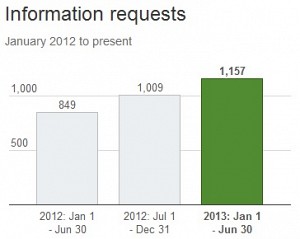
Twitter information requests 2012-13You know you’ve arrived as an online media operation when governments take an interest in who is speaking out, and make efforts to muzzle what’s published. That’s definitely the case with Twitter, the microblogging platform that started as an outlet for exhibitionist ADHD sufferers, only to become a powerful medium for sharing news and grassroots organizing. According to the company’s latest transparency report, governments around the world are issuing ever-more demands for information about the service’s users, and stepping up efforts to suppress tweeted content.



From January 1 through June 30 of this year, Twitter received 1,157 government requests for private information about users and accounts, up from 849 during the same period in 2012. Of those, authorities in the United States were responsible for 902 requests. Twitter complied in whole or part with 55 percent of all requests — 67 percent of those originating in the U.S.

Interestingly, roughly 20 percent of information requests issued by American authorities were “under seal,” meaning that Twitter was forbidden to fulfill its usual policy of informing users about requests for their private information.

July 28, 2013

Follow-up to “First world blogging problems” post

Filed under: Technology — Tags: , , — Nicholas @ 00:01

All good things must come to an end, I guess, so I’ve bid goodbye to the old Tweetdeck, which has been a reliable Twitter client for me for the last several years. When the Twitter corporation took over the original Tweetdeck development, I thought it would be a good thing … until I saw the first release of the “new” Tweetdeck client. It sucked. It was as though the development team’s mission was to find all the good features of the old Tweetdeck and comprehensively ruin them. If that was the case, they succeeded terribly well.

I stuck with the old version of Tweetdeck until it finally stopped working earlier this week. Right now, I’m trying out Janetter, which has been relatively painless to install and configure, and replaces most of the functionality that Tweetdeck used to have. Hopefully, it’ll be around as long as the old Tweetdeck was.

Follow-up to this post from earlier in the week.

July 25, 2013

First world blogging problems

Filed under: Administrivia, Technology — Tags: , , , — Nicholas @ 08:48

I use a few tools to come up with items to post on the blog. The two most useful are Twitter and RSS. I’d been using Google Reader for my RSS needs until it was shut down at the beginning of July, so I switched to The Old Reader and it has been working quite well as a direct Google Reader replacement. Earlier this week, TOR had a server meltdown and multiple failures of drives while attempting to recover. As of this morning, they’re still trying to get back online and (hopefully) recover all the data. Fortunately, I’ve also been testing Newsvibe for RSS, and it’s still working well … but has a different set of feeds than TOR.

My other main tool, Twitter, seems to be having some issues today … or it might just be that my old Twitter client is finally giving up the ghost. I’ve been using the desktop TweetDeck client for years, but I really disliked the “new” version of the tool introduced when TweetDeck was taken over by Twitter itself. Over the last several months, the old client (version 0.38.2) has been slowly losing bits of functionality — for example, sometime in the last week, I lost the ability to send a direct message from Tweetdeck, and earlier this year it became impossible to use the “old” retweet method and more recently to retweet at all.

Today, when I started up the client, it was unable to retrieve any data from earlier this morning. This might be a general issue with the Twitter API or it might be yet another bit of creeping feature-fail. It’s picking up new Twitter posts, but one of the more useful features was that it would also collect tweets from my several lists that had been posted overnight. This morning, only the main feed column in Tweetdeck is being populated, the rest (Mentions, Direct Messages, various list and search columns) are empty.

Old Tweetdeck

I may need to shop around for a new Twitter client. Either way, it puts a crimp in my usual blogging habits.

July 24, 2013

Anti-porn UK MP gets hacked, threatens reporter who publicized the hack

Filed under: Britain, Liberty, Media, Politics — Tags: , , , , , — Nicholas @ 11:13

Apparently British Conservative MP Claire Perry doesn’t know a lot about the way the internet works, despite being described as an “architect” for David Cameron’s proposed porn blocker:

UK MP Claire Perry hacked

Claire Perry is the UK Tory MP who architected David Cameron’s idiotic national porno firewall plan. Her website was hacked and defaced with pornographic gross-out/shock images. When Guido Fawkes, a reporter and blogger, wrote about it on his website, Perry took to Twitter to accuse him of “sponsoring” the hack, and publicly announced that she would be speaking to his editor at the Sun (Fawkes has a column with the tabloid) to punish him for writing about her embarrassment.

Perry is so technologically illiterate that she can’t tell the difference between writing about someone hacking your website and hacking itself. No wonder she’s credulous enough to believe the magic-beans-peddlers who promise her that they’ll keep porn off the British Internet — a feat that neither the Chinese nor the Iranian governments have managed.

July 15, 2013

Prime Minister live-tweeted his own cabinet shuffle

Filed under: Cancon, Government, Politics — Tags: , , , — Nicholas @ 10:47

In Canada, we do things a bit differently these days:

And on, naming each new minister or minister with changed portfolio.

July 12, 2013

Satanists and the Texas abortion debate

Filed under: Media, Politics, Religion, USA — Tags: , , , , — Nicholas @ 09:03

Kathy Shaidle finds the Satanists aren’t at all what she expected them to be:

At the height of all the #HailSatan hilarity on the left side of Twitter, a single thunderclap of a Tweet shut down the party pronto:

    Unfortunate to see Satan’s name used in such a diabolical manner. Another example of what ‘Satanism’ doesn’t represent. #HailSatan”—@UKChurchofSatan

It was that utterly breathtaking inclusion of the word “diabolical” that got me thinking like a liberal: that is, that the @UKChurchofSatan Twitter account had to be fake, set up specifically to mock the proceedings, in the tradition of “Clint’s Empty Chair.”

My suspicions were confirmed when I saw that, according to their profile, @UKChurchofSatan was following precisely 666 others on Twitter. Cute.

Their profile didn’t display the address of an official website, either. Not a good sign.

But I kept scrolling down. @UKChurchofSatan had sent out over 150 Tweets — wishing followers happy bank holiday weekends and re-Tweeting Richard Dawkins and Ricky Gervais — dating back through March.

It was legit.

Unlike messages regularly spewed out by the right and the left, the Church’s Tweets were models of old-fashioned decorum even when they were responding to critics, written in that anachronistic, typing-with-a-quill-pen style typical of earnest, fairly well-read males:

    Why wouldn’t Satanism be pro-life? What else is there? We are all free to make choices. Agreeable or not. Everyone is entitled to choice.

At least in this online iteration, Satanism comes across as a kind of Goth objectivism but manages to express itself without the average Ayn Rand follower’s pompous, unearned sense of superiority.

Thanks to its disapproving July 3 Tweet, which was re-Tweeted over one hundred times and gleefully reported all over the Web and a few newspapers such as the Telegraph, the @UKChurchofSatan is getting lots of positive attention, much of it from a most unlikely source: conservative Christian bloggers in the US, who’ve joked that “Hail Satan!” would make a fine Democratic campaign slogan for the 2014 midterms.

June 30, 2013

Social media marks the end of the red carpet

Filed under: Media, Technology — Tags: , , , — Nicholas @ 00:01

In Reason, Nick Gillespie gets to the root of Alec Baldwin’s problem with social media:

In an interview with Gothamist, the talented actor and annoying loudmouth inadvertently lays bare the real online dynamic behind his anger with new media — and it has less to do with factually incorrect journalism than you might think.

Baldwin’s real issue with new media — he slags Tumblr, Vine, MySpace, Facebook, and more — is that they level kings and queens and even celebrities into a mosh pit of direct, unmediated exchange that is hard as hell to control. It turns out that there’s really no red carpet or champagne room when it comes to the way that stars (read: world leaders, sitcom heroes, famous authors, former child actors, you name it) are treated.

In the Q&A, Baldwin says,

    Twitter began for me as a way to bypass the mainstream media and talk directly to my audience and say, “hey here’s a show I’m doing, here’s something I’m doing.”… But I realized it’s something I’m not really… it certainly isn’t worth the trouble. Rosie O’Donnell is on my podcast this week, and she said that she’s getting off of Twitter, and I said “God, I was thinking the same thing.” I said “you just end up absorbing so much hatred.” You get these body blows of all this hatred from people who… their profiles are almost identical, like “tea party mom, I love my job, I love my kids, I love my country #millitary #guns” and there’s a screaming eagle in the background of their profile, grasping some arrows and tanks rolling in the background and they all want to tell me how much they can’t stand my politics. And I go, “OK.” What kills me is these are people who want to put me out of business, so to speak, as fast as they possibly can, but they don’t want to put BP out of business, who turned the Gulf of Mexico into a cesspool….

Baldwin sputters that the very tools he can use to bypass “the mainstream media and talk directly” to his audience also empowers all those dim people out there in the dark. What’s more, his followers have minds of their own. They may enjoy his turns in Glenngarry Glenn Ross and 30 Rock and guest-hosting on Turner Classic Movies but not really find his views on fracking to be worth a damn. It’s a real kick in the pants for a celebrity to be reduced to asking, “Do you think I’m really changing anybody’s mind?”

[. . .]

Reading Baldwin’s comments, I’m struck by how his comments strongly vindicate what we’ve been stressing at Reason since the dawn of the Internet Age: That the audience has a mind of its own that it’s always been dying to express. What’s different now is that we can. Baldwin’s complaint that “there’s no journalism anymore” (except for the people he likes) and his attack on “tea party moms” who thrill to see the Gulf of Mexico foam with oil are best understood as howls of rage from the ancien regime as new-media sans-culottes storm the gates of privilege and power. Being in charge — of government, of media, of art, of business, of religion — just ain’t what it used to be.

Given his temperament and the massive amount of abuse he seems to have taken, Baldwin’s probably right to vacate Twitter and other forums that allow direct, unmediated access to him. That’s his right to exercise. But among the costs he and other powerful people — pols, pashas, pundits, etc. — will bear is lack of engagement with exactly where the world is literally and figuratively trending.

June 26, 2013

Buh-bye, DOMA

Filed under: Law, Liberty, USA — Tags: , , , , — Nicholas @ 12:59

I was away from my computer for about an hour this morning and when I came back online, my Twitter feed had exploded with news and opinion links about the US Supreme Court striking down the Defence of Marriage Act. While I’m delighted with the result (check my posts tagged Same Sex Marriage if you’re curious), it’s interesting to watch the reactions on all sides of the issue.

June 13, 2013

Twitter and #EthicalCleansing

Filed under: Britain, Law, Liberty, Media — Tags: , , , , — Nicholas @ 10:02

In sp!ked, Mick Hume talks about the dangers to free speech on Twitter:

The latest bizarre episode in this campaign of ‘ethical cleansing’ on the web occurred at the end of last week, when a 21-year-old London student was sentenced to 250 hours of community service as punishment for a 16-word tweet, having been found guilty of sending a malicious electronic message at an earlier hearing.

Like several other recent Twitter incidents, the case began after the murder of Drummer Lee Rigby in Woolwich on 22 May. As a natural home of rumour, gossip and ill-informed opinion, Twitter was soon ablaze with comments about the killing, including rumours that Drummer Rigby had been decapitated in the street. Deyka Ayan Hassan, a 21-year old English and politics undergraduate from north London, quickly joined in the Twitter-fest with what she intended to be a fashion joke about Lee Rigby’s outfit: ‘To be honest, if you wear a Help for Heroes t-shirt you deserve to be beheaded.’ Hassan’s lawyer told the court that this was the sort of remark she would typically make ‘about clothes and shoes she didn’t like’ (which sounds believable enough to anybody familiar with the level of online ‘banter’). Hassan also insists that at the time of tweeting, she did not know that the dead man was a soldier or that Islamic extremists were accused of his murder.

Perhaps unsurprisingly, Hassan’s joke about the t-shirt did not meet with universal approval online. She was soon inundated with hundreds of hate tweets, threatening her with everything from rape to being burned alive in her home. The naive and shocked student then went to a local police station to report these threats and insults. Rather than listen to her complaints, the police arrested Hassan for sending the original tweet. She was then fast-tracked into court, as if this was an urgent case, and pleaded guilty.

Bad taste in humour and a bad sense of timing should not be criminal offences, and the authorities talk about this as though incidents like this don’t actually happen:

Cases such as this demonstrate how the creeping culture of You Can’t Say That is now spreading across the supposedly free fringes of the internet. As other incidents listed below show, it can now be deemed a crime to post accusations, insults or just ‘naughty’ words that tweeters, the police and the courts consider ‘inappropriate’, ‘offensive’ or ‘insensitive’. And we thought that Thought Crime belonged in the realm of fiction.

The Hassan case should also be a warning to those many users of social-media sites who now see it as their role to police what others say online – and to inform the real police about tweets and posts they find offensive. The police are happy to act on such information, since they far prefer pursuing thought criminals across their tweets to chasing real ones on the streets. But as Deyka Ayan Hassan’s experience shows, the law is no respecter of anybody’s freedom of expression. She thought she was reporting a crime, and ended up with a criminal record. Those who try to live by the ‘hate speech’ laws can perish by them, too.

[. . .]

The culture of You Can’t Say That is making seemingly unstoppable progress across society, even while apparently oblivious civil libertarians rage against the spectre of state surveillance. Last September, no less a figure than the UK Director of Public Prosecutions himself announced that ‘offensive comments made on Twitter are unlikely to lead to criminal charges unless they include threats or turn into campaigns of harassment’. In what was billed as ‘an important statement about the boundaries of free speech’, Keir Starmer reportedly ‘suggested that prosecutions would not be brought over one-off jokes made online, even if in they were in poor taste’. Tell that to such examplars of one-off poor taste jokes as Deyka Ayan Hassan and some of the other characters listed below.

« Newer PostsOlder Posts »

Powered by WordPress