
Extra Credits
Published on 16 Sep 2017Charles XII had gone to the Ukraine hoping for supplies and reinforcements, especially from the cossacks led by Ivan Mazeppa. But Peter the Great was hot on his trail, and had no intention of letting him off that easy.
September 18, 2017
Great Northern War – IV: Clash of Kings – Extra History
Comments Off on Great Northern War – IV: Clash of Kings – Extra History
September 13, 2017
The Thirty Years War
Published on 10 Nov 2014
The Thirty Years’ War was fought from 1618-1648 (Thirty Years!) in the Holy Roman Empire. It began as a conflict between Catholics and Protestants in Bohemia, but grew to involve Denmark, Sweden, and France. After the French began helping Gustavus Adolphus, the Protestant king of Sweden, the lines became blurry and the war became more about the balance of power in Europe than about religion. The Peace of Westphalia paved the way for France to become the dominant power in Western Europe and for the permanent decline of the Holy Roman Empire as a political institution.
If you like this lecture, check out my other lectures for AP European History and Western Civilization!
September 12, 2017
Great Northern War – III: Young and Violent – Extra History
Published on 9 Sep 2017
Flush from his victories against Poland-Lithuania, Charles XII of Sweden sets his eyes on an even greater enemy: Russia. But its ruler, Peter the Great, is no pushover: as the Swedish troops advance, he burns down the countryside and leaves them starving and exposed as a ferocious winter sets in.
Comments Off on Great Northern War – III: Young and Violent – Extra History
September 9, 2017
The Seven Years’ War
Published on 19 Nov 2016
The Seven Years’ War essentially comprised two struggles. One centered on the maritime and colonial conflict between Britain and its Bourbon enemies, France and Spain; the second, on the conflict between Frederick II (the Great) of Prussia and his opponents: Austria, France, Russia, and Sweden. Two other less prominent struggles were also worthy of note. As an ally of Frederick, George II of Britain, as elector of Hanover, resisted French attacks in Germany, initially only with Hanoverian and Hessian troops but from 1758 with the assistance of British forces also. In 1762, Spain, with French support, attacked Britain’s ally Portugal, but, after initial checks, the Portuguese, thanks to British assistance, managed to resist successfully.
Comments Off on The Seven Years’ War
August 28, 2017
Great Northern War – II: A Good Plan – Extra History
Published on 26 Aug 2017
The wrath of Charles XII was now aimed directly at Poland-Lithuania. But their leader had a plan! ..A terrible plan.
Augustus the Strong was determined to prove his might by defeated Charles XII on the battlefield. He gathered his Polish-Lithuanian forces, met the Swedes, and proceded to… lose. And lose. And lose. Then he got deposed and started a civil war which of course he also lost.
Comments Off on Great Northern War – II: A Good Plan – Extra History
August 26, 2017
When is an archaeological artifact merely “recyclable”?
In Sweden, apparently, it’s actually becoming a common practice to discard “excess” metal artifacts for literal recycling:
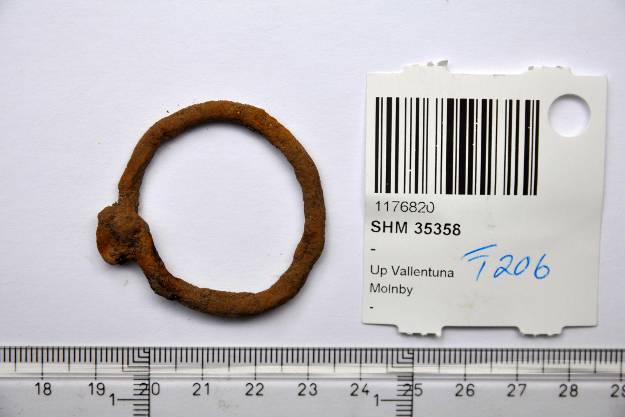
One of the amulet rings from the Iron Age that archaeologists are recycling. Previously, this type of object was saved, says archaeologist Johan Runer.
(Photo from Svenska Dagbladet, caption from Never Yet Melted)
Rough translation from Swedish language article in Svenska Dagbladet:
While the debate about burning books is raging in the media, Swedish archaeologists throw away amulet rings and other ancient discoveries. It feels wrong and sad to destroy thousands of years of ritual arts and crafts, and I’m not alone in feeling so.
“What you do is destroy our history! Says Johan Runer, archaeologist at Stockholm County Museum.
Amulet rings from the Iron Age, like Viking weights and coins, belong to a category of objects that, as far as Runer knows, were previously always saved.
He tried to raise the alarm in an article in the journal Popular Archeology (No. 4/2016), describing how arbitrary thinning occurs. Especially in archeological studies before construction and road projects, the focus is on quickly and cheaply removing the heritage so that the machine tools can proceed.
He works himself in these kinds of excavations. Nobody working in field archeology wants to get a reputation as an uncooperative “find-fanatic” but now he cannot be quiet any longer.
“It’s quite crazy, but this field operates in the marketplace. We are doing business,” says Runer.
Often, especially in the case of minor excavations, there is a standing order from the county administrative boards that as few discoveries as possible should be taken.
If you think it seems unlikely, I recommend reading the National Archives Office’s open archive, such as report 2016: 38. An archaeological preamble of settlement of bronze and iron age before reconstruction by Flädie on the E6 outside Lund.
In the finds catalog, coins, knives, a tin ornament, a ring and a weight from the Viking Age or early Middle Ages have been placed in the column “Weeded Out”.
Comments Off on When is an archaeological artifact merely “recyclable”?
August 25, 2017
Great Northern War – I: When Sweden Ruled the World – Extra History
Published on 19 Aug 2017
A young boy king had inherited the crown of the Swedish Empire, and his neighbors saw an opportunity to attack. To their surprise, young Charles XII of Sweden turned out to be a fearsome opponent who quickly repelled their assaults – and then sought revenge.
Comments Off on Great Northern War – I: When Sweden Ruled the World – Extra History
August 10, 2017
The Treaty of Westphalia
Published on 20 Nov 2008
Treaty of Westphalia
Comments Off on The Treaty of Westphalia
March 21, 2017
Icelandic standup about Nordic neighbours in general and Finnish language in particular
Published on Dec 1, 2016
H/T to Colby Cosh for the link.
Comments Off on Icelandic standup about Nordic neighbours in general and Finnish language in particular
February 16, 2016
September 20, 2015
Interview with Indy Neidell I THE GREAT WAR – Special
Published on 19 Sep 2015
THANK YOU FOR 150.000 SUBSCRIBERS!
Our producer David sat down with Indy in his garden for an interview that answers a few questions you all have been dying to ask. Why Stockholm? Why The Great War Channel? Are you a Historian?
Comments Off on Interview with Indy Neidell I THE GREAT WAR – Special
September 19, 2015
September 15, 2015
Sweden during World War 1 – Balancing Neutrality I THE GREAT WAR Special
Published on 14 Sep 2015
Sweden was neutral during the Great War and like all neutral countries in World War 1 it was affected by the global conflict. Balancing neutrality between the Central Powers and the Entente while also maintaining trade with both sides was not easy – but very profitable. Especially the trade with Germany was very lucrative since it was circumventing the British Naval Blockade. But that was not the only effect the war had on Sweden which became the nation it is today during WW1.
Comments Off on Sweden during World War 1 – Balancing Neutrality I THE GREAT WAR Special
September 2, 2015
Seattle is considering implementing rent control
Megan McArdle on the things Seattle may learn — painfully — if they fail to heed the experiences of other cities that have implemented rent control:
So I see that Seattle is considering rent control. For a columnist who covers economic issues, this is a little bit like hearing that residents are debating how big to make the reet pleats on their zoot suits. It’s hard to get economists to agree on much of anything, but as Alex Tabarrok notes, this is an area of rare consensus among economists: Rent control creates more problems than it solves.
If you want a vivid example of what those problems look like, you can do no better than a letter written by a resident of Stockholm to the good citizens of Seattle, quoted by Tabarrok: “Seattle, you need to ask your citizens this: How would citizens like it if they walked into a rental agency and the agent told them to register and come back in 10 years? … Stockholm City Council now has an official housing queue, where 1 day waiting = 1 point. To get an apartment you need both money for the rent and enough points to be the first in line. Recently an apartment in inner Stockholm became available. In just 5 days, 2000 people had applied for the apartment. The person who got the apartment had been waiting in the official housing queue since 1989!”
Now, Stockholm is extreme. But the general effect always goes in the same direction. Rent control creates two classes of tenants: people who have the right to rent at below-market rates, and renters who would like to get a long-term lease on an apartment, but cannot, or must pay through the nose for a limited number of uncontrolled properties. Meanwhile, landlords let the quality of the existing stock decline and become very reluctant to build new housing that they can’t make a profit on.
This is not some sort of arcane secret that has not reached the policy analysts in our nation’s fair metropolises. They’re well aware of what rent control does. So why is it ever on the table?
Comments Off on Seattle is considering implementing rent control
August 5, 2015
A report on phasing out nuclear power in Sweden
It may make politicians and activists feel empowered and righteous, but it has negative aspects that don’t seem to get the same level of attention as the “feel good” rhetoric does:
Nuclear power faces an uncertain future in Sweden. Major political parties, including the Green party of the coalition-government have recently strongly advocated for a policy to decommission the Swedish nuclear fleet prematurely. Here we examine the environmental, health and (to a lesser extent) economic impacts of implementing such a plan. The process has already been started through the early shutdown of the Barsebäck plant. We estimate that the political decision to shut down Barsebäck has resulted in ~2400 avoidable energy-production-related deaths and an increase in global CO2 emissions of 95 million tonnes to date (October 2014). The Swedish reactor fleet as a whole has reached just past its halfway point of production, and has a remaining potential production of up to 2100 TWh. The reactors have the potential of preventing 1.9–2.1 gigatonnes of future CO2-emissions if allowed to operate their full lifespans. The potential for future prevention of energy-related-deaths is 50,000–60,000. We estimate an 800 billion SEK (120 billion USD) lower-bound estimate for the lost tax revenue from an early phase-out policy. In sum, the evidence shows that implementing a ‘nuclear-free’ policy for Sweden (or countries in a similar situation) would constitute a highly retrograde step for climate, health and economic protection.
Comments Off on A report on phasing out nuclear power in Sweden


