Quotulatiousness

February 6, 2023

QotD: US railroad land grants

Filed under: Business, Economics, Government, History, Quotations, Railways, USA — Tags: , , , — Nicholas @ 01:00

In 1871, Kentucky Congressman J. Proctor Knott gave a humorous speech on the floor of the House of Representatives ridiculing the idea of giving land grants to western railroads. He focused on Duluth, which at the time had about 3,000 residents, and his basic argument was that U.S. taxpayers in general should not be required to subsidize projects that benefitted only a few.

The speech was widely reprinted by those skeptical of government pork barrel (a term that first became popular about the time Knott gave his speech). Sixteen years later, Northern Pacific, which received what was probably the largest land grant to a private company in American history, reprinted the speech in this brochure.

This might seem strange except that NP annotated the speech with recent facts in bright red letters, such as that Duluth had grown to house 26,000 people by 1886, that more wheat was delivered to Duluth each year than to any other American city, and that it also saw deliveries of millions of board feet of lumber and hundreds of thousands of tons of iron ore each year.

NP didn’t say so in so many words, but its point was clearly that the land grants, contrary to Knott’s predictions, were a good thing for most if not all Americans. However, the brochure also didn’t mention that James J. Hill was proving that a railroad that didn’t receive any land grants or subsidies could provide just as many benefits without going bankrupt, which would leave both investors and taxpayers in the lurch. (The St. Paul & Pacific did receive a small land grant, but Hill paid fair market value for that railroad and land after it went bankrupt, thus Hill didn’t particularly benefit from the subsidy.)

Train Lover (Randal O’Toole), “Debate Over Railroad Land Grants”, Streamliner Memories, 2022-11-01.

January 12, 2023

QotD: Describing the CBC to Americans

Filed under: Cancon, Government, Media, Politics, Quotations — Tags: , , , , — Nicholas @ 01:00

    an audience of any size has yet to be found

So far so CBC, then.

I’m not sure how to describe the CBC to American viewers. The BBC routinely produces content that’s quite entertaining (deliberately, I mean) so it’s not a good analogy. I suppose the best analog would be if NPR and PBS merged and were run by the CPUSA with $20 billion dollars of taxpayer money, and still managed to produce nothing anyone wanted to watch.

Daniel Ream, commenting on David Thompson, “The Giant Testicles Told Me”, DavidThompson, 2022-10-10.

December 16, 2022

The Online News [Shakedown] Act passes the House of Commons

Filed under: Business, Cancon, Government, Media — Tags: , , , , , , , , — Nicholas @ 03:00

Michael Geist summarizes the farcical progress of Justin Trudeau’s legalized theft from the “tech giants”:

Later today, the House of Commons will vote to approve Bill C-18, the Online News Act, sending it to the Senate just prior to breaking for the holidays. While Canadian Heritage Minister Pablo Rodriguez and media lobbyists will no doubt celebrate the milestone, it should not go unremarked that the legislative process for this bill has been an utter embarrassment with an already bad bill made far worse. The government cut off debate at second reading, actively excluded dozens of potential witnesses, expanded the bill to hundreds of broadcasters that may not even produce news, denigrated online news services as “not real news”, and shrugged off violations of international copyright law. All the while, it acknowledged that mandated payments for links are the foundation of the bill with officials stating that individual Facebook posts accompanied by a link to a news story would be caught by the law. As for the purported financial benefits, the government’s own estimates are less than half those of the Parliamentary Budget Officer, who also concluded that more than 75% of the revenues will go to broadcasters such as Bell, Rogers, and the CBC. The end result is a bill that will undermine competition and pose a threat to freedom of expression, while potentially leading Facebook to block news sharing in Canada and Google to cancel dozens of existing agreements with Canadian news outlets.

As I’ve chronicled for months, Bill C-18 is the product of an intense lobbying campaign from some of Canada’s largest media companies. While the Globe and Mail broke from the pack at the last minute, years of one-sided editorials — even devoting full front pages to the issue — had its effect. Indeed, Canadian newspapers would be exhibit #1 for how government intervention in the media space has a direct impact on an independent press. From the moment of its introduction, the consequences were immediately obvious as payments for links serves as the foundation for a law that treats “facilitating access to news” as compensable. Canadians can be forgiven for thinking the bill is about compensating for reproduction of news stories. It is not, since the platforms don’t do that. Instead, it is about requiring payments for links, indexing or otherwise directing traffic to the news organizations who are often the source of the link itself. In most circumstances, recipients pay for the benefits that come from referral traffic. With Bill C-18, the entities providing the referrals pay for doing so.

Further, the bill is about far more than struggling Canadian newspapers as it expands eligibility into broadcasters such as the CBC, foreign news outlets such as the New York Times, and hundreds of broadcasters licensed by the CRTC that are not even required to produce news. The end goal is negotiated payments for links, backed by the threat of a one-sided arbitration process overseen by the CRTC in which the arbitration panel can simply reject offers if it believes it fails to meet the government’s policy objectives. That isn’t a commercial deal, it is a shakedown.

I’ve been operating on the assumption that the government is betting that the big internet companies won’t do the obvious and ban linking to any Canadian media outlet on their respective platforms, but the feds don’t have a great track record of predictions in recent years …

In a later post, Michael Geist illustrated the literal misinformation that was pushed by government MPs during Bill C-18’s path through to final reading by quoting some of Liberal MP Lisa Hepfner’s contributions:

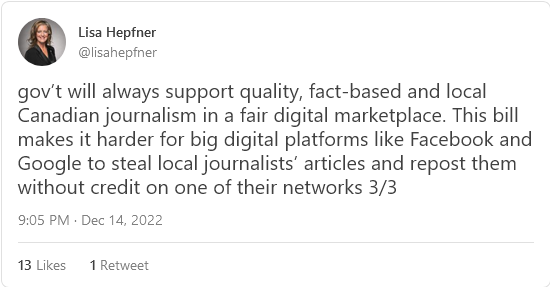
Last month, Liberal MP Lisa Hepfner shocked Canadian online news outlets by stating that “they’re not news. They’re not gathering news. They’re publishing opinion only.” The comments sparked instant criticism from news outlets across the country, leading Hepfner to issue a quick apology. In the aftermath of the comments, Hepfner said nothing for weeks at Heritage committee studying Bill C-18. That bill passed third reading yesterday – I posted on the embarrassing legislative review – and Hepfner was back at it. Rather than criticizing online news outlets, this time she targeted the Internet platforms, saying the bill would make it “harder for big digital platforms like Facebook and Google to steal local journalists’ articles and repost them without credit.” 

[…]

Hepfner’s comment not only provide a troubling example of an MP engaging in misinformation about links who has effectively labelled her own Facebook posts as theft, but strikes at the heart of the problem with Bill C-18. As government officials have acknowledged, the entire foundation of the bill is based on paying for links. In fact, when a proposal to remove links from the bill was raised at committee, government MPs described the change as a loophole and voted against it. In the case of the CBC links, the government confirmed that Hepfner could write about the availability of children’s medications (ie. “Great news! CBC reports a million bottles of pain medication are on the way”) but once she added a link to provide a source for the claim, Bill C-18 is triggered.

These examples highlight the absurdity of a law that treats links as compensable and MPs who equate those links to theft. To be clear, there is nothing wrong with Hepfner or anyone else providing a link to a story on greater availability of children’s medicine. In fact, the CBC story has effectively already been paid for by the public and should be shared widely without the government creating barriers to sharing that information. What is wrong that is ill-informed MPs have voted for Bill C-18, creating a framework in which the government is imposing a mandatory payment scheme for some platforms for hosting links. The bill is now headed to the Senate which will hopefully make the necessary amendments to set Hepfner’s mind at ease that her own Facebook posts do not make her an accomplice to theft.

December 12, 2022

“The reason that Canada’s arts do not resonate with 95% of Canadians is that they are products of socialist realism’

Filed under: Books, Cancon, Government, Media — Tags: , , , , , , , — Nicholas @ 05:00

Elizabeth Nickson on the parasitic world of official “Canadian culture” with its gatekeepers, subsidies, and luxury beliefs:

When I say society, I don’t mean the upper reaches of the wealthy. While we do have the very rich in Canada, they are rigorous in their hiddenness because we have the worst lefties on the continent and that is saying something. The safe thing for any wealthy family is give $ to socialists, bow and scrape to the harpies at the CBC and hope they don’t notice your bank balance. Anyway, these dreadful people arrived post WW2 with their hideous Frankfurt School ideas and just preyed on the simplest most innocent well-meaning good white people you could ever imagine, and literally ate, ravenous and braying all the while, the country’s potential.

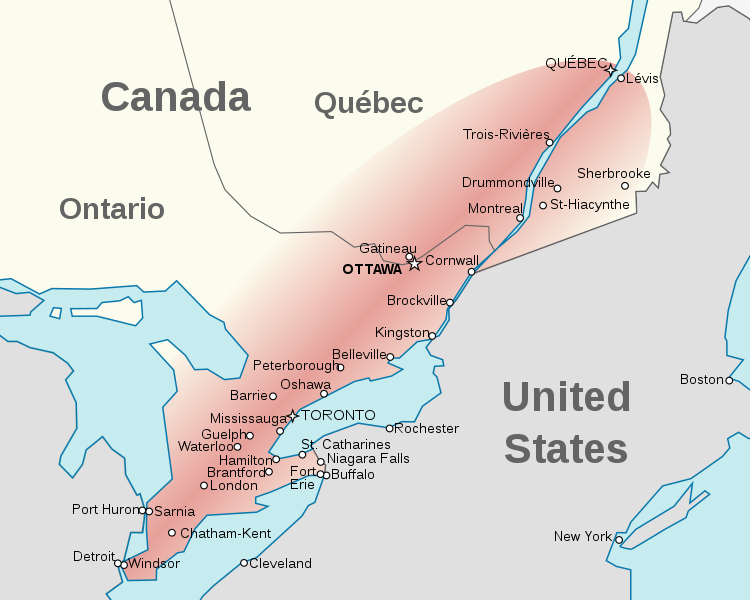
So the scandal took place among them, or rather the world they created, which is basically a clutch of 150,000 grifters located between Ottawa, Toronto and Quebec City, whose only mission is to divest the government of as much public money as possible. This is particularly true of their defensive line which consists of the arts and journalism. Theirs is a world where no stone is left unsubsidized by taxes on the hidden rich, waitresses at truck stops in Kamloops and anyone who dares to make money unapproved by the CBC. They are, as a former editor swore to me, the gatekeepers. That was before her circulation collapsed by 65%., but no doubt she still believes it.

The arts and media in Canada are constructed entirely for the 5%, consumed by those who live the lush subsidized life — or those who want to — whether in government or in semi-independent corporations or businesses who require government help and “seed” money etc. (There are a hundred terms for the grift.)

Books, if you look at their sales, are tragic. There have been a handful of impressive films, despite the literal billions thrown at filmmakers over the past 20 years. Most of them are catastrophically depressing, the books make you want to cut out your heart with a grapefruit spoon. Painters paint, if you subtract all the hectoring from minor artists, from forced inclusion, some of them are very good. We can create good art. But not with our current curators.

The reason that Canada’s arts do not resonate with 95% of Canadians is that they are products of socialist realism. They describe humans and human life as they either believe it to have been (dark and in need of enlightened beings like themselves) or as they feel it must be in the future (filled with people expressing their oppression and being paid for it). It’s basically fantasy, and no one likes it, watches it, reads it.

The rest of Canada is a centre-right country, a gut-it-out-and-build-it-kind of place. I know that is the exact opposite of the propaganda, but Conservatives win a majority of the votes in every election, yet still only amount to 40%. We have five parties, and four of them are leftie — their platforms are all “more money for us” — but the big party, the one that receives about 30% of the vote is so crafty, so embedded in our vast vast bureaucracy that fixing the game is child’s play. Informed by their Frankfurt School gurus, they have been in power 100 years, with brief Conservative interludes.

We take in about half a million immigrants a year, and most of them are from desperate places. Vote harvesting in those neighborhoods is done by leaders in each immigrant community. These men and women are the strongest, most educated and frankly from the ones I’ve met, thuggish, and through them comes all access to government programs, housing and education. Therefore, when they collect your vote, you know for whom your vote is meant. The thing about immigrants though is that they were coming for the old Canada, not the new Commie police state.

But for now? Easy. No one investigates this. Why not? Our media is subsidized. ALL of it.

December 6, 2022

The outcome of the latest Munk Debates

Filed under: Cancon, Media, Politics — Tags: , , , , , , , — Nicholas @ 03:00

Donna Laframboise summarizes what happened last week in the Munk Debates as Matt Taibbi and Douglas Murray spoke in favour of the proposition “Be it resolved, don’t trust mainstream media” while Malcolm Gladwell and Michelle Goldberg argued against:

Last week, an old fashioned public debate took place here in Canada. The topic:

Be it resolved, don’t trust mainstream media.

Journalists Douglas Murray (UK) and Matt Taibbi (US) argued the pro/agree side.

Journalists Malcolm Gladwell (Canada) and Michelle Goldberg (US) argued the con/disagree side.

The event was sponsored by Munk Debates, which has been holding these events since 2008. Before the debate commences, audience members vote. Two hours later, they vote again.

On this occasion, the opinion swing was dramatic. The “don’t trust” side grew by 39% — apparently the largest swing ever in a Munk debate. At the beginning, slightly less than half of the in-house audience held this opinion (48%). Afterward, it was two-thirds (67%).

(When two-thirds of a population agrees on anything, you’re in supermajority territory — a number large enough to change constitutions.)

Here’s the key point: the winning side of the debate placed great emphasis on the scandalous manner in which Canada’s mainstream media covered the Freedom Convoy. Residing as he does in Britain, Douglas Murray had no trouble cutting through the nonsense. In the 3-minute video clip at the top of this post, he says our Prime Minister started by calling protesters names, and ended by invoking the Emergencies Act. Here’s what he says next:

    At such a time, what would the mainstream media do? It would question it. It would question it. The Canadian mainstream media did not.

    The Canadian mainstream media acted as an Amen chorus of the Canadian government. I will give you a couple of examples, but ladies and gentlemen I could go on for hours with examples of this. You had a CBC host describing the Freedom Convoy as a quote feral mob

    Why is this so rancid? Utterly, utterly rancid and corrupt. Because in this country, your media, your mainstream media is funded by the government. A totally corrupted system.

November 8, 2022

The inevitable next act of the media subsidy game – “Before long we will be back for more”

Filed under: Business, Cancon, Government, Media, Technology — Tags: , , , , , , — Nicholas @ 05:00

In The Line, Peter Menzies outlines the state of play in the continued efforts of the federal government to pass C-18, a bill that will massively benefit certain media outlets … or convince the “tech giants” to pull out of the Canadian market altogether rather than pay the blackmail:

News Media Canada’s persistent campaigning finally produced its Holy Grail — Bill C-18. All might have been well for Torstar, Postmedia and Le Devoir except that once the flesh was thrown on the bones of the Act, broadcasters that aren’t facing economic peril heard the dinner bell and came running.

The result, according to the Parliamentary Budget Officer, is that Bill C-18 is expected to produce $329 million in annual revenue for Canadian media (for context, that’s less than the Calgary Herald, Edmonton Journal, Edmonton Sun and Calgary Sun were bringing in between them 20 years ago). Of that, $249 million will go to broadcasters, few of whom are on a fiscal ledge and a good many of whom have contributed to the demise of local newspapers. Remarkably, the CBC, already receiving $1 billion in taxpayer funding, will get the most of that cash, followed by CTV (Bell), Rogers, Videotron and others. The newspapers and start ups will have $80 million (a little more than what the Edmonton Journal and Edmonton Sun used to make in combined annual profit) to fight over.

And very few of those previously mentioned startups — run by mostly young and often female innovators — trying to find a sustainable business model for good journalism can expect anything more than a token pay off. No. They will have to go to the little kids table and see what they can find on the children’s menu of subsidies.

It is distressingly obvious that while so many were tricked into believing this was the most progressive Canadian government ever, it is in fact, a slave to the status quo; as staunch a defender of the corporate establishment as the Toronto Club could wish for. With the 21st century and all its opportunities staring it in the face, Justin Trudeau’s government has not only turned its back on innovation, it has put its thumb on the scale in favour of failed business models that long ago ran out of ideas.

Yet there may be a final twist in this tale.

Bill C-18’s particulars are, as Meta/Facebook’s Kevin Chan put it to a Parliamentary committee last week “globally unprecedented”. For all its sins — and for all we know there are a few more skeletons rattling around in its closet — Meta is unlikely to pay up. Sure, it can cover the Canadian shakedown; what it can’t afford though is to pay every other country in the world that makes the same demand. So Meta says it may simply stop serving up news links which, when you think about it, is a better idea in the long run than permanently entrenching its dominant market position

So while the publishers of those blank pages appear to have bullied even the Conservatives into supporting this travesty, they are still left to ponder:

“Imagine if Facebook wasn’t there.”

September 23, 2022

Is This Atlanta Streetcar “The Worst Transit Project of All Time”?

Filed under: Economics, Government, Railways, USA — Tags: , , , , , — Nicholas @ 04:00

ReasonTV
Published 22 Sep 2022

Transit ridership, especially rail, has collapsed post-pandemic, but the Atlanta BeltLine Coalition says now is the time to take federal dollars and build a $2.5 billion streetcar.

Full text and links: https://reason.com/video/2022/09/22/i…


Twenty-three years ago, Atlanta-native and architecture and urban planning student Ryan Gravel had an experience that opened his mind to what urban living could be.

“My senior year I spent abroad in Paris and lived without a car for a year and traveled by train everywhere,” says Gravel. “And within a month of arriving, I had lost 15 pounds. I was in the best shape of my life because I was walking everywhere, and the role of the physical city was made clear to me in a way it really had never been before.”

For his Georgia Tech master’s thesis, Gravel sketched out a plan to make Atlanta more like Paris. He proposed redeveloping the land along the city’s historic rail lines to create a 22-mile loop called the Atlanta BeltLine. He proposed turning the city’s abandoned industrial areas and single-family home neighborhoods into business districts and walking trails. And he proposed connecting downtown to the rest of the city all with a new train running along the entire Atlanta BeltLine.

“I never imagined we would actually do it,” says Gravel.

But they did — for the most part. Cathy Woolard, who was president of the Atlanta City Council, read Gravel’s thesis and decided to use it as a blueprint to remake much of the city. Today, the Atlanta BeltLine is a walking and biking trail, parts of which are bordered by retail and condos.

But one piece of Gravel’s grand vision didn’t get built: The train.

Today, Gravel runs a co-working and event space along the BeltLine, which also serves as a gathering place for urbanists interested in making Atlanta less dependent on cars. He says that the train line is essential for improving city life.

“In those early days, when we built the movement behind the [BeltLine] project, it was around transit,” says Gravel.

The three COVID relief bills set aside $69 billion in federal funding for local transit agencies to operate and add to their transportation systems, meaning that Atlanta might finally get its train—with many American taxpayers who will never step foot on it picking up much of the tab.

Many American cities have used federal money in the past to build rail transit lines that suffer from dismal ridership, that are expensive to maintain, and that are a major drain on their budgets.
(more…)

August 19, 2022

The DeLorean Story

Filed under: Britain, Business, History, Technology, USA — Tags: , , , , , , , — Nicholas @ 02:00

Big Car
Published 5 Jan 2020

There’s much more to the DeLorean Motor Company than Doc’s 88mph time machine in Back to the Future. It’s a story of a playboy founder with a meteoric rise, a story of hope and regeneration in an area torn apart after a decade of fighting, and of a cocaine smuggling fall from grace. Yes, this story has it all!
(more…)

June 25, 2022

Kenneth Whyte announces the Sutherland House Prize

Filed under: Books, Cancon, Government, History — Tags: , — Nicholas @ 03:00

If the Canada Council for the Arts — the most important prize-awarding organization in Canadian literature — decides to ignore the majority of works of history in their award schemes, what can the Canadian literary community do about it? Sutherland House reacts by creating their own prize for those works deemed no longer prize-worthy by the Canada Council:

Almost from the start of this newsletter in May 2019, we’ve been concerned with the crisis in Canadian nonfiction publishing.

It began with our realization (SHuSH 10 and SHuSH 17) that the Canada Council had decided that books relying primarily on facts as opposed to the author’s voice are not art. Personal history, personal memoir, personal essay meet the Canada Council’s standard for art and are therefore eligible for grants and awards. Objective fact-based journalism, essays, histories, biographies, business and science writing, not so much.

We were bothered by the notion that the distance an author chooses to take from a subject (first person, say, versus third-person) is what makes or breaks a work of art. Same goes for an author’s fidelity, or lack thereof, to verifiable fact.

It also seemed bonkers that a government agency like the Canada Council would bail on researched nonfiction in favor of works in which the subjective experience of the writer is primary at a time when the rest of the government was so panicked over the lack of reliable fact-based information in the public sphere that it was pumping more than $500 million into our failing newspaper chains. If Ottawa was genuinely concerned about the quality of public discourse in Canada and the information available to the electorate, it would be directing the Canada Council to rescind its policy and support fact-based nonfiction to the same levels as fiction, poetry, and personal literature.

SHuSH pursued the issue. We explained why Canada Council funding matters: most publishers in Canada would be out of business or much reduced without their grants, so they naturally produce books that keep them in the money. Researched nonfiction is expensive and time-consuming to produce at the best of times; when it’s relatively disadvantaged by arts funders, it begins to disappear. It’s no accident that the shortlists of all the major nonfiction prizes in Canada have been dominated by memoir in recent years.

(We’ve always been at pains to add that we have nothing against memoir — we publish our share — but it is no substitute for well-researched, fact-based nonfiction. We need investigative journalism, history, biography, politics, current affairs, science & health books if we’re going to understand ourselves and our times.)

June 18, 2022

“Fusion is 30 years away and always will be” … how much progress have we made toward practical fusion energy?

Filed under: Books, History, Science, Technology, USA — Tags: , , , — Nicholas @ 05:00

One of the readers of Scott Alexander’s Astral Codex Ten has contributed a review of The Future of Fusion Energy by Jason Parisi and Justin Ball. This is one of perhaps a dozen or so anonymous reviews that Scott publishes every year with the readers voting for the best review and the names of the contributors withheld until after the voting is finished:

Fusion is the power which lights the stars. It is the source of all elements heavier than hydrogen in the universe. Wouldn’t it be great if we could use and control this power here on Earth?

I predict that we will get fusion before 2035 (80%) or 2040 (90%). I am a professional plasma physicist, a fusioneer if you will, so I probably know more about this subject than you, but am likely to overemphasize its importance.

The Future of Fusion Energy is the best introduction to fusion that I know. I can confirm that the information it contains is common knowledge among plasma physicists. My parents, who are not physicists, can confirm that it is accessible and interesting to read.

Things are changing fast in fusion right now, and The Future of Fusion Energy is already out of date in some important ways. I will summarize our quest for fusion as it is portrayed in the book, describe what has happened in the field since 2018, and make some predictions about where we go from here. The predictions are my own and do not reflect the opinions of Parisi or Ball.


Why Don’t We Have Fusion Already?

There is an old joke:

    Fusion is 30 years away and always will be.

What happened? Why has fusion failed to deliver on its promise in the past?

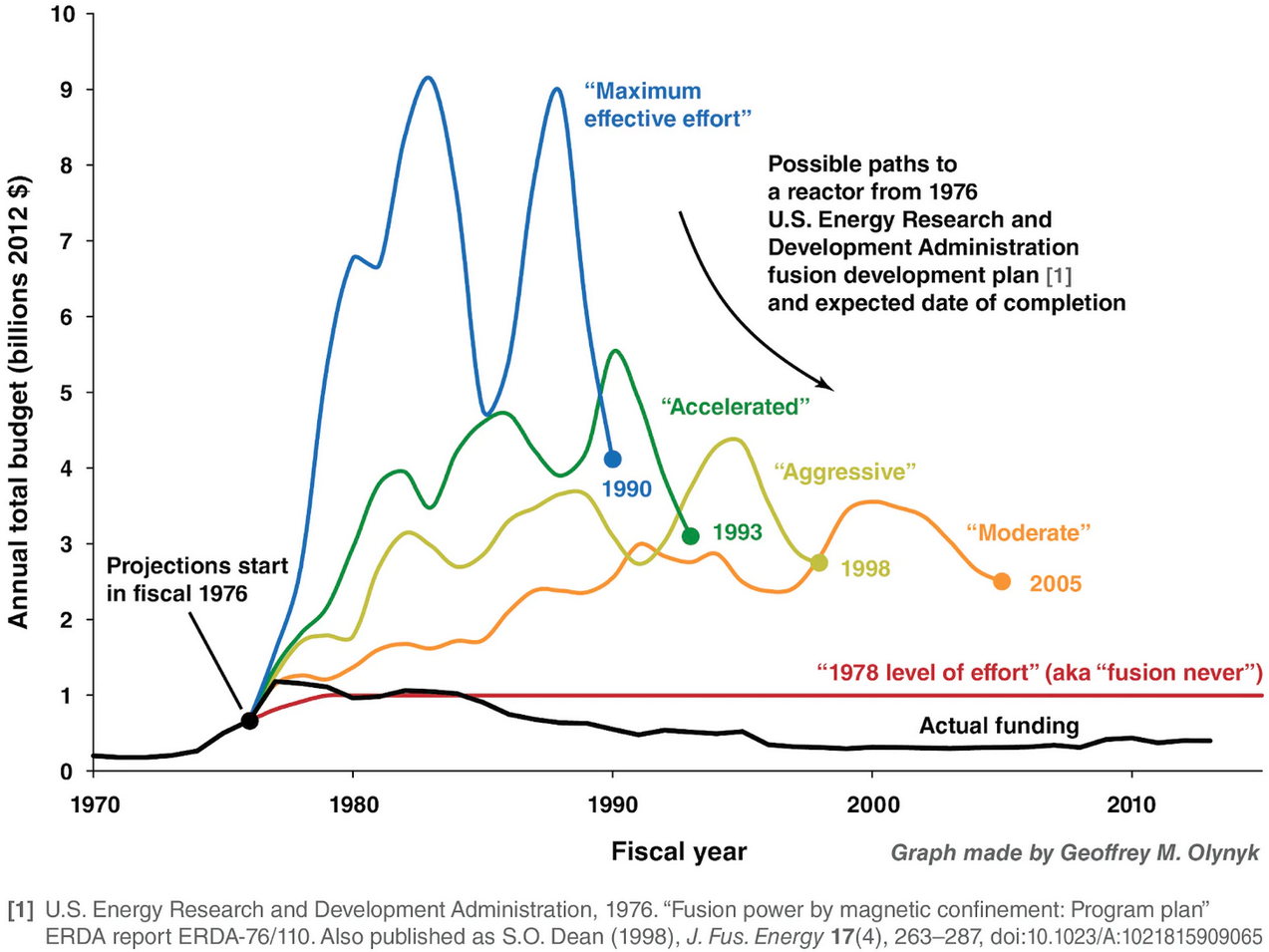
By the 1970s, it was apparent that making fusion power work is possible, but very hard. Fusion would require Big Science with Significant Support. The total cost would be less than the Apollo Program, similar to the International Space Station, and more than the Large Hadron Collider at CERN. The Department of Energy put together a request for funding. They proposed several different plans. Depending on how much funding was available, we could get fusion in 15-30 years.

How did that work out?

Along with the plans for fusion in 15-30 years, there was also a reference: “fusion never”. This plan would maintain America’s plasma physics facilities, but not try to build anything new.

Actual funding for fusion in the US has been less than the “fusion never” plan.

The reason we don’t have fusion already is because we, as a civilization, never decided that it was a priority. Fusion funding is literally peanuts: In 2016, the US spent twice as much on peanut subsidies as on fusion research.

June 4, 2022

Bill C-18 might as well be called the “Keep legacy media alive at all costs, even if nobody wants it anymore” act

The Line‘s Jen Gerson lays out the case against the federal government’s plans for permanent corporate welfare for the big Canadian legacy media organizations:

How Jen Gerson might visualize Torstar and Postmedia during the lobbying effort for Bill C-18.
“Zombie nuns” by Michael Cavén is licensed under CC BY-NC-SA 2.0

This week, The Line signed on to a campaign put together by a coalition of independent media publishers calling for amendments to the panda trash fodder piece of legislation known as C-18. To be fair, I mostly signed on; my co-founder Matt Gurney had some reservations, and I figured it would be best to hash them out in full here.

The bill is a hot mess created by a clearly well-intentioned government that appears to have been bamboozled by a group of media industry lobbyists helmed by organizations like Postmedia and Torstar — companies that despite extraordinary history and resources have largely failed to sustainably transition to a digital media environment. These large outlets are now using the last of their dying power and influence to champion legislation that will force big technology companies like Facebook and Google to compensate them for linking to their content.

This is a straightforward case of regulatory capture, the very thing we would condemn in any other industry; big media companies are using their credibility and political power to pressure the government into forcing “Big Tech” to sustain their dying business models — the very “Big Tech” that they’ve spent years deriding and defaming in their very own newspapers and outlets.

This whole process is corrupt. I don’t say that lightly. Perhaps inevitably, I’ve grown totally disillusioned with the industry to which I have devoted all of my adult life. We used to consider journalism a calling or a vocation — manipulative terms that justified the low pay, harassment, and sometimes abusive management. How can the church of journalism and its holy mandate to preserve democracy continue to take itself seriously when the very catechism of the craft are nowhere present in its own self-created lobbying arm, New Media Canada?

I think the leaders of this initiative have convinced themselves that the business model they enjoyed in the ’80s and ’90s is so totally central to the survival of democracy and liberal values that they’ve committed to keeping it afloat by any means necessary regardless of the ethical and philosophical cost. In doing so, I believe that they’re only ensuring their own failure.

By driving legislation in this way, they are not proving their worth to the broader public. Rather, they are conceding that what they produce has so little value that they need to evolve into parasites of the state. It demonstrates that commitment to democracy and accountability is secondary to their primary functions; running a business. They have stockholders to please and interest on loans to pay. Big loans.

Meanwhile, the legacy media they have managed is little more than a zombie in nun’s drag. It is in a state of terminal decline, and keeping it alive poisons the earth for the generations to come after.

May 18, 2022

For the Canadian government, announcing new programs is far more important than implementing them

Filed under: Cancon, Europe, Government, Media, Politics — Tags: , , , — Nicholas @ 03:00

It often appears that the Liberal government in Ottawa operates almost exclusively on an “appearance only” basis: whatever the situation, it’s the “optics” that matter the most and actual delivery on announcements barely counts at all. It doesn’t help at all that the media generally has the same set of priorities, because they need things to talk about on news shows and the headlines don’t write themselves in the newspapers — and legacy media’s social media concerns are even more about flash and clickbait than their primary product.

Canada has been quick to announce new initiatives to help Ukrainian refugees, but true to form, very slow to actually make any of these initiatives happen, as Joti Heir discusses in The Line:

Justin Trudeau has always had a strong affinity for the symbolic gesture, especially when the media are around to record it.

It’s almost as though the Canadian federal government is working buttocks-backward when it comes to the Ukrainian refugee file. After Russia invaded Ukraine on February 24, helping Ukrainian refugees get to a safe place fast was the biggest concern. However, now, close to three months later, the bigger concern is how to help the refugees that are in Canada or making their way here.

“We are seeing an increasing amount of frustration within our community about the pace with which programs and announcements are being implemented,” says Orest Zakydalsky, senior policy analyst with the Ukrainian Canadian Congress (UCC).

“For example, a month ago, the prime minister announced income support when he co-hosted the [StandWithUkraine] telethon with the European Council president, he announced there would be income support for people coming to Canada. A month later, they’re not available.”

The announcement on April 9 indicated that Ukrainian refugees would be able to access $500 per week for a period of up to six weeks. At the same time, it was also announced that housing support in the form of two-week hotel stays would be provided. Both programs do not appear to have been implemented.

“We appreciate this is a very difficult situation for governments, this is a crisis that emerged very suddenly,” says Zakydalsky.

“On the other side, the other problem is that the people that are in Europe, that have left Ukraine, that are looking to come to Canada, see these announcements and quite reasonably think that when a program is announced it is available.”

April 10, 2022

“Canadian media, ‘independent’ or otherwise, is about as sparkly as dry toast”

Filed under: Bureaucracy, Business, Cancon, Government, Media — Tags: , , , — Nicholas @ 05:00

It’s impossible to disagree with the editors at The Line about the negative impact of government involvement, oversight and subsidization of the media, and the ensuing neutralization (or even Pablumization) of the news presented to Canadians:

“Newspaper Boxes” by Randy Landicho is licensed under CC BY 2.0

There is no way to create such a system without an inherently political process to answer philosophically fraught questions like “what is news?” and “what is a journalist?” And that takes us ever closer to the perilous path of state credentialization of a profession that only operates properly when it is free of both undue government interference and of government assistance. State meddling is bad for journalism whether the intent be good, bad or indifferent.

Every outlet is beholden to the people who cut the cheque, and if your business model relies on impressing government grant gifters or corporate social responsibility committees, then your content is going to reflect the milquetoast sensibilities of your true audience.

Which, bluntly, is why so much Canadian media, “independent” or otherwise, is about as sparkly as dry toast. Whole grain. To rely on government money is not only philosophically untenable, it is almost inherently corrupting. There are public journalism enterprises in Canada, including, for instance, the CBC and TVO, and your Line editors contribute to both. You can trust us when we tell you that the people in charge of those organizations work very, very hard to avoid the impossible conflicts public funding of journalism cannot help but produce. The readers can judge the results, but no one in either outlets pretends it’s easy. It’s not.

And in case it needs to be noted here again, The Line accepts no public cash. Not a dime. We rely entirely on paid subscriptions from our reader base, and we like it that way. Our relationship with you, the reader, is what allows us to be risky, innovative, and occasionally belligerent. You’re here because you like us — you really like us! — and as a result, we serve only you. That doesn’t mean that you’re always going to agree with us, of course, but rather that you can trust us to tell you what we really think.

We looked into the QCJO program and although we believe we would qualify for the program, we are simply too horrified by its mere existence to consider applying. This puts us at a severe competitive disadvantage, and one that can only be overcome by outperforming everyone else.

March 20, 2022

Florida’s new passenger rail service

Thomas Walker-Werth contrasts the different experiences of California and Florida in trying to build new passenger railway services:

“BrightLine – The Return of FEC passenger service” by BBT609 is licensed under CC BY 2.0

When the Federal Government ordered the construction of the Interstate Highway System in the 1950s and 1960s (at a cost to taxpayers of roughly $580 billion in 2022 dollars), it all but killed America’s privately operated passenger railroads. Since then, rail travel in America has mostly consisted of government-subsidized Amtrak services of deteriorating quality that amble across the country, catering to a niche market of leisure travelers and those with no other options. On the busy Northeast Corridor between Boston and Washington D.C. there is still enough demand to operate a busy, profitable service, but elsewhere Amtrak’s services are too slow, inconvenient, and infrequent to effectively compete with highways and airlines.

But with gas prices rising and traffic congestion strangling many American cities, passengers, investors, and government planners are all reconsidering railroads. Several new projects have sprung up across the country, aiming to link major cities a few hundred miles apart, where a train might provide a more convenient journey than a plane, car, or bus. Some of these projects are led by state governments, others by private companies. The contrast between the two is dramatic. To illuminate that difference, compare the government-run California High Speed Rail project with Brightline, a new private rail system in Florida.

Approved in 2008, California High Speed Rail (CHSR) was expected to deliver a 520-mile two-track, electrified high-speed railway on an all-new route between Los Angeles and San Francisco by 2029. Fourteen years later, CHSR is now only expected to have a 171-mile single-track section between Madera and Bakersfield will be operational by 2030. Meanwhile the project’s cost has ballooned to $80 billion from an original budget of $33 billion, and costs are expected to rise further to $100 billion, or triple the original budget.

Meanwhile in Florida, a very different kind of passenger railroad is already up and running. Brightline was launched in 2012 by the Florida East Coast Railway, a private freight railroad. Unlike CHSR, Brightline mostly uses existing routes, removing the need to acquire (or appropriate) large amounts of land. Instead of building the whole line before beginning any passenger services (as CHSR is doing), Brightline began construction on a 70-mile section from Miami to West Palm Beach in 2014 and opened it to passengers in 2018. This meant that Brightline already had an operational, revenue-producing service before embarking on the 170-mile northward extension to Orlando Airport. That extension is expected to open in 2023, and the entire project will cost about $1.75 billion, raised through private financing.

This equates to about $7.3 million per mile for Brightline, compared to $153.8 million per mile for CHSR (using the current $80 billion budget). Why will CHSR cost at least twenty times more per mile than Brightline? How has Brightline managed to deliver a high-speed intercity passenger rail system within ten years whereas CHSR needs twenty-two years to deliver an incomplete, scaled-down version of its original plan? Much of the answer comes down to the fundamental nature of public works projects such as CHSR.

This isn’t quite a fair apples-to-apples comparison between Brightline and CHSR, as Brightline’s services will have to interact with freight trains on conventional rails while CHSR — if ever completed — will be a separate line hosting only CHSR’s own high-speed passenger trains. Brightline’s trains will probably not have the theoretical top speed that CHSR is intended to use, as the physical plant of rail lines intended for mixed-use traffic will limit the speeds due to signalling, traffic density and braking distances of the respective types of trains.

January 16, 2022

Library borrowing versus book store sales

Filed under: Books, Business, Cancon, USA — Tags: , , — Nicholas @ 05:00

I used to be a regular library user, but tapered off substantially after a few unhappy visits to the Toronto Reference Library on Yonge Street in the late ’80s (I’m now fully a believer in some of the wilder tales of disruptive and even criminal behaviour within libraries). I had my doubts about the direction most western library systems chose to concentrate on “popular” books and to get rid of “old” or infrequently borrowed books. It seemed to me that this was an attempt to set up libraries in direct competition with bookstores, and a deliberate act of neglect toward the function of libraries as repositories of valuable but less popular media. In the latest SHuSH newsletter, Kenneth Whyte details a fascinating natural experiment we’ve all be involved in over the last two years that seems to prove that library systems have been, in effect, taking money away from book sellers:

“Toronto Public Library” by Jim of JimOnLight is licensed under CC BY-NC-ND 2.0

Those of you who have been reading SHuSH for a while know that I suspect public libraries are doing harm to the publishing industry and author incomes.

Before the shooting starts, my standard qualifiers: I love libraries; they do a lot of fine work and are crucial civic institutions, running many outstanding programs and providing many necessary services, including the lending of books to children and people who genuinely can’t afford to buy them; I am always in libraries for research and to borrow and read hard-to-find books; I don’t want libraries to go away; I don’t want them harmed; I want their lending practices adjusted before they swallow what’s left of commercial publishing, book retailing, and, along with it, what’s left of author incomes.

By way of background, I’ve written at length in previous newsletters about how public libraries in the last decades of the last century abandoned their traditional role as gatekeepers of the culture, responsible for the moral, intellectual, and aesthetic growth of the public, choosing instead to pander to their patrons. They began pimping the likes of Mickey Spillane and Jacqueline Susann to goose the foot traffic and circulation stats they habitually use to demand of their political masters more funding and better buildings.

Over time, librarians have trained people who can afford to buy books for their own entertainment — the vast majority of library reading is for entertainment — to borrow them instead. Today, three out of four books read in the US and four out of five read in Canada are borrowed, not bought. That is bad for publishing, bookselling, and author incomes.

And then the Winged Hussars Wuhan Coronavirus arrived:

I believe it is self-evident that spending loads of taxpayer money to make the most popular books available at no charge at dozens of points around a city (as well as online) undermines retail sales of books, as it would if the same were done for coffee, running shoes, or Leafs’ tickets.

I have to admit, at the same time, that I’ve lacked hard evidence showing a portion of book borrowing represents lost sales. Nobody has thoroughly researched the question (it certainly isn’t in the interests of libraries to do so). The absence of a smoking gun has made it easy for library defenders to throw up their hands: maybe there’s a relationship, maybe not. People love free shit and will cheerfully strangle good faith to retain access to it.

I’ve tried to devise ways to prove conclusively that libraries are seriously undermining book sales. Maybe some huge experiment where we closed the public libraries in a large jurisdiction and studied what happened to retail book sales. But who was going to organize that? It seemed impossible until COVID-19 stepped up.

Libraries across North America and, indeed, around the world, have been closed, semi-closed, or otherwise limited in their borrowing activities throughout the two-year course of the pandemic. According to Library Journal, total circulation of library materials collapsed by 25.7% in 2020 (notwithstanding a huge spike in e-book borrowing). It looks like physical borrowing fell by roughly half. The 2021 numbers aren’t out yet but individual library reports suggest they will look a lot like 2020.

Meanwhile, over in publishing land, the champagne corks are flying. US book sales, which grew healthily in the first pandemic year 2020, grew again in 2021 and are now 19% ahead of the pre-pandemic year, 2019. All the major publishers have reported smashing sales (attributing the increase to their own genius). All categories are up, including adult fiction (31% over 2019) and adult non-fiction (10% over 2019).

Going by these numbers, it appears that a roughly 25% reduction in library borrowing leads over a two-year period to an increase of 19% in bookselling. I wouldn’t bank on those numbers, or even on the rough proportions, but I think the data demonstrates that when you make books more difficult to borrow for free, people turn more frequently to booksellers.

« Newer PostsOlder Posts »

Powered by WordPress