Quotulatiousness

December 6, 2021

QotD: Modern “Canadian culture” is a vast vanity press operation funded with lots of government money

Filed under: Books, Cancon, Government, Media, Quotations — Tags: , , , , , — Nicholas @ 01:00

From a distance, it is beginning to look as if Canada does not have a specific culture. No one is buying books, no one is watching television, no one is watching or listening to the CBC. People trail through galleries sometimes, and at the top of the investment tree, people buy art. But not because they love it, they buy it because it lends them status.

CanCon is a heavy lift at the best of times, being close neighbors to that hulking great monster south of us which is the most creative culture on earth. That is why we spend billions every year to prop up our creators, our artists, who we love.

Except we don’t.

Film salaries are funded up to 50%, books, 30%, news media 60%, and yet … no one is watching, reading, or listening. It is like a giant vanity project which various foreign appointees can brandish in foreign capitals.

Last month I traced the sales of this year’s Canadian literary award winners and I suppose “best-sellers”. Their sales on Amazon, hardcover, soft cover and digital ranged from 4 books to 33 books per month, incomes hovering in the three figures. (Amazon accounts for roughly 70% of sales.) This during summer reading months where Canadians are at their lake shacks from coast to coast reading one would hope about themselves, the world they live in, and well … just curiosity.

Equally looking at the viewer and listener stats for the CBC, our national behemoth, which eats up $1.5 billion annually, and which amounts to 50% of the media dollars spent, is equally disheartening. The state spends another $600 million supporting once-successful media because “internet”.

CBC television is watched by 3.9% of Canadians and only .8% watch CBC News. Again, half of all media dollars, half. Half is spent engaging less than 4% of Canadians.

CBC radio is considered reasonably good, and is listened to despite the almost vindictive calling out of anyone who disagrees with their hard socialist stance. Despite every conceivable advantage, advertising on the CBC dropped 20% during the pandemic.

In fact, they are so disliked that CBC is hiring “close protection security” for the next two years. They are so disliked, they have turned off commenting on their various programs. They are so disliked that there is a brand of coffee called “Defund the CBC”. This isn’t passive ignoring, this is active dislike to the point of needing bodyguards.

Why?

Because our media show us Canadians as racist, stupid, sexist, stupid, stupid and more stupid. And while they are at it, shallow and violent.

That is the real reason, and the only reason CanCon is dying. They hate us.

Elizabeth Nickson, “Canadian Culture on the Ropes”, Elizabeth Nickson, 2021-09-01.

October 21, 2021

If Quebec is the model for universal childcare services, then voters will be waiting a long, long time for that promise to be fulfilled

Filed under: Business, Cancon, Government — Tags: , , , , — Nicholas @ 03:00

In The Line, Andrea Mrozek talks about the promises (mostly still unfulfilled) of Quebec’s “universal” childcare service model:

Since last month’s election, many have been asking which promises the Liberals made will prove the most difficult to keep. Put child care at the top of the list: The federal government’s five-year, $30 billion Canada-wide child-care plan is rife with complicating factors. When government officials point to Quebec as the model for the rest of Canada, what that means is a system plagued by lack of access, inequality and poor quality.

When Quebec introduced its low-user fee “universal” system in 1997, the goal was to create a centre-based, publicly-funded system for all children. Fees started at $5 a day, briefly shifting to a fee structure based on income, before settling in at the current daily rate of $8.50.

The rapid reduction in fees in only one part of the child-care sector disrupted the care options parents were using in Quebec. Private providers, who were not to be included in Quebec’s system, “understandably crumbled” after the system began. Unfortunately, the public system never picked up the slack. So the Quebec government then coaxed them back into the business of child-care provision through a system of tax credits.

Consider this: We are told publicly funded child care offered at a fixed low price for parents is the way to go across Canada. Consider further that we are told Quebec is the model for said child-care system. Then consider that between 2003 and 2021, in Quebec, public (“Centres de la petite enfance” or CPE spaces) increased by about 55 per cent, or 35,000 spaces. In the same time period, private, unsubsidized spaces increased by about 4,200 per cent or 68,500 spaces. This growth in private provision is not at all what architects of public child-care provision desire. It has, however, proved unavoidable in Quebec, precisely because provision of public spaces has been so slow. Whether it’s lack of funds, political will or some other combination of factors, Quebec has been unable over two decades to build the system of CPE’s envisioned in the mid 1990s.

None of this is a secret: The Quebec auditor general reported last fall there are “not enough spaces available in subsidized child care to meet the needs of families in Quebec.” There are 98,014 spaces in CPEs but 46,000 on a waiting list for a CPE space, as per the auditor general. Does this sound like a policy success?

Further, the waitlists are now themselves a source of inequity. The same auditor-general report highlights that in Montreal in particular, “the children of low-income families are underrepresented in (CPEs).” Previous studies showed this to be a problem across Quebec. Sociologist Rod Beaujot wrote this in a 2013 paper: “In Quebec, day care is used less by children in vulnerable environments, and the services they use are of lower quality (Giguère and Desrosiers 2011). In contrast, the higher the mother’s education, and the higher the family income, the greater the usage of child-care in the Quebec program (Audet and Gingras 2011.) While the program has provisions for disadvantaged families, it would appear that other provinces are more successful in tailoring programs to families with lower incomes.”

So, it’s another “universal” program that disproportionally benefits the wealthy and well-connected (who tend to be Liberal Party supporters and voters)? Tabarnak! Who could ever have possibly seen this coming? Oh, and the Quebec model the rest of the country is supposedly eager to adopt has literally the worst ratios of adult caregivers to children, and 81% of Quebec parents say “Finding quality child care is a way bigger hassle than it should be for parents today”, which is a higher percentage than it is in any other province.

July 20, 2021

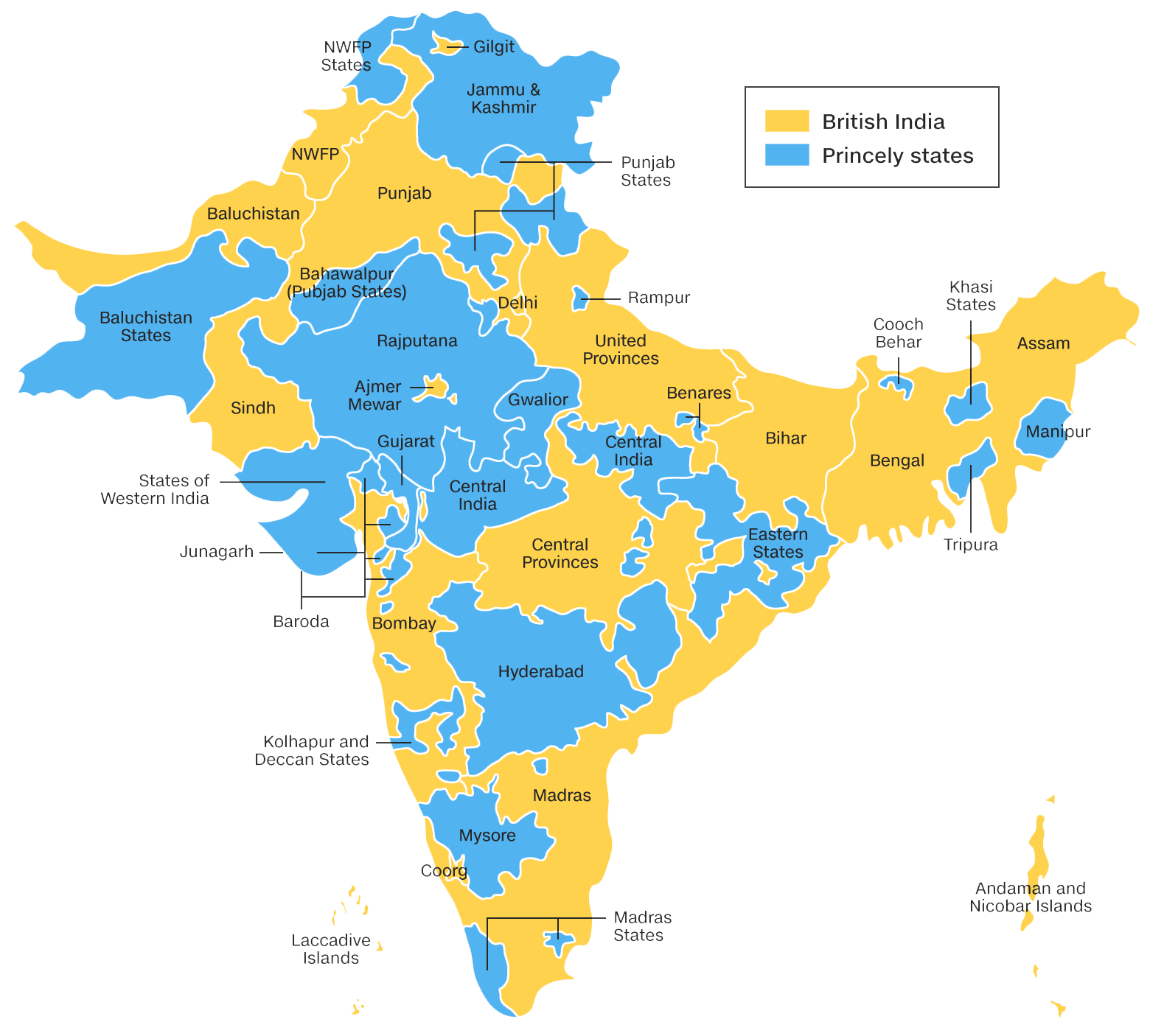
An unlikely survivor in India, His Highness the Prince of Arcot

Filed under: Britain, Government, History, India — Tags: , , , — Nicholas @ 03:00

Ned Donovan explains why there is still a Prince of Arcot, despite the Indian government having abolished all the titles and privileges of the nearly 600 “Maharajas, Maharanas, Rajas, Nawabs, Khans and so on” of the Princely states that were incorporated into modern India after Partition in 1947:

A significant amount of effort was taken during the process of independence to integrate these princely states into the newly independent countries. Almost all of the rulers acceded quickly and peacefully in return for recognition of their symbolic status and titles by the new republics who also promised perpetual large annual payments to sweeten the deal. A handful of princely states were stubborn and were integrated by force, with issues as a result to this day, such as Jammu and Kashmir.

As a result, for the first few decades of independent India, there existed a class of royals recognised within the republic, with privileges and financial support not that different to what they received during the period of British rule. But in 1971 this came tumbling down.

The then-Prime Minister Indira Gandhi amended the Indian Constitution to abolish all privileges and titles, along with any financial subsidies. She believed the whole system to be at odds with the secular socialist republic she was attempting to perfect. The move also had financial benefits: the large princely subsidies stopped being a drain on the Indian treasury while much of the royals’ gold and property were seized by the Government in the process. In 1972, Pakistan followed suit and similarly abolished its remaining princes’ titles.

But the title “Prince of Arcot” somehow escaped to carry on to the modern day … thanks to an unusual historical situation and the presentation of letters patent from Queen Victoria:

In 1855, the 13th Nawab of Arcot died without children. The British, influenced by the East India Company, declared the kingdom had lapsed as a result and annexed it entirely. As a token compensation, Queen Victoria in 1870 gave the last Nawab’s uncle a pension and the title of “His Highness the Prince of Arcot” for him and his descendants in perpetuity. This was granted in a type of royal charter, known as letters patent.

As there was no land still to rule, the Princes of Arcot existed in a strange realm of being kings without a kingdom but with significant influence and prestige. The title continued to pass down through the original holder’s family and they built a large palace, Amir Mahal, in Madras that became a centre of culture instead of one of government.

H/T to Colby Cosh for the link.

December 17, 2020

QotD: Light rail systems are almost always an upper middle class boondoggle

What we can see here is exactly what Randall O’Toole of Cato has been saying for years — that light rail projects tend to actually hurt total transit use as they scavenge resources from other modes, like buses. This is because light rail costs so much more to move a passenger, both in terms of capital investment and operating cost, so $X shifted from buses to rail reduces total system capacity and ridership substantially. We have seen this in Phoenix, as light rail costs have forced closing or reduced services in a number of bus routes, with obvious results in the ridership numbers.

[…]

The problem with light rail (and the reason it is popular with government officials) is that it is an upper middle class boondoggle. There can be no higher use of transit than to provide mobility to poorer people who can’t afford reliable automobiles. Buses fulfill this goal better than any mode of transit. They are flexible and can reach into many corners of the city. The problem with buses, from the perspective of government officials, is that upper middle class people don’t like to ride on them. They like trains. So the government builds hugely expensive trains for these influential, wealthier voters. Since the trains are so expensive, the government can only build a few routes, so those routes end up being down upper middle class commuting corridors. As the costs mount for the trains, the bus routes that serve the poor and their dispersed commuting destinations are steadily cut.

Warren Meyer, “Phoenix Light Rail Fail, 2019 Update”, Coyote Blog, 2019-11-13.

December 12, 2020

Trains and Oil | California History [ep.8]

Filed under: Business, Economics, Government, History, Politics, Railways, USA — Tags: , , , — Nicholas @ 02:00

The Cynical Historian
Published 4 Jul 2019

After a long hiatus, here is the return of the History of California series. For those who haven’t seen the previous episodes, here’s the playlist: https://www.youtube.com/playlist?list…

Today we’re going over the history of transcontinental railroads, monopolistic practices, and crude oil production in California.
————————————————————
references:
eds. Richard Francaviglia and David Narrett, Essays on the Changing Images of the Southwest (Arlington: University of Texas at Arlington, 1994). https://amzn.to/2JwNiHk

William H. Goetzmann, Army Exploration in the American West, 1803-1863, new ed. (1959; Lincoln: University of Nebraska, 1979). https://amzn.to/2K8tslY

Paul Sabin, Crude Politics: The California Oil Market, 1900-1940 (Berkeley: University of California Press, 2005). https://amzn.to/2W16gtt

Jules Tygiel, The Great Los Angeles Swindle: Oil, Stocks, and Scandal During the Roaring Twenties (Berkeley: University of California Press, 1996). https://amzn.to/2ASH7Z0

Richard White, Railroaded: The Transcontinentals and the Making of Modern America (New York: W.W. Norton, 2011). https://amzn.to/2zkURO3
————————————————————
Support the channel through PATREON:
https://www.patreon.com/CynicalHistorian

LET’S CONNECT:
Discord: https://discord.gg/Ukthk4U
Twitter: https://twitter.com/Cynical_History
————————————————————
Wiki: The history of the Southern Pacific stretches from 1865 to 1998. For the main page, see Southern Pacific Transportation Company; for the former holding company, see Southern Pacific Rail Corporation. The Southern Pacific was represented by three railroads. The original company was called Southern Pacific Railroad, the second was called Southern Pacific Company and the third was called Southern Pacific Transportation Company. The third Southern Pacific railroad, the Southern Pacific Transportation Company, is now operating as the current incarnation of the Union Pacific Railroad.

The story of oil production in California began in the late 19th century. In 1903, California became the leading oil-producing state in the US, and traded the number one position back-and forth with Oklahoma through the year 1930. As of 2012, California was the nation’s third most prolific oil-producing state, behind only Texas and North Dakota. In the past century, California’s oil industry grew to become the state’s number one GDP export and one of the most profitable industries in the region. The history of oil in the state of California, however, dates back much earlier than the 19th century. For thousands of years prior to European settlement in America, Native Americans in the California territory excavated oil seeps. By the mid-19th century, American geologists discovered the vast oil reserves in California and began mass drilling in the Western Territory. While California’s production of excavated oil increased significantly during the early 20th century, the accelerated drilling resulted in an overproduction of the commodity, and the federal government unsuccessfully made several attempts to regulate the oil market.
————————————————————
Hashtags: #history #California #trains #oil

November 18, 2020

Trudeau’s internet policy — cash grab or power grab? Embrace the healing power of “and” (TM Instapundit)

Filed under: Business, Cancon, Government, Media, Technology — Tags: , , , , , , — Nicholas @ 03:00

The Canadian government is taking advantage of the ongoing economic and social disruption of the Wuhan Coronavirus to widen their existing regulation of both broadcasting and internet entertainment. It’s not just a bit of maple-flavoured cultural imperialism, but it’s also a blatant cash grab:

Canadian Heritage Minister Steven Guilbeault, 3 February 2020.
Screencapture from CPAC video.

I see, in the Globe and Mail, that Justin Trudeau and Steven Guilbeault want to further regulate the broadcasting services in Canada. Their goals seem to be, in part, a cash grab ~ online streaming services, like Netflix, are offering Canadians, for a price, what they want, while the CBC offers Canadians, thanks to a $1+ Billion annual subsidy from taxpayers like you and me, what we, pretty clearly, do not want to watch and the Liberals want a share of that money ~ and also an appeal to those who play identity politics.

I think we need to look at the “products” of broadcasting ~ information (news and “public affairs” and documentary programmes) and entertainment, including sports, as “consumable products,” rather like food and, say, soft drinks.

We do allow, even demand that governments exercise some important regulatory functions in regard to food and soft drinks: we want to make sure that they are safe to consume and Canadians want to know what is in the food we consume.

The Canadian Radio-television and Telecommunications Commission (CRTC) was, originally, conceived to solve a fairly simple problem: allocating broadcast licences. Government engineers calculated how many radio channels could be used in any given place but they didn’t want to have to decide who should get to use them. Politicians didn’t want to do it, either, because while the successful applicant was (usually) happy the more numerous unsuccessful ones were disappointed and politicians hate to disappoint people. Thus they created an arms length agency to make the tough decisions for them. Licence allocation is still an important job for the CRTC. But the CRTC’s mandate was expanded with the birth of cable TV. Companies, like Rogers, built cable systems ~ and they received both direct and indirect government support to reach more and more Canadians ~ and then “sold” access to consumers. In the normal course of events one might have thought that the government would attach some business conditions to its loans, grants and tax deductions, but there was an ever-growing demand, from the Canadian cultural community ~ based almost entirely in Montreal and Toronto ~ to regulate the fledgling cable and “pay TV” market to ensure that Canadian programmes were not shut out but, in fact, could have privileged positions in the cable lineup, which led to the government, in the 1960s, telling the CRTC to regulate how companies like Famous Players, Maclean Hunter and Rogers configured the private product they sold to individual consumers.

The initial government argument was “we regulate all kinds of things for the common good: that’s why we all drive on the right, for example, and the delivery of broadcasting by cable is like that.” “No it’s not,” the cable operators replied, “you build and maintain the roads, using taxpayers’ dollars, so you’re allowed to regulate how they’re used, plus it’s a safety issue. Cable service and ‘pay TV’ are private, commercial transactions between us, the companies who built and operate the systems, and the individual consumer who wants to subscribe to what we offer. You don’t presume to regulate, beyond the laws against libel and pornography, what people can read in MacLean’s magazine or the Globe and Mail, why is ‘pay TV’ and cable different?” It’s still a good question. But the cable operators surrendered gracefully and the CRTC has been, broadly, for the last half-century, protective of the rights of incumbents in the infotainment markets. In return the cable and internet operators have agreed to “tiers” of programming which means that if you want to watch, say, BBC World Service or Deutsche Welle or Fox News, you must also pay for CBC News Network and CTV News Channel and, no matter who you are and what your individual preferences might be, when you subscribe to a cable/internet service you must also support a number of French stations/channels; it’s the law. And now Minister Guilbault wants to ensure that you pay for the output of indigenous producers, writers, actors and so on, on both indigenous networks ~ to which you must already subscribe if you have a “basic” Canadian cable or satellite TV package ~ and, it appears to me, in programmes produced by Canadians and even by Netflix.

October 29, 2020

How to fix the CBC

Filed under: Business, Cancon, Government, Media — Tags: , , , — Nicholas @ 03:00

… aside from cutting off the massive subsidies from the federal government, which would be my preferred solution if “nuke it from orbit” isn’t a viable choice. Let it sink or swim as a purely private media entity — I’d be betting on the “sink”, personally because they don’t currently have to compete thanks to their funding from the feds and are not noted for their quick adaptation skills. However, Peter Menzies isn’t quite as anti-CBC as I am:

In a recent piece here at The Line, I lamented the current status of the CBC. That’s easy enough to do, but it’s fair to ask what can actually be done to fix it. These ideas don’t provide all the answers but, implemented with conviction and speed, here’s where to start. Because there are some things that can be done, and relatively quickly, to revitalize the institution: the CBC may well be hell-bent on its own destructive dualism but clarifying its role and purifying its soul are still possible by getting it out of the advertising business and turning it into a proper public media.

Right now, the CBC is neither fish nor fowl. Sometimes, as with radio, it is a popular public broadcaster. At others, with its television channels, it fancies itself a commercial broadcaster, albeit a publicly-funded and relatively unpopular one. It plows both of those personalities into its commercial online operations and supplements them with reportage of the kind traditionally associated with newspapers. Like a creature of mythology, it shape-shifts through all of these roles as best suits its needs and moods.

On top of that, its OMG obsession with Trump’s America has drawn it far away from its content mandate to ensure Canadians learn about each other wherever they live in this vast and beautiful country. While its performance indicates otherwise, CBC’s purpose is not to secure a large audience share in the GTA or, in French, in Montreal, in order to earn more revenue. Nor is CBC News Network’s mandate to compete with CNN. The Corp’s raison d’etre, as defined in legislation, is to tell Canadians each other’s stories — even if the GTA and Montreal don’t care.

The only way to purify the CBC then, is to ban it — once and for all — from collecting advertising revenue from domestic consumption of its product. As its radio operations are already advertising-free this means no more ads on its TV or websites. Done. Finished.

October 22, 2020

Carbon taxes may be the most efficient way to address GHG emissions, but no government has implemented them properly

I was persuaded by the economic arguments in favour of a carbon tax to address the externaly of greenhouse gas emissions, but I’ve long been skeptical that governments would actually implement them in a way to minimize economic distortion. A report from the Fraser Institute this week shows I was right to be doubtful, as none of the 31 OECD countries in the study have managed to introduce some form of carbon pricing without political “tinkering” … rather than replacing inefficient regulations, taxes and mandates with the carbon tax, they’ve generally just added carbon pricing on top of existing rules, making the carbon pricing scheme merely another tax grab that fails to achieve the stated goals:

Most economists consider human-made greenhouse gas (GHG) emissions an unintended negative externality of production and consumption. A negative externality occurs when the effects of producing or consuming goods and services impose costs on a third party which are not reflected in the prices charged for said goods and services. In the context of GHG emissions, this negative externality is calculated using the “social cost of carbon,” which is the future damage to society (adjusted to present value) of one additional tonne of carbon emitted to the atmosphere today.

Governments have a wide variety of policy alternatives to address the negative externality of emissions depending on the degree and depth of the policy intervention. They can either mandate individuals and firms to change their behaviour through com­mand-and-control regulations, grant subsidies and tax credits to foster cleaner energy sources, or use market-based mechanisms to correct the misalignment of incentives. It is widely acknowledged that carbon pricing, one of these market tools, is the most cost-effective policy to reduce emissions, as it relies on price signals and trade to provide flex­ibility to economic agents as to where and how emissions mitigation occurs.

[…]

This report includes thirty-one high-income OECD countries, where each country has either implemented a carbon tax, an ETS [emissions trading system], or a combination of both pricing mechan­isms. Carbon taxes are being implemented in 14 of them whereas 25 of these countries have their emissions covered by an ETS. Our analysis finds that, on average, 74 percent of carbon tax revenues in high-income OECD countries go directly into their general budget with no earmarking for any specific expenditure, while 12 percent are ring-fenced for environmental spending, and only 14 percent for revenue-recycling measures. This means that most governments are using carbon taxes as a revenue-raising tool rather than a mechanism to internalize the negative externalities of emissions in a cost-effective man­ner. Additionally, the vast majority of ETS revenues are being used to artificially acceler­ate the use of renewable energy sources, infrastructure, and technology.

The study also finds that no high-income OECD country has used carbon pricing to repeal emission-related regulations, but instead have introduced new ones following the adoption of the carbon tax or the ETS. Emissions caps, mandated fuel standards, technology-based standards, and renewable power mandates are just some examples of these regulations that undermine the cost-effectiveness of carbon pricing mechanisms. The majority of high-income OECD countries have a combination of support schemes for renewable energy sources, carbon pricing tools, and command-and-control regulations.

Overall, no high-income OECD country is following the textbook model of an optimal carbon pricing system, undermining their theoretical efficiency by design and implementation.

QotD: The needs of creative people

Filed under: Economics, Humour, Media, Quotations — Tags: , — Nicholas @ 01:00

… I can’t help feeling there’s a message here about supply and demand, dreary things like that. Something to bear in mind when, say, leaving school or choosing your degree course. The glamour of the artistic and literary life is, I fear, beginning to look quite thin:

    The question of where to live on such a low income while trying to write becomes crucial: in the middle of nowhere with cheap rent, or in the city where day jobs help pay for housing? Compromise clouds every decision.

And this simply will not do. You see, creative people, that’s people like Ms Delaney, must live in locales befitting their importance, not their budget. You, taxpayer, come hither. And bring your wallet.

    The city of Sydney recently tried to address the problem of artists being priced out by introducing six rent-subsidised studio spaces in Darlinghurst. Those chosen get a year-lease and pay reduced rent of $250 a week on a one-bedroom with work studio.

Creative people, being so creative, deserve nothing less than special treatment. I mean, you can’t expect a creative person to write at any old desk in any old room in any old part of town. What’s needed is a lifestyle at some other sucker’s expense. And so that garret has to be in a fashionable suburb or somewhere happening, where the creative vibrations are at their strongest and genius will surely follow. And that pad of choice has to come before the publishing deal and film rights and the swimming pool full of cash. Indeed, it has to materialise before the book itself, or any part thereof. How else can their brilliance flourish, as it most surely will, what with all that creativity. Our betters just need a little cake before they eat those damn vegetables. And possibly ice cream. Here’s some money that other, less glamorous people had to actually earn. You fabulous creature, you.

David Thompson, “The Humble Among Us”, David Thompson, 2014-01-21.

October 7, 2020

Canada’s new documentary monoculture – many now “skew the truth by reinforcing the viewpoint du jour

Filed under: Bureaucracy, Cancon, Media, Politics — Tags: , , , — Nicholas @ 03:00

In The Line, Christina Clark explains why she’s no longer in the business of making documentaries in Canada:

Many of the stories now told through documentary skew the truth by reinforcing the viewpoint du jour. Interviews and scenes that break with the chosen narrative, that offer something other than a black-and-white approach to society and the complexities of humanity, happen off camera or end up on the editing room floor. This is all in an effort to promote diverse voices and the political opinions that allegedly support them. But when we lay claim to a singular viewpoint or dismiss a perspective because the creator’s or the subject’s skin tone or gender does not fit the narrative of inclusion, we are actually removing diversity from the storytelling equation. And what we’re left with are one-sided storylines that reinforce an echo chamber of virtue signalling.

I can no longer deny the dysfunctional approach to telling half-truths and undermining alternate viewpoints in my industry in the name of securing public funding for programming that fails to resonate with the public that is paying for it. Over the last year, I’ve been turning down contracts and finding an exit strategy. I’m pre-emptively cancelling myself.

Documentary was once considered Canada’s national art form. Part of our country’s success with the medium can be attributed to the creation of our National Film Board (NFB), established to “make and distribute films designed to help Canadians in all parts of Canada to understand the ways of living and the problems of Canadians in other parts.” The NFB was founded to provide public funding to storytellers to show us who we are, as a country, as citizens.

To secure public funding for a documentary film or program in Canada, producers typically need to have a broadcaster already signed on to the project. Then, they can apply to funds like the Canada Media Fund, Telefilm or Rogers. Without a broadcaster licence, you cannot apply for public funding. The criteria for licencing a film or television series has narrowed in recent years — not unlike the audiences these programs are targeting.

Take, for example, the Creative Relief Fund that the CBC put together during the early months of COVID to award $2 million in development and production funding for new projects, ranging from fiction and non-fiction television to documentary shorts to plays and podcasts. This was an enticing invitation for creators in lockdown. During this time, friends and colleagues of mine in the industry were messaging each other back and forth, offering feedback on each other’s ideas, as we were all intending to apply. These are some questions we all wondered aloud, in the safety of our private chats: “Do you think this story is diverse enough?” “This story might be too white …” “I don’t think the language is woke enough, do you think they’ll see the bigger story here?” That’s because many broadcasters have “Inclusion and Diversity Plans” that you have to fill out for your project, that track the racial and gender makeup of your crew and your interviewees. While it is not explicitly mandatory to accommodate broadcasters’ criteria for diversity, a lot of filmmakers already know before they even pitch an idea that their chances of getting greenlit are greater if they do.

September 20, 2020

The CBC’s latest bit of “mission creep”

Filed under: Business, Cancon, Media — Tags: , , , — Nicholas @ 05:00

At The Line, Jen Gerson wonders what the hell the CBC thinks it’s doing with this move:

Let us take a moment to leverage a little credibility under the CBC’s ass.

What the fuck is the CBC playing at, here? The corporation receives a cool $1 billion in public funding per year and it’s using taxpayer funds to, yet again, horn into the revenue streams of private communications outlets. No one — literally not a single Canadian taxpayer who isn’t already employed by the CBC — wants to throw money at a public broadcaster so that it can: “Help Canada’s strongest brands shape and share inspiring stories across our platforms and across the country.” Vomit.

No one asked for a taxpayer-funded advertising firm, you goddamn loons.

This is yet another classic example of one of the most dysfunctional habits of the MotherCorp: mission creep. A massive and rudderless operation unfettered from the practical limitations of profit-seeking has proven itself unable to restrain its own boneheaded impulses.

We, at The Line, can hear the pitiable defences already: “Oh, but they’re already underfunded. Of course they need to, uh, use their incredible taxpayer-funded competitive advantage to eat into the dwindling revenue streams of failing private media outlets just to survive!”

No. No. No they do not.

When faced with a dysfunctional hydra-headed cultural behemoth that is demonstrably incapable of keeping its mandate in its pants, the first impulse should not be to shovel ever-more taxpayer funds into the ever-widening maw. The CBC could respond to *cough* “inadequate funding” by narrowing its scope and focus to the things that make it most necessary to the Canadian public that it serves — radio, news, documentary, serving regions and topics that the private sector cannot adequately penetrate. Instead it goes off and does weird shit like this, and CBC Comedy, and CBC Music.

CBC. Guys.

You cannot be everything to everyone. You shouldn’t be everything to everyone. Canadians are not well served by a monopolistic government-funded one-stop #content communications shop. Figure out what you do best and stick to it. Focus on supplementing — rather than crushing — private-sector journalism. Maybe even consider ways to support private-sector start ups and independents, especially in local markets. “Revenue generation” is not the place where a public broadcaster should demonstrate self-defeating, industry-following innovation.

June 24, 2020

Trudeau government wants to introduce an Internet “link tax”

Filed under: Business, Cancon, Government, Technology — Tags: , , , — Nicholas @ 03:00

Michael Geist on the Trudeau government’s latest indications of support for a tax grab to benefit certain favoured groups and organizations:

Canadian Heritage Minister Steven Guilbeault, 3 February 2020.
Screencapure from CPAC video.

Last week, Canadian Heritage Minister Steven Guilbeault called into question his own government’s policies on supporting news media, suggesting that those programs should be replaced by copyright rules that would open the door to payments from internet companies such as Google and Facebook. Mr. Guilbeault indicated that a legislative package was being prepared for the fall that would include new powers for Canada’s communications regulator and what are commonly referred to as Netflix taxes and internet linking taxes.

My Globe and Mail op-ed notes the government’s support for new internet taxes should not come as a surprise. There were strong signals that the spring budget – postponed indefinitely due to the current public health crisis – was going to include expanding sales taxes to capture digital sales such as Netflix or Spotify subscriptions.

[…]

It is Mr. Guilbeault’s plans for a link tax that should spark the most concern, however. The government has long promoted its policies designed to support the Canadian media sector, including direct funding for local journalism as well as labour and subscription tax credits. The taxpayer cost runs into the hundreds of millions of dollars, but is justified on the grounds that journalism is an essential service that requires public support.

Yet Mr. Guilbeault now says that government should not be funding media, characterizing the policies as short term measures aimed at mitigating a media emergency. Instead, Mr. Guilbeault supports a controversial copyright reform measure that would establish a news publisher’s right to demand payment for services that link to their content.

This payment – effectively a tax on linking – raises a host of concerns, not the least of which is that the proposal was not recommended by the government’s own copyright review last year. Copyright reform in Canada is always complicated, particularly given that responsibility for it is shared with Innovation, Science and Economic Development Minister Navdeep Bains, but delving into reforms that sparked protests in Europe could be politically risky for a minority government.

News organizations already benefit from large platforms linking to their content since the links generate visitors that increase advertising revenues and paying subscribers. Organizations that do not want the links can easily opt-out of appearing in services such as Google News or Facebook. In fact, after Google shut down its Google News service in Spain, studies found publisher website traffic dropped by 10 per cent.

April 20, 2020

“New York City subways were ‘a major disseminator — if not the principal transmission vehicle — of coronavirus infection'”

Filed under: Government, Health, Politics, Railways, USA — Tags: , , , , , — Nicholas @ 05:00

Randal O’Toole wonders why the lone sacred cow of mass transit is still running, despite its potential role in spreading disease:

MTA NYC Subway 1 trains at 125th St., 14 May, 2018.
Photo by Mtattrain via Wikimedia Commons.

Sit‐​down restaurants and bars have been shut down. Public officials are discouraging or even forbidding people from doing “unnecessary travel,” even if it is to visit a second home where they might be able to socially distance themselves better than in their first, more urban home. All sorts of other rules are being passed, all supposedly for our own good.

So why are urban transit systems still running? A 2018 study found that “mass transportation systems offer an effective way of accelerating the spread of infectious diseases.” A 2011 study found that people who use mass transit were nearly six times more likely to have acute respiratory infections than those who don’t. Not surprisingly, a study published a few days ago found that New York City subways were “a major disseminator — if not the principal transmission vehicle — of coronavirus infection.”

Transit agencies say they are helping “essential workers” go about their business. But if they are so essential, isn’t it important to find them a safe way of getting to work? If we truly cared about people’s safety, then transit services should have shut down at the same time we closed other non‐​essential businesses and asked people to stay at home.

[…]

Unfortunately, the transit lobby has successfully turned government‐​subsidized transit into a sacred cow. Transit is supposedly greener than driving when in fact it’s an energy hog. Transit is supposedly needed to help poor people get to work when in fact the people most likely to commute by transit are those earning more than $75,000 a year.

When the pandemic took away most of transit’s customers, instead of shutting down, which would have been the responsible thing to do, transit agencies demanded that Congress give them $25 billion, tripling federal support to transit this year. Thanks to transit’s sacred cow status, Congress agreed without any serious debate.

Effectively, Congress rewarded the agencies for spreading disease. It would have been better to use that money to help transit‐​dependent essential workers buy a car so they could have a safe way of getting to work.

New York City subway system.
Image by Jake Berman (maps.complutense.org) based on information from the MTA, via Wikimedia Commons.

April 13, 2020

James J. Hill, US railroading’s premier “market entrepreneur”

Filed under: Business, Government, History, Railways, USA — Tags: , , , — Nicholas @ 03:00

Dane Stuhlsatz outlines the story of US federal government subsidies and other interventions into the 19th century railroad industry and the one tycoon who avoided the lure:

Postcard photo of the Great Northern Railway’s “Empire Builder” streamliner between Everett and Seattle, Washington, circa 1963.
Great Northern Railway postcard via Wikimedia Commons.

Burton W. Folsom, Jr. outlined this story in his book, The Myth of the Robber Barons, identifying two models of entrepreneurship; the “political entrepreneurism” of lines like the Union Pacific and Central Pacific versus the “market entrepreneurism” of James J. Hill and his Great Northern Railway.

Canadian-born James J. Hill (1838-1916) in 1914.
Photo from Famous Living Americans, edited by Mary Griffin Webb and Edna Lenore Webb via Wikimedia Commons.

As Folsom details, the former chased government largesse, ultimately in exchange for loss of control of their business, while the latter chased profits through prudent business decisions. Hill’s success juxtaposed with UP’s and CP’s failure is due in no small part to his steadfast refusal to accept any federal subsidies. In short, UP’s and CP’s government subsidized incentives were vastly different from Hill’s profit driven incentives, which lead to vastly different outcomes.

Federal subsidies incentivized speed, not efficiency. The subsidies were paid in the form of both land grants and direct payments. For each mile of track laid, the UP and CP would receive 20 acres of land and either $16,000 (for track on flat land), $32,000 (for track on hilly terrain), or $48,000 (on mountainous terrain). This incentive for speed resulted in winding, inefficient, routes built with inferior materials, ultimately culminating in a federal price tag of 44,000,000 acres and $61,000,000 (astronomical sums in the 1860s-70s). Despite all this federal assistance, shortly after the golden spike was driven on May 10, 1869 at Promontory Summit, Utah, the UP and CP were nearly bankrupt and required further assistance to stay afloat.

The lines which were born and brought up on federal aid needed federal aid to continue. This led to the passage of the Thurman Law in 1874 which forced UP to pay 25% of its earnings a year to pay its federal debt.

UP’s profitability decisions were also subject to government approval. Branch lines — smaller lines off the main line into rural communities — which could have helped UP’s bottom line, were often not approved by federal bureaucrats. Additionally, the federal Bureau of Railroad Accounts required constant checking of UP’s books. All these measures stifled the ingenuity that UP so desperately needed to make its line profitable. UP quickly found out that the power to subsidize was the power to destroy.

Hill’s line on the other hand was methodically surveyed and built, on the shortest routes possible, with the least gradient possible, and using the best steel and other materials on the market at the time. Rather than political largess, Hill made his decisions based on profit and loss. But, for all the efficiency that Hill built into his line — he was able to transport across the country faster, cheaper, and with less maintenance costs than could the UP and CP — arguably the most important aspect for the viability of his business was the freedom to conduct business untethered by the strings that accompanied government subsidies.

While Hill was free to build when and where he wanted so long as he reached voluntary agreements with landowners, consumers, and employees, UP was tied up in red tape. As Hill’s line grew evermore profitable and reliable for customers, the UP and CP struggled along on federal aid, until they ultimately went bankrupt in 1893.

For his part, Hill’s line was the only transcontinental railroad to never go bankrupt.

Route map from the Great Northern Railway, circa 1920. Red lines are the GN route; dotted lines are other railroads. Created from the Map Maker at nationalatlas.gov and routes drawn in, using a 1920 map as a reference.
Map by Elkman via Wikimedia Commons.

April 1, 2020

Getting the federal government out of the media business

Filed under: Business, Cancon, Government, Media — Tags: , , , , , , — Nicholas @ 03:00

Far from subsidizing the faltering mainstream media, the Canadian government should follow Ted Campbell’s advice here:

Direct subsidies will make many Canadians suspicious that the media has been bought and paid for and is little better than a government PR agency. Government advertising will bring charges of taxpayers’ money being used to publish propaganda. I wonder if tax breaks might help … maybe, as long as they are available, equally, to The Star and Rebel Media, and the North Renfrew Times, too I suppose. But where does it stop? Is my blog a news source? No, quite clearly not, it is almost 100% opinion, but what about blogs like Vivian Krause’s Fair Questions? It looks a lot more like reporting than what I do. In fact, some of her reporting looks a lot better than what the CBC does, doesn’t it? So where would the bureaucrats who draft the laws and regulations and then implement them draw the lines? Let’s assume that the traditional, mainstream media ~ the Globe and Mail and Global TV and so on ~ get tax breaks, and let’s assume that I don’t qualify. Who else does? Who makes that decision? Is it a politician, someone like the current Heritage Minister Steven Guilbeault? Is it another the so-called “arm’s-length” boards that act as surrogates for the ministers? Or is it a team of bureaucrats? Who do we trust? None of the above?

The better answer, it seems to me, is to do pretty much exactly the opposite of what Daniel Bernhard recommends:

  • First: defund most of the CBC. Make it a national (and international) radio network (actually, two networks: one English and one French). Sell off ALL of the CBC’s TV broadcast licences and ALL of its TV production facilities and many of its major radio production facilities, too. Keep a fair number of local studios, especially in rural and remote regions, and a handful (five or six?) larger regional news centres and two (one English, one French) national and international newsrooms that will provide both voice and text reports ~ over the air and on the internet, free for all Canadians and totally free of copyright so that any news agency can use them;
  • Second, provide no, zero, nada, zilch funding to any news organization. Watch and see how they shake out in this rapidly changing environment. Remove or reduce most foreign ownership restrictions. Encourage “bundling” ~ allow e.g. telecom companies like Bell and Rogers to own and to integrate newspapers and TV stations and radio stations and internet platforms and entertainment sources, too; and
  • Third, get the CRTC out of the business of the internet and cable. There is a legitimate role for an independent regulator to manage scarcity. Over-the-air radio and TV channels are always in limited (and often in short) supply and they need to be allocated (licensed) to individual broadcasters; that’s a useful job for the CRTC. There is no scarcity of capacity on the landlines, cables and even satellite links in Canada. The market does a first-rate job of regulating them; the CRTC does, at best, a third-rate job.

I am certain that there are useful, profitable business models for media out there. The fact that we don’t seem to have one in Canada is, in my opinion, because of the existence of the CBC, which distorts the market too much, and the constant efforts of governments (national, provincial and even local) to try to “support” commercial favourites. The right move is to stand back and remove the heavy hand of bureaucracy and let the media find its own, profitable business model. There is a very limited role for government but Canada does not need a Ministry of Truth.

« Newer PostsOlder Posts »

Powered by WordPress