Modern economics explains to governments how they and their crony capitalist mates can steal from you while pretending they are doing you good. And before we go any farther, here is something you should know before you listen to another word from anyone in government: Government spending never creates a net increase in employment. Government spending only creates jobs in one place at the expense of jobs somewhere else, and does it by giving money to the government’s best friends to run projects no firm, based on profit and loss, would ever undertake. And if the project is loss making, which government projects almost invariably are, it has taken the economy backwards — that is, people in general invariably become less well off than they otherwise would have been had these projects not gone ahead — even if those to whom the government has paid money are better off, which they almost invariably are. Government spending, unless there is a genuine and calculated return above the cost, is a ripoff, and it is you who are being ripped off. They pick your pockets and pretend they are doing you good.
Steven Kates, “Classical economic theory and the American recovery”, Catallaxy Files, 2018-01-15.
April 1, 2020
QotD: Government spending in theory and practice
March 30, 2020
“Hoarders” and “gougers” … when the market delivers unwelcome news
Tom Mullen on the efficient functioning of prices in a free market economy:
Market prices are the foundation of civilization. They are the signal that tells producers how much of any one thing to produce. They tell consumers how much to consume or whether to consume a product at all. The reason retailers don’t normally throw away 80 percent of their stock is because market prices tell them how much to have on hand at any one time to meet current demand.
When they miscalculate and buy a little too much, they still don’t typically waste their stock. They put it on sale and meet the demand at a lower price.
To the extent the market is allowed to set prices, producers generally produce what consumers want to buy in the quantities they want to buy. When all supply is consumed and large amounts of consumers are not left with unmet demand, it is referred to as the market “clearing.”
The government is always and everywhere at war with market prices. Regulations creating barriers to entry limit supply, artificially inflating prices. Price controls, including “anti-price gouging” laws override market prices, creating shortages. Subsidies to producers (farm subsidies, for example), allow producers to limit supply, artificially inflating the price.
But when the market works properly, it often delivers news to consumers and to governments that is unpopular, and governments frequently attempt to “hold back the sea” by introducing market distortions:
All these price adjustments by the market are essential for our well-being. They are the cure for the economic disease caused by the government response to the virus and the previous 12 years of monetary inflation and artificially low interest rates.
What is the government doing in response? It is escalating its usual, conventional war on market prices to a nuclear war. It is punishing suppliers of essential goods for raising prices. It is ramping up monetary inflation to historic levels to keep stock prices artificially high and unprofitable businesses alive to go on producing products for which there is no demand. At a time when market prices are more essential to our survival than ever, the government is doing more to override them than ever.
This is not an academic theory that only works on a graph in a classroom. This plays out before our very eyes in the form of essential goods not available to us at any price.
Why is there no toilet paper available? Ask most people and they will say it is because of “hoarders.” These are people who bought far more than they needed in anticipation of future shortages. The people who arrived at the store after the toilet paper is sold out vilify them. Others might just call them prudent.
The same people who vilify hoarders also vilify “price gougers.” They don’t seem to grasp the obvious cause/effect relationship here. If it weren’t for artificial limits on price, i.e., “anti-price gouging” laws, the price of toilet paper would rise dramatically with the surge in demand and the so-called hoarders would not be able to buy nearly as much. That would leave far more for everyone else. The toilet paper market would find the optimal price level where the greatest number of people could get what they need.
The Ontario government, of course, is doing everything they can to obstruct the market from operating freely.
February 26, 2020
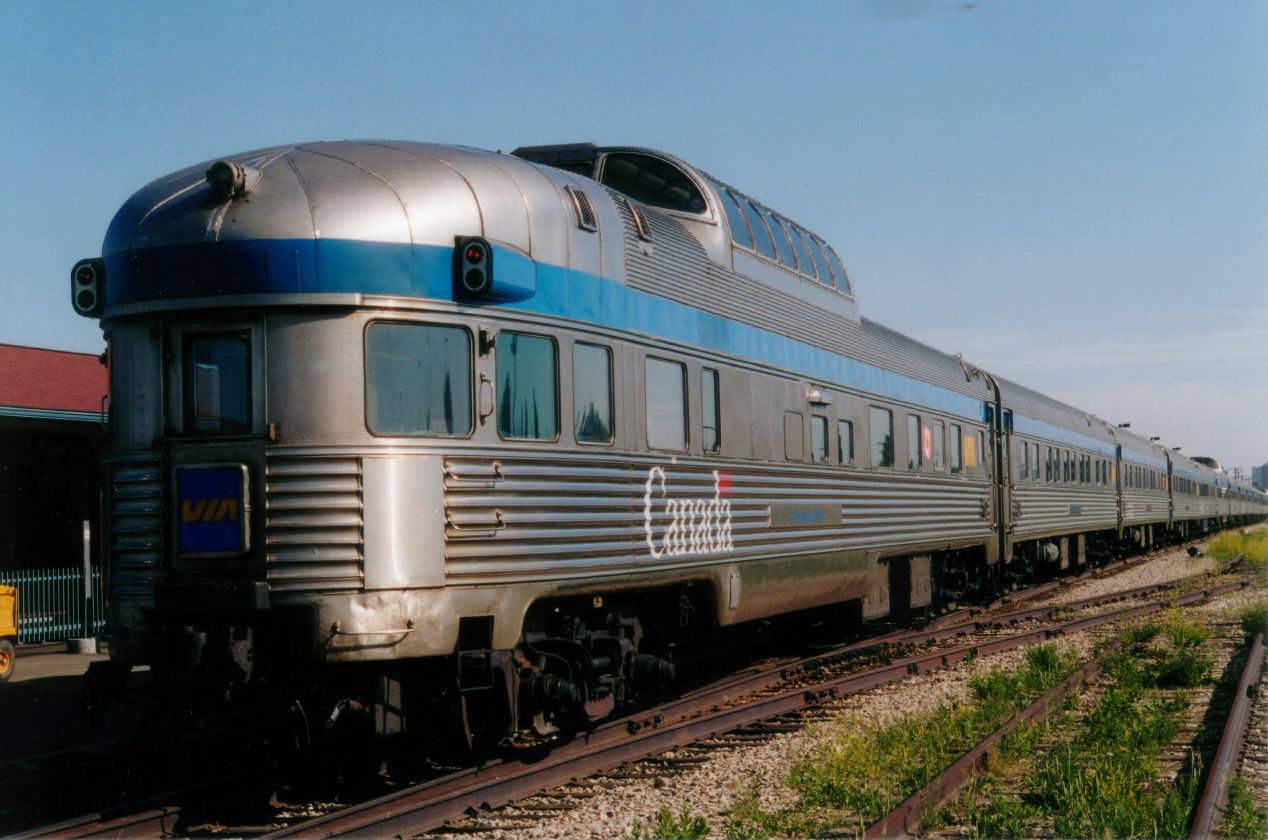
“… the First World’s most dysfunctional train: The Canadian, which in theory links Vancouver to Toronto”
Chris Selley fires all his guns at the pride of VIA Rail Canada’s passenger services, The Canadian:
With the Ontario Provincial Police somehow finally roused to action in Tyendinaga, Ont., it seems the CN railway blockade may not last its third week. This outstanding achievement in law enforcement will come as a relief in particular to the nation’s business community, people who enjoy staple foods, and the propane-dependent. The minority of travellers along the Windsor-to-Quebec City corridor who ride VIA Rail were not as imperilled: most essential, tight-budgeted VIA trips can also be made by bus, with only moderate time lost and with money saved as a consolation. But they too will be pleased. As maddening as VIA’s corridor services can be, with their ancient rolling stock, outrageously stale food, mostly theoretical wi-fi, schedules that get slower rather than faster and reliable delays regardless, trains are just genetically superior to buses.
Or at least, most are. The Windsor-to-Quebec City services are practically Japanese in comparison to what must be the First World’s most dysfunctional train: The Canadian, which in theory links Vancouver to Toronto. It has been shut down almost since the blockade began, and hardly anyone has noticed. It’s time we talk about this crazy thing.
What, you may ask, is the most ridiculous thing about The Canadian? Some might point to the astonishing level of subsidy: In 2018, the average corridor passenger enjoyed a subsidy of $32, or 17 cents per mile. The average passenger on The Canadian: $596, or 48 cents a mile, for a total of $49 million.
But never mind the price for a second; look what it’s buying. Fifty years ago, CN’s Super Continental was scheduled to take 67 hours. Today The Canadian, plying the same route and giving way to every freight train, is budgeted a mind-boggling 85 hours eastbound and 97 westbound.
[…]
For all the subsidies, The Canadian is eye-wateringly expensive. For the full one-way trip, a cabin for two will set you back $3,824, meals included. You can take a five-day mid-range Caribbean cruise for that, and that’s no coincidence: The Canadian is essentially a cruise ship on rails. It’s just that, well, Canadian taxpayers don’t subsidize cruise lines. Because that would be nuts.
I’ve always wanted to ride The Canadian, but I never could afford both the time and the money at the same time. (I have the time now, but I’m struggling to pay my bills, so even a GO Train trip into Toronto needs to be carefully budgeted … a trip on The Canadian would be a very significant percentage of my gross annual income!).
February 10, 2020
QotD: Welfare programs as a form of subsidy to employers
A final line of argument is that these public assistance programs have become de facto subsidies for low-wage employers. For a program to be a subsidy for an employer, it needs to lower wages. Is this plausible for the public assistance programs considered? I think it is for the EITC [Earned Income Tax Credit], but not for other programs. Depending on where one is on the EITC schedule, that policy can increase work incentives. And there is a lot of empirical evidence showing EITC encourages labor force participation. An unintended consequence of that labor supply response, however, is that employers capture some of the tax subsidies. This can happen in a simple supply and demand framework, where an increased labor supply to the market drive wages down. This can also happen in a bargaining context where the size of the bilateral surplus expands from lower taxes, and employers capture some of this increased surplus. Work by UC Berkeley’s Jesse Rothstein suggests that for every $1 of transfer to workers using the EITC, post-tax income rises only by $0.73 because of employer capture.
But what about other programs like food stamps or housing assistance? These means tested public assistance programs are not tied to work, and we should not expect them to lower wages. Let’s take food stamps, which are available to eligible families whether or not a family member works or not. Indeed, when people are not working, they are more likely to be eligible for food stamps since their family incomes will be lower. Therefore, SNAP [Supplemental Nutrition Assistance Program] is likely to raise, and not lower a worker’s reservation wages — the fallback position if she loses her job. This will tend to contract labor supply (or improve a worker’s bargaining position), putting an upward pressure on the wage. Whether or not wages are increased is an empirical matter: there is evidence that the initial roll-out of the food stamps program across counties in the 1970s lowered work hours, consistent with an increase in the reservation wage. The key point is that it is difficult to imagine how food stamps would lower wages. And if they don’t lower wages, they can’t be thought of as subsidies to low wage employers. The same logic applies to other means tested programs like energy or housing assistance. Moreover, these conclusions hold in a wide array of models of the labor market, including ones that emphasize bargaining or efficiency wage concerns.
Arindrajit Dube, “Public Assistance, Private Subsidies and Low Wage Jobs”, Arindrajit Dube, 2015-04-19.
January 18, 2020
Economic interventions during the Roman republic and empire
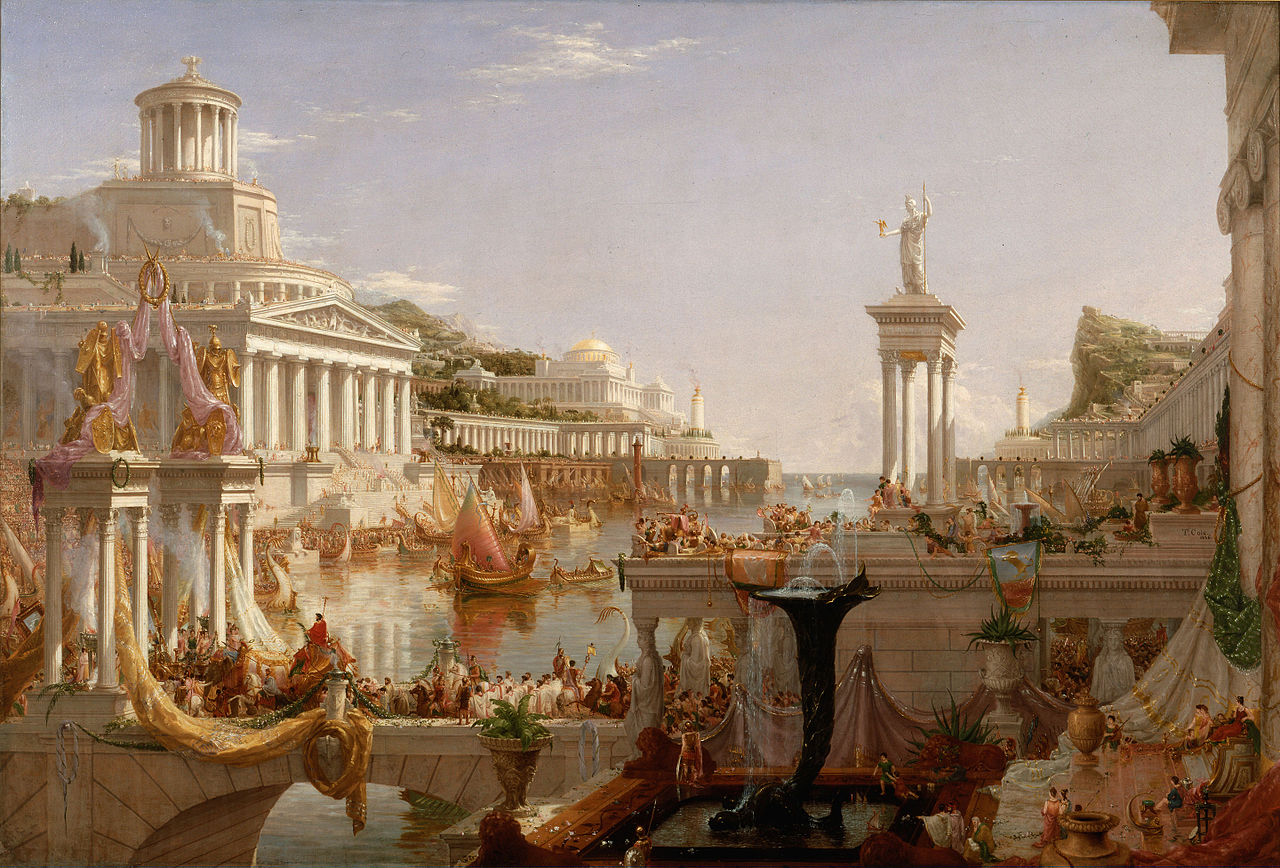
Even during the republican period, state intervention in the economy — usually to “fix” another problem already caused or exacerbated by previous interventions — often made the situation worse. Fortunately there’s a lot of ruin in a nation, but over a long enough run, you do reach the economic end-game:

“The Course of Empire – The Consummation of Empire” by Thomas Cole, one of a series of five paintings created between 1833 and 1836.
Wikimedia Commons.
Debt forgiveness in ancient Rome was a contentious issue that was enacted multiple times. One of the earliest Roman populist reformers, the tribune Licinius Stolo, passed a bill that was essentially a moratorium on debt around 367 BC, a time of economic uncertainty. The legislation enabled debtors to subtract the interest paid from the principal owed if the remainder was paid off within a three-year window. By 352 BC, the financial situation in Rome was still bleak, and the state treasury paid many defaulted private debts owed to the unfortunate lenders. It was assumed that the debtors would eventually repay the state, but if you think they did, then you probably think Greece is a good credit risk today.
In 357 BC, the maximum permissible interest rate on loans was roughly 8 percent. Ten years later, this was considered insufficient, so Roman administrators lowered the cap to 4 percent. By 342, the successive reductions apparently failed to mollify the debtors or satisfactorily ease economic tensions, so interest on loans was abolished altogether. To no one’s surprise, creditors began to refuse to loan money. The law banning interest became completely ignored in time.
The original “dole” was implemented as part of the reforms of the Gracchi brothers, and quickly became a major part of government spending:
Gaius, incidentally, also passed Rome’s first subsidized food program, which provided discounted grain to many citizens. Initially, Romans dedicated to the ideal of self-reliance were shocked at the concept of mandated welfare, but before long, tens of thousands were receiving subsidized food, and not just the needy. Any Roman citizen who stood in the grain lines was entitled to assistance. One rich consul named Piso, who opposed the grain dole, was spotted waiting for the discounted food. He stated that if his wealth was going to be redistributed, then he intended on getting his share of grain.
By the third century AD, the food program had been amended multiple times. Discounted grain was replaced with entirely free grain, and at its peak, a third of Rome took advantage of the program. It became a hereditary privilege, passed down from parent to child. Other foodstuffs, including olive oil, pork, and salt, were regularly incorporated into the dole. The program ballooned until it was the second-largest expenditure in the imperial budget, behind the military. It failed to serve as a temporary safety net; like many government programs, it became perpetual assistance for a permanent constituency who felt entitled to its benefits.
In the imperial government, economic interventions were part and parcel of the role of the emperor:
In 33 AD, half a century after the collapse of the republic, Emperor Tiberius faced a panic in the banking industry. He responded by providing a massive bailout of interest-free loans to bankers in an attempt to stabilize the market. Over 80 years later, Emperor Hadrian unilaterally forgave 225 million denarii in back taxes for many Romans, fostering resentment among others who had painstakingly paid their tax burdens in full.
Emperor Trajan conquered Dacia (modern Romania) early in the second century AD, flooding state coffers with booty. With this treasure trove, he funded a social program, the alimenta, which competed with private banking institutions by providing low-interest loans to landowners while the interest benefited underprivileged children. Trajan’s successors continued this program until the devaluation of the denarius, the Roman currency, rendered the alimenta defunct.
By 301 AD, while Emperor Diocletian was restructuring the government, the military, and the economy, he issued the famous Edict of Maximum Prices. Rome had become a totalitarian state that blamed many of its economic woes on supposed greedy profiteers. The edict defined the maximum prices and wages for goods and services. Failure to obey was punishable by death. Again, to no one’s surprise, many vendors refused to sell their goods at the set prices, and within a few years, Romans were ignoring the edict.
Actually that last sentence rather understates the situation. The Wikipedia entry describes the outcome of the Edict:
The Edict was counterproductive and deepened the existing crisis, jeopardizing the Roman economy even further. Diocletian’s mass minting of coins of low metallic value continued to increase inflation, and the maximum prices in the Edict were apparently too low.
Merchants either stopped producing goods, sold their goods illegally, or used barter. The Edict tended to disrupt trade and commerce, especially among merchants. It is safe to assume that a black market economy evolved out of the edict at least between merchants.
Sometimes entire towns could no longer afford to produce trade goods. Because the Edict also set limits on wages, those who had fixed salaries (especially soldiers) found that their money was increasingly worthless as the artificial prices did not reflect actual costs.
December 28, 2019
American railways are simultaneously world-beating and terrible
That’s because, as Sean Smith and Peter Earle point out, there are two very different entities running on America’s rails:

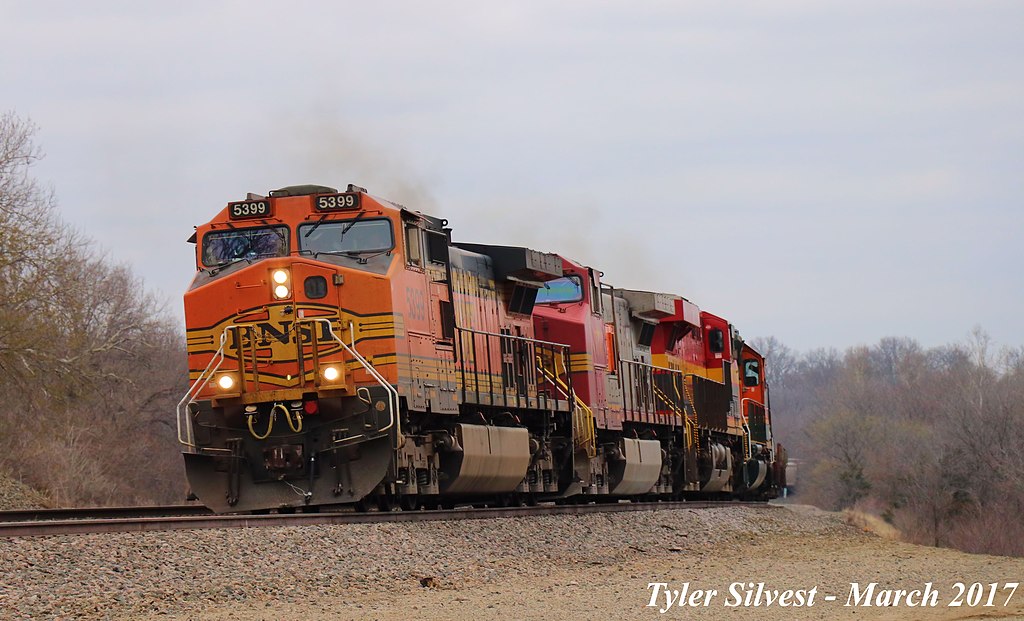
Burlington Northern Santa Fe (BNSF) locomotive 5399, Kansas City Southern (KCS) 4807, and 1890 westbound on the BNSF Emporia Sub near Timberland Blvd West of Northgate Street in Olathe, Kansas.
Photo by Tyler Silvest via Wikimedia Commons.
American railways are the envy of the world.
Many might shake a collective head at that statement. In the case of passenger rail that is an appropriate reaction. Since it was pieced together – a government-constructed Franken-rail system built of numerous bankrupt railways which were essentially nationalized – Amtrak has been a reliable money sink, losing tens of billions of dollars since 1970.
Any traveler that has used Amtrak to any significant extent has firsthand experience with the crumbling infrastructure, frequent delays, and general unpleasantness that accompanies U.S. passenger rail service. Even the oft-cited bright spot of Amtrak, the “high speed” Acela system (which shuttles between Boston and Washington D.C) pales in comparison when compared to high-end passenger rail systems in Western Europe, Japan, and China.
Bullet trains routinely travel at least 200 mph, whereas Acela trundles along at a pedestrian 84 mph, and there is no indication (and probably no intention) of that gap closing anytime soon.
U.S. passenger rail services in general are money-losing and antiquated versus their global counterparts, an inarguable (and to public transport proponents, embarrassing) fact. Passenger rail is just one part of the story, and serves as an excellent example of how not to manage a rail system. In fairness, efforts to turn Amtrak around (mainly through aggressive cost cutting) do seem to be having an impact, as current year losses total a shade under $30 million. It’s an admirable effort to be sure, but decades of losses, poor service, and general mismanagement cannot be ignored.
The U.S. freight railway system, conversely, is the envy of the world, and this is not hyperbole or chest thumping; the facts back it up. Since the Staggers Act of 1980, which deregulated freight rail, improvements have been substantial. U.S. freight railways carry 81% more ton-miles of freight, and costs have fallen 46%. (It isn’t common for an industry to increase its capacity by 81% while reducing costs by nearly half.) That level of success has even been noted by the Community of European Railway and Infrastructure Companies, which might be surprising, given the common assumption that Europe has a monopoly on rail excellence.
Compared side by side, it seems a conundrum: Amtrak limps along, still relying upon billions of dollars worth of taxpayer-financed subsidies, while U.S. freight railways evince growing profitability and capacity amid rapidly falling costs. Why are U.S. freight rails so profitable when U.S. passenger rail – sometimes traveling the same routes, on some of the same rails – remains a perennial money pit?
October 13, 2019
Modern journalism encompasses “activism,” “advocacy,” “partisanship,” “satire,” “hoaxing,” “unbearable self-promotional bluster,” “pranks,” “torquing of facts,” “invective,” “demagoguery” and “stunts”
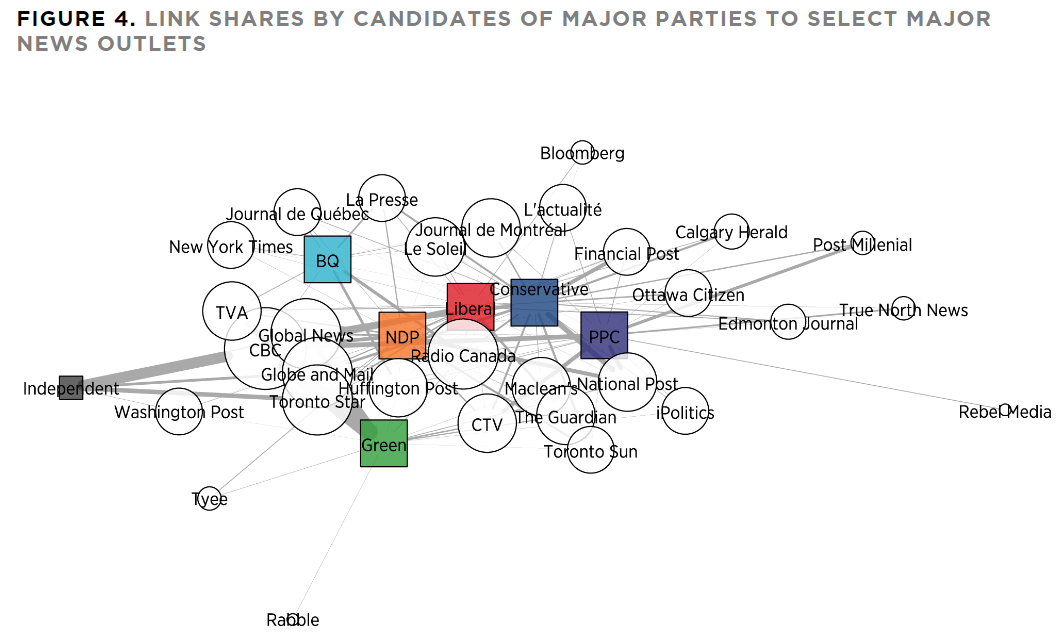
I’ve always been pretty cynical about the media, so it was no surprise to me when the federal government decided to start explicitly subsidising the rest of the media (they already fund the CBC), and part of the fun was deciding who qualifies for those juicy subsidies. I mean, “journalism” today is a pretty broad category that covers a lot more than the traditional TV, radio, magazine, and newspaper formats. I’m sure everyone is shocked — Shocked! — to discover that the government is playing favourites among the many media outlets over not just who gets subsidies, but even who gets accredited to cover political events.

Jack Layton, leader of the federal New Democratic Party of Canada, on January 2, 2006 in a media scrum outside a campaign rally at the Kent Street legion in Ottawa, Canada.
Photo by Thorfinn Stainforth via Wikimedia Commons.
As we’re in the late stages of a federal election campaign, the question of who is considered to be a “journalist” merits closer attention, as Colby Cosh explains:
Two media outlets of a right-wing character, Rebel Media and the True North Centre for Public Policy, have been denied accreditation for post-debate press appearances at the last minute. The Parliamentary Press Gallery, acting on behalf of the federal Leaders’ Debates Commission, has somehow decided that their delegates are advocates rather than journalists. Oh-ho.
Here, an agent of the state seems to have pushed the “So who’s a journalist?” question really to the forefront, and introduced a distinction between journalism and activism that may not be tenable. The history and practice of journalism, even at the highest levels of public and professional esteem, includes entities and activities that fall into all of the following categories: “activism,” “advocacy,” “partisanship,” “satire,” “hoaxing,” “unbearable self-promotional bluster,” “pranks,” “torquing of facts,” “invective,” “demagoguery” and “stunts.”
If we must march toward state licensing of journalism in double-quick time, and this seems to be happening whether I like it or not, arguments about the definition of journalism will have to recognize these realities. But, of course, the word “journalism” as used from day to day is mostly just a status marker (really, a label concocted for academic use). “Journalism” will resist any historically aware attempt to bound it with a list of scientific-type taxonomic criteria.
This, of course, does not rule out an ignorant or fanciful attempt to set criteria. But most of the concepts in the list I made above, a list of things some people would like to exclude from journalism, are themselves ideas founded on fuzzy judgments of value, or of mere taste.
The media outlaws who found the debate gates shut in their faces got together and sought an injunction requiring the commission to allow them to appear in the magic chamber of questions after the debate. No one had really explained the decision to exclude them; no one could point to a solid pre-existing definition of journalism that they did not meet (surprise!), or to a relevant formal policy of the commission. It really gets the attention of a judge when the state behaves in an arbitrary way, and this proved to be the case, foreseeably, at the oral hearing for the injunction. Which was granted.
But an injunction is a temporary emergency remedy that does not require a full hearing of the facts — only the possibility of immediate incorrigible harm. The question haunting the Dominion — the question of who is a journalist — remains athwart our path.
September 17, 2019
QotD: Rent-seeking
[Progressives] should also be delighted by public choice scholars’ development of the theory of privilege-seeking (or “rent-seeking“). It’s an old observation, really: when the state’s personnel have favors to dispense, people in the private sector will invest resources to obtain them. Such favors are by nature impositions on third parties. They may take the form of cash subsidies, taxes and regulations that hamper or quash competition and raise incomes in a non-market manner, and other devices. But the principle is the same: private- and government-sector individuals collude to use the state’s coercive power to obtain what they could not obtain through voluntary exchange for mutual benefit. It’s a theory of exploitation the good-faith left should embrace.
By the same token, the state’s personnel, seeing opportunities to sell favors, are just as likely to initiate the privilege-seeking process. In this sense, public choice scholars are right when they see the political arena as a series of exchanges. The big difference with the marketplace, however, is that in the political arena the largest group of people is forced to participate.
The bottom line on privilege-seeking, which should interest the left, is this: the people with the greatest access to power will not be those the left cares most about, but those who run Boeing and ExxonMobil and GE and Lockheed Martin. Wealth transfers will tend overwhelmingly to be upward.
Sheldon Richman, “TGIF: What the Left Should Like about Public Choice”, The Libertarian Institute, 2017-07-28.
August 16, 2019
The CO2-reduced future the elites want for the rest of us
Arthur Chrenkoff outlines the self-imposed hardship of a new Swedish MEP as he struggles to make his 24-hour weekly commute between Stockholm and Strasbourg (because he’s pretending that there are no flights between those two locations) and explains that it’s emblematic of the kind of future “our” leaders want all of us peasants to be living in the future:

Greta Thunberg at the EU Parliament, 16 April, 2019.
European Parliament photo via Wikimedia Commons.
Listen, I’m all for it; if people want to go back in time as a result of their own free choice that’s wonderful. At least these martyrs for Gaia are putting their money where their mouth is – on train as opposed to plane tickets. They are not being hypocrites, unlike the two hundred celebrities who came on 114 private jets and numerous superyachts to Google’s climate change summit in Sicily the other week. Even St Greta herself, the teenage idiot savant of the green movement, will be eschewing plane travel and going to the UN Climate Action Summit in New York in September on a zero-emission yacht. Want to suffer 24-hour Strasbourg-Stockholm regular commutes or a few weeks at sea between Europe and America so as not to sin again the planet, knock yourself out. My problem starts as soon as the environmental flagellanti decide it’s not enough that simply they care and want to start imposing their totalitarian solutions on everyone else.
[…]
This indeed seems to be the vision of an ecommunist utopia now increasingly on offer from its vocal and influential supporters:
- As Thunberg herself declares in her musical collaboration with the Brit pop band The 1975 released last month (all proceeds to the pests of Extinction Rebellion who have a tendency to glue themselves to busy intersections): it’s “time to rebel” and for “civil disobedience” … “We have to acknowledge that the older generations have failed, all political movements in their current form have failed, but Homo sapiens have not yet failed … Now is not the time for speaking politely. Now is the time to speak clearly.”
- David Runciman, politics professor at Cambridge University: “If electoral democracy is inadequate to the task of addressing climate change, and the task is the most urgent one humanity faces, then other kinds of politics are urgently needed … Channeling more energy into these other forms of democracy — into citizens’ assemblies and civil disobedience, rather than elections and party-building — will change our politics drastically. But it may be the only way to ensure our planet does not change beyond recognition.”
- Greenpeace: “We’re not advocating that everyone adopt a ‘meatless’ diet tomorrow. But we all must develop “meat consciousness” and reduce the level of meat in our diets. Shifting to more plant-based foods is essential to combatting climate change, soil, air and water pollution, ocean dead zones, and myriad other problems caused by industrial livestock production.” Sentiments echoed this week by UN’s Intergovernmental Panel on Climate Change.
- And don’t even mention Alexandria Ocasio-Cortez’s Green New Deal.
This is the future according to eco-warriors: anti-democratic, anti-growth and prosperity, with your options on everything from how (and if) you travel to what you eat restricted by your moral betters.
As my more favourite Scandinavian, Bjorn Lomborg, wrote recently:
This year, the world will spend $US162 billion ($230bn) subsidising renewable energy, propping up inefficient industries and supporting middle-class homeowners to erect solar panels, according to the International Energy Agency. In addition, the Paris Agreement on climate change will cost the world from $US1 trillion to $US2 trillion a year by 2030. Astonishingly, neither of these hugely expensive policies will have any measurable impact on temperatures by the end of the century …
Global warming is a real, man-made problem — but it is just one of many challenges facing humanity. We shouldn’t base our policy decisions on Hollywood movies or on scare scenarios but on the facts. According to the UN Intergovernmental Panel on Climate Change, even if we did absolutely nothing to respond to global warming, the total impact by the 2070s will be the equivalent to a 0.2 per cent to 2 per cent loss in average income. That’s a challenge that requires our attention — but it’s far from the end of the world …
Despite costing a fortune, the Paris Agreement will have virtually no impact on global temperatures. The UN Framework Convention on Climate Change has estimated that even if every country makes every single carbon cut suggested in the Paris treaty to the fullest extent, CO2 emissions would be cut by only 1 per cent of what would be needed to keep temperature rises under 2C. Incurring an annual $US1 trillion cost while failing to rein in temperature rises is a very poor idea.
August 12, 2019
August 2, 2019
Doug Ford’s sudden onset “Winegate” scandal
Ontario premier Doug Ford is now taking flak for promoting an Ontario winery after his party accepted what some Toronto media reports characterized as a “generous” donation from the winery’s owner. How generous? Are we talking millions? Tens of millions? A thousand dollars. Toronto media considers $1,000 to be enough money to sway the provincial government and at least one local media outlet encouraged its readers to boycott the winery. But that turned out to be only the tip of the iceberg from a media investigation point of view: Ford’s ultra-cheesy “Ontario News Now” party propaganda channel had given Ford’s endorsement to at least four other mega-corporations whose political contributions may have gone as eye-wateringly high as $2,000! Torontonians may never have heard of these corporate puppet-masters who clearly now control Premier Ford’s every waking moment, but as Canadians have never seen corruption on this scale before — nearly ten thousand dollars in political contributions!! — they’re demanding all the usual things that media-ginned-up protests tend to demand.

“Pelee Island winery”by John Kannenberg is licensed under CC BY-NC-ND 2.0
At the National Post, Chris Selley wonders why the Ontario Progressive Conservatives are acting just as badly as the Liberals they replaced:
When it comes to Canadian politicians and money, it might be difficult to explain to a foreign visitor exactly what’s kosher and what’s not. Ontario Premier Doug Ford got some bad press this week for having promoted the Pelee Island Winery in one of his impossibly cheesy “Ontario News Now” propaganda videos, just weeks after the winery’s owner, Walter Schmoranz, donated $1,000 to Ford’s Progressive Conservatives. In isolation, it didn’t look great. If it’s a coincidence, as the premier claims, then it’s the sort of coincidence a government wishing to claim moral rectitude should endeavour to avoid.
Viewed in the broad landscape of Canadian politics, however, it all seems rather overblown. Politicians regularly stump for certain products and businesses, after all, implicitly at the expense of others. More to the point they routinely give businesses free money without asking us, and not out of the goodness of their hearts.
According to David Akin’s indispensable @ottawaspends Twitter feed, the federal government doled out $723,000 to wineries and winery associations this year and last. The Nova Scotia Winery Association hoovered up $522,000 of the total, plus another $175,000 back in 2012. Perhaps it would be cynical to observe that the riding of West Nova, home to the Annapolis Valley wineries, is notorious for changing hands between the Liberals and Conservatives. Whoops — too late.
Here in Ontario, meanwhile, between 2013 and 2018, the province and feds collectively gave away at least $1.1 million to wineries and $1.5 million to breweries, plus $140-odd million more to an endless queue of cap-in-hand distillers, mushroom farmers, meat processers, goat dairies, sugarmakers and bakeries. Pelee Island Winery isn’t on that list, incidentally, which might put the premier’s non-financial contribution — quid pro quo or not — in perspective.
All that taxpayer dough got handed out under a program called Growing Forward 2, which was an “initiative that encouraged innovation, competitiveness and market development, adaptability and industry sustainability in Canada’s agri-food and agri products sector.” That’s a fancy way of saying “corporate welfare,” which can be unpopular in Canada when it comes to bailing Bombardier out of its latest fiasco or buying the Weston clan new freezers, but which is entirely uncontroversial when it comes to smaller, less obviously villainous businesses — especially if they happen to be farms.
August 1, 2019
QotD: Small government provides little scope for special interest lobbying
When a government is small, it can provide very limited benefits to special interest groups, so there is a small incentive for special interest groups to lobby the government. The successes of those that do lobby the government will cause the government to grow. This occurs because the great majority of voters and taxpayers are rationally ignorant about most government activity, making it easy to increase everybody’s taxes a small amount to provide a sizable benefit to a few. Most people do not have an incentive to investigate in detail the allocation of their tax dollars, but the special interest groups with the sizable benefit will repay the representatives with political support. Thus, special interest groups cause government growth.
The growth of government, in turn, raises the payoff available to special interest groups. With a higher payoff to special interest groups, this encourages the formation of new special interest groups to share in the payoff. A larger government can support a larger number of special interest groups. Thus, as government grows, more special interest groups form. The formation of special interest groups in turn increases the demand for special interest legislation, cause a further growth in government spending.
Randy Holcombe, An Economic Analysis of Democracy, 1985.
July 28, 2019
With the SNC-Lavalin affair fading from memory, Justin Trudeau looks set for the fall election
They say that memories are short in politics, but this short? Thanks largely to the dog days of summer and a complicit media desperate for more government subsidies, Justin Trudeau and the Liberals are being allowed to shed the scandal-tainted skin of four whole months ago to emerge glistening and new with election promises galore. Democracy dies in government subsidies, apparently.
On the other hand, perhaps Canadian voters’ memories will last long enough to get past the casting of ballots in October:
Supposedly, the Liberals have put the SNC-Lavalin scandal behind them: the polls have rebounded, the media have moved on, while the company has worse problems to deal with than a mere hair-raising multi-million-dollar corruption charge.
Even the return of Gerry Butts, the prime minister’s former principal secretary, albeit in a part-time, temporary, what-are-friends-for capacity as adviser to the party’s election campaign, seems to have caused little stir, although he was one of two senior government officials to resign over their part in the affair.
Perhaps the Liberals have concluded the passage of time is enough to earn them a pass from the public. I mean this all took place, what, four months ago? Who even remembers that far back?
But as recent events have shown, the same ingredients that combined to produce the SNC-Lavalin scandal — hubris, a maniacal desire to run everything from the centre, and an unwillingness, in all this overweeningness and control-freakery, to be bound by basic legal and procedural norms — remain very much in place in the prime minister’s office.
For starters, there is the affair of the two ex-ambassadors. First, David Mulroney, Canada’s ambassador to China from 2009 to 2012, then his successor, Guy Saint-Jacques, reported a senior official in the Global Affairs department had called them to demand they clear any public comments on the government’s policy towards China with the government.
Both men are now private citizens. Both have been critical of the government’s handling of the China file. Unlike the most recent former ambassador, former Liberal cabinet minister John McCallum, neither has framed his comments on Sino-Canadian relations in terms of what would assist in the re-election of the Liberals. Apparently, that was the problem.
The official, assistant deputy minister Paul Thoppil, claimed to be speaking on behalf of the PMO and explicitly cited “the election environment” as a reason to shut up. Oh, also the current state of “high tension” between the two countries, presumably over China’s seizure of two Canadians as hostages, which supposedly made it essential for everyone in Canada, whether in the government’s employ or not, to “speak with one voice,” i.e., refrain from criticizing the government.
As a China policy, this has the advantage of closely resembling the Chinese way of doing things. It’s hard to say which is the more extraordinary: the notion that private citizens should be compelled to clear their criticisms of the government with the government, or the notion that they could be.
April 8, 2019
Comparing the economic performance of China’s private versus state-owned companies
If you’ve been following the blog for a while, you’ll know that I’ve long been skeptical of any official economic statistics coming out of China. The reasons for my skepticism are that vast areas of the Chinese economy were owned or controlled by the state and reporting from those entities was performed through layers of officials whose positions and personal well-being depended on those reports being as positive as possible. In a capitalist system, announcing false production or profit figures will eventually be detected (sometimes not as soon as we’d like), and the company loses the trust of customers, suppliers, and banks, making survival much more difficult. In a state-owned organization, everyone in the hierarchy has a vested interest in false information not being uncovered or reported. In a private firm, you could lose your job … in a state-run enterprise, you could be shot or sent to a “re-education camp” along with all your family. The incentive to lie is much stronger when your risks are that high.
Tim Worstall comments on a recent report that compares the performance over time of Chinese private companies, privatized state companies, and companies that are still state-run:
That China has relaxed the governmental grip upon industry in recent decades is true. That China has become very much richer in recent decades is also true. The two are not a coincidence, there’s causality there. However, we hear often enough that it’s the residual control over industry by the government that drives that success. Sure, OK, so the bureaucracy doesn’t specify prices or detailed actions but the general guidance provided by a politically driven bureaucracy explains the outperformance.
Except it doesn’t. Those former state industries still enjoying that government guidance perform worse than the free market firms sadly lacking it. State planning is keeping China poorer than it need be, not aiding its growth.
The report he’s commenting on:
Changing the tiger’s stripes: Reform of Chinese state-owned enterprises in the penumbra of the state
Ann Harrison, Marshall W. Meyer, Will Wang, Linda Zhao, Minyuan Zhao 07 April 2019The conventional wisdom that privatisation of state-owned enterprises reduces their dependence on the state and yields positive economic benefits has not always been borne out by empirical work. Using a comprehensive dataset from China, this column shows that privatised SOEs continue to benefit from government support in the form of low-interest loans and subsidies relative to private enterprises that have never been state-owned. Although there are clear improvements in performance post-privatisation, privatised SOEs continue to significantly under-perform compared to private firms.
Much of China’s economic growth has been driven by the emergence of a vibrant private sector, today accounting for approximately 60% of GDP and 80% of employment. Conventional wisdom holds that privatisation of state-owned enterprises (SOEs) reduces their dependence on the state and yields positive economic benefits including enhanced firm performance, productivity, and innovation. The pro-privatisation argument is that the state either cannot monitor managers properly or chooses not to pursue efficiency because state interests take precedence over financial results (Boardman and Vining 1989, Vickers and Yarrow 1991, Shleifer and Vishny 1994). Empirical work, however, has produced mixed results on privatisation. For example, DeWenter and Malatesta (2001) found that, among the 500 largest firms globally in 1975, 1985, and 1995, private enterprises had significantly lower costs and higher profits than SOEs. Yet, when they examined a sub-sample of privatised firms, they found inconsistent results – performance increased post-privatisation, while leverage and employment increased mainly pre-privatisation. Market returns from privatisation also differed across countries, positive in Hungary, Poland, and the UK but insignificant elsewhere.
Our research on privatisation in China (Harrison et al. 2019) is unique in several respects. We analyse an extremely large sample of industrial firms, more than 3.5 million firm-years from 1998 to 2013, drawing on the Annual Industrial Survey conducted by the China National Bureau of Statistics. We compare privatised firms with firms that remained state-owned and firms that had never been state-owned. Most importantly, we compare both the performance and dependence on the state of privatised firms with firms having no prior state ownership. Overall, our results indicate selective performance gains from privatisation – privatised firms have greater productivity and are more likely to file patents than firms remaining state-owned even though their return on assets barely improves. The performance effects notwithstanding, privatised firms remain dependent on the state. Subsidies, concessionary interest rates, and loans granted to privatised firms remain at nearly the same levels as those to SOEs. Privatisation changes the behaviour of firms but not firms’ dependence on the state.
A graphical portrayal of the differing performance of the three types of Chinese companies from the report:
February 13, 2019
California mercifully kills the High Speed Train project
In Reason, Scott Shackford reports on the sudden acceptance that California’s high speed train dream is dead:

Construction of the Fresno River Viaduct in January 2016. The bridge was the first permanent structure constructed as part of California High-Speed Rail. The BNSF Railway bridge is visible in the background.
Photo by the California High-Speed Rail Authority via Wikimedia Commons.
California’s wasteful, expensive, and likely doomed-to-fail statewide bullet train project is getting killed. Today, Democratic Gov. Gavin Newsom said he’s abandoning the plan as “too costly.”
Newsom made the announcement in his State of the State address this morning. As the Associated Press reports:
Newsom said Tuesday in his State of the State address it “would cost too much and take too long” to build the line long championed by his predecessor, Jerry Brown. Latest estimates pin the cost at $77 billion and completion in 2033.
Newsom says he wants to continue construction of the high-speed link from Merced to Bakersfield in California’s Central Valley. He says building the line could bring economic transformation to the agricultural region.
And he says abandoning that portion of the project would require the state to return $3.5 billion in federal dollars.
Newsom also is replacing Brown’s head of the board that oversee the project and is pledging to hold the project’s contractors more accountable for cost overruns.
Newsom actually turned against the bullet train project years ago but then went quiet about it when he began his plans to run for governor. He declined to discuss what he saw as the train’s future on the campaign trail, but after he was elected he suggested some sort of cutback was coming, possibly eliminating the bottom half of the project, making it a train from San Francisco to the Central Valley of California.
Now it looks like he’s scaling even that back. Californians are just going to be left with a train in the middle of some of the more rural parts of the state because the Newsom administration doesn’t want to have to repay the federal funding.
Whatever may come next, this is happy news for most California citizens. Voters approved a ballot initiative in 2008 that set aside a $10 billion bond to begin the project of building a high-speed rail line from Los Angeles to San Francisco with the promise that more funding would come through from the feds or from private sources, that the train would not require subsidies to operate, and that it would help fight climate change.