
When a government is small, it can provide very limited benefits to special interest groups, so there is a small incentive for special interest groups to lobby the government. The successes of those that do lobby the government will cause the government to grow. This occurs because the great majority of voters and taxpayers are rationally ignorant about most government activity, making it easy to increase everybody’s taxes a small amount to provide a sizable benefit to a few. Most people do not have an incentive to investigate in detail the allocation of their tax dollars, but the special interest groups with the sizable benefit will repay the representatives with political support. Thus, special interest groups cause government growth.
The growth of government, in turn, raises the payoff available to special interest groups. With a higher payoff to special interest groups, this encourages the formation of new special interest groups to share in the payoff. A larger government can support a larger number of special interest groups. Thus, as government grows, more special interest groups form. The formation of special interest groups in turn increases the demand for special interest legislation, cause a further growth in government spending.
Randy Holcombe, An Economic Analysis of Democracy, 1985.
August 1, 2019
QotD: Small government provides little scope for special interest lobbying
July 28, 2019
With the SNC-Lavalin affair fading from memory, Justin Trudeau looks set for the fall election
They say that memories are short in politics, but this short? Thanks largely to the dog days of summer and a complicit media desperate for more government subsidies, Justin Trudeau and the Liberals are being allowed to shed the scandal-tainted skin of four whole months ago to emerge glistening and new with election promises galore. Democracy dies in government subsidies, apparently.
On the other hand, perhaps Canadian voters’ memories will last long enough to get past the casting of ballots in October:
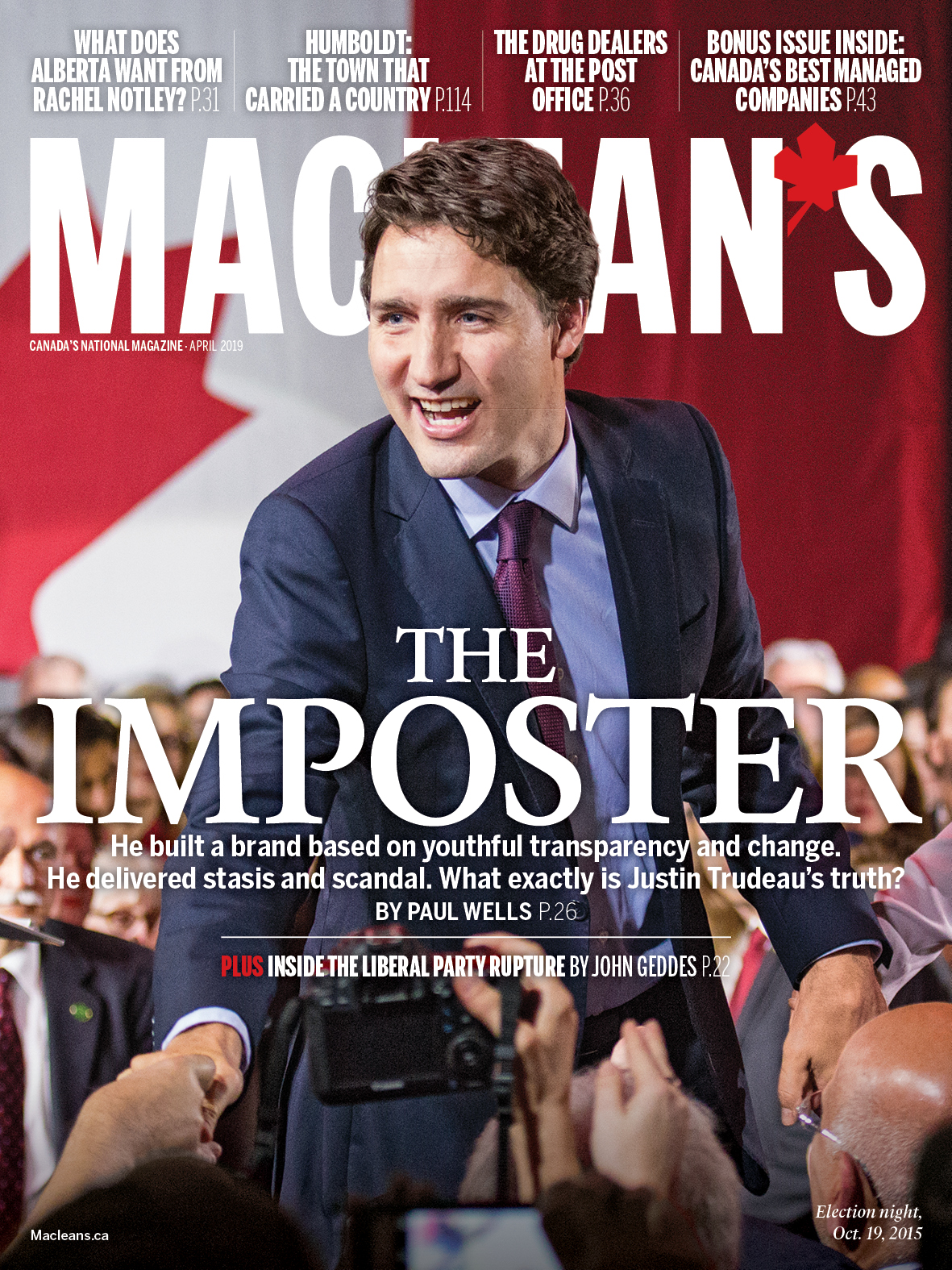
Supposedly, the Liberals have put the SNC-Lavalin scandal behind them: the polls have rebounded, the media have moved on, while the company has worse problems to deal with than a mere hair-raising multi-million-dollar corruption charge.
Even the return of Gerry Butts, the prime minister’s former principal secretary, albeit in a part-time, temporary, what-are-friends-for capacity as adviser to the party’s election campaign, seems to have caused little stir, although he was one of two senior government officials to resign over their part in the affair.
Perhaps the Liberals have concluded the passage of time is enough to earn them a pass from the public. I mean this all took place, what, four months ago? Who even remembers that far back?
But as recent events have shown, the same ingredients that combined to produce the SNC-Lavalin scandal — hubris, a maniacal desire to run everything from the centre, and an unwillingness, in all this overweeningness and control-freakery, to be bound by basic legal and procedural norms — remain very much in place in the prime minister’s office.
For starters, there is the affair of the two ex-ambassadors. First, David Mulroney, Canada’s ambassador to China from 2009 to 2012, then his successor, Guy Saint-Jacques, reported a senior official in the Global Affairs department had called them to demand they clear any public comments on the government’s policy towards China with the government.
Both men are now private citizens. Both have been critical of the government’s handling of the China file. Unlike the most recent former ambassador, former Liberal cabinet minister John McCallum, neither has framed his comments on Sino-Canadian relations in terms of what would assist in the re-election of the Liberals. Apparently, that was the problem.
The official, assistant deputy minister Paul Thoppil, claimed to be speaking on behalf of the PMO and explicitly cited “the election environment” as a reason to shut up. Oh, also the current state of “high tension” between the two countries, presumably over China’s seizure of two Canadians as hostages, which supposedly made it essential for everyone in Canada, whether in the government’s employ or not, to “speak with one voice,” i.e., refrain from criticizing the government.
As a China policy, this has the advantage of closely resembling the Chinese way of doing things. It’s hard to say which is the more extraordinary: the notion that private citizens should be compelled to clear their criticisms of the government with the government, or the notion that they could be.
April 8, 2019
Comparing the economic performance of China’s private versus state-owned companies
If you’ve been following the blog for a while, you’ll know that I’ve long been skeptical of any official economic statistics coming out of China. The reasons for my skepticism are that vast areas of the Chinese economy were owned or controlled by the state and reporting from those entities was performed through layers of officials whose positions and personal well-being depended on those reports being as positive as possible. In a capitalist system, announcing false production or profit figures will eventually be detected (sometimes not as soon as we’d like), and the company loses the trust of customers, suppliers, and banks, making survival much more difficult. In a state-owned organization, everyone in the hierarchy has a vested interest in false information not being uncovered or reported. In a private firm, you could lose your job … in a state-run enterprise, you could be shot or sent to a “re-education camp” along with all your family. The incentive to lie is much stronger when your risks are that high.
Tim Worstall comments on a recent report that compares the performance over time of Chinese private companies, privatized state companies, and companies that are still state-run:
That China has relaxed the governmental grip upon industry in recent decades is true. That China has become very much richer in recent decades is also true. The two are not a coincidence, there’s causality there. However, we hear often enough that it’s the residual control over industry by the government that drives that success. Sure, OK, so the bureaucracy doesn’t specify prices or detailed actions but the general guidance provided by a politically driven bureaucracy explains the outperformance.
Except it doesn’t. Those former state industries still enjoying that government guidance perform worse than the free market firms sadly lacking it. State planning is keeping China poorer than it need be, not aiding its growth.
The report he’s commenting on:
Changing the tiger’s stripes: Reform of Chinese state-owned enterprises in the penumbra of the state
Ann Harrison, Marshall W. Meyer, Will Wang, Linda Zhao, Minyuan Zhao 07 April 2019The conventional wisdom that privatisation of state-owned enterprises reduces their dependence on the state and yields positive economic benefits has not always been borne out by empirical work. Using a comprehensive dataset from China, this column shows that privatised SOEs continue to benefit from government support in the form of low-interest loans and subsidies relative to private enterprises that have never been state-owned. Although there are clear improvements in performance post-privatisation, privatised SOEs continue to significantly under-perform compared to private firms.
Much of China’s economic growth has been driven by the emergence of a vibrant private sector, today accounting for approximately 60% of GDP and 80% of employment. Conventional wisdom holds that privatisation of state-owned enterprises (SOEs) reduces their dependence on the state and yields positive economic benefits including enhanced firm performance, productivity, and innovation. The pro-privatisation argument is that the state either cannot monitor managers properly or chooses not to pursue efficiency because state interests take precedence over financial results (Boardman and Vining 1989, Vickers and Yarrow 1991, Shleifer and Vishny 1994). Empirical work, however, has produced mixed results on privatisation. For example, DeWenter and Malatesta (2001) found that, among the 500 largest firms globally in 1975, 1985, and 1995, private enterprises had significantly lower costs and higher profits than SOEs. Yet, when they examined a sub-sample of privatised firms, they found inconsistent results – performance increased post-privatisation, while leverage and employment increased mainly pre-privatisation. Market returns from privatisation also differed across countries, positive in Hungary, Poland, and the UK but insignificant elsewhere.
Our research on privatisation in China (Harrison et al. 2019) is unique in several respects. We analyse an extremely large sample of industrial firms, more than 3.5 million firm-years from 1998 to 2013, drawing on the Annual Industrial Survey conducted by the China National Bureau of Statistics. We compare privatised firms with firms that remained state-owned and firms that had never been state-owned. Most importantly, we compare both the performance and dependence on the state of privatised firms with firms having no prior state ownership. Overall, our results indicate selective performance gains from privatisation – privatised firms have greater productivity and are more likely to file patents than firms remaining state-owned even though their return on assets barely improves. The performance effects notwithstanding, privatised firms remain dependent on the state. Subsidies, concessionary interest rates, and loans granted to privatised firms remain at nearly the same levels as those to SOEs. Privatisation changes the behaviour of firms but not firms’ dependence on the state.
A graphical portrayal of the differing performance of the three types of Chinese companies from the report:
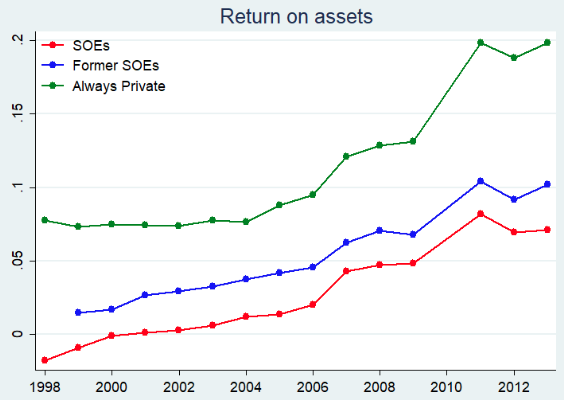
Return on assets of state-owned enterprises, privatised state-owned enterprises, and privately-owned enterprises
February 13, 2019
California mercifully kills the High Speed Train project
In Reason, Scott Shackford reports on the sudden acceptance that California’s high speed train dream is dead:

Construction of the Fresno River Viaduct in January 2016. The bridge was the first permanent structure constructed as part of California High-Speed Rail. The BNSF Railway bridge is visible in the background.
Photo by the California High-Speed Rail Authority via Wikimedia Commons.
California’s wasteful, expensive, and likely doomed-to-fail statewide bullet train project is getting killed. Today, Democratic Gov. Gavin Newsom said he’s abandoning the plan as “too costly.”
Newsom made the announcement in his State of the State address this morning. As the Associated Press reports:
Newsom said Tuesday in his State of the State address it “would cost too much and take too long” to build the line long championed by his predecessor, Jerry Brown. Latest estimates pin the cost at $77 billion and completion in 2033.
Newsom says he wants to continue construction of the high-speed link from Merced to Bakersfield in California’s Central Valley. He says building the line could bring economic transformation to the agricultural region.
And he says abandoning that portion of the project would require the state to return $3.5 billion in federal dollars.
Newsom also is replacing Brown’s head of the board that oversee the project and is pledging to hold the project’s contractors more accountable for cost overruns.
Newsom actually turned against the bullet train project years ago but then went quiet about it when he began his plans to run for governor. He declined to discuss what he saw as the train’s future on the campaign trail, but after he was elected he suggested some sort of cutback was coming, possibly eliminating the bottom half of the project, making it a train from San Francisco to the Central Valley of California.
Now it looks like he’s scaling even that back. Californians are just going to be left with a train in the middle of some of the more rural parts of the state because the Newsom administration doesn’t want to have to repay the federal funding.
Whatever may come next, this is happy news for most California citizens. Voters approved a ballot initiative in 2008 that set aside a $10 billion bond to begin the project of building a high-speed rail line from Los Angeles to San Francisco with the promise that more funding would come through from the feds or from private sources, that the train would not require subsidies to operate, and that it would help fight climate change.
February 3, 2019
The CBC, Netflix, and the questionable role of mandatory “CanCon”
Chris Selley explains why the CBC’s own shows are appearing on Netflix and how this undermines the raison d’être for government-funded CBC television:
To the vast majority of Canadians, including those who support the CBC, the idea that Netflix represents any kind of threat — and should thus be taxed or forced to carry minimum amounts of Canadian content or otherwise regulated, as various groups urge — will just seem irretrievably bizarre. Whether or not it’s a good idea, CanCon only works in a restricted market where channels broadcast specific things at specific times. Back in the day you might just find yourself bored enough to watch or listen to something you didn’t really want to, and it might just be Canadian.
No one watches anything on Netflix that they don’t want to — no one single, anyway — so there’s no earthly reason to put stuff there if people don’t want it. The irony, though, is that there’s a ton of Canadian content on Netflix, precisely because people want to watch it. And as University of Ottawa professor Michael Geist explained in a blog post on Friday, Netflix makes it very easy to find: Not only are there direct links to Canadian TV shows and films, but it algorithmically detects a user’s preference for CanCon and recommends other titles.
Goodness, just look at all the Canuck shows: Baroness Von Sketch Show, Workin’ Moms, Mr. D, Kim’s Convenience, Schitt’s Creek, Intelligence … hang on a tic, those are all CBC shows! How did those imperialist Silicon Valley pigdogs get their filthy hands on it? Because as more and more Canadians cut the cord, Netflix is a perfectly logical place for CBC and the production companies it works with to showcase their work — not just to Canada but to the world. In short, there doesn’t seem to be any problem or threat here at all, to anyone — just success, and the opportunity for more.
We cut the cord about six months ago, and haven’t missed broadcast TV in the slightest (so I hear … I wasn’t watching much TV even before then). I watch Minnesota Vikings games on DAZN and The Grand Tour on Amazon Prime, and that’s just about all my screen time (YouTube and other online video sources more than compensate).
January 10, 2019
What Happened to America’s Passenger Trains?! The Truth – from Class to Crap!
American Rail Club
Published on 1 Jul 2017Did America’s once industrious and world-famous passenger rail system fall because of “fair and equal” competition – or did the federal government tax it to death? Did America’s shift from rails to roads come out naturally – or from lobbying from General Motors? We visit two of America’s passenger rail cars from a bygone era to reminisce and then dive into the history and truth behind the decline of America’s passenger railroad system.
January 5, 2019
We may already have passed the peak of High Speed Railways
Hans Bader looks at the mass transit mess, including a brief glance at the state of high speed passenger rail:

So-called bullet trains generally turn out to be white elephants. South Korea is abolishing its celebrated high-speed rail line from its capital, Seoul, to a nearby major city because it can’t cover even the marginal costs of keeping the trains running. Most people who ride trains don’t need maximum possible speed, and most of those who do will still take the plane to reach distant destinations.
Despite Japan’s much-vaunted bullet trains, most Japanese don’t take the bullet train either; they take buses because the bullet train is too expensive. Bullet trains do interfere with freight lines, so Japanese freight lines carry much less cargo than in the United States, where railroads—rather than trucks—carry most freight, thereby reducing pollution and greenhouse gas emissions.
California’s so-called bullet train is vastly behind schedule and over budget, and will likely never come close to covering its operating costs once it is built. As Reason magazine noted, transportation officials have warned that California’s misnamed “bullet train” is a disaster in the making. California is drastically understating the costs of its high-speed rail project. Just the first leg of this $77 billion project will cost billions more than budgeted. And the project is already at least 11 years behind schedule.
January 2, 2019
In violation of Betteridge’s law of headlines, this question can clearly be answered “yes!”
A few days back, Ted Campbell posted under the title “Is it time to get rid of the CBC? Should we?” Betteridge’s law says the answer should be “no”, but in this case the answer is more like “Why haven’t we sold that thing off already?”:
OK, the source of this cringeworthy video clip, Rebel Media, may be suspect to many ~ I do not follow them ~ but it does bring up a question: is this what we expect for the $1 Billion plus we pay for the CBC?
The complete interview, which I watched. looks, as someone else said, more like an advertisement for one of those online dating sites than news. It certainly caused a small storm about the CBC’s bias … which, in this case, especially when compared to CBC journalists’ question and comments directed to e.g. Andrew Scheer and Maxime Bernier, seems over the top, even by the CBC’s standards. And that begs the question: is the CBC living up to its mandate? The Broadcasting Act says (§3(1)(d)(i), inter alia, that “The Canadian broadcasting system should serve to safeguard, enrich and strengthen the cultural, political, social and economic fabric of Canada.” I suspect that someone will want to make a case that the CBC, as a network, at least in it’s English language ‘news’ services, has crossed a line and looks too much like a 24 hour a day informercial for the Laurentian Consensus as represented by the Liberal Party of Canada.
[…]
What does the CBC do? Basically it provides, in both English and French, three services:
- Radio Canada International ~ this is Canada’s voice to the world, it is, today, entirely on the internet. In 2012 the Harper government imposed a 10% cut on CBC/Radio Canada ~ then CBC/Radio Canada decide that RCI, which is little known, would have its budget cut by 80% from $12+ Million to just over $2 Million. That ended the era of RCI‘s shortwave, world wide service. It was a criminally stupid decision that, in my considered, professional opinion, should have caused the government of the day to summarily dismiss the entire CBC/Radio Canada Board and all of the most senior managers for cause. Every country needs a “voice,” RCI was ours … the gold standard for international broadcasting is found in the BBC World Service and Deutsche Welle, both still provides near global coverage using nearly jam-proof shortwave and satellite radio stations. Both, of course, make extensive and intensive use of the internet;
- CBC Radio ~ CBC Radio has a big, integrated network of stations covering most of Canada. You can see a list of transmitters on their web site. If you live in Arctic Bay, in Nunavut, population 850±, you are served by radio station CKAB-FM which is a community-owned CBC North rebroadcaster that gets its programming from CFFB in Iqaluit; if you live in Prince Rupert, BC, your are served by CBC Radio 1 (a national network which has a mix of local, regonal and national programmes) broadcasting on 860 KHz and if you live in Shilo, MB you are also served by CBC Radio 1 on FM from Brandon, the people in Twillingate, NL are served, again by Radio 1 from Grand Falls which is rebroadcast on 90.7 MHz from a transmitter in Botswood. In short, CBC Radio is doing a first rate job of serving most Canadians, even if you find some of the content banal and biased. I think it is, by and large, money well spent because in many, many, many communities the CBC provides the only news and weather; but
- CBC Television is, in my opinion, a near total waste of taxpayer’s money. As you can see from this list (you have to select the province you want) the CBC has only 14 English language TV broadcast stations which serve about 25 urban ‘markets’ and serves less than 10% of the Canadian market in prime time. (Rex Murphy, in a talk to the Manning Centre, quipped about the low audience levels of the CBC at about the 2’50” mark.) It used to have hundreds of transmitters providing near national coverage but in 2012, when Canada converted to digital TV, it closed all but 14 because only a tiny number (certainly less than 5%, likely less than 2%) of Canadians want to watch CBC and do not have cable or internet access. Electing to not serve Canadians with many, many local TV stations was a smart business decision because, as you can see from this listing, Canadians from Kamloops, through Kenora and on to Halifax and St. John’s are served by other networks.
I think that Radio Canada International should be upgraded; CBC Radio should remain about the same, government funded and commercial free, and CBC TV should be closed, completely and the money saved should be used to directly subsidize TV, film and radio production in Canada based on Canadian content rules: n% for the production company being Canadians and using Canadian studios, x% for using Canadian talent ~ on screen and in in the studio, y% for using Canadian locations and so on.
Some, at least half, I suspect, of the CBC’s 14 television licences will sell, at auction, for a tidy sum, making room for new, innovative, probably ethnic, services in larger cities ~ Vancouver, Calgary, Toronto and Montreal and a couple of others. The CBC”s excellent production facilities will also sell for a good sum to private entrepreneurs who will then host dozens of independent radio and TV programme producers. There’s nothing wrong with Canadian production values and in a more open market I suspect that Canadian drama, public affairs, education and political commentary programmes can survive and even thrive, each on its own merits.

December 20, 2018
Remy: It’s Beginning to Look a Lot Like Christmas (EV Tax Credit Edition)
ReasonTV
Published on 19 Dec 2018Government plays Santa Claus with your tax money.
—–
Subscribe to our YouTube channel: http://youtube.com/reasontv
Follow us on Twitter: https://twitter.com/reason
Subscribe to our podcast at Apple Podcasts: https://goo.gl/az3a7aReason is the planet’s leading source of news, politics, and culture from a libertarian perspective. Go to reason.com for a point of view you won’t get from legacy media and old left-right opinion magazines.
—–Have a Tesla on your Christmas wish list? Don’t thank Santa — thank Tom in Ohio.
Parody written and performed by Remy. Video by Austin Bragg. Music tracks, background vocals, and mastering by Ben Karlstrom
LYRICS:
It’s beginning to look a lot like Christmas
Everywhere you go
Folks with six-figure salaries
Are shopping in galleries
With a gift card paid by Tom in OhioIt’s beginning to look a lot like Christmas
Roadsters all around
And while Tom can’t afford a car
He’ll buy part of one for John
Cuz somehow that’s allowedWell a black Model X and a tax credit check
Is the wish of Connor and Ken
And a dark Model 3 that is partially free
Is the hope of Bobby and Ben
While Tommy takes the bus and eats Vienna sausagesIt’s beginning to look a lot like Christmas
Hear those sleigh bells ring
But what else could you expect
With a tax code so complex?
Ensuring just these things?Yes a car with aplomb that’s, in part, paid by Tom
Is the wish of Victor and Von
A sedan that can drive and takes years to arrive
Is the hope of Lenny and Lon
While Tommy pinches pennies never flushing number oneIt’s beginning to look a lot like Christmas
Soon the credits end
But the funniest sight to see’s
When typical for DC
They’re renewed again
Everything’s renewed again
December 19, 2018
QotD: Maple-flavoured corporate welfare
There’s that word: “investments.” That’s what Canadians — Ontarians and Quebecers, certainly — have been trained to expect in these situations: An elaborate mating dance culminating in a greasy press conference where corporate leaders hail bold new provincial and federal “investments” in the company and its workers and its world-beating widgets. Critics are assailed as uncaring and testily reminded that every jurisdiction subsidizes the widget industry.
Traditionally, this is later followed by outrage when it emerges the company has used taxpayers’ bold investment to pay out lavish bonuses or dividends. In the fullest version of the performance, the company just pulls up stakes and leaves town anyway — sometimes having fulfilled its stated obligations, sometimes not, but always leaving behind a bad taste and a per-employee subsidy rate that makes no sense in hindsight.
If the company is Bombardier, it might extract lavish subsidies from government for an airplane project on the theory the Canada needs an aerospace industry, then turn around and sell the project to a foreign competitor for basically nothing.
Chris Selley, “A reminder that governments don’t ‘invest’ in businesses. It’s just corporate welfare”, National Post, 2018-11-28.
December 5, 2018
The true lesson to be learned from GM Canada’s economic plight
Andrew Coyne tries to encapsulate the key economic concept that should be taken away from the GM Canada collapse:
Think of it this way. Governments have proven more than ready in the past to pay whatever the auto companies demanded to hold onto threatened jobs. If there were any chance whatsoever of buying the plant’s reprieve, no matter how foolishly or expensively, can there be any doubt they would have? That they did not — apparently GM waved them off — tells you how hopeless the plant’s prospects really are.
Many have recalled that the closure of the Oshawa plant comes less than a decade after the Canadian operations of GM and Chrysler were bailed out with $14 billion in federal and provincial money, $4 billion of which was never recovered. The lesson some have drawn from this is that GM is a devious ingrate, which may be fair comment but is not especially helpful. The real lesson is this: when you try to buy jobs with public money, the jobs last only as long as the money does. In the end, all you will have done is to lure people into taking or staying in jobs that were long since doomed.
Like most of economics, this is wholly alien to popular wisdom. There is a rich vein of commentary to the effect that the laws of economics are effectively optional, something we can resist by force of will: we can either bend to “market forces,” or we can “stand up” to them in some fashion. But in fact the latter option is entirely imaginary, at least in the long run. You can perhaps lure plants and jobs your way at the outset with subsidies and other goodies. But the only assurance they will stay is if it makes economic sense to the company to keep them there.
If not, then all you have won with your subsidy is the right to go on providing more subsidy, which is a fairly accurate description of Canadian automobile policy in recent decades. The workers whose jobs successive governments boasted of creating or saving were effectively hostages; as in all hostage-takings, the payment of ransom only stimulates further demands for ransom. Until one day when the money runs out, and the workers whose jobs were supposedly saved find themselves abandoned. This may be many things, but one thing it is not is compassionate.
November 30, 2018
“Infrastructure” is a Canadian word meaning “jobs for the boys”
H/T to Colby Cosh for the link.
November 28, 2018
The bitter economics of North American passenger railways
Earlier this month, I posted an excerpt from The Romance of the Rails, by Randal O’Toole. It’s a book I haven’t yet read, but based on what I’ve heard, his analysis of the state of US and Canadian passenger rail is both savage and accurate — as in, we’re insane to subsidize long-distance or high-speed rail for the wealthy out of the taxes levied on the poor. Recently, Trains columnist Fred Frailey got a chance to chat with O’Toole about his work:

Amtrak Acela passing through Old Saybrook, CT
Photo by Chasesmith via Wikimedia Commons
That was one of the pleasures of reading your book, to discover you are a lover of trains and railroads, and that you marry this with a contrarian way of thinking. Do you take perverse pleasure in that combination? Oh, not at all. To me, it’s really sad. I wish I could support passenger trains, and I do support them as far as riding them and things like that. But I know enough about government subsidies to know that they reduce overall productivity and usually end up taking from the poor and giving to the rich. The people who are riding the Acela are not people in need of government handouts. The people who are riding light rail and things like that are not the poor, by and large.
What is the future of the long-distance trains? The role they fulfill is giving people access to scenery they can’t see in any other way, and really, it ends up being something for the wealthy. I think the Rocky Mountaineer model is the future of long-distance trains, and if you look at the United States, where can we have a Rocky Mountaineer? Certainly, Oakland to Denver, probably Oakland to Los Angeles, and after that, it gets pretty iffy. They would become cruise trains.
You seem almost as uncharitable towards the short-distance passenger trains. Amtrak does its best to deceive people about how well these trains do, for example, counting state subsidies as “passenger revenues,” in order to make itself eligible for more subsidies. I wouldn’t mind short-distance trains if they worked, but the Cascades, the California service, those trains aren’t really doing anything. A lot of money is spent carrying not that many people.
[…]
Statistics of yours that struck me are that public transit paid 90 percent of operating costs in 1964 from fares and just 32 percent today. Why not try to make the rail part of public transit more viable? You don’t address that in your book. You can’t make it more economically viable, simply because buses are so much better in every respect than rails. If you take the rail lines, and pave them over, and turn them into busways, you’ll be able to move more people, faster and cheaper and with far lower maintenance costs. Even if you could make the rails pay for themselves, since the buses are so much cheaper, why would we bother?
You seem most upset at places like Orlando and Dallas and Nashville, where commuter rail or light rail began but so few seem to ride. It this money thrown to the wind? I think so. Why is it that we allowed steam to change to diesel, sailing ships to steam ships — all these different technological evolutions to take place — but when it came to passenger rail, we said, “Halt, we don’t want more technological change.” The answer is threefold. It’s nostalgia. It’s people who are making money from wasting money, such as contactors — crony capitalism. And it’s accidents of history. The accident of history affecting urban rail transit was in 1973. Governor Francis Sargent of Massachusetts asked Congress to let cities substitute capital investments in transit for interstate highway grants. Congress said yes, but you can’t spend that amount of money on new busses. Instead, cities such as Buffalo, Portland, and San Jose built new rail lines with money from cancelled freeways because they are expensive and could use up those federal dollars. That’s what started the light-rail revolution, not because it was cheap, but because it was expensive.
November 27, 2018
Cutting back on ethanol makes financial and environmental sense
Craig Eyermann explains why President Trump’s push to expand the use of ethanol in cars is a bad call for many reasons:
For example, because ethanol packs less energy per gallon than gasoline does, vehicle owners can expect to get even lower fuel mileage from the expansion of E15 fuel (a blend of 15% ethanol with 85% gasoline) under the new mandate to include more ethanol in automotive fuels, which would be 4% to 5% less than they would achieve if they only filled their vehicles with 100% gasoline. Today’s vehicle owners already pay a fuel efficiency penalty of 3% to 4% lower gas mileage from the E10 ethanol-gasoline fuel blend mandated under the older ethanol content rules, where the new rules will require even more fill-ups.
Beyond that, to the extent that it diverts corn from food markets to fuel production, corn-based ethanol production also jacks up the price of food—the corn itself, plus everything that eats corn, like beef cattle. One review of multiple studies found that the U.S. government’s corn-based ethanol mandates added 14% to the cost of agricultural commodity prices from 2005 through 2015.
Last summer, the Environmental Protection Agency also found that burning increasing amounts of ethanol has made America’s air dirtier because it generates more ozone pollution, which contributes to smog formation. Worse, growing the additional corn to make more ethanol has also increased agricultural fertilizer runoff pollution in the nation’s rivers and waterways.
That runoff has been linked to the increased incidence of harmful algal blooms, which have been responsible for contaminating drinking water and contributing to red tide events in coastal regions, where fish and other aquatic organisms have been killed off.
There is a solution to these federal government-generated pollution problems: stop forcing corn-based ethanol to be used in the nation’s fuel supplies. There’s even a case study from Brazil, where the city of Sao Paulo found that its air became cleaner after it switched from ethanol-based fuels to gasoline in the years from 2009 to 2011.


