
Quotulatiousness

June 1, 2019

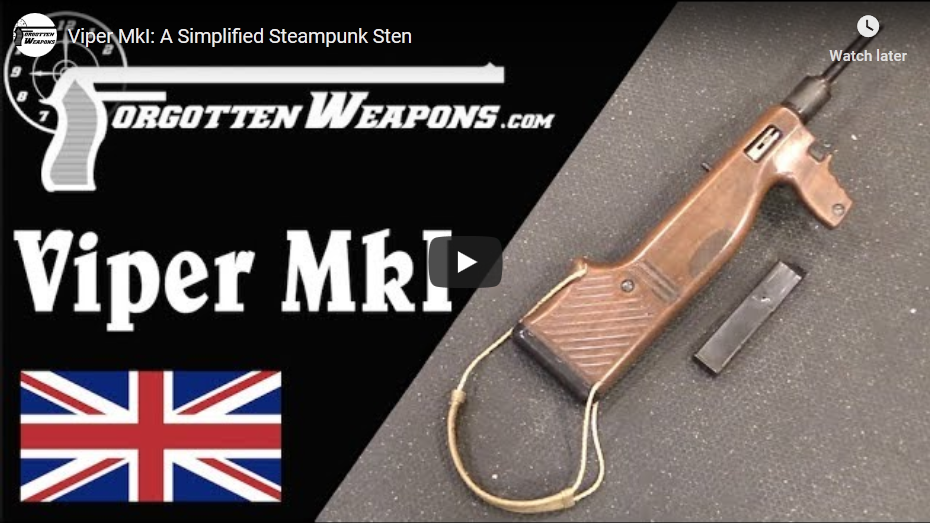
Viper MkI: A Simplified Steampunk Sten

Forgotten Weapons
Published on 26 Apr 2019

http://www.patreon.com/ForgottenWeapons

Cool Forgotten Weapons merch! http://shop.bbtv.com/collections/forg…

The Viper Mk I was an experimental submachine gun developed in the UK for use by military policemen in post-WW2 occupation West Germany. It was a simplified Sten gun (full-auto only, without the semiauto option normally included in the Sten trigger mechanism) put into a wooden housing. It was intended to be carried slung over one shouldered [and] fired under the arm with just one hand. To this end, it had neither sights nor trigger guard. The whole concept seems pretty questionable, and while multiple different Viper submachine guns were designed to fill this role, none were ever adopted.

Many thanks to the Royal Armouries for allowing me to film and disassemble this very rare weapon! The NFC collection there – perhaps the best military small arms collection in Western Europe – is available by appointment to researchers:

https://royalarmouries.org/research/n…

You can browse the various Armouries collections online here:

https://royalarmouries.org/collection/

Contact:
Forgotten Weapons
PO Box 87647
Tucson, AZ 85754
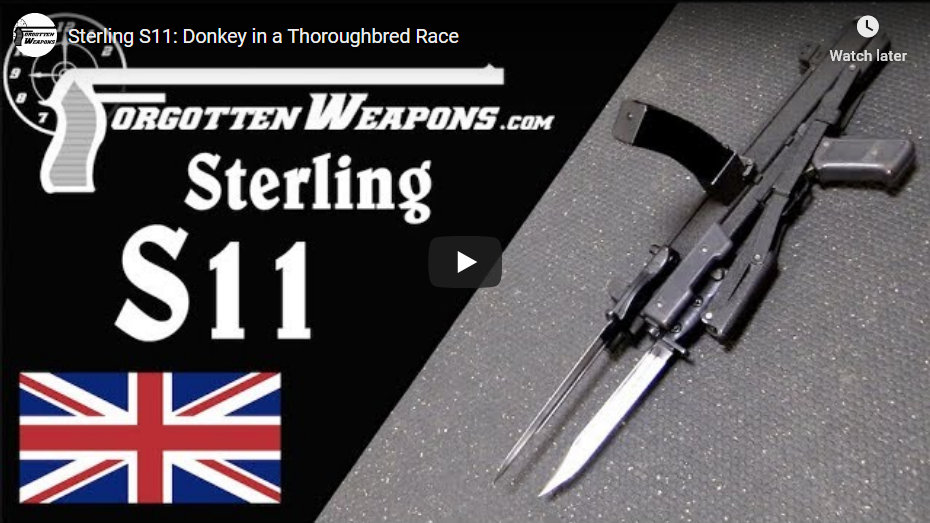
Experimental screen capture for social media thumbnailing purposes:

April 23, 2019

MAC Operational Briefcase

Filed under: History, Technology, USA, Weapons — Tags: , , , — Nicholas @ 04:00

Forgotten Weapons
Published on 21 Apr 2019

This MAC briefcase, gun, and suppressor are lot #1063 at Morphy’s April 2019 auction:

https://www.forgottenweapons.com/mac-…

If a swanky outfit like H&K can make an “Operational Briefcase” with a submachine gun hidden inside it, then you can bet Military Armament Corporation is going to do the same! MAC made these briefcases for both the M10 and M11 submachine guns, and made a shortened suppressor for the M10 pattern guns to fit. They actually have a distinct advantage over the H&K type by fitting a gun with suppressor – but a distinct disadvantage in the exposed trigger bar on the bottom of the case, with no safety device of any kind.

Note: Possession of the briefcase with a semiauto MAC-type pistol that fits it is potentially seen as constructive possession of an AOW. A machine gun can be legally fitted in the case, but a semiauto pistol in it is considered a disguised weapon, and thus requires registration as an AOW.

http://www.patreon.com/ForgottenWeapons

Cool Forgotten Weapons merch! http://shop.bbtv.com/collections/forg…

Contact:
Forgotten Weapons
PO Box 87647
Tucson, AZ 85754
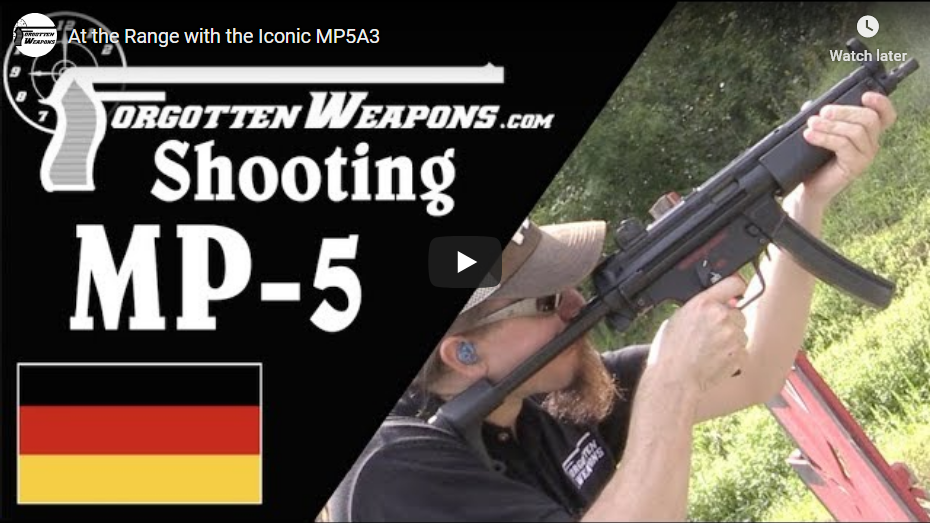
April 14, 2019

Model 1927 Thompson Semi Automatic Carbine

Filed under: History, Technology, USA, Weapons — Tags: , , — Nicholas @ 02:00

Forgotten Weapons
Published on 13 Mar 2019

Note: Rock Island has not yet posted the catalog for this auction – I will replace this note with a link when they do.

http://www.patreon.com/ForgottenWeapons

Cool Forgotten Weapons merch! http://shop.bbtv.com/collections/forg…

One of the rarest versions of the Thompsons Submachine Gun is the Model of 1927 Thompson Semi Automatic Carbine. These were regular 1921 machine guns that had their fire control groups slightly modified to only firm in semiauto and their receivers remarks to show Model 1927 instead of 1921. The rationale was a number of requests Auto Ordnance received from potential customers who wanted the look of a Thompson, but not an actual machine gun – mostly police and prison agencies that did not want to entrust their officers will fully automatic arms. Only about 100-150 1927 model guns were sold (and there is no specific serial range, they were simple converted one at a time as ordered). Of that very small number, only a very small percentage survive intact today, as most were converted back to fully automatic by later owners. Note that because the receiver is basically identical to a standard Thompson SMG receiver, these are considered machine guns under US law despite being factory semiauto carbines. However, this does mean that they can be legally converted to fully automatic (as, in fact, most have been).

Contact:
Forgotten Weapons
PO Box 87647
Tucson, AZ 85754
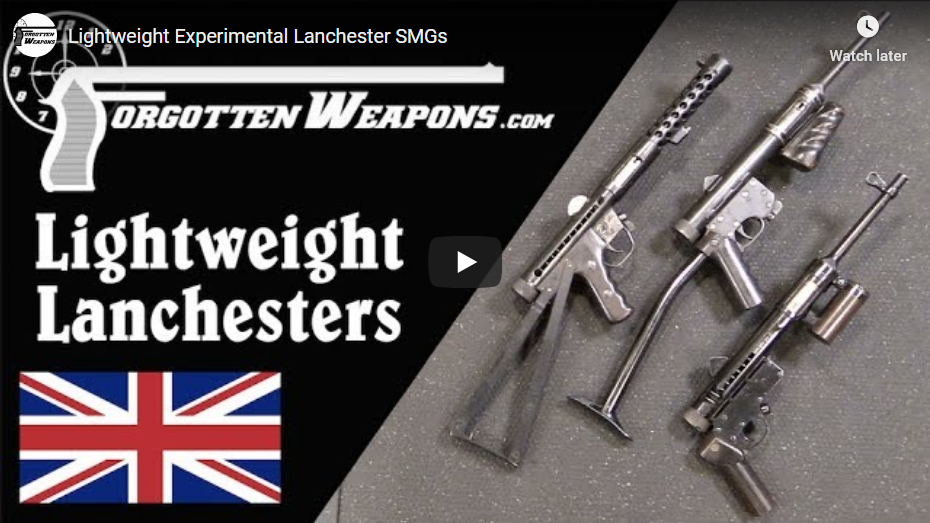
April 12, 2019

Machine-guns: light, medium, heavy, or sub?

Filed under: History, Military, Technology, Weapons, WW1, WW2 — Tags: , , , — Nicholas @ 02:00

Lindybeige
Published on 2 Mar 2016

Machine-guns – do you know the difference between light, medium, and heavy? What is a ‘submachinegun’?
Support me on Patreon: https://www.patreon.com/Lindybeige

Many people are hazy over the differences between the various types of machine-gun, and here I ramble on for ten whole minutes about the distinctions. It is a bit of a moving target, as terminology alters as technology does, but the terms used in World War Two are still reasonably current.

Lindybeige: a channel of archaeology, ancient and medieval warfare, rants, swing dance, travelogues, evolution, and whatever else occurs to me to make.

For the detail-minded, don’t panic: he’s taken to task in the comments on this video for a few of the howlers you may have noticed on the way by.

April 4, 2019

Ingram M10 & M11 SMGs: The Originals from Powder Springs

Filed under: Business, History, Military, Technology, USA, Weapons — Tags: , , , , — Nicholas @ 06:00

Forgotten Weapons
Published on 3 Apr 2019

These SMGs are lots 1069 (M10/45), 1070 (M10/9), and 1067 (M11) at Morphy’s April 2019 auction:
https://www.forgottenweapons.com/ingr…

After the commercial failure of Gordon Ingram’s M6 submachine gun in the early 50s, he would radically change the layout of his designs. Instead of a Thompson-lookalike Ingram’s M10 (the M7, M8, and M9 doing experimental prototypes only) would be a boxy and compact affair with a Czech-style telescoping bolt. It found little interest until a meeting between Gordon Ingram and Mitch WerBell resulted in WerBell demonstrating it to excited military audiences in Vietnam in 1969.

WerBell was an ex-OSS man who had started a company called Sionics, selling suppressors to the US military. He thought the combination of Ingram’s submachine gun and his suppressor would be a fantastic package, and he found plenty of interest among special operations personnel in Vietnam. He would create the Military Armament Corporation based at his farm in Powder Springs, GA and entice Ingram to join as his chief engineer. The result would be the .45ACP M10, a 9mm version of the M10 (made for use with subsonic 9mm ammunition), and a scaled-down .380 ACP M11 submachine gun.

MAC would have a short life, with all its assets sold at a bankruptcy auction in April 1976 – but it had plenty of time to create what would become an iconic gun – the Big MAC. Many imitations and copies would follow, but Powder Springs was the home of true original Ingram M10 and M11 submachine guns!

http://www.patreon.com/ForgottenWeapons

Cool Forgotten Weapons merch! http://shop.bbtv.com/collections/forg…

Contact:
Forgotten Weapons
PO Box 87647
Tucson, AZ 85754
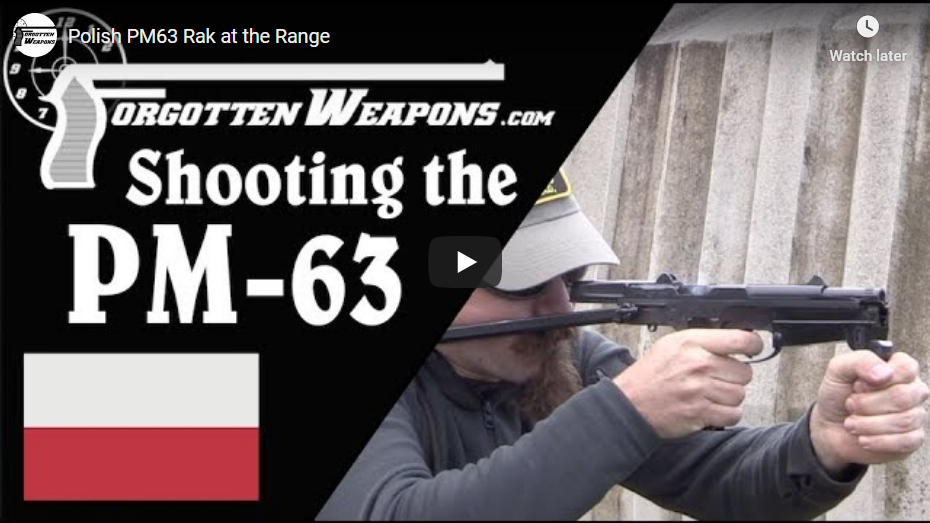
February 11, 2019

How Does it Work: Blowback Action

Filed under: Technology, Weapons — Tags: , , , , , — Nicholas @ 02:00

Forgotten Weapons
Published on 10 Jan 2019

http://www.patreon.com/ForgottenWeapons

Cool Forgotten Weapons merch! http://shop.bbtv.com/collections/forg…

How Does it Work: Blowback Action

The simplest for of firearms action is blowback, also called simple blowback. It is basically just an application of Newton’s 3rd Law; that for every action there is an equal and opposite reaction. As the bullet moves forward down the barrel, the slide or bolt of the gun moves backwards. The two move with the same energy, meaning that the light and very fast bullet is balanced out by the heavy and slow bolt or slide.

Contact:
Forgotten Weapons
PO Box 87647
Tucson, AZ 85754
February 10, 2019

Semiauto M2 Hyde Reproduction: The Interim US WW2 Subgun

Filed under: History, Technology, USA, Weapons, WW2 — Tags: , , , , — Nicholas @ 02:00

Forgotten Weapons
Published on 9 Jan 2019

http://www.patreon.com/ForgottenWeapons

Cool Forgotten Weapons merch! http://shop.bbtv.com/collections/forg…

George Hyde designed the gun that would eventually be adopted as the M2 submachine gun in the late 1930s, and it was first tested at Aberdeen Proving Grounds in October of 1939. At that time, the gun had many good traits (weight, handlings, etc) but suffered from parts breakage and unreliability. Hyde went back to work on the gun at the Inland Division of GM, and came back with a much improved version in April of 1942.

The Inland-Hyde SMG was chambered for .45 ACP ammunition and used standard Thompson magazines, and was poised to become the US Army’s new submachine gun, replacing the overly expensive Thompson. The Hyde passed a 6080 round endurance test with flying colors, and exhibited much better effectiveness in fully automatic than the Thompson. At the end of the April tests, it was formally accepted to replace the Thompson and given the designation M2.

A contract was given to the Marlin company (Inland being busy with other projects) to manufacture 164,450 of the guns, with delivery to begin in December 1942. However, Marlin had problems tooling up to produce the new gun, in particular with dies for several parts to be made using powdered metal sintering. Actual delivery of the first guns did not happen until May of 1943. In the meantime, Hyde and Inland had continued working on cheaper and simpler designs, and created the stamped sheet metal M3 “Grease Gun”. By the time the M2 was actually ready for delivery, the M3 had been tested and accepted by the Army as a better replacement than the M2. By mid-June, the M2 was declared obsolete and Marlin’s contract cancelled.

In total only about 500 M2 submachine guns were made, with (I believe) 6 surviving today. The example in this video is a semiautomatic-only reproduction made from scratch by a viewer of the channel, who graciously offered to loan it to me for this filming. Thanks, K!

Contact:
Forgotten Weapons
PO Box 87647
Tucson, AZ 85754
February 3, 2019

How Does it Work: Open Bolt vs Closed Bolt Firearms

Filed under: Technology, Weapons — Tags: , , , , — Nicholas @ 02:00

Forgotten Weapons
Published on 3 Jan 2019

http://www.patreon.com/ForgottenWeapons

Cool Forgotten Weapons merch! http://shop.bbtv.com/collections/forg…

How Does it Work: Open Bolt vs Closed Bolt Firearms

Most semiauto firearms fire from a closed bolt and most fully automatic firearms fire from an open bolt, but these are far from strict rules, and many exception exist. Open bolt offers better cooling and prevents any possibility of cookoff, while closed bolt offers better practical accuracy.

Contact:
Forgotten Weapons
PO Box 87647
Tucson, AZ 85754
January 12, 2019

Shooting the H&K MP5K Operational Briefcase

Filed under: Technology, Weapons — Tags: , , , , — Nicholas @ 02:00

Forgotten Weapons
Published on 22 Dec 2018

http://www.patreon.com/ForgottenWeapons

Heckler & Koch’s “Operational Briefcase” is a clever system for covert carry of a submachine gun without the need to conceal such a large type of weapon under bulky clothing. By putting the gun into a briefcase, they gave security personnel a way to blend right into the business and executive type of environment. Of course, the idea has become rather well known, at least in some circles. It may not have quite the same element of surprise it once did, but it is still a remarkably discreet contraption.

Thanks to H&K and Trijicon, I had the chance today to actually do some shooting with one of the briefcases. When properly used (which is to say, braced against the belly and aimed with the torso) it is quite a lot more useful and accurate than I had anticipated! It should definitely say something that H&K still sells these briefcases to law enforcement and security firms to this day…

Contact:
Forgotten Weapons
PO Box 87647
Tucson, AZ 85754

October 26, 2018

The German WWII Standby: The MP38 and MP40 SMGs

Filed under: Germany, History, Military, Weapons, WW2 — Tags: , , , — Nicholas @ 02:00

Forgotten Weapons
Published on 4 Aug 2017

http://www.patreon.com/ForgottenWeapons

The MP40 is an iconic piece of World War 2 weaponry, and it’s about time we took a closer look at its development…

Thanks to the Institute of Military Technology for allowing me to have access to these three examples so I can bring them to you! Check out the IMT at:

http://www.instmiltech.com

If you enjoy Forgotten Weapons, check out its sister channel, InRangeTV! http://www.youtube.com/InRangeTVShow

October 3, 2018

The Uzi Submachine Gun: Excellent or Overrated?

Filed under: Middle East, Military, Technology, Weapons — Tags: , , , — Nicholas @ 02:00

Forgotten Weapons
Published on 5 Mar 2018

The Israeli Uzi has become a truly iconic submachine gun through both its military use and its Hollywood stunts – but how effective is it really?

I found this fully automatic Uzi Model A to be actually rather better than I had expected. Despite the uncomfortable sharp metal stock, the rate of fire and large sights make this a relatively easy gun to shoot. Not one of the absolute best, but certainly above average.

http://www.patreon.com/ForgottenWeapons

If you enjoy Forgotten Weapons, check out its sister channel, InRangeTV! http://www.youtube.com/InRangeTVShow

September 7, 2018

Suomi m/31 – Finland’s Excellent Submachine Gun

Filed under: Europe, History, Military, Technology, Weapons, WW2 — Tags: , , , — Nicholas @ 02:00

Forgotten Weapons
Published on 17 Aug 2018

More info: https://www.forgottenweapons.com/suomi-m-31-finlands-excellent-submachine-gun/

http://www.patreon.com/ForgottenWeapons

Designed by Aimo Lahti, the Suomi m/31 submachine gun is in my opinion one of the standout submachine guns of the World War Two era. Despite its hefty weight (10.4lb / 4.7kg) and lack of a good pistol grip stock, it still manages to be tremendously controllable and accurate, with a very high rate of fire (about 900 rpm).

For a detailed written description of the history and development of the weapon, I would refer you to the excellent article by Jaeger Platoon: http://www.jaegerplatoon.net/MACHINEP…

If you enjoy Forgotten Weapons, check out its sister channel, InRangeTV! http://www.youtube.com/InRangeTVShow

May 1, 2018

Shooting a Suppressed Sten Gun

Filed under: Britain, History, Military, Technology, Weapons, WW2 — Tags: , , , — Nicholas @ 02:00

Forgotten Weapons
Published on 19 Mar 2018

Sold for $7,475 (transferrable).

During World War Two, the British spent several years developing a silenced version of the Sten gun for special operations commandos and for dropping to mainland European resistance units. This is a recreation of one of the experimental types, based on a MkII Sten with the receiver lengthened into an integral suppressor. So – how does it shoot?

November 22, 2017

The Canadian version of the Sterling submachine gun

Filed under: Cancon, Military, Weapons — Tags: , , , — Nicholas @ 03:00

The Canadian army kept the Sten as their standard SMG for several years after the war, but eventually had to come up with a replacement weapon. The selection committee eventually settled on Sterling SMG, which the British army had been using, with a few modifications. Historical Firearms has the details:

…in November 1956, the first Anglo-Canadian Submachine Gun Steering Committee meeting was held. The Canadians liked the Sterling and requested a manufacturing license. They did, however, wish to make some changes to the weapon before they adopted it.
These changes included a small bayonet boss and redesigned lug reinforcement for the L1A1 rifle bayonet, a simpler trigger mechanism designed by Sterling engineer Les Ruffell, a height adjustable front sight taken from the L1A1, an adjustable rear sight with wider sight protectors. In early 1957, these changes were encapsulated in a sample model assembled from Fazakerly-made L2A3s, these were re-designated the L2A4. Later changes were also made to simplify the Canadian Sterling’s end cap and a squarer brass deflector and hand stop.

The primary internal departures from Patchett’s original design were the decision to have a single rather than double return spring and to use a non-helically grooved bolt. Instead using an improved Sten breech block, this had a number of advantages including being able to use existing tooling, avoiding paying royalties for Patchett’s bolt and simplifying production. Compared to the Sterling-made guns the C1 was certainly simpler using stampings and spot-welding.

However, the C1 retained a surprising level of parts commonality with many parts interchangeable between both Canadian and British weapons. This commonality included magazines, however, the Canadians also simplified the magazine’s design. They dispensed with Patchett’s roller system and designed their own magazine which held 30, rather than 34 rounds, but could be used in all Sterling-pattern guns.

Two experimental suppressed C1s were made by Long Branch to replace the Sten MkII(s) and the MkVI, but the Sterling-Patchett L34A1/Mk5 was adopted instead. Canada purchased at least 5 L34A1s.

The Long Branch Arsenal was just west of Toronto along Lakeshore Road in what is now Mississauga (my cadet hall was adjacent to the former factory site):

I didn’t realize the site had been active that late … I’d assumed it was demolished shortly after the Korean War.

September 8, 2017

Book Review: The Schmeisser Myth by Martin Helebrant

Filed under: Books, Germany, History, Military, Technology, Weapons, WW1, WW2 — Tags: , , , — Nicholas @ 02:00

Published on 17 Feb 2017

The Schmeisser Myth: German Submachine Guns Through Two World Wars is a newly published history of SMG development from the Villar Perosa and MP18 through the MP38 and MP40, written by Martin Helebrant. Given that it is published by Collector Grade, it should be no surprise that it is an excellent volume, which includes both historical and developmental context as well as detailed collectors’ information on markings, variations, and production numbers.

« Newer PostsOlder Posts »

Powered by WordPress

