
Forgotten Weapons
Published on 4 Aug 2017http://www.patreon.com/ForgottenWeapons
The MP40 is an iconic piece of World War 2 weaponry, and it’s about time we took a closer look at its development…
Thanks to the Institute of Military Technology for allowing me to have access to these three examples so I can bring them to you! Check out the IMT at:
If you enjoy Forgotten Weapons, check out its sister channel, InRangeTV! http://www.youtube.com/InRangeTVShow
October 26, 2018
The German WWII Standby: The MP38 and MP40 SMGs
Comments Off on The German WWII Standby: The MP38 and MP40 SMGs
October 3, 2018
The Uzi Submachine Gun: Excellent or Overrated?
Forgotten Weapons
Published on 5 Mar 2018The Israeli Uzi has become a truly iconic submachine gun through both its military use and its Hollywood stunts – but how effective is it really?
I found this fully automatic Uzi Model A to be actually rather better than I had expected. Despite the uncomfortable sharp metal stock, the rate of fire and large sights make this a relatively easy gun to shoot. Not one of the absolute best, but certainly above average.
http://www.patreon.com/ForgottenWeapons
If you enjoy Forgotten Weapons, check out its sister channel, InRangeTV! http://www.youtube.com/InRangeTVShow
Comments Off on The Uzi Submachine Gun: Excellent or Overrated?
September 7, 2018
Suomi m/31 – Finland’s Excellent Submachine Gun
Forgotten Weapons
Published on 17 Aug 2018More info: https://www.forgottenweapons.com/suomi-m-31-finlands-excellent-submachine-gun/
http://www.patreon.com/ForgottenWeapons
Designed by Aimo Lahti, the Suomi m/31 submachine gun is in my opinion one of the standout submachine guns of the World War Two era. Despite its hefty weight (10.4lb / 4.7kg) and lack of a good pistol grip stock, it still manages to be tremendously controllable and accurate, with a very high rate of fire (about 900 rpm).
For a detailed written description of the history and development of the weapon, I would refer you to the excellent article by Jaeger Platoon: http://www.jaegerplatoon.net/MACHINEP…
If you enjoy Forgotten Weapons, check out its sister channel, InRangeTV! http://www.youtube.com/InRangeTVShow
Comments Off on Suomi m/31 – Finland’s Excellent Submachine Gun
May 1, 2018
Shooting a Suppressed Sten Gun
Forgotten Weapons
Published on 19 Mar 2018Sold for $7,475 (transferrable).
During World War Two, the British spent several years developing a silenced version of the Sten gun for special operations commandos and for dropping to mainland European resistance units. This is a recreation of one of the experimental types, based on a MkII Sten with the receiver lengthened into an integral suppressor. So – how does it shoot?
Comments Off on Shooting a Suppressed Sten Gun
November 22, 2017
The Canadian version of the Sterling submachine gun
The Canadian army kept the Sten as their standard SMG for several years after the war, but eventually had to come up with a replacement weapon. The selection committee eventually settled on Sterling SMG, which the British army had been using, with a few modifications. Historical Firearms has the details:
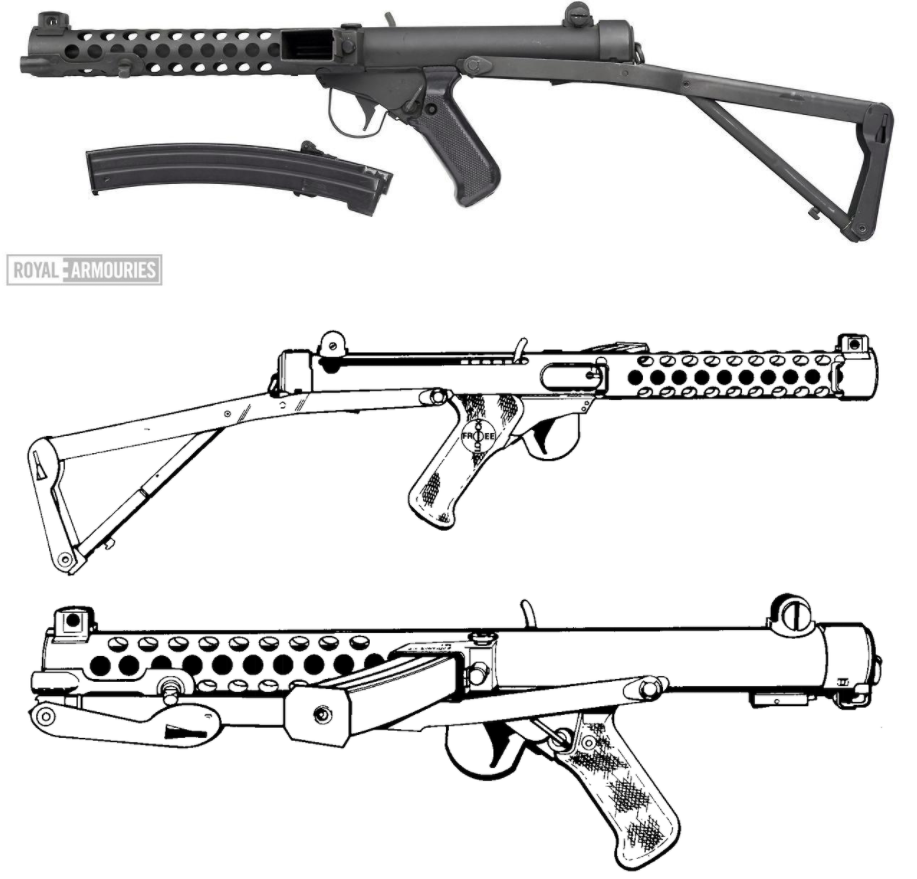
…in November 1956, the first Anglo-Canadian Submachine Gun Steering Committee meeting was held. The Canadians liked the Sterling and requested a manufacturing license. They did, however, wish to make some changes to the weapon before they adopted it.
These changes included a small bayonet boss and redesigned lug reinforcement for the L1A1 rifle bayonet, a simpler trigger mechanism designed by Sterling engineer Les Ruffell, a height adjustable front sight taken from the L1A1, an adjustable rear sight with wider sight protectors. In early 1957, these changes were encapsulated in a sample model assembled from Fazakerly-made L2A3s, these were re-designated the L2A4. Later changes were also made to simplify the Canadian Sterling’s end cap and a squarer brass deflector and hand stop.The primary internal departures from Patchett’s original design were the decision to have a single rather than double return spring and to use a non-helically grooved bolt. Instead using an improved Sten breech block, this had a number of advantages including being able to use existing tooling, avoiding paying royalties for Patchett’s bolt and simplifying production. Compared to the Sterling-made guns the C1 was certainly simpler using stampings and spot-welding.
However, the C1 retained a surprising level of parts commonality with many parts interchangeable between both Canadian and British weapons. This commonality included magazines, however, the Canadians also simplified the magazine’s design. They dispensed with Patchett’s roller system and designed their own magazine which held 30, rather than 34 rounds, but could be used in all Sterling-pattern guns.
Two experimental suppressed C1s were made by Long Branch to replace the Sten MkII(s) and the MkVI, but the Sterling-Patchett L34A1/Mk5 was adopted instead. Canada purchased at least 5 L34A1s.
The Long Branch Arsenal was just west of Toronto along Lakeshore Road in what is now Mississauga (my cadet hall was adjacent to the former factory site):
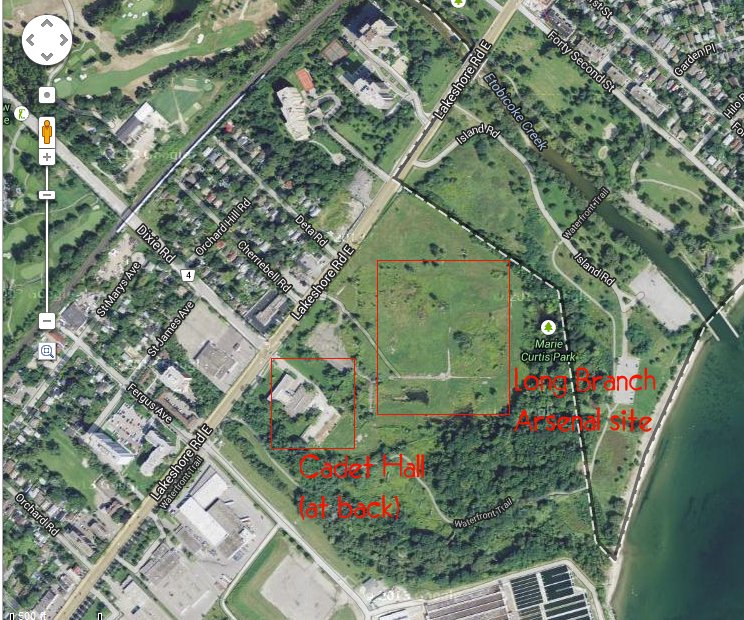
I didn’t realize the site had been active that late … I’d assumed it was demolished shortly after the Korean War.
Comments Off on The Canadian version of the Sterling submachine gun
September 8, 2017
Book Review: The Schmeisser Myth by Martin Helebrant
Published on 17 Feb 2017
The Schmeisser Myth: German Submachine Guns Through Two World Wars is a newly published history of SMG development from the Villar Perosa and MP18 through the MP38 and MP40, written by Martin Helebrant. Given that it is published by Collector Grade, it should be no surprise that it is an excellent volume, which includes both historical and developmental context as well as detailed collectors’ information on markings, variations, and production numbers.
Comments Off on Book Review: The Schmeisser Myth by Martin Helebrant
August 16, 2017
Thompson SMG in 30 Carbine
Published on 17 Oct 2016
When the US military released a request for what would become the M1 Carbine in 1940, the Auto-Ordnance Corporation offered up a Thompson submachine gun simply rechambered for the new .30 Carbine cartridge. This entailed a new magazine, a receiver modified for the longer magazine, and a new barrel and bolt face – but the other Thompson parts could remain unchanged from the standard .45 ACP models. This made the submission a pretty cheap and easy effort for Auto-Ordnance … which is a good thing, considering that it was almost assured to be rejected.
The stipulations for the new carbine included a weigh requirement of 5 pounds, and the Thompson weighed more than double that (in both .45ACP and .30 Carbine forms). Only a few were made, and the one submitted for military testing was rejected outright on the basis of weight. This example is serial number 1, and resides at the Cody Firearms Museum.
Comments Off on Thompson SMG in 30 Carbine
November 20, 2016
Know your audience, children’s division
M. Harold Page, guest-posting at Charles Stross’s blog:
Little Harry blinks at me through his heavy Sellotaped glasses. “What’s that for?”
“It’s a submachine gun,” I say. “It fires lots of bullets.” I mime. “Bang bang bang!”
I’m helping out on a school trip. Normally I avoid volunteering – it’s too easy for self employed parents to end up as the school’s go-to. However this visit is to Edinburgh Castle and my daughter Morgenstern was very keen I should put in a showing…
So here I am helping to herd 5-year olds through the military museum. Morgenstern is nowhere in sight, but little Harry has latched onto me.
“Oh,” says Harry. He copies my mime and sprays the room. “Bang bang bang bang bang bang bang bang bang bang bang bang bang.”
“Not like that,” I say. “Three round bursts or you’ll run out of bullets. Plus the thing pulls up.” I mime. “So like this: Bang bang bang!… Bang bang bang!”
Solemnly, Harry discharges three imaginary bullets. “Bang bang bang!”
“Right,” I say, “Now, the other side have guns too. You have to use cover… better if you have a hand grenade, of course.”
His blue eyes widen. “What’s a hand grenade?”
So together we have a great time clearing each gallery with imagined grenade, automatic fire and bayonet.
Later on the way back to the bus Harry says, “My Daddy says wars are bad because people get killed…”
Yes, I had in fact spent the afternoon teaching (my best recollection of) World War Two house clearing tactics to the son of a local clergyman and peace activist.
Comments Off on Know your audience, children’s division


