Quotulatiousness

November 19, 2012

Hurricane Sandy, storm surges, and superstition

In sp!ked, Dominic Standish looks at how some recent extreme weather incidents are being attributed to climate change/global warming without sufficient scientific evidence:

Hurricane Sandy brought havoc in the Caribbean, especially Haiti, and caused approximately 60 deaths. Then the storm hit the US east coast; New York experienced exceptional floods and at least 40 people lost their lives. Next, Venice in Italy witnessed high flooding on 11 November, when the city’s tide measurements reached their sixth-highest level for 140 years. No one died from these floods in Venice, but — like Haiti and New York — the economic impact was significant.

Global warming was widely blamed for the flooding, yet in all three cases flooding was principally caused by storm surges. In the Caribbean and America, there was an unfortunate convergence of weather systems creating storm surges. As Hurricane Sandy swirled north in the Atlantic and towards land, a wintry storm headed towards it from the West and cold air was blowing south from the Arctic. After the hurricane devastated parts of the Caribbean, it moved towards the north-east of the US, pushing water up the estuaries of New York into the city. Venice’s floods were unconnected to Hurricane Sandy, but were also caused by high winds creating storm surges pushing water through the three inlets between the sea and the Venetian lagoon towards the city. Subsidence over the past century has made Venice more susceptible to storm surges. Nevertheless, after 70 per cent of Venice was under water on 11 November, Italy’s environment minister, Corrado Clini, insisted that global climate change was to blame.

Although storm surges were the cause of the floods in all three locations, global warming was widely identified as the culprit. Of course, we cannot ignore climate change. The Intergovernmental Panel on Climate Change (IPCC) established in 2007 that there was a global temperature rise of 0.74 degrees Celsius between 1906 and 2005, which added to global sea levels rising by an average rate of 1.8 millimetres per year from 1961. We need to have an open debate about climate change and its relationship with bad weather events. Some argue that climate change has increased hurricanes and storm surges, while others suggest there is insufficient evidence to prove this link. Whether climate change impacts on the frequency and strength of hurricanes remains uncertain, yet global warming has definitely been deployed as a superstitious narrative to close down discussion.

Update: Of course, the storm damage will eventually repaired and the federal government will pay the lion’s share of the costs. This is one of the bigger causes of rising costs due to storm damage along the US coastline: properties that are more exposed to damage keep getting rebuilt. Here’s an example from Dauphin Island, Alabama:

The western end of this Gulf Coast island has proved to be one of the most hazardous places in the country for waterfront property. Since 1979, nearly a dozen hurricanes and large storms have rolled in and knocked down houses, chewed up sewers and water pipes and hurled sand onto the roads.

Yet time and again, checks from Washington have allowed the town to put itself back together.

Across the nation, tens of billions of tax dollars have been spent on subsidizing coastal reconstruction in the aftermath of storms, usually with little consideration of whether it actually makes sense to keep rebuilding in disaster-prone areas. If history is any guide, a large fraction of the federal money allotted to New York, New Jersey and other states recovering from Hurricane Sandy — an amount that could exceed $30 billion — will be used the same way.

Tax money will go toward putting things back as they were, essentially duplicating the vulnerability that existed before the hurricane.

November 9, 2012

FEMA’s embarrassing record

Filed under: Bureaucracy, Media, USA — Tags: , , — Nicholas @ 12:38

Shikha Dalmia on the odd phenomenon that FEMA is just flat-out terrible at doing the job it’s supposed to do — co-ordinating emergency relief efforts — but is still beloved by big-government fans:

Hurricane Sandy hadn’t even touched down when liberals started blowing kisses to FEMA, or Federal Emergency Management Agency, the federal disaster relief agency. A New York Times editorial declared that the impending storm proved that the country needs FEMA-style “Big Government” solutions more than ever. Salon, New Republic and other liberal outfits heartily agreed.

Why do liberals love FEMA so much? Certainly not for its glorious track record. Rather, FEMA has been a great vehicle for expanding the welfare state.

FEMA’s tragic missteps after Katrina earned it well-deserved disgrace. The Times blames those on the Bush administration, whose anti-government philosophy supposedly gutted FEMA. President Obama, the argument goes, straightened things out, and Americans should now “feel lucky” that the agency is there for them. Without it, local and state authorities wouldn’t be able to coordinate where “rescuers should go, where drinking water should be shipped, and how to assist hospitals that have to evacuate.”

So how did the new and improved FEMA perform post-Sandy, a storm for which it had lots of advance warning? Not so well.

It didn’t set up its first relief center until four days after Sandy hit — only to run out of drinking water on the same day. It couldn’t put sufficient boots on the ground to protect Queens residents from roving looters. The Red Cross — on whom FEMA depends for delivering basic goods — left Staten Island stranded for nearly a week, prompting borough President Jim Molinaro to fume that America was not a Third World country. But FEMA’s most egregious gaffe was that it arranged for 24 million gallons of free gas for Sandy’s victims, but most of them couldn’t lay their hands on it.

November 2, 2012

Modern inventory control and Hurricane Sandy

Filed under: Business, Economics, Food, USA — Tags: , , — Nicholas @ 08:53

Unlike major disasters of the past, storm-hit New Jersey and New York City won’t have to face the crippling shortages of food and other essentials in the wake of Hurricane Sandy. The just-in-time food supply chain is proving its versatility yet again:

The day Hurricane Sandy made landfall, the Jersey City, New Jersey, warehouse for food distribution giant Sysco Corp. (SYY) sent out 30,000 cases of food and drinks. Most of the shipments were headed across the Hudson to New York City. On Tuesday, the day after the storm ravaged the city, the warehouse sent out none.

Yet while news of flooding, power outages, downed trees, and other storm-inflicted wreckage abounds, you won’t hear stories of mass starvation in the streets. Food may not be moving in or out of the city, but the data-driven supply chains perfected by some of the world’s biggest companies in the pursuit of profits have become so resilient that even a cataclysm like Sandy registers as little more than a logistical hiccup. While the subways have stopped indefinitely, few in the storm’s path will have to deal with empty shelves for long, if at all.

[. . .]

Wilson says the key adjustment Sysco made ahead of Sandy was to shift shipments to mainly non-perishable goods to ensure customers would have food to last through power outages. The company also prioritized getting orders to institutions that would have to keep large numbers of people fed through the storm, such as hospitals, hotels, airports, shelters, jails, and college campuses. Restaurants will stay near the bottom of the list as the recovery proceeds. But Wilson says the process of getting back to normal won’t drag out. “It’ll be a week or so of business-not-as-usual. But we’ll get back to business-as-usual eventually.”

Large companies like Sysco with nationwide reach and a long history of managing supply chains can adapt quickly to natural disasters because they’ve been there before, and they have the data to show for it. Over the years, as real-time inventory tracking and analysis has become the norm, companies know what people buy before and after disasters. They know how demand has varied between a Gulf Coast hurricane and a New England blizzard. By cross-referencing that granular data with the latest weather predictions, companies can forecast changes in their supply chain needs in parallel with coming storms.

H/T to Charles Stross for the link.

October 30, 2012

Detecting Photoshopped images – a primer

Filed under: Media, Technology — Tags: , , , — Nicholas @ 10:18

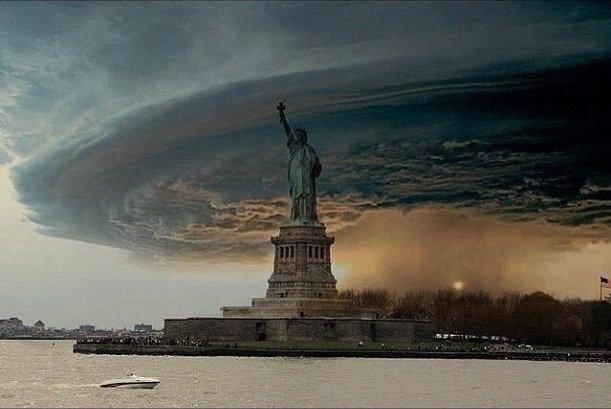
I’m sure almost everyone saw dramatic and scary images of “Hurricane Sandy” like this one that went round my friends’ Facebook timelines yesterday:

As you’ve probably guessed from the title, this is a ‘shopped image. RJS Security has a quick primer on detecting doctored images using this example:

Whenever a major media event happens (like Hurricane Sandy), we are inundated with news. Sometimes that news is useful, but often it merely exists to create FUD… Fear, Uncertainty and Doubt. While I have not personally seen any malware campaigns capitalizing on the event yet, it is inevitable. The pattern is generally as follows:

  1. Event hits the news as media outlets try to one-up eachother to get the word out.
  2. People spread the warnings, making them just a little bit worse each time they are copied.
  3. Other people create hoaxes to ride the wave of popularity.
  4. Still other people create custom hoaxes to exploit the disaster financially.

A few minutes ago, at least in my little corner of the internet, we hit stage 3 when this image was posted

H/T to Bruce Schneier for the link.

Beginning to assess the damage

Filed under: USA — Tags: , , , — Nicholas @ 09:40

ESR posts a “we’re fine” report on Google+ and then points out the damage to New York City’s power grid may be incredibly expensive and difficult to repair quickly:

Reporting from a diner in Paoli, PA, near 40°02′27″N 75°29′24″W.

Power went out in Malvern about 2AM this morning. After sleep, we have fled to where there is power and light and steak and eggs.

It feels like aftermath. The NOAA seems to no longer be issuing track updates and the storm track has disappeared from the Google crisis map, suggesting that the anticipated conversion to a large but normally (un)structured nor’easter has completed.

This area got off lightly, especially compared to the ration of apocalypse-now the storm handed New York City. Exploding high-power transformers are very bad news — they tell us that all that tunnel flooding seriously damaged the downtown end of the Manhatten power grid. That kind of equipment is extremely expensive and difficult to replace, and the halogen compounds they use as insulators are hazmats when they get loose. The prompt repair costs are going to be a large fraction of a billion dollars.

But that isn’t the worst of it. Considering that this will have have paralyzed the largest node in the international financial system for some time, downstream economic losses could easily crack a trillion dollars. The impact will be global and manifest as higher prices for everything with cross-border supply chains, rippling all the way down to Third-World farmers buying fertilizer.

Update: In almost record-setting time, here’s the first example of the Broken Window Fallacy to make it past the editors:

Disasters can give the ailing construction sector a boost, and unleash smart reinvestment that actually improves stricken areas and the lives of those that survive intact. Ultimately, Americans, as they always seem to do, will emerge stronger in the wake of disaster and rebuild better-making a brighter future in the face of tragedy.

Sandy is unusual storm and complex to gauge. Coming late in the season and combining with cold fronts to the west and north, it is really a post-tropical cyclone and has the potential to deliver epic destruction. However, coming so soon after Irene in August 2011, the level of anticipation and preparedness demonstrated by federal and state officials is commendable and should mitigate some losses-especially loss of life.

[. . .]

However, rebuilding after Sandy, especially in an economy with high unemployment and underused resources in the construction industry, will unleash at least $15-$20 billion in new direct private spending — likely more as many folks rebuild larger than before, and the capital stock that emerges will prove more economically useful and productive.

October 29, 2012

Twenty million broken windows

Filed under: Economics, Environment, Media — Tags: , , — Nicholas @ 09:03

At Forbes, Tim Worstall patiently explains that the damage from Hurricane Sandy (or any major storm) will appear to boost GDP, because it only measures money spent to repair damage, not the costs incurred or the opportunities foregone because of the damage:

We know very well that Hurricane (or Frankenstorm as some are calling it) Sandy will leave a trail of destruction across parts of the US today. There will almost certainly be deaths, as there have been in the hurricane’s passage across the Caribbean. And there will also be a boost to the US economy. Which is really evidence of quite how wrong we are in the way that we measure the economy.

[. . .]

The problem with this is that it is only true because of the way that we calculate GDP. In our working of the numbers we assume that it’s final consumption at market prices: that is, the value that consumers put on everything. However, this is not true of government spending. It’s very difficult indeed to work out what government spending is actually worth: for as we’ve not a choice in it then there’s no market price nor accurate valuation from the people who actually get whatever is produced. Some government spending is most certainly worth more than the actual amount spent. The court system say: a pre-requisite of our having a complex society at all. Other parts not so much: what is the true value of a diversity adviser for example? So what we actually do is value all government spending, for GDP purposes, at the cost of that actual spending. Government spends $100, GDP goes up by $100. That’s just how we define it. This can cause amusement in measuring the success of welfare programs for example. Even Census admits that some of the people who receive Medicaid, or food stamps, value what they receive at less than the cost of providing it.

[. . .]

Now imagine that Hurricane Sandy does $10 billion of damage to that wealth (for our purposes it doesn’t matter whether it’s $100 billion or $1 trillion. Although this obviously matters to everyone except for the purposes of this example). The US is now worth $99.990 Trillion. GDP might rise to $15.1 trillion as we repair that damage. But we’re not in fact any richer at all: despite the fact that GDP has gone up. What has actually happened is that some of our stock of wealth has been destroyed and we’re having to do more work in order to rebuild it. This is exactly the same as our pollution example. We’re measuring what we produce but not the capital stock of what we have (or had).

Yes, the rebound from Sandy may well provide a boost to the economy. But that’s a function of the way that we measure that economy, not a real boost in our general wealth.

July 14, 2012

Flood policy and personal responsibility

Filed under: Britain, Environment, Government — Tags: , , , , , — Nicholas @ 00:03

James Delingpole on the British government’s latest announcements on flood policy:

Yesterday it was reported that the Coalition had decided we should all be liable for the cost of flood damage, regardless of where we live. This puzzled me, as the Coalition’s decisions so often do. The only way it would make any kind of sense would be if you believed a) flooding is a new and unnatural phenomenon resulting directly from late 20th century Man Made Climate Change or b) that everyone is now so stupid they cannot be trusted to act in their own best interests and that it is therefore government’s job to hold their hands and wipe their bottoms for them from cradle to grave.

To discount a) you only have to go somewhere like the River Severn, just below Worcester Cathedral, and look at the flood marks on the wall. Many of the most dramatic inundations happened in years long before “man made global warming” was even a sinister glint in Al Gore’s eye. This isn’t to say that the cost of flood damage hasn’t risen to unprecedented levels these last few decades. But that has more to do with our insane practice of allowing property developments to be built on flood plains, together with our unfortunate habit of paving and tarmacking everything (such as the front gardens we would once have kept as front gardens) which means that in times of high rainfall floodwater is likely to accumulate in drains more rapidly. Plus, of course, we’re all richer — so there’s more expensive property for flooding to damage.

But it’s the b) aspect I find more worrying because of the way it rides roughshod over the most basic principles of free market economics. Can we really assume that when anybody buys a house by a river — or near a floodplain — they don’t do so in the full knowledge that flood-risk is one of the prices they pay for their pleasing waterside ambience? The very idea is a nonsense. Buyers, being rational, will factor this into their calculations: “OK, so it will be great for fishing and swimming and boating. But getting insurance will be a bugger and we’d better not keep anything too precious on the ground floor.” These complexities will be reflected by the market. While the value of the property may be enhanced by its attractive location, it will simultaneously be decreased by its flood-damage potential.

June 2, 2012

The end of a weird week in Canadian journalism

Filed under: Cancon, Media — Tags: , , , , , , — Nicholas @ 10:26

David Akin on all the unusual happenings over the past week:

I suspect Alex felt that way because he and his staff had to deal with a) the ongoing battle between students and Premier Jean Charest b) a grisly murder that forced police in Montreal to issue an international warrant for kitten-killing gay porn star Luka Magnotta c) a freak rain storm that put 70 mm of water on the ground in 30 minutes pretty much flooding most of downtown Montreal for an afternoon. But enough of that, let’s get to God using a bear to deliver God’s own brand of justice [. . .]

“The corpse of a man eaten by a B.C. bear was that of a convicted killer, officials have confirmed.”

[. . .]

“46 mm of rain in half an hour floods Montreal.”

[. . .]

On Friday, heavy rain would contribute to flooding which would end up flooding and shutting down Toronto’s Union Station on Friday causing commuter chaos

[. . .]

The Montreal flash floods occurred as Quebec Premier Jean Charest was trying to broker a deal with post-secondary students who have been “on strike” for more than 3 months because they don’t want to pay an extra $350 or so a year in tuition — over five years. Charest has been over-patient. The students have been, as they say on St. Urbain Street, “stiff-necked”. So the two sides met and then talks broke down.

All that, plus the kitten-killing, body dismembering fugitive porn star…

March 16, 2012

Last night’s storm

Filed under: Randomness — Tags: , — Nicholas @ 09:31

I had to shut down my computer last night as a thunderstorm rolled in. After the typical flashing and booming, the rain started. After a couple of minutes of rain, it changed to hail. The entire house was ringing with the impact of the hailstones. It continued off-and-on for about an hour and a half. It was so loud that both our dogs were huddled up to me, shivering. Once the worst of it was over, I went to bed.

This morning, I got up and noticed there were still drops of rain sitting on top of the gazebo in our back yard. A few minutes ago, I got up to let Xander out and noticed that the raindrops still appeared to be sitting on the gazebo roof.

They’re not raindrops:

A bit closer:

The entire roof of the gazebo looks like a “No Hunting” sign up north: riddled with bullet holes.

February 8, 2012

European energy policy based on renewables falters in face of severe winter weather

Filed under: Environment, Europe, Health, Technology — Tags: , , — Nicholas @ 00:06

Kevin Myers on the folly of abandoning nuclear power generation in favour of renewables:

Russia’s main gas-company, Gazprom, was unable to meet demand last weekend as blizzards swept across Europe, and over three hundred people died. Did anyone even think of deploying our wind turbines to make good the energy shortfall from Russia?

Of course not. We all know that windmills are a self-indulgent and sanctimonious luxury whose purpose is to make us feel good. Had Europe genuinely depended on green energy on Friday, by Sunday thousands would be dead from frostbite and exposure, and the EU would have suffered an economic body blow to match that of Japan’s tsunami a year ago. No electricity means no water, no trams, no trains, no airports, no traffic lights, no phone systems, no sewerage, no factories, no service stations, no office lifts, no central heating and even no hospitals, once their generators run out of fuel.

Modern cities are incredibly fragile organisms, which tremble on the edge of disaster the entire time. During a severe blizzard, it is electricity alone that prevents a midwinter urban holocaust. We saw what adverse weather can do, when 15,000 people died in the heatwave that hit France in August 2003. But those deaths were spread over a month. Last weekend’s weather, without energy, could have caused many tens of thousands of deaths over a couple of days.

[. . .]

Frau Merkel has announced that Germany is going to phase out nuclear power, simply because of the Japanese tsunami. Well, that is like basing water-collection policies in Rhineland-Westphalia on the monsoon cycle of Borneo. As I was saying last week, the Germans have a powerfully emotional attachment to everything that is “green”, and an energy policy based on renewables will usually win German hearts. But it will not protect the owners of those hearts from frostbite and death due to exposure, for wind can often be not so much a Renewable as an Unusable, and also an Unpredictable, an Unstorable, and — normally when it’s very cold — an Unmovable.

The seriousness of this is hard to exaggerate. The temperature in the Baltic countries last weekend was -33 degrees Celsius. The Eurasian landmass from Calais to Naples to Siberia was an icefield in which hundreds of millions of people were trapped. Without coal, oil and nuclear energy, mass deaths of the old and the young would have occurred on the first night. Three nights on of such conditions, and even the physically fit would have been dying of exposure, as the temperature inside dwellings fell and began to match that of the outside, an inverse image of what happened during the French heatwave 10 years ago, when there was no escape from the heat.

February 3, 2012

Great moments in advertising

Filed under: Environment, Europe, Media — Tags: , , , , — Nicholas @ 09:55

This is not one of them:

BMW apologized after a PR strategy to pay for the naming rights to a weather system backfired — that system turned into the deep freeze that’s claimed dozens of lives across Europe.

The goal was to promote BMW’s Mini Cooper brand by paying Germany’s meteorological office 299 euros ($392) to name a system “Cooper” — a practice in place since 2002 to help fund weather monitoring work in Germany. Unfortunately for BMW, the system it was assigned to turned out to be a killer.

On the face of it, this seems like a pretty stupid notion: pay money to associate your brand with a major weather disturbance? Didn’t BMW’s PR folks notice that the association most people have with named weather is negative?

September 2, 2011

US flood insurance is “a veritable bucket of fail”

Filed under: Economics, Government, Politics, USA — Tags: , , , , , — Nicholas @ 12:12

Felix Salmon on the state of US flood insurance:

Ben Berkowitz has a big report on the the National Flood Insurance Program — something which is a veritable bucket of fail. In a nutshell, it undercuts private insurers and therefore is the only game in town; it insures only a small minority of homeowners; and it loses gobs of money. In September 2005, the NFIP was $1.5 billion in hock to the federal government; that number has now ballooned to $21 billion, and is certain to rise further.

There’s a simple answer to all these problems: let the NFIP raise its rates. And I don’t understand why it’s not being allowed to do so. If the rates rose, then that might allow private insurers into the flood-insurance game, giving consumers a choice and helping to get the word out about how insuring your home against flood damage is a really good idea. The NFIP could become profitable, and thereby start paying back all the money it owes. And while homeowners are quite price sensitive when it comes to flood insurance, the fact is that so few homeowners take out flood insurance right now that the number would be unlikely to fall dramatically if rates went up to a reasonable level.

August 22, 2011

Ontario town of Goderich hit by tornado

Filed under: Cancon, Environment — Tags: , — Nicholas @ 08:46

One man died and nearly 40 others were reported injured in the Sunday tornado which devastated the historic town centre:

Environment Canada confirmed the Southwestern Ontario town was struck by either an F-2 or F-3 level tornado around 4 p.m. Sunday. The rating makes this the most powerful storm to strike Ontario since 1996, bringing winds of up to 300 km/h.

The one fatality, a 61-year-old man, was confirmed by officials as Norman Laberge of Lucknow, Ont. He had been working at a nearby salt mine when the tornado struck. Reports indicate he was working on a crane that collapsed during the storm.

Goderich’s historic square was hit directly by the storm and left completely ravaged. Several buildings had their roofs ripped off, numerous windows were shattered and a number of cars were tossed around. The downtown area, which has classic historic buildings, has been declared a “no-go” zone because of the severity of the damage.

July 13, 2011

Expanding government-provided flood insurance?

Filed under: Economics, Environment, Government, USA — Tags: , , , , , — Nicholas @ 12:42

It has always amazed me that the US government is the primary insurer for flood damage, but the idea of putting the few remaining private insurace companies out of business is insane:

The House of Representatives is scheduled this week, as early as today, to consider an extension and “reform” of the National Flood Insurance Program (NFIP), administered by FEMA. Since Hurricane Katrina in 2005, the NFIP has been about $18 billion in the hole. And this is from a program that only collects around $2 billion a year in premiums, which barely covers losses and expenses in a normal year. So make no mistake, the NFIP is still on course to cost the taxpayer billions more in the future.

Even before Katrina, the Congressional Budget Office estimated that the NFIP was receiving a subsidy of close to a billion dollars a year. Under CBO’s optimistic projections, the House’s reform bill would increase NFIP revenues by about $4 billion over the next ten years, making only a small dent in the program’s current deficit.

If private insurers aren’t willing to offer insurance to people and businesses located on flood plains, isn’t that a strong indication that building a house or a plant on that location is a bad idea? Why should people who chose not to locate in risky locations be forced to subsidize the risk-taking of those who do?

June 14, 2011

Pack up your worries about global warming: unpack your parka and mittens

Filed under: Environment, Science — Tags: , , , , — Nicholas @ 15:18

I’ve been skeptical about the whole global warming issue, and I’d like to be equally skeptical about a new ice age threat:

What may be the science story of the century is breaking this evening, as heavyweight US solar physicists announce that the Sun appears to be headed into a lengthy spell of low activity, which could mean that the Earth — far from facing a global warming problem — is actually headed into a mini Ice Age.

Lower sunspot activity translates into likely lower temperatures here on earth, just like in the “Maunder Minimum” period, also known as the “Little Ice Age”.

Early records of sunspots indicate that the Sun went through a period of inactivity in the late 17th century. Very few sunspots were seen on the Sun from about 1645 to 1715. Although the observations were not as extensive as in later years, the Sun was in fact well observed during this time and this lack of sunspots is well documented. This period of solar inactivity also corresponds to a climatic period called the “Little Ice Age” when rivers that are normally ice-free froze and snow fields remained year-round at lower altitudes. There is evidence that the Sun has had similar periods of inactivity in the more distant past.

As I wrote back in 2004, “I’ve never been all that convinced of the accuracy of the scientific evidence presented in favour of the Global Warming theory, especially as it seemed to play rather too clearly into the hands of the anti-growth, anti-capitalist, pro-world government folks. A world-wide ecological disaster, clearly caused by human action, would allow a lot of authoritarian changes which would radically reduce individual freedom and increase the degree of social control exercised by governments over the actions and movement of their citizenry. “

On the other hand, as Bjorn Lomborg has pointed out, humanity is better adapted to dealing with higher temperatures than lower ones — as are most living creatures. Given a choice between the risks of increasing temperatures globally and the risks of a new ice age, it should be pretty easy to figure out which scenario allows the better chances for all of humanity to survive and thrive.

Update: Anthony Watts has more. “If we are right, this could be the last solar maximum we’ll see for a few decades,” Hill said. “That would affect everything from space exploration to Earth’s climate.”

Update, 15 June: My skepticism is overwhelmed by the skeptic-in-this-instance New Scientist‘s Michael Marshall, who does the quick math that a Maunder Minimum for the next 90 years would only lower global temperatures by 0.3C. And New Scientist is still bullish on the global warming potential of between 2 and 4.5 degrees Celsius over that same time period. They’re science writers and I’m not, but I have to say I’m still much more worried about the potential cooling than the potential warming.

« Newer PostsOlder Posts »

Powered by WordPress