Last time we discussed Rome’s popular assemblies, which at least notionally expressed the will of the people. One of the key tasks those assemblies had, we noted, was the election of magistrates, the executive officials of the Roman state. Those magistrates will be our focus this week, though we’re not going to get through all of them. Today we’re going to focus on the structure of a Roman political career, the cursus honorum and the first few steps on that career: serving as military tribunes, quaestors and aediles.
Similar to the magistrates in the Greek polis, Roman magistrates should not be thought of as bureaucrats within a unitary governing institution. Rather each magistrate is an independent actor, granted certain powers to oversee the public interest in a specific field. This is perhaps even more true of Roman magistrates, who rarely function as “boards” the way Greek magistrates often do (none of the senior magistrates in Rome function as a board, they are all individual actors). Instead of having an chief executive (like a president or prime minister) to coordinate the different actions of government, the Romans in the Middle Republic instead rely on the Senate, which will be our topic for next week, though the Senate’s guidance is going to show up a fair bit here as well.
Each of these offices has a range of functions and some interesting powers and prerogatives, so it is worth discussing each one in turn.
Bret Devereaux, “Collections: How to Roman Republic 101, Part IIIa: Starting Down the Path of Honors”, A Collection of Unmitigated Pedantry, 2023-08-11.
April 27, 2024
QotD: Roman magistrates during the middle Republican period
April 26, 2024
Economic inefficiencies in the water market? Don’t worry, here’s the government to make it much worse
Tim Worstall discusses the economics of water markets in the US … that Senator Elizabeth Warren and Representative Ro Khanna seem determined to make far less efficient if their plans come to fruition:
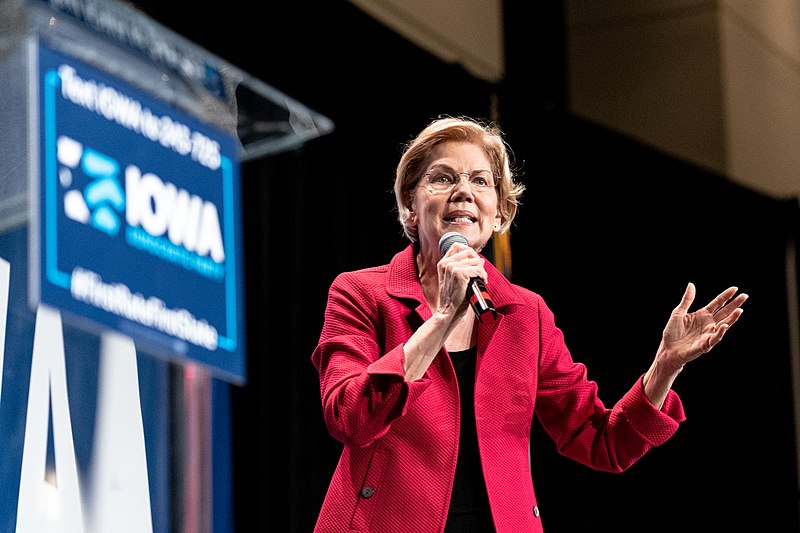
Senator Elizabeth Warren speaking at the Iowa Democrats Hall of Fame Celebration in Cedar Rapids, Iowa, on 9 June, 2019.
Photo by Lorie Shaull via Wikimedia Commons.
Aficionados for truly stupid political interventions into matters economic will already be aware of the idiocies perpetrated by Senator Elizabeth Warren and Representative Ro Khanna. The two seem to end up as if someone rolled together the ideas of Professor Richard J Murphy and The Guardian opinion page then removed all the insight, subtlety and sensibility. True, not an arduous task removing those three but …
The basic water problem out in the Western US is that the wrong people currently own the water rights. We would therefore like to see more trade in those rights. Warren and Khanna are insisting upon further limitations upon the trade in those rights. This is rampant idiocy.
To set the scene, as folk moved out there they realised that water was not one of those things in great surplus in the area. So, those who got there first made sure that the property rights to the water were assigned to them. Nothing odd about this and rights to a scarce resource do need to be allocated. Otherwise we just end up with the commons problem and the resource is exhausted.
OK. And, y’know, quite a lot of things have changed in the century, century and a half since that Wild West was properly populated. But the descendants of those original farmers still own near all the water rights. Hmm, bit of a problem.
That’s OK, we’ve Coase to advise us here:
Ronald Coase (1960), “The Problem of Social Cost”
In the absence of transaction costs, if property rights are well-defined and tradable, voluntary negotiations will lead to efficiency.
It doesn’t matter how rights are allocated initially …
… because if they’re allocated inefficiently at first, they can always be sold/traded …
so the allocation will end up efficient anyway
Now, the distribution — who gets the cash from all of that — is dependent upon that first distribution. But that’s a minor problem compared to the efficient use of water.
So, we want lots of buying and selling. The idiots using $300 of irrigation water to grow $100 worth of alfalfa (pretty much my first English-world piece was on exactly this subject, near 30 years back) can instead sell that same acre-foot to a city, where the two households will happily each pay $500 a year for the half an acre-foot they require.
The asset — the water — has moved from a lower valued (actually, value destructive) use to a higher, the world is richer in aggregate. It doesn’t matter that the farmers get the money because Grandpappy shot all the Injuns. Even without the who gets the money we’re all richer — we’re getting $1k not $100 from the same acre-foot of water.
Coolio!
Enter Warren and Khanna:
With private investors poised to profit from water scarcity in the west, US senator Elizabeth Warren and representative Ro Khanna are pursuing a bill to prohibit the trading of water as a commodity.
Idiots. Damn fools. Politicians, but I repeat myself triply.
Now, do note they’re not trying to insist that water cannot be bought and sold — not because they don’t want to, they do, but because as Federal politicians they’ve no power whatever over within state markets. However, as Federal politicians they can claim power over commodity markets — the speculators will come from around the country, over state lines and interstate commerce is Federal.
So, as with onion futures, they want to ban water futures.
February 20, 2024
Rome: Part 3 – The Expansion of Roman Power
seangabb
Published Feb 18, 2024This course provides an exploration of Rome’s formative years, its rise to power in the Mediterranean, and the exceptional challenges it faced during the wars with Carthage.
Lecture 3: The Expansion of Roman Power
• The Conquest of Central Italy
• The Gallic Sack of 390 BC
• The Conquest of the Greek Cities
• Relations with Carthage
(more…)
February 9, 2024
Rome: Part 2 – Consolidation of the Republic
seangabb
Published Feb 8, 2024This course provides an exploration of Rome’s formative years, its rise to power in the Mediterranean, and the exceptional challenges it faced during the wars with Carthage.
Lecture 2: Consolidation of the Republic
• The Roman Revolution against the Kings
• How Brutus put his own sons to death
• How Horatius kept the Bridge
• Scaevola and Lars Porsena
• The Roman Constitution: an Overview
(more…)
His Year: Julius Caesar (59 BC)
Historia Civilis
Published Jul 5, 2016
(more…)
December 15, 2023
Bill S-210 “isn’t just a slippery slope, it is an avalanche”
You sometimes get the impression that the only person in Ottawa who actually pays attention to online privacy issues is Michael Geist:

“2017 Freedom of Expression Awards” by Elina Kansikas for Index on Censorship https://flic.kr/p/Uvmaie (CC BY-SA 2.0)
After years of battles over Bills C-11 and C-18, few Canadians will have the appetite for yet another troubling Internet bill. But given a bill that envisions government-backed censorship, mandates age verification to use search engines or social media sites, and creates a framework for court-ordered website blocking, there is a need to pay attention. Bill S-210, or the Protecting Young Persons from Exposure to Pornography Act, was passed by the Senate in April after Senators were reluctant to reject a bill framed as protecting children from online harm. The same scenario appears to be playing out in the House of Commons, where yesterday a majority of the House voted for the bill at second reading, sending it to the Public Safety committee for review. The bill, which is the brainchild of Senator Julie Miville-Duchêne, is not a government bill. In fact, government ministers voted against it. Instead, the bill is backed by the Conservatives, Bloc and NDP with a smattering of votes from backbench Liberal MPs. Canadians can be forgiven for being confused that after months of championing Internet freedoms, raising fears of censorship, and expressing concern about CRTC overregulation of the Internet, Conservative MPs were quick to call out those who opposed the bill (the House sponsor is Conservative MP Karen Vecchio).
I appeared before the Senate committee that studied the bill in February 2022, where I argued that “by bringing together website blocking, face recognition technologies, and stunning overbreadth that would capture numerous mainstream services, the bill isn’t just a slippery slope, it is an avalanche”. As I did then, I should preface criticism of the bill by making it clear that underage access to inappropriate content is indeed a legitimate concern. I think the best way to deal with the issue includes education, digital skills, and parental oversight of Internet use including the use of personal filters or blocking tools if desired. Moreover, if there are Canadian-based sites that are violating the law in terms of the content they host, they should absolutely face investigation and potential charges.
However, Bill S-210 goes well beyond personal choices to limit underage access to sexually explicit material on Canadian sites. Instead, it envisions government-enforced global website liability for failure to block underage access, backed by website blocking and mandated age verification systems that are likely to include face recognition technologies. The government establishes this regulatory framework and is likely to task the CRTC with providing the necessary administration. While there are surely good intentions with the bill, the risks and potential harms it poses are significant.
The basic framework of Bill S-210 is that it creates an offence for any organization making available sexually explicit material to anyone under the age of 18 for commercial purposes. The penalty for doing so is $250,000 for the first offence and up to $500,000 for any subsequent offences. Organizations (broadly defined under the Criminal Code) can rely on three potential defences:
- The organization instituted a “prescribed age-verification method” to limit access. It would be up to the government to determine what methods qualify with due regard for reliability and privacy. There is a major global business of vendors that sell these technologies and who are vocal proponents of this kind of legislation.
- The organization can make the case that there is “legitimate purpose related to science, medicine, education or the arts”.
- The organization took steps required to limit access after having received a notification from the enforcement agency (likely the CRTC).
The enforcement of the bill is left to the designated regulatory agency, which can issue notifications of violations to websites and services. Those notices can include the steps the agency wants followed to bring the site into compliance. This literally means the government via its regulatory agency will dictate to sites how they must interact with users to ensure no underage access. If the site fails to act as instructed within 20 days, the regulator can apply for a court order mandating that Canadian ISPs block the site from their subscribers. The regulator would be required to identify which ISPs are subject to the blocking order.
November 6, 2023
Justin Trudeau’s (latest) very bad week
Paul Wells wonders if Justin Trudeau would even want to stay on as Liberal Party leader for the next election after the more recent awful week he’s had:
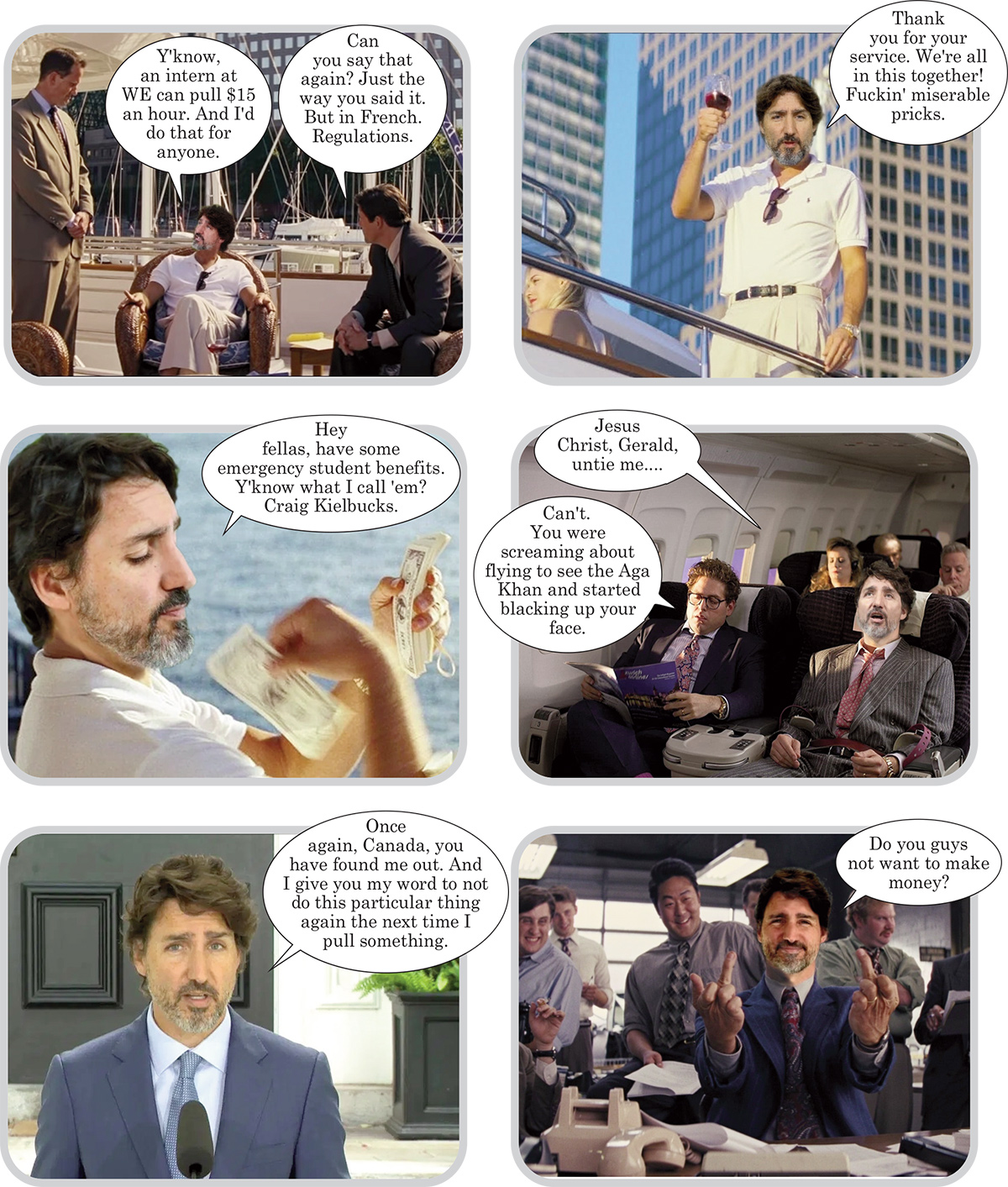
That was fun of Justin Trudeau to act out the message that somebody who spends his days in the Senate is a nobody. Of course, the kind of year he’s having, his bit of theatre came two days after he appointed five new senators. Welcome to the upper chamber, suckers. If you’re really lucky, a flailing prime minister might use you for a punchline.
This felt like the week that Trudeau’s hold on his leadership became precarious. I’ve had people asking me all week whether Trudeau will run again. Of course I don’t know. I guess the only thing that’s new is that if he does stay until the next election, and lead the Liberals into it, I’ll wonder — more keenly than before — why he bothered.
The decision still feels like his alone. The headline-making assaults on his power this week fell well short of what it would take to remove him if he doesn’t want removing. I find Percy Downe a serious and likable man, but he is not gregarious, he doesn’t have networks of people ready to do his bidding, and the truth is that the Senate isn’t a base for getting anything done within the Liberal Party. Hasn’t been for a decade.
As a good Liberal who was working hard long before “hard work” became a Trudeauite slogan, Downe has never forgiven Trudeau for kicking senators out of the Liberal caucus. As a good Prince Edward Islander, he has never forgiven Trudeau for maintaining tolls on the Confederation Bridge between the Island and the mainland while removing tolls on the Champlain Bridge into Montreal. This was a straightforward transfer of wealth from PEI to Central Canada, and turned out to be foreshadowing for last week’s fuel-oil transfer in the other direction. So Downe has a grudge or two to motivate him, and no army to deliver his desired outcome. His preference for Trudeau’s political future is widely shared in the country but he lacks a mechanism for delivering it in real life.
At least Downe has been expressing a clear preference in coherent language. In this he contrasts nicely with Mark Carney. Carney was a successful central-bank governor in two countries, a feat without obvious precedent. But politics is a different line of work. Reading Carney’s interview with the Globe was like watching somebody shake a Ziploc bag full of fridge magnets. In fact I’m pretty sure that when he started talking, he wasn’t planning to deliver any message about party politics.
He’ll “lean in where I can”. He has a list of things he hasn’t ruled out: becoming the next Liberal leader; running for Parliament. Running for Parliament is also on his list of things he hasn’t ruled in. Not ruling things out is, notoriously, not how you actually get into Parliament. I haven’t ruled out becoming a backup dancer for Taylor Swift, and yet I’m not in the new concert film. I checked.
October 4, 2023
“John Adams said that a republican constitutional structure didn’t guarantee republican virtue in government”
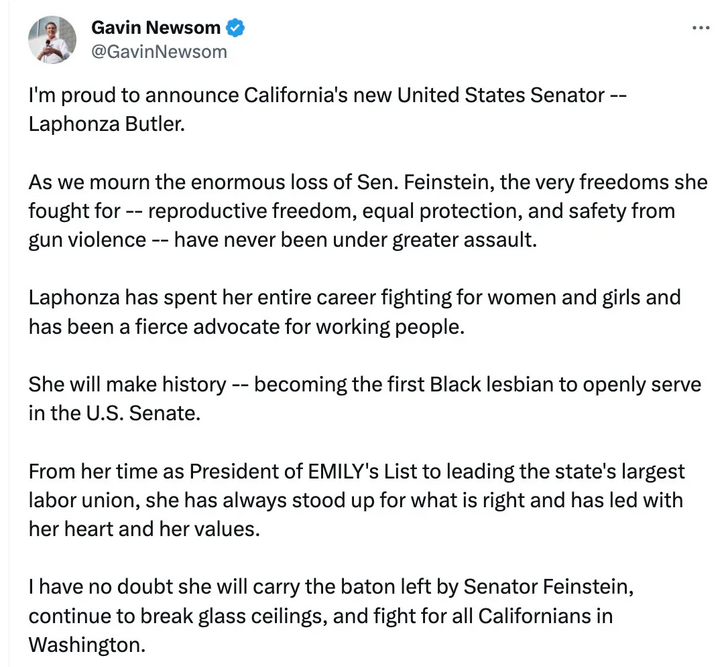
Chris Bray reflects on the 17th amendment to the US Constitution in light of the appointment of California’s new senator:
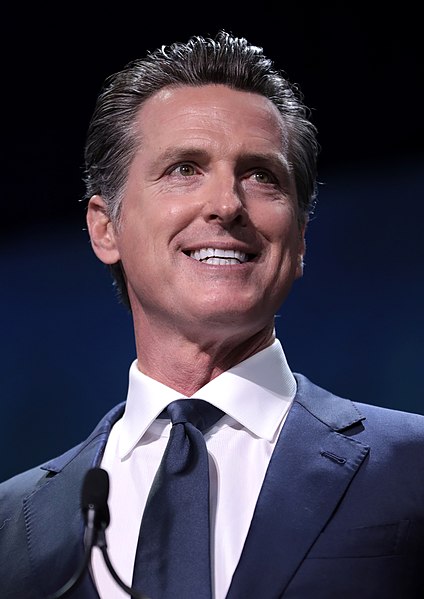
California Governor Gavin Newsom speaking at the 2019 California Democratic Party State Convention in San Francisco, California on 1 June, 2019.
Photo by Gage Skidmore via Wikimedia Commons.
… the Senate was supposed to be the national storehouse of wisdom, restraint, discipline, and worldly experience. You may already be seeing that we wandered away from this idea at some point.
The 17th Amendment, ratified in 1913, gave voters the power to directly elect senators, reducing the influence of state legislatures and opening the upper house to mass media popularity contests. The 16th Amendment — “Congress shall have power to lay and collect taxes on incomes” — was ratified the same year, a one-two punch of Progressive centralization of power.
The democratizing and centralizing character of the 17th Amendment gave us a parade of powerful idiots that culminated in John Fetterman, passing through Mazie Hirono and the professional Ted Baxter impersonator Sheldon Whitehouse, so it looks like a failure. But we’ve just run an experiment, thanks to Dianne Feinstein’s white-knuckled grip on her personal status, and the results are … interesting.
The California legislature, in its infinite wisdom, has given the governor the unilateral authority to appoint Feinstein’s replacement, so we’re not quite seeing the exact duplicate of the original constitutional design for the Senate. But we’re seeing something like it: a senator chosen by something other than the popular vote, elevated to the Senate after selection by a longtime state official who has deep personal familiarity with the pool of people who might do the job. You know, a statesman.
Newsom’s choice for Feinstein’s seat is almost miraculous in its awfulness, an appointment distinguished by cravenness and sleazy insiderism. Naming a new senator from a state with 39 million people in it, he has chosen the Maryland resident Laphonza Butler — who has never held any elected office anywhere.
Butler is a career activist and party hack, an SEIU official who went on to run the abortion PAC EMILYs List. She is, in other words, one of the people whose function in life has been to raise money for the Democratic Party. She’s an ATM, and she’s never been anything else. She’s being appointed to the United States Senate without having ever convinced any voters anywhere to elect her to anything, and she’s rising to the upper house of the national legislature with no experience of any kind in any relevant field. Advice and consent on foreign policy? Confirmation of judicial nominees? Well, she has experience raising money for candidates, so. It’s a straight payoff: generate cash for the party for twenty years, get a free high-status ride in the Senate.
Here’s how Newsom explains the choice:
She’s a black lesbian who gives us money, end of statement. California’s idiot politicians find the choice exciting.
August 7, 2023
The Longest Year in Human History (46 B.C.E.)
Historia Civilis
Published 24 Apr 2019
(more…)
May 1, 2023
“And I, for one, welcome our new CRTC internet overlords”
In this week’s Dispatch from The Line, among other maple-flavoured items is the discussion of how the newly passed Bill C-11 will impact Canadians’ everyday online experience:

We at The Line have spent a lot more time trashing Bill C-18 than its cousin, C-11; the reason for that is fairly simple, if unflattering. Both bills are unwieldy little monsters, rife with competing agendas and we only have so much time and energy to spare. Of the two, though, C-18 affects us and our business more directly as it attempts to force Big Tech companies into secret negotiations to prop up dying legacy media outlets.
C-11, which passed this week, is the Liberals’ attempt to overhaul the Broadcasting Act to bring major streaming services like YouTube and Netflix under the heel of the CRTC. This is generally a pretty bad idea — and we’ll get into that in a second. But the passing of the first major overhaul of the act since the ’90s will, we expect, be heralded by the usual suspects of CanCon leeches who see in the legislation an opportunity to siphon evil Big Tech profit while forcing major platforms to force-feed Canadians into consuming more home-grown shite.
Anyway, part of the bill, it is hoped, will force online streamers to feature more Canadian content for Canadian users, particularly content that highlights the usual progressive checkboxes. And while this does make us roll our eyes a bit — just make good stuff and let people choose what they want for themselves! — we admit that this provision is the less objectionable aspect of C-11.
After this, matters get much more dicey. The attempts to force tech companies to pay for more CanCon will almost certainly backfire in the long run: companies like YouTube have already promised that they will comply with legislation by creating pass-through fees for their creators. In other words, if the government forces YouTube to pay a percentage of its profits into a CanCon fund, YouTube will generate that revenue the only way it can — by skimming more cash from its content creators and re-directing some to the creation of Canadian shows that are then commercialized by major broadcasting networks like Rogers. Seems fair!
Where the bill goes off the rails is over years-long battle over user-generated content protections. Upon hitting the upper chamber, the senate actually advocated for amendments that would ensure that Joe Blow YouTuber wasn’t going to fall under the auspices of CRTC regulation — changes that were rejected by the House. How the CRTC defines a content generator worthy of its regulation, or uses any of its new powers, is now up for consideration by the CRTC itself.
Obviously, we at The Line are concerned about how a regulator is going to employ poorly defined and vaguely stipulated legislative powers to control how Canadians are presented which content, and by whom. We are open to the hopeful possibility that the CRTC is so completely in over their heads that all of the concerns about the bill prove fruitless and overblown. But as a rule, we don’t like to rely on the incompetence of our betters to assure our protections and freedoms.
And that brings us to the major philosophical problems with C-11; the first is that legislation should generally not generate more confusion and uncertainty. As a rule, we think that our laws should be written in such a way that an ordinarily intelligent person with a standard education should be able to understand the laws that govern them. By this measure, the Broadcasting Act — like many others — fail a very basic test. C-11 is written so poorly that even experts seem to disagree about the scope of the bill and how our media landscape will be affected by it in the years to come.
[…]
There is, arguably, no reason for the CRTC, nor for the Broadcasting Act in its current form, to exist anymore. Digital space isn’t finite. Canadians can easily find news and entertainment that is relevant to them. We don’t need the government to ensure that Canadian content is produced and funded. Or, if some government intervention is deemed necessary, it need not amount to anything more complicated than a simple tax, with revenues diverted to one of this country’s myriad granting agencies to aid production. Instead, we have a government that seems hellbent on extending the power of a regulator at the very moment in history that this regulator is most redundant.
Given that we’re being led by an increasingly insular government that equates all criticism to disingenuous misinformation, and seems to want to stamp out the evils of wrong opinions on the Internet in the coming Online Harms bill, well, let’s just say we’re increasingly concerned and perturbed.
April 7, 2023
Political demands without proper definitions
Chris Bray identifies an all-too-common pattern from the people who demand change, but can’t seem to adequately explain what they’re so all-fired passionate about:
There’s an exchange I’ve seen a dozen times in the last few months, and it’s always more or less the same. The faces and the names change, but the structure of the discussion is consistent. It happened last week between Senator John Kennedy and Homeland Security Secretary Alejandro Mayorkas (video is time-stamped to 1:55 or so, when the discussion begins, but Substack sometimes eats the timestamp, so fast-forward if necessary):
I won’t quote from it, because it’s so casually bizarre and unsettling you should just watch it to see for yourself, but Kennedy notes that Mayorkas has recently and very publicly demanded a federal ban on assault weapons — and then he asks Mayorkas to define “assault weapons”. You want to ban X, so what is X? What is the thing you intend to ban?
Mayorkas responds with all known forms of rhetorical deflection short of diving under the table: “I defer to the experts,” do it for the children, it is no longer acceptable to do nothing as people die, the children the children the children. But he will not propose a definition for the term. He wants to ban something, but he refuses to say what he wants to ban. Kennedy keeps asking; Mayorkas keeps right on with not ever saying. The closest he ever comes to an answer is that at one point he tentatively upspeaks a firm maybe, saying that possibly assault weapons are kind of … military style? But then he won’t say what that means, either.
Not noticing himself, Mayorkas just comes right out and says one of the things that fatally undermines his own claim that he lacks the expertise to participate in the discussion, noting that he worked as both an assistant U.S. attorney and as the U.S. Attorney for the Central District of California while the last federal assault weapons ban was on the books. So he’s been a federal prosecutor, and has led federal prosecutors, during a period when federal prosecutors went to court to enforce an assault weapons ban, but he can’t possibly discuss a legal definition of the term “assault weapon,” because he’s not an expert in a question that was central to his professional identity for years. I don’t know nothin’ about all this giraffe anatomy, says local zoo veterinarian.
So this is the structure of the exchange:
Very Senior Government Official: I demand that we do X, because X is very important.
Questioner: Okay, what is X?
Very Senior Government Official: I have no idea.
[…]
Over and over and over again, prominent members of the political class argue for things by throwing their givens around the room, and that’s all they can do. I feel very strongly that we need common sense solutions, in the sense that the solutions we need are very common sense things that we can all agree are very common sense. If you try to penetrate the half-millimeter of topsoil to find out what’s underneath, you see that there isn’t anything down there. You can ask them to explain their underlying premises, or to explain by logical steps how they reached their policy conclusions, but you’re just being charitable. They don’t have any of that, and wouldn’t admit it if they did. They simply feel, senator, that we must protect the children. With bipartisan solutions. That are common sense.
Yes, this is sometimes a tactic, and they know what they mean. But the brittle crust at the top edge of the discourse increasingly seems to not be characterized by the sneaky maneuver. There’s often nothing to probe for. There’s no debate to be had by opening a space for the discussion. Remarkable numbers of “leaders” read what’s on the index card — and then look up, finished with the statement, waiting for a treat like a golden retriever.
I am for [symbol]!
Mister Secretary, what do you mean by [symbol]?
I am for [symbol], I am for [symbol]! (Long pause.) I am for [symbol!]
So it seems to me that the first fact about our political discourse is that it’s increasingly about nothing, populated by people who don’t mean anything and can’t think about anything. There’s often no possibility of an exchange that leads to a deepened understanding, because there’s nothing in there. We must fight inflation by passing the Inflation Reduction Act! The public sphere has been emptied; its where we go to pass null sets back and forth.

January 18, 2023
Our western gerontocracy
In The Free Press, Katherine Boyle outlines the death-grip that elderly boomers retain on so many of the levers of our shared society, from government to business to (of course) the legacy media:

“Millennials” by EpicTop10.com is licensed under CC BY 2.0

The tens of millions of Americans that are, like me, millennials or members of the generation just younger, Gen Z, have been treated as hapless children our entire lives. We have been coded as “young” in business, in politics, and in culture. All of which is why we shouldn’t be surprised that millennials are the most childless and least home-owning generation in modern American history. One can’t play house with a spouse or have their own children when they’ve moved back into mom’s, as 17 percent of millennials have.
Aside from the technology sector — which prizes outliers, disagreeableness, creativity and encourages people in their twenties to take on the founder title and to build things that they own — most other sectors of American life are geriatric.
The question is why.
There are many theories — and many would-be culprits. Some believe it’s the fault of the Boomers, who have relentlessly coddled their children, perhaps subconsciously, because they don’t want to pass the baton. Others put the blame on the young, who are either too lazy, too demoralized or too neurotic to have beaten down the doors of power to demand their turn.
Then again, life expectancy is growing among the healthy and elite in industrialized nations, so perhaps this is all just progress and 70 is the new 40. But one can take little solace in the growing life expectancy of the last 200 years when comparing ourselves to more productive generations that didn’t waste decades on extended adolescence.
Every Independence Day, we’re reminded that on July 4, 1776, the most famous founders of this country were in their early 20s (Alexander Hamilton, Aaron Burr) and early 30s (Thomas Jefferson). Even grandfatherly George Washington was a mere 44. These days much of our political class, from Bill Clinton (elected president 30 years ago at age 46) to financial leaders like Warren Buffett (92), and Bill Gates (67) who launched Microsoft 48 years ago, are still dominant three and four decades after seizing the reins of power. CEOs of companies listed on the S&P 500 are getting older and staying in their jobs longer, with the average CEO now 58 years old and staying in his or her role 10.8 years versus 7.2 a decade ago. And our political culture looks even more gray: Twenty-five percent of Congress is now over the age of 70 giving us the oldest Congress of any in American history.
The Boomer ascendancy in America and industrialized nations has left us with a global gerontocracy and a languishing generation waiting in the wings. Not only does extended adolescence — what psychologist Erik Erikson first referred to as a “psychosocial moratorium” or the interim years between childhood and adulthood — affect the public life of younger generations, but their private lives as well.
In 1990, the average age of first marriage in the U.S. was 23 for women and 26 for men, up from 20 for women and 22 for men in 1960. By 2021, that number had risen to 28.6 years for women and 30.4 years for men, according to the Census Bureau, with 44 percent of U.S. women between the ages of 25 and 44 expected to be single in 2030. Delayed adulthood has had disastrous consequences for procreation in industrialized nations and is at the root of declining fertility and all-but-certain population collapse in dozens of countries, many of which expect the halving of their populations by the end of the century.
“Twenty-five is the new 18,” said The Scientific American in 2017, pointing to research that extended adolescence is a byproduct of affluence and progress in society. Which is why the finiteness of a mid-thirties half-life is such a surprise to those in their 20s and 30s. It runs counter to every meme and piece of advice young people receive about building a career, a family, a company and in turn, a country.
The prevailing wisdom in Western nations is that the ages of 18-29 are a time for extreme exploration — the collecting of memories, friends, partners and most importantly, self-identity. A full twelve years of you! Self-discovery aided by platforms built for broadcasting photos of artisanal cocktails and brunch. And with no expectation for leadership because there will be time for that, a generation can absolve oneself of responsibility for their actions. (Tragically, that was never true for half of the population, which is why we have a generation of extremely accomplished older women, who weren’t really aware how difficult it is to become pregnant at 39.)
January 5, 2023
Roman Emperors, Part 8 – Nero: Life and Death
seangabb
Published 20 Dec 2022This is a video record of a lecture given by Sean Gabb, in which he discusses what we can know or suspect about the life of the Emperor Nero. Some criticism here of Tacitus as a reliable source.
The Roman Empire was the last and the greatest of the ancient empires. It is the origin from which springs the history of Western Europe and those nations that descend from Western Europe. It is the political entity within which the Christian faith was born, and the growth of the Church within the Empire, and its eventual establishment as the sole faith of the Empire, have left an indelible impression on all modern denominations. Its history, together with that of the Ancient Greeks and the Jews, is our history. To understand how the Empire emerged from a great though finally dysfunctional republic, and how it was consolidated by its early rulers, is partly how we much understand ourselves.
(more…)
December 27, 2022
Marcus Licinius Crassus, the richest man in Rome
In The Critic, Bijan Omrani reviews Crassus: The First Tycoon by Peter Stothard:

If you are feeling despondent about the dismal quality of the current generation of politicians, it may be some comfort to remember that even in the golden age of Rome such complaints were legion.
The poet Horace wrote at length about how the ruling class had gone downhill. Once, there had been paragons of virtue such as Cincinnatus, who after saving Rome as dictator laid down his power without demur and returned to live on his humble farm; or the consul Regulus, who refused to make any concessions after being captured by the Carthaginians, although he knew they would torture him to death. Instead of these titans, the modern age had brought forth a base generation. Marcus Licinius Crassus, the richest man in Rome and subject of this new biography, was foremost among them.
The formidable influence wielded by Crassus in the final years of the Roman Republic — he was an ally, and rival, of Julius Caesar and Pompey the Great — came not by way of old-fashioned heroics and victories on the battlefield. His methods were recognisably modern. Peter Stothard characterises him as a “disrupter of old rules, fixer and puller of the puppet strings of power”. His tools were money and the economy of favours. He employed them with a coldness, ruthlessness and level of calculation that makes him unappetising, but deeply compelling. Stothard’s description of him as “The First Tycoon” is apt. He is the sort of character one might expect to find wearing red braces in a New York boardroom, rather than a brocaded toga in the Roman Forum.
By origin, Crassus was a member of one of Rome’s blue-blooded families. His pursuit of political influence by means of business rather than military prowess would seem at first sight unexpected, given the traditional prohibition against the senatorial aristocracy engaging in trade. Yet, the turmoil of Crassus’s formative years overturned these niceties. The last sight he had of his father, who had served as a consul, was of his head on a spike in the Forum.
He was a victim of the perennial strife that plagued Rome at the beginning of the 1st century BC, caused by imbalances in wealth and tensions between Rome and wider Italy, not to mention discord over land, military and constitutional reforms. With the death of his father and two of his brothers, Crassus had to flee Rome and hide in a cave for eight months in Spain, where his family still had allies. It is doubtless these upheavals — similar to those of Julius Caesar, who lost his father young and had to go into hiding during this chaos — led Crassus to seek an inviolable security, regardless of whether he trampled on old Roman conventions and upset others to do so.
When the aristocratic faction seized power in the late 80s BC, Crassus was able to return to Rome. There, he pursued every commercial method, no matter how disreputable, to accumulate wealth. It satisfied not only his needs for security but, as Stothard argues, it was also a way of seeking revenge for the death of his father. He bought up the properties of those families allied to the earlier populist regime which had just been displaced.
These came at a knock-down price, as the families had been outlawed, with some executed and others sent into exile. Crassus appears to have been on a committee which determined the loyalty of citizens to the new government and appears not to have scrupled to condemn those whose property he coveted. His other prime method for enlarging his portfolio was to buy up cheaply buildings that were on fire, or else in the path of a fire. He organised his slaves along military lines, using them with relentless efficiency to acquire, rebuild and sell on property for a huge profit.
December 23, 2022
Never, ever be the first to stop clapping
Chris Bray on the echoes of Soviet-era mandatory celebrations expected of US elected politicians during a speech by Comrade Stalin to the Politburo state visit by the President of Ukraine:
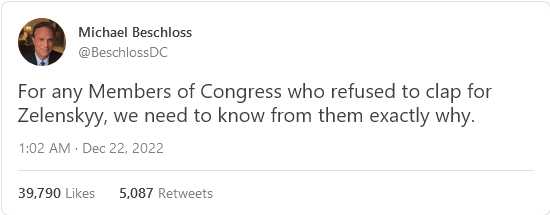
I hesitate to say any of this, because it’s December 22 and none of us should be thinking about the grotesqueries of the political and media classes, but it’s been a busy week for them. I started writing here a little more than a year ago, and have argued since the beginning that our notional leadership classes have developed a set of ritual behaviors that are entirely severed from any form of reality you’ll ever see in your own daily life. (Dana Loesch: “You can’t run a country you’ve never been to.”)
And so here’s one of the least subtle court eunuchs with a message about ritual obedience:
I wish I could replicate the awkward burst of nervous laughter that came out of me at the moment that I saw this message. The policing of performative applause in a formal political setting is so obviously a theme of totalitarian societies that … well, that Chief Eunuch Michael Beschloss can be counted on to not notice what he’s just done. I didn’t get a harumph outta that guy, he said, from deep inside a cloud of obtuse self-regard.
“They insist on inflicting on us such bloated theater & they seem not to know how false it all appears.” The Ukrainian president made it all the way to the Capitol in his combat fatigues, doncha know, and was greeted with a rapturous standing ovation by members of Congress, seen here in this actual footage:
Are there any normal human beings who don’t taste bile when they see this performance? And, Thomas Massie and Rand Paul aside, are there any normal human beings left inside the Beltway?
“Squee! Squee! Squee!” they explained, shaking their pom poms in a dignified ritual of state.