
Adrian Goldsworthy. Historian and Novelist
Published 1 Oct 2024Today’s question is about the career paths for senatorial and equestrian officers in the Roman army. This is a big theme, so take this as an introduction. We will return to this topic in the future.
February 3, 2025
Roman Senior Army Officers and their careers
Comments Off on Roman Senior Army Officers and their careers
January 5, 2025
QotD: The customary Dictatorship in the Roman Republic before 82BC
It’s important to note at the outset that the Romans had no written constitution and indeed most of the rules for how the Roman Republic functioned were, well, customary. The Roman term for this was the mos maiorum, the “custom of the ancestors”, but Roman practice here isn’t that different from how common law and precedent guide the functioning of something like the British government (which also lacks a written constitution). Later Roman writers, particularly Cicero, occasionally offer theoretical commentary on the “rules” of the Republic (as a retrojected, ideal version), but just as often their observations do not actually conform to the practice we can observe from earlier periods. In practice, the idea here was that the “constitution” of the Republic consisting in doing things as they had always been done, or at least as they were understood to have always been done.
Consequently, as historians, we adopt the formulation that the Republic is what the Republic does – that is that one determines the rules of offices and laws based on how they are implemented, not through a hard-and-fast firm legal framework. Thus “how does the dictatorship work?” is less a question of formal rules and more a question of, “how did the eighty-odd Roman dictatorships work?”
The basic idea behind the office was that the dictator was a special official, appointed only in times of crisis (typically a military crisis), who could direct the immediate solution to that crisis. Rome’s government was in many ways unlike a modern government; in most modern governments the activities of the government are carried out by a large professional bureaucracy which typically reports to a single executive, be that a Prime Minister or a President or what have you. By contrast, the Roman Republic divided the various major tasks between a bunch of different magistrates, each of whom was directly elected and notionally had full authority to carry out their duties within that sphere, independent of any of the other magistrates. In crude analogy, it would be as if every member of the United States cabinet was directly elected and none of them reported to any of the rest of them but instead all of them were advised by Congress (but in a non-binding manner). Notionally, the more senior magistrates (particularly the consuls) could command more junior magistrates, but this wasn’t a “direct-report” sort of relationship, but rather an unusual imposition of a more senior magistrate on a less senior one, governed as much by the informal auctoritas of the consul as by law.
In that context, you can see the value, when rapid action was required, of consolidating the direction of a given crisis into a single individual. This is, after all, why we have single executive magistrates or officials in most countries. So, assuming you have a crisis, how does this process work?
The typical first step is that the Senate would issue its non-binding advice, a senatus consultum, suggesting that one or both of the consuls appoint a dictator. The consuls could ignore this direct, but almost never did (save once in 431, Liv. 4.26.5-7). The consuls would then have to nominate someone; they might agree on the choice (which would make things simple) or one of them might be indisposed (out of the city, etc.), which would leave the choice to the one that remained. If both consuls were present and did not agree, they’d draw lots to determine who got to pick (which happens in the aforementioned instance in 431 after the tribunes got the consuls of that year to relent and pick someone, Liv. 4.26.11).
The nominating consul could pick anyone except himself; if you, as consul, wanted to be dictator, you would need your co-consul to so nominate you. There were no formal requirements; of course nominations tended to go to experienced commanders, which tended to mean former consuls, but this was not a requirement. Publius Claudius Pulcher (cos. 249), enraged when the Senate directed him to appoint a dictator (because of his own bungled military command) infamously nominated his own freedman, Claudius Glicia, as dictator (Liv. Per. 19.2; Seut. Tib. 2.2), which was apparently a bridge too far; Glicia was forced to abdicate but his name was duly entered onto the Fasti because the appointment was valid, if ill-advised (despite the fact that, as a freedman, Glicia would have been ineligible to run for any [office]). Nevertheless, dictators were usually former consuls.
Once the name was picked, in at some cases the appointment may have been confirmed by a vote of the Comitia Curiata, Rome’s oldest voting assembly, which was responsible for conferring imperium (the power to command armies and organize law courts; essentially “the power of the kings”) on magistrates; not all magistrates had imperium (consuls, praetors, proconsuls, propraetors, dictators and their magistri equitum did; quaestors, aediles, tribunes, both plebeian and military, and censors did not). We do not know of any instance where the Comitia Curiata put the kibosh on the appointment of a dictator, so this step was little more than a rubber-stamp, and may have been entirely optional (Lintott, op. cit., 110, n. 75), but it may have also reflected the notion that all imperium had to be conferred by the people through a voting assembly. It is often hard to know with clarity about pro forma elements of Roman politics because the sources rarely report such things.
The dictator was appointed to respond to a specific issue or causa, the formula for which are occasionally recorded in our sources. The most common was rei gerundae causa, “for the business to be done” which in practice meant a military campaign or crisis. In cases where the consuls were absent (out on campaign), a dictator might also be nominated comitiorum habendorum causa, “for having an assembly”, that is, to preside over elections for the next year’s consuls, so that neither of the current consuls had to rush back to the city to do it. Dictators might also be appointed to do a few religious tasks which required someone with imperium. Less commonly but still significantly, a dictator might be appointed seditionis sedenae causa, “to quell sedition”; only one instance clearly under this causa is known, P. Manlius Capitolinus in 368, but several other instances, e.g. L. Quinctius Cincinnatus in 439, also dealt with internal matters. Finally, once in 216, Marcus Fabius Buteo held the office of dictator senatus legendi causa, “to enroll the Senate”, as the Battle of Cannae, earlier that year, had killed so many Senators that new inductions were needed (Liv. 23.23).
The dictator then named a subordinate, the magister equitum (“master of the horse”). The magister equitum was a lieutenant, not a colleague, but interestingly once selected by a dictator could not be unselected or removed, though his office ended when the dictator laid down his powers. We should note Marcus Minucius, magister equitum for Q. Fabius Maximus in 217 as an exception; his selection was forced by the people via a law and his powers were later made equal to Fabius’ powers. This turned out to be a substantial mistake, with Fabius having to bail the less prudent Minucius out at Geronium – the undermining of Fabius generally during 217 was, in retrospect viewed as a disaster, since the abandonment of his strategy led directly to the crushing defeat at Cannae in 216.
One of the ways that legal power was visually communicated in Rome was through lictors, attendants to the magistrates who carried the fasces, a bundle of rods (with an axe inserted when outside the sacred bounds of the city, called the pomerium). More lictors generally indicated a greater power of imperium (consuls, for instance, could in theory give orders to the praetors). Praetors were accompanied by six lictors; consuls by 12. The dictator had 24 lictors when outside of the pomerium to indicate his absolute power in that sphere (that is, in war), but only 12 inside the city. The magister equitum, as the dictator’s subordinate, got only six, like the praetors.
It also seems fairly clear that while dictators had almost complete power within their causa, those powers didn’t necessarily extend beyond it (e.g. Liv. 2.31.9-11, the dictator Manius Valerius, having been made dictator to resolve a military problem, insists to the Senate that he cannot resolve internal strife through his dictatorial powers and instead lays down his office early). The appointment of a dictator did not abolish the other offices (Cicero thinks they do, but he is clearly mistaken on the matter, Cic. De Leg. 3.9, see Lintott, 111). In essence then, the dictator was both a supreme military commander and also expected to coordinate the other magistrates with his greater degree of imperium, though of course in practice the ability to do that is going to substantially depend on the individual dictator’s ability to get cooperation from the other magistrates (but then, on the flip side, the dictator has just been designated as the leader in the crisis, so the social pressure to conform to his vision must have been intense). Notably, dictators could not make a law (a lex) on their own power or legislate by fiat outside of their causa; they could and did call assemblies which could by vote approve laws proposed by a dictator, however.
The dictator served for six months or until the task for which he was appointed was resolved, whichever came first. There is a tendency in teaching Roman history to represent a figure like Cincinnatus, who laid down his dictatorship after just fifteen days in 458, as exceptional but while the extreme shortness of term was exceptional, laying down power was not. Indeed, Cincinnatus (or perhaps a relative) served as dictator again in 439 and again laid down his power, this time in merely 21 days. In practice, the time-limited nature of the dictatorship meant there were few incentives to “run out the clock” on the office since it was so short anyway – better, politically, to solve the crisis quickly and lay down power ostentatiously early and “bank” the political capital than try to run out the period of power, accomplish relatively little and squander a reputation for being public-spirited.
Bret Devereaux, “Collections: The Roman Dictatorship: How Did It Work? Did It Work?”, A Collection of Unmitigated Pedantry, 2022-03-18.
Comments Off on QotD: The customary Dictatorship in the Roman Republic before 82BC
January 2, 2025
DOGE has a lot of low-hanging fruit to pick
Patrick Carroll selects some of the least-defendable ways the US government has been spending taxpayer money from Senator Rand Paul’s 2024 Festivus Report, including pickleball courts, $10B in unused office space, DEI initiatives for birdwatchers, crop fertilizer in foreign countries, and literal circus performances:

Rand Paul by Gage Skidmore is licensed under CC BY-SA 2.0 

 .
.
Why does such government waste persist year after year? A significant part of the explanation traces back to the concept of concentrated benefits and dispersed costs. Essentially, the beneficiaries tend to be a small, concentrated group, so they lobby hard for these outlays because they stand to gain a lot from them. Taxpayers, on the other hand, tend to be dispersed and only minimally affected by any single expense, so it’s not usually worth it for them to lobby against the spending, or even learn about it in the first place.
Economist Gordon Tullock famously illustrated this concept with his fictional Tullock Economic Development Plan. The plan “involves placing a dollar of additional tax on each income tax form in the United States and paying the resulting funds to Tullock, whose economy would develop rapidly”.
Think about the incentive Tullock would have to advocate for this plan, compared to the incentive that an ordinary taxpayer would have to look into it and voice their objections. With campaign contributions and votes to be gained from the special interest beneficiaries, is it any wonder politicians often go for these kinds of wealth transfers?
The ubiquity and stubborn persistence — year after year — of all this waste, combined with the economic theory that explains why it happens, suggests that there is a fundamental problem with the process of government as we know it. This is not, as many are itching to believe, a “Democrat” problem or a “Republican” problem. The degree of government waste changes very little with changing administrations. No, this is a problem with the government as such.
To solve this problem, we need to ask not just who should run the government, but what the government should be allowed to spend money on in the first place, given what we know about its entirely predictable and repeatedly demonstrated propensity for waste and dysfunction.
Milei has already started that conversation in Argentina. Let’s hope that with the new Trump administration and DOGE, that’s a conversation we can have here as well.
December 27, 2024
The First Triumvirate – The Conquered and the Proud 10
Adrian Goldsworthy. Historian and Novelist
Published Jul 10, 2024This time we take a look at the Fifties BC, the formation of the first triumvirate, Caesar’s consulship, Clodius and Milo’s organised violence, Caesar in Gaul, Crassus in Syria and Parthia. The context is conquest and Roman success abroad with spiralling chaos at home. A big theme is the build-up to the Civil War and Caesar crossing the Rubicon in January 49 BC. We end with a quick run through the campaigns of the Civil War.
Primary sources include Caesar’s War Commentaries, Cicero’s letters and speeches, Plutarch’s Lives, Appian’s Civil War.
Comments Off on The First Triumvirate – The Conquered and the Proud 10
November 26, 2024
Crony Capitalist Canada – “Conservative Leader Pierre Poilievre … has vowed to protect Big Dairy just like every other party leader”
In the National Post, Chris Selley discusses the latest attempt to further protect the outrageous profits our dairy companies make by overcharging Canadians for milk, butter, cheese, and other dairy products:

That unelected senators should not overrule the will of the House of Commons has always struck me as a rule most Canadians could agree on, whatever they think ought to happen with Canada’s upper chamber. Senators can propose amendments to bad bills, rake ministers over the coals at committee, call witnesses the House wasn’t interested in for whatever reason, raise red flags that haven’t yet been raised, all to the good. But gutting a bill, as the Senate has done with proposed legislation that would protect supply management in Canadian dairy, poultry and eggs even more than it’s already protected, is not kosher.
Not all violations of this policy are equally appalling, however. When the House of Commons is clearly not operating for the benefit of Canadians, when its focus demonstrably isn’t the public good but rather coddling and currying favour with special interests, it behooves the Senate to intervene as strenuously as possible while still at the end of the day respecting the lower chamber’s democratic legitimacy.
Coddling and currying favour is exactly what C-282, a private member’s bill from Bloc Québécois Luc Thériault, does: It proposes to make it illegal for a future government to lower the tariff rate for foreign products in supply-managed industries. You could call it the “no to cheaper groceries act.” Some senators wish to neuter it, such that it wouldn’t apply to any existing trade deals or deals already in negotiation. Bloc Leader Yves-François Blanchet had originally demanded the bill passed as one condition of keeping the Liberals afloat (although his deadline to do so has passed).
Fifty-one MPs of 338 opposed the pricey-groceries act at third reading. I would have said “only 51” except that’s a shocking number: 49 Conservatives and two Liberals, Nathaniel Erskine-Smith and Chandra Arya. It’s almost reason for hope … except of course that Conservative Leader Pierre Poilievre voted for it, and has vowed to protect Big Dairy just like every other party leader. It goes without saying that Prime Minister Justin Trudeau not only supported it, but has come out against the Senate’s amendments.
“We will not accept any bill that minimizes or eliminates the House’s obligation to protect supply management in any future trade agreement,” Trudeau reassured Blanchet in the House on Wednesday. ” No matter what the Senate does, the will of the House is clear.”
I mean, what elected politician in Ottawa gives a shit about Canadians being gouged on grocery staples every week? They’d rather get the support of the milk, poultry and egg crony capitalists than help ordinary Canadians, and they’re terrified of being portrayed as anti-Quebec in an election year. Spineless cowards, the lot of them.
Comments Off on Crony Capitalist Canada – “Conservative Leader Pierre Poilievre … has vowed to protect Big Dairy just like every other party leader”
November 10, 2024
The Sixties, Cicero, Catiline, Cato and Caesar – The Conquered and the Proud Episode 9
Adrian Goldsworthy. Historian and Novelist
Published Jul 3, 2024Continuing our series on the the history of Rome from 200 BC to AD 200, this time we look at the turbulent decade following the consulship of Pompey and Crassus in 70 BC. These years saw Pompey being given major commands against the pirates and Mithridates. Men like Cicero, Caesar and Cato were on the ascendant. Cicero’s letters can make the decade seem calm, but further consideration reveals the threat and reality of political violence, seen most of all in Catiline’s conspiracy which led to a brief civil war.
In this talk we explore the themes we have already considered and consider how imperial expansion continued to change the Roman Republic.
This talk will be released in July — and as this is the month named after Julius Caesar, it seemed only appropriate to have a Caesar theme to most of the talks.
Next time we will look at the Fifties BC and the start of the Civil War in 49 BC.
Comments Off on The Sixties, Cicero, Catiline, Cato and Caesar – The Conquered and the Proud Episode 9
October 10, 2024
HBO’s Rome – Ep. 2 “How Titus Pullo brought down the Republic” – History and Story
Adrian Goldsworthy. Historian and Novelist
Published Jun 26, 2024A look at episode 2 of the first series/season of HBO’s Rome drama. Once again we talk about the actual history and how the characters, events and institutions are presented in the series. This time this includes Antony becoming tribune of the plebs, as well as a meeting of the Senate and Julius Caesar crossing the Rubicon.
Vidcaps taken from the dvd edition, so copyright belongs to HBO.
Comments Off on HBO’s Rome – Ep. 2 “How Titus Pullo brought down the Republic” – History and Story
September 30, 2024
Sulla, civil war, and dictatorship
Adrian Goldsworthy. Historian and Novelist
Published Jun 5, 2024The latest instalment of the Conquered and the Proud looks at the first few decades of the first century BC. We deal with the final days of Marius, the rise of Sulla, the escalating spiral of civil wars and massacres as Rome’s traditional political system starts breaking down.
Primary Sources – Plutarch, Marius, Sulla, Pompey, Crassus, Cicero and Caesar. Appian Civil Wars and Mithridatic Wars.
Secondary (a small selection) –
P. Brunt, Social Conflicts in the Roman Republic & The Fall of The Roman Republic
A. Keaveney, Sulla – the last Republican
R. Seager, Pompey the Great: A political Biography
Comments Off on Sulla, civil war, and dictatorship
September 22, 2024
History and story in HBO’s Rome – S1E1 “The Lost Eagle”
Adrian Goldsworthy. Historian and Novelist
Published Jun 12, 2024Starting a series looking at the HBO/BBC co production drama series ROME. We will look at how they chose to tell the story, at what they changed and where they stuck closer to the history.
Comments Off on History and story in HBO’s Rome – S1E1 “The Lost Eagle”
August 17, 2024
Caesar Marches on Rome – Historia Civilis Reaction
Vlogging Through History
Published Apr 23, 2024See the original here –
• Caesar Marches on Rome (49 B.C.E.)
See “Caesar Crosses the Rubicon” here –
• Caesar Crosses the Rubicon – Historia…#history #reaction
Comments Off on Caesar Marches on Rome – Historia Civilis Reaction
August 4, 2024
Caesar Crosses the Rubicon – Historia Civilis Reaction
Vlogging Through History
Published Apr 22, 2024See the original here – Caesar Crosses the Rubicon (52 to 49 …
#history #reaction
Comments Off on Caesar Crosses the Rubicon – Historia Civilis Reaction
July 12, 2024
QotD: Membership in the Senate during the Roman Republic
Despite that lack of formal powers, the Senate of the Roman Republic largely directed the overall actions of the republic, coordinating its strategic policy (both military and diplomatic), setting priorities for legislation, handling Rome’s finances and assigning and directing the actions of the various magistrates. The Senate – not the Pontifex Maximus1 – was also the final authority for questions of religion. The paradox exists because the Senate’s power is almost entirely based in its auctoritas and the strong set of political norms and cultural assumptions which push Romans to defer to that auctoritas [the Mos maiorum].
[…]
We should start with who is in the Senate. Now what you will generally hear in survey courses is this neat summary: the Senate had 300 members (600 after Sulla) and included all Romans who had obtained the office of the quaestorship or higher and its members were selected by the censors. And for a basic summary, that actually serves pretty well, but thinking about it for a few minutes one quickly realizes that there must be quite a bit of uncertainty and complexity underneath those neat easy rules. And indeed, there is!
First we can start with eligibility by holding office. We know that in the Sullan constitution, holding the quaestorship entitled one into entrance into the Senate. Lintott notes that the lex repetundarum of 123/4 lumped every office aedile-and-above together in a phrasing “anyone who has or shall have been in the Senate” when setting eligibility for the juries for the repetundae courts (the aim being to exclude the magistrate class from judging itself on corruption charges), and so assumes that prior to Sulla, it was aediles and up (but not quaestors) who were entitled to be in the Senate.2 The problem immediately occurs: these higher offices don’t provide enough members to reach the frequently attested 300-Senator size of the Senate with any reasonable set of life expectancies.
By contrast, if we assume that the quaestors were enrolled in the Senate, as we know them to have been post-Sulla (Cicero is a senator for sure in 73, having been quaestor in 75), we have eight quaestors a year elected around age 30 each with roughly 30 years of life expectancy3 we get a much more reasonable 240, to which we might add some holders of senior priesthoods who didn’t go into politics and the ten sitting tribunes and perhaps a few reputable scions of important families selected by the censors to reach 300 without too much difficulty. The alternative is to assume the core membership of the Senate was aediles and up, which would provide only around 150 members, in which case the censors would have to supplement that number with important, reputable Romans.
To which we may then ask: who might they choose? The obvious candidates would be … current and former quaestors and plebeian tribunes. And so we end up with a six-of-one, half-dozen of the other situation, where it is possible that quaestors were not automatically enrolled before Sulla, but were customarily chosen by the censors to “fill out” the Senate. Notably, when Sulla wants to expand the Senate, he radically expands (to twenty) the number of quaestors, which in turn provides roughly enough Senators for his reported 600-person Senate.
That leads us to the role of the censors: if holding a sufficiently high office (be it the quaestorship or aedileship) entitles one to membership for life in the Senate, what on earth is the role of the censors in selecting the Senate’s membership? Here the answer is in the sources for us: we repeatedly see the formula that the meetings of the Senate were attended by two groups: the Senators themselves and “those who are permitted to state their opinion in the Senate”. Presumably the distinction here is between men designated as senators by the censors and men not yet so designated who nevertheless, by virtue of office-holding, have a right to speak in the Senate. It’s also plausible that men who were still iuniores might not yet be Senators (whose very name, after all, implies old age; Senator has at its root senex, “old man”) or perhaps men still under the potestas of a living father (who thus could hardly be one of the patres conscripti, a standard term for Senators) might be included in the latter group.
In any case, the censors seem to have three roles here. First, they confirm the membership in the Senate of individuals entitled to it by having held high office. Second, they can fill out an incomplete Senate with additional Roman aristocrats so that it reaches the appropriate size. Finally, they can remove a Senator for moral turpitude, though this is rare and it is clear that the conduct generally needed to be egregious.
In this way, we get a Senate that is as our sources describe: roughly 300 members at any given time (brought to the right number every five years by the censors), consisting mostly of former office holders (with some add-ons) who have held offices at or above the quaestorship and whose membership has been approved by the censors, though office holders might enter the Senate – provisionally, as it were – immediately pending censorial confirmation at a later date. If it seems like I am giving short shrift to the “filling the rank” add-ons the censors might provide, it is because – as we’ll see in a moment – Senate procedure combined with Roman cultural norms was likely to render them quite unimportant. The role of senior ex-magistrates in the Senate was to speak, the role of junior ex-magistrates (and certainly of any senator who had not held high office!) was to listen and indicate concurrence with a previously expressed opinion, as we’re going to see when we get to procedure.
Bret Devereaux, “Collections: How to Roman Republic 101, Part IV: The Senate”, A Collection of Unmitigated Pedantry, 2023-09-22.
1. I stress this point because this is a common mistake: assuming that the Pontifex Maximus as Rome’s highest priest was in some way the “boss” of all of Rome’s other priests. He was not; he was the presiding officer of the college of Pontiffs and the manager of the calendar (this was a very significant role), but the Pontifex Maximus was not the head of some priestly hierarchy and his power over the other pontifices was limited. Moreover his power over other religious officials (the augures, haruspices, the quindecimviri sacris faciundis and so on) was very limited. Instead, these figures report to the Senate, though the Senate will generally defer to the judgment of the pontifices.
2. With sitting tribunes able to attend meetings of the Senate, but not being granted lifelong membership.
3. A touch higher than the 24 years a L3 Model West life table (what we generally use to simulate Roman populations) leads us to expect, but then these are elites who are likely to be well nourished and not in hazardous occupations, so they might live a bit longer.
Comments Off on QotD: Membership in the Senate during the Roman Republic
June 17, 2024
For want of a security clearance, the (potential) traitors escaped scot-free
In the free-to-cheapskates section of this week’s Dispatch from The Line, we get a summary of the state of brain-freeze in Parliament over the NSICOP (National Security and Intelligence Committee of Parliamentarians) report, that in a functioning state would have triggered much more action than it has in the dysfunctional Dominion:
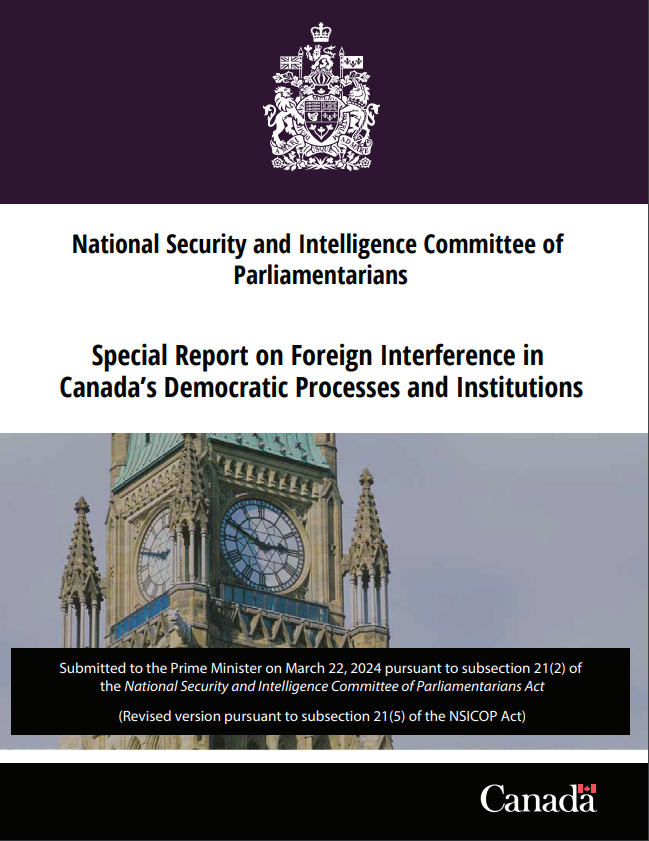
The cover of the NSICOP special report on foreign interference (PDF – https://nsicop-cpsnr.ca/reports/rp-2024-06-03/special-report-foreign-interference.pdf )
The lead story this week, clearly, was the continuing fallout from the NSICOP report last week. Because of this report, even though there is much that we do not know, there are absolutely some things that are clearly established. Let’s run through some of the key points that are uncontested and draw some very modest and safe conclusions from them.
Here are facts.
- There are multiple parliamentarians, meaning members of the House of Commons and the Senate, who have been deemed by eight of their colleagues to be engaged in activities with hostile foreign powers on either a witting or semi-witting basis.
- The prime minister and the PMO have been aware of who these individuals are for at least a month, if not longer. That is when NSICOP filed its unredacted report to them for review, as required.
The above facts are unchallenged. Now let’s draw a few conclusions.
The phrasing of the NSICOP report, as well as both Elizabeth May’s and Jagmeet Singh’s press conferences this week, led us to believe some of these individuals are still sitting in both the House of Commons and the Senate. We acknowledge that Elizabeth May and Jagmeet Singh differ considerably on the severity of what these individuals are alleged to have done, but both seem to agree that the relevant parties, in at least some cases, remain in Parliament.
The prime minister, as the person responsible for the administrative and legal apparatus of government, could call the Clerk of the Privy Council, the Director of CSIS, the minister of public safety and others as necessary into his office today, and inform them that he would be making the names public, and that it would be the responsibility of those individuals to figure out how that could be accomplished while protecting intelligence sources and methods. At this time, there is no indication that he has done so, or has any interest in doing so.
So we got the grotesque theatre that was the House of Commons this week. The government has spent the last week and change challenging various opposition leaders to obtain security clearances so that they could view information that the prime minister has had for at least a month, and perhaps longer, even though both the Security of Information Act and the National Security and Intelligence Committee of Parliamentarians Act (depending on the auspices under which their security clearances were issued) prevents them from disclosing what they read.
And, therefore, doing anything about it. Because to remove a caucus member would be to reveal it, and if a leader has no caucus members that are implicated, there is no urgency to their reading the report.
Protecting the national security of Canada, and the democratic institution of parliament itself, is the prime minister’s job before it is anyone else’s. And the prime minister has had this information for at least a month.
It’s worth repeating that because we want you to envision something. Imagine there are three U.S. Senators accused of aiding and abetting a foreign power, and Joe Biden knew about it for a month.
When do you think impeachment proceedings would start?
Boris Johnson was unceremoniously dumped by his party for lying about throwing a party during COVID lockdowns (and we have no problem with that). Our prime minister has known that there are people currently sitting in parliament that have turned themselves into intelligence assets for hostile foreign powers for a month, and …
… the government would like you to know that it thinks Pierre Poilievre should get a security clearance so that he can read the documents.
We think Poilievre should, too. Because here’s the thing. The Security of Information Act says right there in Section 24 “No prosecution shall be commenced for an offence against this Act without the consent of the Attorney General”.
That reads to us like so: Pierre Poilievre can read those documents, release the names, and then dare Justin Trudeau to prosecute him. Indeed, anyone with the names could.
Your Line editors have raised this before on the podcast, but it bears repeating. Canada’s international reputation has taken a lot of hits lately. So imagine if you would, gentle reader, a situation where Justin Trudeau’s Attorney General signs off on having his political opponent arrested for revealing that hostile foreign powers have coerced sitting MPs into becoming intelligence assets … especially if one or more of those MPs is revealed to be a Liberal.
That’s a front page international news story. We’d look like a banana republic. Our international reputation would take decades to recover.
Spoiler: we already do look like a banana republic and our international reputation is lower than it has ever been. Trudeau isn’t a dummy: he figures that our reputation literally can’t get much worse no matter what he does, so he’s choosing to protect … someone … and what’s Poilievre going to do? He proved during the lockdowns that he’s not willing to get arrested on a matter of principle (unlike Maxime Bernier), so he’s likely to just posture endlessly until something new pops up in the silly season news rotation.
Comments Off on For want of a security clearance, the (potential) traitors escaped scot-free
June 13, 2024
Fun new family game – Who’s the Parliamentary Traitor?
In the National Post, Tristin Hopper presents the rulebook for an exciting new family game literally “ripped from the headlines” – Who’s the Parliamentary Traitor?
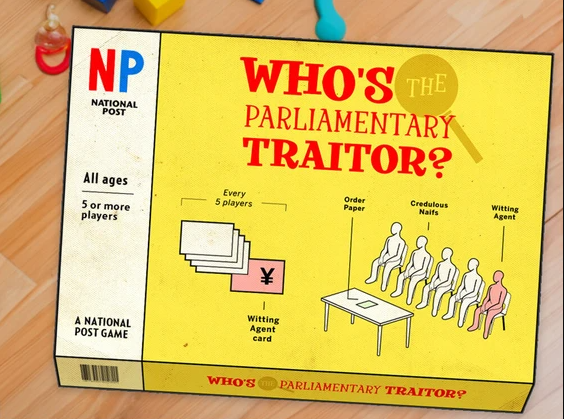
“To simulate what it’s like to go to work in a national parliament secretly housing foreign agents, the National Post presents a tongue-in-cheek instruction manual to play this group game: Who’s the Parliamentary Traitor?
Photo by Brice Hall”
WHAT YOU NEED TO PLAY:
- One large writing surface, such as a chalkboard, whiteboard or flip chart (THE ORDER PAPER)
- 20-70 note cards
- A timer
SETTING UP PLAY:
Gather at least five of your closest friends and have them sit in a line facing the ORDER PAPER. They will be divided into two categories: The WITTING AGENTS and the CREDULOUS NAIFS.To choose who among them will be the WITTING AGENTS, prepare a stack of IDENTITY CARDS equal to the number of players. On every fifth card, mark the symbol for the Chinese yuan (¥). In the case of five players, mark a single card, for 10 players, mark two, etc.
Shuffle the IDENTITY CARDS and distribute them among the players. Anyone receiving a “¥” is now a WITTING AGENT.
Set aside another stack of note cards to serve as MANDATE LETTERS. The text for each card is below. Shuffle the MANDATE LETTERS and place them face down.
RULES OF THE GAME:
Each round begins with a CANADA IS NOT BROKEN phase in which all players close their eyes, put their thumbs in their ears and bury their face for two minutes (the elapsed time to be marked with a timer). During this phase, the WITTING AGENTS open their eyes, stride over to the ORDER PAPER and write down a piece of binding public policy that damages Canada to the advantage of a hostile government (suggestions below).Once this act of treachery is done, the WITTING AGENTS return to their seats will pretend to wake up alongside them as if nothing happened.
Now begins the CONCERNED FOLLOW-UP phase. First, players must pull a MANDATE LETTER card that will determine conditions of discussion. Now, the parliamentarians must decide who among them is the foreign cat’s paw who has defaced their ORDER PAPER with disloyal policy. Uncomfortable questions are asked, accusations are made, and at the end of the round the players vote on who among them will be ejected as a traitor.
Only after the accused traitor is exiled will they show their IDENTITY CARD, revealing whether the accusations have been true, or whether they have been unjustly maligned.
Ejected players are then exiled to THE SENATE, a separated area of chairs where they are served port, ginger ale and black liquorice. They continue to participate in the CANADA IS NOT BROKEN and the CONCERNED FOLLOW-UP phases, but they no longer have a vote.
Comments Off on Fun new family game – Who’s the Parliamentary Traitor?
May 16, 2024
The Canadian Senate is an anti-democratic fossil … that might totally frustrate a future Conservative government
Tristin Hopper considers the constitutional weirdness of Canada’s upper house, an appointed body that has the power to block a popularly elected House of Commons:
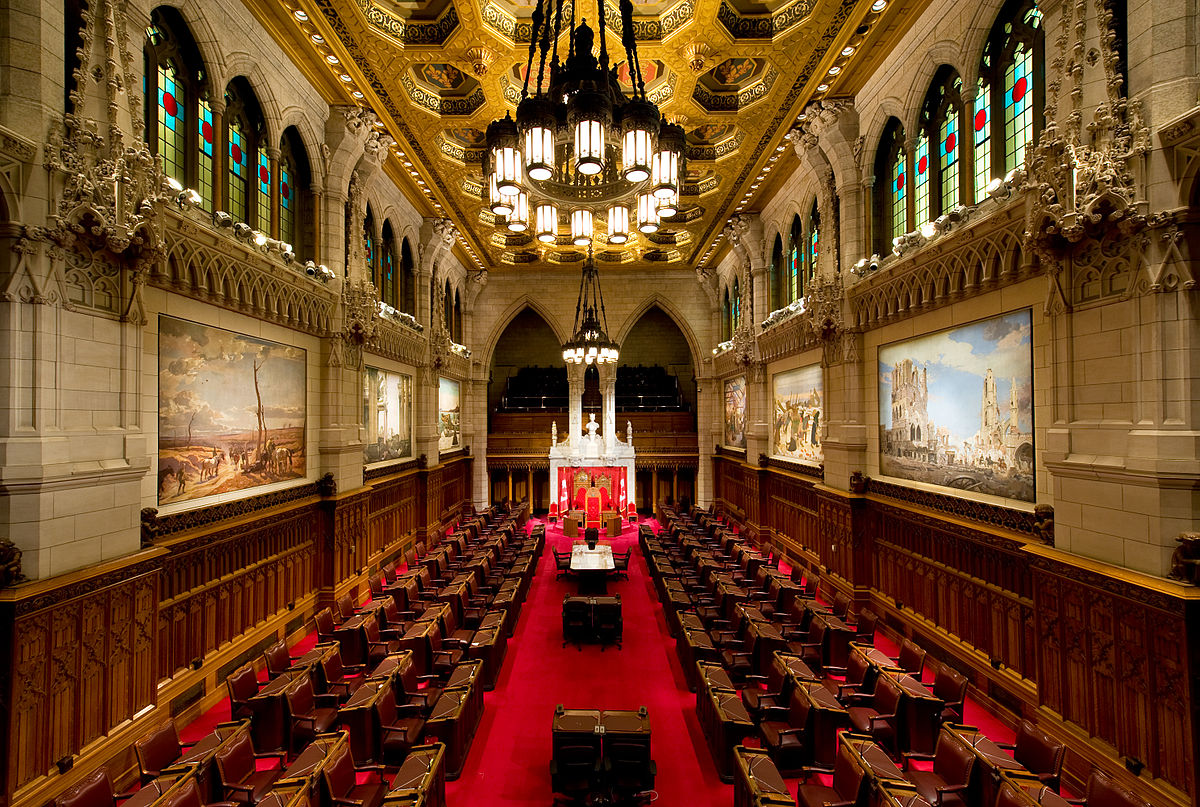
“In the east wing of the Centre Block is the Senate chamber, in which are the thrones for the [King and Queen], or for the federal viceroy and his or her consort, and from which either the sovereign or the governor general gives the Speech from the Throne and grants Royal Assent to bills passed by parliament. The senators themselves sit in the chamber, arranged so that those belonging to the governing party are to the right of the Speaker of the Senate and the opposition to the speaker’s left. The overall colour in the Senate chamber is red, seen in the upholstery, carpeting, and draperies, and reflecting the colour scheme of the House of Lords in the United Kingdom; red was a more royal colour, associated with the Crown and hereditary peers. Capping the room is a gilt ceiling with deep octagonal coffers, each filled with heraldic symbols, including maple leafs, fleur-de-lis, lions rampant, clàrsach, Welsh Dragons, and lions passant. On the east and west walls of the chamber are eight murals depicting scenes from the First World War; painted in between 1916 and 1920”
Photo and description by Saffron Blaze via Wikimedia Commons.
By the anticipated date of the 2025 federal election, only 10 to 15 members of the 105-seat Senate will be either Conservative or Conservative appointees. The rest will be Liberal appointees. As of this writing, 70 senators have been personally appointed by Trudeau, and he’ll likely have the opportunity to appoint another 12 before his term ends.
What this means is that no matter how strong the mandate of any future Conservative government, the Tory caucus will face a Liberal supermajority in the Senate with the power to gut or block any legislation sent their way.
“If a majority of the Senate chose to block or severely delay a Conservative government’s legislative agenda, it would plunge the country into a constitutional crisis the likes of which we have not seen in more than a century,” reads an analysis published Tuesday in The Hub.
Constitutional scholars Howard Anglin and Ray Pennings envisioned a potential nightmare scenario in which the Senate casts themselves as “resisting” a Conservative government. Given that senators are all permanently appointed until their mandatory retirement at age 75, it would take at least 10 years until a Conservative government could rack up enough Senate appointments to overcome the Liberal-appointed majority.
“Canadian politics would grind to the kind of impasse that is only broken by the kind of extraordinary force whose political and social repercussions are unpredictable,” they wrote.
The piece even makes a passing reference to 1849, when mobs burned down Canada’s pre-Confederation parliament.
The prospect of an all-powerful Senate able to block the mandate of an elected government is a legislative situation almost entirely unique to Canada.
New Zealand abolished its Senate and is now governed by a unicameral legislature. Australia and the United States both employ term-limited elected senates. The U.K. House of Lords – on which the Canadian Senate is closely modelled – is severely constrained in how far it can check the actions of the House of Commons.
But in Canada, the Senate essentially retains the power of a second House of Commons; it can do whatever it wants to legislation that has passed the House of Commons, including spike it entirely.
Comments Off on The Canadian Senate is an anti-democratic fossil … that might totally frustrate a future Conservative government


