Quotulatiousness

July 9, 2023

“… corporations sit in the late adopter phase of the marketing curve”

Filed under: Business, Media, Politics, USA — Tags: , , , , , — Nicholas @ 03:00

Elizabeth Nickson reminds us that the mass media corporate messaging is trailing edge, not leading edge:

Now everything is filtered through a warped looking glass, a Mad Hatter tea party of nonsense, run by the grimmest socialist operatives who ever lived, backed by buckets and wheelbarrows of stupid corporatist/fascist money. They are running a demoralization program on us.

It’s not working.

Never forget that corporations sit in the late adopter phase of the marketing curve, which is to say the lifeless part, the raking-in-the-money-from-stupid-women part. Women too, as a class, are part of the late adopter curve, because as Jordan Peterson once pointed out, women instinctively see humans as helpless babies needing protection and SAFETY FIRST. We are easily manipulated by our compassion, as is clear from the fact that only women and those who want to be, support the left now. The left traffics faux compassion and it is a killer drug. Included of course are beta males, hornswoggled by mommy, the wet diaper babies of Antifa and BLM. And of course, the paid operatives of the stinking cabal, the truly horrid public sector unions, the vicious thugs at AFL-CIO and the humanity-hating environmental movement.

The people the left cultivated so carefully over several generations have all fled to populism and eventually their vicious operatives won’t even be able to steal the votes they need. How big is it? Imagine 2000 Trump rallies. And then ten times that. And then quadruple it. Double and double and double again. And they are having the best time, more fun than you can imagine, working away in obscurity, asserting their human right to determine their own future.

[…]

Normals have turned, all of them. They are not available to the Trudeaus, Macrons and Rishi Sunaks of the world. They are wised up. Some of them know more than me about the filth at the heart of “environmentalism” and I know a lot. They are not Russian serfs or Chinese peasants. There is no way they are going to be corralled in 15 minute cities. They are going to bring the house down.

They/we are the people that Richard Haas, when resigning from the Council of Foreign Relations, a nest of nasty neo-liberal, neo-con oppressors if there ever was one, warned against when he said the greatest threat facing the world is American populists. Sure, buddy.

One of the those dreadful people (as they call us) is Kevin Fernandes82 on Instagram. Probably not his real name, but he is not aiming for public recognition. What he does, methodically, every day many times, is chronicle the slow crumbling of the old regime. I am using a lot of his reporting and as he shows, we are beating the pants off them every single day.

Their jobs are untenable. People are resigning from every safe berth in the world or being fired from plush jobs because the world the neo-liberal hegemon has created is counter-rational, so chaotic, it is unstable. It is unstable because we know it is stupid. We are opposed. And our opposition is slowly slowly bringing it down.

This is long. You don’t have to read it all to get the point, but give it to the despairing, keep it for when you despair. All these wins happened in the last two weeks. People, judges and administrators and politicians within the system, are starting to dance to the populist tune. Many of the worst are running as fast as they can.

We are the future.

Time to start thinking about what we want the new world to look like.

Herewith:

The Sound of Freedom has outsold the new Indiana Jones film, on 2,000 fewer screens and with no PR, against the full force of the Hollywood machine.

The Dutch government has reportedly fallen over asylum policy. Farms confiscation is wildly unpopular. Mark Rutte, architect of the prosecution of farmers has resigned.

The decoupling of the BRICS from the dollar means the death of the neo-liberal hegemon. Mark Wauk and Tom Luongo do a neat job of wrapping up this particular mess. As they say: there are no neo-liberals in a multi-polar, decoupled world.

The BRICS are set to introduce a new currency backed by gold, against the US backed dollar which depreciates in value every day because of inflation caused by choking energy supply and crazed overspending by governments.

EU laws that let banks shut accounts over political views to be scrapped.

Federal judge in Louisiana prohibits DHS, FBI and DOJ from working with Big Tech to censor posts.

The list goes on for quite a lot longer…


July 5, 2023

Intersectionality showdown

Filed under: Education, Media, Politics, USA — Tags: , , , , , — Nicholas @ 04:00

Chris Bray on the major break in progressive solidarity caused by non-white American Muslims’, Ethiopian Christians’, and Peruvian Catholics’ unexpected reaction to woke teachers wanting to sexually indoctrinate their children:

We’re wading through this culture war sewage because we have a political class that’s deliberately pumping it into the culture to keep us from noticing that, how can I put this in a sophisticated way, they suck.

But this really tedious maneuver is increasingly leading to moments like this — and Twitter still won’t let Substack writers embed tweets, so click to watch video, but here’s the substance of the thing:

The fake conflict is increasingly likely to be a dozen sanpaku-eyed AWFL’s against a thousand genuinely multicultural parents, battling over insane questions like the “book bans” that remove highly explicit sexual content from elementary school libraries. In 2023, the culture war is rapidly cooking down to STOP PREVENTING US FROM TALKING TO YOUR EIGHT YEAR-OLDS ABOUT SUCKING DICK, YOU NAZIS.

If you’ve never read what I wrote about Jim Jones and the Peoples Temple, please take a moment to go read this. About 900 people died at Jonestown in 1978, but Jones started in Indianapolis in the 1950s. He moved his church to a rural property in California, and then to Guyana, by constantly telling his parishioners that they were threatened by hostile forces outside the church that were maneuvering to destroy them. The frequent recourse to invented threats is a sign of a sick movement, not a sign of something the grows and flourishes.

That’s where we are. We’re watching a sick thing die. The question, now, is how long it takes to die, and how much damage it does in its death throes. But the increasingly hysterical tone, against an increasingly matter-of-fact response — a thousand parents saying calmly that no, we won’t let you inflict this curriculum on our children — suggests that the inflection point is getting closer.

June 26, 2023

America can’t build anything these days and “it’s all Ralph Nader’s fault”

One of the readers of Scott Alexander’s Astral Codex Ten has contributed a review of Public Citizens: The Attack on Big Government and the Remaking of American Liberalism by Paul Sabin. This is one of perhaps a dozen or so anonymous reviews that Scott publishes every year with the readers voting for the best review and the names of the contributors withheld until after the voting is finished:

Today, pundits across the political spectrum bemoan America’s inability to build.

Across the country, NIMBYs and status-quo defenders exploit procedural rules to block new development, giving us a world where it takes longer to get approval for a single new building in San Francisco than it did to build the entire Empire State Building, where so-called “environmental review” is weaponized to block even obviously green initiatives like solar panels, and where new public works projects are completed years late and billions over budget — or, like California’s incredible shrinking high-speed rail, may never be completed at all.

Inevitably, such a complex set of dysfunctions must have an equally complex set of causes. It took us decades to get into this mess, and just as there’s no one simple fix, there’s no one simple inflection point in our history on which we can place all the blame.

But what if there was? What if there was, in fact, a single person we could blame for this entire state of affairs, a patsy from the past at whom we could all point our censorious fingers and shout, “It’s that guy’s fault!”

There is such a person, suggests history professor Paul Sabin in his new book Public Citizens: The Attack on Big Government and the Remaking of American Liberalism. And he isn’t isn’t a mustache-twirling villain — he’s a liberal intellectual. If you know him for anything, it’s probably for being the reason you know what a hanging chad is.

That’s right: it’s all Ralph Nader’s fault.

How’d he do it? By creating what’s now called the public interest movement: a new form of activism through which citizens force change — or, more often, block change — by suing the government. Though it was begun with the best of intentions and achieved some real good along the way, this political innovation led to the constipated governance we all complain about today.

How did a movement launched by an unassuming 30-year-old lawyer become the dominant form of activism in the country, and completely change the way our government operates?

To find out, we have to go back to a time before Ralph Nader had even hit puberty — the era of the New Deal.

[…]

It is the inherent nature of politics that no reform works forever, because the next generation of political entrepreneurs will inevitably discover new ways to bend the process to their will. Eventually, there will always be another Dick Fosbury revealing a way to work the system that no one saw coming.

Still, I do think some of the blame for the way this all panned out can be laid on Nader’s particular personal idiosyncrasies. His ironclad black-and-white view of the world, combined with his near-pathological aversion to dealmaking and compromise, made him uniquely suited to a form of activism that focused on regulatory and legal action rather than coalition-building and electoral politics. Nader was infamously rigid and inflexible, so it’s no surprise that his movement was too. But a less rules-oriented movement might have created fewer of the bureaucratic barriers that have now become a hindrance to progressive action.

Much like the movement whose story it tells, Public Citizens the book is a worthwhile project that nonetheless suffers from significant flaws. The main problem is that it can’t decide if it’s a historical narrative or a work of political theory. As a work of political theory, it doesn’t take nearly a strong enough stand — I’ve made explicit a lot of claims that are only lightly implied in the book. I think we’re making the same argument, but the book makes its argument with such a delicate touch that it’s hard to be 100% sure.

As a historical narrative, Public Citizens has a much simpler problem: it’s boring. The author writes like an academic (which, to be fair, he is), and the book is quite light on colorful details. The uncreative chapter titles (chapter three is called “Creating Public Interest Firms”) give you a taste of what the writing is like. One particularly egregious issue is how little biographical information is provided about Nader, even though the majority of the book is about him. For someone who apparently subscribes to the Great Man theory of history, the author includes surprisingly little information about the Great Men themselves. Any interesting biographical fact you read in this review — even something as basic as the fact that Nader never married—is almost certainly something I found through other sources.

Paradoxically, this book manages to be simultaneously boring and too concise. It’s over in less than 200 generously-spaced pages, and I frequently had to look stuff up on the internet to get a full understanding of what was going on. I get the sense that the author is trying to give this book mass appeal, but come on: anyone who’s willing to read a nerdy book like this is willing to read an additional hundred pages or so. Besides, Robert Caro and Ron Chernow have proven that people will read thousand-page tomes if the story is compelling and the details are juicy.

Basically, my critique of Public Citizens is like that old Catskills joke about the restaurant where the food is terrible — and the portions are too small.

The struggle for equal rights turned into the struggle to oppress others so gradually, most people didn’t notice

Filed under: Media, Politics, USA — Tags: , , , , — Nicholas @ 03:00

From the most recent Weekly Dish by Andrew Sullivan:

Many, many moons ago, when I was a marriage equality pioneer and not a total pariah among the gays, I was asked to speak at the Human Rights Campaign Fund, as it was then called. Determined as ever not to read the room, I said (paraphrasing from memory): “The goal of any civil rights movement should be to shut itself down one day. And once we get marriage equality and military service, those of us in the gay rights movement should throw a party, end the movement, and get on with our lives.”

You can imagine how well that went down. And, sure enough, 30 years later, with marriage, military service and trans equality enshrined in the law, the HRC building now has a massive, six-story high poster hanging on it: “BLACK LIVES MATTER. TRANS BLACK LIVES MATTER.”

That tells us a bit about where we are today, and how we got here.

The point I was making in the early 1990s was that liberalism knows limits. A liberal politics does not seek to impose meaning on everyone; it creates the space for individuals to choose that for themselves. It doesn’t seek to deliver the truth about anything either; it merely provides the mechanisms for the open-ended pursuit of truth. A liberal politics will seek formal equality for members of minorities; but not substantive equality — what is now called “equity”. It would not require us to come to one, single understanding of reality; it would always allow diversity of opinion and encourage free debate. Live and let live. Remember that?

Technically speaking, that makes me a liberal conservative: accepting the reality of liberal modernity (even, in my own case, being happily at home in it), while seeking to limit its illiberal overreach and utopian ambitions. And that was what I tried to sketch out in Virtually Normal. It’s a book less about homosexuality than about politics itself. It’s about a politics of going this far — and no farther. From the NYT review in 1995:

    Mr. Sullivan offers his own prescription for a “politics of homosexuality” that reconciles “the best arguments of liberals and conservatives”. It is a liberal stand, Mr. Sullivan argues, in that it puts a premium on individual liberty and equality before the law, but its requirements would apply only to government policies on homosexuality, avoiding “the regulation of people’s minds and actions” in the private sphere.

Homosexual citizens absolutely deserved equal rights, but the question of homosexuality itself would — and should — always be open to dispute and debate. Since a liberal society contains both fundamentalist preachers as well as lesbian atheists, it cannot resolve the core question. So it shouldn’t try. And it should celebrate, not bemoan, this ideological diversity.

I can see why the religious fundamentalists are queasy with the settlement that came from this. They have to live in a society that accepts civil marriages for couples of the same sex. The deal is that in return, they are free to deny the morality of such marriages, to reserve religious marriage to heterosexual couples, and not be forced to participate in any way. I can also see why queer theorists are queasy as well. They don’t like the heteronormativity of civil marriage, or the respectability politics that goes with it. But they in turn are free to live their lives as “queerly” as they want in society, to create culture that seeks to subvert and radicalize.

This, in the end, is my response to all the “slippery slope” arguments about gay marriage now being raised again on the right. There is no slope in the case I made. There is a clear line: formal legal equality alongside cultural and social freedom on all sides. From my liberal conservative perspective, the gay rights movement should have shut down in 2015 after Obergefell; and the trans rights movement should have shut down in 2020 after Bostock. Once gay men and lesbians and trans people achieved legal and constitutional equality, the fight was over.

But in the movement I was once a part of, many, of course, were not liberals, let alone liberal conservatives — but radicals, who reluctantly went along with marriage equality, but itched to transform society far more comprehensively. And these radicals now control everything in the hollowed-out gay rights apparatus. Their main ticket item is a law that would replace biological sex with gender in the law, and remove protections for religious liberty: smashing the liberal settlement. Combine that with acute polarization in the Trump era, and information silos, so that many gays get their sense of reality from MSNBC and Elton John, and you can see how the spiral into illiberal madness began.

June 25, 2023

Workers will be forced to stop working to salve the consciences of university-educated elite wankers

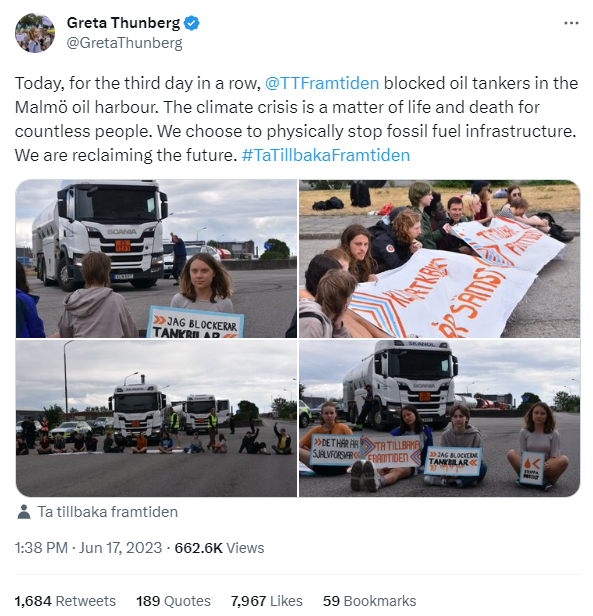
Brendan O’Neill on the Climate Goblin’s latest stunt in Sweden:

Picture the daughter of an opera singer preventing working-class men from doing their jobs. A young woman so well-connected that she probably has presidents on speed-dial physically blocking truck drivers from doing what they do. A child of privilege gathering with her similarly comfortable pals to stop working people from working.

Well, shorn of all the fact-lite bluster about “saving the planet”, that’s exactly what Greta Thunberg’s latest eco-stunt adds up to. The pint-sized prophetess of doom is back in the headlines. This time for getting arrested in Malmo harbour in Sweden, where she and other members of the End is Nigh cult have been holding a sit-down protest to stop oil tankers from leaving and delivering their life-giving cargo to the good people of Sweden and beyond.

The photographs from this temper tantrum disguised as a political protest tell a fascinating tale of the classism and narcissism in green politics. In the middle of the road are the smug-looking youths. One has green hair. Others sport beanie hats. None has ever driven a truck, clearly. Their banners speak of defending Earth from man’s evil burning of the toxic sludge of oil. And in the background are the supposed agents of this evil – the truckers; working men idly standing by their tankers while the world’s media get shots of Greta looking sad for Gaia.

What an apt snapshot of the hierarchy of virtue in what passes for radical politics today. Working-class people reduced to background actors, non-player characters, in a drama feverishly focussed on the jumped-up angst of the privileged. Working men as mere backdrop to the eco-neuroses of the comfortably off. In the moral universe fashioned by eco-influencers and their legion fawners in the political and media elites, the irrational fears of the upper-middle class carry more weight than the living standards of the working class.

It’s a story we see repeated across every act of eco-agitation today. In the UK, the plummy activists of Just Stop Oil, all called Poppy or Edred, block roads and prevent builders, scaffolders, deliverymen, mums and others from carrying out their essential work. The fightback of working men against this imperious imposition on their right to earn a living – witness scaffolders pushing eco-irritants out of the road – has been heartening to see. As a worker at Smithfield meat market in London put it a few years back when Extinction Rebellion types stormed in to speak up for animal rights or something, why should I allow this “happy-clappy mob” to stop me from being “able to pay my bills”?

June 18, 2023

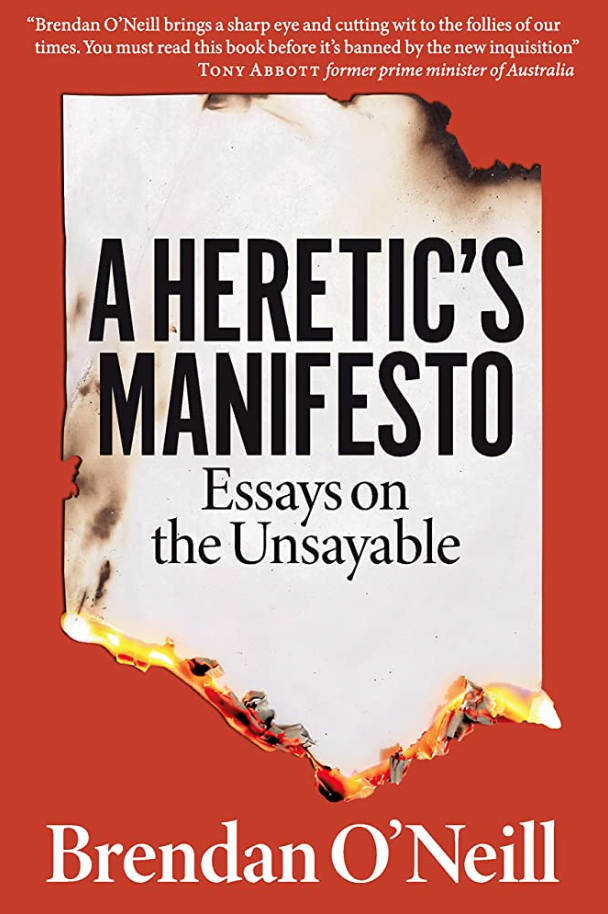
Brendan O’Neill’s new book, A Heretic’s Manifesto

Filed under: Books, Britain, Media, Politics — Tags: , , , , , — Nicholas @ 05:00

This is an extract from A Heretic’s Manifesto thanks to Spiked:

Words hurt, they say. This is the ideological underpinning to so much censorship today – the idea that words wound, as a punch might wound. The imagery of violence is deployed in almost every call for censure in the 21st-century West. Speech has been reimagined as aggression, hence “microaggressions”. People speak of feeling “assaulted” by speech. “Words, like sticks and stones, can assault; they can injure; they can exclude” – that’s the thesis of Words That Wound, an influential tome published in 1993. Activists claim to feel “erased” by controversial or disagreeable utterances. Trans campaigners speak darkly of “trans erasure”, as if words from the other side of the divide, the speech of gender-critical feminists, might contain that most awesome and nullifying power of genocide.

Words make us feel “unsafe”, people say. Witness the rise and rise of Safe Spaces on university campuses, designed to ensure students’ psychic security against the terrible threat of their hearing an idea they disagree with. Safe Spaces recreate the state of childhood, complete with colouring books and ice cream, speaking to how determinedly some long to retreat from the adult world of hurtful chatter and brickbats.

The United Nations wrings its hands over “hate speech and real harm” (my emphasis). The “weaponisation of public discourse for political gain” can lead to “stigmatisation, discrimination and large-scale violence”, it says. Better keep a check on those hurtful words. One US university even maintains a list of “words that hurt“. It includes the phrase “You guys”. That scandalous utterance “erases the identities of people who are in the room” and “generalise[s] a group of people to be masculine”. Shut it down. Silence that act of violence.

Both the formal and informal punishment of words rests on the belief that they can wound. Laws in Europe claim to guard people from speech that is alarming, distressing, hurtful. The overlords of social media censor speech for “the wellbeing of our community“. Everywhere the cry goes up: words injure, they can cut like a knife, they can be used as “weapons to ambush, terrorise, wound, humiliate and degrade“. And just as the law protects us from such dreadful things when they are done to our bodies with fists and kicks, surely it should also protect us from them when they are done to our minds with words and ideas. Surely our psychic wellbeing should be accorded as much respect by the powers-that-be as our physical integrity is.

The temptation of many of us who believe in freedom of speech, in the liberty of all to utter their beliefs and ideas, is to damn this claim that “words hurt” as a libel against public discourse. As a slippery untruth that is cynically designed to depict words as all-powerful, as containing so much energy, so much heat, that they can lay waste to self-esteem and even make us fret over erasure, over being wiped out entirely by that sore comment or that disturbing idea. Actually, we often say, words are just words. They’re not sticks, they’re not stones, they’re words. They won’t kill you, they won’t hurt you, you’ll be fine. They say words are a force of nature like no other, we say: “Relax. It’s just speech.”

We need to stop doing this. We need to stop countering the new censors by accusing them of exaggerating the power and the potency of words. We need to stop responding to their painting of speech as a dangerous, disorientating force by defensively pleading that words don’t wound because they’re just words. We need to stop reacting to their branding of speech as a weapon, as a tool of ambush and degradation, by effectively draining speech of its power and saying: “It’s only speech.” As if speech were a small thing, almost an insignificant thing, more likely to contain calming qualities than upsetting ones, more likely to help us overcome conflict rather than stir it up, more likely to offer a balm to your soul than to stab at it as a knife might stab at your body.

For when we do this, we play down the power of words. And that includes the power of words to wound. Words do wound. It’s true. Words hurt people, they hurt institutions, they hurt belief systems. Words make churches tremble and ideologies quake. Words inflict pain on priests and princes and ideologues. Words upend the social order. Words rip away the comforting ideas people and communities might have wrapped themselves in for decades, centuries perhaps. Words ambush the complacent and degrade the powerful. Words cause discord, angst, even conflict. Isn’t every revolution in history the offspring of words? Of ideas? Words do destabilise, they do disorientate. People are right to sometimes feel afraid of words. Words are dangerous. When they say words wound, we should say: “I agree.”

Today, “‘gender-critical’ is a jargonny way of describing the ordinary views held by the vast majority of the planet’s population”

Filed under: Australia, Media, Politics — Tags: , , , , , , — Nicholas @ 03:00

The Quillette Editorial Board on the startling difference between LGBT activists’s views and the default view of most of humanity:

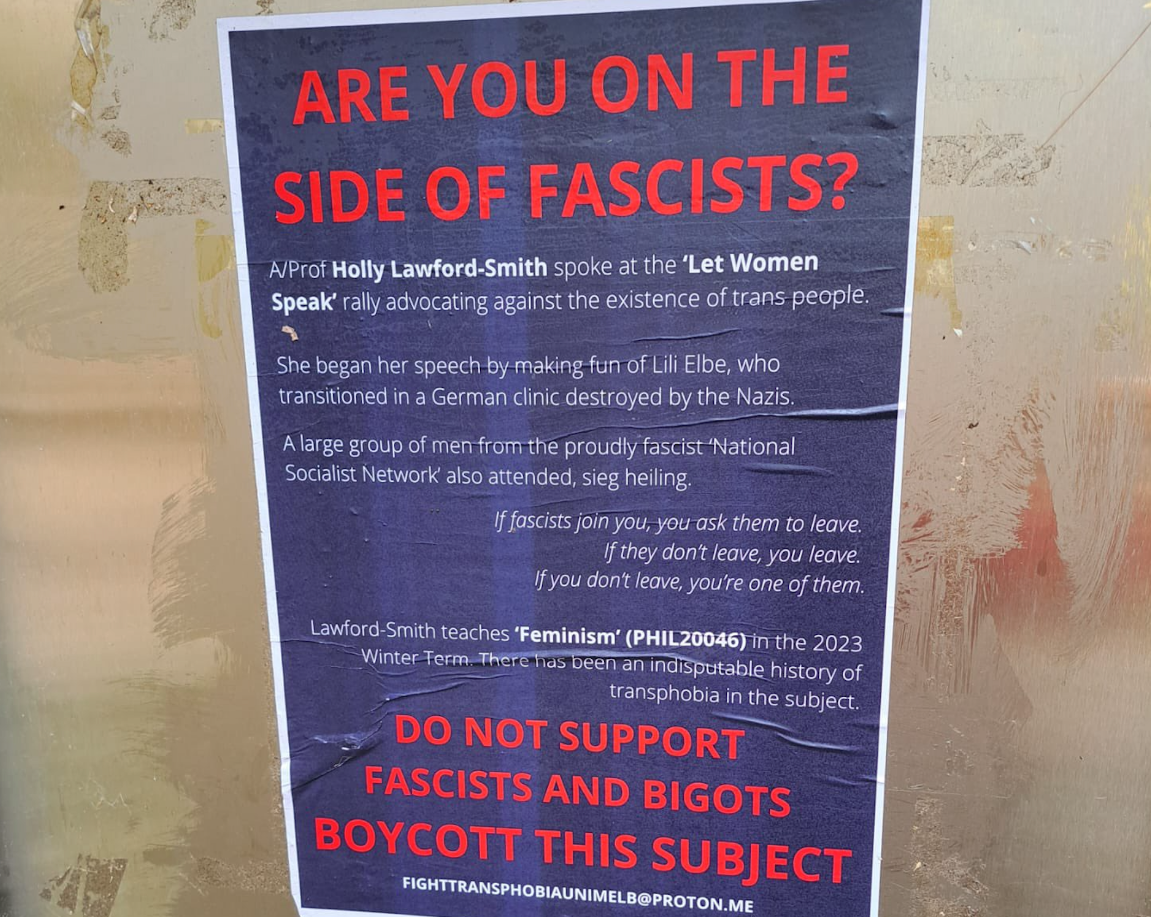
“What is feminism? Who is it for? Can men be feminists, or only allies? What is intersectionality, and must feminism be intersectional?” These are some of the questions tackled in a University of Melbourne course on the philosophy of feminism, formally designated in the university’s handbook as PHIL20046. Prospective students are informed that course content will include “a range of feminist theories, including both radical feminism and liberal feminism, and from all four ‘waves’ (with an emphasis on second wave feminism). We’ll also consider a range of applied topics like prostitution and pornography, inclusion of transwomen, theories of gender, gendered social norms, and reproductive rights.”

Content that is not included in PHIL20046, on the other hand, includes white supremacist propaganda, neo-Nazi talking points, and an approving literary exegesis of Mein Kampf. This might seem like an odd detail to note. But it is important to state for the record, given the profusion of stickers and posters recently plastered around the University of Melbourne campus, accusing the course instructor, Holly Lawford-Smith, of crafting her syllabus for the exclusive benefit of “fascists”.

Those who are familiar with the mantras of “intersectional feminism” likely won’t require an explanation for the quantum logic leap by which feminist philosophizing might be casually equated with the doctrines of Hitler, Mussolini, and Franco. But for those unschooled in such matters, the basis of complaint here is that Lawford-Smith is a “gender-critical feminist” — a term indicating one’s belief that biologically rooted differences between men and women are real; and so must be considered when marking the boundaries of female-protected spaces, such as women’s sports leagues, prisons, and domestic-violence centres.

Which is to say that “gender-critical” is a jargonny way of describing the ordinary views held by the vast majority of the planet’s population. And it speaks to the shocking extent of academia’s radicalization that Lawford-Smith’s belief in biological science would be regarded as the academic equivalent of a Nazi salute.

Gender-critical feminists trace their roots to the radical-feminism movement of the 1960s. They often focus on the pernicious effects of gender stereotypes; and critique the industries that profit from women’s pain, such as pornography. This kind of analysis focuses attention on the hardships that have historically gone along with existing as a woman. It also focuses attention on the real policy solutions required to address such hardships, including, where necessary, the maintenance of safe single-sex spaces. As one might assume, gender-critical feminists typically have little time for men who, having recently announced the discovery of some soul-like spark of womanhood within them, commence hectoring women about the imperfect nature of their intersectional feminism.

Gender crits speak their mind at their professional peril. In 2021, Kathleen Stock, a British analytic philosopher, was forced to abandon her academic position at Sussex University following a prolonged harassment campaign. Like other prominent gender-critical intellectuals, Stock is perfectly forthright about her support for the rights of trans people to live, study, and work as they please, free from discrimination and harassment — while also being equally forthright about the plain fact that transwomen are not literal women. As a consequence of expressing such (again, widely held) views, Stock was advised to install CCTV cameras in her home and to venture onto campus only when accompanied by bodyguards.

June 17, 2023

QotD: Civil War 2: Electric Boogaloo

Filed under: Politics, Quotations, USA — Tags: , , , — Nicholas @ 01:00

I used to think there’d be no Civil War II: Electric Boogaloo in this country because nobody had any real reason to fight. The Left (retaining that term strictly for convenience) don’t know what they want. They have never known. Flipping cars and lighting shit on fire is the sum total of their political philosophy. As we call it around here, the Great Inversion — whatever is, is wrong, and since there’s a level of “what is” that is impervious to even the most nonintersectional, genderfluid level of make believe, they’d rather burn the whole world down than admit it. Still, while “burn the motherfucker down!” is a fun chant with which to replace the Pledge of Allegiance — coming to your kids’ kindergarten classroom, Spring 2021 — it doesn’t really rally the troops.

The Right, meanwhile (and again, strictly for convenience), had an equally impossible fantasy, since however it manifested itself — CivNat, BoomerCon, Normie, pick your Internet-speak — it was predicated on the “Left” being physically capable of leaving well enough alone. Alas, “the motherfucker” which the Left feels compelled to burn down includes institutions, infrastructure, the foundations of empirical knowledge, along with the idea of “knowledge” itself — in short, ambient civilization. It’s not that they won’t leave you alone, gang, it’s that they can’t, since whatever is, is wrong.

Will it be a nicely organized civil war, with Ordinances of Secession and neato-looking battle flags and stirring speeches and truly excellent beards on all the general officers? Doubtful. See above. The whole “secession” schmear takes some doing, and we’re living in a world where the mere ability to walk slightly faster than a reanimated corpse is an appealing-enough fantasy to keep a tv series running for over a decade. But people these days absolutely loathe each other, to the point that, when someone finally does pull the trigger — and someone will — the killing won’t stop for a long, long, long time, McDonald’s be damned.

Severian, “Random Thoughts”, Rotten Chestnuts, 2020-12-17.

June 15, 2023

Ketman, in theory and practice

I first encountered the idea of Ketman in an article by Severian on his old Rotten Chestnuts site (no longer online, alas). He was talking about it in the context of university:

I got into the higher ed biz fully intending to practice what Milosz calls “aesthetic ketman“. [“paying lip service to official ideology while secretly subverting it”] I loved my subject, but my subject was recondite enough, I figured, that I could keep the SJW bullshit to a bare minimum. I don’t remember what they called “intersectionality” back then, but whatever it was, I’d just make a few brief nods to it, then get on with my work in relative peace. Throw a few quotes from Foucault, Judith Butler, Gayatri Spivak, and the like in my dissertation intro, and that was that.

The problem, though, is that the sour pleasure of ketman is addictive, and like any addiction, you need to keep upping the dose to feel the same effect.

In The Critic, Colette Colfer discusses “gender ketman” today:

Ketman is a game of acting. It involves outwardly performing in compliance with a dominant belief system whilst inwardly rejecting it. Ketman is a form of self-protection, particularly when living under strict religious or totalitarian rule. Today, the game of Ketman is played as a way of hiding real opinions about gender ideology.

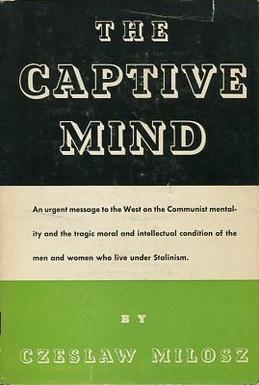
I first came across the concept of Ketman in Csezlaw Miłosz’s powerful 1953 book The Captive Mind, about life in Poland under Nazi right-wing and Stalinist left-wing totalitarian control. Miłosz dedicates one full chapter to Ketman. To play Ketman is to wear a mask, to simulate the behaviour that is required to fit in with the masses, to avoid the consequences of speaking up against a dominant ideology.

When the UK trade union for academics and lecturers, the University and College Union, released a video last month of their 2023 congress, it showed a crowded room of people loudly chanting in unison “trans rights are human rights”. They were holding up identical cerise-pink signs with words in all-caps, “TRANS RIGHTS ARE HUMAN RIGHTS”. I wondered, as I watched the clip, how many in that room were practising Ketman.

Miłosz came across the idea of Ketman in a book by Count Joseph-Arthur Gobineau (1816–82), entitled Religions and Philosophies in Central Asia. Gobineau served as a French diplomat in Persia during the mid-19th century, and he reckoned that the masses in Persia were practising Ketman. Gobineau also wrote about the “Allah lexicon” that included expressions such as inshallah and mashallah and insisted that scarcely one out of twenty Persians believed what they were saying.

Although Miłosz considered Gobineau a “rather dangerous writer”, he recognised Gobineau’s description of Ketman in the behaviour of people in Poland under Stalinist rule. The person practising Ketman must keep silent about their true convictions and must sometimes engage in trickery to deceive their adversaries. This can mean participating in rituals, waving banners, saying words or phrases to deceive others, and writing books filled with ideas the authors themselves don’t believe.

Miłosz said there were many different varieties of Ketman. Versions outlined in The Captive Mind include Metaphysical Ketman, which involved pretending to have no religious beliefs; and Ethical Ketman, which resulted from inwardly opposing the ethics of the “New Faith” of Stalinist communism, such as informing on neighbours.

However, practicing Ketman comes at a cost:

Miłosz points out that when a person plays Ketman for an extended period of time, they end up unable to distinguish their real self from the self they simulate. It’s almost like they begin to believe the lie. This level of association with the role being played gives some relief however, as the person no longer has to worry about dropping their guard when in conversation with others.

Severian, as you’d expect, has a more direct way of explaining it:

But more importantly, there’s the pleasure of ketman. So long as I make a few radical noises, I can get you sheep to believe anything I say. I used to tell people I studied transgendered potato farmers in the Kenyan uplands. I told this obnoxious girl from the Gender Studies department my dissertation was on resistance strategies of Eskimos in the Waffen-SS. I cited Alan Sokal’s hoax paper on the social construction of gravity in every seminar taught by a radical feminist, and no one ever called me on it. Anyone who thinks I’m kidding obviously hasn’t been on campus in the last 20 years or so. It was fucking hilarious …

… for a time. And then it got sad, then nauseating, because I eventually realized I was no different from the fools who swallowed my bullshit. It doesn’t matter if you’re being exquisitely ironic when you tell a room full of freshmen that “gender is a social construction”. They can’t recognize irony anyway, and even if they could, parroting the phrase “gender is a social construction” is still required to pass the class. More importantly, what if they did recognize it? I’m up there thinking I’m a shitlord, speaking truth to power to anyone smart enough to figure it out, but all they see is another fat, middle-aged sellout parroting nonsense. If I were serious about my shitlordery, they think, then I’d quit. But I don’t quit, which must mean my so-called “principles” are worth … what? We’ve already established you’re a whore, madam; now we’re just haggling over the price.

Sarah Hoyt objects to being an “imaginary creature”

Filed under: Media, Politics, USA — Tags: , , , , , , , — Nicholas @ 03:00

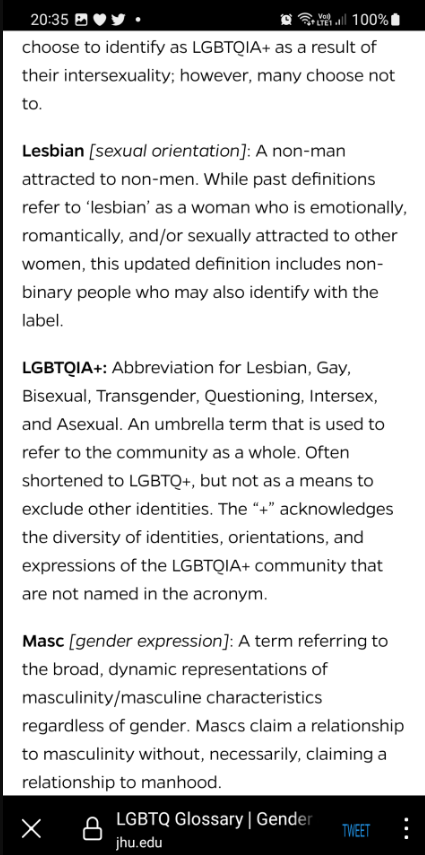
Recent revisions to the quasi-official dictionary of the woke English language seem to have classified individuals like Sarah as “non-men”:

I was born female in a country that was profoundly patriarchal and, back then, patriarchal without guilt. So, it was acceptable to make jokes about women being dumber than men. And it was acceptable for teachers to assume you were dumb because female.

Most of these things amused me. It was always fun in mixed classes after the first test to watch the teacher look at my test and at the boys in the class trying to figure out what parent was so cruel as to name their son a girl’s name.

I enjoyed breaking people’s minds. And once I was known in a group or place, I was not treated as inferior. The only things that truly annoyed me were the ones I thought were arbitrary restrictions, like not going out after 8 pm alone. Took flaunting them a few times to find out they weren’t arbitrary. Or rather, they were arbitrary but since culture-wide flaunting was dangerous, and I was lucky not to pay for the flaunting with life or limb.

Yes, I went through a phase of screaming that I was just as good as any man. Then realized it was true and stopped screaming it.

Then got married and had kids, and realized I was just as good but different. I could do things men couldn’t do. Parenthood is different as a woman. And none of it mattered to my worth, just like being short and having brown hair doesn’t make me inferior to tall blonds. Just different.

And even though I’m a highly atypical woman, at the beginning of my sixth decade, I find myself completely at peace with the fact I am a woman and not apologetic at all for it.

Imagine my surprise when I found out women don’t exist. There’s only man and non-man.

This nonsense, from here, has got to stop. When you get so “inclusive” you’re excluding an entire biological sex (but curiously not the other) you might want to re-evaluate your principles. Also, your sanity.

Yes, I know, saying this makes me a TERF, which is nonsense. Maybe a TERNF, since I’ve not called myself a feminist since I was 18 and realized feminism aimed for making women “win” at men’s expense. It wasn’t aiming for equality but for “equity” and since I never needed a movement to outcompete males, I decided it was spinach and to h*ll with it.

Also I’m not trans-exclusionary. If women don’t exist, what the heck are men who are trans trans TO? Non-man? Uh … what? What are drag queens imitating? Is it just non-man?

June 14, 2023

“‘Misogyny’ is overtaking ‘fascist’ in the ‘I Don’t Own a Dictionary’ championships”

Filed under: Europe, Media, Politics — Tags: , , , , — Nicholas @ 03:00

Christopher Gage suspects that George Orwell lived in vain:

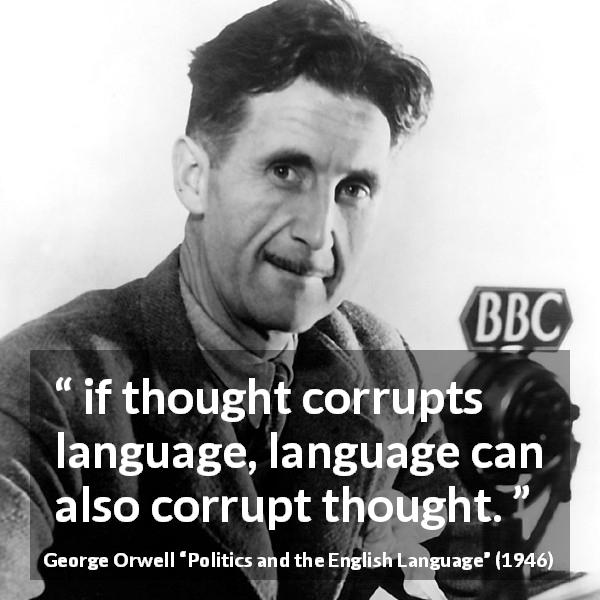
In his essay, “Politics and the English Language”, George Orwell lamented the decline in the standards of his mother tongue.

For Orwell, all around him lay the evidence of decay. Orwell argued sloppy language came from and led to sloppy thinking:

    A man may take to drink because he feels himself to be a failure, and then fail all the more completely because he drinks. It is rather the same thing that is happening to the English language […] It becomes ugly and inaccurate because our thoughts are foolish, but the slovenliness of our language makes it easier for us to have foolish thoughts.

With his effortless knack for saying in plain English the resonant and enduring, Orwell’s dictum is obvious as soon as uttered.

Orwell wrote that back in 1946. What would the author of Animal Farm and 1984 make of today’s standards?


“Misogyny” is overtaking “fascist” in the “I Don’t Own a Dictionary” championships.

Spend five minutes online, and you’ll encounter words defined in their starkest definitions. Words like “misogyny”, “misandry”, and “narcissist”, once possessed specific meanings. Now they mean whatever the speaker claims they mean.

The beauty of the English language lies in its precision. Sadly, those who populate the land which spawned the English language wield the language with all the grace and precision of a meat hook.

According to The Guardian, the recent Finnish election was suppurated with misogyny and fascism.

In that election, the one debased in misogyny and fascism, the losing incumbent Sanna Marin, a woman, won more seats in parliament than in 2019. The three candidates with the most votes — Riikka Purra, Sanna Marin and Elina Valtonen — were all women. Women lead seven of the nine parties returned to parliament — including the “far-right” Finns Party.

The Guardian didn’t permit reality to spoil a good headline.

As Orwell had it, “Fascism” is a hollow word. In the essay mentioned above, he said: “The word Fascism has now no meaning except in so far as it signifies ‘something not desirable’.” In modern parlance, the same applies to “misogyny”. “misandry”, “narcissism”, “gaslighting”, and just about every other buzzword shoehorned into a HuffPost headline.

June 13, 2023

Liberal woman frustrated she can’t find non-conservative but traditionally masculine men

Filed under: Media, Politics, USA — Tags: , , , , — Nicholas @ 05:00

Tom Knighton responds to a progressive woman’s lament:

Originally found on fark.com about 15 years ago, artist unknown.

    She is at a loss because she wants to be with a masculine man but doesn’t want to compromise her morals and values. She asks her followers if she is asking for too much when she requests a man she can be “equal” with while he still provides for her.

What she doesn’t seem to get is that it was women like her that basically destroyed manhood to the point that there’s little chance she’ll find a liberal guy with traditional values.

See, liberal men are basically obligated to take the subservient role. They’re required by their ideology to accept that the woman is just as capable — and obligated — to be at least an equal in providing for the family, if not the provider herself.

Failure to act according to this, at least in their minds, is to undermine the feminist values the left claims to hold so dear.

It didn’t have to be this way. It was always possible to empower women without trying to tear masculinity down, which is what has been happening.

Opening doors for women, for example, is one of those things guys used to do all the time. It wasn’t that women were somehow incapable of operating a doorknob. It was because it was just something a gentleman did.

Now, if a man opens the door for a woman, he’s taking a chance. Will she appreciate it or will she launch into a feminist diatribe about the patriarchy?

Leftist men already know which they expect, so they do no such thing. Guys with more of a traditional lean, however, can and will open that door because they’re not impressed with feminist screeching.

The surprisingly authoritarian reflexes of the “true” anti-authoritarian

Filed under: Government, Media, Politics, USA — Tags: , , , , — Nicholas @ 04:00

Chris Bray surveys the “anti-authoritarian” stances and actions of Professor Ruth Ben-Ghiat, a dedicated opponent of all things Trump:

I’ve called the NYU professor Ruth Ben-Ghiat, an “expert” on authoritarianism, an inversion blender, a narrative-producing machine with an astonishing gift for turning meaning upside-down. Your decision to drive north is ironclad proof that you intend to travel to the south! You’re spraying water on that fire to make it bigger! You gave me a sandwich because you want me to starve to death!

Currently, Ben-Ghiat’s frantic production of anti-authoritarian messaging on Twitter, the preferred platform of true intellectuals, is tightly focused on the dangerous authoritarianism of the megafascist Donald Trump, who is doing what all true authoritarians do: questioning and criticizing the government. Go stroll through Ruth Ben-Ghiat’s Twitter posts. It’s like having lunch with Felix Dzerzhinsky. Only the guilty and the fascist elements resist the cleansing power of the state and its gloriously pure-hearted investigative apparatus!

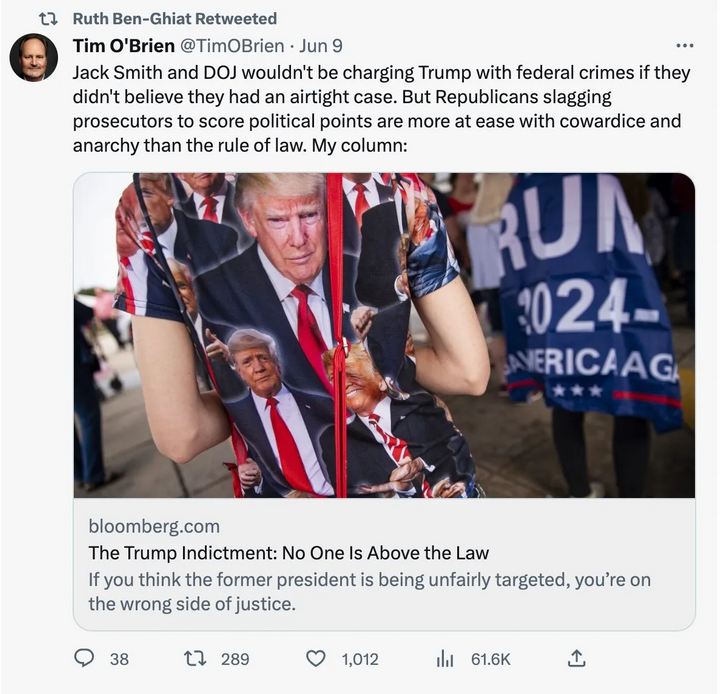
A suggestion up front from the maître d’hotel: What you’re about to consume is the filet mignon of dimwitted propaganda. Chew it slowly. Savor. Let’s start with a light appetizer, a mere retweet, to tease the ironic gustation:

Archie Bunker and Meathead have become one, united by the power of the Trump. If a prosecutor charges you, the case is airtight, full stop. Government never charges innocent people with crimes. To criticize a prosecutor is to oppose the rule of law, which can only be defended by the immediate presumption of guilt. Here, let’s try it out:

Prosecutors wouldn’t be charging Rick Perry with crimes if they didn’t believe they had an airtight case.

Prosecutors wouldn’t be charging Kyle Rittenhouse with crimes if they didn’t believe they had an airtight case.

Prosecutors wouldn’t be charging Tom Robinson with crimes if they didn’t believe they had an airtight case. Atticus Finch is an authoritarian!

This is why criminal defense lawyers are all so infamously right-wing, by the way. Especially public defenders.

[…]

Nothing says progressive anti-authoritarian like the sacralization of national security as a preeminent value. If government says that something has been done in the name of national security, you must accept it and support it without question. Or else you’re an authoritarian, doubting the state security apparatus. Fascists always do that.

There is, of course, a long and deeply established tradition on the American political left of criticism directed at the FBI and DOJ — and at federal law enforcement in general, and at law enforcement in general, and the “carceral state” — as hegemonic instruments. Historians and activists on the left have long viewed the FBI with political suspicion, and with reason.

Until pretty much right this instant, because Trump.

June 11, 2023

QotD: The revolt against “meritocracy”

Filed under: Education, Media, Politics, Quotations, USA — Tags: , , , , — Nicholas @ 01:00

As with almost every one of these crusades the left goes on, it ain’t what they’re saying it is. And those of us on the right(ish) who think that it’s all part of a master plan to destroy society so the great communist utopia appears automagically aren’t precisely right. I mean, most people on the left would welcome collapse, because, yes, they believe a communist matriarchy is ONLY waiting for the “oppressors” who create capitalism and patriarchy to vanish (oblivious to the fact that “capitalism” is trading, which seems to be a natural condition of the human monkey and not eradicable by any regime real or imaginary; and that “patriarchy” doesn’t exist in the west.) But that’s not the point, because they don’t think they’re bringing about collapse. They think they’re fighting injustice.

When we say “merit” and “meritocracy” they think we’re using “code words” to say “white males”. There are reasons for this, besides the fact that the left is heavily into Manichaean thought systems that go something like: identify problem — find a person who MIGHT be responsible for/benefits from the system as it exists — assume that if that person were removed, the problem would be gone. See, French Revolution.

The initial confusion on the left arises from the fact that they might never, in fact, have witnessed meritocracy in their dealings or those of people around them.

This is because, as part of the long march, and to secure absolute control of all fields and institutions, the left has a mythology (the Manichaean thing again) that anyone who disagrees with them is evil. And of course, you don’t hire evil people.

The problem with that type of hiring is that you’re NOT hiring the best. And most people know they’re not the best. And hire someone less bright than they are. This in four generations takes you to the level of management/operation that takes monarchies twenty generations of inbreeding to achieve.

Right now, in everything but the hard sciences and STEM (and they’ve gotten into some of those, and can’t always be routed around.) the people in power would consider pouring piss out of a boot with the instructions written on the sole a feat of unachievable genius.

Most of them are so vacuous they don’t even know they’re incompetent. Or, like Michelle Obama in her essay on why everyone was mean to her at Harvard, they assume everyone else is just as incompetent.

The reason they get hired, stay hired and continue to get push/accolades/power is that they have the “right picture in head” by which you should understand “the left picture in head”. They view the world exactly as they were taught to view it by their Marxist teachers and professors. Reality is Manichean, and if there is any issue at all, you find the person who might be causing it (hint, usually you find the person who is a heretic to the left, even if in a minor thing) and you attack that person. If the person is not immediately obvious, you look for deviationism or examples of hidden thought crime.

It’s appalling, and in a society with no protection for the individual, it fills mass graves, but it is the way their minds — for lack of a better term — operate. They’ve been trained to operate that way. Not to look at human nature, or the conditions in the world, or even the limits of engineering and materials (what’s holding us back on batteries, for instance. They prefer to think oil executives, personally, are holding back the all-electric solar cars we should already have.) No. “Find the culprit” “Eliminate him/her” “Everything is beautiful in the garden”. Seen in this light, the Green Nude Heel makes “perfect sense”. And is a genius work in scope. Which is why she got all upset at criticism and thought that it only meant people wanted her to find all the little subculprits and work out all the details of the pogroms necessary to make it work. Not getting that people were saying “Not in this world, not with these humans, not in this REALITY”.

Sarah Hoyt, “Just Deserts”, According to Hoyt, 2019-06-06.

June 9, 2023

Putting an end to “stakeholder” capitalism

The Streetwise Professor explains what “stakeholder capitalism” is and why it needs to be staked through the heart to save western economies:

A graphic from Wikipedia showing typical internal and external stakeholders.

At its root, stakeholder capitalism represents a rejection – and usually an explicit one – of shareholder wealth maximization as the sole objective and duty of a corporation’s management. Instead, managers are empowered and encouraged to pursue a variety of agendas that do not promote and are usually inimical to maximizing value to shareholders. These agendas are usually broadly social in nature intended to benefit various non-shareholder groups, some of which may be very narrow (transsexuals) or others which may be all encompassing (all inhabitants of planet earth, human and non-human).

This system, such as it is, founders on two very fundamental problems: the Knowledge Problem and Agency problems.

The Knowledge Problem is that no single agent possesses the information required to achieve any goal – even if universally accepted. For example, even if reducing the risk of global temperature increases was broadly agreed upon as a goal, the information required to determine how to do so efficiently is vast as to be unknowable. What are the benefits of a reduction in global temperature by X degrees? The whole panic about global warming stems from its alleged impact on every aspect of life on earth – who can possibly understand anything so complex? And there are trade-offs: reducing temperature involves cost. The cost varies by the mix of measures adopted – the number of components of the mix is also vast, and evaluating costs is again beyond the capabilities of any human, no matter how smart, how informed, and how lavishly equipped with computational power. (Daron Acemoğlu, take heed).

[…]

Agency problems exist when due to information asymmetries or other considerations, agents may act in their own interests and to the detriment of the interests of their principals. In a simple example, the owner of a QuickieMart may not be able to monitor whether his late-shift employee is sufficiently diligent in preventing shoplifting, or exerts appropriate effort in cleaning the restrooms and so on. In the corporate world, the agency problem is one of incentives. The executives of a corporation with myriad shareholders may have considerable freedom to pursue their own interests using the shareholders’ money because any individual shareholder has little incentive to monitor and police the manager: other shareholders benefit from, and thus can free ride on, any individual’s efforts. So managers can, and often do, get away with extravagant waste of the resources owned by others placed in their control.

This agency problem is one of the costs of public corporations with diffuse ownership: this form of organization survives because the benefits of diversification (i.e., better allocation of risk) outweigh these costs. But agency costs exist, and increasing the scope of managerial discretion to, say, saving the world or achieving social justice inevitably increases these costs: with such increased scope, executives have more ways to waste shareholder wealth – and may even get rewarded for it through, say, glowing publicity and other non-pecuniary rewards (like ego gratification – “Look! I’m saving the world! Aren’t I wonderful?”)

H/T to Tim Worstall for the link.

« Newer PostsOlder Posts »

Powered by WordPress