
What is political correctness? As I see it, it is a predictable feature of the life cycle of modern revolutions, beginning with the French Revolution of 1789, which was inspired by the American Revolution of the prior decade but turned far more violent. A first generation of daring rebels overthrows a fossilized establishment and leaves the landscape littered with ruins. In the post-revolutionary era, the rebels begin to fight among themselves, which may lead to persecutions and assassinations. The victorious survivor then rules like the tyrants who were toppled in the first place. This is the phase of political correctness — when the vitality of the founding revolution is gone and when revolutionary principles have become merely slogans, verbal formulas enforced by apparatchiks, that is, party functionaries or administrators who kill great ideas by institutionalizing them.
Camille Paglia, “The Modern Campus Has Declared War on Free Speech”, Heat Street, 2016-05-09.
January 2, 2018
QotD: Political Correctness
December 29, 2017
QotD: Post-structuralism
Another problem in 1970s academe was a job recession in the humanities that arose just as deconstruction and post-structuralism arrived from Europe. The deconstructionist trend started when J. Hillis Miller moved from Johns Hopkins University to Yale and began bringing Jacques Derrida over from France for regular visits. The Derrida and Lacan fad was followed by the cult of Michel Foucault, who remains a deity in the humanities but whom I regard as a derivative game-player whose theories make no sense whatever about any period preceding the Enlightenment. The first time I witnessed a continental theorist discoursing with professors at a Yale event, I said in exasperation to a fellow student, “They’re like high priests murmuring to each other.” It is absurd that that elitist theoretical style, with its opaque and contorted jargon, was ever considered Leftist, as it still is. Authentic Leftism is populist, with a brutal directness of speech.
Post-structuralism, in asserting that language forms reality, is a reactionary reversal of the authentic revolutionary spirit of the 1960s, when the arts had turned toward a radical liberation of the body and a re-engagement with the sensory realm. By treating language as the definitive force in the world — a foolish thesis that could easily be refuted by the dance, music, or visual arts majors in my classes — post-structuralism set the groundwork for the present campus impasse where offensive language is conflated with material injury and alleged to have a magical power to create reality. Furthermore, post-structuralism treats history as a false narrative and encourages a random, fragmented, impressionistic approach that has given students a fancy technique but little actual knowledge of history itself.
Camille Paglia, “The Modern Campus Has Declared War on Free Speech”, Heat Street, 2016-05-09.
December 23, 2017
Words as weapons, words as tools
In City Journal, Howard Husock looks at the recent media fuss about certain words being “banned” by Trump or the Republicans:
A political tempest arose last week when the Washington Post reported that the Department of Health and Human Services had banned the use of certain words or phrases — “vulnerable,” “science-based,” and “entitlements,” among others — in official budget documents. National Affairs editor Yuval Levin debunked the story, though, finding instead that bureaucrats concerned about offending Republican budget overseers had, in fact, decided to censor themselves. If so, that suggests that the bureaucrats have been reading their George Orwell, who observed in his classic essay “Politics and the English Language” that language is “an instrument which we shape for our own purposes”; they are sharp enough to realize that even neutral terms can constitute mini-arguments. Each of the terms in question — and a great many more — have been weaponized for use in political conflict.
“Vulnerable,” for example, is a substitute for “poor” or “low-income,” but it usually suggests that the person in question should not be considered in any way responsible for his or her situation, because social conditions that transcend individual action have stacked the deck adversely. “Science-based” is a pithy way to characterize the views of one’s political opponents as ignorant or superstitious. The belief that climate change will prove catastrophic is said to be science-based; any view that minimizes the risk constitutes “denial,” another noun that has become an argument. The widely used “entitlement” has also become an argument. The idea that all citizens are “entitled” to certain forms of financial support — checks for those above a certain age, health insurance for those below a certain income — implies no other way of seeing the situation. Those who would change the way entitlements are disbursed, then, are impinging on rights, not programs.
Other examples abound. “Disadvantaged” describes low-income children — while implying that other children are advantaged — and thus that the system is unfair and violates “social justice,” another loaded term. The “homeless,” by and large, are not living on the street but are often doubled up with friends or family; they don’t have their own home, in other words. But the word-picture painted by “homeless” is more powerful. The Right plays the same game. “Death tax” as a substitute for “estate tax,” for example, characterizes a debatable policy as an immoral absurdity.
Repost – “Merry Christmas” versus “Happy Holidays” versus “Happy Midwinter Break”
L. Neil Smith on the joy-sucking use of terms like “Happy Midwinter Break” to avoid antagonizing the non-religious among us at this time of year:
Conservatives have long whimpered about corporate and government policies forbidding employees who make contact with the public to wish said members “Merry Christmas!” at the appropriate time of the year, out of a moronic and purely irrational fear of offending members of the public who don’t happen to be Christian, but are Jewish, Muslim, Hindu, Buddhist, Sikh, Jain, Rastafarian, Ba’hai, Cthuluites, Wiccans, worshippers of the Flying Spaghetti Monster, or None of the Above. The politically correct benediction, these employees are instructed, is “Happy Holidays”.
Feh.
As a lifelong atheist, I never take “Merry Christmas” as anything but a cheerful and sincere desire to share the spirit of the happiest time of the year. I enjoy Christmas as the ultimate capitalist celebration. It’s a multiple-usage occasion and has been so since the dawn of history. I wish them “Merry Christmas” right back, and I mean it.
Unless I wish them a “Happy Zagmuk”, sharing the oldest midwinter festival in our culture I can find any trace of. It’s Babylonian, and celebrates the victory of the god-king Marduk over the forces of Chaos.
But as anybody with the merest understanding of history and human nature could have predicted, if you give the Political Correctness Zombies (Good King Marduk needs to get back to work again) an Angstrom unit, they’ll demand a parsec. It now appears that for the past couple of years, as soon as the Merry Christmases and Happy Holidayses start getting slung around, a certain professor (not of Liberal Arts, so he should know better) at a nearby university (to remain unnamed) sends out what he hopes are intimidating e-mails, scolding careless well-wishers, and asserting that these are not holidays (“holy days”) to everyone, and that the only politically acceptable greeting is “Happy Midwinter Break”. He signs this exercise in stupidity “A Jewish Faculty Member”.
Double feh.
Two responses come immediately to mind, both of them derived from good, basic Anglo-Saxon, which is not originally a Christian language. As soon as the almost overwhelming temptation to use them has been successfully resisted, there are some other matters for profound consideration…
December 12, 2017
QotD: The development of all the various university “studies” departments
After the 1960s cultural revolution, it was clear that the humanities had become too insular and removed from social concerns and that they had to reincorporate a more historical perspective. There were many new subject areas of contemporary interest that needed to be added to the curriculum — sex and gender, film, African-American and Native American studies among them. But the entire humanities curriculum urgently demanded rethinking. The truly radical solution would have been to break down the departmental structure that artificially separated, for example, English departments from French departments and German departments. Bringing all literature together as one field would have created a much more open, flexible format to encourage interdisciplinary exploration, such as cross-fertilizations of literature with the visual arts and music. Furthermore, I wanted an authentic multiculturalism, a curriculum that affirmed the value and achievements of Western civilization but expanded globally to include other major civilizations, all of which would be studied in their chronological unfolding. Even though I am an atheist, I have always felt that comparative religion, a study of the great world religions over time, including all aspects of their art, architecture, rituals, and sacred texts, was the best way to teach authentic multiculturalism and achieve world understanding. Zen Buddhism was in the air in the 1960s as part of the legacy of the post-war Beat movement, and Hinduism entered the counterculture through the London scene, partly because of Ravi Shankar, a master of the sitar who performed at California’s Monterey Pop Festival in 1967.
However, these boundary-dissolving expansions were unfortunately not the route taken by American academe in the 1970s. Instead, new highly politicized departments and programs were created virtually overnight — without the incremental construction of foundation and superstructure that had gone, for example, into the long development of the modern English department. The end result was a further balkanization in university structure, with each area governed as an autonomous fiefdom and with its ideological discourse frozen at the moment of that unit’s creation. Administrators wanted these programs and fast — to demonstrate the institution’s “relevance” and to head off outside criticism or protest that could hamper college applications and the influx of desirable tuition dollars. Basically, administrators threw money at these programs and let them find their own way. When Princeton University, perhaps the most cloistered and overtly sexist of the Ivy League schools, went coeducational after 200 years in 1969, it needed some women faculty to soften the look of the place. So it hastily shopped around for whatever women faculty could be rustled up, located them mostly in English departments at second-tier schools, brought them on board, and basically let them do whatever they wanted, with no particular design. (Hey, they’re women — they can do women’s studies!)
I maintain, from my dismayed observation at the time, that these new add-on programs were rarely if ever founded on authentic scholarly principles; they were public relations gestures meant to stifle criticism of a bigoted past. In designing any women’s studies program, for example, surely a basic requirement for students should be at least one course in basic biology, so that the role of hormones in human development could be investigated — and rejected, if necessary. But no, both women’s studies and later gender studies evolved without reference to science and have thus ensured that their ideology remains partisan and one-dimensional, stressing the social construction of gender. Any other view is regarded as heresy and virtually never presented to students even as an alternative hypothesis.
Today’s campus political correctness can ultimately be traced to the way those new programs, including African-American and Native American studies, were so hastily constructed in the 1970s, a process that not only compromised professional training in those fields over time but also isolated them in their own worlds and thus ultimately lessened their wider cultural impact. I believe that a better choice for academic reform would have been the decentralized British system traditionally followed at Oxford and Cambridge Universities, which offered large subject areas where a student could independently pursue his or her special interest. In any case, for every new department or program added to the U.S. curriculum, there should have been a central shared training track, introducing students to the methodology of research and historiography, based in logic and reasoning and the rigorous testing of conclusions based on evidence. Neglect of that crucial training has meant that too many college teachers, then and now, lack even the most superficial awareness of their own assumptions and biases. Working on campus only with the like-minded, they treat dissent as a mortal offense that must be suppressed, because it threatens their entire career history and world-view. The ideology of those new programs and departments, predicated on victimology, has scarcely budged since the 1970s. This is a classic case of the deadening institutionalization and fossilization of once genuinely revolutionary ideas.
Camille Paglia, “The Modern Campus Has Declared War on Free Speech”, Heat Street, 2016-05-09.
November 29, 2017
Something rotten at the Royal Military College of Canada
Ted Campbell discusses the concerns about the Royal Military College (RMC) in the latest Auditor General’s report:
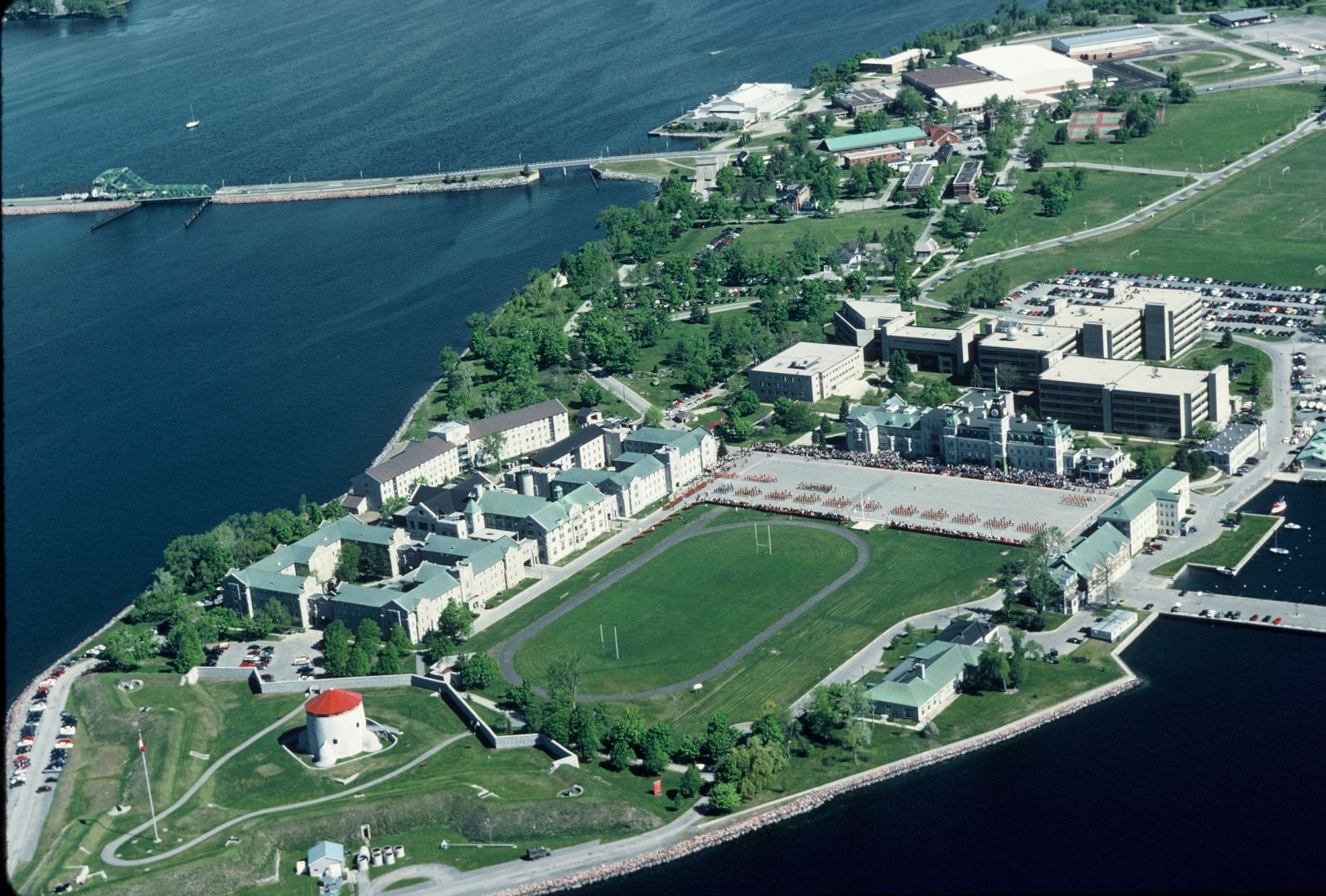
Aerial view of the main RMC campus in Kingston, Ontario.
Photo from Ted Campbell’s Point of View
As you can well imagine, despite the almost zero interest in government and the media ~ reflecting the fact that taxpayers neither know much nor care even a tiny bit about the military, unless there’s a scandal with sexual overtones ~ this is a hot topic amongst many of my friends. Reactions range from:
- Hey, RMC is doing just fine, it is meeting its assigned mission ~ “The mission of the Royal Military College of Canada (RMC) is to produce officers with the mental, physical and linguistic capabilities and the ethical foundation required to lead with distinction in the Canadian Armed Forces (CAF)” ~ and who cares if it costs a bit more than, say, getting a tainted BA from Laurier?
… through to …
- Burn. It. To. The. Ground.
Most of my military friends and acquaintances agree, broadly, with the Auditor General:
- The Royal Military College is a pretty good university that produces well educated men and women, most of whom are, perhaps, somewhat less than adequately prepared for further military training; but
The Royal Military College is notably weaker than in years (decades) past and weaker than it should be, today, at producing young men and women who are physically fit, even tough, who have high ethical standards and who display an acceptable level of leadership skill and ability.
So, why, one might ask, is The Royal Military College an academically fine college but not so good at the military stuff?
Friends and acquaintances who are reasonable closely connected to RMC (current and former academic and military staff and/or officers in the parts of the HQ that have responsibility for RMC) suggest that the academic staff (currently led by the College Principal, Dr. H.J. (Harry) Kowal, CD, rmc, BEng, MSAe, MA(SS), MDS, PhD, PEng, BGen (Ret’d)) has a better focus on what it is doing and why it is doing it than does the military staff (currently led by the Commandant, Brigadier General Sébastien Bouchard, an Army officer from one of the engineering branches). Should BrigadierGeneral Bouchard be fired and replaced with someone better? No, the problem is not his leadership ability, it is that Dr. Kowal’s mission is clearer, simpler and easier to accomplish than is General Bouchard’s. In theory the reverse ought to be true, but …
Most of my friends and acquaintances who are “in the know” agree that RMC’s biggest problem is that the military, proper, has far, far too little say in who gets in and once in students are not allowed to fail out for fitness (athletic), ethical or leadership deficiencies.
A while ago a friend related a story (it’s actually three or four stories, all put together) about one of the courses at the College ~ it was about a mid-term exam: one student was caught cheating, one simply failed to even write the exam and a third had to be given a second chance because (s)he had a learning disability. “Wait!” I exclaimed, “How in hell did someone with a learning disability get into RMC in the first place? How in hell will someone with a learning disability ever stand watch on the bridge of a ship, command a troop of tanks in battle or fly an airplane?” “Not to worry,” my friend said, “(s)he will never get that far … but (s)he will graduate.” He went on to explain that no one in “official Ottawa” is wiling to enforce standards any more. No one believes that a person with a learning disability severe enough to require special attention like an exam re-write can ever do any useful job as an officer in the CF, but no one has the courage to say, up front, “sorry, Margaret or Mike, but you are not qualified to study at RMC because we, the military, have our own, valid, operationally required standards and you don’t meet them.” In the 21st century we all know that every snowflake is special and every special snowflake will go to some human rights tribunal if the military ties to enforce reasonable, legitimate standards, and the admirals and generals and bureaucrats and politicians are far more afraid of a human rights story in the media than they are of North Korean missiles.
“But,” I said, “what about the one who cheated and the one who just ditched the exam?” They, I suggested, must, surely, have been given the old “heave-ho.” “Nope,” my friend answered, “the exam was just declared optional ~ it will count as, say, 15% of the final course mark so the young person who ditched it will still, most likely, graduate and the cadet who cheated was given a bureaucratic rap on the knuckles because no one in the military chain had the balls to fail him/her.” Failing someone, he said, is very, very difficult because even the military has adapted to a social system in which everyone must pass everything … only, he said, in a few (hard science and engineering) departments is there some doubt about everyone passing everything.
October 2, 2017
John Cleese: Political Correctness and Islam
Democracy In Name Only
Published on 11 Jan 2017John Cleese speaks frankly about political correctness, the right to offend and Islam.
September 13, 2017
QotD: The changed nature of “class”
For a while communists went around looking lost [after the collapse of the Soviet Union]. Umberto Ecco referred to them as “defrocked priests” who have lost their vision of paradise. And then … And then they decided we just hadn’t tried it hard enough or well enough.
But by the time they found this “new vision” (these doomsday cults never admit they were wrong, you know) they had given up on the idea of the proletariat conquering the bourgeoisie and rich, and had instead turned into sort of missionaries of victims and wounded people.
Instead of social class meaning what it meant to Marx, which was entirely economics based, it now meant “group vaguely aligned through some (usually natural) characteristic.” So we have the oppressed class of oh, gay people who come from all backgrounds and regions and who face differing levels of acceptance from family and society, but who are deemed to be all equally victimized, and as such to need equal intervention from the elites to make them whole. Then there are racial groups, so factionalized that at some point we’re all going to become a race of one.
The elites took to this new way of viewing society like ducks to water, partly because you don’t actually need to do anything to help anyone anywhere. Like Marx, who mistreated his illegitimate son from the woman who was somewhere between an indentured servant and a slave to his family, even as he preached social revolution and the triumph of the lower classes, they can simply preach acceptance and talk about how poor victims suffer without bothering to notice that their neighbor is unemployed and surviving on cat food. If you ask them about this particular instance, they’ll tell you that, well, come the revolution he will have a job and food… Meanwhile they’re working for the greater cause of bringing about the revolution.
And thus, more dreary than the “quality” that consisted of unpleasant people doing unpleasant things, we have the taste makers hailing the new “quality” which consists of “fighting patriarchy” or “white hegemony” or whatever latest crazycakes lens is applied to society. Yep, the people with the power are accusing other people of keeping them down because they have a vagina or can tan or whatever. (And the proof of this is the Dolezals of the world who find great rewards in pretending to be victims.)
Sarah A. Hoyt, “The Quality of Writing”, According to Hoyt, 2015-10-11.
September 6, 2017
QotD: Suicidalism
The most important weapons of al-Qaeda and the rest of the Islamist terror network are the suicide bomber and the suicide thinker. The suicide bomber is typically a Muslim fanatic whose mission it is to spread terror; the suicide thinker is typically a Western academic or journalist or politician whose mission it is to destroy the West’s will to resist not just terrorism but any ideological challenge at all.
But al-Qaeda didn’t create the ugly streak of nihilism and self-loathing that afflicts too many Western intellectuals. Nor, I believe, is it a natural development. It was brought to us by Department V of the KGB, which was charged during the Cold War with conducting memetic warfare that would destroy the will of the West’s intelligentsia to resist a Communist takeover. This they did with such magnificent effect that the infection outlasted the Soviet Union itself and remains a pervasive disease of contemporary Western intellectual life.
Consider the following propositions:
- There is no truth, only competing agendas.
- All Western (and especially American) claims to moral superiority over Communism/Fascism/Islam are vitiated by the West’s history of racism and colonialism.
- There are no objective standards by which we may judge one culture to be better than another. Anyone who claims that there are such standards is an evil oppressor.
- The prosperity of the West is built on ruthless exploitation of the Third World; therefore Westerners actually deserve to be impoverished and miserable.
- Crime is the fault of society, not the individual criminal.
- Poor criminals are entitled to what they take. Submitting to criminal predation is more virtuous than resisting it.
- The poor are victims. Criminals are victims. And only victims are virtuous. Therefore only the poor and criminals are virtuous. (Rich people can borrow some virtue by identifying with poor people and criminals.)
- For a virtuous person, violence and war are never justified. It is always better to be a victim than to fight, or even to defend oneself.
- But “oppressed” people are allowed to use violence anyway; they are merely reflecting the evil of their oppressors.
- When confronted with terror, the only moral course for a Westerner is to apologize for past sins, understand the terrorist’s point of view, and make concessions.
These ideas travel under many labels: postmodernism, nihilism, multiculturalism, Third-World-ism, pacifism, “political correctness” to name just a few. It is time to recognize them for what they are, and call them by their right name: suicidalism.
Eric S. Raymond, “Suicidalism”, Armed and Dangerous, 2005-09-13.
August 18, 2017
“Rebel Commander Ezra Levant” calls retreat
In the National Post, Chris Selley recounts the sudden changes in staffing and editorial policy at Ezra Levant’s mini media empire:
If Rebel Media’s uppance was coming, if some event was finally going to wipe the smirk off its face, it could hardly have been more hideously appropriate than what happened over the weekend in Charlottesville, Va.
Live on the internet, Rebel personality Faith Goldy was blathering on about how intolerant the left is, and about left-right double standards in the media and in policing, and about all the other things that gladden the hearts of the Rebel’s grievance-based nihilist-conservative fans.
And then, right there in the frame, someone rammed his car into the crowd of counter-protesters she was mocking, killing 32-year-old Heather Heyer and injuring many others. That guy, allegedly, was 20-year-old James Alex Fields, whose high school teachers said he was obsessed with Adolf Hitler in all the wrong ways.
Fun time was over. This was, apparently, a real live neo-Nazi committing, certainly, real live murder.
At this point, Rebel Commander Ezra Levant could have steered his vessel in one of several directions. “Nothing to do with us,” he could have said, plausibly enough.
[…]
Levant could have gone there; instead, he blinked.
“When I first heard of the alt-right a year ago, I thought it simply meant the insurgent right, the politically incorrect right … the right that backed Trump and his ‘Make America Great Again’ style over Jeb Bush and the swamp,” he wrote in a purported “staff memo.”
“But the alt-right has changed into something new, especially since Trump’s election,” Levant lamented. “Now the leading figure … is Richard Spencer, and other white nationalists.” There were actual Nazi flags in Charlottesville, Levant noted, waxing appalled (while allowing they might have been carried by “agents provocateurs”). That’s “racist,” he averred, rather than “conservative,” and he would have none of it.
It is, in a word, pathetic. Spencer coined the term “alt-right,” for heaven’s sake. He has never, ever been shy about his white nationalist views. A manifesto he released before the march in Charlottesville talks of “a shared civilization” that “sprang” from the “Aryan” race, and dismisses the idea of “Judeo-Christian values” as “a distortion of the historical and metaphysical reality of both Jews and Europeans.”
I haven’t closely followed the adventures of Ezra and his Rebel Media organization, so the sudden rash of departures (Brian Lilley and Barbara Kay, in particular) caught me somewhat by surprise. I don’t use Rebel Media as a source, but I have linked to non-Rebel Media articles by Lilley and Kay, and probably other contributors outside that affiliation. I had noted the organization’s dedication to “afflicting the comfortable” — almost always those on the political left — without much corresponding “comforting the afflicted” to balance it out. Explicitly abandoning the Richard Spencer wing of the alt-right is probably a good move, but it may have come too late to prevent the alt-right taint from permanently damaging their brand.
August 13, 2017
June 17, 2017
QotD: The Progressive comedy pause
Tell a joke to a liberal. Between your punchline and his laughter, there is a Progressive Comedy Pause. In this second or two, the liberal will process the joke to make sure he is allowed to laugh.
Is that joke racist? He mentioned Obama, but didn’t make light of him, so to speak. He also mentioned Michelle, but I didn’t notice sexism. Is it dismissive of the LGBTQIA community? Latinos? Muslims? Vegans? Will this joke hurt progressive causes? Will my laughter trivialize oppressed communities? Will I appear intolerant? I think it’s okay if I laugh. Yes, I’ll laugh now to signal my appreciation and to indicate that I’m not a joyless liberal scold.
“Ha ha.”
I first noticed the Progressive Comedy Pause while sharing my hilarity at office staff meetings. The majority would laugh but the committed lefties would stare blankly, each eye like that spinning wheel your smartphone shows while an app is loading. (The PCP might be why progressives just hoot and clap at Bill Maher’s jokes; the laughter reflex is considered problematic.)
[…]
It’s harder to laugh when you’re scared and much of the left is terrified. They know that an inappropriate chuckle, the wrong tweet, or last year’s term for an aggrieved minority can lessen their standing with progressive peers, if not get them fired from a job. Lefties also have turned the negative of humorlessness into the positive of moral superiority. Sniffing “That’s not funny!” at an inoffensive Caitlyn Jenner joke signals that you are more evolved than the average cis-het-white-oppressor. The same people who laughed at Dana Carvey’s “Church Lady” now aspire to be her.
Jon Gabriel, “Jerry Seinfeld and the Progressive Comedy Pause”, Ricochet, 2015-06-08.
May 24, 2017
QotD: The evil of political correctness
PC [political correctness] represents, in essence, the institutionalisation of dishonesty, of deception, where people are given carte blanche to behave in an immoral way — ‘erect those fences, release the dogs, deport those people’ — but are encouraged to make it all seem nice and ‘non-hostile’. It brings to mind Wilde’s observation in his essay ‘The Soul of Man Under Socialism’, that ‘the worst slave-owners were those who were kind to their slaves, and so prevented the horror of the system being realised by those who suffered from it, and understood by those who contemplated it’. So today, the worst people in politics are those who are nice about the individuals they repress, whether it’s British politicians whose policies keep migrants in degrading limbo in Calais yet who insist everybody use nice words when talking about those migrants, or American army officials who kill Afghans yet demand that their soldiers write only PC, gay-friendly messages on the bombs that do the killing (as, remarkably, happened during the Afghan War).
Some apologists for PC describe it as simply ‘being nice’: ‘institutionalised politeness’. There’s nothing remotely nice about PC. It is the friendly slave-owner; it suppresses open, honest discussion; it obfuscates the divisions and tensions in modern society through stymying the expression of certain ideas; it is the ornate lid on a society which, however civil we make our speech, remains fractured, sometimes tense, packed with clashing interests that will never be resolved by niceness. Whether PC is being used as a glossy cover for brutal policies, as in the case of Calais, or is being used to justify anew old racial and gender divisions, as it does when it demands that we recognise and celebrate the alleged differences between blacks and whites and between men (competitive) and women (consensual), PC is a tool of censorship and conservatism, its chief accomplishment being the repression of difficult words and ideas in the name of pacifying public life.
Brendan O’Neill, “The Calais migrants and the moral bankruptcy of PC”, Spiked, 2015-08-03.
May 7, 2017
QotD: The privilege of colourblindness
In Slate magazine, SF author Ursula LeGuin complains that the producers of the new Earthsea miniseries have butchered her work. One form of butchery that she zeroes in on is by casting characters who she intended to be red, brown, or black as white people.
I have mixed feelings. LeGuin has every right to be POed at how her intentions were ignored, but on the other hand my opinion of her has not been improved by learning that she intended the books as yet another wearisomely PC exercise in multiculturalism/multiracialism.
I liked those books when I read them as a teenager. I didn’t notice any character’s skin color. I would really prefer not to have had my experience of those characters retrospectively messed with by LeGuin’s insistence that the race thing is important.
Note: I am not claiming that all casting should be colorblind. I remember once watching an otherwise excellent Kenneth Branagh production of Much Ado About Nothing that was somewhat marred for me by Branagh’s insistence on casting an American black man as a Renaissance Italian lord. This was wrong in exactly the same way that casting a blue-eyed blond as Chaka Zulu or Genghis Khan would be — it’s so anti-historical that it interferes with the suspension of disbelief. Fantasy like LeGuin’s, however, doesn’t have this kind of constraint. Ged and Tenar don’t become either more or less plausible if their skin color changes.
But what really annoyed me was LeGuin’s claim that only whites have the “privilege” of being colorblind. This is wrong and tendentious in several different ways. Colorblindness is not a privilege of anyone, it’s a duty of everyone — to judge people not by the color of their skin but the content of their character, and to make race a non-issue by whatever act of will it takes. (It doesn’t take any effort at all for me.)
Eric S. Raymond, “The Racist of Earthsea”, Armed and Dangerous, 2004-12-16.
April 24, 2017
Today’s study in “problematic” issues for Teen Vogue
Amy Alkon fisks a recent Teen Vogue piece on soi-disant “cultural appropriation”:
Silly Teen Vogue-ers, Fashion *Is* Appropriation
This bit — from Teen Vogue — is hilariously sad and sadly hilarious:
In our new column Don’t Do It Girl, Jessica Andrews explores the cultural appropriation epidemic at Coachella.
EPIDEMIC! Like AIDS, Zika, or Ebola!
Fashion always has been about appropriation. Appropriating style and appropriating culture. Those lace-up-the-ankle sandals? Ancient Rome!
Yet, do you see Italian kids mewling that you stole their culture? Of course not, because Italians, generally speaking, are exuberant people who really know how to live life.
Meanwhile, back here in America…
The kids growing up now, especially in the United States, are the freest people in human history — both as individuals and through the technology that removes the drudgery that’s been a constant companion for humans throughout the ages.
Naturally, their response to all this unparalleled freedom is to try to control other people’s behavior.
Fashion policing, in this case. Here, from Andrews story on that EPIDEMIC of appreciation:
Even when people feign ignorance, there’s little excuse. In the past, I’ve worn a Pocahontas costume for Halloween. It’s a mistake I regret, and I’ll never do it again knowing how hurtful it is.
Oh, please. I grew up Jewish. If you pretend to be a character from Fiddler on the Roof, should I take to bed and cry for a few days?
With appropriation being such a huge conversation these days…
So much talk…so little reasoning
Like fashion, appropriative hairstyles are now ubiquitous at Coachella. Cornrows or box braids are not a “hot new festival trend”; black women have been wearing them for centuries. When outlets cover the hairstyle as if it started with Kylie Jenner, it’s not appreciation; it’s erasure. Those celebratory headlines are yet another reminder that black hairstyles are only acceptable when they’re removed from actual black people.
Do you need to be high to write for Teen Vogue? It’s a fucking hairstyle. Women wear it because they think it will look good on them. If they’re white with dark hair, they’re probably wrong (nothing like rows of scalpage showing through to make a woman’s head remind us of freshly plowed fields). Women with big honking faces like mine don’t look so hot in them, either.
Unbeknownst to some Coachella attendees, there’s a stigma associated with cornrows and braids when black people wear them.
Unbeknownst to a fucking lot of us, I’d guess.


