World War Two
Published 25 Aug 2020Indy and Sparty are back again for “Across the Airwaves”, where we look at interesting and unique comments from our videos and forums. In this episode, we will look at foreign volunteers in the SS, and the Polish experience in World War Two.
Join us on Patreon: https://www.patreon.com/TimeGhostHistory
Or join The TimeGhost Army directly at: https://timeghost.tvFollow WW2 day by day on Instagram @World_war_two_realtime https://www.instagram.com/world_war_two_realtime
Between 2 Wars: https://www.youtube.com/playlist?list…
Source list: http://bit.ly/WW2sourcesHosted by: Indy Neidell & Spartacus Olsson
Director: Astrid Deinhard
Producers: Astrid Deinhard and Spartacus Olsson
Executive Producers: Astrid Deinhard, Indy Neidell, Spartacus Olsson, Bodo Rittenauer
Creative Producer: Joram Appel
Post-Production Director: Wieke Kapteijns
Research by: Francis van Berkel
Edited by: Karolina Dołęga
Sound design: Marek Kamiński
Maps: Eastory (https://www.youtube.com/c/eastory) & Karolina DołęgaColorizations by:
Jaris Almazani (Artistic Man), https://instagram.com/artistic.man?ig…Visual Sources:
Imperial War Museums: KID1265, STT 4459, 009752., D26726, D26731
Bundesarchive
Auschwitz Memorial and Museum
Icons from The Noun Project by: Icon Lauk, iconixar, Evgeni Moryakov, Panzano, Adrien Coquet, Eucalyp, Eris Natansa, Gan Khoon Lay, sumirna, priyanka & DanishiconMusic:
“The Inspector 4” – Johannes Bornlöf
“Remembrance” – Fabien Tell
“Superior” – Silver Maple
“Rush of Blood” – Reynard Seidel
“London” – Howard Harper-Barnes
“Never Forget” – Fabien Tell
“Guilty Shadows 4” – Andreas JamshereeArchive by Screenocean/Reuters https://www.screenocean.com.
A TimeGhost chronological documentary produced by OnLion Entertainment GmbH.
August 26, 2020
“Your Strict Thesis is not Correct!” – WW2 – Reading Comments
August 14, 2020
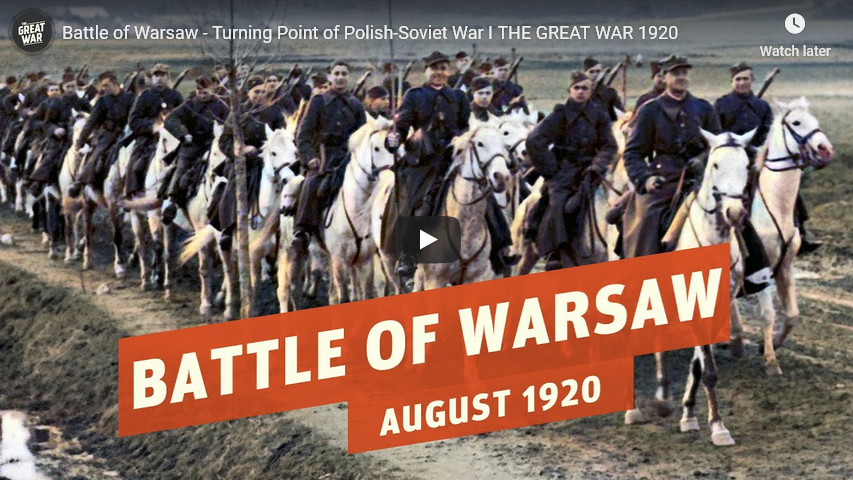
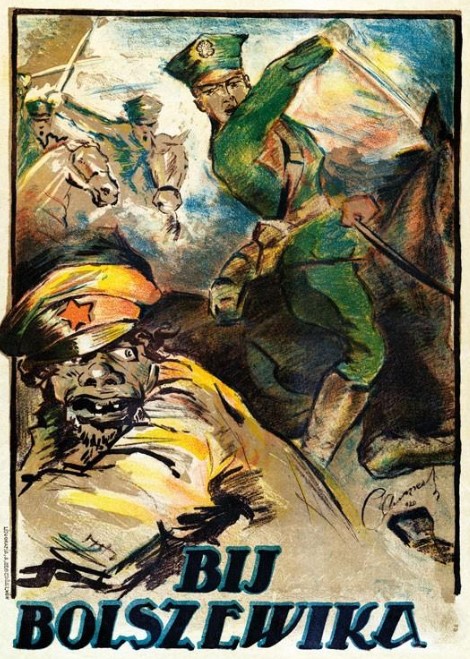
Warsaw, 1920 – “Smash a Bolshevik!”
Arthur Chrenkoff on the important but little-known Russo-Polish conflict a century ago:
The Polish-Russian war of 1919-20 was the last major conflict where massed cavalry played an important role. Unlike the static Western Front a few years earlier (but similarly to the much more mobile Eastern Front) it was a war of maneuver and speed, conducted over vast swathes of territory. While still fought in a pre-armour era, its conduct directly and indirectly inspired the major proponents of the future tank warfare and the doctrine of blitzkrieg, from the young De Gaulle (who was one of the official French Army observers in Poland at the time) through Tukhachevsky in the Soviet Union to Guderian in Germany. Two million troops from both sides took part in the conflict, making it the most significant foreign intervention against the newly installed Bolshevik regime over the course of the Russian Civil War. It might have even succeeded in strangling communism in its cradle; what prevented the cooperation with the counter-revolutionary White forces was their old imperial hostility to independent Poland (coincidentally, the anti-Hitler German opposition of 1944 was likewise unfriendly to the idea).
The basic story of the war is easily enough told. After 123 years of partition between Russia, Prussia and Austria-Hungary, Poland was recreated (or, really, recreated herself) among the chaos of the late 1918, with the collapse of all three of her occupying empires. The new “Versailles” Poland was smaller than in the past, which led the new government to try to restore by force what has been denied to her at the negotiating table (where Poles had no seat in any case). The Russian Revolution (or rather the Bolshevik coup d’etat) and the following civil war provided a perfect opportunity. Throughout 1919, the reconstituted Polish Army under the command of Marshall Jozef Pilsudski fought against and took over the briefly independent Western Ukraine republic and then marched on Kiev, this time in alliance with the forces of also briefly independent Eastern Ukraine republic (it was Pilsudski’s intention to recreate some form of an independent Ukrainian state – minus the predominantly Polish areas – as part of his larger project to create the Miedzymorze (Intermarum) Confederation of both anti-Russian and anti-German states stretching from the Baltic to the Black Sea).
But the Polish Army became overstretched and the Soviet government, now having defeated its major White opponents, found itself willing and able to stand up to and roll back what they saw as the Polish aggression against historically Russian territories. The Red Army, which sporadically skirmished with the Poles over the previous year, now counter-attacked across the whole wide front across what is now Belarus and Ukraine, driving the Polish Army back at an unprecedented pace of 30 kilometres a day. Soviet Marshall Tukhachevsky ordered his troops “To the West! Over the corpse of White Poland lies the road to worldwide conflagration. March on Vilno, Minsk, Warsaw!” and “onward to Berlin over the corpse of Poland!” Pravda newspaper echoed “Through the corpse of the White Poland lies the way to World Inferno. On bayonets we will carry happiness and peace to working humanity”. British Labour Party and French Socialists vowed not to support “reactionary” Poland; German and Czech unions sabotaged the delivery of crucial military supplies to the beleaguered Poland.
On 10 August, Cossack units of Tukhachevsky’s northern Army crossed the Vistula River north of Warsaw in at attempt to envelop the capital. This was a mistake, as the southern Army, under Budyonny, was still stuck around Lwow, three hundred kilometres to the south-east. For weeks preparing in secret, the last Polish reserves punched through the centre, first cutting off the two Soviet fronts from each other and then in a series of counter-enveloping maneuvers routing three Soviet armies. Now it was the Poles’ turn to advance 30 kilometres per day, as the Red Army collapsed and retreated in chaotic circumstances. The Polish counter-strike subsequently became known as “Cud nad Wisla” (Miracle of the Vistula), but it was less of a supernatural intervention and more a combination of several favourable factors: Soviet missteps, good Polish organisation, the growing hostility between Stalin and Trotsky as well as various military commanders, which hampered the cooperation between the Soviet fronts. Last but not least, and this was only revealed in 2004, Polish cryptographers had managed to break the Red Army codes – just as they would later be instrumental in breaking the German Enigma.
August 13, 2020
Warsaw, August 1920
Lawrence W. Reed discusses one of the most historically significant battles of the 20th century:

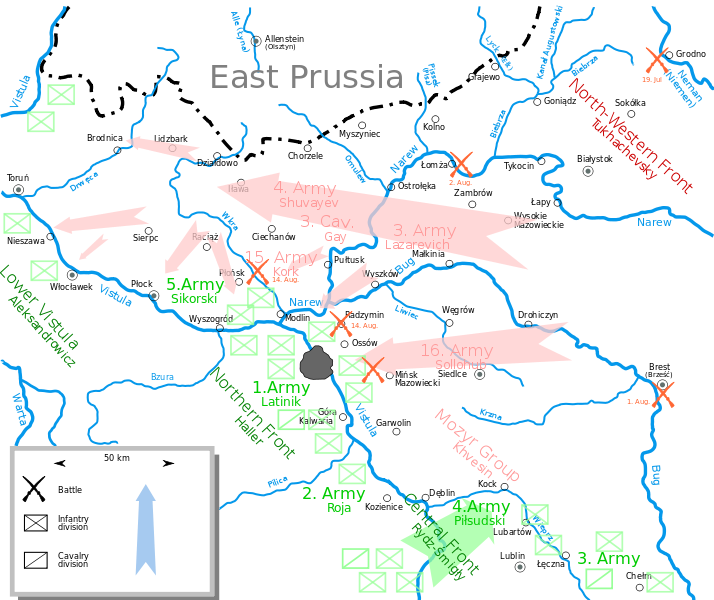
Initial Soviet advances during the Battle of Warsaw, 12 August, 1920.
Map by Halibutt via Wikimedia Commons.
This month marks the 100th anniversary of one of the most important military engagements of the 20th Century. It will be celebrated in Poland, the country which won it decisively. The country which lost it, Vladimir Lenin’s nightmarish gulag known as the Soviet Union, is thankfully extinct. Free people everywhere should be grateful to the Poles for the victory.
From 1795 until 1918, Poland disappeared as Austria, Prussia, and Russia partitioned it into pieces for themselves. Upon its re-emergence as an independent nation (an outcome of World War I), a reconstituted Poland immediately faced an existential challenge from Moscow. Lenin’s Bolsheviks were still consolidating power at home but their territorial appetites were well known to Poles and their new Chief of State, Józef Piłsudski. The fateful Polish-Soviet War broke out in February 1919.
Making war on Poland was more than a local affair to the Soviets. They made it plain that the Poles were simply in the way of their larger goal: exporting communism to the rest of Western Europe. Germany, gripped by post-war economic and political chaos, seemed ripe for a Marxist revolution if only Soviet troops could move in and assist, but Poland would have to be disposed of first.
Nicknamed “the Red Napoleon,” Soviet commander Mikhail Tukhachevsky ordered, “To the West! Over the corpse of Poland lies the road to worldwide conflagration. March upon Vilnius, Minsk, Warsaw and onward to Berlin over the corpse of Poland!” Bolshevik theoretician and Lenin confidant Nikolai Bukharin publicly declared that the campaign would take communist forces “straight to London and Paris.” In a letter to Joseph Stalin, Lenin himself suggested the Red Army should attack Romania, Czechoslovakia, and Hungary for the purpose of provoking a communist revolution in Italy, to which Stalin replied in the affirmative.
Both Tukhachevsky and Bukharin, by the way, were executed during Stalin’s purges in 1938 but they were at Lenin’s side and at the pinnacle of Soviet power in 1920. Lenin died in 1924 and was eventually succeeded by Stalin.
Soviet victories in the summer of 1920 looked unstoppable, as Moscow’s Red Army pushed to within striking distance of the Polish capital. From August 12-25, the Battle of Warsaw raged. Foreign observers expected the imminent collapse of Poland. Then, the tactical brilliance of Pilsudski and his chief of staff Tadeusz Jordan-Rozwadowski plus the legendary courage of Polish fighters combined to produce what Poles call “the Miracle on the Vistula.” Author Michael Peck writes in The National Interest:
Just as all seemed lost, Marshal Pilsudski unleashed his masterstroke, a move worthy of Robert E. Lee or Rommel. While the central Russian armies were fixated on Warsaw, a Polish strike force side-slipped to the south of the city, and then turned north in a left hook into the exposed Russian flank. Surprised, demoralized, and outmaneuvered, the Russian armies disintegrated, with some retreating back to Russia and others fleeing to German territory to be interned. Pilsudski’s counteroffensive was assisted by the breaking of Russian codes, a Polish specialty that they later used to crack the Nazi Enigma machine.
August 7, 2020
“40:1” Pt. 2 – Another Polish Last Stand – Sabaton History 079 [Official]
Sabaton History
Published 6 Aug 2020At the end of September 1939, Poland was burning. Trapped in an ever shrinking corridor between the Wehrmacht and the Red Army, the last remaining Polish forces were still holding out. Isolated, short of ammunition and supplies, and without hope for relief. The last Polish Army, the SGO Polesie, was making its way towards the Vistula, as it was cut off by German motorcycle troops. Determined to sell their lives dearly, the SGO Polesie dug in and prepared for a last stand.
Support Sabaton History on Patreon: https://www.patreon.com/sabatonhistory
Listen to “40:1” from the album The Art Of War:
https://music.sabaton.net/TheArtOfWarWatch the Official Music Video of “40:1” here:
https://www.youtube.com/watch?v=epeQw…Listen to Sabaton on Spotify: http://smarturl.it/SabatonSpotify
Official Sabaton Merchandise Shop: http://bit.ly/SabatonOfficialShopHosted by: Indy Neidell
Written by: Markus Linke and Indy Neidell
Directed by: Astrid Deinhard and Wieke Kapteijns
Produced by: Pär Sundström, Astrid Deinhard and Spartacus Olsson
Creative Producer: Joram Appel
Community Manager: Maria Kyhle
Executive Producers: Pär Sundström, Joakim Broden, Tomas Sunmo, Indy Neidell, Astrid Deinhard, and Spartacus Olsson
Post-Production Director: Wieke Kapteijns
Edited by: Karolina Dołęga
Sound Editing by: Marek Kaminski
Maps by: Eastory – https://www.youtube.com/c/eastory
Archive by: Reuters/Screenocean https://www.screenocean.com
Music by Sabaton.Sources:
Paul Otto courtesy Glenn Jewison
University of Wisconsin-Milwaukee Libraries
Bundesarchiv
Imperial War Museums: HU106375
Museum of Warsaw
Narodowe Archiwum Cyfrowe
Centralne Archiwum WojskoweAn OnLion Entertainment GmbH and Raging Beaver Publishing AB co-Production.
© Raging Beaver Publishing AB, 2019 – all rights reserved.
From the comments:
Sabaton History
2 days ago (edited)
Once again the time has come for the Polish people to show what they’re made of.This time they’re facing a gargantuan two-headed monster of an enemy and are outnumbered many many times over.
They may not win, they may not even live to see another day — but The Polish will not give up without giving their all.
Spirit of Spartans
Death and glory
Soldiers of Poland
Second to noneSo come, bring on all that you’ve got
Come hell, come high water — never stop!With the help of Indy and the TimeGhost team you can learn more about the Soviet invasion of Poland and the last days of The Polish Defensive War in these two episodes of the “World War Two In Real Time” series:
“The Russians are Coming! – The Soviet Invasion of Poland” – WW2 – 004 – September 22, 1939
https://youtu.be/8vjBp-qyNVE“Poland is Crushed” – WW2 – 005 – 29 September, 1939
https://youtu.be/OOPiUaakSXM
August 4, 2020
Nationalism DOESN’T explain WHY Austria-Hungary collapsed
TIK
Published 3 Aug 2020The go-to answer is that national or ethnic divisions caused the collapse of the Austro-Hungarian Empire. But is this really the case? Using multiple sources, it’s time to provide YouTube with a narrative which doesn’t confirm nationalist beliefs. The Habsburgs survived the collapse, with Emperor Karl / Charles trying to reclaim his throne later on before being exiled. However, by about mid-November 1918, he had lost all power. The fact that there is no specific date when Austria-Hungary collapsed, and the fact that the “national revolutions” were met with relatively little opposition, speaks volumes. As does the fact that the new states were all multinational, which undermines the narrative that nationalism was the reason why Austria-Hungary collapsed. Leave your thoughts in the comments below.
⏲️ Videos EVERY Monday at 5pm GMT (depending on season, check for British Summer Time).
– – – – –
📚 BIBLIOGRAPHY / SOURCES 📚
Judson, P. The Habsburg Empire: A New History. Belknap Press, Kindle 2016.
Kiste, J. The End of the Habsburgs: The Decline and Fall of the Austrian Monarchy. Kindle 2019.
Macgregor, J. & Docherty, G. Prolonging the Agony: How the Anglo-American Establishment Deliberately Extended WW1 by Three-and-a-Half Years. Trine Day LLC, 2018.
Marx, K. Capital: A Critique of Political Economy: Volume III. PDF, English edition, 2010. (Originally written 1894)
Mises, L. Socialism: An Economic and Sociological Analysis. Liberty Fund, 1981. 1969 edition (roots back to 1922).
Oxford Dictionary of English, Oxford University Press, Third Edition 2010.
Rady, M. The Habsburgs: The Rise and Fall of a World Power. Perseus Books, Kindle 2020.
Watson, A. Ring of Steel: Germany and Austria-Hungary at War, 1914-1918. Penguin Books, 2015.Cornwall, M. “Propaganda at Home (Austria-Hungary).” 1919. https://encyclopedia.1914-1918-online….
Online Latin-Dictionary http://www.latin-dictionary.net/defin…
Online Etymology Dictionary https://www.etymonline.com/word/publicFull list of all my sources – https://docs.google.com/spreadsheets/…
– – – – –
⭐ SUPPORT TIK ⭐
Want to ask a question? Please consider supporting me on either Patreon or SubscribeStar and help make more videos like this possible. For $5 or more you can ask questions which I will answer in future Q&A videos. Thank you to my current Patrons! You’re AWESOME! https://www.patreon.com/TIKhistory or https://www.subscribestar.com/tikhistory
– – – – –
ABOUT TIK 📝
History isn’t as boring as some people think, and my goal is to get people talking about it. I also want to dispel the myths and distortions that ruin our perception of the past by asking a simple question – “But is this really the case?” I have a 2:1 Degree in History and a passion for early 20th Century conflicts (mainly WW2). I’m therefore approaching this like I would an academic essay. Lots of sources, quotes, references and so on. Only the truth will do.
This video is discussing events or concepts that are academic, educational and historical in nature. This video is for informational purposes and was created so we may better understand the past and learn from the mistakes others have made.
July 17, 2020
“Uprising” – The 1944 Warsaw Uprising – Sabaton History 076 [Official]
Sabaton History
Published 16 Jul 2020August 1944. After nearly 5 years of suffering and oppression at the hands of the Nazis, the Polish resistance in Warsaw was ready to rise up against the German occupation. With the Red Army approaching towards the Vistula from the east, the insurgents planned to take over much of the Polish capital and hold it until help from their Allies arrived. In the early morning hours of August 1, groups of armed young men broke the curfew and stormed official buildings and German warehouses. But as insurgents fought for their lives and future, the outside world however, remained eerily quiet to their pleas for help.
Support Sabaton History on Patreon: https://www.patreon.com/sabatonhistory
Listen to “Uprising” on the album Coat Of Arms:
“CD: http://bit.ly/CoatOfArmsStore
Spotify: http://bit.ly/CoatOfArmsSpotify
Apple Music: http://bit.ly/CoatOfArmsAppleMusic
iTunes: http://bit.ly/CoatOfArmsiTunes
Amazon: http://bit.ly/CoatOfArmsAmzn
Google Play: http://bit.ly/CoatOfArmsGooglePlayWatch the Official Music Video of “Uprising” here:
https://www.youtube.com/watch?v=01IaK…Listen to Sabaton on Spotify: http://smarturl.it/SabatonSpotify
Official Sabaton Merchandise Shop: http://bit.ly/SabatonOfficialShopHosted by: Indy Neidell
Written by: Markus Linke and Indy Neidell
Directed by: Astrid Deinhard and Wieke Kapteijns
Produced by: Pär Sundström, Astrid Deinhard and Spartacus Olsson
Creative Producer: Joram Appel
Community Manager: Maria Kyhle
Executive Producers: Pär Sundström, Joakim Broden, Tomas Sunmo, Indy Neidell, Astrid Deinhard, and Spartacus Olsson
Post-Production Director: Wieke Kapteijns
Edited by: Iryna Dulka
Sound Editing by: Marek KaminskiEastory YouTube Channel: https://www.youtube.com/channel/UCEly…
Archive by: Reuters/Screenocean https://www.screenocean.com
Music by SabatonColorizations by Mikołaj Kaczmarek – Kolor Historii – https://www.facebook.com/KolorHistorii/
Sources:
– Imperial War Museum: H 4963.
– Mil.ru
– Bundesarchiv, CC-BY-SA 3.0: Bild_183-S73507, Bild_146-2005-0038, Bild_101I-695-0411-02A, Bild_183-97906, Bild 101I-695-0425-13, Bild_146-1973-113-23, Bild_146-1996-057, Bild_146-1994-054-30
– Liftarn from WikimediaAn OnLion Entertainment GmbH and Raging Beaver Publishing AB co-Production.
© Raging Beaver Publishing AB, 2019 – all rights reserved.
July 13, 2020
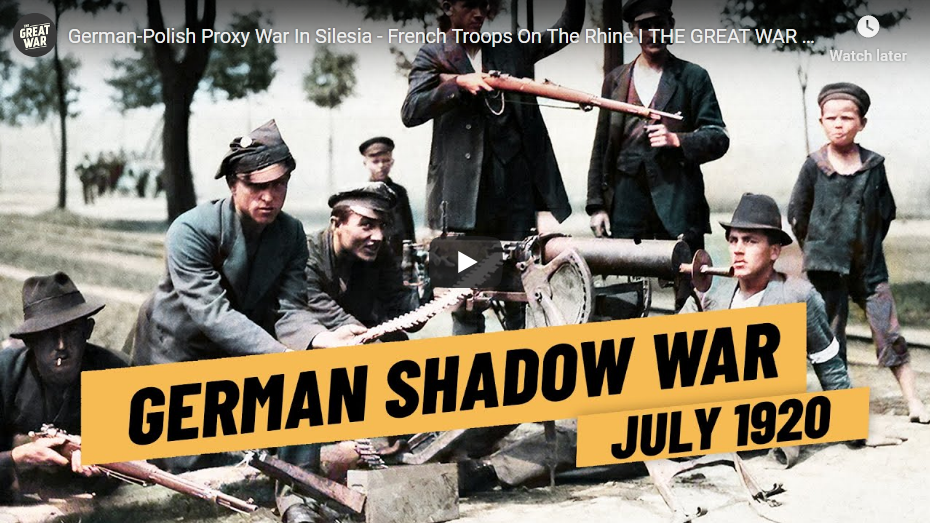
German-Polish Proxy War In Silesia – French Troops On The Rhine I THE GREAT WAR 1920
The Great War
Published 11 Jul 2020Sign up for Curiosity Stream and get Nebula bundled in: https://curiositystream.com/thegreatwar
The summer of 1920 was marked by escalating tensions on the borders of the German Reich. In the Rhineland, a neutral zone per the Versailles Treaty, the revolutionary uprising after the failed Kapp Putsch was put down with the help of the army and the Freikorps. In Upper Silesia, the conflict between Poland and Germany was escalating into a proxy war. And all that while the German government was negotiating the payments of reparations at the Spa Conference.
» SUPPORT THE CHANNEL
Patreon: https://www.patreon.com/thegreatwar» OUR PODCAST
https://realtimehistory.net/podcast – interviews with World War 1 historians and background info for the show.» BUY OUR SOURCES IN OUR AMAZON STORES
https://realtimehistory.net/amazon *
*Buying via this link supports The Great War (Affiliate-Link)» SOURCES
Buat, Edmond. 8 (Perrin, 2015)
Beaupré, Nicolas. Occuper l’Allemagne après 1918 (Revue historique des armées, 2009)
Böhler, Jochen. Civil War in Central Europe, 1918-1921 (Oxford University Press, 2019)
Gietinger, Klaus. Kapp-Putsch (Stuttgart: Schmetterling, 2020)
le Naour, Jean Yves. La Honte Noire (Hachette, 2004)
Le Figaro, numéro du 8 avril 1920 (via Gallica)
Stengers, Jean. L’accord militaire franco-belge de 1920 et le Luxembourg (Revue belge de de Philologie et d’Histoire, 2004)
https://www.dhm.de/lemo/jahreschronik…
Pöppinghege, Rainer: Republik im Bürgerkrieg. Kapp-Putsch und Gegenbewegung an Ruhr und Lippe 1919/1920 (2019)
van Galen Last, Dick. Des soldats noirs dans une guerre de blancs (1914-1922): une histoire mondiale (Editions de l’Université de Bruxelles, 2015)» MORE THE GREAT WAR
Website: https://realtimehistory.net
Instagram: https://instagram.com/the_great_war
Twitter: https://twitter.com/WW1_Series
Reddit: https://reddit.com/r/TheGreatWarChannel»CREDITS
Presented by: Jesse Alexander
Written by: Jesse Alexander
Director: Toni Steller & Florian Wittig
Director of Photography: Toni Steller
Sound: Toni Steller
Editing: Toni Steller
Motion Design: Philipp Appelt
Mixing, Mastering & Sound Design: http://above-zero.com
Maps: Daniel Kogosov (https://www.patreon.com/Zalezsky)
Research by: Jesse Alexander
Fact checking: Florian WittigChannel Design: Alexander Clark
Original Logo: David van StepholdContains licensed material by getty images
All rights reserved – Real Time History GmbH 2020
July 1, 2020
June 12, 2020
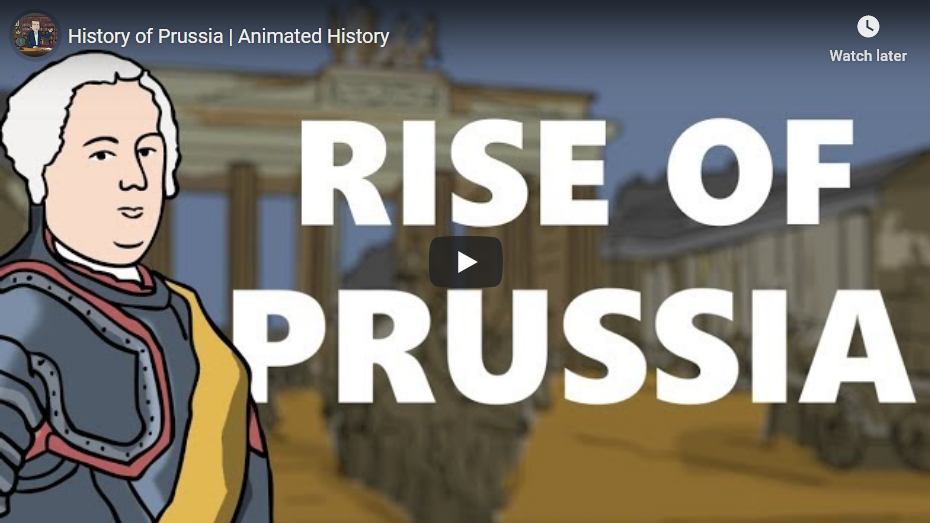
History of Prussia | Animated History
The Armchair Historian
Published 14 Sep 2018Sign up for The Armchair Historian website today:
https://www.thearmchairhistorian.com/Our Twitter: https://twitter.com/ArmchairHist
Sources:
The Rise and Fall of Prussia, Sebastian Haffner
Germans and Slavs, Arno Lubos
Frederick the Great, Tim BlanningMusic:
“Hungarian Rhapsody” by Franz Liszt“Twenty six variations on La Folia de Spagna”, London Mozart Players
Matthias Bamert, conductor*Correction 1: In 1648, Brandenburg-Prussia also acquired parts of Pomerania, which isn’t shown in the video. Pomerania is a state directly above Brandenburg.
May 27, 2020
The Battle to Crack Enigma – The real story of ‘The Imitation Game’ – WW2 Special
World War Two
Published 26 May 2020For the British, breaking the Germans’ seemingly unbreakable codes is one of the most vital battles of the war. If they fail, there is litte to stop the German U-Boats hunting down Allied shipping in the Atlantic.
Join us on Patreon: https://www.patreon.com/TimeGhostHistory
Or join The TimeGhost Army directly at: https://timeghost.tvFollow WW2 day by day on Instagram @World_war_two_realtime https://www.instagram.com/world_war_t…
Between 2 Wars: https://www.youtube.com/playlist?list…
Source list: http://bit.ly/WW2sourcesHosted by: Indy Neidell
Written by: Francis van Berkel
Director: Astrid Deinhard
Producers: Astrid Deinhard and Spartacus Olsson
Executive Producers: Astrid Deinhard, Indy Neidell, Spartacus Olsson, Bodo Rittenauer
Creative Producer: Joram Appel
Post-Production Director: Wieke Kapteijns
Research by: Francis van Berkel
Edited by: Mikołaj Cackowski
Sound design: Marek Kamiński
Map animations: Eastory (https://www.youtube.com/c/eastory)Colorizations by:
Jaris Almazani (Artistic Man), https://instagram.com/artistic.man?ig…
Norman Stewart, https://oldtimesincolor.blogspot.com/
Carlos Ortega Pereira, BlauColorizations, https://www.instagram.com/blaucoloriz…Sources:
Bundesarchiv
Narodowe Archiwum Cyfrowe
IWM D 23310, A 13709, A 23513
Picture of Enigma G model, courtesy Austin Mills https://flic.kr/p/2bQ9Q
reconstructed bombe machine at Bletchley Park, courtesy Gerald Massey
Picture of Enigma M4 model displayed at Bletchley Park, courtesy Magnus Manske
Picture of John Herivel, courtesy GCHQ
From the Noun Project: Letter by Mochammad Kafi, Desk by monkik, Phone by libertetstudio, person by Adrien Coquet, Letter by Bonegolem, Table by Creative Stall, documents by Johannes Hirsekorn, sitting at desk by IYIKON, Paper by James KopinaSoundtracks from the Epidemic Sound:
Reynard Seidel – “Deflection”
Johannes Bornlof – “The Inspector 4”
Phoenix Tail – “At the Front”
Johannes Bornlof – “Deviation In Time”
Gunnar Johnsen – “Not Safe Yet”
Hakan Eriksson – “Epic Adventure Theme 3”
Howard Harper-Barnes – “London”Archive by Screenocean/Reuters https://www.screenocean.com.
A TimeGhost chronological documentary produced by OnLion Entertainment GmbH.
From the comments:
World War Two
4 hours ago (edited)
Hopefully you’re all staying safe in these difficult times. We’re still marching on so that we can keep all of you entertained when you’re stuck at home. But we can only continue doing so thanks to your ongoing support. Ad revenue has dropped significantly because of COVID, and we rely on your support now more than ever. If you can, please support us on www.patreon.com/timeghosthistory or https://timeghost.tv.Please let us know what other specials you’d like to see. And if you would like to know something about a smaller topic, make sure to submit that as a question for our Q&A series, Out of the Foxholes. You can do that right here: https://community.timeghost.tv/c/Out-of-the-Foxholes-Qs.
Cheers,
Francis
May 16, 2020
Polish-Soviet War – First Phase 1919 – May 1920 I THE GREAT WAR 1920
The Great War
Published 15 May 2020Sign up for Curiosity Stream and Nebula – and get 40% off annual plans right now: https://curiositystream.com/thegreatwar
The Polish-Soviet War was one of the biggest conflicts after the armistice of 1918 and the culmination point of the many sub-conflicts that made up the Western Front of the Russian Civil War. The question about the Polish-Russian border was decided with armored trains, cavalry charges and also on the negotiating table.
» SUPPORT THE CHANNEL
Patreon: https://www.patreon.com/thegreatwar
Merchandise: https://shop.spreadshirt.de/thegreatwar/» SOURCES
Centek, Jarosław: “Polish-Soviet War 1920-1921”, in: 1914-1918-online. International Encyclopedia of the First World War, ed. by Ute Daniel, Peter Gatrell, Oliver Janz, Heather Jones, Jennifer Keene, Alan Kramer, and Bill Nasson, issued by Freie Universität Berlin, Berlin 2014-10-08Leonhard, Jörn. Der überforderte Frieden. Versailles und die Welt 1918-1923 (CH Beck, 2018).
Borzecki, Jerzy. The Polish-Soviet Peace of 1921 and the Creation of Interwar Europe (New Haven and London: Yale University Press, 2008)
Engelstein, Laura. Russia in Flames (Oxford University Press, 2017).
Smele, Jonathan. The “Russian” Civil Wars 1916-1926 (London: Hurst, 2015).
Davies, Norman. White Eagle Red Star (Random House, 2003 (1972))
Böhler, Jochen. Civil War in Central Europe, 1918-1921 (Oxford University Press, 2019)
Timothy Snyder. The Reconstruction of Nations. (New Haven: Yale University Press, 2003)
» SOCIAL MEDIA
Instagram: https://instagram.com/the_great_war
Twitter: https://twitter.com/WW1_Series
Reddit: https://reddit.com/r/TheGreatWarChannel»CREDITS
Presented by: Jesse Alexander
Written by: Jesse Alexander
Director: Toni Steller & Florian Wittig
Director of Photography: Toni Steller
Sound: Toni Steller
Editing: Toni Steller
Mixing, Mastering & Sound Design: http://above-zero.com
Maps: Daniel Kogosov (https://www.patreon.com/Zalezsky)
Research by: Jesse Alexander
Fact checking: Florian WittigChannel Design: Alexander Clark
Original Logo: David van StepholdA Mediakraft Networks Original Channel
Contains licensed material by getty images
All rights reserved – Real Time History GmbH 2020
May 15, 2020
QotD: Gandhi and the rise of Hitler
Gandhi’s views on the European crisis were not entirely consistent. He vigorously opposed Munich, distrusting Chamberlain. “Europe has sold her soul for the sake of a seven days’ earthly existence,” he declared. “The peace that Europe gained at Munich is a triumph of violence.” But when the Germans moved into the Bohemian heartland, he was back to urging nonviolent resistance, exhorting the Czechs to go forth, unarmed, against the Wehrmacht, perishing gloriously — collective suicide again. He had Madeleine Slade draw up two letters to President Eduard Beneš of Czechoslovakia, instructing him on the proper conduct of Czechoslovak satyagrahi when facing the Nazis.
When Hitler attacked Poland, however, Gandhi suddenly endorsed the Polish army’s military resistance, calling it “almost nonviolent.” (If this sounds like double-talk, I can only urge readers to read Gandhi.) He seemed at this point to have a rather low opinion of Hitler, but when Germany’s panzer divisions turned west, Allied armies collapsed under the ferocious onslaught, and British ships were streaming across the Straits of Dover from Dunkirk, he wrote furiously to the Viceroy of India: “This manslaughter must be stopped. You are losing; if you persist, it will only result in greater bloodshed. Hitler is not a bad man …”
Gandhi also wrote an open letter to the British people, passionately urging them to surrender and accept whatever fate Hitler had prepared for them. “Let them take possession of your beautiful island with your many beautiful buildings. You will give all these, but neither your souls, nor your minds.” Since none of this had the intended effect, Gandhi, the following year, addressed an open letter to the prince of darkness himself, Adolf Hitler.
The scene must be pictured. In late December 1941, Hitler stood at the pinnacle of his might. His armies, undefeated — anywhere — ruled Europe from the English Channel to the Volga. Rommel had entered Egypt. The Japanese had reached Singapore. The U.S. Pacific Fleet lay at the bottom of Pearl Harbor. At this superbly chosen moment, Mahatma Gandhi attempted to convert Adolf Hitler to the ways of nonviolence. “Dear Friend,” the letter begins, and proceeds to a heartfelt appeal to the Führer to embrace all mankind “irrespective of race, color, or creed.” Every admirer of the film Gandhi should be compelled to read this letter. Surprisingly, it is not known to have had any deep impact on Hitler. Gandhi was no doubt disappointed. He moped about, really quite depressed, but still knew he was right. When the Japanese, having cut their way through Burma, threatened India, Gandhi’s strategy was to let them occupy as much of India as they liked and then to “make them feel unwanted.” His way of helping his British “friends” was, at one of the worst points of the war, to launch massive civil-disobedience campaigns against them, paralyzing some of their efforts to defend India from the Japanese.
Here, then, is your leader, O followers of Gandhi: a man who thought Hitler’s heart would be melted by an appeal to forget race, color, and creed, and who was sure the feelings of the Japanese would be hurt if they sensed themselves unwanted. As world-class statesmen go, it is not a very good record. Madeleine Slade was right, I suppose. The world certainly didn’t listen to Gandhi. Nor, for that matter, has the modern government of India listened to Gandhi. Although all Indian politicians of all political parties claim to be Gandhians, India has blithely fought three wars against Pakistan, one against China, and even invaded and seized tiny, helpless Goa, and all without a whisper of a shadow of a thought of ahimsa. And of course India now has atomic weapons, a satyagraha technique if ever there was one.
Richard Grenier, “The Gandhi Nobody Knows”, Commentary, 1983-03-01.
May 14, 2020
Three reasons the Western allies fail to fully acknowledge the efforts of the Soviets in WW2
Arthur Chrenkoff suggests three major reasons for why many Russians and other Soviet-nostalgics feel the west is wrongly denying the Soviet Union full credit for the defeat of Nazi Germany:

Kombat (Russian: Комбат, lit. “battalion commander”) is a black-and-white photograph by the Soviet photographer Max Alpert. It depicts a Soviet military officer armed with a TT pistol who is raising his unit for an attack during World War II. This work is regarded as one of the most iconic Soviet World War II photographs, yet neither the date nor the subject is known with certainty. According to the most widely accepted version, the photograph depicts junior politruk (political officer) Aleksei Gordeyevich Yeryomenko, minutes before his death on 12 July 1942, in Voroshilovgrad Oblast, Ukraine.
Wikimedia Commons.
But while the Russian – or, more correctly, Soviet – role in defeating Hitler is beyond question and deserves wider attention and recognition, there are several reasons why the Western acknowledgement of the eastern front will always remain qualified and somewhat ambiguous.
Firstly, while Russia continues to variously deny, downplay or excuse the fact, the Soviet Union was the initial co-aggressor in World War Two and for the first two years a Nazi ally and collaborator. Stalin might have had legitimate realpolitik reasons for the Ribbentrop-Molotov pact, in effect sacrificing Europe to win more time to prepare for the inevitable war with Germany (nice in theory, the gambit in any case did not work out in practice), but the fact remains that in concert with Hitler, Stalin invaded Poland and was rewarded with its eastern half, subsequently also helping himself to Bessarbia, annexing the Baltic states and invading Finland. In turn, the fact that Hitler assured himself he would not be facing a war on two fronts, which doomed Germany in World War One, allowed him to successively snatch Poland, Norway, Denmark, the Netherlands, Belgium, France, Yugoslavia and Greece, giving Germany a complete dominance over the continental Europe from the Atlantic to the Bug river and the Arctic Circle to Crete. And while Great Britain stood alone against Germany for a year from mid-1940 to mid-1941, Soviet resources and produce kept flowing in, feeding and arming the Nazi monster. This makes Stalin’s subsequent anger over the Allied delay in launching the Second Front in the West quite hypocritical – where was the Second Front in the East while Luftwaffe was blitzing Britain and its troops were battling Italians and Rommel in north Africa?
Secondly, without in any way diminishing the German barbarity in the east, a significant proportion of the Soviet military and civilian casualties were unnecessary and resulted from the communist government’s complete and utter disregard for the lives and well-being of its subjects. Stalin fought the war as he fought the peace at home. The man who prior to 1941 had managed to send somewhere upwards of 15 million of his own people to an early grave, clearly wasn’t going to spare the long suffering population when faced with an external existential threat. The Soviet Union might not have (at least initially) had much else, but it certainly had people, and they were sacrificed in obscene numbers by the man in the Kremlin and his minions on the ground. For most of the war, several Red Army soldiers were dying for every one German, while obeying absurd orders to stand ground or frontally attack in total disregard for the local circumstances or for that matter any reasonable tactical and strategic consideration. When Eisenhower and Zhukov caught up some time later in the war and the conversation turned to the best method of clearing mine fields, the Russian astonished the Allied Commander-in-Chief when he nominated simply sending the infantry through as the easiest and the cheapest method. This wasn’t a joke either; it was the way the Red Army fought from the first days of Barbarossa all the way to Berlin, even though the eventual overwhelming material superiority did save many an Ivan’s life in the later stages of the conflict. Not enough, however, to wipe out the entire generation of men born in the mid-1920s.
Thirdly, while the Red Army did indeed end the brutal Nazi occupation of the Central and the Eastern Europe, it did not bring freedom in any meaningful sense of the word, except perhaps (in most cases) freedom from sudden death. Debates about similarities and differences between the two totalitarian systems will no doubt continue well into the future. Unquestionably, for an average Slav, the Soviet domination was a better option that the Nazi one. Nazis, by and large, considered Slavs to be subhuman (though making some allowances, often quite significant, for their Slavic allies, like the Slovaks, the Croats or the Bulgarians), fit only to be initially enslaved and eventually exterminated. This was the far deadlier and much more ideological continuation of Germany’s 1000-year “drang nach osten” or the “civilising” mission to expand into the fertile east. Particular hatred was reserved for the Poles, who stood as a barrier for most of that millennium, preventing the dream of lebensraum from being realised. Russia was a much more recent enemy, having overlaid its Slavic barbarity with a Bolshevik malignancy. Even the initial Nazi plans called for starving between 25-30 million Belorussians, Ukrainians and Russians in order to free up food and resources for Germany. Communists could be deadly too, of course, and both the Reds and the Blacks were fond of decimating the local elites and intelligencia, but the Soviets at least did not see their Slavic brethren as subhumans but as proletarian masses to be converted to the glories of Marxism-Leninism.
Be that as it may, the Soviet liberation did not bring liberty or independence to the people of Eastern Europe. That had to wait until 1989-91.
May 10, 2020
April 9, 2020
The True Story of How WW2 Began | BETWEEN 2 WARS I 1939 Part 3 of 3 I SEASON FINALE
TimeGhost History
Published 8 Apr 2020In this final episode of Season 1 of Between Two Wars we examine what caused the world to stand on the brink of total war in just two decades after the War to End All Wars. Events that end with three words through a phone line: “Grandmother is dead,” words that launch World War II.
Join us on Patreon: https://www.patreon.com/TimeGhostHistory
Hosted by: Indy Neidell
Written by: Spartacus Olsson
Directed by: Spartacus Olsson and Astrid Deinhard
Executive Producers: Bodo Rittenauer, Astrid Deinhard, Indy Neidell, Spartacus Olsson
Creative Producer: Joram Appel
Post-Production Director: Wieke Kapteijns
Research by: Spartacus Olsson
Edited by: Daniel Weiss
Sound design: Marek KamińskiSources:
From the Noun Project:
soldier By Wonmo Kang
coin stacks By emilegraphicsColorizations by:
– Dememorabilia – https://www.instagram.com/dememorabilia/
– Olga Shirnina
– Spartacus Olsson
– Daniel WeissSoundtracks from Epidemic Sound:
– “Sophisticated Gentlemen” – Golden Age Radio
– “First Responders” – Skrya
– “Easy Target” – Rannar Sillard
– “The Inspector 4” – Johannes Bornlöf
– “Last Point of Safe Return” – Fabien Tell
– “Death And Glory 3” – Johannes Bornlöf
– “Split Decision” – Rannar Sillard
– “March Of The Brave 9” – Rannar Sillard
– “Mystery Minutes STEMS INSTRUMENTS” – Farrell Wooten
– “The Charleston 3” – Håkan ErikssonArchive by Reuters/Screenocean http://www.screenocean.com
A TimeGhost chronological documentary produced by OnLion Entertainment GmbH.
From the comments:
TimeGhost History
1 day ago
Dear friends, this is the 58th and final episode of the first season of Between 2 Wars. Almost exactly two years ago, when the first episode went live, on April 14, 2018 we were three people. We had not started the WW2 channel yet. The TimeGhost Army had less than 100 members, and we had no idea where we would end up. As it turned out, it has been a magnificent journey through twenty years of history.We are now a team of around sixteen individuals working on three channels and publishing more than five historical videos per week. And this is thanks to all of you who have graced us by watching, liking, commenting, and joining the TimeGhost Army. And it is especially thanks to the now over 4,000 members of the TimeGhost Army and their faithful contributions that we are able to do this at all. Thanks to you all, we can add a little bit of knowledge, a little bit of perspective, and hopefully a little bit of sanity (and also a measure healthy insanity) to the world.
It’s especially in times like these that we feel blessed by your support, so that we can continue our mission of remembrance and education. So it is with humble gratitude and some pride that we deliver this season finale. With your participation we will keep marching on, and try to do even more, even better, and exciting historical content.
Thank you all!
Let’s make history!
Spartacus
Definition note: when we use the term Socialist we always use the academic and dictionary definition: an ideology that aims to abolish private ownership of capital, goods, and enterprise to transfer it to the collective for use rather than profit. The means to achieve that being a violent revolution. We do not use the popular US redefinition of the word that makes it mean something vaguely like “anything the government does.”