
It is my conviction that no normal man ever fell in love, within the ordinary meaning of the word, after the age of thirty. He may, at forty, pursue the female of his species with great assiduity, and he may, at fifty, sixty or even seventy, “woo” and marry a more or less fair one in due form of law, but the impulse that moves him in these follies at such ages is never the complex of outlandish illusions and hallucinations that poets describe as love. This complex is quite natural to all males between adolescence and the age of, say, twenty-five, when the kidneys begin to disintegrate. For a youth to reach twenty-one without having fallen in love in an abject and preposterous manner would be for doubts to be raised as to his normalcy. But if he does it after his wisdom teeth are cut, it is no more than a sign that they have been cut in vain — that he is still in his teens, whatever his biological and legal age. Love, so-called, is based upon a view of women that is impossible to any man who has any experience of them. Such a man may, to the end of his life, enjoy the charm of their society, and even respect them and admire them, but, however much he respects and admires them, he nevertheless sees them more or less clearly, and seeing them clearly is fatal to true romance. Find a man of forty-five who heaves and moans over a woman, however amiable and lovely, in the manner of a poet and you will behold either a man who ceased to develop intellectually at twenty-four or thereabout, or a fraud who has his eye on the lands, tenements and hereditaments of the lady’s deceased first husband. Or upon her talents as nurse, or cook, amanuesis and audience. This, no doubt, is what George Bernard Shaw meant when he said that every man over forty is a scoundrel.
H.L. Mencken, “The Nature of Faith”, Prejudices, Fourth Series, 1924.
September 7, 2014
QotD: Love in later life
June 23, 2014
Censoring WW1 art
In BBC News Magazine, Alan Little looks at some early WW1 art that fell afoul of the censors for being too accurate:
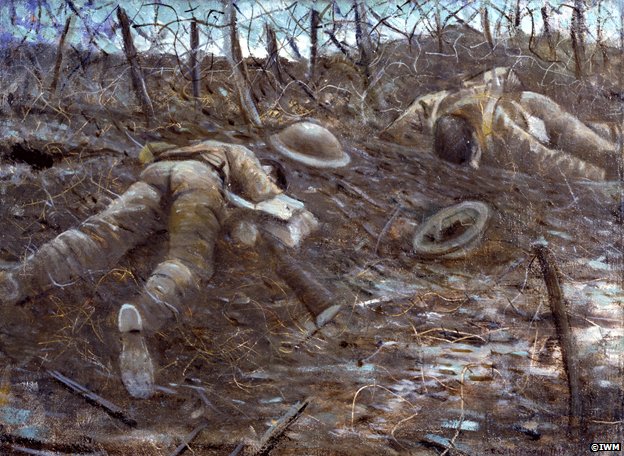
What you notice first about the two figures in Christopher Nevinson’s painting Paths of Glory is the banality of their deaths. Their commonplace, mundane fate. They lie face down in the blasted earth, two men in British military fatigues, their helmets and rifles lying in the mud beside them.
They are indistinguishable from each other, stripped of individual identity. Nothing marks them out as the unique human beings they must once have been with names, and families, and remembered childhoods, and desire and love and hope and ambition.
From the bottom left of the composition, where the corpse in the foreground lies with the soles of his boots facing you, your eye moves diagonally upwards and to the right, to the second dead man, who has fallen forwards towards you, and you see the top of his dark head but Nevinson denies you a glimpse of his face. He has no face, no personality, no story of his own. In colour, texture and even contour, the lifeless bodies are almost indistinguishable from the land on which they lie, and which will now swallow them.
In my time as a war reporter for the BBC I have come across scenes like this. You cannot mistake the recently dead for the sleeping, for there is something bloodless, something shockingly, arrestingly lifeless about them. I have found myself transfixed by odd detail — a bootlace tied just a few hours ago, by fingers that will now never move again. What talents lie locked into the muscle memory of those fingers? Could they, as recently as this morning, have picked out a melody on a piano? With the death of each individual, an entire universe vanishes.
[…]
I think of those two young men whose names I never learned when I look at Nevinson’s Paths of Glory. Its title is taken from Thomas Gray’s Elegy Written in a Country Church-Yard. “The boast of heraldry, the pomp of pow’r, / And all that beauty, all that wealth e’er gave / Awaits alike th’inevitable hour. / The paths of glory lead but to the grave.”
Government censors did not like Paths of Glory. They judged it bad for morale and refused to pay Nevinson for it. But he included it anyway in the first exhibition of his war paintings in London early in 1918, with a brown paper strip across the canvas carrying the word “censored”. He was reprimanded both for exhibiting a censored painting and, bizarrely, for unauthorised use of the word “censored” in a public place. But the painting was bought, during that exhibition, by the Imperial War Museum, where it remains.
February 26, 2013
Kipling rediscovered
In the Guardian, Alison Flood talks about the newly discovered Rudyard Kipling poems:
Kipling scholars are celebrating the publication of lost poems by the author whose exhortations in “If” to “keep your head when all about you / Are losing theirs and blaming it on you” are regularly voted the nation’s favourite poem. Discovered by the American scholar Thomas Pinney in an array of hiding places including family papers, the archive of a former head of the Cunard Line and during renovations at a Manhattan house, more than 50 previously unpublished poems by Rudyard Kipling will be released for the first time next month.
The collection includes several poems dating from the first world war, which Kipling initially supported, helping his son John to gain a commission in the Irish Guards.
A short poem, “The Gambler”, finishes with the couplet: “Three times wounded; three times gassed / Three times wrecked – I lost at last”, while another fragment runs: “This was a Godlike soul before it was crazed / No matter. The grave makes whole.”
After his son’s death at the Battle of Loos in 1915, Kipling regretted his earlier enthusiasm for the conflict, writing in his “Epitaphs of the War”: “If any question why we died / Tell them, because our fathers lied”.
November 30, 2012
Stopping by the Copyright Office on a Snowy Evening
Virginia Postrel charts the ever-expanding copyright protections under US law:
Even as digital technology has made reproducing, remixing and repurposing creative works easier — with potentially enormous benefits for consumers and producers of new works — the monopoly privileges of copyright have expanded. The result is a bizarre combination of rampant copyright violations, frequent encroachment on legitimate fair use, suppression of new technologies and business models, and the ever-present threat of draconian penalties.
Consider how the law applies to Robert Frost’s classic poem “Stopping by Woods on a Snowy Evening,” first published in 1923. Back then you only got copyright privileges for works officially registered with the copyright office, and only for a term of 28 years, which could be renewed if you filed again, as Frost did in 1951.
Requiring such simple procedures reserved copyright privileges for creators with strong commercial or sentimental interests in limiting the publication of their works. Today, by contrast, copyright automatically applies to every eligible work, including your vacation snapshots and your 4-year-old’s handmade Mother’s Day card.
Under the law when Frost wrote his poem and renewed the copyright on the volume including it, it would have presumably entered the public domain in 1979, more than a decade after its author’s death in 1963. That’s not what happened. Beginning in 1962, Congress gradually extended copyright terms, and in 1976 it passed a new copyright act that gives works already under copyright a new term of 75 years from their first publication. That meant “Stopping by Woods” wouldn’t go into the public domain until 1998.
That’s not what happened either. Just as the poem’s copyright was about to expire, Congress passed the Sonny Bono Copyright Term Extension Act, which gave existing works a new copyright term of 95 years. (The 1923 Frost volume including the poem was one of the works cited in a lawsuit unsuccessfully challenging the act’s constitutionality.) So Frost’s poem won’t enter the public domain until 2018 — assuming that Congress doesn’t pass yet another extension.
July 29, 2012
“Look on my works, ye Mighty, and despair!”
The amusing “real” story of how Percy Bysshe Shelley was inspired to write Ozymandias:
I met a traveller from an antique land
Who said: Two vast and trunkless legs of stone
Stand in the desert. Near them on the sand,
Half sunk, a shatter’d visage lies, whose frown
And wrinkled lip and sneer of cold command
Tell that its sculptor well those passions read
Which yet survive, stamp’d on these lifeless things,
The hand that mock’d them and the heart that fed.
And on the pedestal these words appear:
‘My name is Ozymandias, king of kings:
Look on my works, ye Mighty, and despair!’
Nothing beside remains. Round the decay
Of that colossal wreck, boundless and bare,
The lone and level sands stretch far away.Percy Bysshe Shelley
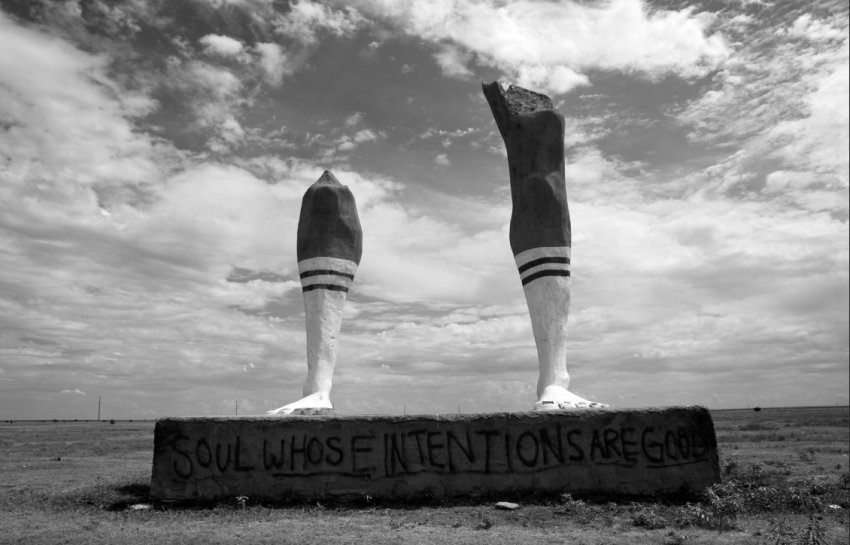
Out in a field just off I-27 south, maybe 15 minutes away from Amarillo, our beloved Stanley Marsh 3 commissioned this statue, “Ozymandias.” Of course, being a merry prankster, he pretends on an introductory plaque that these “ancient ruins” in fact inspired Shelley’s poem.
H/t to “Fishplate” Jeff for the link.
June 30, 2012
The cruellest month in Newfoundland is July
Rex Murphy in the National Post on the worst month in Newfoundland’s calendar:
T.S. Eliot did not write for Newfoundlanders. April is not the cruelest month. For us, it’s July. Both the first and second day of July are marked indelibly in the province’s common memory, the first perhaps the saddest day in the historic calendar, the second as the day of the most fundamental change in the essential makeup of the province.
The greatest tragedy in Newfoundland’s history occurred on July 1, 1916 the opening day of the Battle of the Somne, when nearly 800 men from the 1st Newfoundland Regiment went “over the top” at Beaumont Hammel, only to suffer close to 700 casualties within less than half an hour. It was a virtual annihilation of the entire Regiment. The shockwaves from Beaumont Hammel went through every town and village, city and outport of the time. There was not a place unmarked with grief. To this day, the memory of Beaumont Hammel commands deep respect and notice.
A different kind of event, one not drawn from conflict or war, marks the second day of the month. Just 20 years ago, for the very first time since the late 15th century and the arrival of the Europeans and John Cabot to the fish-crowded waters off Newfoundland, catching cod-fish was declared illegal. The fishery, that great and traditional fishery of Newfoundland, was shut down for the first time in nearly 500 years.
It’s been 20 years since the fishery was closed, and there’s still no sign that it will be re-opening any time soon.
February 2, 2012
Repost: A tribute (of sorts) to Wiarton Willie
John Scalzi, several years ago, wrote a tribute to Wiarton Willie, who was in the news in an unaccustomed way at the time:
To tell you the truth, the most disturbing thing is not that the groundhog died — certainly this animal earned his eternal rest — but that his handlers couldn’t think of anything better to do but tell a festival crowd that he had croaked. Those kids in the crowd will be forever traumatized. Groundhog Day will no longer be a happy time, but a constant reminder of death and mortality in the bleak midwinter. 10 years from now, I expect that Wiarton, Canada will become the new North American epicenter of dark, gothic teenage poetry.
Lying frozen in the snow
The groundhog soul resides far below
Gone to a place of doom and gray
Now winter will always stay.
Die Groundhog Die!
Mommy and Daddy Lied!
But wait, there’s more:
Now, on to the groundhog Wiarton Willie, who, as you know from yesterday’s entry, died before Groundhog Day and whose body was photographed lying in state in a dinky little pine coffin. Or was it? Now news comes from the sordid little burg of Wiarton, Canada, that the rodent corpse in the coffin was not Wiarton Willie at all, but a stuffed stand-in. The real Willie was apparently found so decomposed that the gelatinous remains were unsuitable for public display. So the town elders found a stuffed groundhog that just happened to be lying around (apparently the body of a previous “Wiarton Willie,” who was no doubt poisoned by the current, and now rotting, Willie in an unseemly palace coup), plopped it into that Barbie coffin, and presented the remains to a horrified public. Here’s the groundhog you’ve all been waiting for! And he’s dead! Winter for the next ten years!
The people of Wiarton meant well, I’m sure. But I’m having serious doubts as to their combined mental capacity. First off, the real Willy was found in a state of advanced decomposition, which means he had been dead for weeks. Weeks. How could that happen? This rodent is the cornerstone of Wiarton’s entire tourism economy for the month of February, and no one bothers to check on him from time to time? Did they just stick him in a cage after last Groundhog Day and then forget to feed him? Every kid in the world had a hamster they forgot to feed, but you’re usually, like, five at the time. These were actual adults. They say he was hibernating when he died. Sure he was. I used that excuse about the hamster.
June 9, 2011
February 2, 2011
A tribute (of sorts) to Wiarton Willie
John Scalzi, several years ago, wrote a tribute to Wiarton Willie, who was in the news in an unaccustomed way at the time:
To tell you the truth, the most disturbing thing is not that the groundhog died — certainly this animal earned his eternal rest — but that his handlers couldn’t think of anything better to do but tell a festival crowd that he had croaked. Those kids in the crowd will be forever traumatized. Groundhog Day will no longer be a happy time, but a constant reminder of death and mortality in the bleak midwinter. 10 years from now, I expect that Wiarton, Canada will become the new North American epicenter of dark, gothic teenage poetry.
Lying frozen in the snow
The groundhog soul resides far below
Gone to a place of doom and gray
Now winter will always stay.
Die Groundhog Die!
Mommy and Daddy Lied!
But wait, there’s more:
Now, on to the groundhog Wiarton Willie, who, as you know from yesterday’s entry, died before Groundhog Day and whose body was photographed lying in state in a dinky little pine coffin. Or was it? Now news comes from the sordid little burg of Wiarton, Canada, that the rodent corpse in the coffin was not Wiarton Willie at all, but a stuffed stand-in. The real Willie was apparently found so decomposed that the gelatinous remains were unsuitable for public display. So the town elders found a stuffed groundhog that just happened to be lying around (apparently the body of a previous “Wiarton Willie,” who was no doubt poisoned by the current, and now rotting, Willie in an unseemly palace coup), plopped it into that Barbie coffin, and presented the remains to a horrified public. Here’s the groundhog you’ve all been waiting for! And he’s dead! Winter for the next ten years!
The people of Wiarton meant well, I’m sure. But I’m having serious doubts as to their combined mental capacity. First off, the real Willy was found in a state of advanced decomposition, which means he had been dead for weeks. Weeks. How could that happen? This rodent is the cornerstone of Wiarton’s entire tourism economy for the month of February, and no one bothers to check on him from time to time? Did they just stick him in a cage after last Groundhog Day and then forget to feed him? Every kid in the world had a hamster they forgot to feed, but you’re usually, like, five at the time. These were actual adults. They say he was hibernating when he died. Sure he was. I used that excuse about the hamster.
July 22, 2010
Cultivating a taste for parody
The Economist reviews The Oxford Book of Parodies by John Gross:
Writing a parody is hard. In the 1940s, a competition in the New Statesman invited readers to parody Graham Greene. Greene himself entered under a pseudonym and only came second. Get it right, though, and you have a withering form of criticism and an immortal entertainment rolled into one. John Gross’s new anthology of parodies in English (with a few foreign titbits) has samples both high and low of this diverse genre.
[. . .]
Any well-known poem or character is fair game. A.A. Milne’s Christopher Robin is revisited as an ailing pensioner who has retired to Spain (“He peers through a pair of bifocals;/He talks quite a lot to a bear that he’s got/Who is known as El Pu to the locals.”) Ezra Pound wrote a wintry variation on “Sumer is icumen in” (“…skiddeth bus and sloppeth us…”) But why limit oneself to a single writer? Portmanteau parodies let writers do two voices at once, thus “Chaucer” rewrites Sir John Betjeman (“A Mayde ther was, y-clept Joan Hunter Dunn…”) and “Dylan Thomas” redoes “Pride and Prejudice” (“It is night in the smug snug-as-a-bug-in-a-rug household of Mr and Mrs Dai Bennet and their simpering daughters — five breast-bobbing man-hungry titivators, innocent as ice-cream, panting for balls and matrimony.”)
[. . .]
Documents, philosophies and schools of thought can be good fodder, too. H.L. Mencken did a “Declaration of Independence in American” (“When things get so balled up that the people of a country got to cut loose from some other country, and go it on their own hook, without asking no permission from nobody, excepting maybe God Almighty, then they ought to let everybody know why they done it, so that everybody can see they are not trying to put nothing over on nobody . . .”)


