Quotulatiousness

November 5, 2012

Remember, Remember the Fifth of November

Filed under: Britain, History, Religion — Tags: , , , , , — Nicholas @ 11:20

Today is the anniversary of the Gunpowder Plot:

Everyone knows what the Gunpowder Plotters looked like. Thanks to one of the best-known etchings of the seventeenth century we see them ‘plotting’, broad brims of their hats over their noses, cloaks on their shoulders, mustachios and beards bristling — the archetypical band of desperados. Almost as well known are the broad outlines of the discovery of the ‘plot’: the mysterious warning sent to Lord Monteagle on October 26th, 1605, the investigation of the cellars under the Palace of Westminster on November 4th, the discovery of the gunpowder and Guy Fawkes, the flight of the other conspirators, the shoot-out at Holbeach in Staffordshire on November 8th in which four (Robert Catesby, Thomas Percy and the brothers Christopher and John Wright) were killed, and then the trial and execution of Fawkes and seven others in January 1606.

However, there was a more obscure sequel. Also implicated were the 9th Earl of Northumberland, three other peers (Viscount Montague and Lords Stourton and Mordaunt) and three members of the Society of Jesus. Two of the Jesuits, Fr Oswald Tesimond and Fr John Gerard, were able to escape abroad, but the third, the superior of the order in England, Fr Henry Garnet, was arrested just before the main trial. Garnet was tried separately on March 28th, 1606 and executed in May. The peers were tried in the court of Star Chamber: three were merely fined, but Northumberland was imprisoned in the Tower at pleasure and not released until 1621.

[. . .]

Thanks to the fact that nothing actually happened, it is not surprising that the plot has been the subject of running dispute since November 5th, 1605. James I’s privy council appears to have been genuinely unable to make any sense of it. The Attorney-General, Sir Edward Coke, observed at the trial that succeeding generations would wonder whether it was fact or fiction. There were claims from the start that the plot was a put-up job — if not a complete fabrication, then at least exaggerated for his own devious ends by Robert Cecil, Earl of Salisbury, James’s secretary of state. The government’s presentation of the case against the plotters had its awkward aspects, caused in part by the desire to shield Monteagle, now a national hero, from the exposure of his earlier association with them. The two official accounts published in 1606 were patently spins. One, The Discourse of the Manner, was intended to give James a more commanding role in the uncovering of the plot than he deserved. The other, A True and Perfect Relation, was intended to lay the blame on Garnet.

But Catesby had form. He and several of the plotters as well as Lord Monteagle had been implicated in the Earl of Essex’s rebellion in 1601. Subsequently he and the others (including Monteagle) had approached Philip III of Spain to support a rebellion to prevent James I’s accession. This raises the central question of what the plot was about. Was it the product of Catholic discontent with James I or was it the last episode in what the late Hugh Trevor-Roper and Professor John Bossy have termed ‘Elizabethan extremism’?

September 2, 2012

Proposed federal riding boundary changes

Filed under: Cancon, Politics — Tags: , , — Nicholas @ 11:36

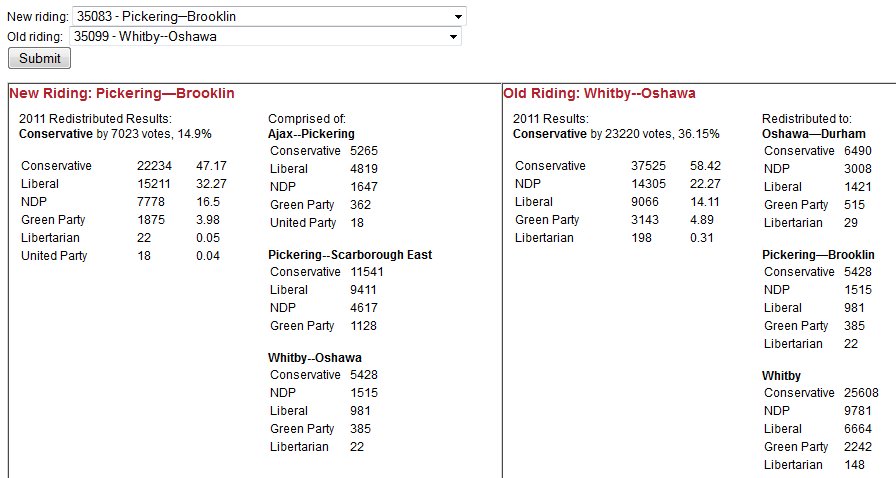
The proposed new federal riding boundaries are now available to view here. Here’s a comparison of my current riding (Whitby-Oshawa) and the proposed new riding (results if the last election had been held using the new boundaries:

Of course, the most important information is the vast decrease in Libertarian voters in the proposed new riding (down to 0.05% from a majestic 0.31% in the existing riding).

August 6, 2012

Canada’s (lack of) Access To Information system

Filed under: Bureaucracy, Cancon, Government, Media — Tags: , , — Nicholas @ 11:12

David Akin explains just how badly broken the Access to Information (ATI) system is, and the clear lack of intent to improve it on the part of the Harper government:

Canada’s Access to Information (ATI) system was broke long before Stephen Harper became prime minister in 2006 but the Conservatives, like the Liberals before them, have failed to fix the system that gives Canadians the right of access to records the government holds, creates, and collects on all our behalf. […]

Indeed, despite promising to fix the ATI system in its 2006 campaign, the Conservatives have made it worse. Great example? Over at the Department of Foreign Affairs and International Trade, John Baird as much thumbed his nose at the Information Commissioner of Canada — an officer of Parliament, no less — when she told him earlier this year, in response to a complaint that I had made, that the steps his bureaucrats were taking to prevent the release of documents was flat out wrong, likely against the law, and that he ought to tell his bureaucrats to change their ways.

[. . .]

There is little, sadly, that the Information Commissioner can do to force a government to change. The Commissioner’s chief power is the power of persuasion and shame, although, as we saw with Baird and DFAIT, the Tories appear to have no shame when it comes to a commitment to living up to both the spirit and the letter of our Access to Information Act.

Still, naming and shaming is the only power all of us — Information Commissioner included — have when it comes to trying to improve this system.

And that’s why I (and, I suspect, other frequent ATI users) end up playing the kind of bizarre bureaucratic games I am about to describe.

July 4, 2012

ACTA rejected decisively by European Parliament

Filed under: Europe, Law, Media — Tags: , , , , — Nicholas @ 09:37

Apparently even the insulated, protected European Parliament can be moved if enough people are actively against something — in this case it was the Anti-Counterfeiting Trade Agreement (ACTA). Michael Geist explains:

When ACTA was formally signed by most participants in October 2011 in Tokyo, few would have anticipated that less than a year later, the treaty would face massive public protests and abandonment by leading countries. But with tens of thousands taking to the streets in Europe earlier this year, ACTA became the poster child for secretive, one-sided IP agreements that do not reflect the views and hopes of the broader public. This morning, the European Parliament voted overwhelmingly against the agreement, effectively killing ACTA within the EU. The vote was 478 against, 39 in favour, with 165 abstentions. This is a remarkable development that was virtually unthinkable even a year ago. Much credit goes to the thousands of Europeans who spoke out against ACTA and to the Members of the European Parliament who withstood enormous political pressure to vote against the deal.

The European developments have had a ripple effect, with the recent Australian parliamentary committee recommendation to delay ACTA ratification and the mounting opposition around the world. ACTA is not yet dead — it may still eke out the necessary six ratifications in a year or two for it to take effect — but it is badly damaged and will seemingly never achieve the goals of its supporters as a model for other countries to adopt and to emerge as a new global standard for IP enforcement. That said, ACTA supporters will not take today’s decision as the final verdict. In the coming weeks and months, we can expect new efforts to revive the agreement within Europe and to find alternative means to implement its provisions. That suggests the fight will continue, but for today, it is worth celebrating how the seemingly impossible — stopping a one-sided, secretly negotiated global IP agreement — became possible.

This has been referred to as the biggest parliamentary defeat ever for a European Commission initiative. In theory, the ACTA treaty cannot be enacted into EU law without being approved by the European Parliament (although, as we’ve seen before, the EU is adept at getting around minor inconveniences like referenda and recalcitrant national governments).

June 26, 2012

The “Draft Andrew Coyne” movement

I’ve met Andrew Coyne. We had a pleasant chat about political matters a few years ago (although I was one of dozens of Toronto-area bloggers he talked with that night: I doubt he remembers me). I often agree with his writings (and even when I don’t, he’s usually quotable). But how would he fare as a candidate for the Liberal leadership? Abacus ran the numbers:

Nationally, most Canadians told us they didn’t know enough about Mr. Coyne to say whether they had a favourable or unfavourable impression of him. Sixty-four percent were not sure of their opinion while 15% said they had a favourable impression while 21% had an unfavourable impression. Unfortunately for Mr. Coyne, the percentage of respondents who had “very unfavourable” was higher than those who had a “very favourable” impression of him (9% very unfavourable vs. 3% very favourable).

Nonetheless, there are “pockets” of Coynemania out there.

  • Men are slightly more likely to have a favourable impression of him than women (men 18% favourable, women 12% – women were also much more likely to be unsure).
  • There was no significant age difference although older Canadians (no surprisingly) were more likely to be aware of Mr. Coyne.
  • Regionally, he is more popular in Manitoba and Saskatchewan (25% favourable) than in other regions of the country. He is a tough sell in Quebec where his favourable rating is a mere 8%.
  • Considering his occupation and the audience likely to read and watch him, it is no surprise that respondents with a university degree were most aware and favourable to Mr. Coyne. 24% of those with a bachelor’s degree and 29% of those with a post-graduate degree had a favourable impression of the National Post columnist.
  • He is also more likely to be viewed favourably by those who live in urban communities (urban 18% favourable, suburban 13% favourable, rural 12% favourable).
  • Mr. Coyne is also viewed more favourable by those who own stocks, bonds, or mutual funds: 20% favourable vs. 10% among those who don’t own those kinds of investments.
  • Finally, there isn’t a significant partisan difference. Those who voted Liberal in 2011 are only slightly more likely to view him positively than NDP and CPC voters but the differences are marginal. He is a post-partisan candidate!

I don’t know if he’s actually interested in a political career, but he’d at least be a different kind of candidate than the Liberals have had in decades. I’ve never voted Liberal in my life, but I could imagine voting for a Liberal if Andrew Coyne was the Liberal leader. He appears to actually believe in smaller government and free markets — which is why he’d never be able to run as a Conservative. He’s on the record as being almost libertarian in his views on individual rights (especially on Nanny State issues) — which is why he couldn’t run as a New Democrat.

It’s not clear whether there are any members of today’s Liberal Party of Canada who could cope with a classical liberal as leader. But it would create a viable third choice in federal politics: that’s worth a lot in my books.

Update: There’s a Twitter hashtag for the movement: #coyne4lpc, and Jesse Helmer points out that there’s a Facebook group, too:

Update, the second: Apparently Andrew Coyne is getting into the swing of being a big-time politician, having already fired his first campaign manager:

June 25, 2012

The rot began at the top: Britain’s rotten state

Filed under: Britain, Government, Media, Politics — Tags: , , , , — Nicholas @ 09:06

David Conway reviews The Rotten State of Britain by Eamonn Butler:

In fourteen pithy, well-documented chapters, Butler guides the reader through the maze of political, economic and social changes to which New Labour subjected Britain during their period in office. After noting that ‘the rot starts from the top’, Butler summarize the main political changes the country was made to undergo so:

‘From Magna Carta in 1215, our rights and liberties have been built up over the centuries. Trial by jury, habeas corpus, the presumption of innocence — all these and more grew up to restrain our leaders and prevent them from harassing us. Yet within a decade almost all these protections have been diluted or discarded. Our leaders are no longer restrained by the rule of law at all [22]…The Prime Minister and colleagues in Downing Street decide what is good for us and then it’s nodded through Parliament. It’s hardly democracy: it’s a centralist autocracy.’ [31]

One by one, Butler explains how each of the country’s traditional constitutional restraints on uncurbed executive power was deliberately weakened, if not altogether discarded, by New Labor in pursuit of their master political project which was, having come to equate the national good with that of their own party, to perpetuate their hegemony indefinitely. Their first step was to effect a massive centralization of power in the hands of the Prime Minister and a small clique of unelected advisors that led to a systematic downgrading of Parliament, the Cabinet and civil service.

To observers of the Canadian system, this critique sounds hauntingly familiar: change “Downing Street” to “Sussex Drive” and it’s equally valid here. Some of the centralization was already well underway before 2001, but it was accelerated by terrorist attacks and governments’ response to them:

9/11 also served New Labor, Butler argues, as a pretext for making a power-grab in the name of security that turned Britain into ‘a surveillance state’ where ‘freedom exists only in name’. [106] He chillingly observes:

‘Of course, the terrorism threat is real… But in response, we seem to have given our government powers to track us anywhere, stop and search us in the street, arrest us for any imagined offense, imprison us for peaceful protest, hold us without charge for 28 days, extradite us to the United State without evidence, ban us for being members of non-violent organizations that they don’t happen to like, export us to other EU countries to stand trial for things that aren’t a crime here, take and file our DNA samples before we’ve been convicted, charged or even cautioned for any offense — and much more as well. In the name of defending our liberties against terrorism, we seem to have lost them.’ [92-93]

June 24, 2012

Paul Wells: What is behind the easy ride for Thomas Mulcair?

Filed under: Cancon, Politics — Tags: , , , , — Nicholas @ 10:41

In Maclean’s, Paul Wells ponders what could be preventing Stephen Harper from bringing down the hammer on Thomas Mulcair the way he did on Stéphane Dion, Michael Ignatieff, and Bob Rae:

For six years Stephen Harper’s opponents have wondered when he would stop spending millions of dollars to whale the tar out of them. Apparently the answer was that he’d stop as soon as his opponent stopped being Liberal.

[. . .]

The surprise is that Harper is not yet using his old tricks to change it.

His old tricks would consist of a heavy, sustained advertising campaign against the man who has risen highest against him. That’s what he did against Stéphane Dion, Michael Ignatieff and then, three months ago, against Bob Rae. Now, one of these things is not like the others. In minority government parliaments where an election always loomed, Dion and Ignatieff were present dangers. But going after Rae looks like a concession to instinct—and a mistake. The money spent has been lost, the neutralized enemy is now gone, and if the Liberals manage to find somebody more impressive to lead them, Harper will wish he’d let Rae limp to the next election.

Meanwhile, apart from the odd bit of ineffectual Conservative sass-talking, Mulcair rises unhindered. Why? Three possibilities. Maybe Harper is lost in the face of superior opposition. Maybe his minions are preparing ads that will take Mulcair apart in 2013.

Or maybe Harper is happy to see Mulcair rise. The Liberals, who governed Canada for most of the 20th century while the Conservatives didn’t, are left squeezed from both sides but too stubborn to disappear. The left-of-Conservative vote remains split. With the Liberals dominant in the centre, Conservative parties won three elections between 1963 and 2004. With the NDP dominant on the left, Conservatives would win more. Harper doesn’t control all of Canadian politics or anywhere close, but if he left a landscape like that behind him, he could retire a happy man.

June 21, 2012

Conservative government, but only in name

Filed under: Cancon, Government — Tags: , , , — Nicholas @ 00:03

Andrew Coyne on the palpable absurdity of the “Harper government” stonewalling the very office it insisted on setting up for oversight of government spending:

The reality is that the PBO has been given anything but the “free and timely access” that Parliament demanded. Time and time again, rather, he has been given the back of the government’s hand — stonewalled by the bureaucrats, ridiculed by the politicians, and lied to by both.

When, for example, the Department of National Defence at last consented to share the cost of the F-35 fighter jet purchase with the PBO, it provided only the most rudimentary figures, without any indication of how they were arrived at. These figures, on which the last election was fought, were later shown to understate the true costs of the jets by at least 40% and probably 60%, in violation not only of Treasury Board rules but the department’s own stated policies. For the crime of having been right, the PBO was subjected to a volley of ministerial insults, while the department pretends to this day not to have understood the office’s clearly stated requests.

More recently, the PBO (Kevin Page is his name) has been trying to get government departments to explain how they plan to achieve the $5.2-billion in largely unspecified “efficiencies” pencilled into the 2012 budget. How much of these, Page wanted to know, would be achieved by reducing costs, and how much by reducing services? How would federal employment be affected in either event? In other words, what did the budget mean by “efficiencies”? This would seem useful information for Members of Parliament considering their vote, assuming — you’ll indulge me here — MPs do indeed consider their votes.

Power corrupts, as Lord Acton reminds us, and the discipline that Stephen Harper enforced over his unruly caucus on their way to winning a minority government is now extended to the majority he enjoys today. What affronted him about Jean Chretien’s imperial ways now seems quite normal and unexceptional. Power does indeed corrupt.

June 18, 2012

The wins and losses in the C-11 copyright reform bill

Filed under: Books, Cancon, Law, Liberty, Media — Tags: , , , , — Nicholas @ 10:14

Michael Geist on the good and the bad aspects of bill C-11 which will probably pass third reading today in the House of Commons and be sent to the Senate for approval:

There is no sugar-coating the loss on digital locks. While other countries have been willing to stand up to U.S. pressure and adopt a more flexible approach, the government, led by Canadian Heritage Minister James Moore on the issue, was unwilling to compromise despite near-universal criticism of its approach. It appears that once Prime Minister Stephen Harper made the call for a DMCA-style approach in early May 2010, the digital lock issue was lost. The government heard that the bill will hurt IP enforcement, restrict access for the blind, disadvantage Canadian creators, and harm consumer rights. It received tens of thousands of comments from Canadians opposed to the approach and ran a full consultation in which digital locks were the leading concern. The NDP, Liberals, and Green Party proposed balanced amendments to the digital lock rules that were consistent with international requirements and would have maintained protection for companies that use them, but all were rejected. [. . .]

Since the Conservatives took power in 2006, there were effectively four bills: the Pre-Bill C-61 bill that was to have been introduced by Jim Prentice in December 2007 but was delayed following public pressure, Bill C-61 introduced in June 2008, and Bill C-32/C-11, which was introduced in June 2010 (and later reintroduced in September 2011). The contents of December 2007 bill was never released, but documents obtained under the Access to Information Act provide a good sense of what it contained (a call was even scheduled on the planned day of introduction between Prentice and U.S. Ambassador David Wilkins to assure the U.S. that digital locks were the key issue and would not be altered). This chart highlights many of the key issues and their progression over the years as the public became increasingly vocal on copyright:

Issue Pre-Bill
C-61 (2007)
Bill C-61
(2008)
Bill C-11
(2012)
Fair Dealing Expansion No No Yes (education, parody, satire)
Format Shifting No Limited (only photographs, book,
newspaper, periodical, or videocassette)
Yes (technology neutral, no
limit on number of copies, includes network storage, and no reference
to contractual overrides)
Time Shifting No Limited (no network PVRs,
Internet communications)
Yes (C-61 limitations removed)
Backup Copies No No Yes
User Generated Content Exception No No Yes
Statutory Damages Cap No Limited ($500 cap for
downloading)
Yes (Max of $5000 for all
non-commercial infringement)
Enabler enforcement provision No No Yes
Internet Publicly Available
Materials Exception for Education
Yes Yes Yes
Public Performance in Schools No No Yes
Technology Neutral Display
Exception in Schools
No No Yes
Limited Distance Learning
Exception
Yes Yes Yes
Limited Digital Inter-Library
Loans
Yes Yes Yes
Notice-and-Notice Yes Yes Yes
Notice-and-Takedown No No No
Three Strikes//Website Blocking No No No
Internet Location Tool Provider
Safe Harbour
Yes Yes Yes
Broadcaster Ephemeral Change No No Yes
Expanded Private Copying Levy No No No
Commissioned Photograph Change Yes Yes Yes
Alternate Format Reproduction No No Yes

[. . .]

Public engagement on copyright continuously grew in strength – from the Bulte battle in 2006 to the Facebook activism in 2007 to the immediate response to the 2008 bill to the 2009 copyright consultation to the 2010 response to Bill C-32. While many dismissed the role of digital activism on copyright, the reality is that it had a huge impact on the shape of Canadian copyright. The public voice influenced not only the contents of the bill, but the debate as well with digital locks the dominant topic of House of Commons debate and media coverage until the very end. Bill C-11 remains a “flawed but fixable” bill that the government refused to fix, but that it is a significantly better bill than seemed possible a few years ago owes much to the hundreds of thousands of Canadians that spoke out on copyright.

June 16, 2012

Peter Oborne on Enoch Powell, a “monster” with integrity

Filed under: Britain, Europe, History, Politics — Tags: , , , , — Nicholas @ 10:36

In the Telegraph, Peter Oborne outlines the career of British parliamentarian Enoch Powell:

For years, Enoch Powell has been a monstrous figure in British politics. Even the mention of his name has been enough to invite damnation by association. Before the last election, David Cameron forced Nigel Hastilow to stand down as Conservative candidate for Halesowen after he praised Powell for being “right” about immigration.

[. . .]

With not one word changed, Powell’s speeches on Lords reform, some delivered half a century ago, could be delivered today. This is because his analysis was not dependent on day-to-day events and a transient national mood. His approach was based on first principles, extraordinary learning and a rigorous understanding of the British constitution.

It was this intellectual clarity which caused him to oppose British entry to what was then known as the Common Market. At the start of 1971, during the final stage of negotiations, Powell took himself round Europe speaking in Turin (in Italian), Frankfurt (in German) and Lyon (in French). As he remarked: “There is no more ignorant vulgarity than to treat language as an impediment to intercourse, which education, habit, travel, trade, abolish and then remove.” He used these speeches to warn his French, Italian and German audiences that the British tradition of national sovereignty and parliamentary democracy was incompatible with European economic and political union.

[. . .]

But now we must come to Enoch Powell’s notorious speeches on immigration, which have defined his posthumous reputation and established his pariah status. He challenged the culture of denial that surrounded the subject even then, predicting that the immigrant community would rise much faster than official statistics suggested. His claims were denounced as alarmist and irresponsible, even by The Daily Telegraph. As Tom Bower shows in a well-researched and fair-minded essay, Powell’s projections turned out to be much nearer the truth than the official ones.

[. . .]

The case for the defence goes like this: at the time immigration was surrounded by a culture of silence, and Powell was doing no more than bravely voicing the concerns (and using the language) of his constituents. He was no racist, as even opponents like Michael Foot acknowledged, and as his stance over the Hola Camp suggests. And let’s not forget that Powell, who had a brilliant war, risked his life for five years in the fight against fascism. But I am certain that the Conservative Party was right to drive him out for his remarks, which had the malign effect that no mainstream politician dared raise the issue of immigration for a generation.

For some, this single episode has been enough to damn his memory, and that can be understood. But Enoch Powell was a man of extraordinary integrity. He walked alone. To quote the late Daily Telegraph commentator TE Utley, doing his best to stand up for Powell in the wake of the notorious “rivers of blood” speech of April 1968: “He does not believe that politics is a hand-to-mouth affair, a succession of expedients to meet unforeseen and unforeseeable circumstances.”

Update, 19 June: In the Telegraph, Brendan O’Neill points out that modern anti-racists actually have more in common with Powell than they may realize:

What was the key prejudice in Enoch Powell’s infamous 1968 speech, which everyone is talking about again following Powell’s 100th birthday? It wasn’t actually hatred of immigrants, whom Powell believed to be ambitious, ferociously so. Rather it was fear of native Britons. It was fear of what white Brits, or what Powell referred to as the “ordinary working man”, might do if more and more foreigners turned up in their towns.

Indeed, Powell explicitly argued that “the sense of alarm and resentment lies not with the immigrant population but with those among whom they have come”. It was these people, he said, these “ordinary Englishmen”, who posed a threat to the social order, since their anti-immigrant anger had become so intense that to introduce more immigrants would be to “risk throwing a match in to gunpowder”. In short, “ordinary working men” were a powder-keg of unpredictable emotions whom the state should try its best not to antagonise. Or as Powell put it, “The supreme function of statesmanship is to provide against preventable evils”, including the evil of “ordinary working men” having their “alarm and resentment” further stirred up.

Even Powell’s most notorious line — “like the Roman, I seem to see the River Tiber foaming with much blood” — was a prediction not of immigrant behaviour but of native British violence against immigrants. Powell said native Brits, “for reasons which they could not comprehend” (presumably because they were a bit dim), were feeling dangerously like “strangers in their own country”.

June 14, 2012

What is at stake in the amendment process to the omnibus bill

Filed under: Cancon, Government, Law — Tags: , — Nicholas @ 00:02

As Andrew Coyne points out, if nothing else the stack of amendments the opposition have proposed does accomplish something (even if none of the amendments are accepted):

The House of Commons was to begin voting Wednesday night on several hundred amendments to Bill C-38, the 425-page monster known as the omnibus budget implementation bill. The voting was expected to go on all night and all day Thursday.

Viewed one way, the whole thing is quite silly. Given the government’s majority, none of the amendments is likely to pass, nor is the bill itself in any danger of defeat. Viewed another way, however, this is an important moment. For the first time since the last election, the opposition is putting up a serious fight against the abuses this government has visited upon Parliament: not only the omnibus bill, which repeals, amends or introduces more than 60 different pieces of legislation, but the repeated, almost routine curtailing of debate by means of “time allocation”; the failures of oversight, misstating of costs, and abdication of responsibility in the F-35 purchase; and the refusal to provide basic information on spending to Parliament or the Parliamentary Budget Officer — to say nothing of the stonewalling, prorogations and other indignities of the minority years.

What’s the point? Once, as in the famous “bell-ringing” episode of 1982, the point would have been to hold up parliamentary business until the government relented: not on the substance of the bill, which a duly elected government is entitled to pass, but on the principle that the bill should be split, that Parliament is entitled to vote on each of its several major parts separately, and to give each the kind of informed scrutiny and debate it warrants. Again, that is not only in the opposition’s interests, or even Parliament’s, but the nation’s: it makes for better legislation.

May 30, 2012

Inter-provincial trade in wine comes a bit closer to legality

Filed under: Cancon, Law, Wine — Tags: , , , , — Nicholas @ 10:13

Gloria Galloway in the Globe and Mail:

Private member’s bills rarely make it this far. But politicians of all stripes rose to echo Mr. Albas’s argument that an 80-year-old wrong needs to be made right.

It is an issue that he says he has been hearing about from his constituents — and from wine growers and lovers across Canada — since the election campaign that brought him to Ottawa for the first time last year.

“Every single winery owner that I have spoken with supports this legislation,” Mr. Albas said in an interview with The Globe and Mail, “especially the small family wineries whose production is so low that they can’t sell through the liquor control monopoly.”

As it stands, anyone who wants to send wine from one province to another for his own consumption must route it through a provincial or territorial liquor control board and must pay the associated taxes and markups.

If a tourist from Saskatchewan visits a winery in Ontario and likes what she is tasting, she is not legally permitted to take it home with her or mail a few bottles to herself. In fact, she could be thrown in prison for up to three months for doing so.

On the other hand, a tourist from Texas could visit the same winery and send crates of the stuff back to his home in Austin.

Update: Whoops. Not so fast … Colby Cosh just sent a twitter update that makes me sad:

Did the NDP really block the wine bill? Why is this occupying more than about 30 seconds of Parliament’s time?

Oh, that’s nice. Thanks, Mr. Mulcair. Good going: that’ll show those wine-swilling Tories who’s boss, won’t it?

Update, the second: Apparently the NDP’s over-enthusiastic supporters talked out the available time to prevent the bill being voted on. This is enough to kill it for this session. Nice, work socialist horde!

The bill would have been sent to the Senate and likely passed into law, if the NDP had agreed to collapse debate and send it to a vote.

Mr. Albas thought he had a deal to do just that because members from all sides of the House were enthusiastic about amending the Prohibition-era Importation of Intoxicating Liquors Act that bans wineries across the country from sending their product to another province.

But six NDP MPs were so enthusiastic about their support for the bill, they used up all the available time in an apparent filibuster and Mr. Albas will now have to wait until the fall before he gets a second hour of debate and the chance to go to a vote.

An NDP spokesman said it was an honest mistake. Really? How absent-minded of them. Perhaps they should eat more oily fish.

‘‘This is the stuff that turns most Canadians off politics. It was completely uncalled for,” said Mr. Albas. “I’m disappointed the NDP used petty procedural games, rather than supporting the B.C. and Canadian wine industry.”

Update, 8 June: Well, somehow the filibuster didn’t stop the bill after all:

Canadians will soon be allowed to transport wines across provincial borders after MPs from all parties voted to support a private member’s bill to end the decades-old prohibition. Bill C-311, from British Columbia Tory MP Dan Albas, passed by a vote of 287-0 during third reading in the House of Commons Wednesday. The bill would also allow Canadians to shop for wines online and ship them across borders. “The wine industry has had this thorn in their side for 84 years. It’s time to free the grapes,” Mr. Albas told reporters before the vote. Under the 1928 Importation of Intoxicating Liquors Act, transporting wines is punishable by a $200 fine or even jail time.

May 4, 2012

Gordon O’Connor on the abortion debate

Filed under: Cancon, Government, Health, Law — Tags: , , , , — Nicholas @ 13:04

A fascinating moment in the House of Commons, as related by the editors at Maclean’s:

And then Gordon O’Connor rose from his seat on the government side, immediately behind the Prime Minister. O’Connor, a retired brigadier-general, is the chief Conservative whip — the living symbol, in other words, of the ministry’s discipline and unity. His words bit with surprising sharpness. “The House of Commons . . . is not a laboratory,” he admonished Woodworth. “It is not a house of faith, an academic setting or a hospital. It is a legislature, and a legislature deals with law.” The Criminal Code definition of a human being, he said, is not a medical one; it is a purely legal test defining the moment when personal rights receive protection independent from those of the mother. It is quite reasonable, he added, that this should happen at the moment of their physical separation.

O’Connor went further. He denounced the oft-repeated right-wing heckle that abortion is “unregulated” in Canada. It happens to be absent from the criminal law, O’Connor observed, but the provinces regulate their medical professions, and the doctors in turn regulate their own conduct. The provincial governments and the medical colleges have agreed that since abortion cannot be abolished, it ought to be provided safely by, and to those whose private judgment allows for it. “The decision of whether or not to terminate a pregnancy is essentially a moral decision,” said the whip, “and in a free and democratic society, the conscience of the individual must be paramount and take precedence over that of the state.”

O’Connor concluded by reaffirming that the Conservative determination not to reopen Canada’s abortion debate is unwavering. “Society has moved on and I do not believe this proposal should proceed,” he said. “As well, it is in opposition to our government’s position. Accordingly I will not support [this] motion. I will vote against it and I recommend that others oppose it.” [. . .]

What is interesting about O’Connor’s brief speech is that it frames reproductive choice as a matter of small-C conservative principles. He appealed not only to libertarian considerations of individual conscience, but to the idea that regulations should be made at the political level closest to the citizen. Viewed in this light, the Harper rule against legislating on abortion is not just a convenient, cynical means to social peace and election success. It suggests the influence within the government caucus of a Charter-friendly breed of conservative, one whose first instinct is not always to “stand athwart history yelling, stop.”

April 26, 2012

Canada’s strange and imperfect approach to the abortion debate

Filed under: Cancon, Health, Law, Media — Tags: , , — Nicholas @ 08:40

It’s a highly contentious topic that nobody really wants to tackle (well, no politician anyway). Canada has had no abortion laws on the books, and just the hint that someone wants to bring some in is cause for panic in certain quarters:

Canada’s “consensus” on our unlimited abortion licence — any time, for any reason, fully funded by tax dollars — is a strange one. First of all, it’s not really a consensus, as only a minority of Canadians, when polled, support the extreme position we currently have.

Yet the faux-consensus is apparently so essential that any attempt to moderate Canada’s abortion enthusiasm is thought to be unpatriotic, as if adopting, say, French or German abortion policies would be to accede to the most retrograde social policies imaginable. At the same time, the faux-consensus is so fragile that every attempt must be made to prevent any discussion about it.

This odd consensus produces odd behaviour. This week, Conservative backbench MP Stephen Woodworth has a private member’s motion coming up for debate in the House of Commons. Given that Stephen Harper is committed to maintaining the status quo, pro-life MPs must resort to nibbling around the edges of issues that perhaps, one day, under certain circumstances, might lead to questions being asked about why Canada has the most extreme abortion licence in the world, save for China, where abortions are sometimes compulsory.

April 16, 2012

Member of the House of Lords offers £10 Million bounty for capturing Barack Obama and George Bush

Filed under: Britain, Politics, Religion, USA — Tags: , , , , , , — Nicholas @ 11:11

I’m not sure what they’re putting in the drinking water in the House of Lords, but whatever it is, it must be powerful:

During a recent visit to Pakistan, Lord Nazir Ahmed, a member of the British House of Lords who originally hails from Pakistani Kashmir, announced he was putting up a bounty of £10 million for the capture of U.S. President Barack Obama and his predecessor, George W. Bush. The announcement, made at a conference held in the Pakistani town of Haripur, came in response to a recent U.S. announcement offering a $10 million reward to anyone providing information leading to the capture of Hafiz Muhammad Saeed, founder of the Pakistani jihadi organization Lashkar-e-Taiba (LeT), and emir of LeT’s charity arm, Jamaatud Dawa.[1]

Stressing the seriousness of his offer, Lord Ahmed said he would back the bounty at any cost, even if it meant selling his house. Qazi Muhammad Asad, minister for education in the Khyber Pakhtunkhwa provincial government, was among those present at the conference at which the announcement was made.

Yes, it’s likely a fake story, but it’s too funny to check before running it.

Update: Oh, perhaps it’s a real story after all:

Lord Ahmed suspended from Labour Party after ‘offering £10m bounty for capture of Obama and Bush’

Lord Nazir Ahmed, 53, who in 1998 became the first Muslim life peer, was reported to have made the comments at a conference in Haripur in Pakistan.

A Labour Party spokesman said: “We have suspended Lord Ahmed pending investigation. If these comments are accurate we utterly condemn these remarks which are totally unacceptable.”

[. . .]

But Lord Ahmed complained that party chiefs had not spoken to him before announcing the move and challenged the party to produce evidence against him.

He had told the meeting that Mr Bush and ex-Labour prime minister Tony Blair should be prosecuted for war crimes however, he added, speaking from Pakistan.

[. . .]

Asked about the reported comments, he said: “I never said those words.

“I did not offer a bounty. I said that there have been war crimes committed in Iraq and Afghanistan and those people who have got strong allegations against them — George W Bush and Tony Blair have been involved in illegal wars and should be brought to justice.

“I do not think there’s anything wrong with that,” he said — adding that he was equally concerned that anyone suspected of terrorism should face justice as well.

« Newer PostsOlder Posts »

Powered by WordPress