Quotulatiousness

May 1, 2019

To the surprise of nobody, Ontario’s cannabis stores are still struggling

Filed under: Bureaucracy, Business, Cancon — Tags: , , , , , — Nicholas @ 03:00

The Ontario government created a tightly restricted retail market regime for newly legal cannabis sellers, with a tiny number of licenses issued and highly bureaucratic “safeguards” for the retailers’ guidance and control. The city of Toronto, for example, with a population in the 2.7 million range, was allocated a whopping five stores. Only one of those stores was allowed to open on the first day of legal retail sales, and today there are three in operation, despite penalties and potential loss of licenses at stake for those who haven’t opened yet. The chorus of complaints from would-be customers has not diminished much, if at all since day one:
With legalization day long come and gone (and the euphoria of being able to spark a joint in public gone with it), the turtle-paced roll-out of Toronto’s weed retail scene goes to show the government and the OCS have some work to do before purchasing legal weed can be completely glitch-free (and lineup free, too).

Here are a few of the lows of getting high, courtesy of Toronto weed stores since buying pot became legal.

Weed prices are up
According to Statistics Canada, prices for weed have steadily been on the up and up since legalization last year.

While Nova Cannabis is trying to tackle its biggest competitor (illicit weed stores) with Black Market Buster deals, people who are buying their cannabis from the OCS are now paying an average of about $9.99 per gram—that’s roughly $3 more than those buying their bud from illegal stores.

Black market weed is still thriving
There’s still around 20 illegal dispensaries operating in the city, and at least 100 illegal marijuana delivery services. Why? See above: unlicensed weed stores are significantly cheaper than the legal ones, and loopholes in the city’s laws allow them to operate pretty much undisturbed, save for the occasional raids.

[…]

OCS packaging
Aside from the fact every product coming out of the OCS comes triple-wrapped in excessive, sometimes non-recyclable polypropylene packaging, the containers are just plain confusing.

Lack of packaging standards means your order comes in all shapes and sizes, regardless of whether you’re getting bud or pre-rolled joints, which is as confusing for buyers as it is for those behind the counter.

And that doesn’t even include the even louder chorus of complaints about the quality of the legal product…
April 29, 2019

Cannabis stores struggling against cheaper black market weed outlets

Filed under: Business, Cancon, Law, Liberty — Tags: , , , , , — Nicholas @ 05:00

In a rational world, a license to sell legal cannabis from a storefront where you have almost a legal monopoly would be a license to print money — the market demand is very clearly real and widespread. Yet Toronto’s legal cannabis stores are still suffering:

How much would it suck to go through all the trouble of opening a legal weed store, only to have dozens of people do the exact same thing without paying for permits, inspections or meeting any sort of government regulations?

How much would it suck to then watch these people not only get away with their illegal operations, but do so while luring your customers away with cheaper prices?

Probably as much as it would suck to sink years of your life into building a retail cannabis business and then learning that only 25 of such stores could exist in all of Ontario — and that the owners of those stores would be chosen at random.

It’s been nearly one month since Doug Ford’s PC government allowed the first wave of brick and mortar retail cannabis stores to open across Ontario. Three have launched so far in Toronto, where five licenses were issued in total, but many consumers aren’t pleased with consistently long lines and higher (than pre-legalization) prices.

So, like the rest of Canada, Toronto continues to buy black market weed.

Roughly 20 unlicensed dispensary storefronts are still up and running across the city as of April 25, in addition to more than 100 illegal marijuana delivery services.

You can find them all on WeedMaps, a popular online cannabis community that’s been listing these types of businesses for adult consumers in North America since 2008.

It’s not that police and bylaw enforcement officers can’t find these illicit dispensaries — I mean, operators are advertising their locations and menus online for all to see.

The problem is that no level of government can (or will) shut them down for very long.

“Why not?” you ask? Well, it’s complicated.

April 24, 2019

Opponents claim Doug Ford is using booze liberalization as a distraction … if so, it’s working well

Filed under: Business, Cancon, Law, Media — Tags: , , — Nicholas @ 03:00

Chris Selley documents just how Ontario Premier Doug Ford’s opponents are unable to ignore the (personally teetotal) Ford’s alcohol-related proposals:

A peculiar affliction has broken out among Ontarians who think their relatively new government is devoting far too much time and attention to liberalizing alcohol laws: They can’t stop talking about it.

I don’t mean people with entirely fair public health concerns (though I think those concerns are pretty marginal, given the modest changes). And I don’t mean the pearl-clutching hordes who think allowing alcohol consumption in parks will lead to mayhem, no matter how civilized the results might demonstrably be elsewhere. (That peculiarly Ontarian crew has certainly made itself heard, though, and it seems to include a surprising number of progressive millennials.)

I mean people who didn’t have particularly strong views one way or the other about 9 a.m. mimosas, tailgate parties, drinking in parks or buying beer at the corner store, or might even have supported some legislative relaxation, but who now can’t stop railing against them even as they deplore the government’s actions on objectively more serious files.

[…]

On letters and op-ed pages, you’ll find the topic of booze popping up in all sorts of places it objectively doesn’t belong — not if one doesn’t want to be distracted, anyway. It seems to lead people down all sorts of strange blind alleys. One Toronto Star columnist noted that neither Premier Doug Ford nor Finance Minister Vic Fedeli will “touch a drop themselves,” but that “they are making it easier for you to access just in time for breakfast, happy hour, or a nightcap.” So what? Why would anyone want the premier’s or finance minister’s personal tastes and preferences influencing public policy?

Another Star columnist spent seven paragraphs sneering at the idea of tailgating in Ontario before declaring herself perfectly fine with the idea. “But,” she asked, “is tailgating what Ontario needs?” Is that the standard, then? Government shall only allow the masses such entertainments as they “need”?

Using booze as a “distraction” is not a new tactic. It became a running joke during Kathleen Wynne’s tenure that whenever things were going (especially) badly for her government, she would pop up to announce another batch of supermarkets authorized to sell beer and cider (and sometimes, though much more rarely, wine!).

April 12, 2019

Premier Ford “could go down in history as the premier who landed downtown Torontonians their white whale subway”

Filed under: Cancon, Government, Railways — Tags: , , , , — Nicholas @ 03:00

Chris Selley finds himself surprised at how sane Doug Ford’s GTA subway-and-light-rail expansion plans sound:

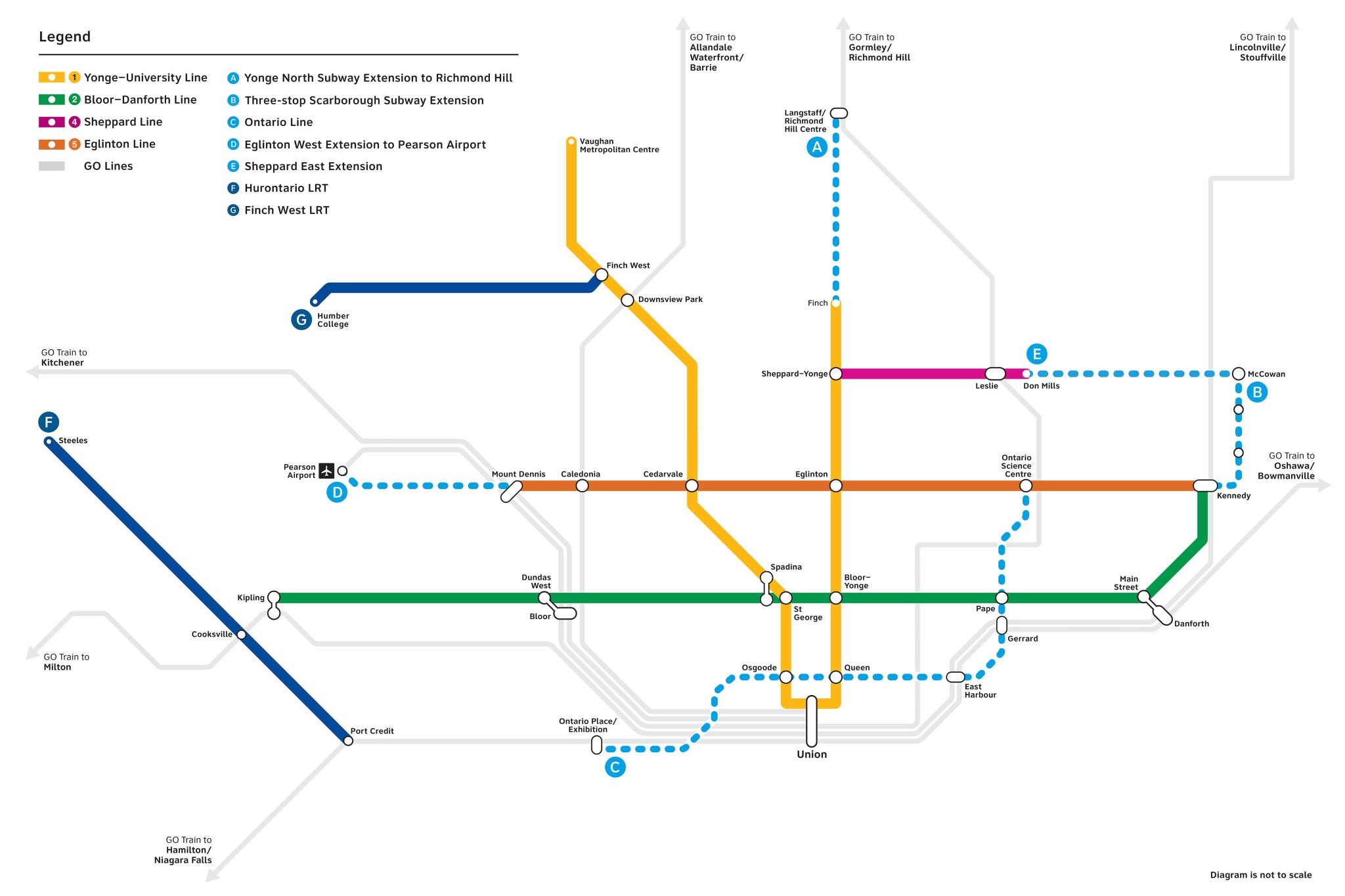
Click map to embiggenate

I’ll say this much at least about Premier Doug Ford’s big $28.5 billion transit announcement on Wednesday morning ($11.2 billion if you only count provincial money): I never thought I would see him so enthusiastically tout a much-needed transit line to and through enemy territory in downtown Toronto. Faint praise, perhaps, but when Ford said he wanted to upload Toronto’s subways to the province, I never imagined a plan even half this superficially sane.

Crowding on the Yonge line at Bloor Street presents “a clear health and safety problem,” Ford told reporters in Etobicoke, “and without action it is only going to get worse.” Thus his number-one transit priority is the same as everyone else’s: the Downtown Relief Line, which the PC government has wisely redubbed the Ontario Line.

The most basic and essential piece of that line, which Toronto city staff are already working on, would connect City Hall with Pape station on Danforth. Passengers who live in the east end and work downtown could thus avoid the bottleneck at Yonge and Bloor, relieving the alarming rush hour situation on platforms there and — assuming new TTC signalling technology works as promised — freeing up southbound capacity for folks from York Region: Ford vows to extend the Yonge line to Richmond Hill (cost: $5.6 billion).

The order here matters more than the timeline (2027, supposedly). It is undisputed that the DRL has to happen before the extension. That’s basic knowledge. But Ford is capable of ignoring or fouling up very basic knowledge when stumping for subways. This is a man who nearly promised Pickering one. On Wednesday, he sounded remarkably well briefed.

Ford’s Ontario Line wouldn’t stop at Danforth and City Hall, either. In the east it would head north across the Don Valley, through Thorncliffe Park and up to Eglinton. This idea is nearly as old as the DRL itself. And it would jog southwest from downtown to Ontario Place — a novelty, but again, not crazy. Total cost for the line: an at least semi-plausible $11.2 billion.

April 11, 2019

Ontario government unveils massive subway and light rail expansion for the GTA

Filed under: Cancon, Government, Railways — Tags: , , , , , — Nicholas @ 05:00

Doug Ford has always been a fan of subways, but now that he’s the Premier of Ontario, he’s getting to indulge his subway fetish in a vast expansion to heavy and light rail transit in and around Toronto:

Click map to embiggenate

The plans include:

  • An expanded downtown relief line, now to be called the Ontario line, running from Ontario Place on the lakeshore through downtown along Queen Street then crossing the Bloor-Danforth subway line at Pape station and running north to the Ontario Science Centre on the Eglinton Crosstown LRT line. This line is optimistically to be ready for opening by 2027.
  • The existing Sheppard Line will be extended east from Don Mills to McCowan, where it will intersect with the planned Scarborough subway extension (now to include three stops, not just the one originally announced, and to be completed by 2030).
  • The Yonge-University line will be extended north from current terminus at Finch to the Richmond Hill Centre with a hoped-for completion date soon after the Ontario line.
  • The Eglinton Crosstown line will be extended west to Pearson airport, with a target completion date of 2031.
  • New light rail lines will be created between Finch West on the Yonge-University subway to Humber College, and along Hurontario Street in Mississauga from Port Credit on the lakeshore to Steeles Avenue in Brampton.

To accomplish all of this will require financial contributions from the City of Toronto, York Region, and the federal government, as the province is only funding just over one third ($11.2 billion) of the estimated $28 billion price tag.

Of course, it’s a Doug Ford plan, so none of the usual suspects in Toronto are happy about any of it.

February 6, 2019

QotD: “Get off my lawn!”

Filed under: Cancon, Government, Quotations, Sports — Tags: , , — Nicholas @ 01:00

The zeitgeist, of course, has also changed since 2002. Childhood obesity and screen addiction are now perceived as urgent matters of public health. A politician who wants those damn kids off his lawn is likely to be told “You’re a monster who is spreading diabetes and ruin, and, frankly, it’s amazing that there are kids on your lawn in 2017 and we would like to know how you accomplished this.”

Colby Cosh, “Hamilton finally ends its decades-old ban on street hockey, and it won’t actually change a thing”, National Post, 2017-03-06.

December 19, 2018

QotD: Maple-flavoured corporate welfare

Filed under: Business, Cancon, Government, Quotations — Tags: , , , — Nicholas @ 01:00

There’s that word: “investments.” That’s what Canadians — Ontarians and Quebecers, certainly — have been trained to expect in these situations: An elaborate mating dance culminating in a greasy press conference where corporate leaders hail bold new provincial and federal “investments” in the company and its workers and its world-beating widgets. Critics are assailed as uncaring and testily reminded that every jurisdiction subsidizes the widget industry.

Traditionally, this is later followed by outrage when it emerges the company has used taxpayers’ bold investment to pay out lavish bonuses or dividends. In the fullest version of the performance, the company just pulls up stakes and leaves town anyway — sometimes having fulfilled its stated obligations, sometimes not, but always leaving behind a bad taste and a per-employee subsidy rate that makes no sense in hindsight.

If the company is Bombardier, it might extract lavish subsidies from government for an airplane project on the theory the Canada needs an aerospace industry, then turn around and sell the project to a foreign competitor for basically nothing.

Chris Selley, “A reminder that governments don’t ‘invest’ in businesses. It’s just corporate welfare”, National Post, 2018-11-28.

November 22, 2018

The apparently unexpected backlash over cancelling a French-language university in Ontario

Filed under: Cancon, Education, Politics — Tags: , , , , — Nicholas @ 03:00

I suspect a lot of the uproar is actually just target-of-opportunity stuff to justify criticism of Ontario premier Doug Ford. Chris Selley points out that until the announcement, there wasn’t actually a lot of support for the new university among French-speaking Ontarians:

You would never know it since Thursday, when the Ontario government cancelled plans to open a new French-language university in Toronto, but those plans were not universally beloved. A lot of people hated the location. In an op-ed in Le Droit, University of Ottawa political scientist François Charbonneau complained it was being built to serve future francophone immigrants, not proper Franco-Ontarians in a community where they’ve been established for generations.

He called it “a historic mistake that perfectly illustrates what it means to be a minority: to have no power over one’s own destiny and to be dependent on ideological rantings with no democratic legitimacy.”

Higher-education consultant Alex Usher was among many who dismissed enrollment projections for the university as “fantasy.” Writing on the Higher Education Strategies blog, Usher called a recent survey of francophone Ontario high school students the “worst piece of social science I have ever seen.” It found lots of interest in attending the new university, but didn’t bother asking about their interest in existing bilingual alternatives like Laurentian University and the U of O.

To language hawks, bilingualism is the enemy: French always loses out in a budget crunch, and it does nothing to advance the right to live one’s life solely in French. Trouble is, very few students at French-language Ontario high schools are remotely interested in living their lives solely in French.

These are all things Premier Doug Ford and his ministers might have mentioned if they hoped to leave an impression other than that Ontario francophones just aren’t worth the money. They might wisely have chosen not to axe the French Language Commissioner in the same fiscal update, transferring its complaint-resolution powers to the ombudsman but orphaning its advocacy mandate. Finance minister Vic Fedeli hasn’t even said how much of its $1.2 million budget he hopes to recoup.

But they did what they did, all at once, and they said it was all about saving money. I suspect the whirlwind they reaped came as a surprise.

Good heavens, though, what wind.

November 20, 2018

Gordon Lightfoot’s “Wreck of the Edmund Fitzgerald

Filed under: Cancon, History, Media, USA — Tags: , , , , — Nicholas @ 03:00

Mark Steyn devotes a column to the work of Canadian singer/songwriter Gordon Lightfoot, particularly his very well-known ballad on the loss of the Edmund Fitzgerald on Lake Superior in 1975:

Edmund Fitzgerald, 1971
Detail of a photo from Wikimedia Commons

When it comes to trains and boats and planes, Gordon Lightfoot has hymned all three, but it’s the middle mode of transportation that produced the song he’s proudest of:

    The ship was the pride Of the American side
    Coming back from some mill in Wisconsin
    As the big freighters go
    It was bigger than most
    With a crew and good captain well seasoned…

In November 1975 Lightfoot chanced to be reading Newsweek‘s account of the sinking of a Great Lakes freighter in Canadian waters. He’s a slow and painstaking writer, which is one reason he’s given up songwriting – because it takes too much time away from his grandkids. But that day forty-three years ago the story literally struck a chord, and he found himself scribbling away, very quickly:

    The legend lives on From the Chippewa on down
    Of the big lake they called Gitche Gumee
    The lake, it is said Never gives up her dead
    When the skies of November turn gloomy…

“Gitche gumee” is Ojibwe for “great sea” – ie, Lake Superior – as you’ll know if you’ve read your Longfellow, which I’m not sure anyone does these days. Evidently Hiawatha was on the curriculum back east across Lake Huron in young Gordy’s Orillia schoolhouse. The Gitche Gumee reference may be why, when I first heard “The Wreck of the Edmund Fitzgerald“, I assumed its subject had sunk long before the song was written. In fact, it sank on November 10th 1975 – just a few days before Lightfoot wrote the number. When she’d launched in 1958, the Edmund Fitzgerald was the largest ship on the Great Lakes, and, when she passed through the Soo Locks between Lakes Superior and Huron, her size always drew a crowd and her captain was always happy to entertain them with a running commentary over the loudspeakers about her history and many voyages. For seventeen years she ferried taconite ore from Minnesota to the iron works of Detroit, Toledo and the other Great Lakes ports …until one November evening of severe winds and 35-feet waves:

    The wind in the wires
    Made a tattle-tale sound
    And a wave broke over the railin’
    And every man knew
    As the captain did too
    ‘Twas the witch of November come stealin’…

And about seventeen miles from Whitefish Bay the Edmund Fitzgerald sank, with the loss of all 29 lives. It remains the largest ship ever wrecked on the Great Lakes, launched in 1958 to take advantage of the new St Lawrence Seaway (to be opened by the Queen and President Eisenhower on an inaugural voyage by the Royal Yacht Britannia the following year) and specifically constructed to be only a foot less than the maximum length permitted. Edmund Fitzgerald was the then chairman of Northwestern Mutual Life Insurance of Milwaukee, and, as far as I’m aware, the only insurance company executive to be immortalized in a song title. Fifteen thousand people showed up for the ship’s launch at River Rouge, Michigan. It took Mrs Fitzgerald three attempts to shatter the champers against the bow, and then there was a further half-hour’s delay as the shipyard workers tried to loosen the keel blocks. After which the ship flopped into the water, crashed against a pier, and sent up a huge wave to douse the crowd. One spectator promptly had a heart attack and died.

And then came seventeen happy years. Even in the twenty-first century, there is something especially awful and sobering about death at sea: it is in a certain sense a reminder of the fragility of security and modernity. Whenever I’m in, for example, St Pierre et Miquelon, the last remaining territory of French North America, I stop by the monument aux marins disparus, sculpted in 1964 and to which many names have been added in the years since – because a ship put out, and somewhere on the horizon the great primal forces rose up from the depths and snapped it in two like a matchstick.

October 31, 2018

Premier Ford’s promise to lower electricity rates in Ontario

Filed under: Business, Cancon, Government — Tags: , , , , — Nicholas @ 05:00

In the Financial Post, Lawrence Solomon says Doug Ford can’t risk abandoning his promises about Ontario electricity costs, despite his cabinet’s worries about provincial reputation damage:

Ford has every reason to return the power system to some semblance of economic sanity. Ontario is now burdened by some of the highest power rates of any jurisdiction in North America, throwing households into energy poverty and forcing industries to close shop or move to the U.S. The biggest reason by far for the power sector’s dysfunction is its renewables, which account for just seven per cent of Ontario’s electricity output but consume 40 per cent of the above-market fees consumers are forced to provide. Cancelling those contracts would lower residential rates by a whopping 24 per cent, making good on Ford’s promise to aid consumers.

[…]

To date, Ford has stopped renewable developments that haven’t been completed, which will prevent things from getting worse, but he has failed to tear up the egregious contracts of completed developments, which will prevent things from getting better. Based on conversations that I and others have had with government officials, it appears that Ford is inclined to cancel the contracts and honour his signature promise, but he is being thwarted by cabinet colleagues who fear that Ontario’s reputation will take a hit in the business community if they don’t play nice.

Except, there’s nothing nice about betraying a promise to the voters who democratically put you in power in order to avoid pressure from lobby groups who think governments are entitled to hand out sweetheart deals to their favoured cronies. There’s also nothing democratic about it. It is an axiom of parliamentary government that “no government can bind another.”

Canadian governments, including Ontario governments, have in the past torn up odious contracts, including those in the energy sector. When they did, upon passing binding legislation, they were able to reset the terms, offering as little or as much compensation as they wished. Outraged business lobbies’ claims that the reputation of governments would be affected were not borne out. Moreover, such rightings of political wrongs serve the interest of small government and free markets, because businesses have always understood that there’s an inherent risk in contracting with governments that are able to unilaterally rewrite contracts. To overcome that inherent risk, businesses add a risk premium when getting in bed with government, helping to explain the rich contracts the renewables developers demanded. That risk premium acts to make business-to-business dealings more economic than business-to-government dealings.

October 19, 2018

Ontario’s lack of retail cannabis stores – “What have they been smoking at Queen’s Park?”

Filed under: Bureaucracy, Business, Cancon — Tags: , , , , — Nicholas @ 03:00

In the Financial Post, William Watson points out the weirdness of Ontario’s decision to delay the opening of legal cannabis stores until next Spring:

For several years now, dozens of dispensaries have been operating quite openly. (They call themselves dispensaries to further the narrative that, like your grandmother’s rye, marijuana is for medicinal purposes.) Only now, with pot use becoming legal, are these dispensaries being shut down — although Toronto’s chief of police says not right away, as he doesn’t have [the] person power to do it all at once.

If they don’t shut down, they may forfeit their chance at a licence to sell pot legally once licensed retail operations do finally start in the province on (when else?) April 1st of next year — 166 days after legalization. Why would they not be granted a licence? Not because they trafficked in marijuana when its use was strictly illegal, if seldom prosecuted. But because they continued to traffic in marijuana after it became legal but before the government gave them a licence, an offence that will be prosecuted slowly, if at all.

Silly me. I thought marijuana legalization would simply say that after a certain date the police wouldn’t arrest you for having such-and-such an amount of marijuana in your possession. End of story.

[…]

Countrywide, as the Financial Post’s Vanmala Subramaniam recently reported, a big roadblock to timely legal supply has been the need to seal products with federal excise revenue stamps. But there’s only one supplier and the stamps come without adhesive. Stamps! In 2018!

In American movies of the 1930s and 1940s, moonshiners and bootleggers waged war against “revenuers,” federal agents charged with levying excise taxes on booze. It seems the revenuers have now taken charge of Canada’s marijuana industry. You might plausibly argue that the former illegal market operated in the interests of consumers. There seems little doubt the new legal market will operate in the interest of governments, their unions and their revenue departments.

When cops did enforce the country’s no-toking laws, they could plausibly tell themselves they were doing it to protect young people and other innocents. Now when they enforce the laws they’re doing it to protect legally privileged producers against producers who find themselves offside with often arbitrary licensing laws. Protecting kids was one thing. Protecting cartels is quite another.

October 17, 2018

How Toronto got its name

Filed under: Britain, Cancon, France, History — Tags: , , , — Nicholas @ 03:00

Colby Cosh on the origins of the name of Canada’s largest city (which, surprisingly, isn’t the Mississauga name for “big stink on the water”):

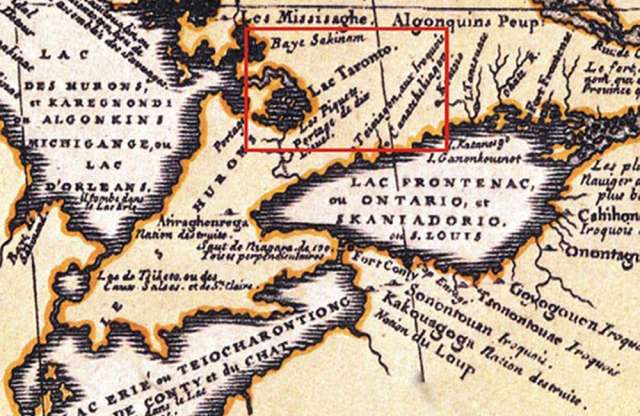
Detail from a 1688 map of western New France by Vincenzo Coronelli that locates “Lac Taronto” at Lake Simcoe.
City of Toronto Culture Division/Library and Archives Canada via the National Post

By the time of Franquelin, “Tkaronto” had already become “Taronto,” a generic name for the highway between Lake Simcoe and Lake Ontario. The Humber River was called the Toronto River by the French before Gen. John Graves Simcoe and the British got hold of everything. The word, in turn, became attached to a trading settlement at the southern end of the trail — a pretty crummy place, by all accounts, but one destined for bigger things as part of a global seafaring empire.

The miracle is that it held on to the name. Simcoe insisted that “Toronto,” on being anointed as the site of the new capital of Upper Canada in 1793, be dubbed “York” in honour of Prince Frederick (1763-1827), Duke of York and second son of George III. This Duke of York is the “Grand Old Duke of York” from the satirical verse about military futility. He was also commander-in-chief of the British armies that helped to chase Napoleon out of Europe twice, and is thought to deserve genuine credit for this, so be careful who you write insulting rhymes about.

Simcoe dubbed Toronto “York” just because he was sucking up to a very identifiable future boss, and for no other reason. The people of Toronto seem to have understood this and resented it. In the decades to come, it was occasionally observed that there were something like a dozen other places in Upper Canada called “York.” Moreover, Simcoe’s “Little York,” as it was often called, seems to have presented an increasingly embarrassing parallel with the Americans’ bustling New York.

In 1834, when the Legislative Council of Upper Canada decided that the capital needed to be formally incorporated as a city, the citizenry remembered that they belonged to “Toronto” and appealed to the council to have the more musical old name restored. Over four decades their annoyance had not receded. Diehards who wanted York to remain York for imperial-grandeur reasons were outvoted, and Toronto’s formal Act of Incorporation observes that “it is desirable, for avoiding inconvenience and confusion, to designate the Capital of the Province by a name which will better distinguish it.” The appellation “Toronto,” of course, had actually been nicked from a spot some way off, but the white settlers had mislaid that information, and didn’t check with anyone who would know better.

October 5, 2018

A quick way for Doug Ford to reduce Ontario’s electrical rates

Filed under: Business, Cancon, Economics, Government — Tags: , , , — Nicholas @ 03:00

Ross McKitrick, Elmira Aliakbari and Ashley Stedman outline one of the fastest ways for the Ontario government to get Ontario electricity rates back down toward the national average:

The Ford government seems to want to repair Ontario’s electricity market. It recently moved to scrap the Green Energy Act and reportedly plans to eliminate or alter the so-called Fair Hydro Plan.

While these moves will mitigate future price increases, they won’t reduce current electricity prices. In fact, according to a Fraser Institute study being released today, to lower existing prices the government must reduce what’s known as the “Global Adjustment” — an extra charge on electricity. It won’t be easy, but reducing the global adjustment could bring down electricity prices by about 24 per cent.

This would be welcome news for Ontarians, as electricity prices increased 71 per cent from 2008 to 2016, far outpacing electricity-price growth in other provinces.

[…]

Between 2008 and 2017, the GA grew from less than one cent per kilowatt-hour (a common billing unit for energy) to about 10 cents, accounting for the entire increase in Ontario electricity commodity costs over that time. Therefore, the key to lowering power prices in Ontario is to reduce the GA.

In our study, we use reports published by the Ontario Energy Board to breakdown the GA to better understand where the money goes and provide specific recommendations on how to lower electricity prices. We found that the largest component of the GA charge — nearly 40 per cent — funds subsidies paid to renewable energy sources (wind, solar, etc.) under feed-in-tariff contracts, yet these sources only provide seven per cent of Ontario’s power output.

And notably, the GA provides almost 90 per cent of revenue earned by renewable generators, with only 10 per cent coming from actual power sales. This overwhelming reliance on government subsidies (paid by ratepayers) rather than actual electricity sales reveals how distorted the pricing structure has become in Ontario.

September 29, 2018

The Ontario government’s amazingly sensible approach to legal cannabis

Filed under: Business, Cancon, Law, Liberty — Tags: , , , , — Nicholas @ 03:00

Chris Selley expresses what a lot of surprised people must be feeling after Premier Doug Ford’s government introduced startlingly mature and sensible rules for the distribution and sale of cannabis products in the province after the federal government’s legalization is enacted:

The Ontario government tabled its cannabis retail framework in the legislature on Thursday, and it only further repudiates the Frightened Communist model envisioned by the Liberals. The government will sell pot online, as before, and will maintain a monopoly on wholesaling. But the rest will be up to the private sector, under the control of the Alcohol and Gaming Commission. As it stands, there won’t even be a cap on the number of licences; a government official said Thursday they expect 500 to 1,000 applications right off the bat.

In response, OPSEU president Smokey Thomas beamed out a furious press release on behalf of his spurned members — er, sorry, on behalf of Ontario’s “municipalities and communities.”

“Unlimited stores and unlimited places to smoke will cause unlimited problems,” Thomas averred. “It’s outrageous. We’re going to become the wild west of cannabis and Sheriff Doug Ford is going to skip town, leaving communities and municipalities holding the dime bag.”

Thomas predicted Premier Ford would hand out retail pot licences to “Conservative insiders” and “corporate donors.” (Corporate donations are illegal.) He accused Ford of funnelling what by rights should be public profits into “private pockets.”

“If Ontario’s finances are truly as bad as Ford wants us to believe, why is he giving away the millions, maybe even billions, in revenue we’d get if cannabis sales were public?” he asked.

Does the government make money on cigarettes? On alcohol sold in bars and restaurants, at privately run LCBO agency stores and, of late, in supermarkets? Of course it does. Scads of it.

So it’s all quite ridiculous, as OPSEU press releases tend to be. But Thomas is not wrong when he argues the new approach is remarkably permissive. Perhaps most notably, whereas the Liberals’ proposed rules banned using marijuana in public, the PCs’ would allow you to smoke or vape it anywhere you can tobacco (though not in cars or boats). But it’s far less permissive than one might expect in other ways as well.

September 28, 2018

Ontario government lays out the path to a fully legal cannabis market

Filed under: Business, Cancon, Law — Tags: , , — Nicholas @ 03:00

There is going to be a gap between the federal legalization date next month and the beginning of legal sales from brick-and-mortar stores in Ontario in April:

With the legalization of recreational marijuana around the corner, the Ontario government has finally answered some of the most burning questions about where residents can officially buy and smoke pot.

A day before new pot legislation is set to be tabled, The PC government announced earlier today that starting Oct. 17, weed will be up for sale at private retail pot shops by April next year.

Doing away with the cap on the number of licensed cannabis stores in the province, the government is officially taking a free-market approach to what would previously have been an LCBO monopoly under the Liberal provincial government.

[…]

Until April, cannabis will be sold exclusively online, distributed through federal wholesalers and the government’s Ontario Cannabis Store.

The Alcohol and Gaming Commission of Ontario will be in charge of regulating the marketplace, including granting and revoking pot shop licenses.

Store owners will need to apply for a retail-operator license as well as a retail store authorization for every location they open, which will be limited to a set number, to prevent possible over-expansion, Walmart-style.

There will also be restrictions for federal cannabis growers, who will only be able to hold “a single retail license at a single production site located in Ontario,” said Ontario Attorney General Caroline Mulroney.

All currently existing pot stores who continuing to operate illegally after Oct. 17 will lose their right to ever apply for a license in the future, as will stores who have a history of dealing with organized crime and providing pot to minors.

Ontario’s new government agency, the Ontario Cannabis Retail Corp., will be in charge of handling online cannabis sales as well as wholesaling to private stores, who will potentially run the gamut from local pot shops to huge cannabis corporations.

There will be a minimum distance requirement between pot shops and schools set up in the future.

Any Ontario municipalities who don’t want pot shops on their turf — like Norfolk County in Southwestern Ontario, the first to vote no on cannabis storefronts — will have to opt out officially by Jan. 22, 2019, which they were previously barred from doing.

« Newer PostsOlder Posts »

Powered by WordPress