Quotulatiousness

August 14, 2018

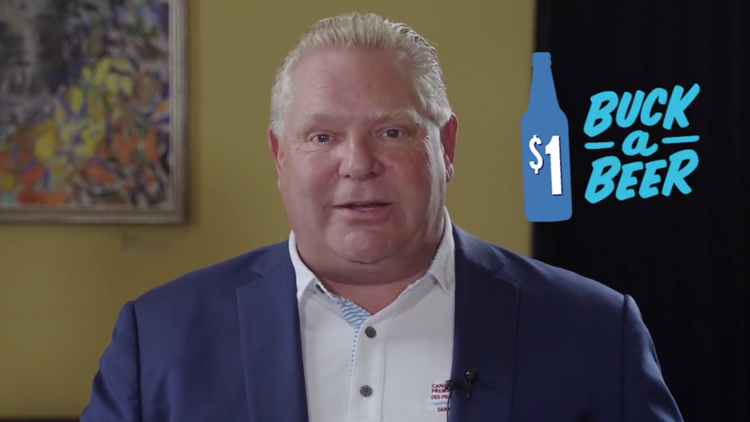
Ontario embraces online sales for marijuana, with retail stores to follow in 2019

Filed under: Business, Cancon, Government, Liberty — Tags: , , , , — Nicholas @ 05:00

Chris Selley on the Ontario government’s surprisingly sensible approach to phasing in retail sales of cannabis over the next eight months:

Ontario’s Progressive Conservative government called a brief truce in its multi-front war with the federal Liberals on Monday to give one of Prime Minister Justin Trudeau’s signature policies a major boost: as had been widely rumoured, the Tories will scrap the previous Liberal government’s tentative public marijuana retail scheme and instead hand out licenses to the private sector.

How many licenses and what kinds of stores are just two of many unresolved details. The government says it will consult widely to determine how best to proceed, with a target opening date for licensed brick-and-mortar stores of April 1, 2019 (with publicly run online sales to commence in October). But it seems safe to hope the cap, if any, will be significantly higher than the previous government’s laughably timid 150.

Thanks to Toronto’s reluctantly laissez-faire approach to illegal storefront (nudge-wink) “medical” marijuana “dispensaries,” we know 150 might not even satisfy a free market in the country’s largest city. Trudeau has always said the goal of legalization was to smash the illegal market and plunk down a legal one in its place. The Ontario Liberals’ plan seemed almost tailor-made to fail in that endeavour.

There remains ample room for the new government to screw this up. But if it gets pricing and regulation and enforcement halfway right, the country’s most populous province should now be well placed to give legalization a good shot at achieving what proponents have always said it should — which is, basically, to make it like booze. Of course kids still get their hands on booze, but at least it’s a bit of a chore. And at least when kids get drunk, they’re not drinking moonshine.

The need to claim the retail market from the existing extra-legal networks will hinge on quality, availability and (especially) the prices that the province sets. Price it too high (pun unintentional), and the legal market will not take over distribution and sales from the black market. Provide poor quality and get the same results. Restrict sales too stringently, and watch the profits go back to the current dealers … who are not noted for their sensibilities about selling drugs to the under-aged.

In the meantime, it’s interesting to ponder why they’re going in this direction. Fedeli and Attorney-General Caroline Mulroney were at great pains Monday to stress their primary concern was the children.

“First and foremost, we want to protect our kids,” said Mulroney. “There will be no compromise, no expense spared, to ensure that our kids will be protected following the legalization of the drug.”

“Under no circumstances — none — will we tolerate anybody sharing, selling or otherwise providing cannabis to anybody under the age of 19,” said Mulroney. Fedeli vowed that even a single sale to a minor would void a retailer’s license.

Yet, let’s be honest, kids well under the age of 19 can already get cannabis and other illicit drugs — more so in urban and suburban areas, but it’s hard to imagine that legalizing cannabis for 19-plus customers somehow magically renders the under-19s uninterested in getting access, too.

July 5, 2018

Barbara Kay on revising Ontario’s sex-ed curriculum

Filed under: Cancon, Education, Health, Politics — Tags: , , , , , — Nicholas @ 03:00

Her latest column in the National Post has some advice for Premier Doug Ford and his merry band of (dare I say) reformers:

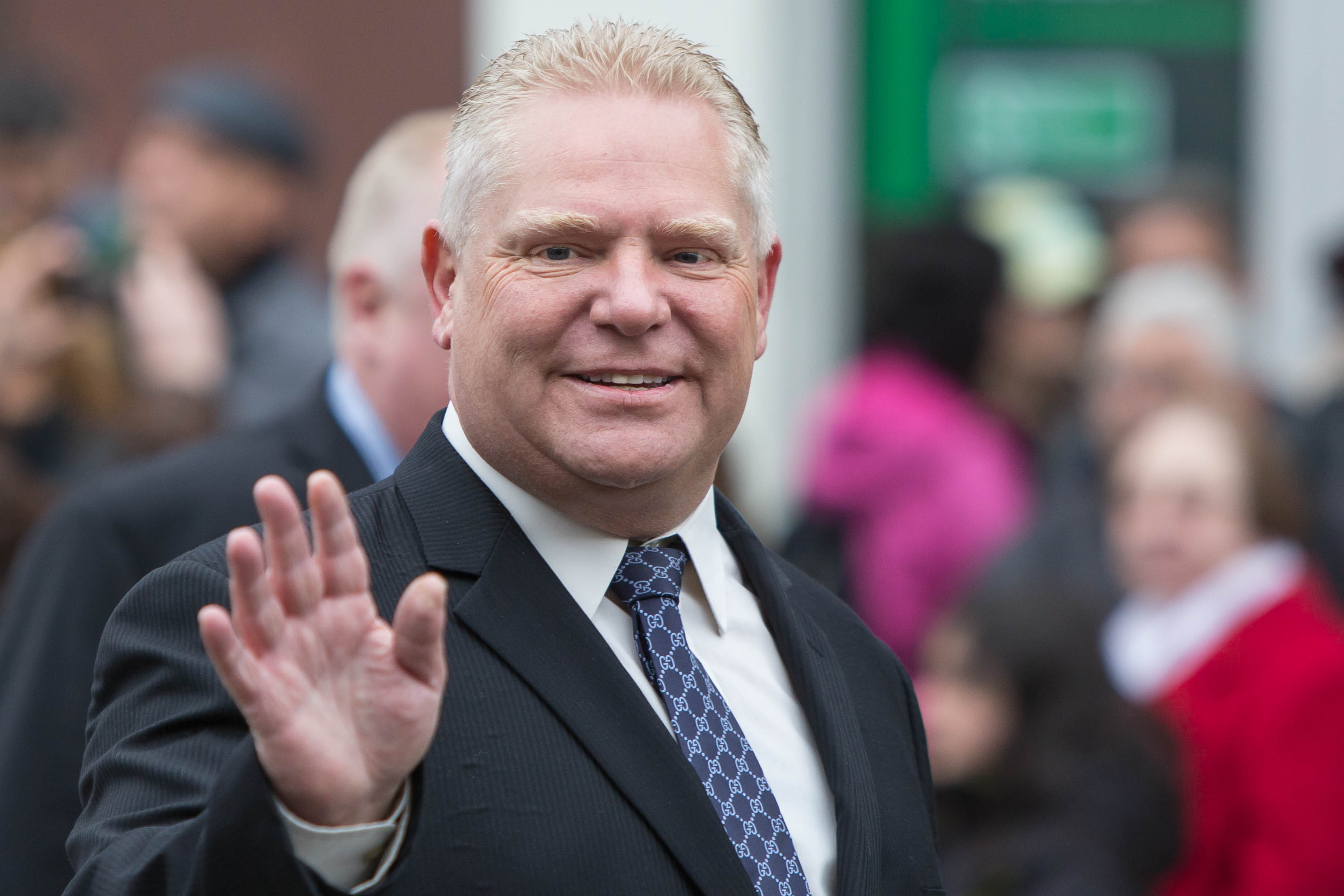
Doug Ford at the 2014 Good Friday procession in East York, Ontario.
Photo via Wikimedia Commons.

Doug Ford’s victory was in some measure due to his promise — I believe a heartfelt one — to repeal the sex ed curriculum in Ontario schools. I assume there’s a replacement program in the works. A sex-ed vacuum is not politically tenable, or even what most conservative parents want.

What principles will undergird a Doug Ford inspired curriculum? I’d suggest four guidelines for his consideration.

First, take sex ed out of the hands of ideologues and activists. Constitute a task force made up of a variety of stakeholders, involving both liberal and conservative parents (including parents of LGBT students), disinterested scientific authorities and, yes, religious representatives, to hammer out recommendations for a sex ed paradigm, in which science is separated from theory, and in which proponents of morality and modesty-based sex ed have a voice and a vote.

Second, revisit the underlying premise in sex ed today that all children must learn everything under the sun that touches on sexuality from the state.

[…]

Third, there is the question of readiness. Children can be taught the facts of biology quite early, but there is no need to engage young children in detailed discussion of sexual preferences before they fully understand the nature of sexual desire. It is obviously appropriate to warn against internet porn and social media perils at a fairly early age, and the reality of same-sex couples (including parents of students) openly acknowledged, but full engagement in the nature of sexual desire in all its diversity and detail is best left for adolescence.

Finally, nowhere is the need for distinction between science and theory more urgently required than in the area of transgenderism.

Much of what children are learning about transgenderism today, at a very tender age, is not science-based, but activist-dictated theory that can result in psychological harm.

June 9, 2018

Various comments on the Ontario election

Filed under: Cancon, Politics — Tags: , , — Nicholas @ 03:00

Once the voting was underway, I briefly checked my Facebook feed and, as expected, saw a lot of declared support for the NDP (even among those who normally lean Liberal), a few of the more outspoken Conservatives fighting their corner, but others I think of as Conservative-leaning were generally being very quiet. I didn’t bother with my Twitter feed, as relatively few of the people I follow are from Ontario, and the same for my Gab feed (Twitter biases as far left as Gab tends to the far right).

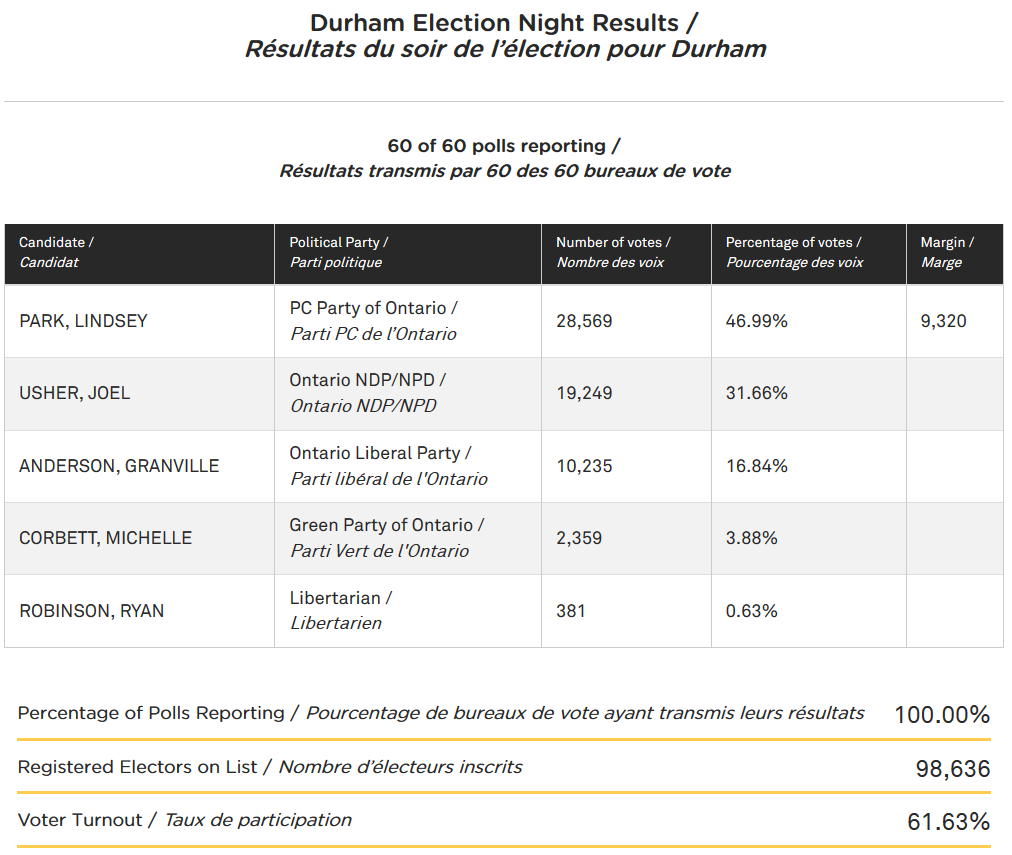
When I went in to vote (I had a Libertarian candidate in my riding), I asked the poll clerk if there had been any ballot refusals and she said “there’d been a few”. The preliminary results shown on the Elections Ontario site for my riding:

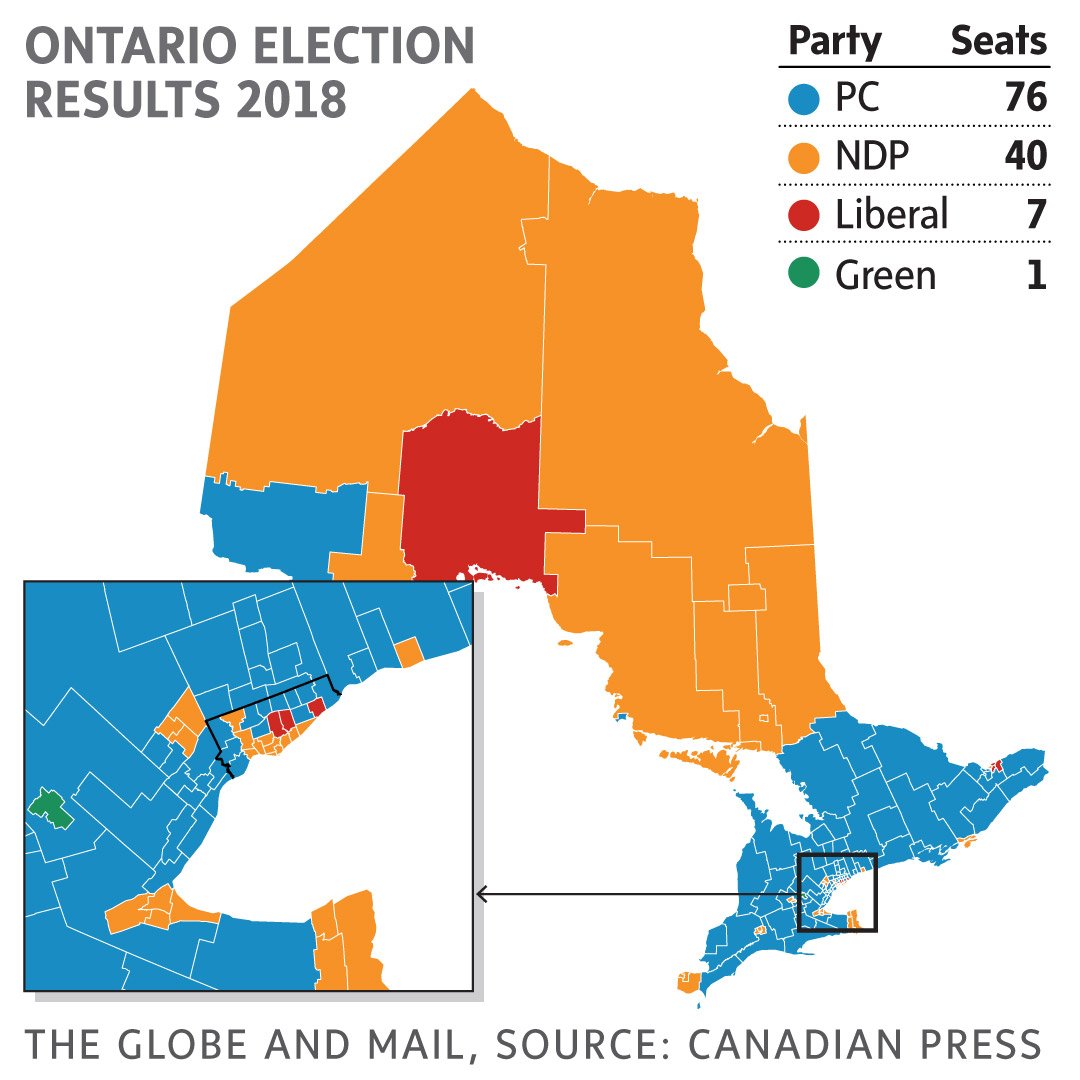
The Globe and Mail sent a tweet showing the overall shape of the PC victory:

David Warren commented on the election results:

My Chief Texas Correspondent leaps naturally upon the result of yesterday’s Ontario provincial election, in which our governing Liberals were annihilated. He sees this as a conventional “shift to the Right,” in Merican party terms, and celebrates it as such.

To which I reply: that the moronic city voters went not Right but over to the NDPee, which promised more spending than even the Liberals could imagine, and various grand new welfare schemes. (They are a zoological garden of various activist nutjobs.) Our outgoing premier’s personal charmlessness factored into the result. The winning Doug Ford is a total clown, and the media will have him for breakfast and snacks, yet for one brief glorious moment the Leftoids are in disarray. Ford is no Trump, though he might be able to match your esteemed President in straightforward vulgarity. He cannot have the fondest clew what he will do with the mess he has inherited, now that he is in power. He will have to betray that half of his constituency to which he promised the opposite of what he pledged to the other half, with unstudied vagueness. His caucus will be crawling with Suburban Saracens and other multicultural eccentrics — not the old solid Tory phalanx of white, Presbo-Methodist, rural hicks. Alas, though the ride may be wild, it won’t be fun to watch.

At BlogTO, Lauren O’Neil gathers a lot of Toronto-centric Twitter comments (not surprisingly, most are not complementary toward the Premier-elect (who, I’m informed we should more accurately be calling the Premier-designate instead)).

Kathy Shaidle posted on Facebook:

Am I relieved? You bet. But: Remember how close the polls were. The NDP got a lot of votes, and while our system means that the PCs won, the “popular” vote still shows how many leftoids there are in the province. And who else noticed that Doug’s “enthusiastic” official opening lines — “What a response. This is incredible.” — was scripted, and delivered with the stilted conviction of an Ed Wood stock player? On that note, I’ve seen less wooden Chippendale highboys…

May 18, 2018

Deploy scare quotes as required when considering the “cultural” “impact” of the suburbs

Filed under: Cancon, History, Politics — Tags: , , , , , — Nicholas @ 05:00

Rick McGinnis has a thoughtful piece on the creation and evolution of the modern western suburb, in the context of the ongoing Ontario election:

Maybe it’s some remnant of our tribal past, but it’s hard for us to leave behind some impulse to fear and vilify whoever lives one village over, beyond the river or in the next valley. We might think we’re sophisticated, cosmopolitan people, but this nascent tribalism is never far from the surface, and I saw it re-emerge with a roar during recent municipal elections here in Toronto.

Back when the late Rob Ford won his surprise mayoral victory in 2010 – certainly a surprise for his opponents, who couldn’t imagine how decisively he’d win – the electoral post-mortems painted his triumph as the revenge of the suburbs that once comprised a group of independent townships over the downtown, Toronto’s older urban core.

It was a battle between the suburbs and the city, won this time by the suburbs, who rallied behind various standards – summed up in the media as a love of cars, ethnic and cultural homogeneity and lower property taxes. As with any history written by the losers – the media, for the most part, who identified as urbanite, not suburbanite – it relied on conveniently ignoring facts that didn’t fit, and the deployment of sweeping generalizations, many of them out of date – if they were ever true at all – by decades.

[…]

Up here in Ontario, the imminent provincial election means that the suburbs versus city scenario will be revived, to either apportion blame should Progressive Conservative leader Doug Ford become premier, or get unpacked if he loses and the boogeyman of a monolithic voting bloc needs to be triumphantly debunked.

There remains the small matter that Ford Nation events – held inevitably in the suburbs since the heyday of Doug’s brother Rob – are visibly far more diverse than, say, the average Liberal fundraiser, and Ford opponents have been chewing on that tough gristle for nearly a decade.

Obviously, the suburbs can’t be both a politically, economically and culturally monolithic place, and a diverse, complex collection of communities mysteriously moved to unite during election cycles to oppose the prerogatives of certain political parties and the urbanites who love them. There’s a very complex story about the suburbs dying to be told, but we’re still invested in stereotypes that are decades out-of-date for the purposes of situational political utility. It’s an object lesson that politics, more than anything else, is the enemy of truth.

Diversity has joined “marriage,” “rights,” “privilege” and “family” on that list of words that we’ve come to use without sharing a common meaning, especially when we talk about places like the suburbs, what have come to mean something very different in our imaginations than they exist in reality. For the people living there – whose lived experience has nothing to do with convenient fictions – the suburbs are really just a place where a mortgage might be affordable, where you can have a front and a back yard, and where you don’t share walls with your neighbours.

May 11, 2018

Imagine Ontario’s election

Filed under: Cancon, Politics — Tags: , , , , , — Nicholas @ 03:00

Andrew Coyne on the fantasy campaign that is just kicking off in Ontario:

The first NDP ad of the 2018 Ontario election campaign invites viewers to “imagine a place” where hydro is cheap, drugs are free, and dental care is on the house — all at no cost to anyone except the “very rich” who will be “asked” to “pay a little more,” which I gather is NDPese for “taxed within an inch of their lives.”

That word — “imagine” — might be the theme of the coming election. The three major parties appear to be living in a world of the imagination, with platforms full of imaginary promises paid for with imaginary dollars. The province is sinking ever deeper in debt, notwithstanding the Liberal government’s desperate efforts to conceal it, its debt-to-GDP ratio headed for 45 per cent even after a decade or more of uninterrupted economic growth. A recession of any length or severity would blow that number skyward.

Beyond that the picture only grows darker, with the first of the baby boomers just into their 70s and the costs of health care projected to rise, relentlessly, as they grow into their dotage. And yet all three parties are merrily racking up new spending promises — daycare, pharmacare, dentacare, the works — with money they wouldn’t have even if the official budget numbers were genuine, and not, as the province’s auditor general has lately warned, a swindle and a fraud (I paraphrase). It’s an election in la-la land.

Oddly, this does not seem to be the conventional view. The advance word on the election, rather, is that Ontario is facing a choice of unprecedented starkness, a polarizing election with no one seeming to occupy the middle ground.

“It’s hard to remember a provincial campaign that’s featured two leaders so diametrically opposed to each other,” broadcaster Steve Paikin wrote recently, of the Liberals’ Kathleen Wynne and the Conservatives’ Doug Ford. “The political centre,” agrees the Globe and Mail’s Marcus Gee, “has vanished like a puddle in the sun.”

It’s true that the Liberals and the NDP are in something of a bidding war for the left-of-centre vote. If the March budget signalled a retreat from the Liberals’ not-overly-stringent devotion to fiscal restraint, the NDP platform goes further in every direction: about $4 billion a year further, in fact.

May 3, 2018

I’m sure just calling him “Ontario’s Trump” will be a fantastic winning strategy in June…

Filed under: Cancon, Politics — Tags: , , — Nicholas @ 03:00

Chris Selley on Ontario Progressive Conservative leader Doug Ford’s on-again, off-again plans for the Greenbelt:

Thus far, for want of many specific Progressive Conservative policy proposals, the Liberal line on Doug Ford has essentially been to brace for catastrophe: trust that no matter what he says, he will fire everyone and cut everything and destroy all that you hold dear, because he’s Doug Ford and that’s what Doug Ford does. Oh also he’s Donald Trump. The Liberals know no other way of campaigning. They were comparing Patrick Brown to Trump way back in October.

On Monday, though, Ford unveiled a specific, bold, novel and controversial policy approach on the major issue of affordable housing in the Greater Toronto Area — something wonks and pundits and opposition politicians could really sink their teeth into. Sadly it was a tremendously dumb policy: to develop “a big chunk” of the Greenbelt, while somehow tacking other compensatory bits of land onto it to ensure it didn’t shrink in overall size.

It was the worst of all things Ford: uninformed (there is no need for this); confusing (where exactly are they going to find all this replacement land?); a bit sketchy (the Liberals released a video of Ford saying the idea came from big developers); and ultimately not worth the napkin it was drawn on the back of. On Tuesday afternoon, citing public feedback, Ford abandoned the plan and promised to be the greenbelt’s fiercest protector.

“I govern through the people, not through government,” he explained in a statement. (He is running to lead Canada’s second-largest government.) Campaign spokesperson Melissa Lantsman was reduced to characterizing it as a great leadership moment.

April 25, 2018

Ontario’s ongoing guaranteed annual income experiment

Filed under: Cancon, Economics, Government — Tags: , , , , — Nicholas @ 05:00

Finland may have given up on their guaranteed annual income pilot, but Ontario’s similar program is still getting positive reviews from GAI fans like Andrew Coyne at the National Post. Colby Cosh isn’t quite as impressed with the program or the chances of it being expanded beyond its current small scale:

The Ontario plan is giving randomly selected low-income working-age individuals $16,989 a year in free money. That’s the basic story, with the detail that couples are eligible for a combined $24,027. This amount replaces provincial welfare, employment insurance, or early Canada Pension Plan payments, dollar-for-dollar; Canada Child Benefit cheques are strictly separate, however, and if study members go out and earn some income, their payment is reduced by 50 cents for every dollar they make until the supplement hits zero.

This is the “negative income tax” model of guaranteed income, intellectually pioneered by the Austria-Mont Pelerin-Chicago strain of economic thought that is my personal heritage and Coyne’s alike. The conclusion of the PBO paper is that the total cost of such a program for the entire country, applied to this year’s economy, would come to about $76 billion.

[…]

Kevin Milligan, a UBC economist who is skeptical of GAI, often points out that GAI advocates face the challenge of reconciling three conflicting elements of such a program: we want it to have a reasonable overall cost, we want it to be generous enough to bother with, and we want it to impose a low “clawback” rate on earned income so as not to discourage that.

The “Ontario model” sort of resolves the “trilemma” by being soggy on all three fronts. The $17,000 basic amount was chosen specifically to come to 75 per cent of Statistics Canada’s “low-income measure”: it is a guaranteed not-even-low income. (At the same time, I notice that the basic personal exemption on federal income tax forms is just $11,809 this year. Before we hurl ourselves headlong at a new social program of a relatively untested nature, maybe we could explicitly just stop taxing the poor first?)

Three points of GST may seem like a reasonable overall cost, if it could be realized, but an entitlement such as this is bound to be a one-way street: by the time we decide we do not like the effects, it will have become the next thing to a sacrament. (Canada’s guaranteed federal income defines us as a country!) Meanwhile, the 50-per-cent clawback in the Ontario model is fairly dramatic, and, moreover, under the model, couples who begin cohabiting would stand to lose up to $10,000 a year of GAI payments between them.

April 8, 2018

Premier Wynne’s crazy (high speed) train proposal

Filed under: Cancon, Economics, Politics, Railways — Tags: , , , , — Nicholas @ 03:00

I usually start any criticism of new railway line proposals with a disclaimer that I’m actually very pro-railways. I do so because it’s absolutely true and it kind of hurts me to shoot down these wonderful-sounding schemes just because they make no economic sense whatsoever. Last week, Jen Gerson found herself doing exactly the same thing while discussing the Ontario Liberal proposal for a new high speed passenger line:

It would be good to preface this column with a confession. I love trains. I loved taking trains while tooling about in Europe in my ‘20s. I would happily trade additional travel time to enjoy the comforts of a train in favour of airport security and an airline seat.

[…]

Train lovers like myself often like to lament the fact that Canada is the only G7 nation without a high-speed rail line, as if that fact makes us technologically backward — as opposed to merely sparsely populated.

But as Feigenbaum points out, there are only two high-speed rail lines anywhere in the world that make any money after factoring in build and operating costs: Tokyo to Kyoto, and Paris to Lyon. “There is another line in Japan that breaks even. All of the rest of the High Speed Rail projects in the world lose money and some lose a lot of money,” Feigenbaum says.

“In the North American context, you need at least 3 million people in each of the metropolitan areas [you’re serving]. You need incredibly high population density in both of these cities. You need very good inner-city transit systems and you need generally low rates of car ownership.”

Toronto qualifies as a reasonable high speed rail hub by this definition. Windsor does not.

And she doesn’t even mention the almost-universal cost overruns on major infrastructure projects like this, nor delays in obtaining equipment (especially if the winning bidder is Bombardier).

I swear I have squandered days of my life thinking about this train to Windsor and I’ve come to the conclusion that it is an onion of stupid. Every layer you peel away reveals some new and terrible aspect that doesn’t make any sense.

Fortunately, this is almost certainly just an election promise that will never actually go further than some lovely animations and perhaps a few physical scale models for politicians’ photo ops leading up to the vote. It will then probably disappear from the picture even if the Liberals get back into office.

March 14, 2018

Ontario’s tax dollars at work

Filed under: Cancon, Economics, Government — Tags: , , — Nicholas @ 06:00

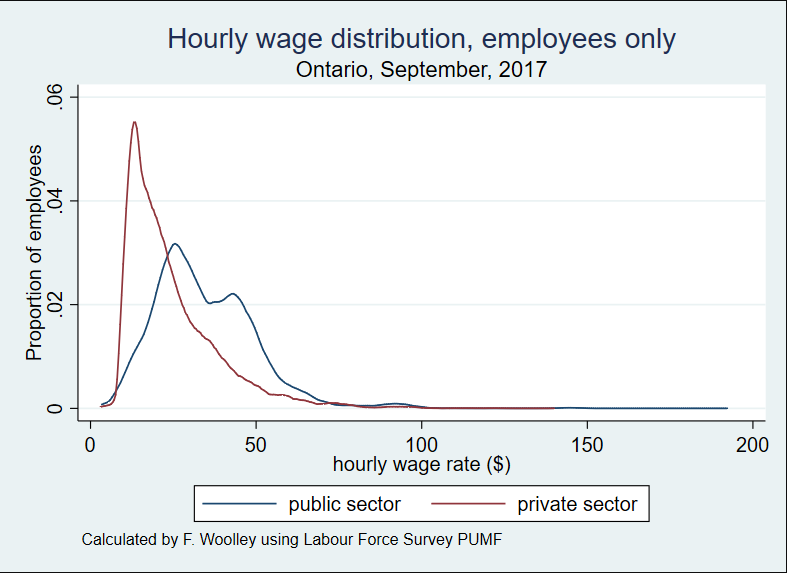
At Worthwhile Canadian Initiative, Frances Woolley shows the picture that will define Ontario politics for years to come:

In Ontario, public sector employees earn more than private sector employees. Many workers in the private sector earn the minimum wage, or only slightly above minimum wage. The peak of the public sector earnings distribution is much higher, at twenty-something dollars per hour, and there are a good number of public sector workers earning $40 or $50 an hour.

There are many things missing from this picture. Most importantly, it excludes highly-paid self-employed professionals, such as doctors, lawyers, and accountants, as well as entrepreneurs and business owners. It also excludes self-employed people in the trades, such as plumbers, electricians and contractors. The numbers are non-trivial: 13 percent of Ontario workers are self-employed. A good chunk of the upper part of the private sector earnings distribution is missing from the picture. On the other hand, the hourly wage distribution above excludes non-wage benefits that are more common in the public than the private sector, such as employer contributions to health insurance and pension plans.

Furthermore, the picture does not take into account the differences in the nature of work in the public and private sector. Many public sector jobs, such as nursing, social work, and teaching, require relatively high levels of skill and education. There are private sector jobs that require skill and education as well – but, as noted earlier, many of those jobs are carried out by self-employed professionals, so are not in the graph.

Even noting the exclusions, it’s striking that the old trade-off between public and private sector jobs — that civil servants got lower pay but better benefits and job security — has long since ceased to function. Civil servants, on the whole, now get higher pay than private sector workers, but have retained or even improved the benefits advantage over their private counterparts … and also still retain the job security that private workers can only dream of.

March 12, 2018

And the next premier of Ontario is likely to be … Doug Ford?

Filed under: Cancon, Politics — Tags: , , , , — Nicholas @ 03:00

Saturday’s Ontario Progressive Conservative leadership contest went down to the wire … and beyond, as voting glitches pushed the announcement of a winner beyond the time the party had rented the facility in Markham, so attendees had to go elsewhere to wait for the final result. In a disturbingly similar way to the last US presidential election, Christine Elliot won the popular vote, but the result hinged on the number of constituencies won, which went to Ford. Several of my (Liberal or NDP) friends on Facebook, who’d announced they’d joined the PCs explicitly to vote against Ford, were aghast at the result.

New Ontario Progressive Conservative leader Doug Ford at the 2014 Good Friday procession in East York.
Photo via Wikimedia.

In the National Post, Chris Selley reports on the three-ring circus:

In the end, maybe caucus had it right. If more than anything else Ontario’s Progressive Conservatives wanted to win on June 7 then maybe they should have stuck with interim leader Vic Fedeli. If the ultra-folksy MPP for Nipissing wasn’t the most compelling imaginable premier-in-waiting, he would certainly have cut a less divisive figure than Doug Ford, who was announced as the party’s new leader late Saturday night in a small room at a Markham conference centre.

“To the party members I say thank you. To the people of Ontario I say relief is on its way,” Ford told reporters and campaign workers. “And to Kathleen Wynne, I say your days as premier are numbered.”

That got a massive cheer, of course, but this is an outcome that many in the party consider a worst-case scenario. An Angus Reid poll released this week asked “soft” Tory voters whether each candidate would make them more or less likely to support the party: Ford’s net score (more likely minus less likely) was minus 27 per cent; Christine Elliott, who finished a very narrow second Saturday — her third failed shot at the position — was at plus 20.

Sticking with Fedeli would also have spared the party the hideous embarrassment of Saturday’s botched convention. Vote-counting dragged on for hours thanks to a chunk of ballots that had been allocated to the wrong ridings. A packed crowd of partisans was left in the dark for three hours, then told to hang tight for another 30 minutes, and then sent away into the night with no result. In lieu of a cascade of balloons, there was booing and hollering. Various Ford supporters, citing ostensibly conclusive media reports earlier in the day that Ford had won, alleged party elites were trying to steal it.

These were not the ideal circumstances in which to build unity, which was the stated purpose of the event. “You’ve been through a very tough couple of months — perhaps the toughest times in the history of the Progressive Conservative Party of Ontario,” Alberta United Conservative Party leader Jason Kenney told the crowd. “You’ve gone through weeks of anxiety and adversity. But I am certain that you will overcome this time of trial, and that this afternoon, with the election of your leader, you will emerge stronger, united and victorious in the election.”

“This afternoon,” he said. We were so young then.

The flow of votes from Allen to Ford was expected, but what I didn’t expect was the proportion of Mulroney votes that flowed to Ford instead of Elliot (I’d expected roughly 100% to Elliot, but a significant number went to Ford instead).

Perhaps the most surprising thing about the leadership campaign was how well Ford managed to stick to his talking points and not be baited into the kind of media spectacle his late brother seemed to specialize in. A tougher test awaits in the June provincial election, however. The Liberals and NDP have been gifted a full warehouse of attack ads, based on the Ford brothers’ chaotic and at times incoherent term in office in Toronto, but there may be a limit to the overall usefulness of this arsenal: rather like the US media attacking Trump during the last US election, we’ve probably heard it all before.

The circus may not be over yet, however, as reports on Sunday indicated that Christine Elliot is demanding an investigation into the election.

March 7, 2018

The reception Mulroney Sr. got shows how little “sizzle” the Conservatives can offer now

Filed under: Cancon, Politics — Tags: , , , — Nicholas @ 04:00

Chris Selley covered the recent Caroline Mulroney event featuring her father Brian:

Watching 79-year-old Brian Mulroney campaign for his daughter on Tuesday, I’d be hard-pressed to argue age matters at all.

The public-facing aspects of this leadership campaign have often been stilted, joyless and jittery, with Doug Ford carefully keeping his powder dry and Mulroney trying to build confidence without screwing up. Only Christine Elliott has often sounded passionate, confident and halfway credible all at once.

Mulroney père, on the other hand, waltzed into a packed banquet hall in Vaughan at noon on Tuesday like a conquering hero, to a standing ovation, and settled in behind the lectern like it was a favourite sweater and a mug of hot cocoa. When he was done, but for the greyer beards, the camera-wielding mob that escorted him out of the room might as well have had Justin Trudeau at its centre.

Mulroney regaled us with a smorgasbord of chucklesome anecdotes, bons mots and name-dropping. He cheerfully batted away several entreaties that he return to politics. He said he mooted the idea to Mila during Jean Chrétien’s infamous “I don’t know if I am in West, South, North or East Jerusalem” press conference in 2000.

“I think it’s a wonderful idea,” she supposedly replied, “and I know your new wife is really going to love the experience.” Much mirth!

Mulroney pooh-poohed the need for legislative experience in an aspiring premier — perhaps the biggest knock against his daughter — arguing he had none when he won the Tory leadership in 1983 and rampaged to a majority government, and suggesting he “want(s) no part of” the sort of experience that Kathleen Wynne and Co. have in spades.

“I knew Ontario when it was the driver of Confederation, the engine of Canada’s economy, a glorious leader in this country,” he prated, crediting the “strong, consistent and brilliant” leadership of Tory premiers John Robarts, Bill Davis and Mike Harris for “the large measure” of its success. “And now Ontario has been reduced to accepting equalization payments from Newfoundland and Labrador.”

[…]

Demonstrably, in Canada, you do not need a huge, room-filling personality to govern effectively. But if you haul out Brian Mulroney to campaign for you, you’re going to invite comparisons. And if you’re going to claim that the current government has literally laid waste to the province, a guy like Mulroney is liable to highlight just how modest the Conservatives’ proposals are to rebuild it all from scratch.

January 28, 2018

“[A] right to due process in politics? That has never been a thing”

Filed under: Cancon, Politics — Tags: , , , — Nicholas @ 05:00

Chris Selley on the weird, fast end of Patrick Brown’s career as leader of the Ontario Progressive Conservatives:

Many women often said they got a creepy vibe off Patrick Brown. His haircut was kind of odd. In question period, he was too shrill.

The Red Bull fridge in his office put me off. I associate Red Bull fridges and their foul contents with terrible nightclubs full of muscle T-wearing jackasses on the make. In 2012, Brown tweeted a photo of himself with two friends dressed up for Halloween at a terrible-looking Barrie nightclub he was known to frequent. He’s dressed up as James Bond. He’s pointing his toy Walther at Goose from Top Gun and Joel from Risky Business. I want to reach back through time and space and slap all three of them.

These would all be bad reasons for a bank to deny Patrick Brown a loan, or for a taxi driver to deny him a ride, or for a company to fire him from a job in the legal department.

But they are precisely the sorts of often silly, unfair, perhaps totally misguided little whims that can turn people off politicians.

It’s widely accepted that Robert Stanfield’s 1974 campaign was materially harmed by his dropping of a football. John Tory’s principled stance in favour of funding religious schools in Ontario besides Catholic ones sent the Tories’ 2007 campaign rolling downhill onto a pier that then collapsed into a lake. People still can’t believe Hillary Clinton’s emails might have cost her the presidency.

In short, there is no justice in politics. Morons win, geniuses lose, people get screwed who don’t deserve it. So it has been very strange to see some commentators and correspondents portray Brown as having been horribly hard done by in the aftermath of two women’s allegations of sexual assault and coercion at his hands.

[…]

In the (seemingly unlikely) event these allegations result in criminal charges, he will have his day in court and face his accusers just like anyone else. And we do have defamation laws in this country. Brown must surely know who his accusers are.

But a right to due process in politics? That has never been a thing.

As party leader, Brown could turf from caucus any MPP who displeased him — as he turfed Jack MacLaren after a spree of idiocies. Every four years, his and all his fellow MPPs’ job prospects rest in the hands of the voters. That’s assuming they pass a party review that considers criteria as vague as “any ethical questions or concerns,” and assuming the leader is willing to sign their nomination papers. (It seems unlikely that whoever leads the Tories into the June 7 election will sign Brown’s.)

I was never a fan of Brown, but I’m not a conservative, so it only bothered me in the sense that I thought he was unlikely to be the one to turf the Liberals out of office at Queen’s Park. I’ve paid so little attention to the man that this will only be the second time his name has appeared on the blog since he was elected leader (another Patrick Brown shows up in searches, but he was an NFL hopeful with the Vikings back in 2010).

January 23, 2018

The unintended consequences of Ontario’s steep minimum wage hike

Filed under: Business, Cancon, Economics — Tags: , , , , , — Nicholas @ 05:00

Colby Cosh on the unpredictable outcomes of Ontario’s recent minimum wage increase:

In Thursday’s edition of this paper, Marni Soupcoff wrote an entertaining column about how Ontario’s fairly aggressive minimum wage increase had suddenly raised the costs of labour-intensive goods and services for consumers — the ones, that is, who don’t benefit themselves from a minimum wage increase. Child care, which is a very pure purchase of labour, is the example that is being exasperatedly discussed this week. The headline did not have “duh” in it, but that was the spirit of the thing.

Soupcoff pointed out that this not only could have been foreseen; an explicit warning of it was given in the pages of the Toronto Star, by the paper’s social justice reporter Laurie Monsebraaten. Our Financial Post section could perhaps easily be called the Social Injustice Gazette, but anyone at FP who got such an early jump on an economics story would be rightly pleased with himself.

Soupcoff’s major point was that the broad-sense law of supply and demand is not some plutocratic swindle devised by the Monopoly Man and his fatcat pals; even believers in “social justice” have to take it into account, as they take gravity into account when they are moving an old couch to a charity shop or sending cosmonauts into orbit. This is obviously right as far as it goes, but the words “supply and demand” are not enough, on their own, to predict the precise market response to a change in a price control — which is what the minimum wage is.

That, perhaps, is the true key point amidst all the various ideological struggles currently in progress over minimum wage levels, which are being yoinked upward in Alberta as well as in Ontario. A minimum wage is a price control. The minimum wage is not really so much a labour standard as it is the abolition of labour bargains that feature a nominal wage below the minimum. And price controls are a blunt instrument. Most economists, whatever their political orientation, instinctively resist them.

The incidence of a price control — the precise place upon which the economic burden of it falls — is not, in fact, foreseeable without other information. In the market for hired child care, for example, it could turn out, with time, that the real effect of increasing a minimum wage is that some parents drop out of the labour market and tend to their own children. It’s just not what one would actually predict, because the need for professional child care is something that a family tends to plan for well in advance, with a longer time horizon than any government’s. (Also, we haven’t invented dependable babysitting robots yet.)

Women, in particular, organize lives and careers around whether they expect their own labour force participation to be able to cover care expenses. Indeed, couples adjust family size for these expectations. We can even imagine circumstances in which a province’s extreme, credible commitment to a very high future minimum wage influenced birth rates.

October 26, 2017

So what was the point in the Sudbury byelection trial?

Filed under: Cancon, Law — Tags: , , , — Nicholas @ 04:00

I admit I didn’t follow this case in any detail, but what little I did read left me scratching my head over what the actual crime was supposed to have been. I certainly don’t have any partiality for the defendants, but there really didn’t seem to be any “there” there in any “breaking the law” way. Chris Selley (who actually did have to pay attention to the trial) seems to have felt much the same way:

Justice Howard Borenstein kicked the living daylights out of the Crown’s case in the Sudbury byelection trial on Tuesday, acquitting Liberal operatives Gerry Lougheed and Pat Sorbara of bribery without the defence calling evidence. The “directed verdict” means he didn’t think any Crown evidence would result in a conviction even if a jury believed it entirely — not a great look for the prosecution. Defence lawyers Brian Greenspan (for Sorbara) and Michael Lacy (for Lougheed) didn’t say whether their clients would pursue the Crown for costs, but they were otherwise inclined to orate. Both called it a “vindication.”

“This is as close in law as you can have to saying, ‘she’s innocent,’ ” said Greenspan.

“Nothing changed during this case. The evidence that was presented was the evidence that was available from the very beginning,” said Lacy. “And yet here we are, however many days later, with no case to answer for. (It) raises questions about why they prosecuted this matter to begin with.”

No kidding. I wouldn’t trust the lawyers the Crown came up with to wash my car, but they can’t have come cheap.

Under the circumstances, it’d be quite reasonable for them to attempt to recoup their legal costs.

So that was that. Two Liberals, three charges, three acquittals — and rightly so, says I. As I’ve said before, the Crown’s desultory shambles of a case managed to shift me from thinking Lougheed and Sorbara behaved greasily, if not illegally, to thinking they had barely done anything noteworthy. Both claimed to have no regrets on Tuesday; moments after the acquittal, the Liberals welcomed Sorbara back into the fold on Twitter. The opposition’s rote angry press releases ring rather hollow — especially in the Tories’ case, considering all the recent allegations of riding-level skullduggery.

On the bright side, we have some precedent at least. This is the first time anyone has ever been charged under the bribery provision of the Ontario Election Act, which dates from 1998. Seven other provinces have similar bribery provisions in their election acts; so far as I can tell no one has ever been charged under them either. The only mentions made of the new provision in debates at the Ontario legislature were about how everyone would surely agree it was a great idea. The next time politicians decide to tinker with the Election Act, they should get their intentions on the record. Had Borenstein sided with the Crown, he would nearly have outlawed politics altogether.

September 30, 2017

Kathleen Wynne’s “War on Economics” is going great!

Filed under: Cancon, Economics, Politics — Tags: , , , , — Nicholas @ 03:00

Giving people “free” stuff will always get you support from people who don’t understand TANSTAAFL (including the leader of the opposition), as Chris Selley explains:

Polls suggest Premier Kathleen Wynne’s ongoing war on economists is paying dividends. Fifty-three per cent approve of her Liberal government extending rent control to units built after 1991, according to a Forum Research poll conducted in May; only 25 per cent disapproved. In June, Forum found 53 per cent of Ontarians supported jacking up the minimum wage to $15 from $11.40 by Jan. 1, 2019, versus 38 per cent opposed. The move was hugely popular among Liberal voters (79 per cent) and NDP voters (28 per cent). Wynne’s approval rating is staggering back up toward, um, 20 per cent. But a Campaign Research poll released Sept. 13 had the Tories just five points ahead of the Liberals. That’s pretty great news for this beleaguered tribe.

The boffins still aren’t playing along, though.

Earlier this month, Queen’s Park’s Financial Accountability Office projected the hike would “result in a loss of approximately 50,000 jobs … with job losses concentrated among teens, young adults, and recent immigrants.” And it could be higher, the FAO cautioned, because there’s very little precedent for, and thus little evidence on which to judge, a hike as rapid as the one the Liberals propose — 32 per cent per cent in less than two years.

This week, TD Economics weighed in with a higher number: “a net reduction in jobs of about 80,000 to 90,000 positions by the end of the decade.” And the Canadian Centre for Economic Analysis paints the grimmest picture: “We (expect) that the Act will, over two years, put 185,000 jobs at risk” — that’s jobs that already exist or that would otherwise have been created.

It’s easy to see why raising the minimum wage is popular. Governments like it because it doesn’t show up in the budget. We in the media can pretty easily find victims of an $11.40 minimum wage, and reasonably compassionate people quite rightly sympathize. Forty hours a week at $11.40 an hour for 50 weeks a year is $22,800. You can’t live on that.

Of course, these Liberal policies are flying in the face of mainstream economic theory, so you’d expect the Ontario Progressive Conservatives to have lots of arrows in the quiver to fight … oh, wait. Tory leader Patrick “I’m really a Liberal” Brown supports both the rent control and the minimum wage hike, just not quite as much at Wynne does. There’s Canadian “conservatism” in a nutshell for you: we also want to get on the express to Venezuelan economic conditions, just not quite as fast as the government wants. There’s a reason Kathleen Wynne isn’t as worried about getting re-elected as she used to be…

« Newer PostsOlder Posts »

Powered by WordPress