Quotulatiousness

October 18, 2019

Colonel Daniel Stepaniuk’s one-man campaign to wipe out (some) religious observance in the Militia

Filed under: Cancon, Military, Religion — Tags: , , , , — Nicholas @ 03:00

Christie Blatchford on the oddly partial actions of the officer in charge of more than a dozen Ontario militia regiments as far as religion is concerned:

The Lorne Scots (Peel, Dufferin and Halton Regiment) on parade in Brampton, Ontario on 24 September, 2016.
Photo by Nicholas Russon.

An army brigade commander has told the 14 Ontario reserve regiments under his charge that they must cancel any “church parade” they have planned.

Despite a lack of complaints about the parades, which see soldiers march to their regimental church, Col. Daniel Stepaniuk urged his commanding officers to stop participating in “any event where the primary purpose is liturgical, spiritual or religious … even if the service is non-denominational.”

A custom in the Canadian Army since the time of Confederation, the parades aren’t as common as they once were, though many units still have at least one a year, often tied to Remembrance Day ceremonies.

[…]

First of all, there is the glaring contradiction with Stepaniuk’s harsh stand on church parades and a parade that happened in Toronto last April.

A group of soldiers — I counted between 15 and 20 — were issued weapons, allowed to march in their military uniforms and were escorted by an armoured vehicle in the annual Khalsa parade for Canada’s Sikh community. It is considered a holy day.

The soldiers were from the Lorne Scots, one of Stepaniuk’s reserve units based in Brampton. The CO of the unit said at the time that he signed off on the weapons only after his commander (that would presumably be Stepaniuk, or perhaps the brigadier-general above him) approved the soldiers’ participation.

So weapons worn at a Khalsa Day parade good, though against the rules (The Canadian Armed Forces Manual of Drill and Ceremonial), according to army spokeswoman Karla Gimby.

But soldiers going anywhere near a church, bad, and against rules five years old that no one cared to enforce until now.

But most of all, in such small incremental strikes, does Canadian history and tradition lose strength.

August 2, 2019

Doug Ford’s sudden onset “Winegate” scandal

Filed under: Business, Cancon, Media, Politics, Wine — Tags: , , , , , , — Nicholas @ 03:00

Ontario premier Doug Ford is now taking flak for promoting an Ontario winery after his party accepted what some Toronto media reports characterized as a “generous” donation from the winery’s owner. How generous? Are we talking millions? Tens of millions? A thousand dollars. Toronto media considers $1,000 to be enough money to sway the provincial government and at least one local media outlet encouraged its readers to boycott the winery. But that turned out to be only the tip of the iceberg from a media investigation point of view: Ford’s ultra-cheesy “Ontario News Now” party propaganda channel had given Ford’s endorsement to at least four other mega-corporations whose political contributions may have gone as eye-wateringly high as $2,000! Torontonians may never have heard of these corporate puppet-masters who clearly now control Premier Ford’s every waking moment, but as Canadians have never seen corruption on this scale before — nearly ten thousand dollars in political contributions!! — they’re demanding all the usual things that media-ginned-up protests tend to demand.

At the National Post, Chris Selley wonders why the Ontario Progressive Conservatives are acting just as badly as the Liberals they replaced:

When it comes to Canadian politicians and money, it might be difficult to explain to a foreign visitor exactly what’s kosher and what’s not. Ontario Premier Doug Ford got some bad press this week for having promoted the Pelee Island Winery in one of his impossibly cheesy “Ontario News Now” propaganda videos, just weeks after the winery’s owner, Walter Schmoranz, donated $1,000 to Ford’s Progressive Conservatives. In isolation, it didn’t look great. If it’s a coincidence, as the premier claims, then it’s the sort of coincidence a government wishing to claim moral rectitude should endeavour to avoid.

Viewed in the broad landscape of Canadian politics, however, it all seems rather overblown. Politicians regularly stump for certain products and businesses, after all, implicitly at the expense of others. More to the point they routinely give businesses free money without asking us, and not out of the goodness of their hearts.

According to David Akin’s indispensable @ottawaspends Twitter feed, the federal government doled out $723,000 to wineries and winery associations this year and last. The Nova Scotia Winery Association hoovered up $522,000 of the total, plus another $175,000 back in 2012. Perhaps it would be cynical to observe that the riding of West Nova, home to the Annapolis Valley wineries, is notorious for changing hands between the Liberals and Conservatives. Whoops — too late.

Here in Ontario, meanwhile, between 2013 and 2018, the province and feds collectively gave away at least $1.1 million to wineries and $1.5 million to breweries, plus $140-odd million more to an endless queue of cap-in-hand distillers, mushroom farmers, meat processers, goat dairies, sugarmakers and bakeries. Pelee Island Winery isn’t on that list, incidentally, which might put the premier’s non-financial contribution — quid pro quo or not — in perspective.

All that taxpayer dough got handed out under a program called Growing Forward 2, which was an “initiative that encouraged innovation, competitiveness and market development, adaptability and industry sustainability in Canada’s agri-food and agri products sector.” That’s a fancy way of saying “corporate welfare,” which can be unpopular in Canada when it comes to bailing Bombardier out of its latest fiasco or buying the Weston clan new freezers, but which is entirely uncontroversial when it comes to smaller, less obviously villainous businesses — especially if they happen to be farms.

July 13, 2019

Piling on the charges to encourage plea bargaining – modern policing at work

Filed under: Cancon, Law, Liberty, USA — Tags: , , , , , — Nicholas @ 03:00

A recent local crime story included the following laundry list of charges for one of the accused:

Shaquille Lovell, 21, of Ritson Road South in Oshawa is charged with careless carry of a prohibited firearm, contravention of storage regulations, unauthorized possession of a firearm, possession of a firearm knowing its possession is unauthorized, possession of a loaded prohibited firearm, and possession of a controlled substance for the purpose of trafficking (cocaine).

He was found to be carrying a prohibited weapon (a handgun) and a controlled substance (cocaine). Those two offences should be more than enough to prosecute with strong chance of conviction. All the rest of the bafflegab charges appear to be piled on to encourage plea bargaining, because they’re literally peripheral to the main criminal activity the accused has been charged with.

Lawyers, especially legal aid lawyers, will encourage the accused to “bargain down” the charges — one of the reasons for so many separate charges being applied — to avoid the cost and delay of a full trial … and the risk of facing the full potential sentence. Even relatively well-to-do middle class people will be more likely to want to avoid a long, drawn-out legal battle because it might well cost them everything they own. Poor people don’t even have that much of an option.

Canadian law enforcement is continuing to follow down the path of the United States, where a 90% conviction rate is considered low. According to Statistics Canada, “In 2013/2014, 63% of all cases completed in adult criminal court resulted in a finding of guilt”, but also “The extent to which plea negotiations are utilized in Canada currently remains unknown.”

July 11, 2019

Unofficial High Speed Tour of Borden Base Military Museum

Filed under: Cancon, History, Military, WW2 — Tags: , , , , , — Nicholas @ 02:00

The_Chieftain
Published on 8 Jun 2019

Canadian Forces Base Borden is located about an hour’s drive North of Toronto. The base is open access, so anyone can go to the museum.

In addition to the vehicles at the museum, there are others scattered as monuments around the base. I encountered a T-72 and T-55 on my way out the gate.

May 30, 2019

Doug Ford versus the Ontario neo-prohibitionists, progressive temperance snobs and other social control freaks

Filed under: Business, Cancon, Law — Tags: , , , , — Nicholas @ 03:00

During the last Ontario election, it was common to disparage Doug Ford as being “Trump-like”, and now that he’s the Premier, it turns out to be true in at least one aspect: Ford does have a Trump-like ability to induce a form of hysteria in his opponents. Ford’s crusade to liberalize Ontario’s alcohol market is a case in point. In the Toronto Star, all the old arguments against liberalization — usually portraying Alberta’s long-since liberalized market as a dystopian hell-hole of alcohol-shattered lives — are being dragged out again:

The key is that the Ford team doesn’t actually care about wine that will be sold in corner stores and more supermarkets. It’s a sop to tourists, which seems reasonable.

No, it cares about beer because beer is a social marker, a shorthand. Wine is considered urban but buck-a-beer is rural/semi-urban. Men drink it. Men with beerbellies drink it. To a government mysteriously seeking a vote that it already has, drinking beer is a signal that a man is a regular guy. But Ford is not a regular guy. He doesn’t drink. He’s not anxious. He’s not renting.

It is very much a problem that any government in power would believe this of the regular guy vote. Alcohol causes hospitalization, crime and early death. It destroys families and jobs, and eventually its victims drink to block out what they lost by drinking.

[…]

They may not know it, they may be doing it instinctively, but it is still madness. Alcoholics are costly to treat and they suffer terribly. Courting their vote comes courtesy of a report by a former health minister in Alberta where booze is sold in private liquor stores.

The problem, as Albertans know, is you’re too afraid to buy it. These stores are often shabby places that are magnets for violence. Watch out, Premier Ford, it’s Ontario and there’s going to be NIMBY.

I am aware that I’m writing like a preacher. Preach on, sister. Anyone over 30 learns to distinguish between people who drink for pleasure and those who cannot cope with it. We are horrified. We offer help.

Back in 2013, Colby Cosh neatly summarized the Ontario neo-prohibitionist rhetoric:

Albertans find it instructive to watch Ontario politicians debate the privatization of liquor retailing, which Klein’s cabinet bulldog, Dr. Stephen West, executed almost overnight in 1993. It was perhaps the representative policy move of the Klein era, the best symbol of his approach to government. Today one will hear Ontarians telling themselves the most bizarre things about Alberta in order to support the idiot belief that booze is a natural monopoly. “You can’t even get red wine there! All they have in the stores is various flavours of corn mash and antifreeze! The streets resound with the white canes of the blinded!” Talk to the saner residents and you rapidly discover the real root of Ontarians’ positive feeling for the LCBO, which is esthetic. It’s just nicer to buy a handle of Maker’s Mark from someone who makes a union wage and has a vague halo of officialdom. You leave the shop feeling okay about your vice.

Klein was liked by Albertans, not because of some mythic popular touch, but because there wasn’t an ounce of tolerance for this sort of thing in him. Alcohol was something he understood very well. (Too well.) People do not need liquor to be flogged to them any harder than the manufacturers already do; put a man in prison and he will make the stuff in the toilet starting on day two. What the old ALCB was really marketing to the public, and what the LCBO markets now, was itself — its own role as social protector/moral approver/tastemaker. Klein identified that part of the system as a parasitic growth, a vestige with no function but its own preservation; and he had West ectomize it with the swiftness of a medieval barber.

May 24, 2019

Ontario universities’ “quarter-million dollar club”

Filed under: Cancon, Education, Law — Tags: , , , , — Nicholas @ 05:00

Being a tenured university professor is generally a well-paid job, even in Canada. But thanks to an unintended interaction between pension legislation and retirement policies, older tenured professors are required to draw their pensions (which are pretty damned good by themselves) and their salaries from the university, which boosts many of them well into the quarter-million a year range:

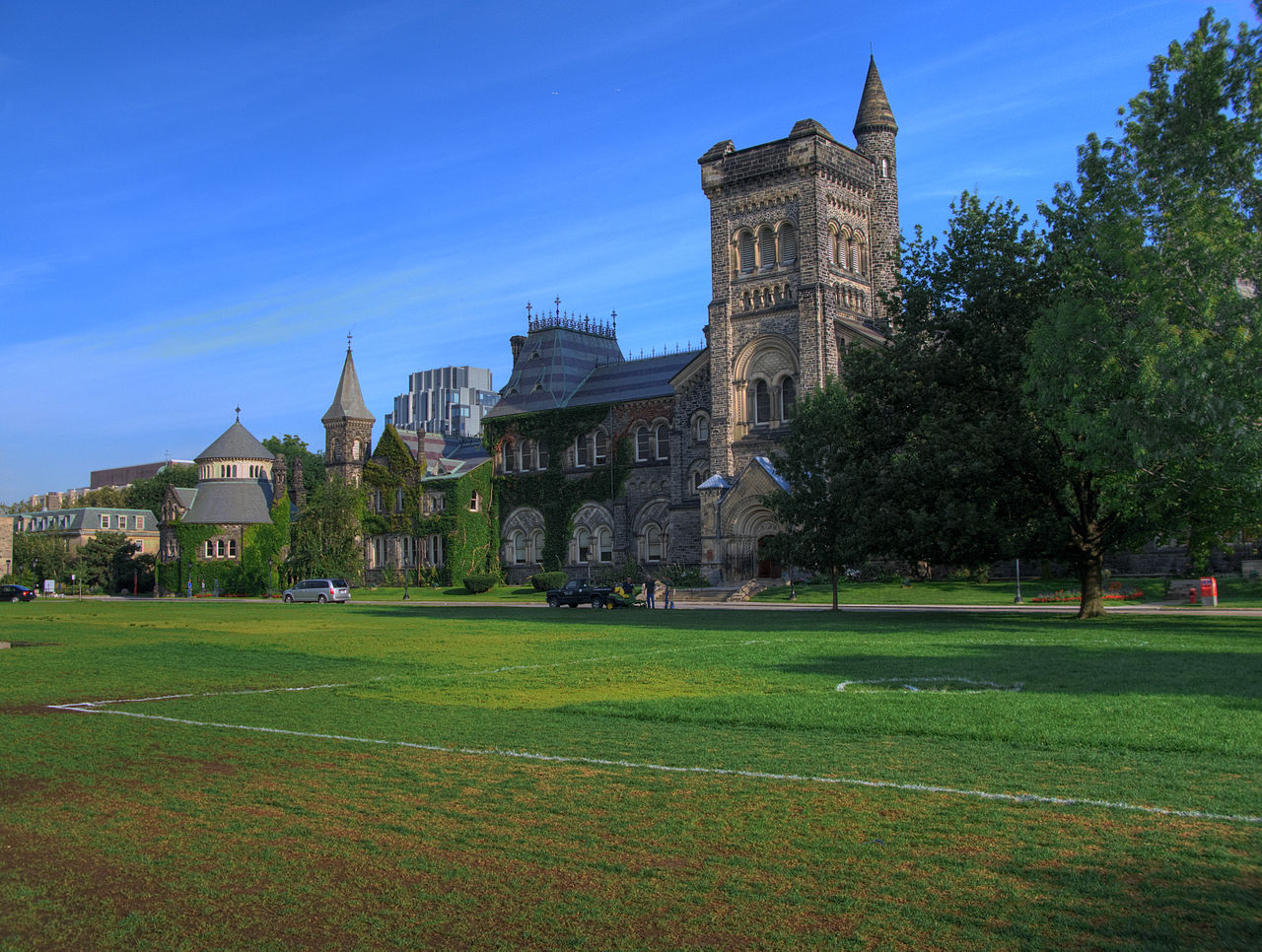
University College, University of Toronto, 31 July, 2008.
Photo by “SurlyDuff” via Wikimedia Commons.

Ontario is a weird place sometimes. One month ago, the government announced that it was implementing a performance-based funding plan which – if you took the government’s half-thought-out comments seriously – raised the possibility that hundreds of millions or perhaps even billions of dollars currently projected to be spent on institutions might be snatched away if institutions failed to hit some ill-defined targets in a type of contract-based funding system. You’d think this would be a big deal, something people would want to talk about and discuss.

But no. Somehow, this is not what is currently obsessing the Ontario university sector. Instead, apparently, we need to talk about how it’s a human rights violation for professors to be asked to enjoy their retirement on a six-figure annual pension.

Crazy? Well, yes. Here’s the deal. Time used to be that universities could tell professors to retire at age 65 or 67 or whenever. Over the course of the 2000s, provinces gradually got rid of mandatory retirement; in Ontario this occurred in 2006, when the provincial government amended the Human Rights Code to that effect. It should have surprised absolutely no one that more and more full professors, who towards the end of their career routinely make over $180,000 per year, decided to delay retirement not just past 65 but pretty much forever. In 2011, only 6.7% of professors were over 65 and 0.9% 70 or over. Just five years later in 2016, that was up to 10.2% and 3.3% respectively. At the time, I estimated that the compensation costs for the over-65s amounted to $1.3 billion, or enough to hire about 10,000 new junior faculty. The share of that going to the 70-pluses would amount to a little north of $400 million.

But here’s the thing: federal pension legislation requires individuals to start drawing down their pensions at age 71. You can’t opt-out. And so as a result you get individuals who are in what Carleton University economist Frances Woolley recently called the “quarter-million dollar club” (do read Frances’ piece – everything she does on higher education is excellent, but she is extra-excellent on this one). Even if you understand the legislative path that led us here, you probably – rightly – think this is an outrageous sum, particularly in light of the fact that research productivity tends to decline over time and teaching loads among full professors are not all that onerous.

On the other side of the pond, a recent tribunal ruling at Oxford’s St. John’s College points in a very different direction:

Oxford and Cambridge universities can force old professors to retire in order to boost diversity, a tribunal ruling suggests.

Prof John Pitcher, a leading Shakespeare scholar and fellow at St John’s College at Oxford, claimed that he had been unfairly pushed out at age 67 to make way for younger and more ethnically diverse academics.

He sued the College and university for age discrimination and unfair dismissal, claiming loss of earnings of £100,000 – but Judge Bedeau dismissed both claims.

May 1, 2019

To the surprise of nobody, Ontario’s cannabis stores are still struggling

Filed under: Bureaucracy, Business, Cancon — Tags: , , , , , — Nicholas @ 03:00

The Ontario government created a tightly restricted retail market regime for newly legal cannabis sellers, with a tiny number of licenses issued and highly bureaucratic “safeguards” for the retailers’ guidance and control. The city of Toronto, for example, with a population in the 2.7 million range, was allocated a whopping five stores. Only one of those stores was allowed to open on the first day of legal retail sales, and today there are three in operation, despite penalties and potential loss of licenses at stake for those who haven’t opened yet. The chorus of complaints from would-be customers has not diminished much, if at all since day one:

With legalization day long come and gone (and the euphoria of being able to spark a joint in public gone with it), the turtle-paced roll-out of Toronto’s weed retail scene goes to show the government and the OCS have some work to do before purchasing legal weed can be completely glitch-free (and lineup free, too).

Here are a few of the lows of getting high, courtesy of Toronto weed stores since buying pot became legal.

Weed prices are up
According to Statistics Canada, prices for weed have steadily been on the up and up since legalization last year.

While Nova Cannabis is trying to tackle its biggest competitor (illicit weed stores) with Black Market Buster deals, people who are buying their cannabis from the OCS are now paying an average of about $9.99 per gram—that’s roughly $3 more than those buying their bud from illegal stores.

Black market weed is still thriving
There’s still around 20 illegal dispensaries operating in the city, and at least 100 illegal marijuana delivery services. Why? See above: unlicensed weed stores are significantly cheaper than the legal ones, and loopholes in the city’s laws allow them to operate pretty much undisturbed, save for the occasional raids.

[…]

OCS packaging
Aside from the fact every product coming out of the OCS comes triple-wrapped in excessive, sometimes non-recyclable polypropylene packaging, the containers are just plain confusing.

Lack of packaging standards means your order comes in all shapes and sizes, regardless of whether you’re getting bud or pre-rolled joints, which is as confusing for buyers as it is for those behind the counter.

And that doesn’t even include the even louder chorus of complaints about the quality of the legal product…

April 29, 2019

Cannabis stores struggling against cheaper black market weed outlets

Filed under: Business, Cancon, Law, Liberty — Tags: , , , , , — Nicholas @ 05:00

In a rational world, a license to sell legal cannabis from a storefront where you have almost a legal monopoly would be a license to print money — the market demand is very clearly real and widespread. Yet Toronto’s legal cannabis stores are still suffering:

How much would it suck to go through all the trouble of opening a legal weed store, only to have dozens of people do the exact same thing without paying for permits, inspections or meeting any sort of government regulations?

How much would it suck to then watch these people not only get away with their illegal operations, but do so while luring your customers away with cheaper prices?

Probably as much as it would suck to sink years of your life into building a retail cannabis business and then learning that only 25 of such stores could exist in all of Ontario — and that the owners of those stores would be chosen at random.

It’s been nearly one month since Doug Ford’s PC government allowed the first wave of brick and mortar retail cannabis stores to open across Ontario. Three have launched so far in Toronto, where five licenses were issued in total, but many consumers aren’t pleased with consistently long lines and higher (than pre-legalization) prices.

So, like the rest of Canada, Toronto continues to buy black market weed.

Roughly 20 unlicensed dispensary storefronts are still up and running across the city as of April 25, in addition to more than 100 illegal marijuana delivery services.

You can find them all on WeedMaps, a popular online cannabis community that’s been listing these types of businesses for adult consumers in North America since 2008.

It’s not that police and bylaw enforcement officers can’t find these illicit dispensaries — I mean, operators are advertising their locations and menus online for all to see.

The problem is that no level of government can (or will) shut them down for very long.

“Why not?” you ask? Well, it’s complicated.

April 24, 2019

Opponents claim Doug Ford is using booze liberalization as a distraction … if so, it’s working well

Filed under: Business, Cancon, Law, Media — Tags: , , — Nicholas @ 03:00

Chris Selley documents just how Ontario Premier Doug Ford’s opponents are unable to ignore the (personally teetotal) Ford’s alcohol-related proposals:

A peculiar affliction has broken out among Ontarians who think their relatively new government is devoting far too much time and attention to liberalizing alcohol laws: They can’t stop talking about it.

I don’t mean people with entirely fair public health concerns (though I think those concerns are pretty marginal, given the modest changes). And I don’t mean the pearl-clutching hordes who think allowing alcohol consumption in parks will lead to mayhem, no matter how civilized the results might demonstrably be elsewhere. (That peculiarly Ontarian crew has certainly made itself heard, though, and it seems to include a surprising number of progressive millennials.)

I mean people who didn’t have particularly strong views one way or the other about 9 a.m. mimosas, tailgate parties, drinking in parks or buying beer at the corner store, or might even have supported some legislative relaxation, but who now can’t stop railing against them even as they deplore the government’s actions on objectively more serious files.

[…]

On letters and op-ed pages, you’ll find the topic of booze popping up in all sorts of places it objectively doesn’t belong — not if one doesn’t want to be distracted, anyway. It seems to lead people down all sorts of strange blind alleys. One Toronto Star columnist noted that neither Premier Doug Ford nor Finance Minister Vic Fedeli will “touch a drop themselves,” but that “they are making it easier for you to access just in time for breakfast, happy hour, or a nightcap.” So what? Why would anyone want the premier’s or finance minister’s personal tastes and preferences influencing public policy?

Another Star columnist spent seven paragraphs sneering at the idea of tailgating in Ontario before declaring herself perfectly fine with the idea. “But,” she asked, “is tailgating what Ontario needs?” Is that the standard, then? Government shall only allow the masses such entertainments as they “need”?

Using booze as a “distraction” is not a new tactic. It became a running joke during Kathleen Wynne’s tenure that whenever things were going (especially) badly for her government, she would pop up to announce another batch of supermarkets authorized to sell beer and cider (and sometimes, though much more rarely, wine!).

April 12, 2019

Premier Ford “could go down in history as the premier who landed downtown Torontonians their white whale subway”

Filed under: Cancon, Government, Railways — Tags: , , , , — Nicholas @ 03:00

Chris Selley finds himself surprised at how sane Doug Ford’s GTA subway-and-light-rail expansion plans sound:

Click map to embiggenate

I’ll say this much at least about Premier Doug Ford’s big $28.5 billion transit announcement on Wednesday morning ($11.2 billion if you only count provincial money): I never thought I would see him so enthusiastically tout a much-needed transit line to and through enemy territory in downtown Toronto. Faint praise, perhaps, but when Ford said he wanted to upload Toronto’s subways to the province, I never imagined a plan even half this superficially sane.

Crowding on the Yonge line at Bloor Street presents “a clear health and safety problem,” Ford told reporters in Etobicoke, “and without action it is only going to get worse.” Thus his number-one transit priority is the same as everyone else’s: the Downtown Relief Line, which the PC government has wisely redubbed the Ontario Line.

The most basic and essential piece of that line, which Toronto city staff are already working on, would connect City Hall with Pape station on Danforth. Passengers who live in the east end and work downtown could thus avoid the bottleneck at Yonge and Bloor, relieving the alarming rush hour situation on platforms there and — assuming new TTC signalling technology works as promised — freeing up southbound capacity for folks from York Region: Ford vows to extend the Yonge line to Richmond Hill (cost: $5.6 billion).

The order here matters more than the timeline (2027, supposedly). It is undisputed that the DRL has to happen before the extension. That’s basic knowledge. But Ford is capable of ignoring or fouling up very basic knowledge when stumping for subways. This is a man who nearly promised Pickering one. On Wednesday, he sounded remarkably well briefed.

Ford’s Ontario Line wouldn’t stop at Danforth and City Hall, either. In the east it would head north across the Don Valley, through Thorncliffe Park and up to Eglinton. This idea is nearly as old as the DRL itself. And it would jog southwest from downtown to Ontario Place — a novelty, but again, not crazy. Total cost for the line: an at least semi-plausible $11.2 billion.

April 11, 2019

Ontario government unveils massive subway and light rail expansion for the GTA

Filed under: Cancon, Government, Railways — Tags: , , , , , — Nicholas @ 05:00

Doug Ford has always been a fan of subways, but now that he’s the Premier of Ontario, he’s getting to indulge his subway fetish in a vast expansion to heavy and light rail transit in and around Toronto:

Click map to embiggenate

The plans include:

  • An expanded downtown relief line, now to be called the Ontario line, running from Ontario Place on the lakeshore through downtown along Queen Street then crossing the Bloor-Danforth subway line at Pape station and running north to the Ontario Science Centre on the Eglinton Crosstown LRT line. This line is optimistically to be ready for opening by 2027.
  • The existing Sheppard Line will be extended east from Don Mills to McCowan, where it will intersect with the planned Scarborough subway extension (now to include three stops, not just the one originally announced, and to be completed by 2030).
  • The Yonge-University line will be extended north from current terminus at Finch to the Richmond Hill Centre with a hoped-for completion date soon after the Ontario line.
  • The Eglinton Crosstown line will be extended west to Pearson airport, with a target completion date of 2031.
  • New light rail lines will be created between Finch West on the Yonge-University subway to Humber College, and along Hurontario Street in Mississauga from Port Credit on the lakeshore to Steeles Avenue in Brampton.

To accomplish all of this will require financial contributions from the City of Toronto, York Region, and the federal government, as the province is only funding just over one third ($11.2 billion) of the estimated $28 billion price tag.

Of course, it’s a Doug Ford plan, so none of the usual suspects in Toronto are happy about any of it.

February 6, 2019

QotD: “Get off my lawn!”

Filed under: Cancon, Government, Quotations, Sports — Tags: , , — Nicholas @ 01:00

The zeitgeist, of course, has also changed since 2002. Childhood obesity and screen addiction are now perceived as urgent matters of public health. A politician who wants those damn kids off his lawn is likely to be told “You’re a monster who is spreading diabetes and ruin, and, frankly, it’s amazing that there are kids on your lawn in 2017 and we would like to know how you accomplished this.”

Colby Cosh, “Hamilton finally ends its decades-old ban on street hockey, and it won’t actually change a thing”, National Post, 2017-03-06.

December 19, 2018

QotD: Maple-flavoured corporate welfare

Filed under: Business, Cancon, Government, Quotations — Tags: , , , — Nicholas @ 01:00

There’s that word: “investments.” That’s what Canadians — Ontarians and Quebecers, certainly — have been trained to expect in these situations: An elaborate mating dance culminating in a greasy press conference where corporate leaders hail bold new provincial and federal “investments” in the company and its workers and its world-beating widgets. Critics are assailed as uncaring and testily reminded that every jurisdiction subsidizes the widget industry.

Traditionally, this is later followed by outrage when it emerges the company has used taxpayers’ bold investment to pay out lavish bonuses or dividends. In the fullest version of the performance, the company just pulls up stakes and leaves town anyway — sometimes having fulfilled its stated obligations, sometimes not, but always leaving behind a bad taste and a per-employee subsidy rate that makes no sense in hindsight.

If the company is Bombardier, it might extract lavish subsidies from government for an airplane project on the theory the Canada needs an aerospace industry, then turn around and sell the project to a foreign competitor for basically nothing.

Chris Selley, “A reminder that governments don’t ‘invest’ in businesses. It’s just corporate welfare”, National Post, 2018-11-28.

November 22, 2018

The apparently unexpected backlash over cancelling a French-language university in Ontario

Filed under: Cancon, Education, Politics — Tags: , , , , — Nicholas @ 03:00

I suspect a lot of the uproar is actually just target-of-opportunity stuff to justify criticism of Ontario premier Doug Ford. Chris Selley points out that until the announcement, there wasn’t actually a lot of support for the new university among French-speaking Ontarians:

You would never know it since Thursday, when the Ontario government cancelled plans to open a new French-language university in Toronto, but those plans were not universally beloved. A lot of people hated the location. In an op-ed in Le Droit, University of Ottawa political scientist François Charbonneau complained it was being built to serve future francophone immigrants, not proper Franco-Ontarians in a community where they’ve been established for generations.

He called it “a historic mistake that perfectly illustrates what it means to be a minority: to have no power over one’s own destiny and to be dependent on ideological rantings with no democratic legitimacy.”

Higher-education consultant Alex Usher was among many who dismissed enrollment projections for the university as “fantasy.” Writing on the Higher Education Strategies blog, Usher called a recent survey of francophone Ontario high school students the “worst piece of social science I have ever seen.” It found lots of interest in attending the new university, but didn’t bother asking about their interest in existing bilingual alternatives like Laurentian University and the U of O.

To language hawks, bilingualism is the enemy: French always loses out in a budget crunch, and it does nothing to advance the right to live one’s life solely in French. Trouble is, very few students at French-language Ontario high schools are remotely interested in living their lives solely in French.

These are all things Premier Doug Ford and his ministers might have mentioned if they hoped to leave an impression other than that Ontario francophones just aren’t worth the money. They might wisely have chosen not to axe the French Language Commissioner in the same fiscal update, transferring its complaint-resolution powers to the ombudsman but orphaning its advocacy mandate. Finance minister Vic Fedeli hasn’t even said how much of its $1.2 million budget he hopes to recoup.

But they did what they did, all at once, and they said it was all about saving money. I suspect the whirlwind they reaped came as a surprise.

Good heavens, though, what wind.

November 20, 2018

Gordon Lightfoot’s “Wreck of the Edmund Fitzgerald

Filed under: Cancon, History, Media, USA — Tags: , , , , — Nicholas @ 03:00

Mark Steyn devotes a column to the work of Canadian singer/songwriter Gordon Lightfoot, particularly his very well-known ballad on the loss of the Edmund Fitzgerald on Lake Superior in 1975:

Edmund Fitzgerald, 1971
Detail of a photo from Wikimedia Commons

When it comes to trains and boats and planes, Gordon Lightfoot has hymned all three, but it’s the middle mode of transportation that produced the song he’s proudest of:

    The ship was the pride Of the American side
    Coming back from some mill in Wisconsin
    As the big freighters go
    It was bigger than most
    With a crew and good captain well seasoned…

In November 1975 Lightfoot chanced to be reading Newsweek‘s account of the sinking of a Great Lakes freighter in Canadian waters. He’s a slow and painstaking writer, which is one reason he’s given up songwriting – because it takes too much time away from his grandkids. But that day forty-three years ago the story literally struck a chord, and he found himself scribbling away, very quickly:

    The legend lives on From the Chippewa on down
    Of the big lake they called Gitche Gumee
    The lake, it is said Never gives up her dead
    When the skies of November turn gloomy…

“Gitche gumee” is Ojibwe for “great sea” – ie, Lake Superior – as you’ll know if you’ve read your Longfellow, which I’m not sure anyone does these days. Evidently Hiawatha was on the curriculum back east across Lake Huron in young Gordy’s Orillia schoolhouse. The Gitche Gumee reference may be why, when I first heard “The Wreck of the Edmund Fitzgerald“, I assumed its subject had sunk long before the song was written. In fact, it sank on November 10th 1975 – just a few days before Lightfoot wrote the number. When she’d launched in 1958, the Edmund Fitzgerald was the largest ship on the Great Lakes, and, when she passed through the Soo Locks between Lakes Superior and Huron, her size always drew a crowd and her captain was always happy to entertain them with a running commentary over the loudspeakers about her history and many voyages. For seventeen years she ferried taconite ore from Minnesota to the iron works of Detroit, Toledo and the other Great Lakes ports …until one November evening of severe winds and 35-feet waves:

    The wind in the wires
    Made a tattle-tale sound
    And a wave broke over the railin’
    And every man knew
    As the captain did too
    ‘Twas the witch of November come stealin’…

And about seventeen miles from Whitefish Bay the Edmund Fitzgerald sank, with the loss of all 29 lives. It remains the largest ship ever wrecked on the Great Lakes, launched in 1958 to take advantage of the new St Lawrence Seaway (to be opened by the Queen and President Eisenhower on an inaugural voyage by the Royal Yacht Britannia the following year) and specifically constructed to be only a foot less than the maximum length permitted. Edmund Fitzgerald was the then chairman of Northwestern Mutual Life Insurance of Milwaukee, and, as far as I’m aware, the only insurance company executive to be immortalized in a song title. Fifteen thousand people showed up for the ship’s launch at River Rouge, Michigan. It took Mrs Fitzgerald three attempts to shatter the champers against the bow, and then there was a further half-hour’s delay as the shipyard workers tried to loosen the keel blocks. After which the ship flopped into the water, crashed against a pier, and sent up a huge wave to douse the crowd. One spectator promptly had a heart attack and died.

And then came seventeen happy years. Even in the twenty-first century, there is something especially awful and sobering about death at sea: it is in a certain sense a reminder of the fragility of security and modernity. Whenever I’m in, for example, St Pierre et Miquelon, the last remaining territory of French North America, I stop by the monument aux marins disparus, sculpted in 1964 and to which many names have been added in the years since – because a ship put out, and somewhere on the horizon the great primal forces rose up from the depths and snapped it in two like a matchstick.

« Newer PostsOlder Posts »

Powered by WordPress