Quotulatiousness

February 2, 2012

Repost: A tribute (of sorts) to Wiarton Willie

Filed under: Cancon, Humour, Media — Tags: , , , — Nicholas @ 00:01

John Scalzi, several years ago, wrote a tribute to Wiarton Willie, who was in the news in an unaccustomed way at the time:

To tell you the truth, the most disturbing thing is not that the groundhog died — certainly this animal earned his eternal rest — but that his handlers couldn’t think of anything better to do but tell a festival crowd that he had croaked. Those kids in the crowd will be forever traumatized. Groundhog Day will no longer be a happy time, but a constant reminder of death and mortality in the bleak midwinter. 10 years from now, I expect that Wiarton, Canada will become the new North American epicenter of dark, gothic teenage poetry.

Lying frozen in the snow
The groundhog soul resides far below
Gone to a place of doom and gray
Now winter will always stay.
Die Groundhog Die!
Mommy and Daddy Lied!

But wait, there’s more:

Now, on to the groundhog Wiarton Willie, who, as you know from yesterday’s entry, died before Groundhog Day and whose body was photographed lying in state in a dinky little pine coffin. Or was it? Now news comes from the sordid little burg of Wiarton, Canada, that the rodent corpse in the coffin was not Wiarton Willie at all, but a stuffed stand-in. The real Willie was apparently found so decomposed that the gelatinous remains were unsuitable for public display. So the town elders found a stuffed groundhog that just happened to be lying around (apparently the body of a previous “Wiarton Willie,” who was no doubt poisoned by the current, and now rotting, Willie in an unseemly palace coup), plopped it into that Barbie coffin, and presented the remains to a horrified public. Here’s the groundhog you’ve all been waiting for! And he’s dead! Winter for the next ten years!

The people of Wiarton meant well, I’m sure. But I’m having serious doubts as to their combined mental capacity. First off, the real Willy was found in a state of advanced decomposition, which means he had been dead for weeks. Weeks. How could that happen? This rodent is the cornerstone of Wiarton’s entire tourism economy for the month of February, and no one bothers to check on him from time to time? Did they just stick him in a cage after last Groundhog Day and then forget to feed him? Every kid in the world had a hamster they forgot to feed, but you’re usually, like, five at the time. These were actual adults. They say he was hibernating when he died. Sure he was. I used that excuse about the hamster.

February 1, 2012

Arson victim now being dragged through the courts for defending himself with firearms

Filed under: Cancon, Law, Liberty — Tags: , , — Nicholas @ 11:26

Canadian prosecutors have a strong aversion to the idea that people should be allowed to protect themselves, especially if firearms are involved:

Just when was Ian Thomson guilty of unsafe storage of a firearm? Mr. Thomson is the Port Colborne, Ont., man currently standing trial in a Welland, Ont. courtroom after he and his home were attacked by firebombers in August, 2010. (That’s correct, in the topsy-turvy world of Canadian criminal justice, Mr. Thomson and his home were the ones attacked and yet he is the one on trial.)

Having dropped other more serious charges — such as dangerous use of a firearm — because they concluded there was no reasonable chance of winning a conviction, Crown prosecutors have nonetheless bullied ahead with unsafe storage charges against Mr. Thomson.

One can only speculate on the Crown’s motives, but many prosecutors are so opposed to private citizens owning guns and, especially, using guns to defend themselves, their loved ones or property, that it is easy to believe prosecutors are running Mr. Thomson through the ringer in an attempt to discourage other homeowners from following his lead. They have conceded they cannot get a conviction against the retired crane operator and former firearms instructor for shooting at the three men who were trying to burn down his house with him in it, but perhaps they are hopeful their decision to drag Mr. Thomson through months of emotionally draining and expensive court proceedings will cause other homeowners to conclude armed self-defence isn’t worth the hassle.

Update: An already strange case appears to be getting stranger, as the judge needed to adjourn the court to allow time for the lawyers to figure out just what the law actually says:

Canada’s laws on the storage and handling of guns and ammunition are so complicated that a veteran judge needed to adjourn court to allow two experienced lawyers more time for legal arguments and a search of case law to help parse and dissect them.

It was a dud of an ending after two days of trial in the case of Ian Thomson, a 54-year-old Port Colborne man who fired three shots from a legally owned gun to scare off three masked men who were firebombing his secluded farmhouse while one threatened: “Are you ready to die?”

And the crown displays a remarkable lack of firearms knowledge:

Mr. Mahler said Mr. Thomson was “less than forthcoming” and “secretive” when police arrived. He suggested Mr. Thomson even picked up the spent shell casings from his porch and hid them in his bedside table.

Seeming confused, Mr. Thomson said he didn’t understand.

“Didn’t they fall to the ground?” Mr. Mahler asked, apparently thinking shell casings from a .38-calibre revolver were ejected from the gun with each shot.

“No,” said Mr. Thomson as the crowd of gun advocates watching from the public gallery chuckled and guffawed at Mr. Mahler’s mistake.

Spent shells from a .38 remain in the gun’s cylinder until it is opened and they are removed. Mr. Thomson took the casings out at the same time he opened the gun to reload it, which was at the bedside table, where the casings were when police arrived, he said.

Of course, if he’d had enough time to collect expended brass — in the dark — before police arrived, it doesn’t support the idea that the police were going to be timely in arriving after he first called 911, does it?

January 26, 2012

The fate of London’s diesel locomotive plant

Filed under: Cancon, Economics, Media, Politics, Railways — Tags: , , , , , — Nicholas @ 10:38

In the Toronto Star, Martin Regg Cohn (who claims he “is not an anti-globalization crusader”) does his level best to put forward a case for massive government intervention in a labour dispute between Caterpillar and the Canadian Auto Workers:

At the old locomotive plant now owned by U.S.-based multinational Caterpillar Inc., the Canadian Auto Workers union is not even on strike. The CAW has been locked out since New Year’s Day because it refused to sign its own death warrant by agreeing to slash wages in half for most workers from $34 an hour to $16.50.

When a powerful multinational negotiates in bad faith, it becomes a story that governments in Queen’s Park and Ottawa can no longer wash their hands of. To put it in language that resonates with Premier Dalton McGuinty: When a bully tries to humiliate people, you can’t just watch in silence.

When high-paying skilled local jobs can be shredded at the whim of a combative multinational giant, it dramatically undermines all the upbeat rhetoric we hear from McGuinty and Prime Minister Stephen Harper about Canada’s global appeal. It sends a signal that Ontario is not so much open for business as it is closed for unions.

We jump directly from Caterpillar’s demand for wage reductions to an assertion that the company is negotiating in bad faith (I guess, from the union’s point of view, anything other than a wage increase is proof). No indication whether the company’s demand is economically justifed — if sales of the plant’s railway locomotives are as bad as the wage offer implies, then the next step will be closing the plant — just straight over to bad-mouthing the company.

And, of course, it’s merely objective reporting to use pejorative descriptors when discussing the eeeeevil multinational firm. Not content merely to malign the company, he then calls on the Premier to support the union to the hilt:

So what can our anti-bullying premier do?

If I were McGuinty, I would ask myself a simple question: What would Bill Davis do?

The former Tory premier of Ontario wasn’t perfect, but he was always plugged in. He took labour seriously, listened closely to business and wooed foreign investors (remember Renault?). He knew how to leverage the power of the premier’s office to stand up for Ontario’s greater interests.

A phone call to Caterpillar’s corporate braintrust would show that Ontario’s premier is no pushover. If that didn’t work, a phone call to Harper — who is still trying to live down the tax breaks he gave the locomotive factory’s former owners a few years ago — might find a receptive ear.

And finally we get to a good point: the foolishness of governments in giving special tax breaks to certain industries or companies. If it’s in the company’s best interests to locate in your jurisdiction, they’ll probably do it. If you have to bribe them with tax breaks, low-interest or interest-free loans, or other special incentives, then once the incentive runs its course, the company has no further requirement to stay in your location.

Update: In the National Post, Kelly McParland has some suggestions for union leaders:

1. A lot of people (the membership figures suggest it’s the vast majority) think unions are concerned solely with their own members and couldn’t give a bird’s turd for anyone or anything else, including other working stiffs, members of other unions, the fortunes of the company they work for or the customers they deal with. When you display a total lack of interest in others, they generally adopt the same attitude towards you.

[. . .]

4. Union politics might consider moving out of the stone age. The world evolves over time, but unions persist in peddling the same trite bromides as if it’s still the dawn of the industrial revolution. The “us against them” mentality; the pretense that all employers exist to exploit workers and can never be trusted; the assumption that every contract must be succeeded by an even richer one no matter the health of the industry, the economy or the company; the fealty to leftwing political parties — all are symptoms of an exhausted, outdated perspective that has barely changed since “modern technology” meant the telephone.

If unions really want to save themselves, they might take a lesson from the market economy. If no one buys what you’re selling, it’s not because they buyers aren’t bright enough. It’s because people see no value in your product.

Update, 3 February: The plant is being closed. Here’s the official announcement:

Progress Rail Services has announced that it will close Electro-Motive Canada’s (EMC) locomotive production operations in London, Ontario.

Assembly of locomotives will be shifted from the London facility to the company’s other assembly plants in North and South America, which will ensure that delivery schedules are not impacted by the closing of the London facility.

All facilities within EMC, EMD and Progress Rail Services must achieve competitive costs, quality and operating flexibility to compete and win in the global marketplace, and expectations at the London plant were no different.

The collective agreement and cost structure of the London operation did not position EMC to be flexible and cost competitive in the global marketplace, placing the plant at a competitive disadvantage. While the company’s final offer addressed those competitive disadvantages, the gulf between the company and the union was too wide to resolve and as such, market conditions dictate that the company take this step.

January 12, 2012

Toronto Hydro takes hostages, threatens eternal darkness if demands not met

Filed under: Cancon, Politics — Tags: , , , — Nicholas @ 12:05

Ah, it must be the time of year for Toronto Hydro to lose its collective shit and start the crazy talk:

Last week, the Ontario Energy Board denied Toronto Hydro’s request for a rate hike for homes within the city limits. The hike, which would have meant a monthly increase of five dollars for a typical household, was necessary, Toronto Hydro said, to renew the city’s electrical transmission grid. Failure to do so, they warned, could result in more, and longer, blackouts.

Not so, the Energy Board ruled. They said that Toronto Hydro had not demonstrated that Toronto’s power grid needed the kind of urgent repairs that were being proposed, and also chided Toronto Hydro for failing to make necessary productivity gains, implying that the requested money was not so much about urgent repairs as needing more cash. Toronto Hydro’s response has been swift: 700 contractors have been let go, and 20% of its workforce is being told that they’re next — that’s another 350 or so jobs. Oh, and without the cash, the city is probably going to go dark.

Do these guys know how to play hardball or what?

January 9, 2012

Wrapping “the maple syrup of truth in the waffle of propaganda”

Filed under: Cancon, History, Military, USA — Tags: , , , — Nicholas @ 09:30

The Economist casts a jaundiced eye at Canada’s plans to celebrate the 200th anniversary of the War of 1812:

Canada and the United States started the new year by firing cannons at each other across the Niagara river, which separates the province of Ontario from the state of New York, leaving a whiff of gunpowder and politicking in the air. The guns at Fort George on the Canadian side and Old Fort Niagara on the American shore were replicas of those from the 1812 war between the two countries, and were loaded with blanks.

They fired the first salvo in what Canada’s government plans as a noisy 200th anniversary celebration of a largely forgotten war in which British redcoats, colonial militia and Indian allies stopped an American invasion (which Thomas Jefferson mistakenly predicted was “a mere matter of marching”) of what was then a sparsely populated string of colonies. “The heroic efforts of those who fought for our country in the War of 1812 tell the story of the Canada we know today: an independent and free country with a constitutional monarchy and its own distinct parliamentary system,” says James Moore, the minister of Canadian Heritage.

That wraps the maple syrup of truth in the waffle of propaganda. Although Canada did not become a self-governing country until 1867, the 1812 war did help to forge a common identity among disparate colonists, many of whom were Americans who had come north out of loyalty to the Crown or in search of cheap land. But the Indians did more to foil the American invasion than the Canadian militia, and the British reneged on a promise to reward them with land, according to Alan Taylor, a historian of the war. The Canadian side won mainly because the Americans were poorly led, supplied and organised. Both sides plundered and murdered civilians.

December 15, 2011

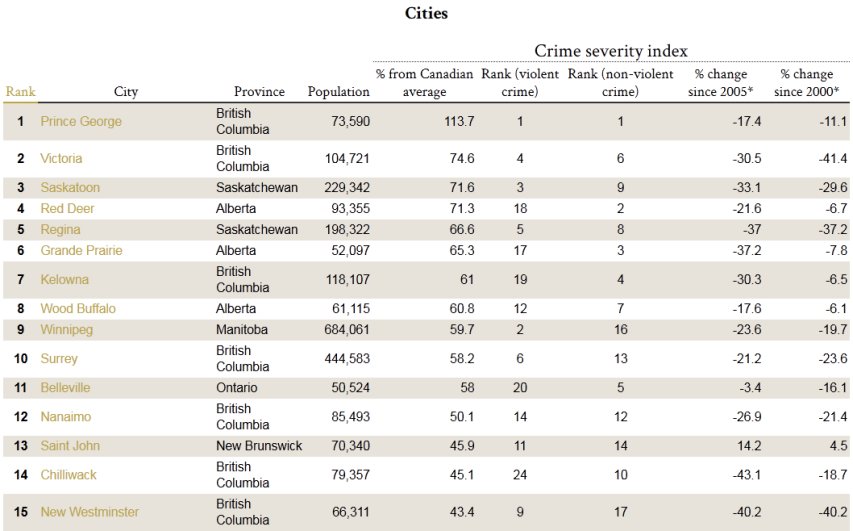
Grim, crime-wracked, post-apocalyptic Toronto ranks … 52nd most dangerous in Canada

Filed under: Cancon, Law, Liberty — Tags: , , , , — Nicholas @ 09:29

Everyone in Canada knows that Toronto is a cess-pit of crime where the oppressed citizenry huddle in fear, while idyllic Victoria is a benign, peaceful enclave of happiness. But what we know just ain’t so:

Toronto ranks 52nd among cities and towns in the country for the label “most dangerous” according to Maclean’s. Victoria, BC? Far from being a peaceful place, ranks second in the country after Prince George, BC. In fact, BC has four of the top ten dangerous cities, while Ontario’s most dangerous place, Belleville, clocks in at number 11.

December 10, 2011

“Green is the easiest virtue”

Filed under: Cancon, Environment, Government, Media, Politics — Tags: , , , — Nicholas @ 12:00

Rex Murphy looks at how what he calls Dalton McGuinty’s “reasonably competent government” could fall for the snake oil salesmen of every shabby Green initiative going:

The Ontario government, and Premier McGuinty in particular, gave themselves over to this madness, becoming overzealous crusaders, because the cause was green. And, sadly, there seems to be no other area of public policy in which fitful enthusiasms, pie-in-the-sky thinking, under-researched proposals and the mere hint of possible benefit get so respectful a response and are shielded — almost as if by magic — from the criticisms and analysis that would greet proposals from any other policy area whatsoever. Call it green and every other consideration goes out the window. Start phantom carbon markets, subsidize a Solyndra, put gardens on roofs . . . green will rationalize every cost and subdue every sane objection.

For example: During the early day’s of McGuinty’s determination to “make Ontario a world leader in green technology,” it was interesting to watch him and his government studiously ignore the articulate criticisms and protests from some Ontario landowners. Now any other project inspiring such protests would naturally instigate the usual relentless series of environmental studies that have become so common in our time. But — windmills being “green initiatives” — naturally it was the reverse. The landowners who protested were pilloried as being the worst of the NIMBY crowd, just selfish types safeguarding their little nooks against the common green future.

Green is the easiest virtue. All it takes in most cases for politicians is simply to say the word often enough and whatever they propose — for a time — gets a pass. Who would question McGuinty against those “selfish” landowners. Wasn’t Dalton moving towards a greener world? Enough then. No studies required. No review of the windmills (until election time, that is, when suddenly Ontario voters were told, in effect, the science “wasn’t in” on what secondary effects windmills might have). Question the contracts for solar power? Impossible. Solar power is “clean.”

December 4, 2011

Lowering allowable blood alcohol limits will not make our roads safer

Filed under: Cancon, Law, Liberty — Tags: , , , , — Nicholas @ 10:38

Jesse Kline on the sounds-good-to-nanny-state-fans legal situation on Ontario roads:

My colleague Matt Gurney argues that creating a legal grey area between federal and provincial laws relating to drunk driving helps no one, and it’s better to have a lower overall limit than two conflicting ones. But lowering the legal limit to .05 is only going to distract police from going after the people who are actually making our roads less safe: dangerous drivers. By lowering the legal limit, we end up punishing motorists who are not driving dangerously, while diverting resources away from catching those who are.

The U.S. embarked on a similar push to reduce the legal limit from .10 to .08 in the 1990s and the results were less than stellar. A 1995 study conducted by the National Highway Traffic Safety Administration found 21 of the 30 states that had adopted the new rule experienced no improvement, or had less safe roads than the rest of the country.

In 2000, the federal government mandated that all states adopt the new standard. In the four years following this change, alcohol-related fatalities actually increased. Part of the reason was that drivers with a blood alcohol content (BAC) between .08 and .10 are generally not the ones swerving all over the road, so police set up checkpoints in order to catch them. This took officers off patrol.

According to Transport Canada’s own data, a person over 19 years of age with a BAC of .015 is statistically just as likely to get into an accident as someone with a blood alcohol level of .099. A majority (80%) of all alcohol-related crashes causing death are caused by drivers with a BAC over .08, while only 5% involve drivers in the grey area between .05 and .08.

December 1, 2011

Nanny LCBO doesn’t think you can handle this label cartoon

Filed under: Bureaucracy, Cancon, Wine — Tags: , , , — Nicholas @ 12:53

Michael Pinkus writes about the LCBO‘s latest nanny twitch:

Stunningly Stupid … and if you happened into the LCBO this past weekend you might have noticed a cartoon-style label on a bottle of Bombing Range Red with a red sticker adorning a certain part of the label. For those who were curious and intrepid enough to remove the sticker, expecting to find profanity or nudity you were disappointed to find a glass of red wine that (with the right amount of imagination) might have resembled a bomb — or at least a glass with a bomb-style fuse. Is this a case of political correctness gone amok? Or is the LCBO afraid we’ll get bombed upon seeing the sight? Personally I am stunned at what the higher ups at the LCBO find offensive or what they think we are too … I don’t know … childish, immature, delicate (you pick your word) to see? As it turns out the truth is even more stunningly stupid then I originally thought. It was ordered to be applied by the LCBO Quality Assurance Department, because the pilot is holding a glass of wine and as part of the LCBO’s social responsibility function they don’t want to give you the impression that it is a responsible action to drink and fly … So instead of taking it as the cartoonish fun that it is, the LCBO has to go and ruin it; but the last laugh is on the Board, because anyone worth their salt will be peeling that sticker off post-haste with a “why the f**k did they cover that” question on their face and on their lips. Thanks for being there to save me LCBO, from the evils that men do.

Image of the “hidden” label from TonyAspler.com.

November 30, 2011

George Jonas: “All governments are communist”

Filed under: Cancon, Economics, Government — Tags: , , , , — Nicholas @ 08:52

George Jonas looks at how the government of Ontario managed to go a quarter of a trillion dollars into debt:

All governments are communist. Please, relax. What I mean is that all governments expect to be recompensed, not according to the value of their contributions to society, but according to their needs.

Marxist mythology defines progress as capitalism changing into socialism and socialism into communism. Under socialism, everyone contributes according to his abilities, and is compensated according to his contribution. This is an improvement over the vagaries of the market, but communist society goes further. While citizens still contribute according to their abilities, they’re compensated according to their needs.

[. . .]

In a free-market-cum-welfare-state such as Canada, people contribute to society according to their abilities, and are compensated for it at the whim of the market, minus the whim of the government, a.k.a. the taxman. Governments also contribute according to their abilities, but then compensate themselves according to their needs. Their needs vary as they aren’t equally corrupt or ambitious, though they seem equally insatiable. Premier Dalton McGuinty isn’t a communist but Ontario’s debt increased by $110-billion since his party came to power in 2003. We could have had Fidel Castro for less — well, Raoul, anyway.

A gentleman has his hand up. Yes? “Didn’t the debt go up because McGuinty kept his promise and didn’t raise taxes?” Nice try, sir, but no. He did.

November 28, 2011

Who won the War of 1812?

Filed under: Cancon, History, Military, USA — Tags: , , , — Nicholas @ 12:09

According to an American historian quoted in the National Post, Canada won:

In a relatively rare admission for an American scholar, a leading U.S. historian who authored a provocative new tome about North American military conflicts states bluntly that Canada won the War of 1812.

Johns Hopkins University professor Eliot Cohen, a senior adviser to former U.S. secretary of state Condoleezza Rice, writes in his just-published book Conquered Into Liberty that, “ultimately, Canada and Canadians won the War of 1812.”

And Cohen acknowledges that, “Americans at the time, and, by and large, since, did not see matters that way.”

The book also echoes a key message trumpeted by the federal Conservative government in recent weeks as it unveiled ambitious plans to commemorate the bicentennial of the War of 1812 over the next three years: that the successful fight by British, English- and French-Canadian and First Nations allies to resist would-be American conquerors — at battles such as Queenston Heights in Upper Canada and Chateauguay in Lower Canada — set the stage for the creation of a unified and independent Canada a half-century later.

“If the conquest of (Canada) had not been an American objective when the war began, it surely had become such shortly after it opened,” Cohen argues in the book. “Not only did the colony remain intact: It had acquired heroes, British and French, and a narrative of plucky defense against foreign invasion, that helped carry it to nationhood.”

November 9, 2011

This is not news: Toronto is Canada’s least-liked city

Filed under: Cancon, Media — Tags: , — Nicholas @ 09:07

In fact, a strong case could be made that hating Toronto is one of the key factors that binds the rest of Canada together:

Ontario’s capital not only had the lowest rate of positive responses, it also had the highest rate of “very negative” responses. “Many Canadians have a hate-on for Toronto,” said Myer Siemiatycki, a Ryerson University politics professor. “Toronto is regarded as totally self-indulgent, so there’s a sort of ‘Who do they think they are believing they’re the centre of the country and the universe?’” Jim Milway, executive director of the Martin Prosperity Institute at the Rotman School of Management, said the poorer perception of Toronto — 19% of respondents gave negative responses — is due to animosity more than anything else. “It’s not necessarily that people like their city more than Toronto,” he said. “It’s that people just don’t like Toronto, period.” Prof. McGrane, of the University of Saskatchewan, said the “grudge” is rooted in historic grievances, particularly harboured by westerners who have long felt “left out.” “It’s not that we hate (Torontonians), but we’re a bit suspicious about them and their motives,” he said.

I can’t claim to have been everywhere in the country, but from Nova Scotia to British Columbia, hatred of Toronto and distaste for Torontonians is almost universal among Canadians.

October 26, 2011

Frank Klees demonstrates how to cross the floor without leaving your seat

Filed under: Cancon, Politics — Tags: , , — Nicholas @ 09:27

Frank Klees lost the leadership race to current Ontario Progressive Conservative leader Tim Hudak. One can only assume that this ploy is his Parthian shot against Hudak and the party that failed to embrace him as leader (you can understand why they didn’t if this is his response):

In politics, there are the publicly stated reasons for doing something, and then there are the real reasons. So, when Ontario PC MPP Frank Klees says that “I felt the best way I could make my experience available to the legislature is in the role of Speaker,” the immediate response is: OK, but what is he really up to?

Problem is, that’s tough to figure. Because Dalton McGuinty’s Liberals are tied with the opposition in the number of seats held in the provincial legislature, a PC speaker would shift the balance of power and make it much harder for the government to be toppled by the Tories and NDP.

[. . .]

All of which makes Mr. Klees’ ploy even harder to understand. He has turned his back on his leader, Tim Hudak, and his party, and if you don’t believe he has done that then have a look at what his colleagues are saying, which suggests his future in the Ontario PCs is doomed. He was runner-up to Mr. Hudak in the last leadership race and a likely contender to succeed him should the Tory leader fail to win the next vote — a distinct possibility — but now he’ll always be the guy who thumbed his nose at the party when it asked him to take one for the team. Thumbed his nose, raised his finger, take your pick. Career-wise, Mr. Klees might as well have lit himself on fire. He better hope he manages, against seemingly stacked odds, to win the Speaker race.

As the last election unfolded, Tim Hudak seemed to be trying to be a carbon copy of Dalton McGuinty (the voters decided they’d prefer the genuine article to the ersatz Tory copy), which seems to have turned what looked like a certain Tory victory into a Liberal minority. I joked after the election that Hudak would certainly be the one to cross the floor to join the Liberals, because he’d effectively run as a Liberal during the campaign. I guess Klees wants to screw over the party that rejected him by getting there first.

October 20, 2011

This is why you don’t want to be a wine importer in Ontario

Filed under: Bureaucracy, Cancon, Wine — Tags: , , , — Nicholas @ 08:53

In the lastest issue of the Ontario Wine Review, Michael Pinkus explains the 16-point process that all independent wine and liquor importers have to follow in order to get their products into customers’ hands:

Recently I received an email from an agent giving a blow by blow account of the process of getting booze onto the shelf of our beloved Monopoly, including the hair pulling and gnashing of teeth that goes along with it.

[. . .]

“I can take samples to the Licensees — Restaurants & Hotels — and if they want to buy it this is the procedure:

1) They must purchase a minimum of one full case
2) They must pay the LCBO a 25% deposit
3) If I want to reduce the freight rate down from $100+ per case to a reasonable freight rate . . . more like $12/case then I need to gather a minimum of 20 cases in orders with specific Licensees names on them who have all paid the deposit.
4) The LCBO Private Ordering department then processes the paperwork
5) The producer would then ship the product to an LCBO pick-up location
6) We wait until the LCBO consolidates our small order into a large container with other suppliers
7) The product usually takes 4 months to arrive and then spends another month going through Lab Analysis at a cost to the supplier of $175 per product.
8) When the product finally gets released we have to hope that the original licensees that ordered it all take delivery
9) The producer gets paid 60 – 90 days after the order lands in Ontario (while the agent pays to get it out of the Private Ordering warehouse).
10) The agent then has to chase the customer for at least 90 days to get them to pay since they will likely have an excuse not to have a cheque ready upon delivery
11) We have to do this for a total a 300 cases sold within one year to EARN the privilege of getting into the Consignment warehouse.
12) Once granted consignment space . . . we can start to ship from the producer to the LCBO consignment warehouse by the pallet (~56 cases)
13) In consignment, the product can be shipped without an advanced licensee order . . . but still must sell by the case to customers.
14) The producer gets paid once ALL of the order is sold through: 120 – 240 days later.
15) If the product does not sell through within 120 days of arrival then the LCBO confiscates the remaining order, discounts it, and puts it into a sale warehouse.
16) This frees up more space back in the consignment warehouse so that they can trap more agents into over-shipping and then the LCBO can punish them for trying to treat Ontario like a free enterprise liquor system.

Oh, and if the LCBO decides to add your product to their regular merchandise, you’ll be out of luck as it’ll probably sell for less than you can (and your hotel and restaurant customers are paying for exclusivity in a lot of cases, so they’ll stop ordering through you if it’s available in the LCBO retail stores).

October 12, 2011

The “Ontario education system [is] a remarkably clean and ongoing experiment in the effects of school choice”

Filed under: Cancon, Economics, Education, Government, Liberty — Tags: , , — Nicholas @ 08:22

Stephen Gordon explains why Ontario’s two parallel school systems are helping to prove the efficacy of school choice:

Public funding for the Ontario separate school system is sometimes a controversial topic for reasons I won’t get into here. But by offering one set of parents with the choice of which school they can send their children, the Ontario education system has set up a remarkably clean and ongoing experiment in the effects of school choice. Catholics have the choice of sending their elementary-school aged children either to separate or to public schools, and non-Catholics do not have this choice.

Elementary school administrators in the two systems face very different constraints:

  • Public schools have a monopoly on non-Catholics who can’t afford private school.
  • Separate schools face a clientele that always has the option of switching to the public school system.

Of the two, separate school administrators have the greater incentive to provide higher-quality education: if the separate system were widely known to be dysfunctional, it would likely disappear.

Basic economics would predict that the competitive pressures on separate school administrators would provide stronger incentives to provide better education outcomes. And that seems to be just what is happening. A recent study (pdf) by McMaster University economists Martin Dooley and Abigail Payne in collaboration with UC-Berkeley’s David Card that examine these effects finds “a statistically significant but modest-sized impact of potential competition on the growth rate of student achievement.” In a related study using similar data, a CD Howe study done by Wilfrid Laurier’s David Johnson finds that of the 13 ‘above-average’ school boards, 11 are in the separate school system, while none of the 10 ‘below-average’ school boards are.

« Newer PostsOlder Posts »

Powered by WordPress


