
Football is football. I mean, come on guys, we’re talking about a bunch of football players,” he said. “It’s not tough to learn an offense. At the end of the day, you have a formation, you have protection, you have a direction to run the ball and you have a route to run as a receiver. It’s not that tough. If you can’t learn an NFL offense, then obviously you shouldn’t be there. … I’m saying, we’re not the brightest people, so therefore how hard can an NFL offense be?
Joe Flacco, quoted by Sarah Ellison in “Late For Work 6/25: Joe Flacco Opens Up About Relationship With Gary Kubiak”, BaltimoreRavens.com, 2014-06-25.
June 26, 2014
QotD: Football players are “not the brightest people”
Comments Off on QotD: Football players are “not the brightest people”
June 19, 2014
The NFL conspiracy theorist
“Draw Play” Dave Rappoccio is running a series of cartoons on the various sub-groups of NFL fans. This week’s subject is the Conspiracy Theorist:
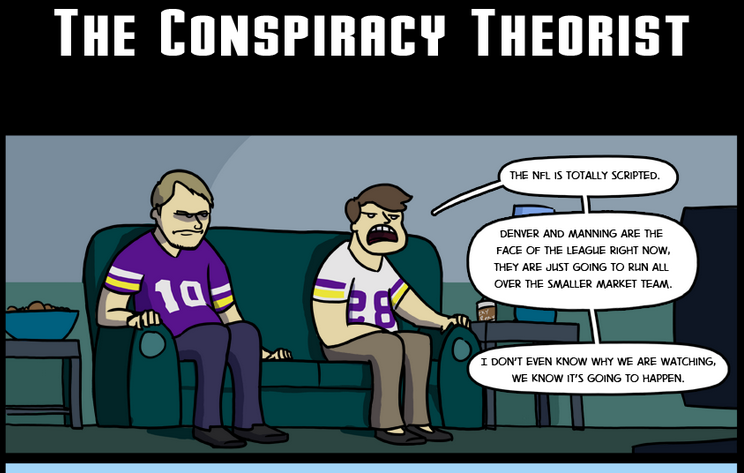
He also talks about the mentality of the conspiracy theorist fan in some detail:
A part of me struggles to accept that people this deluded actually exist, but they do. I’ve heard stories, and I’ve seen the occasional online post about it. These people are few, but not fictional. There are actually people who think the NFL is scripted.
Like most conspiracy theories it sounds absolutely stupid at first, then part of you might go “well, I guess that was kinda perfect that it happened just that way”, then you think about it a little more and you realize that yup, it’s still stupid and the logic falls apart. But some people don’t get past that second stage. I can’t figure out why. The best guess I can muster is that most of the fans are somehow bitter about the way their team loses or something.
[…]
But some people legit think it’s scripted like pro wrestling. These people are…I can’t defend them. They are deluded. For everything that sounds like it might make some sense, lots of other things just make it feel so forced. The NFL has been around for a long time, and started as a small time game. It has grown into the giant it is not overnight, but over decades. There has never, ever, been any evidence that has come out to suggest it’s scripted. No retired referees, no disgruntled employees, nothing. Over decades. Come on. There are so many people covering the league now, so many media members, so many pundits, so many sources. The NFL being scripted would be a huge story, but none of them have ever investigated it? Nothing? No player, current or former, EVER, in all this time, has come out and said things weren’t right. None have even suggested it. You think in a league with players treated as poorly as they are in medical coverage that one wouldn’t want to blow the lid off the biggest sports story ever? There is no evidence of scripted play, and if you think it is, you are dumb. We are not sheeple, you are gullible & trying to find deeper issues where they don’t exist.
I forwarded the link to a friend of mine who is emphatically not a sports fan, but who has floated the occasional theory about “the fix” being in in all professional sports in one way or another. His response was entertaining:
As for the article, I’m not entirely sure of his point. Is he arguing that pro sports cannot possibly be fixed because the key games are often so boring? The author so wants to believe in his fantasy land where men wearing shiny tight pants can bum-pat and hug each other without feeling a little bit weird about it that he’s willing to overlook any possibility of there being corruption in the game. […]
Football gives the illusion of one team being better than another through its very short season. With just 16 games, you just do not have a very large sample size to gauge performance. It’s like me typing 16 words without an error: I must therefore be the world’s best typist. If the NFL season dragged on as long as the insufferable NHL season, I bet we’d see all of the teams finish much closer together in their win-loss-tie figures. With a larger sample, we’d likely see that all the teams are likely pretty much the same.
But pro sports fans really want to believe in heart and giving a-hundred-and-ten-per-cent and playing a good psychological game and putting the biscuit in the basket and all of that other crap. Even if refs and players came forward and admitted to throwing games I suspect that the fans would not want to believe them. Look how the fans keep coming back even after players’ strikes — these are people so desperate for a fix that they will put almost anything in their veins.
Comments Off on The NFL conspiracy theorist
May 21, 2014
QotD: February in Minneapolis
It’s not surprising that the Wilfs, the Vikings and downtown Minneapolis business leaders want the Super Bowl in Minneapolis. Their pockets will be lined, and with more than fur.
The question is why the average Minnesotan would want the Super Bowl here in February.
We don’t invite friends and relatives to Minnesota in February. Why would we invite the world?
Especially the portion of the world that wields laptops and cameras?
You remember February, unless your therapist has helped you block it out. February is when we suffer from cabin fever and cold sores, when we lock ourselves indoors with a fire (whether we have a fireplace or not) and stare at screens until our skin matches the blue fluorescent glow emanating from the TV.
And those are the good days.
I’ve spoken to visitors who are forced to travel here during winter. They ask why we live here. They laugh at us. When Jerry Seinfeld did a show in downtown Minneapolis this winter, he referred to our skyways as “Habitrails.”
The rest of the country cannot fathom why we put ourselves through this, and let’s be honest: We can’t either when we’re in the throes of winter. We all just pile on layers and pray that, this year, summer will fall on a Saturday.
Jim Souhan, “We’re back on center stage, with frozen warts and all”, Star Tribune, 2014-05-21.
Comments Off on QotD: February in Minneapolis
Minnesota’s new stadium to host Super Bowl LII
 As I noted in an update to yesterday’s post on Bud Grant’s 87th birthday, the NFL has awarded the hosting rights for Super Bowl LII in 2018 to the Minnesota Vikings.

Pretty clearly, the winning edge during the bid process was the attraction of having a brand new stadium in which to hold the event, which is why even the 300th anniversary of the founding of New Orleans came in second in the bidding. (That, plus the fact that New Orleans has already hosted the Super Bowl ten times…)
At 1500ESPN.com, Judd Zulgad talks about the winning bid:
Depending on whom you listen to, the NFL’s decision to award 2018 Super Bowl to the Twin Cities on Tuesday is either going to bring great financial gain or it’s going to be a nuisance that’s not worth the time and money that will be spent to host the game.
Making the argument either way is easy.
It’s no different than the spin that was put on building the Xcel Energy Center, Target Field or the new Vikings stadium.
The pro-stadium folks point to the benefits of the venues, and the fact they either attract a team or keep one in town, and the anti-stadium groups rail on the amount of public money that is invested in building a playground for billionaire owners and millionaire athletes.
But what can’t be argued is this: Hosting events such as the Super Bowl, or this summer’s All-Star Game, are what make a city, and state, big league in the public eye.
Patrick Reusse, my colleague at 1500 ESPN and a longtime Star Tribune sports columnist, did a blog for the paper in 2013 that attempted to trace the use of the phrase, “a cold Omaha.”
Reusse wrote that Hubert Humphrey was credited with having said the Twin Cities would become “a cold Omaha” without the presence of major league sports. This dated to 1976, as the back-and-forth was picking up about the Vikings and Twins needing a new home to replace Metropolitan Stadium.
That new stadium, the Hubert H. Humphrey Metrodome, would open in 1982 and host numerous big events, including the 1992 Super Bowl, before meeting its demise this year.
As a Vikings fan, I’m delighted that the team’s new facility will be front-and-centre during the 2018 Super Bowl media blitz (although the non-football-fans among the taxpayers of Minnesota may be less than happy with how some of their tax dollars have been used to build a sports complex for billionaires to be used by millionaires). The optimists in Minneapolis may hope that 2018 will be the first time ever that the Super Bowl champions can be crowned in their own stadium, but that’s unlikely (not impossible, but it hasn’t happened yet).
Update: Speaking of optimists, here’s The Daily Norseman‘s Ted Glover, right on schedule.
After 40 plus years of pessimism and waiting for the other shoe to drop, it’s time to get positive about this team, the new coaching staff, the new stadium, Teddy Bridgewater, and hosting a Super Bowl. Why?
The stadium was dead in the water. Better luck next time, Minnesota. Maybe next year. Then not only wasn’t it dead, it passed in record time for a bill moving through the legislature.
The Vikings blew their chance to get a potential franchise quarterback in the draft, after they had an opportunity to get one early on. Better luck next time, Minnesota, maybe next year. Then Teddy Bridgewater fell in to their laps.
New Orleans was going to get that Super Bowl bid. Better luck next time, Minnesota. Maybe next year. Then they won. And oh yeah…FUCK THOSE GUYS.
Franchise changing moment, turning the corner, things looking up — use whatever phrase you want. I am of the belief that the events of the last couple of seasons (new stadium, new coach, last few drafts) are milestones in the history of this franchise, and twenty years from now, when we look back on it, we’ll look at these events and say:
“Here. It all started right here.”
Comments Off on Minnesota’s new stadium to host Super Bowl LII
May 20, 2014
Happy 87th birthday, former Viking and Blue Bomber coach Bud Grant
On the official Minnesota Vikings page today, an infographic to celebrate former coach Bud Grant’s 87th birthday:
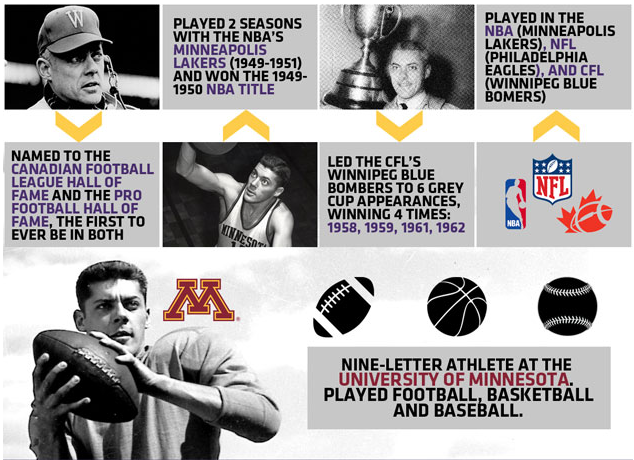
Click to see full infographic
Update: Minnesota will host SuperBowl LII in 2018:
Shocker. Minnesota wins the bid for Super Bowl LII. Breaks New Orleans streak.
— Ian Rapoport (@RapSheet) May 20, 2014
First loss ever for New Orleans, which is now 10 for 11 in Super Bowl bids
— Brian Murphy (@murphPPress) May 20, 2014
Minnesota WINS! http://t.co/TQZpFSZc8g pic.twitter.com/m31LTkB8Mw
— Minnesota Vikings (@Vikings) May 20, 2014
Comments Off on Happy 87th birthday, former Viking and Blue Bomber coach Bud Grant
May 19, 2014
First look at the Vikings 2014 draft class and undrafted free agents
Over this past weekend, the Minnesota Vikings held a three-day rookie camp for their 2014 draft class, undrafted free agents, and members of the 2013 practice squad. By NFL rules, the session didn’t feature any full-contact drills or scrimmages, but it begins the process of determining who will be on the full roster when the team goes to training camp this summer. On the official team website, Mike Wobschall says some players clearly stood out during the weekend sessions:
Anthony Barr was without question a standout player during the camp. He looks every bit the part of a top 10-type of player. His combination of size and speed is what captures your attention first, but I’ve also been hearing positive things about how he’s picking up the defense. I was impressed with Bridgewater overall, but particularly with his drop back and separation from the line of scrimmage, and then his release. The entire process is quick, and I think his ability to reach the top of his drop quickly and release the ball quickly is a big reason why he was such an accurate passer and had so few passes batted down at the line of scrimmage despite being 6-2. A few others who stood out included receiver Kain Colter, safety Antone Exum, cornerback Kendall James and tight end AC Leonard.
At Vikings Corner, Daniel House discusses the strengths and weaknesses of Teddy Bridgewater’s game (keeping in mind that his resumé is all college, no meaningful NFL stats yet):
Teddy Bridgewater was easily the most accurate quarterback in the 2014 NFL Draft class. He throws with nice touch in tight spaces and his arm velocity allows him to place balls in areas where only the receiver can make the play. ESPN Stats and Info recently performed a study using standardized completion percentage as the basis of argument.
[…]
Teddy Bridgewater currently holds a percentage of 78.3%, which fits perfectly behind Russell Wilson and RG3. Bridgewater held the top spot for standardized completion percentage among the 2014 NFL Draft quarterbacks. Johnny Manziel finished a close second with a 76.2% standardized completion percentage. As a whole, Teddy Bridgewater is a capable pocket passer with excellent precision passing abilities, making him one of the most pro-ready quarterbacks in this class.
Mr. Cool
Arguably one of most impressive statistics from Bridgewater is his ability to stay cool under pressure. Per ESPN Stats & Info, Bridgewater completed 53.5 % of his throws under duress in 2013, with a 7-1 ratio; he also completed 70.1% of his attempts against pass rushes of five blitzers or more. The Vikings face top tier pressure in the NFC North every week and need a quarterback that doesn’t display “happy-feet” at the first sign of pressure.
[…]
Cold-Blooded in the 4th Quarter
When tied or trailing by 7 or less in the 4th quarter during 2013, Bridgewater completed 75.0% of his passes with two touchdowns and no interceptions for a passer rating of 126.9. The Vikings need a quarterback who can make plays when the team needs a score late in the game. Head Coach Mike Zimmer has stressed that he is looking for a quarterback who can make plays late in the game and lead the team to victory. Bridgewater definitely has a pedigree in this area and is calm during pressure as I explained during the blitz statistic above. If Bridgewater is provided time to make a decision, he can make an athletic play down the field with his arm.
On the Move
Not only can Teddy Bridgewater make throws inside the pocket, but he is extremely functional outside the pocket. His throwing mechanics are very solid and he has been able to throw well, while rolling to his left or right with absolute ease. When he hits the outside of the pocket, he has an impressive ability to throw accurately with superior velocity into tight spaces. His ability to roll either direction in an offense allows him the chance to be effective in the play-action passing game.
Comments Off on First look at the Vikings 2014 draft class and undrafted free agents
May 17, 2014
Weird NFL lawsuit – “remember that anyone can file a lawsuit for almost anything”
A very unusual lawsuit has been filed against Jacksonville Jaguars first round pick Blake Bortles by David Rothrock and “Theodore Bridgewater”, from a prison in Pennsylvania:
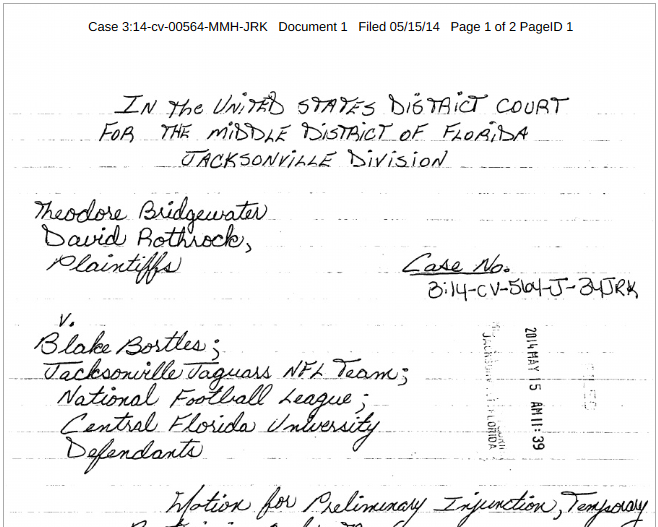
A bizarre, handwritten restraining order has been filed against Jacksonville Jaguars first-round pick Blake Bortles and the NFL in a Central Florida court in what appears to be an attempt to bar Bortles from playing for the Jaguars and in the National Football League.
The plaintiffs, listed as “Theodore Bridgewater” and David Rothrock, allege that Bortles is under the influence of steroids and also HIV positive. The lawsuit was filed from a Pennsylvania prison, presumably where Rothrock is incarcerated, and lists the co-plaintiff as “Theodore Bridgewater,” with a P.O. Box in Louisville, Ky., as the address. The plaintiff named on the suit is surely not Minnesota Vikings quarterback Teddy Bridgewater, despite a P.O. Box in Louisville, KY being listed as the address.
The filing not only accuses Bortles of taking steroids and HGH, but also alleges he’s been involved in some other nefarious dealings including an allegation that Bortles framed Rothrock for a crime so he would be jailed and unable to talk to the Federal Bureau of Investigation, who approached Rothrock about the distribution of steroids and HGH.
The plaintiff in the case is representing himself “pro se,” which means he is advocating on his own behalf.
H/T to Vikings Territory for the link.
Update, 23 May. Further proof that anyone can file a lawsuit for almost any reason. This one is against Cleveland Browns first round draft pick Johnny Manziel:
A person has filed for a restraining order against Cleveland Browns quarterback Johnny Manziel and is seeking $25 million in damages, claiming he has sexually harassed a woman for more than a year.
The document, filed in federal court in Florida on May 16, makes numerous salacious allegations against Manziel centered on him allegedly sending nude photos of himself to a woman. It lists a woman’s name on the complaint, but a deputy court clerk in Tampa said the complaint arrived by mail and the court has no way of confirming who sent it. The court clerk, who did not wish to be named, said the filing was mailed in Trenton, N.J.
The document also does not list an attorney, and no other supporting documents could be found in the record in a search by USA TODAY Sports on Friday.
Manziel’s agent, Erik Burkhardt, immediately wrote on Twitter that the complaint is “fake” and “frivolous.”
“It’s insanity,” Burkhardt told USA TODAY Sports. “You can read the thing for yourself.
“What some people will do for publicity is just embarrassing. That’s all I’ve got to say.”
Comments Off on Weird NFL lawsuit – “remember that anyone can file a lawsuit for almost anything”
May 13, 2014
The NFL’s first openly gay player
Michael Sam was drafted this weekend by the St. Louis Rams. He’s the first openly gay player to be drafted by an NFL team. Back in February, I wrote:
In addition to the questions about whether Sam’s collegiate talents will be enough to allow him to flourish in the NFL, and whether a given team would welcome an openly gay team-mate in the locker room, there’s also the “Tim Tebow” problem … the team that drafts Sam will be in the unrelenting focus of the media’s publicity floodlights. Just drafting Sam would only be the start of the media’s attention. Everything to do with Sam will draw TV cameras, paparazzi, and the team’s beat writers for local media outlets.
Perhaps I misjudged the degree of ongoing interest by media outlets, as after the initial flurry of coverage, I heard very little about Michael Sam until he was actually drafted, as a photo of him kissing his boyfriend hit Twitter (and the knuckle-dragging idiots came out in droves). In February, I didn’t think Sam would be drafted, but I was wrong. However, as David Boaz points out, he was drafted far later than he would likely have been if he wasn’t “out”:
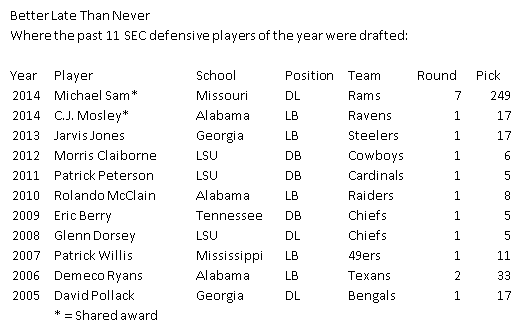
… this past weekend has reminded us that we haven’t quite achieved “opportunity to the talented.” Michael Sam was the Co-Defensive Player of the Year in the country’s strongest football conference, yet many people wondered if any NFL team would draft the league’s first openly gay player. Turns out they were right to wonder. Here’s a revealing chart published in yesterday’s Washington Post (based on data from pro-football-reference.com and published alongside this article in the print edition but apparently not online).
Every other SEC Defensive Player of the Year in the past decade, including the athlete who shared the award this year with Michael Sam, was among the top 33 picks in the draft, and only one was below number 17. Does that mean that being gay cost Michael Sam 232 places in the draft, compared to his Co-Defensive Player of the Year? Maybe not. There are doubts about Sam’s abilities at the professional level. But there are doubts about many of the players who were drafted ahead of him, in the first 248 picks this year. Looking at this chart, I think it’s hard to escape the conclusion that Sam paid a price for being openly gay. That’s why classical liberals – which in this broad sense should encompass most American libertarians, liberals, and conservatives – should continue to press for a society in which the careers are truly open to the talents. That doesn’t mean we need laws, regulations, or mandates. It means that we want to live in a society that is open to talent wherever it appears. As Scott Shackford writes at Reason, Sam’s drafting is “a significant cultural development toward a country that actually doesn’t care about individual sexual orientation. The apathetic should celebrate this development, as it is a harbinger of a future where such revelations become less and less of a big deal.” Let’s continue to look forward to a society in which it’s not news that a Jewish, Catholic, African-American, Mormon, redneck, or gay person achieves a personal goal.
Update: Draw Play Dave gets it exactly right.
Comments Off on The NFL’s first openly gay player
May 12, 2014
Evaluating NFL team drafts
It’s said that you can’t evaluate a draft class until three years later, because you need at least that long to see which players have established careers and which ones are no longer in the league, rather than who won the popularity contest before the draft. Despite that, many talking heads on TV have been eagerly assigning grades to the just-concluded NFL draft, and the fans of each team eagerly follow the narrative. Even Arif Hasan has fallen victim to this temptation, although he’s at least trying to follow a methodology to determine the overall strength or weakness of each team’s 2014 draft class.
One of the interesting things about gathering Big Boards across the country and finding the different ways that evaluators grade the players is that it gives us an ability to take a look at the draft from their perspective. There’s a big stigma against “grading the draft,” that I don’t think makes a lot of sense because we’re so willing to share our opinions on the players and teams who drafted them in every other way.
It seems we can give opinions about individual players and their teams without criticism. but as soon as we summarize it in a letter grade, we’re doing something wrong and have to wait. Instead, it may be better to wait three years to judge it.
But that’s no fun, and we want feedback. We just have to acknowledge we have a high band of uncertainty and give our impressions of the draft.
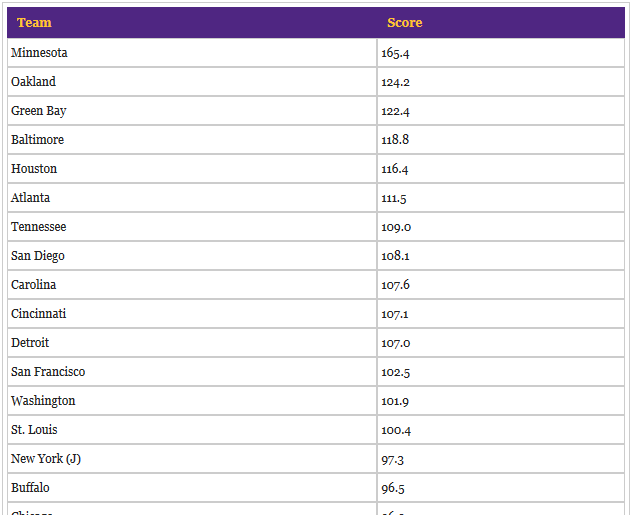
But how about instead of inserting post-hoc opinions about our favorite team, we take a look at a metric we’ve already laid the groundwork for? Let’s compare a team’s draft capital to what the Big Boards accumulated said.
It’s not perfect, especially in a deep draft, but by assigning players in their rankings an amount of points equal to the trade charts’ equivalent pick value, we can find out what players are considered to be worth. Using the NFL Trade Value Chart (put together by Jimmy Johnson way back when), we can compare the amount of draft capital a team entered the draft with to the “value” of players selected. This is perhaps the most appropriate way to gauge the number of “steals” and “reaches” a team makes and quantifying.
Spoiler:
Comments Off on Evaluating NFL team drafts
May 11, 2014
Vikings day 3 draft picks
“Trader” Rick Spielman was in full wheel-and-deal mode on Saturday, as the Vikings traded back a few times to stockpile extra picks. Despite some moaning on the part of the fan base, this is something he’s been remarkably consistent about — he likes to have about ten picks in a given draft. He’ll move up to get a particular player (like Harrison Smith in 2012, Cordarrelle Patterson in 2013, and Teddy Bridgewater this year), but in general he prefers to trade down to get more opportunities to draft players for the long term. There was a particularly persuasive article about this at Vox.com a few days back, arguing that teams should always try to maximize the number of players they draft, to increase their chance of getting players who will be around for a long time in the league:
Draft picks can be traded, and the success of any one player picked is highly uncertain. Because of that, their data says that in the current trade market, teams are always better off trading down — that is, trading one high pick for multiple lower ones — but many teams become overconfident in their evaluation of one particular player and do the exact opposite: package several low picks for the right to take one player very early.
“There are one or two teams out there that philosophically follow this idea,” says Massey, who serves as a draft consultant with several NFL teams that he can’t disclose. “But in my experience, teams always say they’re on board with it in January. Then when April rolls around, and they’ve been preparing for the draft for a long time, they fall in love with players, get more and more confident in their analysis, and fall back into the same patterns.”
My only disagreement with this argument is that due to the current Collective Bargaining Agreement, there’s a discontinuity in the data at the bottom of the first round: teams get an optional fifth year on contracts with first round players. For this reason, I think Minnesota was right to trade up to get Bridgewater at the bottom of the first round, to get that option instead of waiting until they were next on the clock (which would have been eight picks later in the second round).
At the Daily Norseman, KJ Segall looks at the draft philosophy being employed by Rick Spielman and Mike Zimmer:
As we agonized through the pre-draft build up, I contemplated the basic two directions the Vikings could go — solving the offense with relatively few moves, or focusing on a defense that had holes everywhere. On one hand, we needed three things to have an offense worthy of contending in the NFC North: a good quarterback, a good offensive guard, and a reliable backup running back. (Not bad when one of the things you need is a backup position.) If we fixed that, then our solid WR corps, strong Oline, and superstar RB would be giving opposing DCs nightmares… but, that would also mean that our defense would have missed out on some upgrades, and many a team might simply outscore us no matter what we could do with the ball. On the other hand, letting the offense be with the adequate Matt Cassel, Charlie Johnson, and (fill-in-the-blank backup running back), all while attempting to plug as many holes on the leaky longship that was our defense could create a relatively well-balanced team that might not scare a lot of people but could still sneak out some surprises.
So it came down to this — be mediocre across the board, or be great at one thing and weak at another. Ultimately, through FA and what has been a shockingly good draft (shockingly because when you get the hands-down best QB available at freakin’ pick 32… well, the mind, it gets blown), they basically have gone with the latter. Yes, we solved our quarterback situation beyond our wildest expectations, and our offense will in fact be much, much better this year (and it wasn’t even all that terrible last year, either). And yes, by drafting
DaddyDavid Yankey and Jerick McKinnon, we did technically solve those other two holes- although McKinnon is most definitely a project at first, and Yankey’s ability to unseat Charlie Johnson yet remains to be seen. (Although he should hopefully do so at some point in the season.) In reality, we focused pretty heavily on defense throughout the draft, starting off with the selection of Anthony Barr. The Bridgewater awesomeness aside, it would appear that the Vikings were determined to work on the defensive upgrades made in free agency as their primary focus.
On to the actual day three picks below the fold.
Comments Off on Vikings day 3 draft picks
May 10, 2014
Vikings second day draft picks
Having traded away their original second round pick to Seattle to move back up to the bottom of the first round to get Teddy Bridgewater, the Vikings started the evening with only two third round picks. There was some speculation about Rick Spielman trading back up into the second round, but nobody had solid ideas about which player the team might have wanted urgently enough to give up any more later round picks. Spielman later said that they’d tried to “make some movement” but that they couldn’t come up with “a deal we felt comfortable with”.
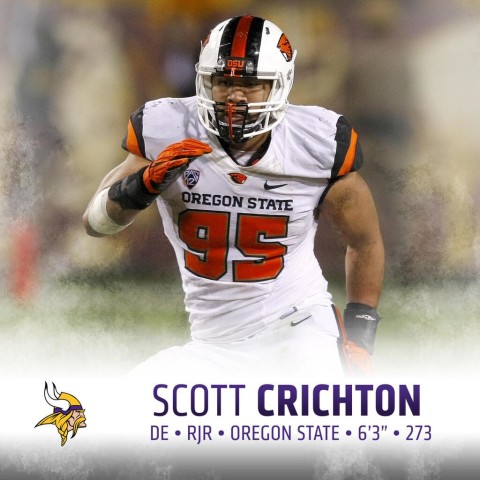 The Vikings selected Oregon State defensive end Scott Crichton with the first of their third round picks. The Daily Norseman‘s Eric Thompson says this was a good selection:
With many fans expecting the team to go after a corner with the 72nd overall pick in the 2014 NFL Draft, the Vikings got another talented pass rusher in Oregon State defensive end Scott Crichton. It was definitely a “value” pick — Crichton had a second round grade on most draft boards and was widely considered one of the best five or six edge rushers available in the draft. Mere moments after being chosen by the Vikings, Crichton jumped on a conference call to talk with Twin Cities beat writers.
[…]
Crichton played a little linebacker his freshman year at Oregon State, but make no mistake about it–he’ll be on the field to get after the quarterback. The Beavers ran a 4-3 defense and Crichton’s bread and butter was his pass rush. “That’s my thing. I love to get after the quarterback.” He played on both sides of the line with the Beavers along with some plays. Like most draft pundits Crichton expected to be drafted in the third round but nonchalantly claimed that the “third round’s fine”. “I’m just grateful for this opportunity. I’m ready to show what I can do and prove people wrong for not picking me earlier.”
At the press conference after the selection, Rick Spielman said “He’s not very nice on the field, which you like to see.”
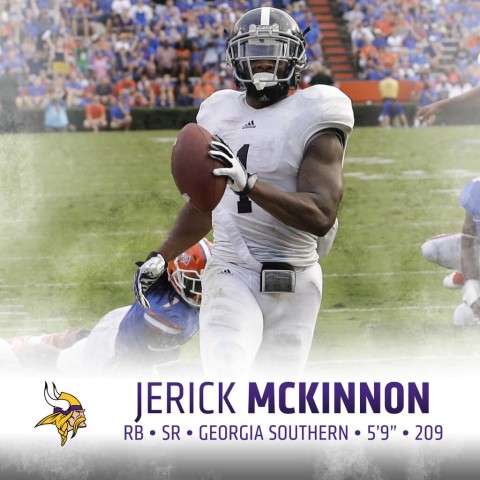 With their last pick of the evening, the Vikings selected running back Jerick McKinnon from Georgia Southern. Arif Hasan said that McKinnon had been a stand-out performer at the combine, but that he’ll be a bit of a project (despite “insane measureables”). He’s certainly not a carbon copy of Toby Gerhart, being 5’9″ tall, weighing 209 lbs, and boasting a 4.4 time at the combine. His college football career was an odd one: started out as a cornerback, then eventually becoming a quarterback and running back (Ben Goessling refers to his role as having been “triple-option”, which is a new one on me). His role isn’t as clear-cut as you’d think, despite being drafted as a running back, during the NFL Network draft coverage, Mike Mayock said he could even start at safety in the NFL. On the official Vikings overview, his weaknesses make you think the team has other plans for him: “On the short side. Runs a bit upright and hesitant. Average burst to the perimeter. Not a creative, make-you-miss runner. Very limited career receiving production (10 career catches). Not stout in pass protection.” Those last two items are not what you’d expect if the team was planning to use McKinnon to spell Adrian Peterson on third down. Ideally, your third round running back would be an experienced receiver with good blocking skills.
With both Chrichton and McKinnon, the Vikings clearly valued their athletic potential or “upside” over more polished players with lower theoretical potential. That’s a strong indication of confidence that they can teach technique on both sides of the ball. And given the strength of the new coaching staff, that’s a sensible approach. Neither of these players is likely to start as rookies, but they both have versatility in the roles they could fill and given a year of seasoning, they could become useful parts of the puzzle down the road.
#Vikings have taken a RB turned LB, and a QB/CB turned RB. Common trait is athletic ability. Can't say they're not going for upside.
— Ben Goessling (@GoesslingESPN) May 10, 2014
The Vikings have four picks remaining in today’s final four rounds of the draft: 145th (5th), 148th (5th), 184th (6th) and 223rd (7th) … before we account for Trader Rick’s taste for wheeling and dealing, anyway.
Update: Arif Hasan profiles Scott Chrichton and Jerick McKinnon. Arif’s always good at analysis.
Comments Off on Vikings second day draft picks
May 9, 2014
Vikings make two moves in first round of the draft
The Vikings were busy in the NFL draft once again, as “Trader” Rick Spielman swapped first round picks with Cleveland to select linebacker Anthony Barr (gaining an extra pick in the process), then traded two later round picks for Seattle’s number 32 (the last pick in the round) to select quarterback Teddy Bridgewater. The Barr pick surprised me, as I thought middle linebacker would be a much higher priority, but you could make the case that Barr was the best athlete if not the best overall player available at that spot.
Linebacker Anthony Barr #11 of the UCLA Bruins sacks quarterback Jared Goff #16 of the California Golden Bears at the Rose Bowl on October 12, 2013 in Pasadena, California. Photo by Stephen Dunn, Getty Images.
Barr was one of the top linebacker prospects, despite only having played two years at that position. It’s expected that he’ll take Chad Greenway’s position on the strong side, while Greenway moves to one of the other linebacking spots.
Teddy Bridgewater of the Louisville Cardinals poses with NFL Commissioner Roger Goodell after he was picked #32 overall by the Minnesota Vikings during the first round of the 2014 NFL draft. Photo by Elsa, Getty Images.
For quite a long time in the run-up to the draft, Teddy Bridgewater was seen as not only the top quarterback prospect, but even as the top overall pick until he had a bad outing at his Pro Day, and then his stock began to drop. Each of the three top quarterbacks were linked to the Vikings in many mock drafts, but Bortles was off the board before the Vikings were on the clock, and Manziel was drafted (by Cleveland) in the second half of the round. I had thought the Vikings were more interested in Bridgewater, but many reported that the Vikings had attempted to get back into the first round to get Manziel, but that Cleveland’s extra first round pick meant they couldn’t top that offer without giving away too much. Personally, I doubt that as Manziel would have been the worst fit of the top three in Norv Turner’s offensive scheme — the skills Manziel offered were not the ones that Turner values the most in a quarterback.
One of the most impressive stats on Bridgewater is his performance against the blitz: a 70.1 percent completion rate averaging 11 yards per attempt, for 15 touchdowns and only 1 interception. That’s head-and-shoulders above the other “top two” quarterbacks. However, Rick Spielman said that there’s no expectation that he’ll start right away, and that he’ll be given time to develop behind Matt Cassel. The coaching staff will determine when he’s ready to step up.
Comments Off on Vikings make two moves in first round of the draft
May 8, 2014
Minnesota Vikings’ 2014 draft needs
Last year, in my annual pre-draft post, I admitted once again that I have no real idea who Minnesota will select, as I don’t follow college football. I’ve been reading the fan sites’ schizophrenic swerving back and forth among the various quarterbacks (this week, Bridgewater is hot garbage, but Bortles is the bomb: last week, Manziel was the man and Bortles was nowhere, etc.), as quarterback is the most obvious long-term need for the team (likely with their first round pick, although trading back to stockpile additional picks is another alternative).
While I don’t have much of a clue about who will be drafted, I do know that the team has certain positional needs that have not yet been addressed in free agency. The Vikings made some good acquisitions during the free agency feeding frenzy, with Linval Joseph at nose tackle and Captain Munnerlyn at cornerback filling two of the biggest deficiencies in 2013. Here are the top positions that should be addressed during the draft (in my opinion, anyway):
- Quarterback. The Vikings have the 8th pick in the first round and given the depth of the talent this year thanks to a record number of college juniors who have declared themselves eligible for the draft, the talent pool is both broad and deep. There are three quarterbacks who have received the most attention in the run-up to the draft and one or more of them may be on the board when the Vikings are on the clock. They’ve got Matt Cassel under contract for 2014 and 2015 and Christian Ponder still has a year left on his rookie deal: the team chose not to exercise their fifth-year option on Ponder’s contract. I had assumed the team was hoping to trade Ponder for a draft pick this year, which might mean spending two draft picks on quarterbacks, one early and one late. However, in a press conference on Tuesday, Rick Spielman specifically ruled out trading Ponder either before or during the draft (and we’re free to believe him or not). Several bloggers are predicting the team will use the #8 pick on a defensive player and attempt to trade back into the bottom of the first round to take a quarterback (so they get the fifth-year option on his rookie contract).
- Middle Linebacker. I was surprised to see the Vikings re-sign Jasper Brinkley after he spent a year with Arizona. He’s good against the run, but not very good at all defending the pass. Others on the roster include fan favourite Audie Cole (he of the back-to-back pick-sixes in preseason play as a rookie), and Michael Mauti (who had three ACL tears in his college career). However, the middle linebacker may not be as important to the new defensive scheme as it was in the Tampa-2 variant the Vikings ran last year — or the responsibilities are changed enough that defending receivers isn’t a priority.
- Safety. Harrison Smith suffered a turf toe injury last year which kept him off the field for half the season, and the team struggled with filling the gap. Andrew Sendejo improved over the season, but drafting a safety to strengthen the passing defence would be a good move.
- Cornerback. Xavier Rhodes made great strides in his rookie season and should be a fixture on the Vikings defence for several years if he continues to develop. New free agent signing Captain Munnerlyn may fill the role Antoine Winfield did so well: outside corner in base, then switching to slot corner in nickel coverage. Josh Robinson had a truly awful year in 2013, but he was playing in the slot and had reportedly never played that position in college. Drafting an outside corner makes a lot of sense for the Vikings, and it’s another position with good depth this year.
- Running Back. Adrian Peterson is still the best running back in the game, but he’s getting to the point in his career where the vast majority of running backs start to decline. The Vikings had the luxury of a high-quality backup in Toby Gerhart, but he departed in free agency to get a chance to be a starter. With the new coaching staff, the Vikings are likely to de-emphasize the running game, so it’s unlikely the team would spend a high draft pick at this position, but a mid-round selection would make a great deal of sense.
- Offensive Guard. The offensive line is one of the strengths of the team, but an upgrade might be in order at the left guard position. Charlie Johnson got a two-year contract to come back, but finding a rookie to be his understudy or even to replace him as a starter would make the line even better than it already is.
- Tight End. The expensive John Carlson experiment came to a close after injuries kept Carlson off the field far too much and the team didn’t get much production for their big money investment as a result. Kyle Rudolph is very good and still improving, and Rhett Ellison does a good job of imitating Jim Kleinsasser as the big blocking tight end/H-back. It wouldn’t be surprising to see the Vikings invest a mid-to-late-round pick on a pass-catching tight end to pair with Rudolph.
Not on my list of priorities but a position that’s suddenly being discussed over the last few days is defensive tackle (specifically Pitt’s Aaron Donald). This might just be a side-effect of the extra two weeks of speculation caused by pushing the draft back into May, or it might indicate that the Vikings have their doubts about last year’s first rounder Sharif Floyd. Floyd played behind Kevin Williams and didn’t seem to have as much impact as you might hope for a first-round selection. While I don’t see the team spending another high pick on that position with so many other areas to address, I guess it should be considered as a possibility. I’d think trading back for more picks would be a much more likely outcome, however.
At 1500ESPN, Andrew Krammer lists the Vikings’ needs on offense and defence.
This all assumes that the Vikings stick with their current allocation of draft picks (eight, including an extra they got in the Percy Harvin trade from Seattle). There’s a strong sense that the Vikings might trade down to amass more picks in later rounds — Rick Spielman didn’t get the nickname “Trader Rick” for nothing. If they do want to move down in the first round, John Holler covered some of the possibilities (including positions I don’t think are worth a first round pick for the Vikings).
Comments Off on Minnesota Vikings’ 2014 draft needs
May 4, 2014
Quarterback boom or bust metrics
At the Daily Norseman, CCNorseman has been working on developing a set of metrics for determining the chances of NFL success for prospective draft picks at the quarterback position:
This past off-season I have been scouring current and past scouting reports to try to develop a metric that we can use to evaluate quarterback prospects. I started by developing a metric to evaluate the traits of successful quarterbacks. I cataloged the traits found in pre-draft scouting reports of an elite list of 25 successful quarterbacks that have been drafted since 1998, and based the metric on those traits that were most common among that pool of players. In other words, I attempted to answer the question, “What common traits did the most successful quarterbacks in the NFL have coming out of college?” Then I went back and re-evaluated the “success metric” based on excellent feedback from the readers here at the Daily Norseman. I also developed a second metric to evaluate the traits of quarterback busts. It was the same process, except that I catalogued the common traits of the 17 quarterback busts since 1998 and based the bust metric on those traits that were most common among those players. That led me to the final Boom or Bust metric, which you can also find in that second link (and is listed below). The last step in this process is what you’ll find here: verifying the accuracy of the metric. I have gone back and run the metric on quarterbacks drafted in the 1st round of past drafts to see how successful it would have been at predicting the future successes of those players. The short of it is: it’s more accurate than a random guess. It’s not fool-proof mind you, but over the course of seven drafts from 2004 through 2010, it would have accurately predicted which 1st round quarterbacks would bust and which would be serviceable or better 73% of the time. Why did I only go back to 2004? Well, I really wanted to use at least two scouting reports for every quarterback when testing the metric to ensure better accuracy, but the farther back in time I went, the harder and harder it was to find reliable scouting reports online. I wasn’t able to track down more than one reliable scouting report for the quarterbacks drafted in 2003 and earlier, so there really is no other reason than that. I stopped at 2010, because a quarterback needs at least 4 years in the league to qualify as a bust or not, and those quarterbacks drafted in 2011 and later haven’t had a full 4 years yet.
[…]
It’s worth pointing out that in this particular data set (2004-2010), the Bust Metric by itself was almost as accurate overall as the combined metric in predicting the future of these quarterbacks and was 68% accurate by itself (although they each had slightly different results on a per quarterback basis). The success metric by itself was a little less accurate, correctly predicting the future only 61% of the time. In any case listed below are the 19 first round quarterbacks drafted between 2004 and 2010, with their metric scores from their pre-draft scouting reports and pre-draft prediction. I have taken some leeway in assigning the outcome score to this. My biggest concern in all of this is to ensure that if the metric predicts the quarterback to be in the bust category that they truly are a bust. After that, we can end up splitting hairs all day about what makes a quarterback “average” or “successful” or not. In other words, if the metric predicts that a quarterback will be merely league average, but he turns out to be a successful one then I’ll still call it a win for the metric, because it didn’t predict that quarterback to bust. I think teams are mostly concerned with not having their 1st round quarterback bust (like JaMarcus Russell or Ryan Leaf), than whether or not they get a Jason Campbell versus Aaron Rodgers type. I have given each quarterback an outcome label of “yes”, “maybe” or “no”. A “maybe” label essentially means that the player has performed reasonably well, but still has enough time left in their career to qualify for their prediction label. In those cases, the quarterback receives half-credit for their outcome.
Comments Off on Quarterback boom or bust metrics
May 3, 2014
Mike Zimmer’s first Vikings mini-camp has even veterans nervous
As a brand-new head coach, Mike Zimmer is allowed to have a few more early team practices and training sessions than established coaches under the NFL’s bargaining agreement. The first mini-camp was held this week, from Tuesday to Thursday, and even the veteran players were approaching it like the first day on the job:
Matt Cassel has been around the NFL block a few times in his 10 seasons as a quarterback. Not much surprises him anymore, and yet he found himself unable to sleep the night before the Vikings minicamp this week.
“I was excited, jittery,” he said.
Chad Greenway felt those same butterflies. The veteran linebacker compared it to being a rookie or college freshman again.
“It was straight-up nerves,” he said.
Captain Munnerlyn arrived in town as a key offseason acquisition who’s supposed to help fix a shipwrecked defense, and even he felt a weird uneasiness.
“With a new coach, it’s a clean slate for everybody,” he said. “That means every position is open. Except for the running back position.”
Good call. We’ll go out on a limb and suggest that Adrian Peterson probably didn’t need to impress the new coaching staff in order to keep his job. But everyone else convened at Winter Park this week with an overarching sense of anxiety not normally evident at a routine offseason workout.
Imagine your first day with a new boss, one who’s known for his no-nonsense personality and brutal honesty. And salty language.
“You’re on edge and trying to make a good first impression,” Greenway said. “You know the draft is coming in a week. They’ll probably make some decisions based off of this camp.”
If Mike Zimmer’s first on-field introduction made players nervous and uncomfortable, that’s a good thing. This organization had become too lethargic under the previous regime. The atmosphere at Winter Park became stale as losses piled up last season.
Comments Off on Mike Zimmer’s first Vikings mini-camp has even veterans nervous


