Quotulatiousness

January 20, 2021

“Canada Post … is not to act as the censor of mail or to determine the extent of freedom of expression in Canada”

Filed under: Cancon, Law, Liberty, Politics — Tags: , , , — Nicholas @ 05:00

Colby Cosh on a recent incident in Regina where a Canada Post employee took it upon himself to act as a local censor for people on his delivery route:

Today’s idiot of the day is not, perhaps surprisingly, the Regina postman who got suspended for refusing to deliver the Epoch Times, the oddball anti-communist newspaper that’s affiliated with China’s persecuted Falun Gong religious movement. Don’t get us wrong: Ramiro Sepulveda is clearly a bit of a nitwit. He seems to believe that a newspaper founded by commie-hating Chinese-Americans is designed to provoke hatred toward “Asian communities in North America.”

Sepulveda didn’t want to deliver free copies of the Times to non-soliciting customers because it “spits lies.” Perhaps regrettably, the strong reaction by Canada Post means that our junk mail, quite a lot of which consists of boastful missives from politicians, is not destined to be fact-checked and aggressively suppressed by the corporation’s rank and file.

Sepulveda was properly punished for not doing his job. And Canada Post used the opportunity to promote its content-neutrality as an agent of the state, although it did not quite dare to use the phrase “statutory monopoly.” In a statement to the broadcasters who reported on Sepulveda’s off-piste personal fact-checking, the agency said: “Canada Post is obligated to deliver any mail that is properly prepared and paid for, unless it is considered non-mailable matter. The courts have told Canada Post that its role is not to act as the censor of mail or to determine the extent of freedom of expression in Canada.”

They might have added that access to the mail has been denied to individuals for spreading hatred only a handful of times in the history of the country; this, too, is as it ought to be, and it is certainly not postal employees who ought to be improvising such bans. Ideally, all postmen would be doing their best not to create the suspicion that they are eyeballing what is sent to our homes with the intention of ringing up a reporter and causing a fuss. Say what you like about these poor toilers: most of them never give us any reason to doubt their discretion.

January 9, 2021

The (declining) power of the political cartoon

Filed under: History, Humour, Media, Politics, USA — Tags: , , , — Nicholas @ 03:00

In Quillette, Jack Reilly outlines the rise of political cartooning from (of all people) Martin Luther to the present day, as it faces the final phase of its long career:

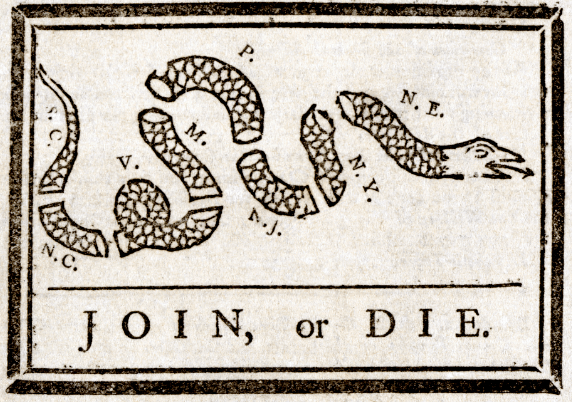
The first influential cartoon published in an American newspaper has traditionally been credited to Benjamin Franklin, who drew his famous serpent divided into eight parts with the legend Join, or Die — the message being that fellow colonists must band together to repel the enemy forces then threatening their territory. Long after Franklin’s death, the image would be dusted off for reuse by supporters of American unity.

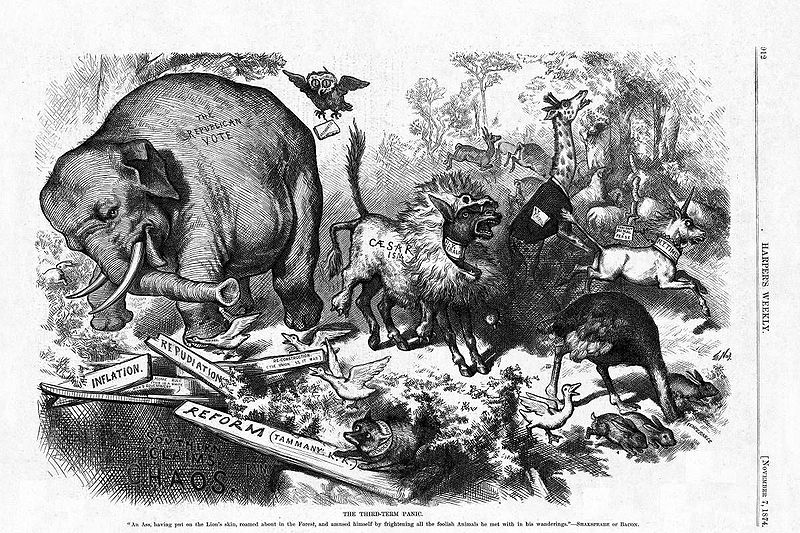
Thomas Nast, whom many consider to be the greatest editorial cartoonist of all time, rose to prominence during the Civil War. Still in his early 20s, the young German immigrant began producing such arresting pro-Union material that Abraham Lincoln — flipping Napoleon’s rueful commentary about James Gillray on its head — referred to Nast as “our best recruiting agent.”

During the national election of 1864, conducted amidst the Civil War, the Democrats pushed a platform of reconciliation with the slaving south. In response, Nast created his famous Compromise with the South cartoon, depicting an injured union soldier, bowing his head and lifelessly shaking hands with a victorious confederate who stands atop the grave of a fallen Yankee, with Lady Liberty weeping in the foreground. The epitaph on a tombstone reads “In memory of the Union heroes who died in a useless war.” Nast’s lurid but masterful image created a sensation, and showed how politically powerful the cartooning medium could be in an age of mass newspaper readership. Two months later, Abraham Lincoln defeated the Democrat candidate, George McClellan, to secure a second term.

In the decades following the war, Nast would continue to elevate the medium to high art. In 1871, he began an ongoing series for Harper’s Weekly attacking the corruption of Tammany Hall, the Democratic political machine that controlled New York politics. Nast so mercilessly lampooned William M. “Boss” Tweed as the machine’s ringleader, that Tweed was heard to rage, “Stop them damn pictures! I don’t care a straw for your newspaper articles. My constituents can’t read. But they can’t help seeing them damn pictures!”

Eventually, Tweed was convicted of money laundering. (He attempted to escape justice by absconding to Spain, but was soon apprehended by Spanish officials, who reportedly recognized him with assistance from Nast’s cartoons.) As for Nast himself, he’d go on to conceive of the elephant as a symbol for the Republican party, popularize the use of the donkey for the Democrats, and help create the modern image of Santa Claus that Americans have come to love.

“The Third-Term Panic”, by Thomas Nast, originally published in Harper’s Magazine on 7 November 1874.

A braying ass, in a lion’s coat, and “N.Y. Herald” collar, frightening animals in the forest: a giraffe (“N. Y. Tribune”), a unicorn (“N. Y. Times”), and an owl (“N. Y. World”); an ostrich, its head buried, represents “Temperance”. An elephant, “The Republican Vote”, stands near broken planks (Inflation, Repudiation, Home Rule, and Re-construction). Under the elephant, a pit labeled “Southern Claims. Chaos. Rum.” A fox (“Democratic Party”) has its forepaws on the plank “Reform. (Tammany. K.K.)” The title refers to U.S. Grant’s possible bid for a third presidential term. This possibility was criticized by New York Herald owner and editor James Gordon Bennett, Jr.
Image and caption via Wikimedia Commons.

December 13, 2020

QotD: The statistical “Rule of Silicone Boobs”

Filed under: Health, Humour, Quotations, Science — Tags: , , , , — Nicholas @ 01:00

If it’s sexy, it’s probably fake.

“Sexy” means “likely to get published in the New York Times and/or get the researcher on a TEDx stage”. Actual sexiness research is not “sexy” because it keeps running into inconvenient results like that rich and high-status men in their forties and skinny women in their early twenties tend to find each other very sexy. The only way to make a result like that “sexy” is to blame it on the patriarchy, and most psychologist aren’t that far gone (yet).

[…]

Anything counterintuitive is also sexy, and (according to Rule 2) less likely to be true. So is anything novel that isn’t based on solid existing research. After all, the Times is the newspaper business, not in the truthspaper one.

Finding robust results is very hard, but getting sexy results published is very easy. Thus, sexy results generally lack robustness. I personally find a certain robustness quite sexy, but that attitude seems to have gone out of fashion since the Renaissance.

Jacob Falkovich, “The Scent of Bad Psychology”, Put a Number On It!, 2018-09-07.

November 19, 2020

White Lives Matter More – A Summer of Blood | BETWEEN 2 WARS: ZEITGEIST! | E.04 – Summer 1919

TimeGhost History
Published 18 Nov 2020

Technology promises a better and more connected world in the summer of 1919. But battles still rage everywhere over who will inherit it.

Join us on Patreon: https://www.patreon.com/TimeGhostHistory

Subscribe to our World War Two series: https://www.youtube.com/c/worldwartwo…
Like TimeGhost on Facebook: https://www.facebook.com/TimeGhost-16…

Hosted by: Indy Neidell
Written by: Indy Neidell and Francis van Berkel
Director: Astrid Deinhard
Producers: Astrid Deinhard and Spartacus Olsson
Executive Producers: Astrid Deinhard, Indy Neidell, Spartacus Olsson, Bodo Rittenauer
Creative Producer: Maria Kyhle
Post-Production Director: Wieke Kapteijns
Research by: Indy Neidell and Francis van Berkel
Image Research by: Miki Cackowski and Michał Zbojna
Edited by: Michał Zbojna
Sound design: Marek Kamiński

Colorizations:
Mikołaj Uchman
Spartacus Olsson

Sources:
From the Noun Project: bridge by Adrien Coquet, Delete by Kevin Eichhorn, Fire by Sweet Farm, Model T by Alex Valdivia, people by Anastasia Latysheva, peoples by Musmellow, revolt by Symbolon, Smoke by Krish, people by Nithinan Tatah, explosion by Aldric Rodríguez

Archive by Screenocean/Reuters https://www.screenocean.com.

A TimeGhost chronological documentary produced by OnLion Entertainment GmbH.

From the comments:

TimeGhost History
21 hours ago
Four episodes into this new series and we think it’s going pretty well. Behind-the-scenes we have been getting ahead with our planning to make make things as laser-focused as possible and we have some pretty fascinating pieces of history we want to talk about.

But we know that there is always a learning curve with a new series and we care what our community thinks. It’s the TimeGhost Army who make our content possible so we’d like to hear from you what you think about Season Two of Between 2 Wars. What are you enjoying about it? Is there anything you think we should work on? How do you feel about Indy’s outrageous suits and ties?

October 27, 2020

Conspiracy theories grow thanks to mistrust of public officials and media

Filed under: Government, Media, Politics, USA — Tags: , , , , , , — Nicholas @ 03:00

It’s commonplace to say that such-and-such a conspiracy theory is merely an intellectual playground for the paranoid and the gullible, but conspiracy theories don’t spontaneously generate — at least not the ones that gain wide audiences. Daniel Miller looks at some of the reasons these theories become attractive and gain adherents:

QAnon alleged clues about the NYC bombing, 10 December 2017.
Wikimedia Commons.

In the wake of six months of mixed-messages and baffling government policies, following four years, if not twenty years, of mystifying imponderables, the concept of a “conspiracy theory” has recently reentered the lexicon of semi-criminalized thought.

In August The New York Times stigmatized anti-lockdown protesters in Berlin as a worrying admixture of “neo-Nazi groups, conspiracy theorists as well as Germans who said they were fed up with the restrictions” and similar language was used about the protesters in London, as social media companies began purging accounts linked to the QAnon conspiracy theory, which conjectures that the world is controlled by a secret global cabal of blood-drinking sex criminals.

Believing conspiracy theories, evidently, is a Bad Thing, but any concept capacious enough to incorporate both the tens, even hundreds of millions of people skeptical about the global political response to SARS-2, and the much smaller number entertaining more involved explanations demands a careful analysis.

Really the first question is who you can trust. One answer is the official authorities, as represented by the esteemed New York Times, but the news website which welcomed the 45th US President to office with three years of spurious coverage of what turned out to be the Russiagate hoax, before pivoting to the historical phantasmagoria of the 1619 Project, no longer strikes everyone as the impeccable source which revealed the existence of Saddam Hussein’s WMD stockpile and links to Al-Qaeda before the 2003 invasion of Iraq, or whose Pulitzer Prize winning journalist Walter Duranty discounted rumours of a 1933 famine in the Soviet Union as “an exaggeration or malignant propaganda.”

This leaves individuals only to their own wits and devices in the face of a puzzling world in which information is everywhere, much of it questionable, not all the facts are available, and many are ultra-politicized, and meanwhile, unknown agendas are being continually carried out.

What’s really going on? As with any speculative enterprise, the problem is to construct a plausible hypothesis by using various models to interpret limited data. There is no question that, at different moments in history, individuals and groups have worked together in secrecy to launch conspiratorial exploits and there is no obvious reason for thinking this practice has now totally ceased. “People of the same trade seldom meet together,” observed Adam Smith in 1776, “even for merriment and diversion, but the conversation ends in a conspiracy against the public.” Still, this is not in itself evidence of any specific plot happening now.

October 26, 2020

QotD: Living in the modern world

Filed under: Health, Media, Quotations, Technology — Tags: , , , — Nicholas @ 01:00

What if … bear with me a moment … checking social media every 15 minutes keeps us in a state of constant stress & agitation without actually keeping us better informed than the old days of reading the morning paper & occasionally watching the evening news did?

Zack Stentz, Twitter, 2018-07-16.

October 21, 2020

QotD: The Guardian

Filed under: Britain, Food, Media, Politics, Quotations — Tags: , , , , — Nicholas @ 01:00

Come work at the Guardian, where the party never stops.

A less impressed commenter, unrelated to the editor, asks,

    What is it with people’s inability to ignore the things they don’t like?

Meaning things you don’t like and which have no bearing whatsoever on your everyday life or the turning of the world. Say, “our” alleged “obsession” with cupcakes and their supposedly debilitating effects on helpless, hapless womenfolk. Women being so mentally insubstantial that even a tiny cake can unhinge their minds, apparently. But fretting ostentatiously about things of no importance has long been a standard template for Guardian articles, especially if you can shoehorn in some sophomoric theorising. It’s something most papers do to some extent, due to the obligation to Fill Space Somehow, but the Guardian is by far the greatest exponent and the most grandiose. Many of its contributors have mastered inadvertent surrealism. First you find some tiny, utterly trivial personal anecdote or grumble and then inflate it to sociological status with lots of wild, baseless assertion. Anything from the feminist politics of toddler excrement to the cruel, cruel agonies of spellcheck software. Whether the complaint is valid, or even sane, or can withstand a minute’s scrutiny, really doesn’t matter. It’s all about display — being outraged as theatre and social positioning. Which is why something as dull as temporary building renovation can be described vehemently, repeatedly and in all seriousness as “cultural apartheid.”

David Thompson, “The Cupcake Menace”, David Thompson, 2013-10-20.

October 19, 2020

QotD: Afflicting the comfortable

Filed under: Books, History, Humour, Media, Quotations, USA — Tags: , , , — Nicholas @ 01:00

In 1893, Finley Peter Dunne, a journalist-turned-humorist at the Chicago Evening Post, introduced Martin J. Dooley to the people of Chicago. Mr. Dooley, as he was best known, was a thick-accented bartender from Ireland who owned a tavern in the Bridgeport neighborhood. Mr. Dooley became popular among Chicagoans for his rich satire of politics and society. Of course, Mr. Dooley wasn’t real. He was a fictional character created by Dunne. His work included countless sketches and wide-ranging commentary, but he may be best known for his biting one-liner on newspapers, since reclaimed by journalists as central to the profession’s creed: “The job of the newspaper is to comfort the afflicted and afflict the comfortable.”

The original quote is from Observations by Mr. Dooley, one of several works Dunne produced as the character, in which Dunne specifically satirizes the press’s penchant for trial-by-media. He presented Mr. Dooley through Irish dialect pieces, hence the diction, so the “affliction” quote below has been lightly edited for comprehension:

    When anything was wrote about a man ’twas put this way: “We understand on good authority that … is on trial before Judge G. on an accusation of larceny. But we don’t think it’s true.” Nowadays, the larceny is discovered by a newspaper. The lead pipe is dug up your backyard by a reporter who knew it was there because he helped you bury it. A man knocks at your door early one mornin’ an’ you answer in your nighty. “In name of the law, I arrest you,” says the man seizin’ you by the throat. “Who are you?” you cry. “I’m a reporter for The Daily Slooth,” says he. “Photographer, do your duty!” You’re hauled off in the circulation wagon to the newspaper office where a confession is ready for you to sign; you’re tried by a jury of the staff, sentenced by the editor-in-chief, and at ten o’clock Friday the fatal thrap is sprung by the fatal thrapper of the family journal. The newspaper does evrything for us. It runs the police force and the banks, commands the militia, controls the legislature, baptizes the young, marries the foolish, comforts the afflicted, afflicts the comfortable, buries the dead and roasts them aftherward.

That journalists of all stripes have touted a scathing critique of their profession and repurposed it as a mission statement is a textbook definition of irony that belongs on a Roman pedestal behind bulletproof glass in the Smithsonian. What is most vexing about the modern interpretation of Dunne’s quote is that its new meaning is implied to be synonymous with dispassionately seeking truth, which it necessarily is not.

Robert Showah, “Journalism Is Not Activism”, Quillette, 2018-07-05.

October 9, 2020

QotD: How to analyze complex multivariate systems for the popular press

Filed under: Media, Quotations, Science — Tags: , , , , — Nicholas @ 01:00

  1. Choose a complex and chaotic system that is characterized by thousands or millions of variables changing simultaneously (e.g. climate, the US economy)
  2. Pick one single output variable to summarize the workings of that system (e.g. temperature, GDP)
  3. Blame (or credit) any changes to your selected output variable on one single pet variable (e.g. capitalism, a President from the other party)
  4. Pick a news outlet aligned with your political tribe and send them a press release
  5. Done! You are now a famous scientist. Congratulations.

Warren Meyer, “Modern Guide to Analyzing Complex Multivariate Systems”, Coyote Blog, 2018-06-25.


September 27, 2020

QotD: The persuasive power of the newspapers

Filed under: Britain, Media, Politics, Quotations — Tags: , , , — Nicholas @ 01:00

It is a standard part of the mythology that newspapers tell their readers what to believe — and the readers believe them. This is why the left keeps shrieking about the barons controlling the press, it could only be that poisoning of the minds of the proletariat which keeps said left from sweeping all before it in politics. The actual study — you know, science — of how this works is that newspapers follow the prejudices of their readers. The Sun is not socially conservative and rightish in its views because Rupert Murdoch is so but because a large portion of the British working class is so.

Or, as we might put it, the reason the left doesn’t sweep the board with the votes of the proletariat is because large numbers of the proletariat think the left either don’t represent them, or are aware that the left are nuts.

Tim Worstall, “This Will Be An Interesting Test – Geordie Greig To Daily Mail Editor”, Continental Telegraph, 2018-06-08.

September 15, 2020

When you mix up cause and effect

In the Continental Telegraph, Esteban remembers a Reagan bon mot that is still observably true today:

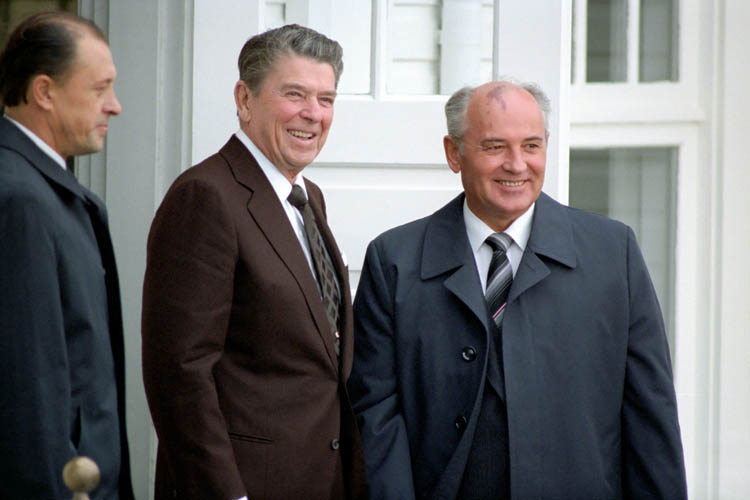
US President Ronald Reagan and Soviet General Secretary Mikhail Gorbachev at the Hofdi House in Reykjavik, Iceland during the Reyjavik Summit in 1986.
Official US government photograph via Wikimedia Commons.

Ronald Reagan once observed that “the trouble with our liberal friends isn’t that they are ignorant, it’s that so much they know isn’t so”. I am repeatedly surprised by Leftists’ ability not to just get something wrong, but to get it spectacularly, 180 degrees wrong.

First, a couple of examples from the archives – some years ago there was an article in the NY Times (or WaPo perhaps) quite distressed that even though crime rates in the U.S. were at historically low levels the percentage of the population in prison was quite high. “Why are we putting so many people in prison when the crime rate is low?” they wondered, seriously. Hmm, how about this – when we put more bad people in prison the crime rate goes down? Keep in mind that the crime rate is what’s happening now, the prison population is who we caught and locked up over the past several years.

Then we had an article in a West Coast newspaper wondering why the homeless population in San Francisco had grown dramatically in recent years despite all the wonderful things the city had done to help them – weekly stipends, free shopping carts, etc. Note that none of this assistance to the homeless enabled them to become independent or required them to better themselves, they were all handouts. How is it that offering lots of goodies to homeless people attracts more of them here?

My point in bringing up these old stories is that it seems impossible that someone could fail to see they had cause and effect reversed. How could someone intelligent enough to write a column get these stories so backwards. The only answer I can see is that their worldview, at least in these areas, flows in only one direction and the underlying premise can never be questioned – putting people in prison is bad, there can be no possible upside, giving homeless people stuff is good, there can be no downside. So, when things get worse it’s a mystery, we can’t reconsider our starting point.

August 8, 2020

Andrew Sullivan – “[T]he Kendi test: does the staff reflect the demographics of New York City as a whole?”

Filed under: Business, Media, Politics, USA — Tags: , , , , — Nicholas @ 05:00

In his latest Weekly Dish, Andrew Sullivan looks at an earnest diversity initiative of The Newspaper Guild of New York:

I’m naming this after Ibram X. Kendi because his core contribution to the current debate on race is the notion that “any measure that produces or sustains racial inequity between racial groups” is racist. Intent is irrelevant. I don’t think many sane people believe A.G. Sulzberger or Dean Baquet are closet bigots. But systemic racism, according to Kendi, exists in any institution if there is simply any outcome that isn’t directly reflective of the relevant racial demographics of the surrounding area.

The appeal of this argument is its simplicity. You can tell if a place is enabling systemic racism merely by counting the people of color in it; and you can tell if a place isn’t by the same rubric. The drawback, of course, is that the world isn’t nearly as simple. Take the actual demographics of New York City. On some measures, the NYT is already a mirror of NYC. Its staff is basically 50 – 50 on sex (with women a slight majority of all staff on the business side, and slight minority in editorial). And it’s 15 percent Asian on the business side, 10 percent in editorial, compared with 13.9 percent of NYC’s population.

But its black percentage of staff — 10 percent in business, 9 percent in editorial — needs more than doubling to reflect demographics. Its Hispanic/Latino staff amount to only 8 percent in business and 5 percent in editorial, compared with 29 percent of New York City’s demographics, the worst discrepancy for any group. NYT’s Newsroom Fellowship, bringing in the very next generation, is 80 percent female, 60 percent people of color (including Asians), and, so far as I can tell, one lone white man. And it’s why NYT‘s new hires are 43 percent people of color, a definition that includes Asian-Americans.

But notice how this new goal obviously doesn’t reflect New York City’s demographics in many other ways. It draws overwhelmingly from the college educated, who account for only 37 percent of New Yorkers, leaving more than 60 percent of the city completed unreflected in the staffing. It cannot include the nearly 19 percent of New Yorkers in poverty, because a NYT salary would end that. It would also have to restrict itself to the literate, and, according to Literacy New York, 25 percent of people in Manhattan “lack basic prose literary skills” along with 37 percent in Brooklyn and 41 percent in the Bronx. And obviously, it cannot reflect the 14 percent of New Yorkers who are of retirement age, or the 21 percent who have yet to reach 18. For that matter, I have no idea what the median age of a NYT employee is — but I bet it isn’t the same as all of New York City.

Around 10 percent of staffers would have to be Republicans (and if the paper of record nationally were to reflect the country as a whole, and not just NYC, around 40 percent would have to be). Some 6 percent of the newsroom would also have to be Haredi or Orthodox Jews — a community you rarely hear about in diversity debates, but one horribly hit by a hate crime surge. 48 percent of NYT employees would have to agree that religion is “very important” in their lives; and 33 percent would be Catholic. And the logic of these demographic quotas is that if a group begins to exceed its quota — say Jews, 13 percent — a Jewish journalist would have to retire for any new one to be hired. Taking this proposal seriously, then, really does require explicit use of race in hiring, which is illegal, which is why the News Guild tweet and memo might end up causing some trouble if the policy is enforced.

And all this leaves the category of “white” completely without nuance. We have no idea whether “white” people are Irish or Italian or Russian or Polish or Canadians in origin. Similarly, we do not know if “black” means African immigrants, or native black New Yorkers, or people from the Caribbean. 37 percent of New Yorkers are foreign-born. How does the Guild propose to mirror that? Ditto where staffers live in NYC. How many are from Staten Island, for example, or the Bronx, two places of extremely different ethnic populations? These categories, in other words, are incredibly crude if the goal really is to reflect the actual demographics of New York City. But it isn’t, of course.

My point is that any attempt to make a specific institution entirely representative of the demographics of its location will founder on the sheer complexity of America’s demographic story and the nature of the institution itself. Journalism, for example, is not a profession sought by most people; it’s self-selecting for curious, trouble-making, querulous assholes who enjoy engaging with others and tracking down the truth (at least it used to be). There’s no reason this skillset or attitude will be spread evenly across populations. It seems, for example, that disproportionate numbers of Jews are drawn to it, from a culture of high literacy, intellectualism, and social activism. So why on earth shouldn’t they be over-represented?

And that’s true of other institutions too: are we to police Broadway to make sure that gays constitute only 4 percent of the employees? Or, say, nursing, to ensure that the sex balance is 50-50? Or a construction company for gender parity? Or a bike messenger company’s staff to be reflective of the age demographics of the city? Just take publishing — an industry not far off what the New York Times does. 74 percent of its employees are women. Should there be a hiring freeze until the men catch up?


August 2, 2020

Words are verbal tools, but tools can be weaponized

In this week’s newsletter, Andrew Sullivan analyzes the roots of wokeness:

In the mid-2010s, a curious new vocabulary began to unspool itself in our media. A data site, storywrangling.org, which measures the frequency of words in news stories, revealed some remarkable shifts. Terms that had previously been almost entirely obscure suddenly became ubiquitous — and an analysis of the New York Times, using these tools, is a useful example. Looking at stories from 1970 to 2018, several terms came out of nowhere in the past few years to reach sudden new heights of repetition and frequency. Here’s a list of the most successful neologisms: non-binary, toxic masculinity, white supremacy, traumatizing, queer, transphobia, whiteness, mansplaining. And here are a few that were rising in frequency in the last decade but only took off in the last few years: triggering, hurtful, gender, stereotypes.

Language changes, and we shouldn’t worry about that. Maybe some of these terms will stick around. But the linguistic changes have occurred so rapidly, and touched so many topics, that it has all the appearance of a top-down re-ordering of language, rather than a slow, organic evolution from below. While the New York Times once had a reputation for being a bit stodgy on linguistic matters, pedantic, precise and slow-to-change, as any paper of record might be, in the last few years, its pages have been flushed with so many neologisms that a reader from, say, a decade ago would have a hard time understanding large swathes of it. And for many of us regular readers, we’ve just gotten used to brand new words popping up suddenly to re-describe something we thought we knew already. We notice a new word, make a brief mental check, and move on with our lives.

But we need to do more than that. We need to understand that all these words have one thing in common: they are products of an esoteric, academic discipline called critical theory, which has gained extraordinary popularity in elite education in the past few decades, and appears to have reached a cultural tipping point in the middle of the 2010s. Most normal people have never heard of this theory — or rather an interlocking web of theories — that is nonetheless changing the very words we speak and write and the very rationale of the institutions integral to liberal democracy.

What we have long needed is an intelligible, intelligent description of this theory which most people can grasp. And we’ve just gotten one: Cynical Theories: How Activist Scholarship Made Everything About Race, Gender and Identity, by former math prof James Lindsay and British academic, Helen Pluckrose. It’s as deep a dive into this often impenetrable philosophy as anyone would want to attempt. But it’s well worth grappling with.

What the book helps the layperson to understand is the evolution of postmodern thought since the 1960s until it became the doctrine of Social Justice today. Beginning as a critique of all grand theories of meaning — from Christianity to Marxism — postmodernism is a project to subvert the intellectual foundations of western culture. The entire concept of reason — whether the Enlightenment version or even the ancient Socratic understanding — is a myth designed to serve the interests of those in power, and therefore deserves to be undermined and “problematized” reason whenever possible. Postmodern theory does so mischievously and irreverently — even as it leaves nothing in reason’s place. The idea of objective truth — even if it is viewed as always somewhat beyond our reach — is abandoned. All we have are narratives, stories, whose meaning is entirely provisional, and can in turn be subverted or problematized.

During the 1980s and 1990s, this somewhat aimless critique of everything hardened into a plan for action. Analyzing how truth was a mere function of power, and then seeing that power used against distinct and oppressed identity groups, led to an understandable desire to do something about it, and to turn this critique into a form of activism. Lindsay and Pluckrose call this “applied postmodernism”, which, in turn, hardened into what we now know as Social Justice.

July 25, 2020

Walter Duranty, Stalin’s tame “journalist”

Filed under: History, Media, Russia, USA — Tags: , , , , , , — Nicholas @ 03:00

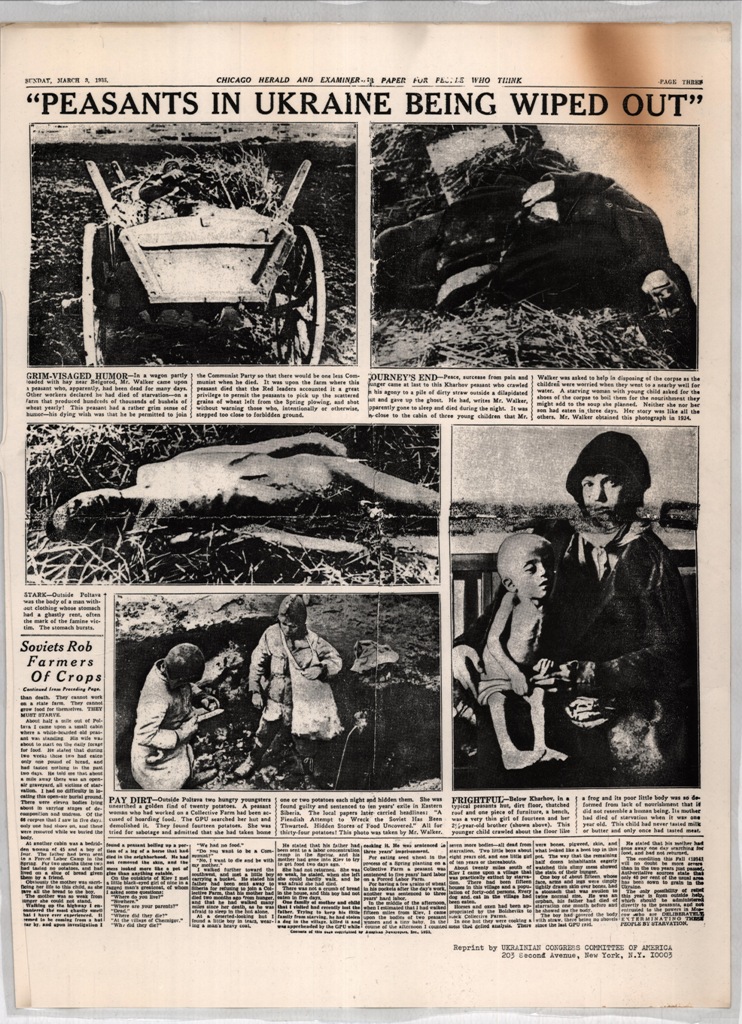
Francis X. Maier makes the case that the Holodomor — the Soviet Union’s deliberate starvation of millions of its own people in Ukraine and surrounding regions — killed even more than the better-known Nazi Holocaust, then identifies one of the key apologists who lied serially and deliberately to hide the genocide:

A page from the Chicago Herald and Examiner from 3 March, 1935.
Wikimedia Commons.

[S.J.] Taylor’s 1990 article was timed to the release of Stalin’s Apologist, her withering biography of journalist Walter Duranty. A Pulitzer Prize winner, celebrated political analyst, and Moscow correspondent for the New York Times during the 1930s, Duranty interviewed Stalin twice. He also played a significant role in securing American diplomatic recognition for the Soviet regime. Less publicly, he was a prodigious womanizer, longtime opium buddy of Satanist Aleister Crowley, compulsive exploiter of friends, a spendthrift, occasional drunk, and an inventive, always-reliable flack for the Soviet regime.

One of Duranty’s lifelong memories involved his religious grandmother who, after catching the adolescent Duranty in a lie, had warned him that “liars go to hell.” He never forgot or forgave the correction. As an adult, he simply erased all family ties and falsely claimed in his autobiography that he’d been orphaned at age ten. Massaging the truth became one of his core skills. Brilliant, engaging, and widely respected at the time, he was, in the words of Malcolm Muggeridge, who also reported from Moscow and saw Duranty in action, “the greatest liar of any journalist I have met in 50 years of journalism.”

Committed to protecting his own influence and to a future “greater good” promised by the Soviet regime, Duranty at first dismissed rumors of the Ukrainian Famine. Then he downplayed them. Then he claimed that Ukraine’s “food shortages” were the result of local mismanagement and the work of “wreckers” and “spoilers” intent on undermining Soviet progress. He repeatedly denied the mass starvation in his reporting. But he did suggest that “you can’t make an omelet without breaking eggs” … especially when the omelet is the task of modernization, and the cooks are tough-minded Bolsheviks intent on a better tomorrow.

As Taylor notes in her book, Western powers struggling with the Great Depression and the rise of Hitler in Germany had little interest in rumors from Ukraine that might antagonize Stalin as a potential ally. Muggeridge had arrived in Russia in 1932 to string for the Manchester Guardian. A convinced socialist at the time, he intended to stay in Russia and renounce his British passport for Soviet citizenship. Reality interfered. By March 1933, he was reporting on Ukraine’s famine as “one of the most monstrous crimes in history,” and his disillusionment with the Soviet paradise was complete. But back in England, thanks in part to Duranty’s counter-reporting and Soviet propaganda, Muggeridge’s work was dismissed as “a hysterical tirade.” Muggeridge himself was slandered, vilified, and unable to find employment. And that might have buried the Holodomor story successfully, except for one man.

Welshman Gareth Jones was a young Russian Studies graduate of Cambridge and a former secretary to British Prime Minister Lloyd George. Stringing for the same Manchester Guardian as Muggeridge, he eluded Soviet press controls and spent three weeks on his own, walking through the hellish conditions of a starvation-ravaged Ukraine. Then he wrote about it in the spring of 1933, confirming and compounding the impact of Muggeridge’s recent work. Walter Duranty led the ferocious, Soviet-prodded attack on Jones’s credibility. He also bullied most other Moscow-based Western journalists — to their enduring disgrace — into doing the same, lest they lose their visas. Jones, however, had a spine. He did not back off. He continued writing and speaking about the famine in Ukraine with lasting effect, until his death under suspicious circumstances two years later.

July 23, 2020

Justin Trudeau and the Overton Window

Filed under: Cancon, Media, Politics — Tags: , , , , , , — Nicholas @ 05:00

Ted Campbell explains how Canada’s mainstream media work so hard to move the Overton Window to benefit Justin Trudeau and the Liberal Party:

… this explanation from Politico might help:

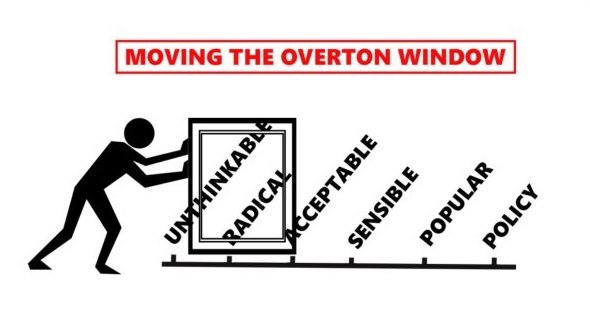
    The concept of the “Overton window,” the range of ideas outside which lie political exile or pariahdom, was first batted around in a series of conversations by the late free-market advocate Joseph Overton in the 1990s. After Overton’s untimely death in a plane crash in 2003, his friend and colleague at the libertarian Mackinac Center, Joseph Lehman, formalized and named the idea in a presentation meant to educate fellow think-tank warriors on the power of consistent advocacy. Ring the bell loudly for your idea, no matter how unpopular, and back it up with plenty of research and evidence, so the thinking went. Today’s fringe theory can become tomorrow’s conventional wisdom by the shifting of the finely tuned gears that move popular opinion; to Overton and Lehman the role of the think tank was to at least familiarize voters with these ideas, giving them an institutional home when public opinion finally moved their way.

Or, and even more brief visual explanation is:

Anyway, I believe that the Liberal Party of Canada and its allies in e.g. the CBC, The Star, and amongst the others who speak for the Laurentian Elites are working very hard, right now, to move the Overton Window frame of one idea from “Unthinkable” to at least barely “Acceptable.” That idea is that Justin Trudeau’s personal corruption (I believe that’s the right word) is acceptable because the alternative is a Conservative government that is, by Liberal/Laurentian Elite definition, authoritarian (fascist), homophobic, militaristic, racist, and sexist.

That’s right, the Liberal/Laurentian Elites admit that Justin Trudeau is dishonest, that he, unthinkingly, breaks the rules, over and over again ~ because, you see, he’s a really nice person but, sadly, he’s just not very smart. I have even made that case for them. I suggested, almost a year ago, that Justin Trudeau is an intellectual lightweight who is in no way qualified to hold high office … but he has the “second hand” celebrity of a famous name and he’s photogenic, too, and so, in 21st-century Canada he’s electable.

« Newer PostsOlder Posts »

Powered by WordPress