
Polyus
Published 21 May 2023The Sea King was a legendary aircraft in the history of the Royal Canadian Navy. It filled the role of hunter and killer in the Cold War against Soviet submarines. By the mid-90s the situation had changed and their retirement seemed eminent. How naive. The process of finding a replacement for this workhorse would be an election promise by government after government for over 30 years. Its replacement, the CH-148 Cyclone, became operational in 2018. This allowed the 55 year old workhorses to finally retire.
(more…)
May 26, 2023
CH-124 Sea King; Legendary ASW helicopter and example of a deeply flawed defense procurement process
Comments Off on CH-124 Sea King; Legendary ASW helicopter and example of a deeply flawed defense procurement process
April 27, 2023
Spending more on defence requires more than just turning on the financial taps
In The Line, Philippe Lagassé explains why just pouring more money into the Department of National Defence won’t automatically improve our defence capabilities:

Canadian defence spending is back in the news, thanks to an open letter urging the government to spend two per cent of GDP on the military and a leaked document suggesting Canada won’t hit that NATO target. Like ending the monarchy, defence spending is one of those issues that gets lots of attention once or twice a year, only to fade away before any serious discussion takes place. It’s unlikely that this time will be any different.
[…]
Even if the government wanted to greatly increase defence spending, though, it would have trouble spending that money effectively in the short term. While more money is needed over the long term, the Department of National Defence (DND) and Canadian Armed Forces (CAF) have to first build up their capacity to spend a much larger budget. As they do so, however, our historical tendency to reduce defence expenditures after pivotal moments should always be kept in mind.
The DND and CAF are already straining to implement the capital equipment and infrastructure programs that were announced in the 2017 defence policy, Strong, Secure, Engaged. This reflects the fact that department’s capacity to manage procurements has to be built back up after decades of anemic capital spending. There aren’t enough people to move the programs that are currently planned, let alone new ones that could be added. Additional money could be funneled to existing projects, but that wouldn’t be enough to cause an increase to two per cent of GDP in the coming years. The capabilities Canada is currently buying will probably be far more expensive to maintain in the future than the government realizes, which strongly suggests that we do need to gradually get to that number, but this reinforces the need for caution and for managing expectations. If ministers insist that new money be attached to still more new capabilities, DND/CAF will not only have trouble acquiring them, but will be unable to afford them.
One could argue that DND/CAF could get around its capacity challenges by simply buying more equipment “off the shelf”. Instead of getting more people to tackle complex procurements and infrastructure projects, the defence department should focus on simpler acquisitions that require less management. It is important to note, though, that “off the shelf” procurements aren’t an obvious solution either — DND and the CAF don’t specify requirements for the hell of it. Many project requirements reflect the need to integrate new capabilities into the existing force, which is no small feat when mixing new and old technologies and operating from installations across a massive country. Projects that gravitate toward “off the shelf” solutions, moreover, can be challenged by competitors who contend that they can develop a new capability that better meets Canada’s needs. Bombardier‘s response to the government’s plan to buy Boeing’s P-8 Poseidon aircraft to fulfil the Canadian Multi-mission Aircraft (CMMA) project is a recent example.
Canada also tends to favour platforms that can perform various missions, which further complicates “off the shelf” procurements, since the equipment sitting on the shelf may not do everything the CAF needs it to do. Unless we want the CAF to be less capable, the way to address this issue is to acquire more platforms that do specific things. The problem is that the CAF would need more people to acquire, operate, and maintain these additional fleets, still more money to sustain this extra equipment, and yet more infrastructure to store it. This approach promises to exacerbate the very problems it’s supposed to solve.
April 24, 2023
Canada won’t meet its defence spending targets, and Trudeau is totally fine saying this to our allies, if not to the public
Canadian defence freeloading has been a hallmark of Canadian government policy since 1968, and as The Line confirms in their weekend dispatch, it should be no surprise that Justin Trudeau is okay continuing his father’s basic policies:
A story we’ve been watching in recent weeks was the remarkable leak of sensitive U.S. national security documents onto the dark web, and from there, widely across social media. A young member of the Air National Guard has been arrested and now faces serious charges. News reports suggest that he had access to classified material at work and began sharing it privately with a small group of online friends, apparently simply to impress and inform them, with no broader political agenda. Some of those friends, in turn, appear to have leaked the documents further afield. It took months before anyone noticed, but once picked up by several individuals with large followings — including some who are none-too-friendly to the U.S. and Western alliance — the story exploded and the full scope of the leak was finally discovered.
This is, for the U.S., a huge embarrassment and a diplomatic nightmare. For us, it was simply a fascinating story. This week, though, we suddenly had the coveted Canadian Angle: the Washington Post claims to have reviewed one of the leaked documents, apparently prepared for the American Joint Chiefs of Staff, that assesses Canada’s military serious military deficiencies, and also reports that Prime Minister Justin Trudeau has privately told fellow NATO leaders that Canada isn’t going to hit NATO’s two-per-cent-of-GDP spending target.
To wit:
“Widespread defense shortfalls hinder Canadian capabilities,” the document says, “while straining partner relationships and alliance contributions.”
The assessment, which bears the seal of the U.S. Joint Chiefs of Staff, says Germany is concerned about whether the Canadian Armed Forces can continue to aid Ukraine while meeting its NATO pledges. Turkey is “disappointed” by the Canadian military’s “refusal” to support the transport of humanitarian aid after February’s deadly earthquake there, the document says, and Haiti is “frustrated” by Ottawa’s reluctance to lead a multinational security mission to that crisis-racked nation.
Your Line editors just sort of sighed heavily and rubbed their temples when they read that. It was, to us, nothing we didn’t know already. It was actually almost some kind of a relief to know that the PM will at least say privately what he won’t admit publicly: we aren’t living up to our pledge, and don’t plan to.
The Post says that Trudeau told NATO that there won’t be much more military spending in this country until the political situation here changes. We aren’t sure if he meant the priorities of the voters or the composition of our parliament. It doesn’t matter — it’s true either way. We are disappointed, but again, in no way surprised, to see Trudeau seeing this as an issue that he’ll just accept as-is, as opposed to attempting the hard work of showing actual leadership. He’s always been more about the easy path of demonstrative gestures instead of working hard to achieve real change.
But hey. In this, he has a lot of company. The Tories under Harper were marginally better on defence, but not nearly good enough. We have little faith — next to none, really — that PM Poilievre would do any better on defence. What bums us out the most about this issue is that we recognize and even agree that the choice to neglect defence and shovel those dollars instead into other, more popular vote-buying files does indeed make political sense. It’s what the voters want. We wish it were otherwise. We’ve spent big chunks of our careers trying to change their minds. Our record to date is one of total, utter failure.
Still, never say die, right? So we’ll make this point: we understand and accept the criticism sometimes made by Canadian commentators, who argue that the two-per-cent-of-GDP target is arbitrary and somewhat meaningless. We don’t entirely agree — targets are useful, and two per cent seems reasonable. But we’d be open to an argument that Canada could still punch above its weight in the alliance, even while spending less, if we could deliver key capabilities.
But … we can’t. We probably could, once upon a time, but we can’t even do that now. The air force is a mess. The navy is a mess. The army is a disaster, and couldn’t even send Nova Scotia all the help it asked for after Hurricane Fiona. Sending a token plane or ship on a quick foreign jaunt is symbolism, not above-weight-punching. And the symbolism taps us out.
So we have to pick what we’re doing here, fellow Canucks. We can meet the two-per-cent target. We can find other ways to meaningfully contribute. Or we can do neither of those things, and admit it, but only in private. Right now, alas, we’ve chosen that third option. We see no sign that’ll be changing any time soon.

Pierre Trudeau discovered that Canadian voters are all too willing to accept “peace dividends” in the form of shorting defence spending to goose non-military spending, and few prime ministers since then have done much more than gesture vaguely at changing it. Worse, it’s also quite accepted practice for defence procurement to prioritize “regional economic benefits” over any actual military requirement, which often means Canada buys fewer items (ships, planes, helicopters, tanks, trucks, etc.) at significantly higher prices as long as there’s a shiny new plant in Quebec or New Brunswick that can be the backdrop for government ministers and party MPs to use as a backdrop during the next election campaign. Military capability barely scrapes into the bottom of the priority list on the few occasions that the government feels obligated to spend new money on the Canadian Armed Forces.
Worse, every penny of “new” spending on the military gets announced many times over before any actual cheques are issued, which helps to disguise the fact that it’s the same thing all over again — sometimes for periods stretching out into years. The Canadian military has a well-deserved reputation for keeping ancient equipment up and running for years (or decades) after all our peer nations have moved on to newer kit. It’s a tribute to the technical and maintenance skills of the units involved, but it probably absorbs far more resources to do it over replacing the stuff when it begins to wear out, and it reduces the number available to, and the combat effectiveness of, the front-line troops when they are needed.
Comments Off on Canada won’t meet its defence spending targets, and Trudeau is totally fine saying this to our allies, if not to the public
January 2, 2023
An in-depth look at the Type 26 frigate design
Navy Lookout
Published 31 Dec 2022The Type 26 frigates being built for the Royal Navy [and Royal Canadian and Royal Australian navies] are specialist submarine hunters but with a range of other capabilities. This video provides a primer on the overall warship design, its weapons, sensors and decoys.
(more…)
Comments Off on An in-depth look at the Type 26 frigate design
August 6, 2022
Canada’s New Warship
Frontline Pros
Published 12 Feb 2022The Type 26 Frigate will become the first dedicated warship Canada has built in decades. Soon the Royal Canadian Navy will take ownership of 15 of these vessels, making them the largest owner of the Type 26 in the world.
(more…)
Comments Off on Canada’s New Warship
July 10, 2022
Seven easy steps to fix military procurement
CDR Salamander wrote these for the US military, so some of them are far out-of-scale for tiddlers like the Canadian Armed Forces, but the spirit is still valid and relevant:
1. No weapon system presently under production will be allowed to stop production until its replacement is under production itself.
2. Acknowledge we have lied to ourselves for decades actual magazine requirements in war (use “new” lessons from the Russo-Ukraine War for the tender to save face — whatever works) — and accelerate/restart production of everything from ASW weapons to strike weapons of all types.
3. Acknowledge that we do not have enough weapons — specifically anti-air and land attack — on our warships. Every war proves this and recent experience tells us this.
4. If I take away your access to satellite VOX & DATA and you cannot navigate and fight, you are not a wartime asset and your funding sent somewhere useful.
5. Accelerate capacity for repair away from fleet concentration areas, preferably afloat. Maximize production of sealift and begin the process to replace the C-5M.
6. If your combat unit does not have organic, robust unmanned ISR under the command of your unit’s commander, you are worthless in the war to come and you will have such a capability by FY25 or you will be disestablished.
7. Pass the Salamander Bill: no General of Flag Officer shall, for a period no less than 5-yrs from retirement date, receive compensation of any kind or anything of value from any publicly or privately held company that does business with the federal government, nor shall they serve in any non-paid positions with same.
Yes, #7 is important. If you have not realized why in 2022, you are part of the problem.
Comments Off on Seven easy steps to fix military procurement
March 31, 2022
Canada’s F-35 procurement process — “Dysfunctional, but, like, a masterpiece of dysfunction.”
In The Line, Matt Gurney reveals the embarrassing secret of his life: he has “a favourite Canadian military procurement fiasco”. He’s quite right that there’s a distressingly wide variety of procurement cock-ups to choose from since the 1960s, but in his opinion the F-35 saga is the best:
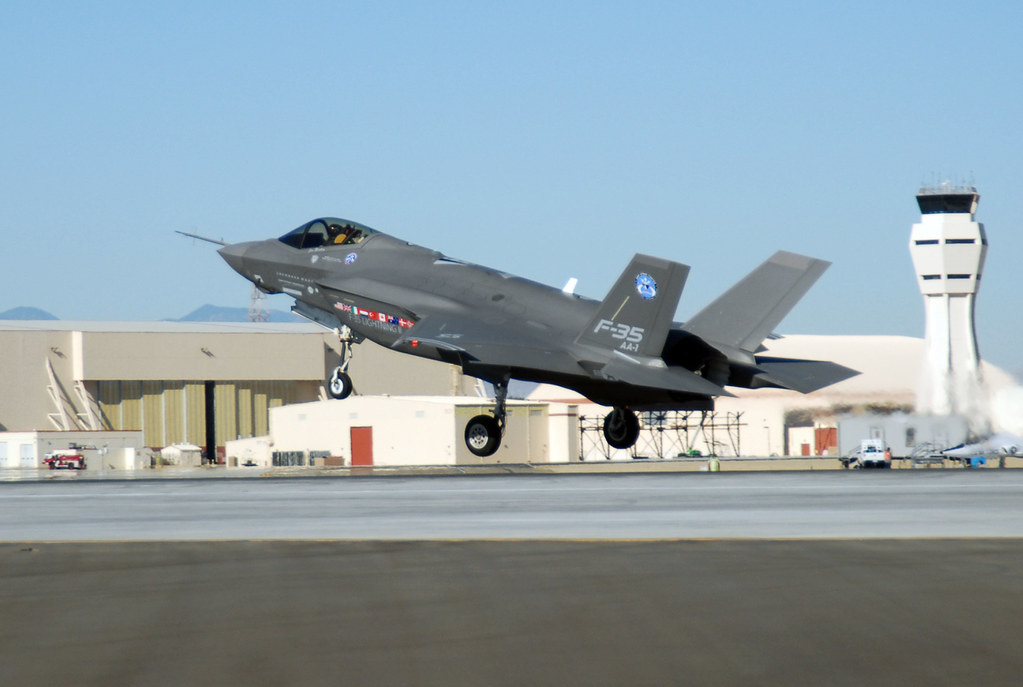
“F-35 Lightning II completes Edwards testing” by MultiplyLeadership is licensed under CC BY 2.0

Having a favourite Canadian military procurement fiasco feels perverse, in a way. It’s like having a favourite gruesome sports injury. Procurement fiascos are bad. We want fewer of them. There’s nothing to be celebrated when yet another one barfs all over the national rug. And yet I find myself indulging a bizarre fondness for a mostly overlooked low point in our long, embarrassing journey to this week’s re-decision to buy a fleet of F-35 fighter jets for the Royal Canadian Air Force. As bad as the low point was — and it was really bad — it also so perfectly summed up our utterly manifest dysfunction that I’ve come to almost admire it. It’s awful, but it’s a pure form of awful. Dysfunctional, but, like, a masterpiece of dysfunction. You couldn’t ask for a better example of what’s wrong with us.
[…]
That wasn’t the original plan; the Liberals first proposed buying 18 new F-18 SuperHornets, the more advanced American successor to the original F-18. That idea fell through due to a trade spat between Canadian darling Bombardier and Boeing, the SuperHornet manufacturer. This was the point of no return: the Boeing dispute was another opportunity for the Liberals to sigh, pop a few Tums and then just do the right thing and proceed with the full replacement as quickly as possible.
They did not. And this, dear readers, is where this embarrassing chapter of our already pathetic history of military procurement reached maximum absurdity.
With our CF-18 fleet at a state of exhaustion, and Boeing in Trudeau’s dog house, instead of actually replacing our old, exhausted jets with new jets, we just gave the air force enough old, exhausted Australian jets so that the RCAF could cobble enough workable jets and spare parts together to allow the Liberals to further delay any decision on a real replacement program.
When you write a lot about military procurement, as I certainly have, you can’t help but grow a bit (!) jaded and cynical. Even by the standards of my appallingly lowered expectations, though, this was an outrageous decision. As I said above, it’s so bad, so cynical, so crassly political, that it has perversely become something I almost admire, in a twisted way. It’s an almost too-brutal-to-be-believed example of politicians dodging accountability and leadership like Keanu bobbing and weaving out of the path of CGI bullets. Every dollar and hour of time we put into scooping up Australia’s leftover jets — they were unneeded because Australia was competent enough to procure more advanced SuperHornets and, ahem, F-35s — was money and time spent not to improve the readiness and capabilities of the Canadian Armed Forces, but to permit the Liberals to avoid acknowledging they’d made a dumb campaign promise.
Stephen Harper failed the Canadian Armed Forces and Canada generally by not getting the ball rolling on a replacement during his majority term. This was a major failure by the Conservatives that they get all awkward and squirmy about when you bring up, but we should bring it up. The CPC botched this, badly, and should feel shame. Justin Trudeau then repeated that failure, and then took it up a level. In this race to the bottom, where no one looks good, Trudeau “wins” by simple virtue of snapping up used jets — the last of which only arrived last spring! — to buy his government time to do absolutely nothing.
Comments Off on Canada’s F-35 procurement process — “Dysfunctional, but, like, a masterpiece of dysfunction.”
March 30, 2022
The RCAF’s long, sad F-35 story
In The Line, Mitch Heimpel tries (without either laughing or crying) to tell the story of how the Canadian government finally got around to admitting they should have bought the F-35 fourteen years ago (when the RCAF told them it was the best fit for our national requirements):
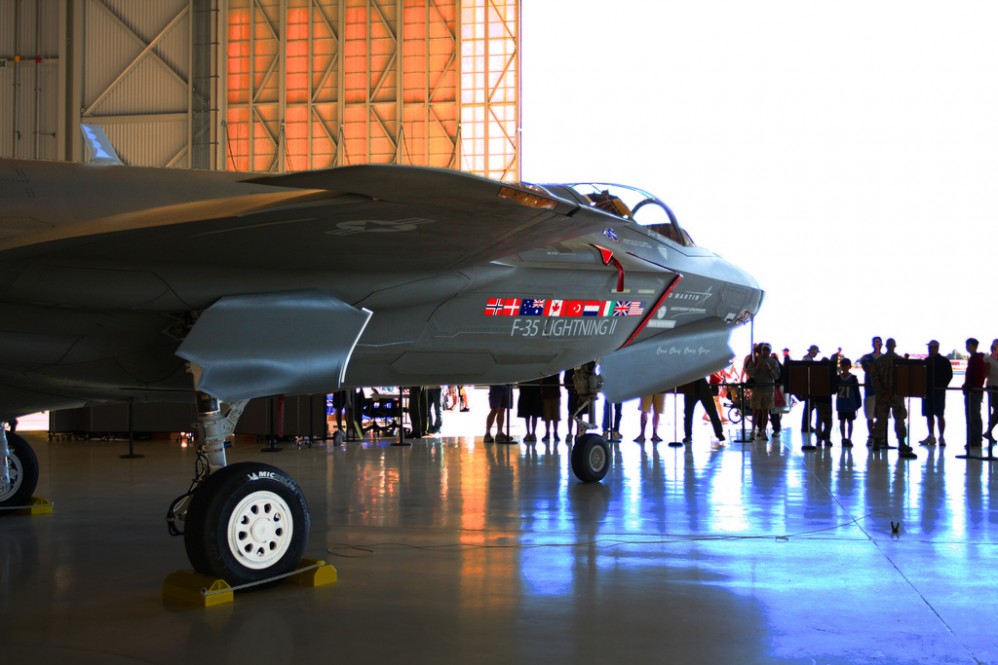
If you’re looking for a simple meta-explanation for all of us, it would be this: Canadian politicians refuse to tell the public one simple truth — military procurement is expensive. There isn’t an inexpensive version of this. That doesn’t mean we should accept any and all costs just because it’s going to be expensive. It does mean that politicians have to stop trying to sell us on there being an inexpensive, or perfect, version of this. There is no MacGyver version of military procurement. No amount of rubber bands and paper clips replaces jet engines and submarines, no matter how many times we pretend it will. Indeed, the longer you delay, the more it’ll cost — the weapons generally get more expensive, and you end up spending more money to wring every last bit of use out of what equipment you already have, instead of replacing it in an efficient, orderly way.
So, let’s recap: We are, in fact, so bad at procurement that we ran a process for years, and then cancelled it. And then pledged not to buy the jets we’d originally pleged to buy. We then bought seven old Australian F-18s so we could keep our elderly and dwindling CF-18 fleet from experiencing a “capability gap” caused mostly by not just buying the F-35 in the first place. Then, almost 12 years after announcing we were going to buy the F-35, after all the drama above, we’ve announced we’ll buy the F-35, after all. Eighty eight of them, in fact. So there’s that, I guess.
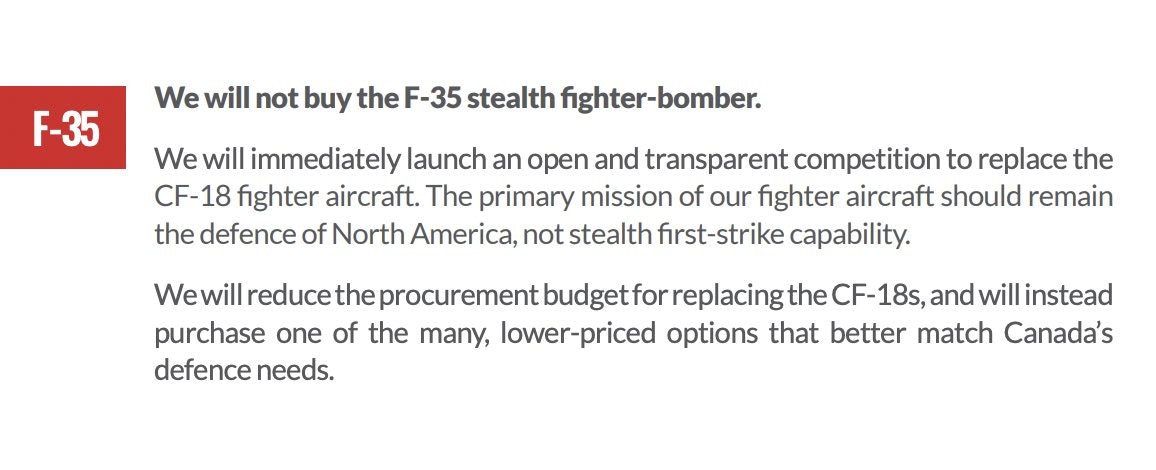
In so many ways, the F-35 saga is another symbol of seven years of Trudeau governance. In 2015, the Liberals could not have been more clear in their campaign platform, which included a whole section titled “We will not buy the F-35 stealth bomber-fighter.”
What were Ministers Anand and Tassi out saying when the F-35 announcement was made this week? “Best plane” and “best price.” Which was true in 2008 when we were first told it was the only fighter that met our needs. It was still true when the Harper government blinked in 2012, and still true when Justin Trudeau was accusing the government of “whipping out” our CF-18s while on the opposition benches in 2014. Remained true in 2015 when the Liberals campaigned against it, too, and every year since.
We have no reason to believe that what is supposed to be a $19-billion announcement for 88 planes to begin delivery in 2025 will actually end up being any of those things. Don’t be surprised if we spend more money to get fewer jets at a later date. But we are now well past the point of being able to blame anyone other than ourselves for cost overruns or late deliveries. The Canadian government failed the Royal Canadian Air Force in this procurement. That is beyond dispute. These guys need the planes. They have for years.
Let’s hope we’ve at least been sufficiently embarrassed by this experience to be more serious when we have to talk about submarines, which is now, come to think of it.
But I doubt it.
Comments Off on The RCAF’s long, sad F-35 story
March 15, 2022
For military procurement blunders, “no nation has mastered the ability to step on every bloody rake quite as well as Canada”
Germany has announced that they will be purchasing US F-35 stealth fighters as part of their re-armament program. My favourite headline on this was over at Blazing Cat Fur: “Germany To Buy 35 Lockheed F-35 Fighter Jets From U.S. Amid Ukraine Crisis … Canada Will Buy Cool ‘Fighter Jet Stickers’ With Eco-Friendly Adhesive”
On a more serious tone — but with sadly the same basic message — Mitch Heimpel looks at the multi-generational rolling catastrophe that is Canadian military procurement since the unification of the forces in 1968:
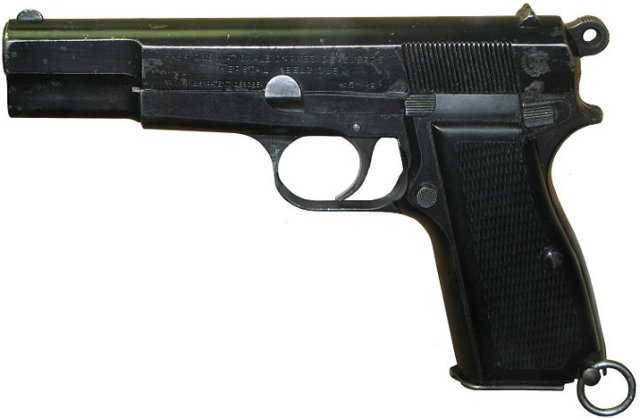
Browning High Power 9mm, the standard side-arm of the Canadian army since WW2. When I was in the reserves, we were told this was due for replacement in a few years. I was in the reserves from 1976-1980. It still hasn’t been replaced.
To say we have a checkered history with military procurement, fails to capture exactly how bad it is. Our political leadership has failed us continually over the course of half a century. No party has done it well. Some have done it better than others. But no one can claim any kind of bragging rights.
Fighter jet procurement in this country is so fraught it once caused the birth of a new political party. Trying to buy helicopters helped bring down a government. We only successfully bought those helicopters after they [the old helicopters] became a greater danger to the personnel manning them than they were to any potential adversary. We have been running a procurement for the next generation of fighter jets for an entire generation. Even Yes, Minister writers would have given up on something that absurd.
Our submarine fleet seems to be almost permanently in dry dock. Our most recent ship procurement resulted in the absolutely monstrous prosecution of one of the country’s most accomplished military leaders.
And we just issued a revised bid to finally replace our Second World War-era pistols … last week.
Just cataloguing that level of incompetence is exhausting. No leader or party looks good. The civil service, as the one constant through all these cartoonish blunders, surely has to wear some of this, too. The fact that we seem to repeat the same mistakes can, at least in part, be attributed to a significant institutional memory failure on the part of the people trusted with having the institutional memory.
Now, it is worth noting in fairness that no nation has an easy time with large scale military procurement. Ask the Americans about the development of the V-22 sometime. But, still, no nation has mastered the ability to step on every bloody rake quite as well as Canada.
I’m not a hardware expert. I can’t tell you which pistol we should buy. There’s also genuine policy questions here that need to be settled — I don’t know whether we should focus on the navy because we’re an Arctic nation, or the air force because it allows us to participate more readily in allied force projection exercises — like, say, no-fly zones? The necessary mix for Canada is no doubt some of both, and it’s fine to have disagreements between parties on what the right mix is.
But setting that aside, I want to talk about what it would take politically, to get us to start taking procurement seriously — just a few basic rules that any government would need to follow to procure anything that they chose was important for Canada to have.
Comments Off on For military procurement blunders, “no nation has mastered the ability to step on every bloody rake quite as well as Canada”
May 15, 2021
Adventures in military procurement
Back in September, Matt Gurney wrote about the generations-long travesty that is the Canadian government’s procurement system for the Canadian Armed Forces. I missed it at the time, but — this is a shock, I know — it’s still fully accurate and up-to-date, because the government hasn’t done anything to address the blatant failings of the “system”:
Browning High Power 9mm, the standard side-arm of the Canadian army since WW2.
Some history first: during the Second World War, Canada manufactured hundreds of thousands of Browning “Hi-Power” 9mm pistols. The pistols were originally made by Belgian manufacturer FN, but Belgium, of course, was overrun by the Nazis early in the war. The schematics and part diagrams were evacuated before the Germans arrived and the pistol saw service in numerous allied militaries. The Canadian army ended up acquiring 60,000 of them, all built in 1944 and 1945. And here’s where things get bonkers: we’ve never replaced them. Some Canadian military units have used more modern pistols, acquired in smaller batches, but the standard sidearm of the Canadian Armed Forces, today, isn’t just the same kind of pistol we used in the Second World War. It’s literally the same pistols.
Reliability issues with the pistols are a chronic problem. I mean, they’re 75 years old, and they’ve been in use continuously. Our military weapons technicians do what they can, and they’ve been stripping some pistols for spare parts to put into other pistols for decades. But the Hi-Powers are in desperate need of a replacement. They’re a generation overdue for replacement. But in keeping with the finest traditions of Canadian military procurement, we can’t get it done. It’s beyond our ability.
We’ve tried, sort of. At the start of 2017, the military began work on a replacement program that would have procured up to 25,000 new 9mm semi-automatic pistols for the Canadian Armed Forces. The military gave itself 10 years to get this accomplished and budgeted $50 million. It’s hard to overstate how crazy that is. Pistols aren’t complicated. If you have a credit card and a firearms licence, you can walk into a store and buy one. A lot of what the military needs is super complex and custom-made. Pistols are easy. There are factories all over the world that are already producing proven, reliable, affordable designs. Buying new pistols has got to be about the simplest procurement any military is ever going to face. And we still thought we’d need 10 years to do it. A decade.
The amazing thing is, by total fluke, in 2016, the British also decided they needed new pistols. And they also decided they needed 25,000 of them. This is entirely coincidental, but it’s a fantastically convenient coincidence: it’s a rare apples-to-apples comparison of two national procurement systems. And how’d it go?
Well, the Brits selected a type of pistol, purchased 25,000 of them and issued them to their military units by 2018. They wrapped the whole thing up in two years. The total cost was $15,000,000.
In Canada, we set a 10-year goal for the same thing, budgeted more than three times as much … but never got it off the ground. No progress was made.
So now, the military is trying again.
When I was in the militia in the late 1970s, we trained with the Browning, although even then we were told it was slated to be replaced within a few years. After thirty-some years of heavy use, the guns were still going strong, but definitely showing significant signs of wear and were probably already at the point they should have been retired even then.
March 17, 2021
Rebuilding the Royal Canadian Navy
I somehow missed this article by Sir Humphrey when he posted it a few weeks back. He’s looking at the Australian and Canadian governments’ respective decisions to use the British Type 26 design to replace their current anti-submarine fleets and considering some of the economic and military concerns that led to the decision.
In both cases there have been media articles in the last week over the programmes and concerns. In Canada, the challenge has been that the cost has grown to a total of $77bn for 15 escorts. There has been cost growth from an originally scheduled $14bn many years ago, and the first of class will not now be delivered until 2031. This has led to suggestions in some media quarters that Canada could do things faster and more cheaply if it simply bought an off the shelf foreign design now and got on with things.
An artist’s rendition of BAE’s Type 26 Global Combat Ship, which was selected as the Canadian Surface Combatant design in 2019, the most recent “largest single expenditure in Canadian government history” (as all major weapon systems purchases tend to be).
(BAE Systems, via Flickr)[…]
The issue now is that Canada will need to establish, almost from scratch, a frigate construction programme and workforce for a finite period of time without a clear plan of what follows on when the last hull is completed. At the same time it will need to run on ships that are becoming increasingly elderly – it is likely that most of the Halifax class will see more than 40 years of service, and some may approach their 50th birthdays before being replaced – something that will pose an increasing maintenance and resource challenge.
Could things be done more cheaply or quickly? Almost certainly yes, but only if you are willing to make massive compromises. It could be possible, for example, to look to licence build an existing design that is already in service. There are plenty of designs out there that could be licence built and brought into service in the next few years — probably at less cost than the T26 programme.
But while this may sound easy, its also a recipe for disaster. It’s easy to look at country X and say “they’re buying this ship for that much” and assume that Canada is getting a bad deal. But Country X is likely to have a very different set of requirements, and their design will reflect it.
For example, Canada needs a ship able to operate with NATO and 5 EYES as a fully integrated player – this adds cost to fit specific systems and equipment that is compatible. Canada will also want to fit bespoke systems to meet national needs – again this will require design changes, that come at a price. Bolting on all manner of different requirements that Canada needs to meet the unique operational circumstances adds price and complexity to the design.
While you probably could take an off the shelf design and build it now, it would be just that, an off the shelf design. It wouldn’t be optimised for local needs, and it wouldn’t have the right equipment, comms, meet local design standards, or be certified for use with national equipment.
You are then faced with two choices – either bring a cheap ship into service that is entirely unsuitable and not designed for your needs, but is a lot cheaper, or spend an enormous amount of money shifting the design to better reflect your needs. If you choose the latter, then suddenly you are adding cost and time in, and the 2031 date will slip even further.
If you choose the former, then you have to accept that the design is “as it comes” and will have minimal Canadian input – so limited industrial offsets, very little economic benefit, and the long-term support solutions will firmly be tied into the country of origin and not Canada. In other words, Canadian taxpayer dollars will be spent to support a foreign economy.
That last point is really the key. Canadian governments, in my lifetime at least, never look at the military requirement as the top priority and sometimes not even the second or third priority. The economic spin-offs, especially in those cases where the benefits can be allocated to marginal parliamentary constituencies, will be the top priority. As is always a talking point in the case of any major military hardware acquisition, this is going to be the “single largest expenditure in Canadian government history”. Just as the replacement of the RCAF’s aged CF-18 fighters will be the largest expenditure in its turn.
Comments Off on Rebuilding the Royal Canadian Navy
March 2, 2021
Warship purchasing is not for the faint-of-heart
Ted Campbell talks about the way the Royal Canadian Navy plans for warship purchases … and how the best-laid plans can be derailed by ignorant political advisors:
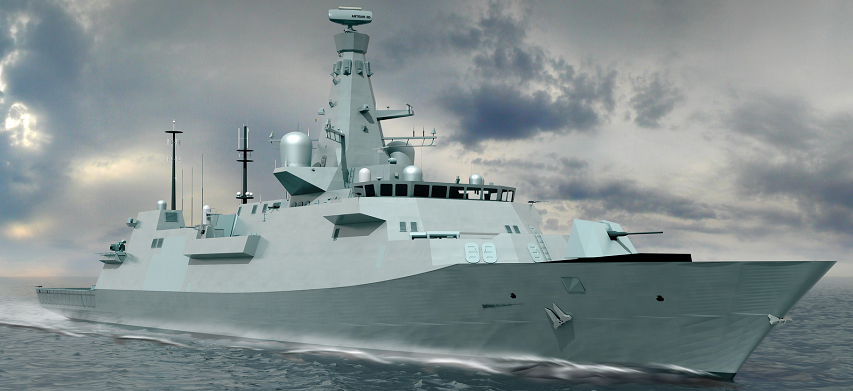
An artist’s rendition of BAE’s Type 26 Global Combat Ship, which was selected as the Canadian Surface Combatant design in 2019, the most recent “largest single expenditure in Canadian government history” (until the RCAF gets their replacement for the CF-18 Hornet).
(BAE Systems, via Flickr)
Once upon time,* about 25 to 30 years ago, in the mid 1990s, when I was the director of a small, very specialized team in National Defence Headquarters (NDHQ) in Ottawa, something like this happened: One of my colleague, who had a title like Director of Maritime Requirements or something similar said to one of his principle subordinates, “Look, now that the 280s (Canada had four Tribal Class destroyers with pennant numbers starting at 280, they were often just called ‘280s’) are finished their mid-life refit and now that the new frigates are entering service it is time to put a ‘placeholder’ in the DSP for their eventual replacements.” The DSP was (still is?) the Defence Services Programme, it is the internal document which sets out the long range spending plans (maybe hopes is a better word) for the Canadian Armed Forces.
Anyway, the Navy commander (the officer assigned to write the document, not the Commander of the Royal Canadian Navy who is nicknamed the Kraken (CRCN)) sat at his desk and consulted the most recently approved planning document which, as far as I can remember, called for a surface fleet of 25 combat vessels and four large support ships plus numerous minor war vessels (like minesweepers) and training vessels. The officer then prepared a memorandum for the joint planning staff which said that the Navy would need 25 new combat ships, to be procured between about 2015 and 2035, in five “batches” of five ships each** at a total cost of about $100 Billion, in 2025 dollars. He didn’t say much beyond that, actually, he was just intending to “reserve” some money a generation or so in the future. His memorandum sailed, smoothly, past his boss and the commodore but questions came from a very senior Air Force general: Where he asked, did the $100 Billion come from? That was an outrageous number, he said.
A meeting ensure where the Navy engineering people came and said, “$100 Billion is a very reasonable guesstimate. Our brand new frigate are costing $1 Billion each when they come down the slipway. They will each have cost the taxpayers two to three times that by the time we send them to be broken up thirty or forty years from now. Adding in the inevitable costs of new technology and inflation, which we know is higher for things like military ships and aircraft than it is for consumer goods, then a life-cycle cost of $4 Billion for each ship is very conservative. The admirals and generals huffed and puffed but they didn’t argue ~ they knew that the engineering branch insisted on using life cycle costing, even though no-one but them understood it, and they also knew that arguing with engineers is like mud-wrestling with pigs: everyone gets dirty but the pigs love it.
A decade later, when a new government was planning the National Shipbuilding Procurement Strategy, which was all about making the Canadian shipbuilding industry competitive and had very little to do with ships ~ except they would be the “product” for which the Government of Canada would pay top-dollar, the Navy was told it could have fewer ships, in two classes, and someone ~ NOT the military’s engineering branch ~ assigned a cost figure to the project which was, to be charitable, pulled out of some political/public relations staffer’s arse.
[…]
* The story is true, in general, but I was not directly involved in any of it. I learned about what happened from three main sources: 1. routine briefings that my bosses (directors-general and branch chiefs) gave, regularly, to we directors, dealing with what was going on in the HQ and in the big wide world; 2. periodic chats with my colleagues, after work on Friday afternoons, in the bar of the Officers’ Mess ~ many of us regarded 2. as a more reliable source of information than 1.; and 3. in the case of the story about the Navy engineers and the Air Force general, by a friend and colleague who was in the room.
** The idea, long before the National Shipbuilding Strategy, was to keep shipyards moderately busy on a continuous basis. The 25 ships would all be similar: the first “batch” of five would be identical, one to the other; the second “batch” would be very similar but with some improvements; the five ships of batch 3 would be similar to the ships from the second batch and those from batch 4 would be rather like their batch 3 sisters. Finally, the batch 5 ships would be product improved versions of batch 4 ~ they would still be “sisters” of the batch 1 ships, but not, in any way, twins. The idea was that about the time that the batch 5 ships were being delivered the first of the batch 1 ships would be getting ready for a mid-life refit (after 15 to 20 years of service) which would result in it being much more like the batch 5 ships … and so on.
Comments Off on Warship purchasing is not for the faint-of-heart
June 27, 2020
QotD: The cost of military equipment
Major military hardware is produced in only limited quantities and involves a massive amount of research, development, and engineering before the first unit goes into service. Because of this, the companies that build it are rarely willing to take the risk of paying for the development themselves and recovering the cost from the units that they sell. What if the customer suddenly decides to cut their buy in half? To avoid this problem, development is paid for by the customer separately from procurement of each item. Well, more or less. The actual answer varies with each particular system, accounting method, and time of the month. But in general, costs break down that way.
So why does this cause so much confusion? Well, it all has to do with what gets reported. Someone who is trying to make the case that some program is outrageously expensive and should be cancelled is going to lump together development and procurement, divide by the number of systems involved, and then publish the resulting number. But, particularly when we’re discussing the cost of a system about to enter production, that’s very different from the actual numbers. To give a well-known example, the B-2 is generally reputed to have cost about $2 billion/plane in the 90s. However, this is the total program cost divided by the 21 airframes. If we’d decided to buy 22 B-2s instead of the 21 we did buy, the extra plane would have cost only $700 million or so. Admittedly, the B-2 is a rather extreme case, and usually the share of R&D cost is less than the procurement (flyaway) cost, but it’s illustrative of the power of this kind of framing.
“bean”, “Military Procurement – Pricing”, Naval Gazing, 2018-03-09.
Comments Off on QotD: The cost of military equipment
August 5, 2019
How Boeing lost its mojo
Rafe Champion linked to this interesting thumbnail-sketch history of the decline and fall of Boeing:

“Boeing 521 427”by pmbell64 is licensed under CC BY-SA 2.0


Let’s start by admiring the company that was Boeing, so we can know what has been lost. As one journalist put it in 2000, “Boeing has always been less a business than an association of engineers devoted to building amazing flying machines.”
For the bulk of the 20th century, Boeing made miracles. Its engineers designed the B-52 in a weekend, bet the company on the 707, and built the 747 despite deep observer skepticism. The 737 started coming off the assembly line in 1967, and it was such a good design it was still the company’s top moneymaker thirty years later.
How did Boeing make miracles in civilian aircraft? In short, the the civilian engineers were in charge. And it fell apart because the company, due to a merger, killed its engineering-first culture.
What Happened?
In 1993, Clinton’s Deputy Secretary of Defense, Bill Perry, called defense contractor CEOs to a dinner, nicknamed “the last supper.” He told them to merge with each other so as, in the classic excuse used by monopolists, to find efficiencies in their businesses. The rationale was that post-Cold War era military spending reductions demanded a leaner defense base. In reality, Perry had been a long-time mergers and acquisitions investment banker working with industry ally Norm Augustine, the eventual CEO of Lockheed Martin.
Perry was so aggressive about encouraging mergers that he put together an accounting scheme to have the Pentagon itself pay merger costs, which resulted in a bevy of consolidation among contractors and subcontractors. In 1997, Boeing, with both a commercial and military division, ended up buying McDonnell Douglas, a major aerospace company and competitor. With this purchase, the airline market radically consolidated.
Unlike Boeing, McDonnell Douglas was run by financiers rather than engineers. And though Boeing was the buyer, McDonnell Douglas executives somehow took power in what analysts started calling a “reverse takeover.” The joke in Seattle was, “McDonnell Douglas bought Boeing with Boeing’s money.”
[…]
The key corporate protection that had protected Boeing engineering culture was a wall inside the company between the civilian division and military divisions. This wall was designed to prevent the military procurement process from corrupting civilian aviation. As aerospace engineers Pierre Sprey and Chuck Spinney noted, military procurement and engineering created a corrupt design process, with unnecessary complexity, poor safety standards, “wishful thinking projections” on performance, and so forth. Military contractors subcontract based on political concerns, not engineering ones. If contractors need to influence a Senator from Montana, they will place production of a component in Montana, even if no one in the state can do the work.
Comments Off on How Boeing lost its mojo
June 27, 2019
$26B, $56B, $70B, and pretty soon you’re talking real money
The headline refers to the constant upward movement of various estimates on how much the Canadian government will be required to spend on the Canadian Surface Combatant program. In shorthand, that’s the money required to replace the Royal Canadian Navy’s current fleet of 12 frigates and the Iroquois-class destroyers that have already been retired from service. The Halifax-class frigates began entering service in the early 1990s and were designed to operate for about thirty years, meaning the RCN needs replacements to start coming into the fleet in the mid-2020s. The government initially budgeted around $26B for fifteen ships in 2008, but as with so many military equipment programs, no actual steel has been cut to begin building the new ships … in fact the design was only formally agreed in October 2018 and not signed (due to a lawsuit from one of the losing bidders) until February of this year. We’re still probably 2-3 years away from construction of the first ship in the class beginning, which will mean the Halifax class will have to remain on duty for longer (and older ships require more frequent and more expensive maintenance).
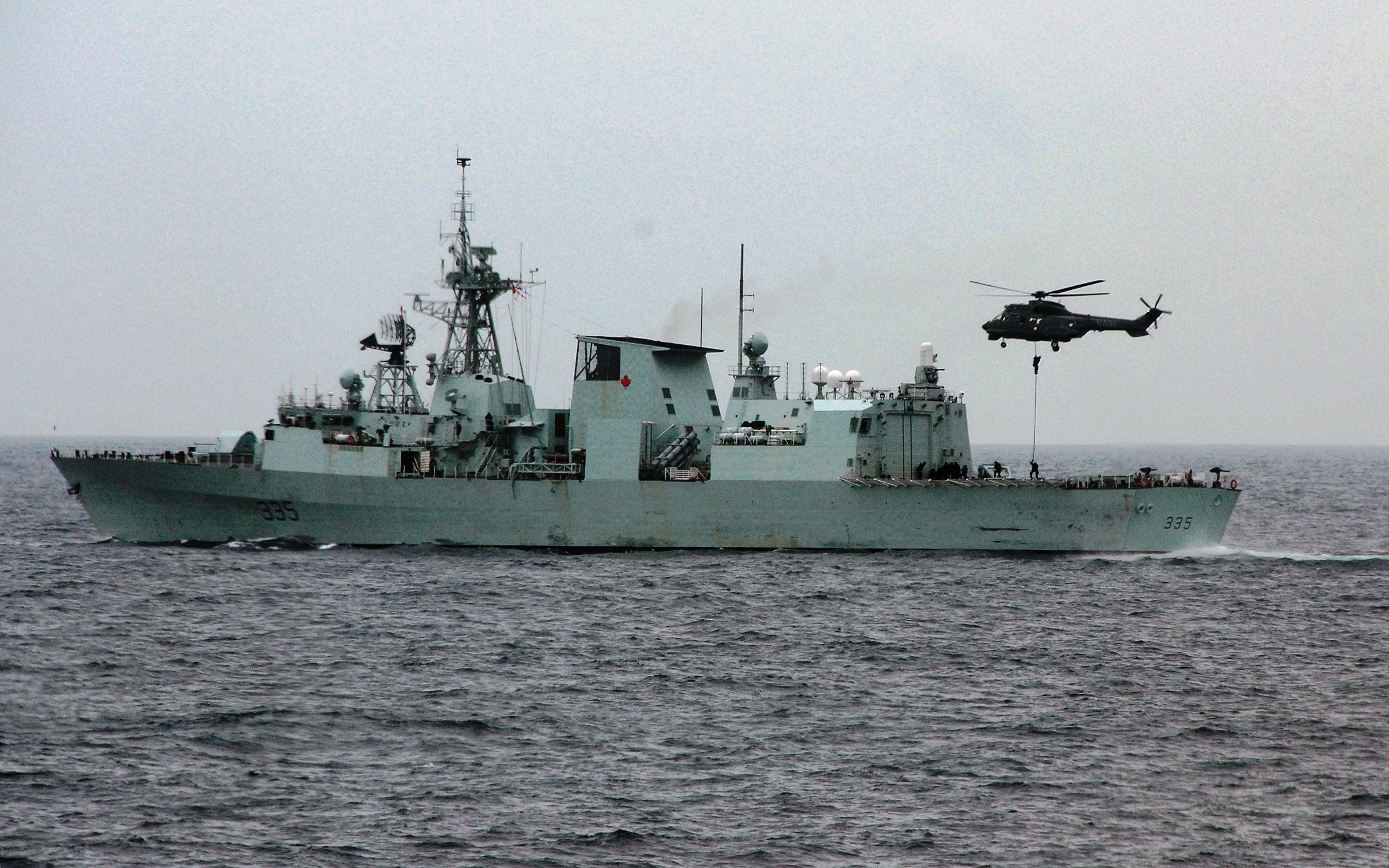
A Chilean navy boarding team fast-ropes onto the flight deck of RCN Halifax-class frigate HMCS Calgary (FFH 335) during multinational training exercise Fuerzas Aliadas PANAMAX 2009.
US Navy photo via Wikimedia.
The Department of National Defence most recently estimated up to a $60B final bill, but the Parliamentary Budget Office estimate was $70B (an increase of $8B over a two-year span), and there’s no reason to assume that things will magically get cheaper between now and whenever Irving Shipbuilding starts construction of the first new ship. David Pugliese reports:
… it could be years before the real cost to taxpayers for the mega-project is actually known as the project is just getting started.
The PBO report warned that any delays in building the first ship will be costly. A delay of one year, for instance, could increase costs by almost $2.2 billion, it added.
The federal government hopes to begin building the ships starting in the early 2020s.
Pat Finn, the head of procurement at DND, said the PBO estimates largely align with what the department figures as the cost of the program. He noted that unlike the PBO, the department does not consider tax in its cost figures. That is because those fees ultimately go back to the federal treasury.
But he also agreed with the PBO on the concern about added cost if the project is delayed. “That is a key one for us. It’s something we’re watching carefully,” said Finn, assistant deputy minister for materiel.
The CSC program is currently in the development phase. The government projects the acquisition phase to begin in the early 2020s with deliveries to begin in the mid-2020s. The delivery of the 15th ship, slated for the late 2040s, will mark the end of that project.
The Liberal government announced in February that it had entered into a contract with Irving Shipbuilding to acquire new warships based on the Type 26 design being built in the United Kingdom. With Canada ordering 15 of the warships, the Royal Canadian Navy will be the number one user of the Type 26 in the world.
The United Kingdom had planned to buy 13 of the ships but cut that down to eight. Australia plans to buy nine of the vessels designed by BAE of the United Kingdom.
The entry of the BAE Type 26 warship in the Canadian competition was controversial from the start and sparked complaints the procurement process was skewed to favour that vessel. Previously the Liberal government had said only mature existing designs or designs of ships already in service with other navies would be accepted, on the grounds they could be built faster and would be less risky. Unproven designs can face challenges as problems are found once the vessel is in the water and operating.
But the requirement for a mature design was changed and the government and Irving accepted the BAE design, though at the time it existed only on the drawing board. Construction began on the first Type 26 frigate in the summer of 2017 for Britain’s Royal Navy, but it has not yet been completed. Company claims about what the Type 26 ship can do, including how fast it can go, are based on simulations or projections.
BAE Systems released this artist’s rendition of the Type 26 Global Combat Ship in 2017, which is the design selected by the Canadian government for the Canadian Surface Combatant program.
(BAE Systems, via Flickr)
Ted Campbell commented on the report:
I’m not sure the new ($70 Billion) figure is a terribly useful number for taxpayers like you or me or for policymakers, either. I’m not convinced that DND, itself, much less the whole of government, including the PBO, has a common, coherent understanding of “life-cycle costs,” and I’m damned sure neither the media nor 99.99% of Canadians has one. I’m glad to see that the government includes “the cost of project development, production of the ships, two years of spare parts and ammunition, training, government program management, upgrades to existing facilities, and applicable taxes” but that’s just the tip of the iceberg. These ships are going to be in service for 35± years and they are going to cost money to own and operate every hour of every day and I hope someone is programming ongoing costs (running costs, routine maintenance, upgrades and refits and life extension projects and even disposal) into the long term defence budget guesstimates.
Good management says that the DND budget should be pretty well fixed for the next year or two, fairly firm (even allowing for a change in government) for four or five years beyond the end of the next fiscal year it should be and a reliable planning guide for the next decade or even two. In other words, DND should have a pretty good idea about what it will cost to operate itself, pretty much as it is now, for a generation. I expect (hope, anyway) that defence planners have a “Christmas wish list” of capabilities they want to add or improve/increase (with costs attached) should a defence friendly government ever materialize in Canada or, sadly but more likely when, not if, the need arises.
He also points out the hidden truism about huge government purchases:
… from 1950 to 1958 the several hundred Canadair F-86 Sabre jets that Canada bought for the RCAF was, probably, “the largest single expenditure in Canadian government history,” then from the early 1950s until 1964 the production of 20 destroyers (DDE and DDH) of the St Laurent, Restigouche, Mackenzie and Annapolis classes (all based on one, baseline, design) was, almost certainly, “the largest single expenditure in Canadian government history,” and I know for a fact that the purchase decision (in 1980) of 138 CF-18 Hornets made it “the largest single expenditure in Canadian government history.” The simple fact is that the costs of high-tech aircraft, howitzers, tanks, radios and, especially, ships, keep climbing far faster than inflation and if, as we must, we want our armed forces to be adequately equipped then we need to accept higher costs … especially if we want to build ships in Canadian yards, employing Canadian workers.
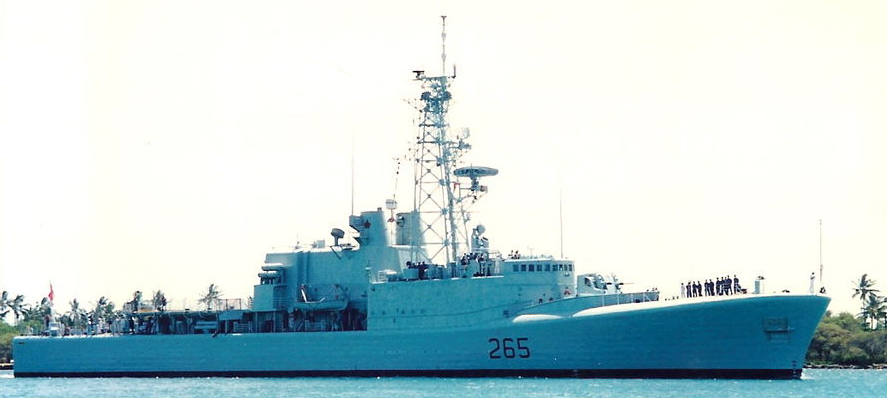
HMCS Annapolis at Pearl Harbour in 1995 (via Wikipedia)
Comments Off on $26B, $56B, $70B, and pretty soon you’re talking real money


