Quotulatiousness

January 9, 2018

The ongoing financial catastrophe that is the National Shipbuilding Procurement Strategy

Ted Campbell rounds up recent discussions of the Canadian government’s farcical National Shipbuilding Procurement Strategy (NSPS):

There is a somewhat biased but still very useful look at the successes of the National Shipbuilding Procurement Strategy (NSPS) in the Ottawa Citizen by Howie Smith who is the Past President of the Naval Association of Canada. Mr Smith is a retired Canadian naval officer who has provided consultancy services to several firms pursuing opportunities within the projects of the National Shipbuilding Strategy, which is why his article is somewhat biased. Mr Smith is responding to a recent report by Professor Michael Byers of the University of British Columbia, who is also a biased commentator on defence issues, which said that the NSPS “was flawed from the outset” and “According to Byers, the Liberal government should open-up the non-contractually-binding umbrella agreements with Irving and Seaspan, then cancel and restart the Canadian Surface Combatant and the Joint Support Ship procurement programs with fixed-price competitions involving completely ‘off the shelf’ designs.”

It is important, I believe, to understand why Canada needed something like the NSPS in the first place. The notion came in about the middle of the Harper government’s term in office – in around 2010. I think that two problems confronted the government:

  • The Canadian shipbuilding industry was, once again, “on the ropes;” Davie, Canada’s largest shipyard was in bankruptcy and the other yards were too reliant on government contracts; and
  • Both of the major federal fleets (the Royal Canadian Navy and the Canadian Coast Guard) were approaching “rust out,” again.

The solution to the first problem was to modernize the yards and make them internationally competitive … but that would cost money and private investment money is scarce ~ especially for shipbuilding, plus under the international trade rules to which Canada has agreed direct government subsidies to commercial shipyards are prohibited. The solution to shipyards that are too reliant on government contracts was ~ wait for it ~ another big government contract that would allow them to modernize themselves.

That indirect government subsidy is perfectly legal if the contracts are for navy and coast guard ships because “national security” is a big loophole in international trade law.

Both Professor Byers and Mr Smith have some good points … but neither is 100% correct. The NSPS was and remains a sound idea … the costs, which is the real crux of Professor Byers’ complaint, are not relevant because the defence and coast guard budgets are being (mis)used for industrial development ~ those are not the real costs of warships: they are the real costs of warships PLUS the cost of yard modernization.

The new surface combatant project is, as Mr Smith says, the biggest and costliest peacetime military procurement ever … and the NSPS is working just about a well as any “system” would at bringing it to fruition. At some point in the future a government will have to decide if Canada gets fewer ships than it needs or spends more more money than it wants … or, most likely, both.

That last sentence has always been the most likely outcome: the RCN will get fewer ships than it needs, and those ships will be significantly more expensive per hull than they need to be. The need for modern naval vessels isn’t the top priority … it’s probably not even in the top three priorities as far as the government is concerned (directing money to the “right” recipients, pandering to provincial sensibilities, lots of photo ops, and then maybe the actual needs of the RCN and CCG).

Update: Of course, it’s not like Canada is unique in the problems we have in military procurement … Australia is also struggling in a similar way:

The [Royal Australian] Navy’s program to replace the Collins Class submarines is known as SEA 1000. It involves modification of a French Barracuda Class submarine from nuclear to diesel-electric propulsion, plus other changes specific to Australia.

The 12 new submarines, to be known as Shortfin Barracudas, are intended to begin entering service in the early 2030s with construction extending to 2050. The program is estimated to cost $50 billion and will be the largest and most complex defence acquisition project in Australian history.

[…]

Then there’s the decision to build them in Australia. The Abbott government’s 2016 Defence White Paper only committed to building them in Australia if it could be done without compromising capability, cost or project schedule. That changed because of South Australian politics, and the new submarines could now be more appropriately described as the Xenophon class.

Even if all goes well, the cost of building warships in Australia will be 30 to 40 per cent more than if they were built overseas. However, the plan to build them in Adelaide at the Australian Submarine Corporation, the same group currently building the Air Warfare Destroyer, years late and a billion dollars over budget, adds to a sense of foreboding.

This follows the prize fiasco of the Collins Class submarine project. Their construction by the Australian Submarine Corporation ran years behind schedule, many millions over budget, and finally delivered a platform that the Navy has struggled to even keep operational.

And then there is the question of whether the new submarines will arrive before the Collins Class subs are retired, scheduled for 2026 to 2033. Even if delivery occurs on schedule, the first will not enter service until 2033. At best there will be one new submarine in service and a nine year gap between the retirement of the Collins Class and the introduction into service of the first six of the twelve new submarines.

Given this, the government has apparently committed an additional $15 billion to keep the 30 year old Collins submarines bobbing in the water. It’s like refurbishing a World War 2 German U-Boat for the mid-1990s.

The elements are all there for the submarine replacement program to become the procurement scandal of the century. Our Shortfin Barracudas will probably be the most expensive submarines ever built anywhere in the world.

For a lot less money, we could achieve a far more potent submarine capability. For example, off-the-shelf Japanese Soryu submarines cost only US$540 million. Modified to meet additional Navy requirements, they were quoted as costing A$750 million. If we simply bought twelve of those, the total cost to the taxpayer would be less than A$10 billion.

Equally, the existing nuclear Barracudas only cost $2 billion each, so we could get twelve of those for $24 billion.

For such an important defence capability, the government’s failure to guarantee Australia is protected by submarines is nothing less than gross negligence.

August 4, 2017

The recent machine gun purchase is a great example of how broken our defence procurement system

Filed under: Cancon, Military, Weapons — Tags: , , , , — Nicholas @ 05:00

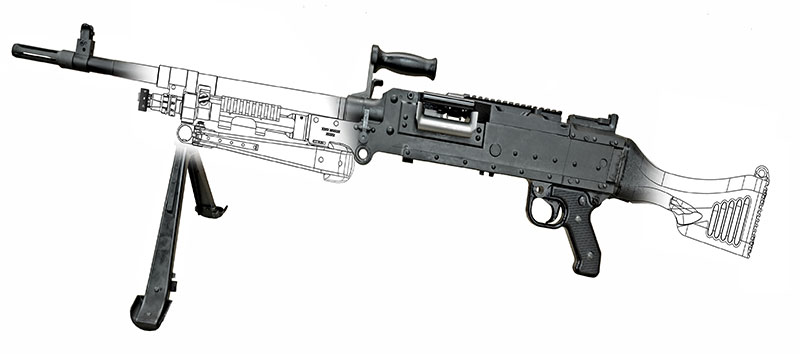
About a week ago, the Department of National Defence announced they were purchasing some new machine guns for the Canadian Army. The new weapon is an improved version of the C6 General Purpose Machine Gun (GPMG) currently in service. The Ottawa Citizen gave the basic information on the deal in this article:

Canadian C6 GPMG. (DND photo)

The Canadian government will purchase 1148 new C6A1 FLEX General Purpose Machine Guns from Colt Canada, Defence Minister Harjit Sajjan announced Wednesday.

The current C6 machine guns were procured over 30 years ago. Some have been removed from service due to wear and tear and others are reaching the end of their service life, according to the Canadian military.

The new C6A1 FLEX (flexible) is designed to be carried by soldiers or attached to vehicles such as the new Tactical Armoured Patrol Vehicle. The new machine gun will feature a durable polymer butt stock instead of the current wooden style, according to the Canadian Forces. Additionally, soldiers will be able to attach pointing devices and optical sighting systems to the new weapon to help increase their operational effectiveness.

Sounds good, right? Not so fast:

On the face of it this is a good news story. The C6, a 7.62-mm is a fully-automatic, air-cooled, gas- and spring-operated medium machine gun that is well liked by the troops of the many western nations which use some version of this weapon. Based on the Fabrique Nationale (FN) MAG it has been used by more than 80 countries, and is made under licence in several countries, most notably the USA where it is known as the M240. It is many ways the standard machine gun, used by all our allies.

A closer look suggests that this announcement reveals everything that is wrong with Canadian defence procurement.

For our $32.1 million we get 1148 new C6A1 machine guns (with cleaning and repair kits, spare parts and carrying slings), 13 jobs which it seems reasonable to assume are for the length of the contract, i.e. two years, and a production line including engineering validation and certifications. Or perhaps more accurately, Colt Canada gets a production line at the Colt Canada plant.

Even if we accept that the implied a cost of nearly $28,000 per weapon should be informed by the fact that about one-quarter of the contract cost goes toward setting up a production line it still means that each weapon is costing almost $21,000 each.

The price of the equivalent US weapon, the M240, is somewhere between $6,600 US and $9,200 US depending on which model is being purchased. This means that, at current exchange rates, if we were to purchase the weapons from FN’s U.S.plant they would cost us about $10,000 each, in Canadian dollars. This in turn suggests that we would save at least $12,628,000. If you assume that in this case we don’t have to buy Colt Canada a new production line it works out to a savings of almost $20 million dollars.

This is the real cost of those 13 jobs for 2 years, over $750,000 for each job per year.

One would think that jobs that cost taxpayers $750,000 per year would raise questions.

Questions like; do we need to make our own machine guns, especially when we consider that they are almost universally available from a number of our allies and that we have the proven ability to maintain them ourselves?

So, it’s not just that we can’t buy ships or fighter aircraft at a competitive price — because our politicians are addicted to using military spending for partisan purposes — we can’t even buy a slight variant on a bog-standard infantry support weapon without paying through the nose.

H/T to MILNEWS.ca for the link (perhaps we should consider changing that standard section heading from “What’s Canada Buying?” to “What’s Canada subsidizing in the form of procurement?” or “What’s Canada being robbed blind over now?”)

January 5, 2017

Canada’s military-industrial complex

Filed under: Business, Cancon, Military — Tags: , , , , , — Nicholas @ 04:00

Ted Campbell briefly outlines the three tiers of military logistics then discusses the most controversial tier, the national industrial base, in more detail:

Behind it all, unseen, misunderstood, unloved and, in fact, often actively disliked is the national defence industrial base.

There are a great many people, including many in uniform, who object to the cost ~ fiscal and political ~ of having a defence industrial base. Many people suggest that a free and open market should be sufficient to equip all friendly, and the neutral and even some not so friendly military forces.

They forget, first of all, that the defence industries of e.g. America, Britain, France, Germany and Israel are ALL heavily supported by their government and, equally, heavily regulated. It is not clear that we will always be in full political accord with those upon whom we rely for military hardware? What if one country wanted, just for example, to gain an advantage in a trade negotiation? Do you think they might not “decide” that since the government (a minister of the crown) has threatened to use military force against First Nations who protest against pipelines that they will not sell us certain much needed military hardware or licence its use in Canada?

It is always troubling when we see the costs of military hardware increase at double or even triple the general rate of inflation for, say, cars or TV sets or food and heating fuel, but that is not the fault of the Canadian defence industries … it is, in fact, the “fault” of too little competition in the global defence industry market: too few Australian, Brazilian Canadian and Danish defence producers, too many aerospace and defence contractors merged into too few conglomerates that control too much of the market. A robust Canadian defence industrial base, supported by extensive government R&D programmes and by a steady stream of Canadian contracts would help Canada and our allies.

[…]

I am opposed to government supported featherbedding by Canadian unions and companies but we do need to pay some price for having a functioning defence industrial base … the costs of our new warships, for example, are, without a doubt, higher than they would be if we had bought equivalent ships from certain foreign yards, but we need to be willing to pay some price for having Canadians yards that are ready and able to build modern warships when needed; ditto for aircraft, armoured vehicles, radio and electronics, rifles and machine guns, cargo trucks and boots and bullets and beans, too. AND, we need a government that will, aggressively, support that defence industrial base with well funded R&D programmes and by “selling” Canadian made military equipment around the world.

It’s one thing to accept that you’ll need to pay a premium over market cost for built-in-Canada equipment that can’t also be sold to other customers. What is disturbing is discovering that the premium can be up to 100% of the cost for equivalent non-domestic items. For example, this was reported in a CBC article in 2014:

Britain, for example, opted to build its four new naval supply ships much more cheaply, at the Daewoo shipyard in South Korea. The contract is for roughly $1.1 billion Cdn. That’s for all four. By contrast, Canada plans to build just two ships, in Vancouver, for $1.3 billion each. So Canada’s ships will be roughly five times more costly than the British ones.

But there’s a twist. Canada’s supply ships will also carry less fuel and other supplies, because they’ll be smaller — about 20,000 tonnes. The U.K. ships are nearly twice as big — 37,000 tonnes. Canadians will lay out a lot more cash for a lot less ship.

Everything is more expensive to build domestically if you don’t already have a competitive market for that item. The federal government’s long-standing habit of drawing out the procurement process makes the situation worse, as the costs increase over time (but the budget generally does not), so we end up with fewer ships, planes, tanks or other military hardware items that arrive much later than originally planned.

March 1, 2015

“The F-35 will cost more than the Manhattan Project every year for the next fifty years”

Scott Lincicome would like to point out to the contending Republicans hoping to become the GOP’s presidential candidate that defence spending is not immune to the massive overspending problem common to big government:

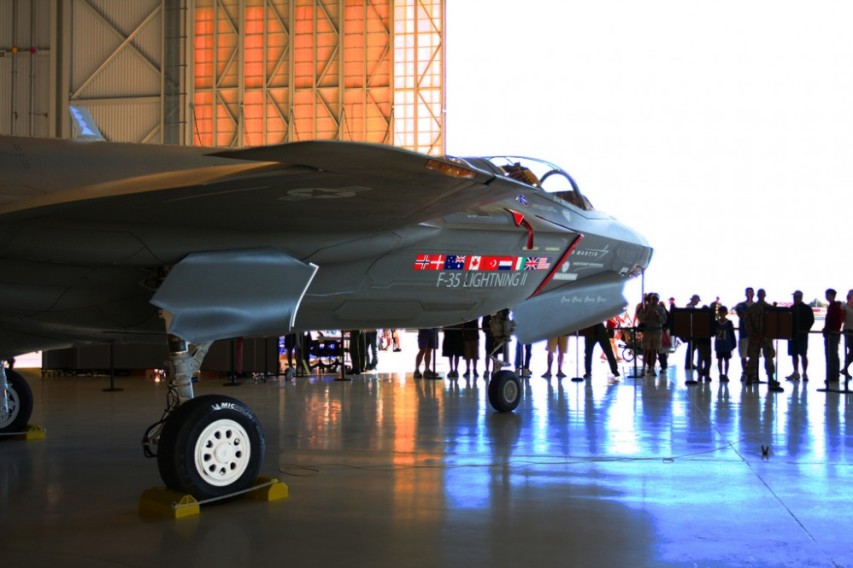
F-35 on display

Over the next 20 months, a clown-car-full of Republican politicians will vie for their party’s presidential nomination. As the candidates crisscross the nation, each will undoubtedly call for smarter, leaner, and (hopefully) smaller government. However, there is one government program that, despite being a paragon of government incompetence and mind-bending fiscal incontinence, will most likely be ignored by these champions of budgetary temperance: the F-35 Joint Strike Fighter. In so doing, these Republicans will abandon their principles and continue a long, bipartisan tradition of perpetuating the broader problems with U.S. defense spending that the troubled jet symbolizes.

During the Obama years, the Republican Party magically rediscovered its commitment — at least rhetorically — to limited government and fiscal sanity. Criticizing the graft, incompetence, and cost of boondoggles like the 2009 stimulus bill, green-energy subsidies, or Obamacare, GOP politicians not only highlighted these programs’ specific failings, but also often explained how such problems were the inevitable result of an unwieldy federal government that lacked discipline and accountability and was inherently susceptible to capture by well-funded interest groups like unions or insurance companies.

They railed against massive bureaucracies, like the Department of Energy, that paid off cronies with scant congressional oversight. And, in the case of well-publicized debacles like the botched, billion-dollar Healthcare.gov roll-out, many Republicans were quick to note that the root of the problem lay not in one glitchy website, but the entire federal procurement process, and even Big Government itself

[…]

One wonders, however, if these Republicans’ philosophical understanding of Big Government’s inherent weaknesses extends to national defense and, in particular, the F-35. According to the latest (2012) estimate from the Pentagon, the total cost to develop, buy and operate the F-35 will be $1.45 trillion — yes, trillion, with a “t” — over the next 50 years, up from a measly $1 trillion estimated in 2011. For those of you keeping score at home, this means that the F-35’s lifetime cost grew about $450 billion in one year. (Who says inflation is dead?)

That number — $1.45 trillion — might be difficult to grasp, especially in the context of U.S. defense spending, so let me try to put it in perspective: the entire Manhattan Project, which took around three years and led to the development of the atom bomb, cost a total of $26 billion (2015), most of which went to “building factories and producing the fissile materials, with less than 10% for development and production of the weapons.” By contrast, the F-35 will cost $29 billion. Per year.

For the next 50 years.

November 9, 2014

A Canadian Mistral (or two)? Not likely say the experts

Filed under: Cancon, France, Military, Russia — Tags: , , , , — Nicholas @ 10:07

Remember those palmy days of summer, when the French helicopter carrier Mistral visited Canadian waters for a joint exercise with the Canadian Army? I half-joking referred to it as Canada “kicking the tires” … but the idea hasn’t gone away completely. In the Ottawa Citizen, David Pugliese reported earlier last week that the International Business Times had run an article about it.

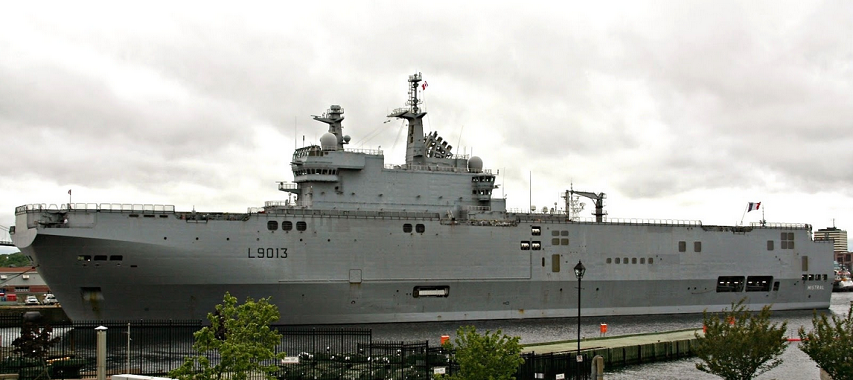
Halifax, Nova Scotia. FS Mistral (L-9013) is an amphibious assault ship, and lead ship of her class. She was commissioned in 2006. She features a landing craft dock, and helicopter facilities. Photo: Halifax Shipping News

Halifax, Nova Scotia. FS Mistral (L-9013) is an amphibious assault ship, and lead ship of her class. She was commissioned in 2006. She features a landing craft dock, and helicopter facilities. Photo: Halifax Shipping News

The deal is worth $1.6 billion to $1.8 billion (different figures are out there) to the French. The Russians are interested in three of the ships. The French haven’t proceeded yet with the sale to Russia because of the situation in Ukraine.

But how probable is it that Canada would buy the Mistral-class ships?

Earlier this year, the Royal Canadian Navy was looking at buying surplus U.S. Navy supply ships. But that is not going to happen, RCN commander Vice Admiral Mark Norman told Defence Watch. What is being examined is the purchase of a commercial oiler (maybe).

The RCN is in dire need of an oiler/supply ship……not, at this point, an amphibious assault ship. So if there is an extra billion dollars or more around, the focus might be on acquiring an oiler/supply fleet to replace the decommissioned AORs.

Mistral-class ships are capable of carrying 16 helicopters, landing barges, up to 70 vehicles and 450 soldiers. They also come equipped with a hospital.

Canadian shipyards could also be expected to oppose such a purchase. There would be little for them (except maybe in-service support) in such an acquisition and they could argue that such a purchase would undermine the National Shipbuilding Procurement Strategy.

In September, I called the idea of Canada buying the Mistrals as the maritime equivalent of “pie in the sky”, despite a passionate article in the US Naval Institute News pushing the idea. They even showed what a Canadian Mistral would look like:

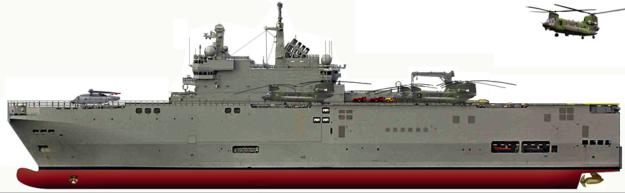
Mistral-class ship, ‘Sevastopol’ configured as a NATO/Canadian Navy ship. CASR Image

Mistral-class ship, Sevastopol configured as a NATO/Canadian Navy ship. CASR Image

So, on the surface, the idea isn’t likely to go anywhere for practical and economic reasons. But, a couple of days later Pugliese posted another article on the Mistral debate, responding to criticism from University of Ottawa professor Roland Paris:

If the Paris had actually read the articles in question he would have found out that the stories arose not from Hugh Segal’s comments from May but from the fact that the delegation led this week by French President François Hollande to Canada contained a significant contingent of the country’s defence industry representatives, including those from Mistral shipbuilder DCNS. That group included the firm’s diplomatic adviser.

In addition, sources have told Defence Watch that the delegation did indeed try to interest Canada in Mistral-class ships, as well as the FREMM class frigates.

Will they succeed with Mistral? Like I have mentioned a number of times at Defence Watch, including in the posting cited by Paris, the answer is likely no.

[…]

France, over the last two years, has embarked on a significant push into Canada to promote its defence products, particularly in the naval arena. With $35 billion on the table for shipbuilding who can blame them?

There was a specific reason a Mistral-class warship sailed across the Atlantic this summer to take Canadian soldiers on board for amphibious exercises. And it wasn’t about any close relationship between the French and Canadian militaries, although that might have played a minor role.

No, the French are interested in selling. They want to sell Canada warships, warship designs, and naval equipment like that on board the Mistral-class and the FREMM frigates. That is the reason the FREMM ship Aquitaine also visited Canada.

Personally, I’d love to see the RCN acquire a pair of Mistral-class ships, but they would not come cheap, they wouldn’t create a lot of jobs in Nova Scotia, Quebec, or British Columbia (and therefore wouldn’t be useful for gathering votes from those provinces), and they’d require the government to fully equip them … helicopters are extra. And we all know how the Canadian government can’t manage to say the word “helicopter” without wasting millions of dollars, never mind actually buying any.

October 17, 2014

Germany’s arms procurement plight

Filed under: Bureaucracy, Europe, Germany, Military — Tags: , , , — Nicholas @ 09:22

Peter Dörrie explains the German government’s current embarrassment due to the revelations about the desperate straits of all German military branches. The combination of delivery delays, cost overruns, technical faults, and low equipment availability mean that Germany could not come to the aid of NATO allies in a crisis:

The German armed forces have come clean. They’ve admitted they’re incapable of managing arms procurement — and have systematically neglected the hardware that’s already in service.

Military procurement and management in Germany have been under heightened scrutiny ever since Berlin’s attempt to buy an European version of America’s Global Hawk drone ended in miserable failure in mid-2013.

In late September, the German military sent an explosive report to parliament, confessing that half of the armed forces’ heavy equipment is unserviceable and can’t deploy in a crisis.

The German navy, for example, possesses 15 Sea King helicopters, but 12 of them are grounded. The situation is similar with respect to the naval Sea Lynx helicopter — just four out of 18 can fly — and the heavy-lifting CH-53 helicopter. Sixteen out of 43 CH-53s are functional.

The Luftwaffe can field only 80 Typhoon and Tornado fighters, out of 140 on the books. So short of equipment, at present Germany would be powerless to respond if a fellow NATO member were to ask for military assistance.

And the bad news doesn’t stop there. On Oct. 6, Defense Minister Ursula Von Der Leyen released a report by an outside consultancy analyzing the military’s nine biggest weapons purchases.

The report is damning. Every single procurement effort suffers some combination of cost overruns, delays and technical shortfalls. And owing to the ministry’s unwillingness or inability to negotiate proper contracts, the government has had to pay for the overruns itself. The arms manufacturers waltz away with their full fees.

This is sounding disturbingly similar to Canada’s military procurement problems.

October 2, 2014

On national defence, don’t listen to Harper’s words – watch his actions

Filed under: Cancon, Government, Military — Tags: , , , , — Nicholas @ 09:28

At The 3Ds Blog, Jack Granatstein explains why the Canadian Forces are once again being starved of funding:

A few years ago I wrote that no government since that of Louis St Laurent in the 1950s had done more to improve the defence of Canada than Stephen Harper’s Conservatives. The St Laurent Liberals built up the armed forces to deal with the war in Korea and with the defence of North America and western Europe in the face of Soviet expansionism. At its peak, the defence budget took more than seven percent of Canada’s Gross Domestic Product, and the army, navy, and air force had as many as 120,000 men and women in the regular forces.

No one could expect any government in this century to spend on that scale, but the Conservative government did treat defence well in its first years in power. The commitment to the Afghan War, never very popular, was handled capably, and the troops received everything they needed — helicopters, new artillery, upgraded armoured personnel carriers, and tanks, not to mention new transport aircraft. The number of regulars rose slowly and slightly toward 65,000, and the government presented a schematic Canada First Defence Policy in 2008 that listed a range of objectives and equipment acquisitions. The budget projections were colossal, almost $500 billions to be spent over the next 20 years.

But that was then, this is now:

The result was that the defence budget was cut, in substantial part because deficit reduction and a budget surplus were more important than “toys for the boys.” From a peak of $21 billion in 2009-10, the defence budget in this fiscal year is $18.2 billion, about a 13 percent reduction in dollars made worse by inflation. The percentage of GDP spent on defence is now hovering at one percent, the lowest since the 1930s. In 2009, it was 1.3 percent. Making matters even worse, the Department of National Defence somehow cannot spend all the money it gets, returning almost $10 billion to the Treasury since 2006.

Despite Harper’s tough talk on the international stage, his government’s active neglect of the needs of the armed forces means we can’t back up his pugnacious rhetoric with any serious military effort: a frigate in the Black Sea, four CF-18s in the Baltic, a couple of transport aircraft shuttling supplies into Erbil, and a small special forces contingent helping the Kurds … and that’s about our current limit for overseas deployment. The Royal Canadian Air Force is still waiting for new helicopters (after more than 20 years of stop-go-stop procurement disasters) and a decision on replacing the CF-18. The Royal Canadian Navy just announced the immediate retirement of four ships, with no replacements available for years (if ever), and the Canadian Army is struggling to maintain equipment and keep up training schedules due to budget constraints.

And, as Granatstein points out, if the Liberals or NDP win the next federal election, the situation will get worse, not better, as neither party sees the military as any kind of priority — quite the opposite.

Update: Speaking of cheeseparing “economies”, here’s the Department of National Defence’s most recent “saving”.

National Defence slashed its annual order of ammunition this year to save money — a revelation that raised fresh questions Wednesday about just how prepared Canada is to do battle with militants in the Middle East, Murray Brewster of the Canadian Press writes.

More from his article:

The 38 per cent cut was large enough to cause other government departments, Public Works and Industry Canada in particular, to sit up and take stock of the impact, internal documents obtained by The Canadian Press show.

One such document, a memo to Public Works Minister Diane Finley dated Feb. 5, 2014, indicates her department tried to convince defence officials to either abandon the cut or at least spread it out over a couple of years.

Defence officials said that would be impossible, because “they would not allow the department to meet its financial targets.”

As a result, the 2014 ammunition budget was reduced to $94 million from $153 million.

During the early phases of the Afghan war, National Defence was caught similarly flat-footed and had to rush an order through General Dynamic Ordnance, particularly for artillery shells.

The memo surfaced on the same day Prime Minister Stephen Harper told the House of Commons that the cost of deploying special forces to northern Iraq is being taken out of the department’s current budget.

September 15, 2014

RCAF “raids” air force museum for spare parts

Filed under: Cancon, Military — Tags: , , , — Nicholas @ 09:27

We often joke about the “museum pieces” that the Canadian Armed Forces have to operate, due to very long procurement processes and budget shortfalls, but this is the first time I’ve heard of scavenging spare parts from actual museum displays:

The Ottawa Citizen has learned that in July 2012 air force technicians raided an old Hercules airplane that is on display at the National Air Force Museum of Canada because they needed navigational equipment for a similar aircraft still in use.

The revelation highlights the difficulties military personnel have increasingly faced in keeping Canada’s ancient search-and-rescue planes flying after more than a decade of government promises to buy replacements.

The air force museum is at Canadian Forces Base Trenton, Ont., and boasts a large collection of military aircraft that have been retired and subsequently placed on display.

[…]

“They sort of called (Colton) up and said ‘Hey, we have these two INUs that we can’t use. Do you have any on yours?’ ” Windsor said. “Some of the parts are interchangeable. They just kind of got lucky on that.”

Defence Minister Rob Nicholson’s office defended the air force’s decision to ask a museum for parts to keep its search-and-rescue planes flying.

“The RCAF took the initiative to remove these functional, perfectly good parts and use them effectively,” spokeswoman Johanna Quinney said in an email.

But former head of military procurement Dan Ross said it’s “embarrassing” that the air force has to “cannibalize old stuff that’s in museums” to keep its planes flying.

Update, 16 September: The story triggered a question to the minister in parliament.

NDP defence critic Jack Harris: “Mr. Speaker, the government’s failed plans to replace Canada’s aging search and rescue aircraft hit a new low with the news that the RCAF had to source parts from a 50-year-old plane on display at the National Air Force Museum. It would be funny if it were not for the fact that Canadians rely on the Hercules and Buffalo aircraft to respond to thousands of emergencies every year. Though started by the Liberals in 2002, there will not be replacement planes in operation until 2019, at the earliest.

Does the minister simply expect the RCAF to raid other museums in the meantime?

Defence Minister Rob Nicholson responded: “What the honourable member was referring to was a mistake. When it was discovered, the RCAF took the appropriate measures. That being said, this is the government that has delivered 17 new Hercules transport aircraft, four strategic transports, and 15 Chinook heavy-lift helicopters. How did the NDP vote? The NDP voted against all of these; every dollar for the military is opposed by the NDP.”

Not sure what Nicholson meant by “a mistake.” He didn’t elaborate in the House of Commons.

But it’s different than the earlier response from his office, which acknowledged the scavenging and praised it as taking the “initiative.”

June 26, 2014

Stop me if you’ve heard this one before – Canadian government puts F-35 decision on hold (again)

Filed under: Cancon, Government, Military — Tags: , , , , — Nicholas @ 07:53

In the Globe and Mail, Steven Chase reports on the on-again, off-again, [on-again, off-again, …] federal government decision on replacing our current RCAF fighters:

The Harper government is pressing pause on a decision to buy new jet fighters, including whether to purchase Lockheed Martin’s F-35 Lightning II without holding a competition, because it feels ministers need more information on other options before selecting a course of action.

There will be no decision this month on the next step — whether to hold a competition for a new plane or purchase the F-35 outright — and it is very unlikely anything will be announced even by mid-July, The Globe and Mail has learned.

Prime Minister Stephen Harper removed the item from the agenda of a recent meeting of cabinet’s priorities and planning committee to give ministers more time to deliberate and gather information, people familiar with the matter say. Priorities and planning is the main cabinet committee that provides strategic direction.

Sources say the government feels it’s being rushed and pressured by the Canadian Armed Forces and parts of the civil service to purchase the F-35 without a competition. The government, which took a serious credibility hit in 2012 over its poor management of the procurement process, is now concerned only one fully fleshed-out option has been presented for review and that it resembled a decision to be ratified rather than a well-developed option.

H/T to Paul Wells, who put it rather well:

February 5, 2014

Battlefield mobility for Canadian infantry in the Cold War

An interesting post by Frank Maas at the LCMSDS website looks at the story of the Canadian army’s attempts during the 1980s to get modern armoured vehicles for infantry support and battlefield mobility:

The Militia, the traditional mobilization base for the Canadian army, withered during the Cold War. Its ranks were flushed with Second World War veterans in the 1950s and there was money for new tanks and vehicles, but morale declined as the Militia’s role became civil defence in the late 1950s, and it languished in the 1960s and 1970s as defence budgets shrank. The Militia reached a nadir of 15,000 by the late 1970s, but ironically, there was a false dawn at the end of the Cold War. In the 1987 Defence White Paper, Challenge and Commitment, the Mulroney government announced that the strength of the Reserves would skyrocket to 90,000, and would complement Regular units and allow Canada to better meet commitments to NATO and continental defence. This increase in strength would be complemented by a package of improvements to bases and new equipment purchases. One of these was for a purchase of 200 armoured personnel carriers, and here the story begins.

Back then, Colonel Romeo Dallaire was head of the army’s department for assessing armoured vehicles. Dallaire was intent on purchasing the venerable and ubiquitous M113, which first entered service in the 1960s, and is one of the most numerous armoured vehicles in the world. (The Canadian army had purchased more than 900 in the 1960s, and fielded up-armoured M113s in Afghanistan). The original plan was to buy 200 M113s from the American manufacturer and have some components licence-built in Canada to fulfill requirements for Canadian content.

At the same time, however, Canada’s only manufacturer of armoured vehicles, Diesel Division General Motors (DDGM), in London Ontario, was nearly out of work. It was approaching completion of a United States Marine Corps order for 758 vehicles, and although some sales to Saudi Arabia were on the horizon for the early 1990s, the company was facing a year with empty production lines. Some salesmen and engineers at DDGM began to think they could scoop up the contract for two hundred APCs by substituting their vehicle, the Piranha Light Armoured Vehicle (LAV), and bridge the gap between the contracts.

Comparing the interiors of the LAV-25 (left) and M113 (right)

Comparing the interiors of the LAV-25 (left) and M113 (right)

There were some significant differences between the Piranha LAV and the M113 that would complicate DDGM’s plan. First, the LAV was wheeled, and the M113 was tracked. Wheeled vehicles were easier to maintain, but tracked vehicles had better off-road mobility. Second, the sides of the LAV’s troop compartment sloped sharply inward, which improved ballistic protection, but reduced internal space. Finally, the LAV had doors at the back for soldiers to deploy from, while the M113 had a ramp which made it much easier for soldiers to run out of the back of the vehicle. DDGM’s engineers could not do much about putting tracks on the LAV-25, although a wheeled vehicle would be better-suited for service with the Reserves because it would be cheaper to operate and soldiers could drive it on roads. (There are prohibitions against driving tracked vehicles on roads). DDGM could reconfigure its vehicle to look more like a M113 from the back to convince the army to accept the LAV-25 as a substitute, but this would require a significant reconfiguration of the vehicle.

Back in the late 1970s, my militia unit got some familiarization training with the then-new Grizzly AVGP, which was based on an earlier model than the LAV. While it was neat to be given the chance to try working with (and in) new equipment, we found that getting in and out of the back of the vehicle was awkward and much slower than we (well, actually our NCOs) had hoped. Practicing a dismount with a full infantry section on board was … less than tactically brilliant. The small doors tended to snag any of our equipment as we squeezed through, so you had to move more slowly to get through successfully.

Here’s a look at the rear of the Cougar AVGP from the same vehicle family as the Grizzly:

A right rear view of a Canadian army Cougar wheeled fire support vehicle that is being used as an observation post by soldiers standing watch during the combined U.S./Canadian NATO Exercise Rendezvous '83. Location: Camp Wainright, AB

A right rear view of a Canadian army Cougar wheeled fire support vehicle that is being used as an observation post by soldiers standing watch during the combined U.S./Canadian NATO Exercise Rendezvous ’83. Location: Camp Wainright, AB

November 28, 2013

Poking holes in the proposed Scottish defence plans

Filed under: Britain, Military — Tags: , , , , — Nicholas @ 08:07

Sir Humphrey says he’s neutral on the political issue of Scottish separatism, but he has a few professional criticisms of the fleet plan contained within the white paper:

At a most basic level, the paper appears to fall foul of what can be described as the ‘fantasy fleet’ syndrome so often found on the internet. In other words, people have taken an order of battle, hived of a reasonable sounding level of equipment and assumed that this would make a good defence force. That’s a great theory, but in reality its likely to be far more complicated than this.

For starters, the British Armed Forces are the product of hundreds of years of evolution, procurement and support. They operate a closely integrated set of equipment, underpinned by a well developed training network, and supported by a very complex set of support contracts to ensure availability. Due to the numbers and amounts of equipment in service, costs can be calculated using economies of scale, and planned workflow, in a way that smaller sized support cannot.

A nascent SDF would find itself operating a truly eclectic collection of units which are not necessarily the most appropriate for its situation. For instance, the proposal that the Navy takes on two Type 23 frigates seems a little odd. The Type 23 is one of the worlds most advanced anti-submarine warfare escorts, and designed to be a submarine killer par excellence. To use it to best effect requires a well trained crew, who have a range of extremely specialised skills. Assuming that no one is forced at independence to join the SDF, the challenge will be recruiting and retaining a core of niche skills to actually employ the vessel in her intended manner. This includes the engineers, weapon systems maintainers, the warfare department and those with the skills and experience at all ranks and rates to use the vessel in its intended manner.

[…]

Similarly, the issue of maintenance will be a complex one. There are no T23s based in Scotland, which means that a great deal of money will be spent creating a permanent support facility for the class in Scotland. In these circumstances the SDF will need to negotiate and establish support contracts, similar to the ones used by the RN, and pay to put in place the complex web of support arrangements in order to keep the vessels available for service. In a small procurement and support budget, it is hard to see where the money will come from for this sort of activity.

The sheer running costs of the vessels will also be a challenge — on average it costs about £20 million per year (source THEY WORK FOR YOU) to keep a Type 23 at sea, and about £3 million for MCMVs and patrol craft. To keep the Scottish Navy afloat, you are looking at an annual running cost of around £60 million — before you consider salary costs of the crew and the shore support infrastructure to go with it. On a relatively small budget of £2.5 billion, it is easy to see how much of a cost it would be just to keep the ships at sea, let alone deploy them.

In a sense, the white paper’s defence plan does appear to have been drawn up with an eye toward “order of battle” and “table of equipment” that would create — on paper, anyway — a scaled-down version of the RN, RAF, and British army. That isn’t the sensible approach for an independent Scotland’s defence needs. The first thing they should have done is analyze what practical tasks their defence forces would be required to undertake, then consider the most cost-effective way to build and equip an organization to accomplish those tasks.

When I was a child, I was obsessed with toy soldiers. I had hundreds and hundreds of them from various eras from Roman versus Celt down to 8th Army versus Afrika Korps. When setting up my “battles”, it was always the soldiers with the cool kit who got to be the heroes: stirring combat poses and cooler weapons were my selection criteria. When I moved on to building models, the same characteristics dictated the particular models I built: more heavily armed ships, bigger tanks, more weapon-studded aircraft. The authors of this portion of the white paper appear to have had similar childhoods … and they’re still influenced by the same selection criteria. What sense does it make for Scotland’s defence forces to operate Type 23 frigates and Typhoon aircraft? They’re cool kit, but do they accomplish the primary protective duties for Scotland cost-effectively? Almost certainly not.

Scotland has a large coastline and significant offshore assets to protect, but it isn’t likely to need the hugely expensive (and admittedly very capable) kit that the Royal Navy and the Royal Air Force need to accomplish their wider tasks. Scotland’s navy is much more likely to end up resembling a strong coastguard than a battle fleet, and their air force will probably not be equipped with top-of-the-line fighter aircraft (especially not F-35 or Typhoon fighters) as they would eat a hugely disproportional share of the defence budget for capabilities the Scots don’t actually need.

I strongly suspect the best course of action for Scotland (in the event of a successful independence vote) would be to negotiate a short-to-medium term deal with the rest of the UK to provide military units to Scotland as an interim solution while a sensible Scottish organization was built-up to take on those roles. It might sting the pride of nationalists to admit that they can’t afford to take on the full trappings of an independent state immediately, but it would be far more practical (and far less expensive) than carving off “their share” of the UK’s existing military.

November 27, 2013

Scottish defence, in a post-independence world

Filed under: Britain, Military — Tags: , , , , , — Nicholas @ 11:35

Think Defence has posted a portion of the Scottish Independence White Paper dealing with defence issues. This includes an outline view of what is thought to be required for Scotland’s (non-nuclear) military establishment at independence:

Maritime forces

One naval squadron to secure Scotland’s maritime interests and Exclusive Economic Zone (EEZ) and contribute to joint capability with partners in Scotland’s geographical neighbourhood, consisting of:

  • two frigates from the Royal Navy’s current fleet
  • a command platform for naval operations and development of specialist marine capabilities (from the Royal Navy’s current fleet, following adaptation)
  • four mine counter measure vessels from the Royal Navy’s current fleet
  • two offshore patrol vessels (OPVs) to provide security for the 200 nautical mile Exclusive Economic Zone (EEZ). However, as the Royal Navy only has four OPVs currently[263], a longer lead time for procurement might be necessary
  • four to six patrol boats from the Royal Navy’s current fleet, capable of operating in coastal waters, providing fleet protection and also contributing to securing borders
  • auxiliary support ships (providing support to vessels on operations), which could be secured on a shared basis initially with the rest of the UK

These arrangements will require around 2,000 regular and at least 200 reserve personnel.

Land forces

An army HQ function and an all-arms brigade, with three infantry/marine units, equipped initially from a negotiated share of current UK assets, and supported by:

  • a deployable Brigade HQ
  • two light armoured reconnaissance units
  • two light artillery units
  • one engineer unit deploying a range of equipment for bridging, mine clearance and engineering functions
  • one aviation unit operating six helicopters for reconnaissance and liaison
  • two communication units
  • one transport unit
  • one logistics unit
  • one medical unit

Special forces, explosives and ordnance disposal teams will bring the total to around 3,500 regular and at least 1,200 reserve personnel.

Air forces

Key elements of air forces in place at independence, equipped initially from a negotiated share of current UK assets, will secure core tasks, principally the ability to police Scotland’s airspace, within NATO.

  • an Air Force HQ function (with staff embedded within NATO structures)
  • Scotland will remain part of NATO‘s integrated Air Command and Control (AC2) system, initially through agreement with allies to maintain the current arrangements while Scotland establishes and develops our own AC2 personnel and facility within Scotland within five years of independence
  • a Quick Reaction Alert (QRA) squadron incorporating a minimum of 12 Typhoon jets based at Lossiemouth
  • a tactical air transport squadron, including around six Hercules C130J aircraft, and a helicopter squadron
  • flight training through joint arrangements with allies

In total this would require around 2,000 regular personnel and around 300 reserve personnel.

Civilian support

In addition to military capability following a vote for independence, the Scottish Government will establish core government capacity for defence functions, such as strategic planning, oversight and policy functions for defence and security. Given the importance of ongoing shared security interests between Scotland and the rest of the UK, we will ensure a partnership approach during the period of transition to independence.

Following a vote for independence, priorities for the Scottish Government capacity dealing with defence will be planning for the strategic security review to be carried out by the first Scottish Parliament following independence, based on the most recent UK National Risk Assessment and input from Scottish experts and academic institutions.

I linked to a couple of posts by Sir Humphrey on this issue that are also worth considering.

October 10, 2013

Defending an independent Scotland

Filed under: Britain, Military — Tags: , , , , — Nicholas @ 08:33

Sir Humphrey has read the British Ministry of Defence paper on Scottish options in a post-independence scenario and has a few thoughts:

The paper nicely highlights the reality that you cannot slice up defence assets and turn them into a coherent military force – ORBATs may look impressive, but dividing them into something more meaningful is particularly difficult.

Additionally the paper highlights the issue of how one takes a world class military, optimised for power projection abroad, and then carves off a smaller chunk of it to focus on missions for which it was not designed. For instance, the idea that Scotland would keep running a modern air force built around Typhoon seems interesting, but where does the pilot training pipeline come from, how is this affordable and what happens when the Eurofighter nations move to upgrade their aircraft? Is it truly feasible to imagine a relatively small Scottish Defence Force being able to shoulder the burden of paying the costs of sustaining an increasingly obsolescent Typhoon fleet, which is no longer at the same standard as its multi-national peers?

The problem facing a newly independent Scotland seems to be that the UK military assets are simply not appropriate for what will be a low level defence force in a relatively small country. Stripped of the recruiting, support and logistical contracts and pipeline that have sustained the equipment, one can imagine a future Scottish Defence Force burdened down with legacy equipment which requires expensive training and support to run properly, and which is too expensive to meet what will be a very small budget.

One could almost argue that rather than take much UK military equipment, it would be more sensible for Scotland to instead take a large cash payment and procure a low level defence force (with UK forces providing sovereignty assurance in the interim) which better meets their specific needs. So, procurement of low level OPVs, simple vehicles and so on – in other words start from scratch with something that is feasible, and not take on equipment that is designed for a very different role.

Update: His look at the SNP’s proposed military structure from last year is also worth reading:

At the moment, the current policy seems to be that on separation, those army regiments deemed Scottish will become part of the SDF. Similarly, an equivalent amount of manpower, roughly 1/8th of all UK military assets and personnel will be offered to the Scottish Government. In broad-brush terms, this leads to an Army of about 10,000 troops, 5,000 air force and 4000 navy/marines (say 19,000 overall).

Here is where the fun really starts. Firstly, the armed forces do not neatly break into component parts which can be divided up. An infantry battalion may have 650 people on its strength, but there may be many more from supporting arms such as REME and so on who will be there to maintain and support weapons and equipment. Do the SNP want to take the supporting arms too?

Secondly — how will they attribute manpower against specialisations — the RN for instance has a deeply specialised manpower structure, made up of composite branches – it’s not just a mixy blob of 30,000 sailors looking good and drinking rum prior to catching the eye of hairy women with tattoos, it’s a collection of branches and capabilities.

[…]

The author knows relatively few individuals who would willingly wish to transfer to any SDF. Most of the Scots personnel he knows are immensely proud of being Scottish, but are also equally proud of belonging to something much greater in the form of HM Armed Forces. They relish the challenge offered by soldiering in a military that has a track record for being employed aggressively overseas. How many of them will willingly want to transfer to a SDF that is unlikely to be used in any similar manner?

The SDF is going to have a challenging initial few years — it will inherit people at all levels, but probably not enough for any one role. It’s going to take time to grow personnel into the jobs required of them, and even if it started recruiting on the day of independence, it would still take 5-10 years to grow the critical mass of SNCOs and junior officers needed to manage and lead the organisation.

Replacing the Sea King – a British alternative

Filed under: Britain, Cancon, Military — Tags: , , , — Nicholas @ 08:21

At Think Defence, Fedaykin wonders if the best solution for the Royal Canadian Navy’s Sea King helicopter might just be the Merlin which is in Royal Navy service:

With the Canadian government threatening to cancel the CH-148 contract, the sending of team to inspect Royal Navy Merlin is an interesting development.

Whilst the Merlin has developed a bit of a reputation for being fragile and expensive to maintain it has nevertheless seen many years of service now and is finally catching its second wind of maturity.

The Royal Navy is upgrading 30 Merlin from HM1 to HM2 standard leaving 8 airframes unchanged. Initially, thinking was these 8 spare airframes would probably form part of Crowsnest getting a permanent AEW fit. Sensibly (in my opinion) the MOD and navy has decided that Crowsnest will instead be a quick fit solution to any of the HM2 fleet ensuring that we don’t end up with “fleets within fleets”.

That leaves 8 standard HM1 going spare and possibly a home for them.

If the Canadian government was to suck up the embarrassment they could buy the AW Merlin HM2 with the 8 HM1 being given to them at a throw away price as a hot swap to get them going.

Once new build HM2 become available off the line the older HM1 in Canadian service can be upgraded to the common standard. The second article does clearly state the Canadian team did look at the HM1 in particular so is a happy solution close to hand.

The main barrier as it stands is the Omni-shambles of the Victoria class procurement, the Canadian public is not exactly happy about that disaster despite a significant proportion of blame being laid at their own door.

The UK does not do enough in terms of defence co-operation with Canada, New Zealand and Australia and there is much we can learn from each other.

H/T to Tony Prudori for the link.

September 9, 2013

When politicians meddle in defence matters

Filed under: Britain, Military, Politics — Tags: , , — Nicholas @ 00:01

An interesting report in Herald Scotland by Kate Devlin illustrates some of the problems created when politicians make decisions without adequately consulting with the civil service:

The man in charge of equipment at the Ministry of Defence (MoD) has warned officials offer “opinion” not fact on defence programmes, including the aircraft carriers being built on the Clyde, because of pressure from ministers.

In recent years the department has become notorious for overspends and procurement problems. But Bernard Gray said that civil servants in his department had “their arms put up behind their backs” to produce hasty costings for projects.

Earlier this week Mr Gray revealed that in 2010, when Tory MP Liam Fox was Defence Secretary, officials were given just hours to estimate the cost of changing the planes to fly from the carriers.

Mistakes in that process led to a humiliating U-turn by Mr Fox’s replacement Philip Hammond last year and have cost the taxpayer at least £74million.

Appearing before a separate committee of MPs, Mr Gray said officials should have been given six months, not a day, to complete the work. He said what was eventually provided was “opinion”.

“People (within the MoD) come under pressure, with people saying, ‘Everybody wants to know, we have to have an answer today,'” he said.

« Newer PostsOlder Posts »

Powered by WordPress