
The Korean War by Indy Neidell
Published 28 Jan 2025Peng Dehuai’s armies rest and recuperate on the banks of the Han River, nursing their supply issues, and the initiative has firmly swung in favor of the UN side. The North Koreans in the east are fleeing, and Matt Ridgway’s latest offensive in the west gets underway without a hitch. Are we about to see yet another reversal of fortune and pursuit up the Korean Peninsula?
Chapters
00:00 Intro
01:11 Recap
01:33 An Aggressor Nation?
07:38 Chinese Sit-Rep
10:59 Operation Thunderbolt
14:56 Summary
15:14 Conclusion
(more…)
January 29, 2025
The Korean War 032 – Thunderbolt! US Troops Go On the Offensive – January 28, 1951
Comments Off on The Korean War 032 – Thunderbolt! US Troops Go On the Offensive – January 28, 1951
January 17, 2025
QotD: Foraging for supplies in pre-modern armies
We should start with the sort of supplies our army is going to need. The Romans neatly divided these into four categories: food, fodder, firewood and water each with its own gathering activities (called by the Romans frumentatio, pabulatio, lignatio and aquatio respectively; on this note Roth op. cit. 118-140), though gathering food and fodder would be combined whenever possible. That’s a handy division and also a good reflection of the supply needs of armies well into the gunpowder era. We can start with the three relatively more simple supplies, all of which were daily concerns but also tended to be generally abundant in areas that armies were.
For most armies in most conditions, water was available in sufficient quantities along the direction of march via naturally occurring bodies of water (springs, rivers, creeks, etc.). Water could still be an important consideration even where there was enough to march through, particularly in determining the best spot for a camp or in denying an enemy access to local water supplies (such as, famously at the Battle of Hattin (1187)). And detailing parties of soldiers to replenish water supplies was a standard background activity of warfare; the Romans called this process aquatio and soldiers so detailed were aquatores (not a permanent job, to be clear, just regular soldiers for the moment sent to get water), though generally an army could simply refill its canteens as it passed naturally occurring watercourses. Well organized armies could also dig wells or use cisterns to pre-position water supplies, but this was rarely done because it was tremendously labor intensive; an army demanded so much water that many wells would be necessary to allow the army to water itself rapidly enough (the issue is throughput, not well capacity – you can only lift so many buckets of so much water in an hour in a single well). For the most part armies confined their movements to areas where water was naturally available, managing, at most, short hops through areas where it was scarce. If there was no readily available water in an area, agrarian armies simply couldn’t go there most of the time.
Like water, firewood was typically a daily concern. In the Roman army this meant parties of firewood forages (lignatores) were sent out regularly to whatever local timber was available. Fortunately, local firewood tended to be available in most areas because of the way the agrarian economy shaped the countryside, with stretches of forest separating settlements or tended trees for firewood near towns. Since an army isn’t trying to engage in sustainable arboriculture, it doesn’t usually need to worry about depleting local wood stocks. Moreover, for our pre-industrial army, they needn’t be picky about the timber for firewood (as opposed to timber for construction). Like water gathering, collecting firewood tends to crop up in our sources when conditions make it unusually difficult – such as if an army is forced to remain in one place (often for a siege) and consequently depletes the local supply (e.g. Liv. 36.22.10) or when the presence of enemies made getting firewood difficult without using escorts or larger parties (e.g. Ps.-Caes. BAfr. 10). Sieges could be especially tricky in this regard because they add a lot of additional timber demand for building siege engines and works; smart defenders might intentionally try to remove local timber or wood structures to deny an approaching army as part of a scorched earth strategy (e.g. Antioch in 1097). That said apart from sieges firewood availability, like water availability is mostly a question of where an army can go; generals simply long stay in areas where gathering firewood would be impossible.
Then comes fodder for the animals. An army’s animals needed a mix of both green fodder (grass, hay) and dry fodder (barley, oats). Animals could meet their green fodder requirements by grazing at the cost of losing marching time, or the army could collect green fodder as it foraged for food and dry fodder. As you may recall, cut grain stalks can be used as green fodder and so even an army that cannot process grains in the fields can still quite easily use them to feed the animals, alongside barley and oats pillaged from farm storehouses. The Romans seem to have preferred gathering their fodder from the fields rather than requisitioning it from farmers directly (Caes. BG 7.14.4) but would do either in a pinch. What is clear is that much like gathering water or firewood this was a regular task a commander had to allot and also that it often had to be done under guard to secure against attacks from enemies (thus you need one group of soldiers foraging and another group in fighting trim ready to drive off an attack). Fodder could also be stockpiled when needed, which was normally for siege operations where an army’s vast stock of animals might deplete local grass stocks while the army remained encamped there. Crucially, unlike water and firewood, both forms of fodder were seasonal: green fodder came in with the grasses in early spring and dry fodder consists of agricultural products typically harvested in mid-summer (barley) or late spring (oats).
All of which at last brings us to the food, by which we mostly mean grains. Sources discussing army foraging tend to be heavily focused on food and we’ll quickly see why: it was the most difficult and complex part of foraging operations in most of the conditions an agrarian army would operate. The first factor that is going to shape foraging operations is grain processing. [S]taple grains (especially wheat, barley and later rye) make up the vast bulk of the calories an army (and it attendant non-combatants) are eating on the march. But, as we’ve discussed in more detail already, grains don’t grow “ready to eat” and require various stages of processing to render them edible. An army’s foraging strategy is going to be heavily impacted by just how much of that processing they are prepared to do internally.
This is one area where the Roman army does appear to have been quite unusual: Roman armies could and regularly did conduct the entire grain processing chain internally. This was relatively rare and required both a lot of coordination and a lot of materiel in the form of tools for each stage of processing. As a brief refresher, grains once ripe first have to be reaped (cut down from the stalks), then threshed (the stalks are beaten to shake out the seeds) and winnowed (the removal of non-edible portions), then potentially hulled (removing the inedible hull of the seed), then milled (ground into a powder, called flour, usually by the grinding actions of large stones), then at last baked into bread or a biscuit or what have you.
It is possible to roast unmilled grain seeds or to boil either those seeds or flour in water to make porridge in order to make them edible, but turning grain into bread (or biscuits or crackers) has significant nutritional advantages (it breaks down some of the plant compounds that human stomachs struggle to digest) and also renders the food a lot tastier, which is good for morale. Consequently, while armies will roast grains or just make lots of porridge in extremis, they want to be securing a consistent supply of bread. The result is that ideally an army wants to be foraging for grain products at a stage where it can manage most or all of the remaining steps to turn those grains into food, ideally into bread.
As mentioned, the Romans could manage the entire processing chain themselves. Roman soldiers had sickles (falces) as part of their standard equipment (Liv. 42.64.2; Josephus BJ 3.95) and so could be deployed directly into the fields (Caes. BG 4.32; Liv. 31.2.8, 34.26.8) to reap the grain themselves. It would then be transported into the fortified camp the Romans built every time the army stopped for the night and threshed by Roman soldiers in the safety of the camp (App. Mac. 27; Liv. 42.64.2) with tools that, again, were a standard part of Roman equipment. Roman soldiers were then issued threshed grains as part of their rations, which they milled themselves (or made into a porridge called puls) using “handmills”. These were not small devices, but roughly 27kg (59.5lbs) hand-turned mills (Marcus Junkelmann reconstructed them quite ably); we generally assume that they were probably carried on the mules on the march, one for each contubernium (tent-group of 6-8; cf. Plut. Ant. 45.4). Getting soldiers to do their own milling was a feat of discipline – this is tough work to do by hand and milling a daily ration would take one of the soldiers of the group around two hours. Roman soldiers then baked their bread either in their own campfires (Hdn 4.7.4-6; Dio Cass. 62.5.5) though generals also sometimes prepared food supplies in advance of operations via what seem to be central bakeries. This level of centralization was part and parcel of the unusual sophistication of Roman logistics; it enabled a greater degree of flexibility for Roman armies.
Greek hoplite armies do not seem generally to have been able to reap, thresh or mill grain on the march (on this see J.W. Lee, op. cit.; there’s also a fantastic chapter on the organization of Greek military food supply by Matthew Sears forthcoming in a Brill Companion volume one of these years – don’t worry, when it appears, you will know!). Xenophon’s Ten Thousand are thus frequently forced to resort to making porridge or roast grains when they cannot forage supplies of already-milled-flour; they try hard to negotiate for markets on their route of march so they can just buy food. Famously the Spartan army, despoiling ripe Athenian fields runs out of supplies (Thuc. 2.23); it’s not clear what sort of supplies were lacking but food and fodder seems the obvious choice, suggesting that the Spartans could at best only incompletely utilize the Athenian grain. All of which contributed to the limited operational endurance of hoplite armies in the absence of friendly communities providing supplies.
Macedonian armies were in rather better shape. Alexander’s soldiers seem to have had handmills (note on this Engels, op. cit.) which already provides a huge advantage over earlier Greek armies. Grain is generally (as noted in our series on it) stored and transported after threshing and winnowing but before milling because this is the form in which has the best balance of longevity and compactness. That means that granaries and storehouses are mostly going to contain threshed and winnowed grains, not flour (nor freshly reaped stalks). An army which can mill can thus plunder central points of food storage and then transport all of that food as grain which is more portable and keeps better than flour or bread.
Early modern armies varied quite a lot in their logistical capabilities. There is a fair bit of evidence for cooking in the camp being done by the women of the campaign community in some armies, but also centralized kitchen messes for each company (Lynn op. cit. 124-126); the role of camp women in food production declines as a product of time but there is also evidence for soldiers being assigned to cooking duties in the 1600s. On the other hand, in the Army of Flanders seems to have relied primarily on external merchants (so sutlers, but also larger scale contractors) to supply the pan de munición ration-bread that the army needed, essentially contracting out the core of the food system. Parker (op. cit. 137) notes the Army of Flanders receiving some 39,000 loaves of bread per day from its contractors on average between April 1678 and February of 1679.
That created all sorts of problems. For one, the quality of the pan de munición was highly variable. Unlike soldiers cooking for themselves or their mess-mates, contractors had every incentive to cut corners and did so. Moreover, much of this contracting was done on credit and when Spanish royal credit failed (as it did in 1557, 1560, 1575, 1596, 1607, 1627, 1647 and 1653, Parker op. cit. 125-7) that could disrupt the entire supply system as contractors suddenly found the debts the crown had run up with them “restructured” (via a “Decree of Bankruptcy”) to the benefit of Spain. And of course that might well lead to thousands of angry, hungry, unpaid men with weapons and military training which in turn led to disasters like the Sack of Antwerp (1576), because without those contractors the army could not handle its logistical needs on its own. It’s also hard not to conclude that this structure increased the overall cost of the Army of Flanders (which was astronomical) because it could never “make the war feed itself” in the words of Cato the Elder (Liv 34.9.12; note that it was rare even for the Romans for a war to “feed itself” entirely through forage, but one could at least defray some costs to the enemy during offensive operations). That said this contractor supplied bread also did not free the Army of Flanders from the need to forage (or even pillage) because – as noted last time – their rations were quite low, leading soldiers to “offset” their low rations with purchase (often using money gained through pillage) or foraging.
Of course added to this are all sorts of food-stuffs that aren’t grain: meat, fruits, vegetables, cheeses, etc. Fortunately an army needs a lot less of these because grains make up the bulk of the calories eaten and even more fortunately these require less processing to be edible. But we should still note their importance because even an army with a secure stockpile of grain may want to forage the surrounding area to get supplies of more perishable foodstuffs to increase food variety and fill in the nutritional gaps of a pure-grain diet. The good news for our army is that the places they are likely to find food (small towns and rural villages) are also likely to be sources of these supplementary foods. By and large that is going to mean that armies on the march measure their supplies and their foraging in grain and then supplement that grain with whatever else they happen to have obtained in the process of getting that grain. Armies in peacetime or permanent bases may have a standard diet, but a wartime army on the march must make do with whatever is available locally.
So that’s what we need: water, fodder, firewood and food; the latter mostly grains with some supplements, but the grain itself probably needs to be in at least a partially processed form (threshed and sometimes also milled), in order to be useful to our army. And we need a lot of all of these things: tons daily. But – and this is important – notice how all of the goods we need (water, firewood, fodder, food) are things that agrarian small farmers also need. This is the crucial advantage of pre-industrial logistics; unlike a modern army which needs lots of things not normally produced or stockpiled by a civilian economy in quantity (artillery shells, high explosives, aviation fuel, etc.), everything our army needs is a staple product or resource of the agricultural economy.
Finally we need to note in addition to this that while we generally speak of “forage” for supplies and “pillage” or “plunder” for armies making off with other valuables, these were almost always connected activities. Soldiers that were foraging would also look for valuables to pillage: someone stealing the bread a family needs to live is not going to think twice about also nicking their dinnerware. Sadly we must also note that very frequently the valuables that soldiers looted were people, either to be sold into slavery, held for ransom, pressed into work for the army, or – and as I said we’re going to be frank about this – abducted for the purpose of sexual assault (or some combination of the above).
And so a rural countryside, populated by farms and farmers is in essence a vast field of resources for an army. How they get them is going to depend on both the army’s organization and capabilities and the status of the local communities.
Bret Devereaux, “Collections: Logistics, How Did They Do It, Part II: Foraging”, A Collection of Unmitigated Pedantry, 2022-07-29.
Comments Off on QotD: Foraging for supplies in pre-modern armies
January 1, 2025
The Korean War 028 – Happy Nuke Year! – December 31, 1950
The Korean War by Indy Neidell
Published 31 Dec 2024Matt Ridgway arrives in Korea to find his Eighth Army broken and dysfunctional from top to bottom. He has a mere few days to rectify these issues and get them combat-ready before the Communist Chinese forces approach once more. But the stakes are high; UN forces commander Douglas MacArthur continues to pressure Washington to expand the war, through either conventional or atomic means. As 1950 expires, the doomsday clock is ticking.
(more…)
Comments Off on The Korean War 028 – Happy Nuke Year! – December 31, 1950
December 18, 2024
The Korean War 026 – Chinese Victory in North Korea Complete – December 17, 1950
The Korean War by Indy Neidell
Published 17 Dec 2024The last UN forces still in the northern half of Korea begin their frantic retreat by sea. The evacuation is a huge operation involving over 100,000 men, and needs to go off smoothly if the UN want any hope of halting the Chinese advance. Eighth Army, who spend this week retreating, are certainly not up to the task on their own.
Chapters
00:00 Intro
00:50 Recap
01:07 Failures of Command
05:36 Hungnam Evacuation
09:02 Eighth Army Situation
13:07 National Emergency
14:12 Conclusion
15:48 CTA
(more…)
Comments Off on The Korean War 026 – Chinese Victory in North Korea Complete – December 17, 1950
December 15, 2024
Nazi Tanks Advance on Kursk: Prokhorovka Part 1
World War Two
Published 14 Dec 2024German tanks advance on Kursk, smashing through Soviet defences and setting the stage for one of history’s most legendary tank battles — The Battle of Prokhorovka. In this six part miniseries we will cover the fierce fighting, the strategies, and the men and machines that take part in this battle.
(more…)
Comments Off on Nazi Tanks Advance on Kursk: Prokhorovka Part 1
December 11, 2024
The Korean War 025 – UN Forces Abandon Pyongyang – December 10, 1950
The Korean War by Indy Neidell
Published 10 Dec 2024This week, UN forces in the west pull out of the North Korean capital Pyongyang. In the east, the marines continue to fight their way towards safety. Over in Washington, the aftershocks of the Chinese intervention have shaken high command as much as they have the troops on the ground, and America’s allies, especially Britain, grow alarmed over the US response.
Chapters
00:00 Intro
00:26 Recap
01:20 The Blame Game
03:58 Retreat in the West
07:43 The Chinese Situation
10:59 Escaping Chosin
13:57 Atoms and Attlees
18:07 Summary
18:20 Conclusion
(more…)
Comments Off on The Korean War 025 – UN Forces Abandon Pyongyang – December 10, 1950
December 4, 2024
Admirals belatedly realize it might be useful to be able to reload those fancy missiles at sea
CDR Salamander has been banging this drum for a long, long time, but it appears that the US Navy is finally acknowledging that being able to reload the (many) Vertical Launch System (VLS) missile cells on ships somewhere other than a fully functional naval base would be more than a nice-to-have capability:
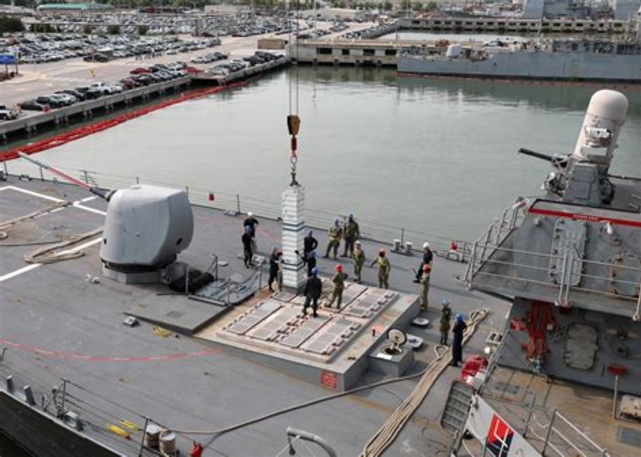
Reloading a VLS cell on a US Navy ship in port.
Photo attributed to defunct website defense-aerospace.com.
If you have made the horrible error of not reading every post here, over at the OG Blog and listening to every Midrats, then you may be new to the issue of being able to reload our warships’ VLS cells forward.
Slowly … a bit too slowly … Big Navy has decided that those people in the 1970s (who still remembered fighting a contested war at sea) might have been right all along. With SECNAV Del Toro’s encouragement, we continue to try to find a way to get the surface force a capability to reload forward.
There is plenty of room on the bandwagon and we’re glad to hoist everyone onboard the reload/rearm party-bus. If you need to catch up, the issue continues to break above the background noise, and WSJ has a very well produced article on it that requires your attention.
However, I got a little bit of an eye twitch at this pull-quote:
Until recently, the Navy didn’t feel much need for speed in rearming its biggest missile-firing warships. They only occasionally launched large numbers of Tomahawk cruise missiles or other pricey projectiles.
Now, Pentagon strategists worry that if fighting broke out in the western Pacific — potentially 5,000 miles from a secure Navy base — destroyers, cruisers and other big warships would run out of vital ammunition within days, or maybe hours.
Seeking to plug that supply gap, Del Toro tasked commanders and engineers with finding ways to reload the fleet’s launch systems at remote ports or even on the high seas. Otherwise, U.S. ships might need to sail back to bases in Hawaii or California to do so — putting them out of action for weeks.
Yes, I am going to do this, and you’re coming along for the ride.
In the name of great Neptune’s trident … THIS IS NOT A NEW REQUIREMENT!!!
My first “… shit, we need to be able to do this …” was during the DESERT FOX strikes against Iraq in 1998. I cannot remember if it were USS Stout (DDG 55) or USS Gonzalez (DDG 66) that we put Winchester on TLAM by the third day … but except for the ships we left on the other side of the Suez (who we would put to good use later), the rest of our TLAM ships and submarines were about done.
The fact we threw away an ability to reload/rearm forward was an old story inside the surface Navy when I picked it up in the last years of the previous century. We had a clunky erector set like contraption that was hard to use and took up VLS cell space, but instead of finding a better way, we just chunked the whole idea, slid in our Jesus Jones CD, and figured we had ownership of the seas until the crack of doom.
There is nothing “until recently” about this. Not to get off topic, but the real story here is why time and again this century’s senior leadership decided it was “too hard” or “too dangerous” while they were in full knowledge not just of the operational experience demanding this capability, but what we discovered over and over again in wargames.
Comments Off on Admirals belatedly realize it might be useful to be able to reload those fancy missiles at sea
November 22, 2024
QotD: Pre-modern armies on the move
Armies generally had to move over longer distances via roads, for both logistical and pathfinding reasons. For logistics, while unencumbered humans can easily clamber over fences or small ridges or weave through forests, humans carrying heavy loads struggle to do this and pack animals absolutely cannot. Dense forests (especially old growth forests) are formidable obstacles for pack and draft animals, with a real risk of animals injuring themselves with unlucky footfalls. After all the donkey was originally a desert/savannah creature and horses evolved on the Eurasian Steppe; dense forest is a difficult, foreign terrain. But the rural terrain that would dominate most flat, arable land was little better: fields are often split by fences or hedgerows which need to be laboriously cleared (essentially making a path) to allow the work animals through. Adding wagons limits this further; pack mules can make use of narrow paths through forests or hills, but wagons pulled by draft animals require proper roads wide enough to accommodate them, flat enough that the heavy wagon doesn’t slide back and with a surface that will be at least somewhat kind on the wheels. That in turn in many cases restricts armies to significant roadways, ruling out things like farmer’s paths between fields or small informal roads between villages, though smaller screening, scouting or foraging forces could take these side roads.
(As an aside: one my enduring frustrations is the tendency of pre-modern strategy games to represent most flat areas as “plains” of grassland often with a separate “farmland” terrain type used only in areas of very dense settlement. But around most of the Mediterranean, most of the flat, cleared land at lower elevations would have been farmland, with all of the obstructions and complications that implies; rolling grasslands tend to be just that – uplands too hilly for farming.)
The other problem is pathfinding and geolocation. Figuring out where you off-road overland with just a (highly detailed) map and a compass is sufficiently difficult that it is a sport (Orienteering). Prior to 1300, armies in the broader Mediterranean world were likely to lack both; the compass (invented in China) arrives in the Mediterranean in the 1300s and detailed topographical maps of the sort that hikers today might rely on remained rare deep into the modern period, especially maps of large areas. Consequently it could be tricky to determine an army’s exact heading (sun position could give something approximate, of course) or position. Getting lost in unfamiliar territory was thus a very real hazard. Indeed, getting lost in familiar territory was a real hazard: Suetonius records that Julius Caesar, having encamped not far from the Rubicon got lost trying to find it, spent a whole night wandering trying to locate it (his goal being to make the politically decisive crossing with just a few close supporters in secrecy first before his army crossed). In the end he had to find a local guide to work his way back to it in the morning (Suet. Caes. 31.2). So to be clear: famed military genius Julius Caesar got lost trying to find a 50 mile long river only about 150 miles away from Rome when he tried to cut cross-country instead of over the roads.
Instead, armies relied on locals guides (be they friendly, bought or coerced) to help them find their way or figure out where they were on whatever maps they could get together. Locals in turn tend to navigate by landmarks and so are likely to guide the army along the paths and roads they themselves use to travel around the region. Which is all as well because the army needs to use the roads anyway and no one wants to get lost. The road and path network thus becomes a vital navigational aid: roads and paths both lead to settlements full of potential guides (to the next settlement) and because roads tend to connect large settlements and large settlements tend to be the objectives of military campaigns, the road system “points the way”. Consequently, armies rarely strayed off of the road network and were in most cases effectively confined to it. Small parties might be sent out off of the road network from the main body, but the main body was “stuck” on the roads.
That means the general does not have to cope with an infinitely wide range of maneuver possibilities but a spiderweb of possible pathways. Small, “flying columns” without heavy baggage could use minor roads and pathways, but the main body of the army was likely to be confined to well-traveled routes connecting large settlements.
Bret Devereaux, “Collections: Logistics, How Did They Do It, Part III: On the move”, A Collection of Unmitigated Pedantry, 2022-08-12.
Comments Off on QotD: Pre-modern armies on the move
November 20, 2024
The Korean War Week 22 – Winter is Coming! – November 19, 1950
The Korean War by Indy Neidell
Published 19 Nov 2024Eighth Army commander Walton Walker makes his final preparations for the big push north to the Yalu River. The Communist Chinese prepare their own forces and wait for the Americans to make their move. At the same time, the freezing Korean winter arrives in force, plunging temperatures well below freezing. The Americans must get this done, and soon.
(more…)
Comments Off on The Korean War Week 22 – Winter is Coming! – November 19, 1950
November 15, 2024
QotD: Battles are over-rated
Start with theory. States fight to impose their will on another state in pursuit of some political goal. To do that requires that they achieve sufficient local military superiority that the other state can’t stop them from achieving their political goal.
Nazi Germany wanted to be the new administrators of the agricultural area of the western Soviet Union. To do that, they had to evict the Soviet military, whether through direct destruction or forcing the Soviet government to withdraw their armed forces. Individual battles for control of a localized area only matter if they are a means to that end.
Does the occupation or non-occupation of that point on the map affect the ability of a combatant to keep fighting?
In some limited cases, yes. Battlefield victory enabled Germany to overrun France before France could really focus its productive effort on the war. After their surrender, the French could not produce weapons, and they functionally could not organize their manpower to fight the Germans. But if the German army conquered, say, a random city in the Soviet Union, like Stalingrad, Soviet production and manpower was barely affected. The war goes on.
In theory, the German army could destroy so much of the Soviet military in one battle (or even a few discrete battles) that the Soviets run out of men or weapons. If there was ever a time this could have happened, it would have been the German invasion of the Soviet Union in 1941, when the Germans basically won a series of crushing victories.
The problem for the Germans was that by World War II, people in the combatant countries were good at building stuff in vast quantities, and the major combatants of World War II generally had access to sufficient natural resources. Even massive armies could not destroy produced weapons systems (e.g., tanks, airplanes) on the battlefield fast enough to remove the other side’s ability to continue fighting. What could (and did) happen was the destruction of the other side’s ability to produce and distribute weapons.
Sure enough, if you look at the actual data from even the largest battles, neither side really destroys a hugely significant amount of stuff. Take the Battle of Kursk — the largest tank and air battle of World War II. Wikipedia will dazzle you with the numbers of soldiers involved (millions), tanks deployed (in the ballpark of 10,000), and aircraft in the sky (in the ballpark of 5,000).
In this entire vast battle that supposedly dictated the outcome of the Eastern Front, the Germans lost approximately 350 armored fighting vehicles (AFVs) during the most intense 10 days of fighting. In the two months around when the battle took place, the Germans lost 1,331 AFVs on the entire Eastern Front. In the year of the battle, 1943, the Germans built more than 12,000 AFVs. Also worth noting: they disproportionately lost older, obsolete tanks at Kursk, and built new, capable tanks. The Germans lost a very manageable amount of equipment at Kursk — less than a month’s worth of AFV production.
If modern war means you cannot realistically destroy enough weapons in one battle to matter — if the largest battle of all time didn’t really matter — what did?
Anonymous, “Your Book Review: How the War Was Won“, Astral Codex Ten, 2024-08-09.
Comments Off on QotD: Battles are over-rated
October 27, 2024
The Great Demobilization: How the Allied Armies Were Sent Home
World War Two
Published 26 Oct 2024After the war, the Allies face the new challenge how to bring home the tens of millions of troops they have deployed across the globe. Today Indy examines this massive logistical effort, looking at the American Operation Magic Carpet, the British government’s slow but steady approach, and the devastation that Soviet troops returned home to.
(more…)
Comments Off on The Great Demobilization: How the Allied Armies Were Sent Home
August 30, 2024
QotD: The stalemate in the trenches, 1914-1918
Before that, it is worth recapping the core problem of the trench stalemate laid out last time. While the popular conception was that the main problem was machine-gun fire making trench assaults over open ground simply impossible, the actual dynamic was more complex. In particular, it was possible to create the conditions for a successful assault on enemy forward positions – often with a neutral or favorable casualty ratio – through the use of heavy artillery barrages. The trap this created, however, was that the barrages themselves tore up the terrain and infrastructure the army would need to bring up reinforcements to secure, expand and then exploit any initial success. Defenders responded to artillery with defense-in-depth, meaning that while a well-planned assault, preceded by a barrage, might overrun the forward positions, the main battle position was already placed further back and well-prepared to retake the lost ground in counter-attacks. It was simply impossible for the attacker to bring fresh troops (and move up his artillery) over the shattered, broken ground faster than the defender could do the same over intact railroad networks. The more artillery the attacker used to get the advantage in that first attack, the worse the ground his reserves had to move over became as a result of the shelling, but one couldn’t dispense with the barrage because without it, taking that first line was impossible and so the trap was sprung.
(I should note I am using “railroad networks” as a catch-all for a lot of different kinds of communications and logistics networks. The key technologies here are railroads, regular roads (which might speed along either leg infantry, horse-mobile troops and logistics, or trucks), and telegraph lines. That last element is important: the telegraph enabled instant, secure communications in war, an extremely valuable advantage, but required actual physical wires to work. Speed of communication was essential in order for an attack to be supported, so that command could know where reserves were needed or where artillery needed to go. Radio was also an option at this point, but it was very much a new technology and importantly not secure. Transmissions could be encoded (but often weren’t) and radios were expensive, finicky high technology. Telegraphs were older and more reliable technology, but of course after a barrage the attacker would need to be stringing new wire along behind them connecting back to their own telegraph systems in order to keep communications up. A counter-attack, supported by its own barrage, was bound to cut these lines strung over no man’s land, while of course the defender’s lines in their rear remained intact.)
Bret Devereaux, “Collections: No Man’s Land, Part II: Breaking the Stalemate”, A Collection of Unmitigated Pedantry, 2021-09-24.
Comments Off on QotD: The stalemate in the trenches, 1914-1918
August 28, 2024
The Korean War Week 010 – MacArthur and the Incheon Meeting – August 27, 1950
The Korean War by Indy Neidell
Published 27 Aug 2024Douglas MacArthur has a plan for an amphibious invasion of Incheon, and he thinks it will turn the tide of the war. This week comes his heavy pitch to be allowed to do it to the powers-that-be among American command. The war in the field continues as the UN forces win the Battle of the Bowling Alley, but an air force attack accidentally hits targets over the border in China. Mao Zedong is furious. Also, MacArthur gets flak this week from the President for outspokenly advocating actions counter to US official policy with regard to China, so the Chinese situation grows ever more tense.
Chapters
01:28 Battle of the Bowling Alley
04:14 U.N. Air Power
06:46 Supply Issues
09:05 The British are coming
10:55 Incheon Plans
14:52 The Incheon Meeting
17:06 MacArthur and the VFW
20:25 KPA Plans for Next Week
21:24 Summary
(more…)
Comments Off on The Korean War Week 010 – MacArthur and the Incheon Meeting – August 27, 1950
August 24, 2024
Operation Downfall – the planned invasion of Japan in 1946
Wes O’Donnell talks about the thankfully never-launched invasion of the Japanese home islands at the end of the Second World War:
History often hinges on the narrowest of margins.
Entire nations can rise or fall based on decisions made under the pressures of the moment.
But what if those decisions had gone the other way?
What if Archduke Franz Ferdinand had survived the assassination attempt in 1914?
What if John F. Kennedy had lived to complete a second term?
And most intriguingly, what if the United States had not dropped atomic bombs on Hiroshima and Nagasaki in August 1945?
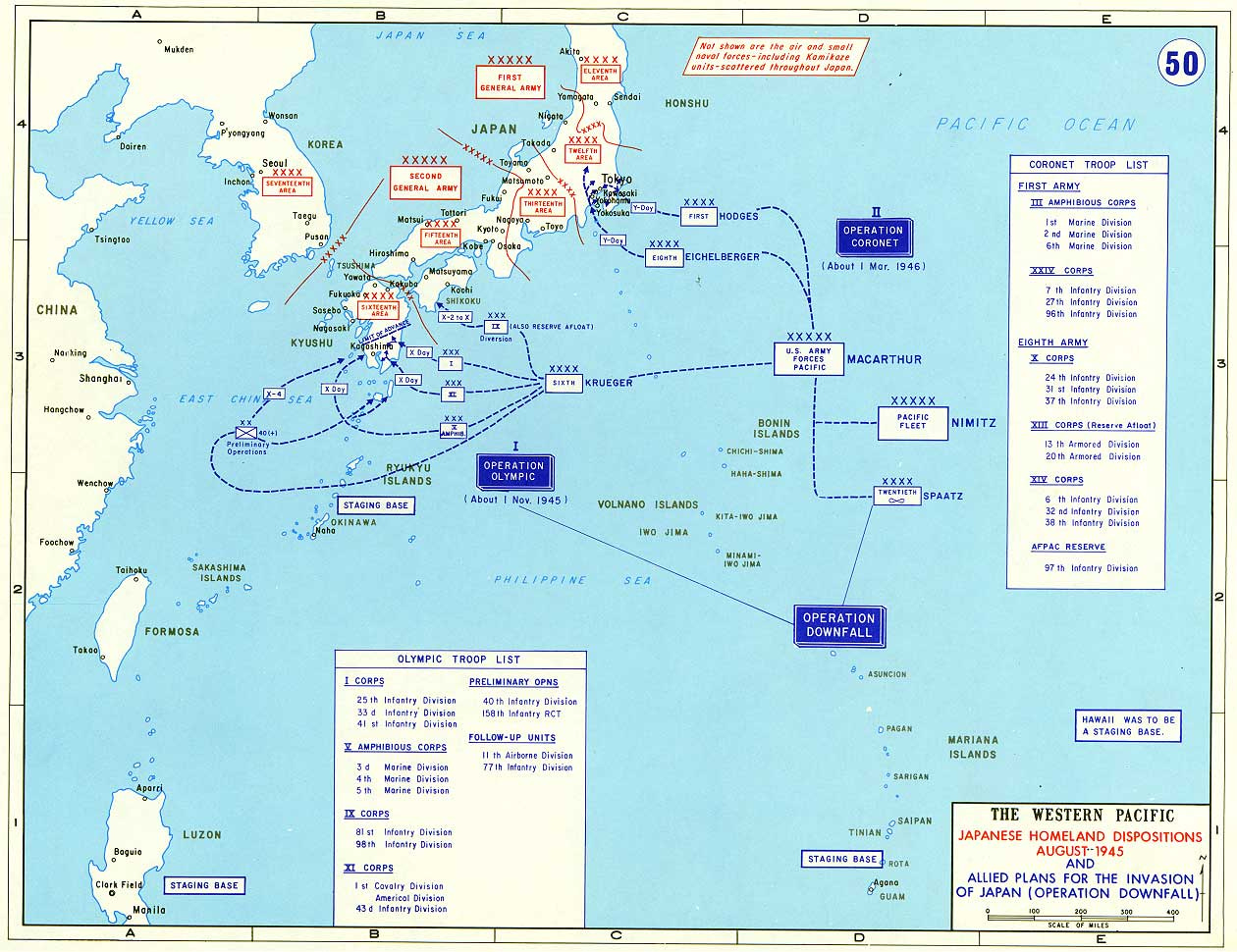
The world would have witnessed Operation Downfall, the Allied invasion of Japan — an operation that, by all accounts, would have been the bloodiest amphibious assault in human history.
Operation Downfall was the codename for the proposed Allied plan for the invasion of Japan near the end of World War II.
The planned operation was abandoned when Japan surrendered following the atomic bombings of Hiroshima and Nagasaki and the Soviet declaration of war.
The operation had two parts: Operations Olympic and Coronet.
Set to begin in November 1945, Operation Olympic was intended to capture the southern third of the southernmost main Japanese island, Kyūshū, with the recently captured island of Okinawa to be used as a staging area.
Later, in the spring of 1946, Operation Coronet was the planned invasion of the Kantō Plain, near Tokyo, on the Japanese island of Honshu.
Airbases on Kyūshū captured in Operation Olympic would allow land-based air support for Operation Coronet.
The most troubling aspect of Downfall may have been the logistical problems facing military planners.
By 1945, there simply were not enough shipping, service troops, or engineers present to shorten the turnaround time for ships, connect the scattered installations across the Pacific, or build facilities like air bases, ports, and troop housing.
By this point in the war, the War Department had several military leaders that the government trusted to execute a quick end to hostilities.
Unlike the heavy political influence found in today’s wars, these men were given almost total freedom to plan large-scale military operations – Truman’s decision to drop the atomic bombs notwithstanding.
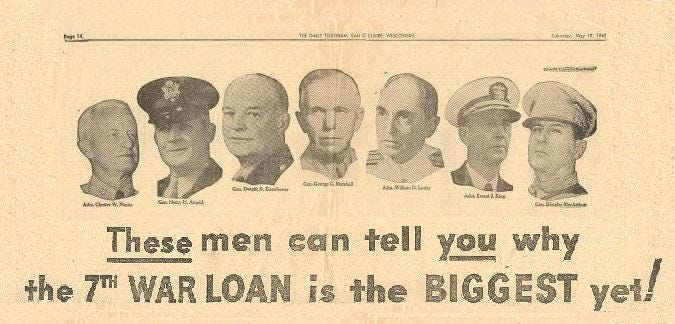
Six men of destiny
Responsibility for planning Operation Downfall fell to some of the most prominent American military leaders of the 20th century: Fleet Admiral Chester Nimitz, General of the Army Douglas MacArthur, and the Joint Chiefs of Staff — Fleet Admirals Ernest King and William D. Leahy, along with Generals of the Army George Marshall and Hap Arnold, who commanded the U.S. Army Air Forces.
These six men, raised in the relatively stable and predictable world of late 19th-century small-town America, carried with them the values instilled by that era.
Arnold and MacArthur were West Point graduates; King, Leahy, and Nimitz came out of the Naval Academy; while Marshall honed his discipline at the Virginia Military Institute, a school renowned for its toughness, even more so than the service academies.
For these leaders, the concepts of duty, honor, and country were more than just words — they were guiding principles.
They approached their roles without a trace of cynicism, supremely confident in their ability and, crucially, their God-given right to steer the course of history, especially in the chaos of war.
Comments Off on Operation Downfall – the planned invasion of Japan in 1946
August 21, 2024
The Korean War Week 009 – Bloody UN Victory at Naktong Bulge – August 20, 1950
The Korean War by Indy Neidell
Published 20 Aug 2024The Marines are deployed to back up the UN forces facing disaster in the Naktong Bulge and by the end of the week the tide has turned, and the crack North Korean 4th Division has been shattered. There is also fighting around the whole rest of the Pusan Perimeter, and it is shrinking from all the attacks, though on the east coast the battle goes in favor of the South Korean forces this week at Pohang-Dong.
(more…)
Comments Off on The Korean War Week 009 – Bloody UN Victory at Naktong Bulge – August 20, 1950


