
HardThrasher
Published Aug 14, 2024In January 1942 the Japanese Army poured over the border with Burma, and pushed back the Indian and British Armies to the border with Burma. Today we look at how that disaster came about, why and the first phase of the campaign
(more…)
August 17, 2024
Forgotten War Ep1 – Witness the Rising Sun
Comments Off on Forgotten War Ep1 – Witness the Rising Sun
August 15, 2024
Yet another revisionist history of World War II
In the latest anonymous review at Astral Codex Ten, the book to be considered is How the War Was Won by Phillips Payson O’Brien:
To a first approximation, there are a million books about World War II. Why should you care about How the War Was Won (hereinafter “HtWWW”) by Phillips Payson O’Brien?
- It provides a new, transformative view of the conflict by focusing on production of key goods and what affected that production instead of the ups and downs of battles at the front.
- That particular lens used can (and should) be applied outside of just World War II, and you can get a feel for how that might be done by reading HtWWW.
- I have lectured about World War II and read many, many books about it. I have never texted friends more excerpts of a book than this one.
I have some criticisms of HtWWW, but if the criticisms dissuade you from reading the book, I will have failed. These complaints are like tut-tutting Einstein’s penmanship.
The Wikipedia-Level Story of World War II (and O’Brien’s Counterargument)
To understand why O’Brien’s argument is so novel, you need to know the modern-day conventional understanding of the story of World War II. Here is my summary of the conventional narrative of World War II:
- Germany conquered Poland and France. It tried to bomb the UK into submission/maybe enable an invasion. That effort failed when Germany was defeated in the Battle of Britain, thanks largely to the plucky efforts of British airmen (memorably summarized by Winston Churchill: “Never in the field of human conflict was so much owed by so many to so few”.)
- Stymied in the West, Germany invaded the Soviet Union, won a bunch of crushing victories, but then got turned back at the gates of Moscow. The Soviets moved all of their factories east of the Ural Mountains and produced a vast tide of T-34 tanks that overpowered the Germans.
- The Germans suffered a catastrophic defeat at Stalingrad and a bloody strategic defeat at Kursk, after which the Soviets relentlessly pounded Germany to defeat.
- The US and the UK sent a lot of material help and eventually fought the Germans too, most notably in the D-Day invasion and the Battle of the Bulge. However, most of the fighting was done by the Soviets.
- It is very difficult to say how important the aerial bombing campaigns of the Western Allies were in defeating Germany. The Germans moved much of their production underground, insulating them from truly disastrous effects.
- The U.S. mostly fought alone against Japan, which won a series of impressive early victories (e.g., Pearl Harbor, the conquest of Singapore) until the decisive Battle of Midway, after which the vastly larger US industrial base outproduced Japan into oblivion.
- The US bombed the Japanese into submission by destroying Japanese cities, ultimately by dropping atom bombs on Hiroshima and Nagasaki.
By examining where the Axis focused their productive capacities and how the Allies disrupted those capacities, O’Brien challenges virtually every part of that narrative:
- The Battle of Britain was not a close-run thing. The fact that British fighter planes were flying over their own territory meant their attrition rate of pilots and aircraft were far lower than the Germans’.
- American and British bombing mattered far more to the war’s outcome than the battles of the Eastern Front, which consumed a much smaller portion of German expenditures.
- American and British airpower made German battlefield victories on the Western Front virtually impossible and dramatically limited the force Germany could bring to bear in the East.
- Japan (really, Japan plus the giant empire it conquered at the beginning of the war) was an industrial behemoth to rival the Soviet Union. However, the destruction of the Japanese merchant fleet by American air and sea forces wrecked Japan’s economy.
- The firebombing of Japanese cities and the atomic bombings of Hiroshima and Nagasaki had an ambiguous strategic effect. American air power played a much more important role in severing Japan from the natural resources it had conquered in the early part of the war.
Comments Off on Yet another revisionist history of World War II
August 10, 2024
“Heavy casualties” in a modern western army might count as “a skirmish” in earlier conflicts
I sent a link to Severian a few weeks ago, thinking it might be an interesting topic for his audience and he posted a response as part of Friday’s mailbag post. First, my explanation to him about why I thought the link was interesting:
I know that Edward Luttwak is what the Brits call “a Marmite figure” … people love or hate him and not much in between. I’ve read several of his books and found he had interesting things to say about the Roman and Byzantine armies in their respective eras but I haven’t found his modern analysis to be anywhere near as interesting. This time, however, he might well have found that acorn … is the dramatic casualty-aversion of western nations going to be a key element of future, shall we say “adventurism”?
Clearly, [Vladimir Putin and Benjamin Netanyahu] can still get their legions moving when they feel they need to, but could [insert current US President here] get the 101st Airborne into a high-casualty environment (let’s not pretend that Rishi Sunak or Keir Starmer could or would, and Macron’s posturing is nearly as bad as Baby Trudeau’s total lack of seriousness)?
Anyway, here’s the Marmite Man’s latest – https://unherd.com/2024/06/who-will-win-a-post-heroic-war
Sev responded:
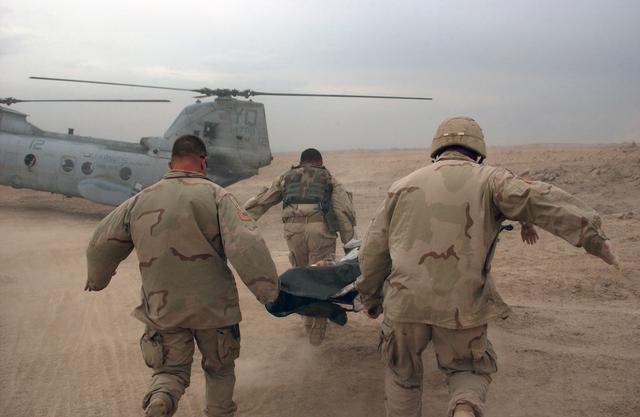
US Army soldiers assigned to 2-7 Cavalry, 2nd Brigade Combat Team (BCT),3rd battalion 1st Division, rush a wounded Soldier from Apache Troop to a waiting USMC CH-46E Sea Knight helicopter during operation in Fallujah, Iraq, during Operation IRAQI FREEDOM.
Photo by SFC Johan Charles Van Boers via Wikimedia Commons.
I’ve often said that, from what I can tell — and bearing in mind my entire military experience consists of a .500 record at Risk! — AINO‘s entire force philosophy amounts to “zero casualties, ever”.
Note that this was true even in the 20th century, when America was still America. “Stupendous casualties” by American standards would hardly rate “a spot of bother” by Soviet. Wiki lists the bloodiest American battle as Eisenborn Ridge (part of the Bulge), with approximately five thousand fatalities.
A Soviet commander who didn’t come home with at least five thousand KIA could probably expect to be court-martialed for cowardice.
That same Wiki article separates “battles” from “campaigns” for some reason. There’s an entire “methodology” section I’m not going to wade into, but even looking at “campaigns”, the bloodiest (by their definitions) is Normandy — 29,204 KIA. That’s an entire campaign, which might rate “a hard week’s fighting” by Soviet, German, or Japanese standards.
Please understand, Americans’ unwillingness to take casualties was greatly to their credit. You want to know about “meat assaults”, ask the Germans, Russians, or Japanese (or the British or French in WWI). George Patton might not have been the best American commander, but he was the most American commander — the whole point of battle is to make the other stupid bastard die for his country. I am 100% in favor of minimal losses, for everyone, everywhere.
But “minimal” does not mean “none”. People die in wars. People die training for wars. People die in the vicinity of the training for war, because it’s inherently risky. It doesn’t make one some kind of monster to call these “acceptable” losses; it makes one a realist. One could just as easily say — and with the same justification — that a certain number of car crash fatalities, or iatrogenic deaths, etc. are acceptable losses, because there’s no way to have “interstate commerce” and “modern medicine”, respectively, without them.
The Fistagon seemingly denies this. Forget human losses for a moment, and consider mere equipment. You read up on, say, Air Force fighter planes, and you’re forced to conclude that their operations assume that all planes will be fully operational at all times. Again, saying nothing of the pilots, just the airframes. The Navy seems to assume that all ships everywhere will not only be serviceable, but actually in service, at all times. Just recently, they shot off all their ammo at Houthi and the Blowfish … and seemingly had no idea what to do, because as Milestone D walked us through it, it’s impossible to rearm while underway.
Think about that for a second. How the fuck is that supposed to work in a real war? Can we just put the war on pause for a few months, so all our ships can head back to port to reload?
In fact, I’d go so far as to speculate that that’s the origin of the phrase “meat assault”. What The Media are calling a “meat assault” is simply what was known to a sane age as “an assault”. No qualifiers. You know, your basic attack — go take that hill, and if you take the hill, and if enough of the attacking force survives to hold it, that’s a win. People who absolutely should know better, though, don’t see it that way.
Since we’re here … I remember having conversations with some folks in College Town re: the Battle of Fallujah, while it was happening (technically the Second Battle of Fallujah). Now, obviously quite a few of my interlocutors were ideologically committed to the position that this was senseless butchery. And in the fullness of time, I too have come around to the position that the entire Operation Endless Occupation was senseless butchery. But leaving all that aside, the point I was trying to make was a simple one: Total US casualties were 95 killed, 560 wounded.
Every one of them a senseless crime, I now believe, but considering Fallujah strictly as a military operation, that’s amazing. House-to-house fighting in a heavily urban area, against a fanatically committed opponent who was willing, indeed eager, to use every dirty trick in the book … and US forces took 655 total casualties. That’s about as well as it can possibly be done. The Red Army probably lost 655 men on the train ride getting to Stalingrad. I wouldn’t be surprised at all to learn that 655 is the daily casualty figure across the entire front in Ukraine … hell, I wouldn’t be surprised to learn that there are lots of individual sectors in Ukraine taking those kinds of daily losses. 655 is pretty damn good …
… but I was called every dirty name they could think of for suggesting it. I was called dirty names by people who called themselves conservatives, who were such ostentatious “patriots” that they’d embarrass Toby Keith.
Fallujah was fought in 2004, a time that seems like the Blessed Land of Sanity compared to now. AINO simply won’t take casualties. The Pentagram won’t — lose a tank, and you lose your job. (In battle, obviously. If you abandon it to the Taliban, no problem. And of course if you lose an entire war, it’s medals and promotions for everyone). And because the high command won’t, the field commanders won’t either. And because they won’t … well, “desertion” is an ugly word, but let’s just say Tim Walz won’t be the only guy who suddenly needs to be elsewhere right before it’s time to ship out. And as for the guys actually shanghaied into whatever foreign fuckup … well, “mutiny” is an even uglier word, but does anyone want to bet against it?
Comments Off on “Heavy casualties” in a modern western army might count as “a skirmish” in earlier conflicts
August 2, 2024
Why WW1 Turned Into Trench Warfare
The Great War
Published Apr 12, 2024Trench warfare is one of the lasting symbols of the First World War, especially on the Western Front. But when the war began, the German and French armies envisioned sweeping advances and defeating the enemy swiftly. So, how and why did the Western Front in 1914 turn into the trench system we associate with WW1?
(more…)
Comments Off on Why WW1 Turned Into Trench Warfare
June 9, 2024
Operation Downfall: 2 Million Men to Invade Japan – WW2 – Week 302 – June 8, 1945
World War Two
Published 8 Jun 2024The plans to invade the Japanese Home Islands in the fall grow ever more concrete, with the main issue being not just how to transport men by the millions around the world, but where to put them once they get there. On land the fight continues in Okinawa and the Philippines, and at sea the American fleet is savaged by a typhoon for the second time in six months.
Chapters
00:34 Recap
01:22 The Allied Control Commission
02:29 Okinawa
03:50 The War in the Philippines
06:22 Halsey and another typhoon
09:13 Operation Downfall
19:07 Summary
19:24 Conclusion
20:28 Dedication to Donald Wilson Round
(more…)
Comments Off on Operation Downfall: 2 Million Men to Invade Japan – WW2 – Week 302 – June 8, 1945
June 7, 2024
Redeployment! – Millions of men from Europe to Asia
World War Two
Published 5 Jun 2024Now that Japan is the only Axis power still in the fight, Allied forces — especially American ones — must redeploy to prepare for the final invasion of the Japanese Home Islands. But how do you move millions of men halfway around the globe? And which ones go — veterans, new recruits, or some combination? Who decides? Where exactly do you send them to prepare too, with some many eastern ports like Manila a shambles? Let’s take a look.
(more…)
Comments Off on Redeployment! – Millions of men from Europe to Asia
June 6, 2024
The reason Germany failed on D-Day (Ft. Jonathan Ferguson)
Imperial War Museums
Published Jun 5, 2024Adolf Hitler was looking forward to D-Day. His plan was simple. Reinforce the western defences, launch a furious counterattack, and “throw the Allies back into the sea”. After that, he could turn his full strength against the Soviet Union and end the war. For Hitler, the outcome of this campaign would be decisive.
In the previous episode of our D-Day series we looked at the air battle for Normandy. This time IWM Curator Adrian Kerrison covers the fighting on land. Why were some beaches bloodier than others? Why did German counterattacks fail? And why did it take so long for the Allies to breakout?
To help us answer some of those questions we’ve brought in the Royal Armouries’ Jonathan Ferguson to look at some of the most important weapons of D-Day.
(more…)
Comments Off on The reason Germany failed on D-Day (Ft. Jonathan Ferguson)
May 3, 2024
The History of Half-tracks, by the Chieftain
World War Two
Published 2 May 2024Is it a tank? Is it a truck? No, it’s a half-track! Nicholas Moran aka “The Chieftain” stops by to cover this Frankenstein of a vehicle. He looks at their origins at the turn of the twentieth century, their heyday as troop transporting, artillery towing, flak gunning, jacks-of-all-trades during the war, and their sudden decline after the war.
(more…)
Comments Off on The History of Half-tracks, by the Chieftain
April 29, 2024
“The disaster at Imphal was perhaps the worst of its kind yet chronicled in the annals of war”
Dr. Robert Lyman makes the case for the Japanese defeat at the battles of Imphal and Kohima being one of the four great turning points in the Second World War:
It is clear to me that the great twin battle of Imphal & Kohima, which raged from March through to late July 1944, was one of four great turning-point battles in the Second World War, when the tide of war changed irreversibly and dramatically against those who initially held the upper hand.
The first great turning point was arguably at Midway in June 1942 when the US Navy successfully challenged Japanese dominance in the Pacific. The second was at Stalingrad between August 1942 and January 1943 when the seemingly unstoppable German juggernaut in the Soviet Union was finally halted in the winter bloodbath of that city, where only 94,000 of the original 300,000 German, Rumanian and Hungarian troops survived. The third was at El Alamein in October 1942 when the British Commonwealth triumphed against Rommel’s Afrika Korps in North Africa and began the process that led to the German surrender in Tunisia in May 1943. The fourth was this battle, that at Kohima and Imphal between March and July 1944 when the Japanese “March on Delhi” was brought to nothing at a huge cost in human life, and the start of their retreat from Asia began. Adjectives such as “climactic” and “titanic”, struggle to give proper impact to the reality and extent of the terrible war that raged across the jungle-clad hills during these fearsome months.
That the Japanese were contemplating an offensive against India in early 1944 was a surprise to Allied planners, who had given no thought to its possibility. By this time Japan had reached the apogee of its power, having extended the violent reach of its Empire across much of Asia since it launched its first surprise attacks in late 1941. Its initial surge in 1942 into what was briefly to be Japan’s “Greater East Asia Co-Prosperity Sphere” was as dramatic as it was rapid and two years further on several millions of peoples across Asia laboured under its heavy yoke. But by early 1944 the tide had turned decisively in the Pacific, the American island-hopping advance reaching steadily but surely towards Japan itself, its humiliated enemies fighting back with desperation, and with every ounce of energy they could muster. They were beginning to prevail in the fight although the struggle on the landmass of Asia was a strategic sideshow in the context of a global conflict: at this time the British and American High Commands were totally occupied with Europe and the Pacific. The British and Americans were preparing for D Day. The Soviets were advancing in Ukraine. There was a stalemate in Italy at Monte Cassino. The Americans were preparing to land in the Philippines. Germany and Japan were both in retreat, but not defeated. In this global context India and Burma appeared strategically peripheral, even inconsequential. Yet in this month, at a time when on every other front the Japanese were on the strategic defensive, Japan launched a vast, audacious offensive deep into India in an attack designed to destroy for ever Britain’s ability to challenge Japan’s hegemony in Burma.
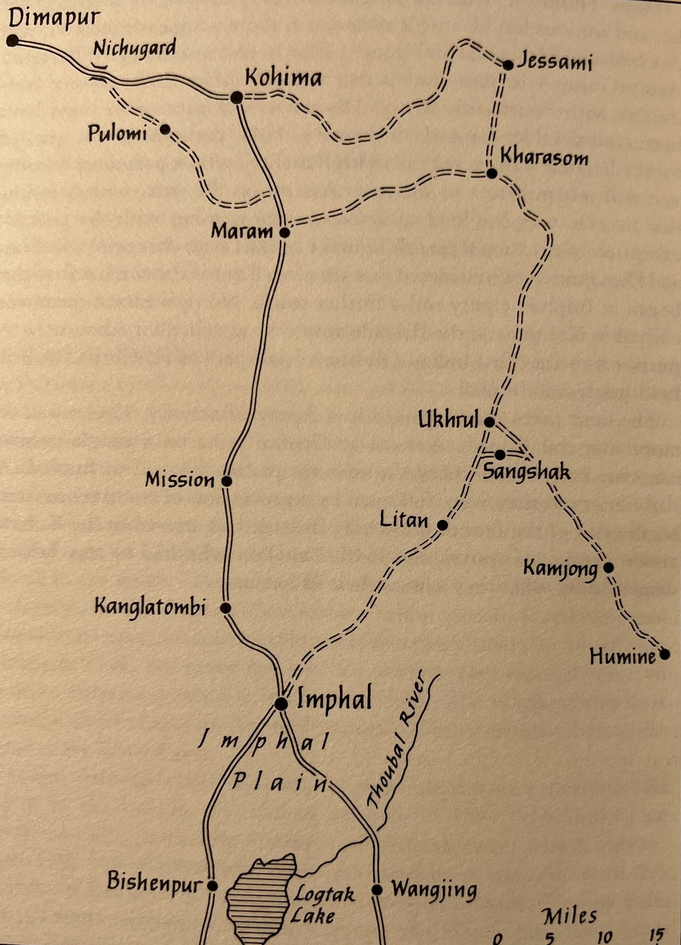
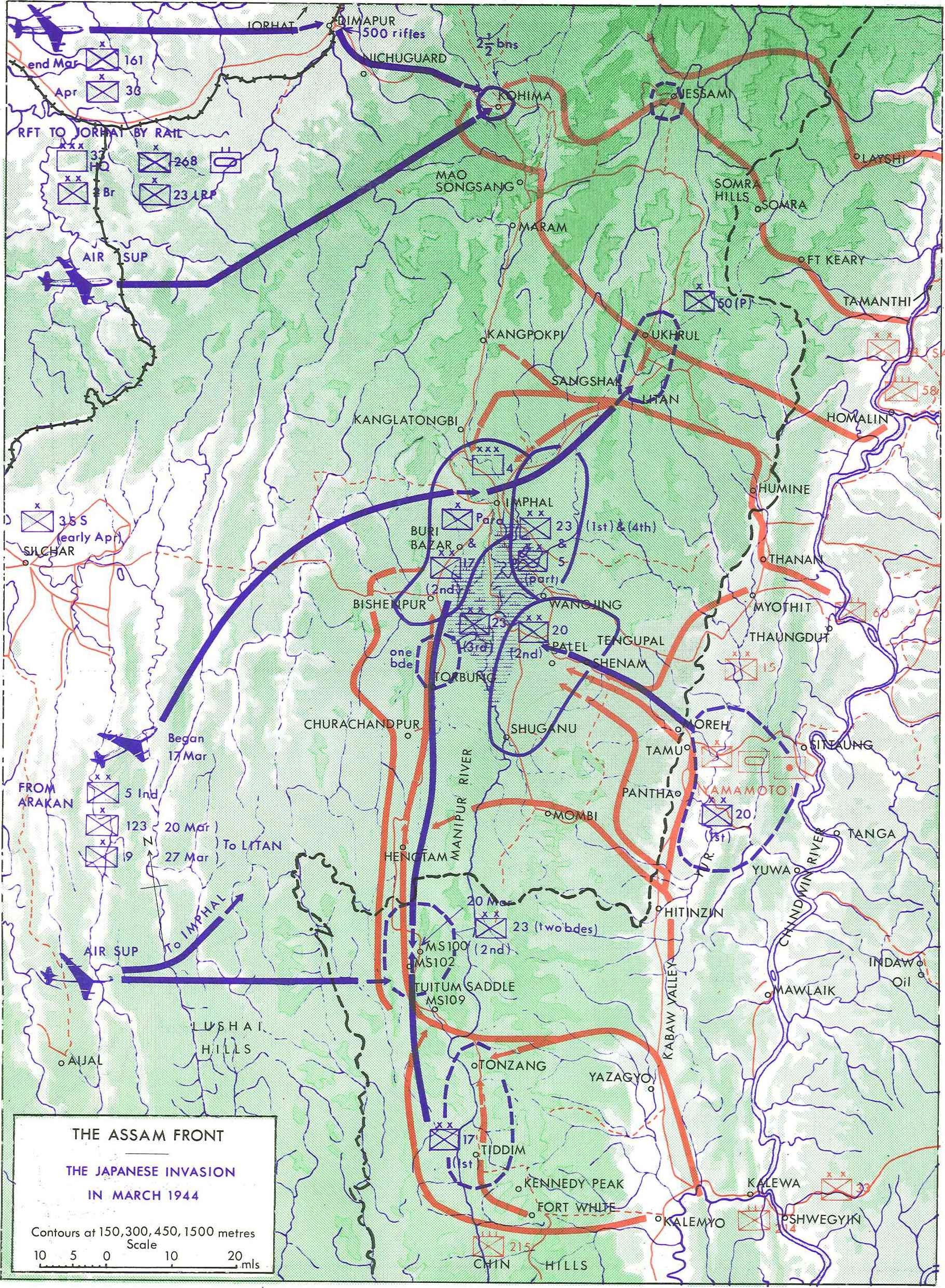
The Japanese commander was General Mutaguchi Renya, a gutsy go-getter who had played a significant role in the collapse of Singapore in February 1942. His evaluation of the British position in northeast India revealed that the three key strategic targets in Assam and Manipur were Imphal; the mountain town of Kohima, and the huge supply base further back on the edge of the Brahmaputra Valley at Dimapur. If Kohima were captured, Imphal would be cut off from the rest of India by land. From the outset Mutaguchi believed that with a good wind Dimapur, in addition to Kohima, could and should be secured. He reasoned that capturing this massive depot would be a devastating, possibly terminal blow to the British ability to defend Imphal, supply the Americans in Northern Burma under Vinegar Joe Stilwell, support the Hump airlift into China and mount an offensive into Burma. It would also enable him to feed his own, conquering army, which would advance across the mountains from the Chindwin on the tightest imaginable supply chain. With Dimapur captured, the Japanese-led Indian National Army under the Bengali nationalist Subhas Chandra Bose could pour into Bengal, initiating the long-awaited anti-British uprising.
(Click to enlarge)
The essence of the battle for India in 1944 can be quickly told. Mutaguchi’s 15th Army advanced in four separate columns into Manipur. The Japanese made determined, even desperate, efforts to seize their objectives: in the north Kohima, with a scratch British and Indian garrison of 1,200 trained fighting soldiers – about two thirds of them Indian – was attacked by an entire division of about 15,000 men in early April. Surrounded and slowly forced back onto a single hill they were supplied by air until relief came on 20 April, although the battle to dislodge the Japanese from Kohima continued bloodily, in appalling weather and battlefield conditions – the annual monsoon was in full spate – through to early June. Further south the Japanese plan entailed attacking Imphal from north, east and south. The plan of the commander of the 14th Army, Lieutenant General Bill Slim, was to withdraw his forces into the hills and there to allow the Japanese to expend themselves fruitlessly against well-supplied and aggressive British bastions, equipped with tanks, artillery and supported by air. The battle for Imphal in Manipur and for Kohima to the north-west in the neighbouring Naga Hills settled down to a bloody hand-to-hand struggle as the Japanese tried to gain the foothold necessary for their survival. They travelled lightly, and reserves soon exhausted themselves and further supplies were almost non-existent. Just as the air situation was becoming critical for Slim through poor weather and shortages of aircraft the relieving division from Kohima – the British 2nd Infantry Division that had last seen action at Dunkirk – began fighting its way towards Imphal, and the four beleaguered divisions began to push out from the Imphal pocket. By 22 June the 2nd Division and the 5th Indian Division met north of Imphal and the road to the plain was open. Four weeks later the Japanese withdrawal to Burma began.
Of all the invading armies of history, it is hard to think of one that was repulsed more decisively, or more ignominiously, than the Japanese 15th Army launched against India in March 1944. Its defeat was not the fault of the Japanese soldiers, who fought courageously, tenaciously and fiercely, but of their commanders, who sacrificed the lives of their troops on the altar of their own hubris. The battle had provided the largest, most prolonged and most intense engagement with a Japanese army yet seen in the war. “It is the most important defeat the Japs have ever suffered in their military career” wrote Mountbatten exultantly to his wife on 22nd June 1944, “because the numbers involved are so much greater than any Pacific Island operation.” The extent of the disaster that befell the 15th Army is captured by a comment by Kase Toshikazu, a member of the wartime Japanese Foreign Office, who lamented: “Most of this force perished in battle or later of starvation. The disaster at Imphal was perhaps the worst of its kind yet chronicled in the annals of war.” The latter might better have included the caveat “Japanese” to avoid charges of exaggeration, but his comment captures something of the enormity of the human disaster that overwhelmed the 15th Army. It might more fairly be described as the greatest Japanese military disaster of all time. The Indian, Gurkha, African and British troops of this remarkably homogeneous organisation had also decisively removed any remaining notions of Japanese superiority on the battlefield.
The importance of this victory was overshadowed at the time, and downplayed for decades afterwards, by the massive victories in 1945 which brought World War II to an end in Europe and the Pacific. But this lack of publicity and of awareness does not remove the fact that, objectively speaking, the battles in India in 1944, epitomized in the fulcrum battle at Kohima, were an epic comparable with Thermopylae, Gallipoli, Stalingrad, and other better known confrontational battles where the arrogant invader became, in time, the ignominious loser.
Comments Off on “The disaster at Imphal was perhaps the worst of its kind yet chronicled in the annals of war”
April 25, 2024
Were the Waffen-SS Really Germany’s Elite Fighters? – WW2 – OOTF 35
World War Two
Published 24 Apr 2024It’s time for another thrilling installment of Out of the Foxholes, but what sort of questions does Indy answer today? Well, it’s good stuff — about Allied security and logistics at the major conferences, about what the British navy was doing once the Atlantic and Mediterranean were secure, and about the skills (or lack thereof) of the soldiers of the Waffen SS. How can you live without knowing about such things? I suppose it’s possible, but it would be a sad life indeed, so check it out!
(more…)
Comments Off on Were the Waffen-SS Really Germany’s Elite Fighters? – WW2 – OOTF 35
March 31, 2024
August, 1945 – The Soviets enter the war in China
Big Serge outlines the Soviet invasion of Manchuria in August 1945 and its devastating impact on the Japanese Kwantung Army, finally shattering any remaining illusions that the Soviets would broker a peace between Japan and the western allies:
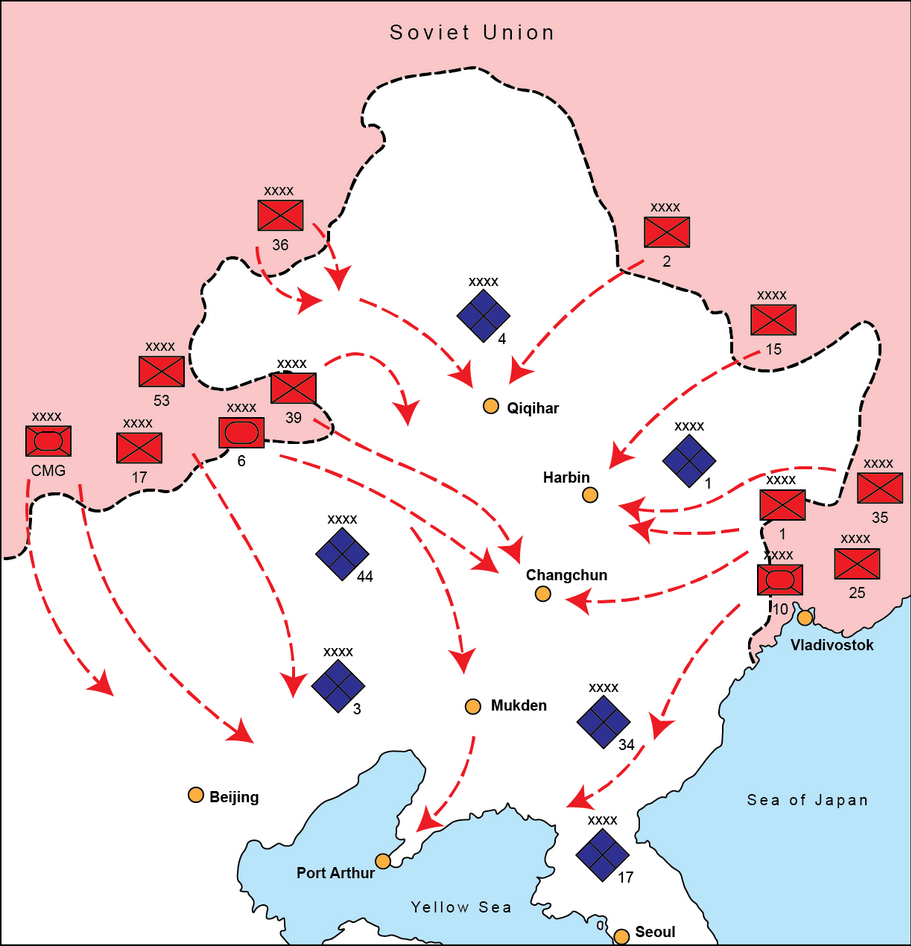
August Storm: The Soviet Invasion of Manchuria (August 9-20, 1945)
The Second World War had a strange sort of symmetry to it, in that it ended much the way it began: namely, with a well-drilled, technically advanced and operationally ambitious army slicing apart an overmatched foe. The beginning of the war, of course, was Germany’s rapid annihilation of Poland, which rewrote the book on mechanized operations. The end of the war — or at least, the last major land campaign of the war — was the Soviet Union’s equally totalizing and rapid conquest of Manchuria in August 1945.
Manchuria was one of the many forgotten fronts of the war, despite being among the oldest. The Japanese had been kicking around in Manchuria since 1931, consolidating a pseudo-colony and puppet state ostensibly called Manchukuo, which served as a launching pad for more than a decade of Japanese incursions and operations in China. For a brief period, the Asian land front had been a major pivot of world affairs, with the Japanese and the Red Army fighting a series of skirmishes along the Siberian-Manchurian border, and Japan’s enormously violent 1937 invasion of China serving as the harbinger of global war. But events had pulled attention and resources in other directions, and in particular the events of 1941, with the outbreak of the cataclysmic Nazi-Soviet War and the Great Pacific War. After a few years as a major geopolitical pivot, Manchuria was relegated to the background and became a lonely, forgotten front of the Japanese Empire.
Until 1945, that is. Among the many topics discussed at the Yalta Conference in the February of that year was the Soviet Union’s long-delayed entry into the war against Japan, opening an overland front against Japan’s mainland colonies. Although it seems relatively obvious that Japanese defeat was inevitable, given the relentless American advance through the Pacific and the onset of regular strategic bombing of the Japanese home islands, there were concrete reasons why Soviet entry into the war was necessary to hasten Japanese surrender.
More specifically, the Japanese continued to harbor hopes late into the war that the Soviet Union would choose to act as a mediator between Japan and the United States, negotiating a conditional end to war that fell short of total Japanese surrender. Soviet entry into the war against Japan would dash these hopes, and overrunning Japanese colonies in Asia would emphasize to Tokyo that they had nothing left to fight for. Against this backdrop, the Soviet Union spent the summer of 1945 preparing for one final operation, to smash the Japanese in Manchuria.
The Soviet maneuver scheme was tightly choreographed and well conceived — representing in many ways a sort of encore, perfected demonstration of the operational art that had been developed and practiced at such a high cost in Europe. Taking advantage of the fact that Manchuria already represented a sort of salient — bulging as it did into the Soviet Union’s borders — the plan of attack called for a series of rapid, motorized thrusts towards a series of rail and transportation hubs in the Japanese rear (from north to south, these were Qiqihar, Harbin, Changchun, and Mukden).
By rapidly bypassing the main Japanese field armies and converging on transit hubs in the rear, the Red Army would effectively isolate all the Japanese armies both from each other and from their lines of communication to the rear, effectively slicing Manchuria into a host of separated pockets.
There were, of course, a host of reasons why the Japanese had no hope of resisting this onslaught. In material terms, the overmatch was laughable. The Soviet force was lavishly equipped and bursting with manpower and equipment — three fronts totaling more than 1.5 million men, 5,000 armored vehicles, and tens of thousands of artillery pieces and rocket launchers.
The Japanese (including Manchurian proxy forces) had a paper strength of perhaps 900,000 men, but the vast majority of this force was unfit for combat. Virtually all of the Japanese army’s veteran units and equipment had been steadily transferred to the Pacific in a cannibalizing trickle — a vain attempt to slow the American onslaught. Accordingly, by 1945 the Japanese Kwantung Army had been reduced to a lightly armed and poorly trained conscript force that was suitable only for police actions and counterinsurgency against Chinese partisans.
Really, there was nothing for the Japanese to do. The Kwantung Army had far less of a fighting chance in 1945 than the Wehrmacht had in the spring of that year, and everyone knows how that turned out. Unsurprisingly, then, the Soviets broke through everywhere at will when they began the assault on August 9. Soviet armored forces found it trivially easy to overrun Japanese positions (armed primarily with archaic, low caliber antitank weaponry that could not penetrate Soviet armor even at point blank range), and by the end of the first day the Soviet pincers were driving far into the rear.
It is easy, in hindsight, to write off the Manchuria campaign as something of a farce: a highly experienced, richly equipped Red Army overrunning and abusing an overmatched and threadbare Japanese force. In many ways, this is an accurate assessment. However, what the offensive demonstrated was the Red Army’s extreme proficiency at organizing enormous operations and moving at high speeds. By August 20 (after only 11 days), the Red Army had reached the Korean border and captured all their objectives in the Japanese rear, in effect completely overrunning a theater that was even larger than France. Many of the Soviet spearheads had driven more than three hundred miles in a little over a week.
To be sure, the combat aspects of the operation were farcical, given the totalizing level of Soviet overmatch. Red Army losses were something like 10,000 men — a trivial number for an operation of this scale. What was genuinely impressive — and terrifying to alert observers — was the Red Army’s clear demonstration of its capacity to organize operations that were colossal in scale, both in the size of the forces and the distances covered.
More to the point, the Japanese had no prospect of stopping this colossal steel tidal wave, but who did? All the great armies of the world had been bankrupted and shattered by the great filter of the World Wars — the French, the Germans, the British, the Japanese, all gone, all dying. Only the US Army had any prospect of resisting this great red tidal wave, and that force was on the verge of a rapid demobilization following the surrender of Japan. The enormous scale and operational proclivities of the Red Army thus presented the world with an entirely new sort of geostrategic threat.
Comments Off on August, 1945 – The Soviets enter the war in China
HMS Unicorn (I72) – Guide 367
Drachinifel
Published Dec 23, 2023The Unicorn, a fleet maintenance carrier of the British Royal Navy, is today’s subject.
(more…)
Comments Off on HMS Unicorn (I72) – Guide 367
March 27, 2024
The Volkssturm – a Million men to save the Reich?
World War Two
Published 26 Mar 2024The Volkssturm is the last-ditch people’s army of the Third Reich. Sure, on paper, there are millions of old men and boys ready to defend Germany. But how will they be armed? Are they truly willing to die for Hitler? Will they make any difference at all?
(more…)
Comments Off on The Volkssturm – a Million men to save the Reich?
March 26, 2024
QotD: Cavalry logistics for Steppe raiders
War parties, as noted, often moved without bringing the entire camp, the non-combatants or the sheep with them. This was actually a crucial operational concern on the steppe, since the absence of a war party might render an encampment – stocked full of the most valuable resources (livestock, to be clear) – effectively unguarded and ripe for raiding, but at the same time, attempting to chase down a moving encampment with an equally slow moving encampment was obviously a non-starter. Better to race over the steppe, concealed (as we’ll see) and quick moving to spring a trap on another group of nomads. But how did a war party make those high speed long-distance movements over the steppe? Horse-string logistics (a term, I should note, that I did not coin, but which is too apt not to use).
Each steppe warrior rode to battle with not one horse, but several: typically five to eight. For reasons that will rapidly become obvious, they preferred mares for this purpose. The Steppe warrior could ride the lead horse and keep the rest of them following along by connecting them via a string (thus “horse-string logistics”), such that each steppe warrior was his own little equine procession. These horses are, you will recall, fairly small and while they are hardy, they are not necessarily prodigiously strong, so the warrior is going to shift between them as he rides, sparing his best mount for the actual fight. Of course we are not looking at just one warrior on the move – that would be very dangerous – but a group on the move, so we have to imagine a large group (perhaps dozens or hundreds or even thousands) of warriors moving, with something like 5-8 times that many horses.
[Edit: It is worth noting that a horse-string war party might well also bring some number of sheep with them as an additional food supply, herding them along as the army rode. So even here, sheep maintain their importance as a core part of the subsistence system.]
Now of course the warriors are going to bring rations with them from the camp, including milk (both liquid in leather containers and dried to qurut-paste) as well as dried meat. But the great advantage of moving on mares is that they when they are lactating, mares are already a system for turning the grass of the steppe into emergency rations. As Timothy May (op. cit.) notes, a mare produces around 2.25-2.5 quarts of milk in excess of the needs of her foal per day during her normal five-month lactation period, equal to about 1,500kcal/day, half of the daily requirement for a human. So long as at least two of the horses in the horse-string were lactating, a steppe warrior need not fear shortfall. This was more difficult in the winter when less grass was available and thus mare’s milk became scarce, which could impose some seasonality on a campaign, but a disciplined band of steppe warriors could move massive distances (the Mongols could make 60 miles a day on the move unencumbered, which is a lot) like this in just a few months.
In adverse conditions (or where time permitted because meat is tasty), steppe warriors on the move could also supplement their diet by hunting, preserving the meat as saddle-jerky. In regions where water became scarce, we are frequently told that the Mongols could keep going by opening a vein on their horse and drinking the blood for both nourishment and hydration; May (op. cit.) notes that a horse can donate around 14 pints of blood without serious health risk, which is both hydrating, but also around 2,184kcal, about two-thirds of the daily requirement. This will have negative impacts on the horses long term if one keeps doing it, so it was an emergency measure.
The major advantage of this kind of horse-string logistics was that a steppe warrior party could move long distances unencumbered by being essentially self-sufficient. It has a second major advantage that I want to note because we’ll come back to it, they light no fires. For most armies, camp fires are essential because food preparation – particularly grains – essentially requires it. But a steppe warrior can move vast distances – hundreds of miles – without lighting a fire. That’s crucial for raiding (and becomes a key advantage even when steppe warriors transition to taking and holding territory in moments of strength, e.g. the Mongols) because sight-lines on the steppe are long and campfires are visible a long way off. Fireless logistics allow steppe warriors to seemingly appear from the steppe with no warning and then vanish just as quickly.
That said, these racing columns of steppe warriors, while they could move very fast and be effectively independent in the short term, don’t seem generally to have been logistically independent of the camp and its herds of sheep in the long term. Not only, of course, would there be need for things like hides and textiles produced in the camp, but also the winter snows would drastically reduce the mares milk the horses produced, making it more difficult to survive purely on horse-string logistics. Instead, the camp formed the logistical base (and store of resources, since a lot of this military activity is about raiding to get captives, sheep and horses which would be kept in the camp) for the long range cavalry raids to strike out from. To the settled peoples on the receiving end of a Mongol raid, it might seem like the Mongols subsisted solely on their horses, but the Mongols themselves knew better (as would anyone who stayed with them for any real length of time).
Bret Devereaux, “That Dothraki Horde, Part II: Subsistence on the Hoof”, A Collection of Unmitigated Pedantry, 2020-12-11.
Comments Off on QotD: Cavalry logistics for Steppe raiders
March 13, 2024
“They won’t be in Gaza, but they’ll be just offshore — a few hundred yards from Gaza”
Apparently a bunch of former military types are getting their collective panties in a bunch just because Biden is sending part of a highly specialized US Army support brigade to install a temporary offshore unloading facility to get “humanitarian aid” in to Hamas fighters the civilian population of Gaza. All the political advisors to the President want to assure everyone that there will be no “boots on the ground”, so there’s no real risk …
The Pentagon has said something that should make us all sit up and pay attention.
Quick background first:
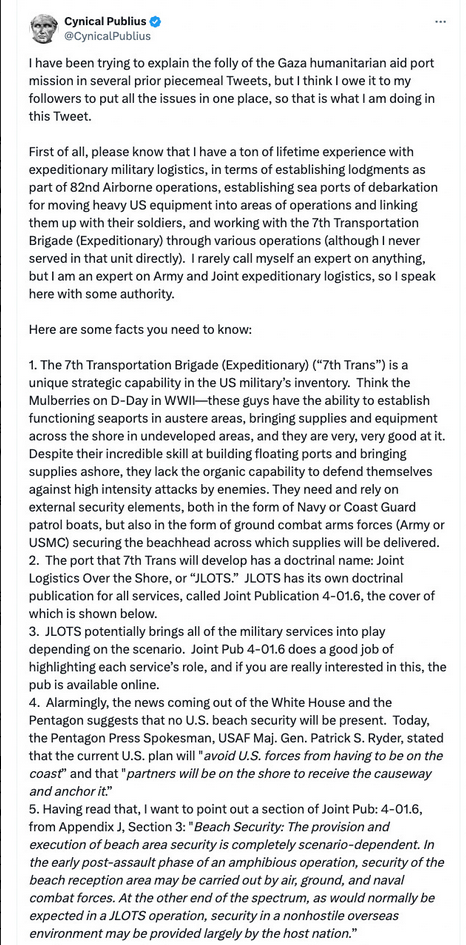
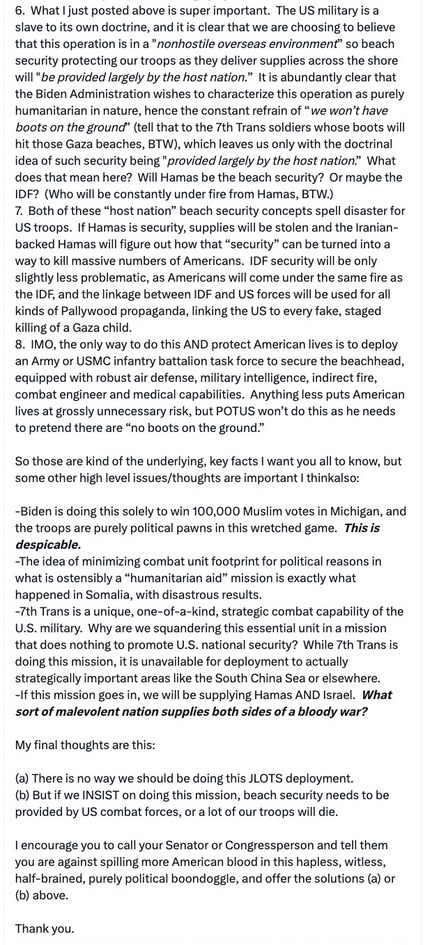
Elements of the US Army’s 7th Transportation Brigade are on the way to Gaza. […] They won’t be in Gaza, but they’ll be just offshore — a few hundred yards from Gaza. Now read this, and take the time to read it closely. I’ll split it into two screencaps to get it all in, which will be awkward to look at, but you can just click on the link to see it all whole (and subscribe to keep up with “Cynical Publius” as all of this develops):
The extremely important part of all of that is that transportation troops aren’t combat arms troops; they’re armed for some degree of self-protection, but “they lack the organic ability to defend themselves against high-intensity attacks by enemies.” In a hostile environment, they need to be screened: they need to be protected by combat-focused forces, both on-shore and off. They need infantry in front of them, warships behind them, and aircraft overhead.
Now, via this account, look at this transcript of an … interesting Pentagon press briefing on March 8, in which a major general talks at length about the security plan for the 7th Transportation Brigade when it gets to Gaza. Sample exchange:
Q: (Inaudible) partner nations on the ground, but you’re talking about operational security, you can’t discuss what will be (inaudible).
GEN. RYDER: Right. I mean, we will — these forces will have the capability to provide some organic security. I’m just not going to get into the specifics of that.
But they don’t — or they do, but the capability of transportation troops, from a combat service support branch, is extremely limited. Again, these are not combat arms troops, and aren’t armed or trained as combat arms troops. Talking about their organic security capability is an interesting choice.
Comments Off on “They won’t be in Gaza, but they’ll be just offshore — a few hundred yards from Gaza”


