
Forces TV
Published on 16 Oct 2018They say an Army marches on its stomach, but who gets the best deal out of British and US troops? One British Army Major has been taste-testing an American ration pack to find out…
Subscribe to Forces TV: http://bit.ly/1OraazC
Check out our website: http://forces.net
Twitter: https://twitter.com/ForcesNews
November 7, 2018
When A British Army Officer Tries A US Ration Pack… | Forces TV
Comments Off on When A British Army Officer Tries A US Ration Pack… | Forces TV
October 12, 2018
The Hindenburg Line Breaks – The Lost Battalion Returns I THE GREAT WAR Week 220
The Great War
Published on 11 Oct 2018The Hindenburg Line or Siegfriedstellung is the backbone of the German defenses on the Western Front and this week 100 years ago, the Allies break through during the Battle of St. Quentin Canal. At the same time, the political fallout within Germany continues and the Allied Army of the Orient continues its offensive on the Macedonian Front.
Comments Off on The Hindenburg Line Breaks – The Lost Battalion Returns I THE GREAT WAR Week 220
October 2, 2018
Stories From The Palestine Front – More About WW1 Trucks I OUT OF THE ETHER
The Great War
Published on 1 Oct 2018In this episode of Out of the Ether, we read a few excellent comments about WW1 Trucks and the Palestine Front.
Comments Off on Stories From The Palestine Front – More About WW1 Trucks I OUT OF THE ETHER
September 14, 2018
The Battle of Saint-Mihiel I THE GREAT WAR – Week 216
The Great War
Published on 13 Sep 2018The American First Army joins the fray on the Western Front with the Battle of Saint-Mihiel. All along the Western Front, the Allies are attacking or planning new attacks. The situation for the Germans looks dire even as the first war reparations from Russia arrive.
Comments Off on The Battle of Saint-Mihiel I THE GREAT WAR – Week 216
September 11, 2018
Unleashing The Tank’s Full Potential – 1918/1919 Tank Tactics I THE GREAT WAR On The Road
The Great War
Published on 10 Sep 2018Support The Tank Museum: https://www.patreon.com/tankmuseum
Indy and David Willy from the Tank Museum sit inside a Mark V tank to talk about the evolution of tank tactics and how the Allies started to properly use tanks during and after the battle of Amiens.
Comments Off on Unleashing The Tank’s Full Potential – 1918/1919 Tank Tactics I THE GREAT WAR On The Road
September 4, 2018
WW1 Trucks and Logistics I THE GREAT WAR On The Road
The Great War
Published on 3 Sep 2018Indy and David Willey of the Tank Museum talk a bit about trucks and logistics during WW1 while sitting in some sweet vintage World War 1 trucks.
Comments Off on WW1 Trucks and Logistics I THE GREAT WAR On The Road
July 31, 2018
The Utah Navy: Clearfield Navy Supply Depot, updated
The History Guy: Five Minutes of History
Published on 5 Aug 2017The History Guy examines the unique role of Utah and the Clearfield Navy Supply Depot in the war in the Pacific. Episode one of History Guy: Five Minutes of History is now available in HD.
Comments Off on The Utah Navy: Clearfield Navy Supply Depot, updated
June 5, 2018
The Landings At ANZAC Cove And Suvla Bay 1915 I THE GREAT WAR On The Road
The Great War
Published on 4 Jun 2018With thanks to Mr. Ali Serim for making this episode possible.
Indy and our guide Can Balcioglu explore the northern landings sites of Gallipoli where the Australian and New Zealand Army Corps (ANZAC) landed in 1915.
Comments Off on The Landings At ANZAC Cove And Suvla Bay 1915 I THE GREAT WAR On The Road
May 29, 2018
Allied Defense During Spring Offensives 1918 I THE GREAT WAR Special
The Great War
Published on 28 May 2018MHV about Stormtrooper tactics: https://www.youtube.com/watch?v=BNqmA-if-4g
The French and British defenses during the German Spring Offensive 1918 were put to a real test when the Germans attacked. The carefully built defenses had to be abandoned and new lessons had to be learned.
Comments Off on Allied Defense During Spring Offensives 1918 I THE GREAT WAR Special
March 16, 2018
How Rifles & Railroads influenced Warfare in the 19th Century
Military History Vlogs
Published on 23 Feb 2018The introduction of the breech-loading rifle and the railroad had a tremendous influence on Warfare in the 19th Century. Although, not everyone was as fast or able to adopt then the Prussians. Austria, France and Russia had major issues. Most notably visible in the Austro-Prussian War (1866) and Franco-Prussian War (1870-1871).
Comments Off on How Rifles & Railroads influenced Warfare in the 19th Century
February 21, 2018
British KFC outlets fall fowl of distribution fustercluck
The BBC reports on recent supply disruptions that have forced the majority of British KFC restaurants to close or run reduced hours:
KFC says some of the outlets which had to close when delivery problems meant they ran out of chicken have reopened.
Latest figures show that 470 of the fast-food chain’s 900 outlets in its UK-based division were shut as of 13:00 on Tuesday.
That compares with 575 that were closed at 21:00 on Monday.
Last week, the fried chicken chain switched its delivery contract to DHL, which has blamed “operational issues” for the supply disruption.
Earlier a KFC spokesperson said: “We anticipate the number of closures will reduce today [Tuesday] and over the coming days as our teams work flat out all hours to clear the backlog.
“Each day more deliveries are being made, however, we expect the disruption to some restaurants to continue over the remainder of the week, meaning some will be closed and others operating with a reduced menu or shortened hours.”
[…]
Until 13 February, KFC’s chicken was delivered by specialist food distribution group Bidvest.
But after the contract switched to DHL, many of the food giant’s outlets began running out of chicken products.
The GMB union said it had tried to warn KFC that switching from Bidvest to DHL was a mistake. The change led to 255 job losses and the closure of a Bidvest depot, said Mick Rix, GMB national officer.
He said: “Bidvest are specialists – a food distribution firm with years of experience. DHL are scratching around for any work they can get, and undercut them.
“KFC are left with hundreds of restaurants closed while DHL try and run the whole operation out of one distribution centre. Three weeks ago, KFC knew they had made a terrible mistake, but by then it was too late.”
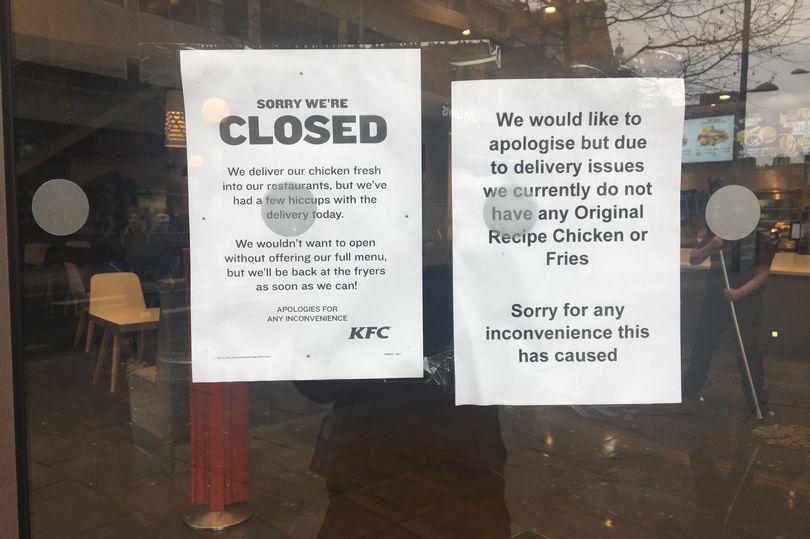
Signs posted in a KFC store window in Nottingham
Photo from the Nottingham Post (click image to read their article)
H/T to Jim Guthrie, who said “I suspect that this will be a ‘how not to do it’ example in delivery logistics for years to come.”
Comments Off on British KFC outlets fall fowl of distribution fustercluck
September 10, 2017
Barbarossa: Why such high Soviet Losses? – Explained
Published on 20 Jun 2017
The Red Army suffered heavy losses during Operation Barbarossa, but it also inflicted heavy losses on the Wehrmacht. This means it was not just some helpless giant, but it also begs the questions, why were the losses so high? This video discusses several factors and refers heavily to current academic research namely from Alexander Hill and David Stahel.
Military History Visualized provides a series of short narrative and visual presentations like documentaries based on academic literature or sometimes primary sources. Videos are intended as introduction to military history, but also contain a lot of details for history buffs. Since the aim is to keep the episodes short and comprehensive some details are often cut.
Comments Off on Barbarossa: Why such high Soviet Losses? – Explained
August 17, 2017
The Most Important Invention You Never Thought About
Published on 26 Jul 2017
One entrepreneur’s invention cut world poverty and revolutionized manufacturing. Learn more with Steve Davies: https://www.youtube.com/watch?v=7QLoeehMw0w&list=PL-erRSWG3IoBe1BsaqgTwYx0nS4nl2m_N&index=2
LEARN MORE:
How to Sabotage Progress (video): During the earliest part of the Industrial Revolution, workers worried about losing their jobs to machinery would throw their shoes into the machines in order to sabotage production. We’re seeing recurrence of sabotage again today, but there’s no more successful saboteur than regulation. Duke University Professor Michael C. Munger explains. https://www.youtube.com/watch?v=K0nSiwnbv4oThe Box: How the Shipping Container Made the World Smaller and the World Economy Bigger (book): Economist Marc Levinson delves into the history of the shipping container and how the invention changed the world. https://www.amazon.ca/Box-Shipping-Container-Smaller-Economy/dp/0691170819/ref=as_li_ss_tl?ie=UTF8&qid=1502034038&sr=8-1&keywords=The+Box:+How+the+Shipping+Container&linkCode=ll1&tag=quotulatiousn-20&linkId=ca8f280248e61c2c42aaae2b3c5f1395
An Awesome Map of World Trade and Shipping (article): Daniel Bier uses UCL Energy Institute’s timelapse of global shipping to illustrate spontaneous order. https://fee.org/articles/an-awesome-map-of-world-trade-and-shipping/
TRANSCRIPT:
For a full transcript please visit: http://www.learnliberty.org/videos/the-most-importa%E2%80%A6er-thought-about/
Comments Off on The Most Important Invention You Never Thought About
June 14, 2017
Canada’s Next Auxiliary Oiler Replenishment Ship – Episode 3
Published on Jun 9, 2017
The third episode in a series about the construction and operation of the Royal Canadian Navy’s next naval support ship.
December 4, 2016
Canada’s Next Auxiliary Oiler Replenishment Ship – Episode 2
Published on Nov 28, 2016
The second installment of the documentary following the build of Canada’s new Auxiliary Oiler Replenishment Ship. Episode 2 follows the journey of Davie, its workers and partners from May to November 2016 as they build the largest ship that will operate in the Royal Canadian Navy fleet.


