This demands a continuous alteration of the past, made possible by the system of thought which really embraces all the rest, and which is known in Newspeak as DOUBLETHINK.
The alteration of the past is necessary for two reasons, one of which is subsidiary and, so to speak, precautionary. The subsidiary reason is that the Party member, like the proletarian, tolerates present-day conditions partly because he has no standards of comparison … This day-to-day falsification of the past, carried out by the Ministry of Truth, is as necessary to the stability of the regime as the work of repression and espionage carried out by the Ministry of Love.
The mutability of the past is the central tenet of Ingsoc. Past events, it is argued, have no objective existence, but survive only in written records and in human memories. The past is whatever the records and the memories agree upon. And since the Party is in full control of all records and in equally full control of the minds of its members, it follows that the past is whatever the Party chooses to make it. It also follows that though the past is alterable, it never has been altered in any specific instance. For when it has been recreated in whatever shape is needed at the moment, then this new version IS the past, and no different past can ever have existed … It is also necessary to REMEMBER that events happened in the desired manner. And if it is necessary to rearrange one’s memories or to tamper with written records, then it is necessary to FORGET that one has done so. The trick of doing this can be learned like any other mental technique. It is learned by the majority of Party members, and certainly by all who are intelligent as well as orthodox. In Oldspeak it is called, quite frankly, “reality control”. In Newspeak it is called DOUBLETHINK.
George Orwell, Nineteen Eighty-Four, 1949.
May 4, 2021
QotD: DOUBLETHINK
April 26, 2021
QotD: Maple-flavoured schadenfreude
Schadenfreude is of course the German word for taking pleasure in the discomfort of others. There should be a specific Canadian variant to indicate our enjoyment of Americans’ discomfort, which is and always has been a major source of satisfaction for many of our media elites. Maybe schadenfreud-eh?
William Watson, “Smug Canada probably wouldn’t let in a caravan of migrants either”, Financial Post, 2018-10-26.
March 14, 2021
QotD: “Logomachia” – the use of language as a culture war weapon
During the Summer of Floyd, I commented to an American friend that this is the first time in my adult life that I am more optimistic about France than about America. The mass derangement of wokeness has been astonishing to watch. And the response from the right has been pathetic. Now, America has driven itself into ditches before, and found deep reservoirs of self-confidence from which to draw. I would never write off America completely. But the rapidity and fanaticism with which American elites have committed themselves to a course of what can only be called civilizational suicide — a kind of anti-American jihad — has been astonishing. Certainly I hope the Europeans take the right lessons from it and, as I mentioned, it seems that French elites aren’t buying it.
One of the left’s key weapons is what the philosopher Jean-Marie Benoist called “logomachia”, or language warfare. They invent all these words and use it to shape the ideaspace in their favor. It should be obvious to anyone who doesn’t have brainworms — at this point it is even obvious to many normies — that in contemporary American discourse a word like “racism” has as much connection to phenomena in the real world as “Trotskyite” had in Russia under Stalin. So if someone says “You’re a racist!” and you respond “I’m not a racist because X and Y and Z” you have already lost because you have implicitly conceded that there is this thing out there called “racism” which is really big and bad and scary, and one that your enemies get to define for you. And it doesn’t matter that your X or Y or Z may be absolutely correct. You still lose by dignifying the accusation e.g. (“I am not part of the Trotskyite conspiracy!”). The entire thing is transparently preposterous and should be responded to appropriately, with laughter and derision.
And let’s face it, we are so eager to say “I’m not a racist!” because we’re afraid of what will happen to us if we don’t. And people can smell fear, and it’s unattractive. Be not afraid!
Niccolo Soldo, “The Zürich Interviews – Pascal-Emmanuel Gobry: Unrepentant Baguette Merchant”, Fisted by Foucault, 2020-12-02.
March 6, 2021
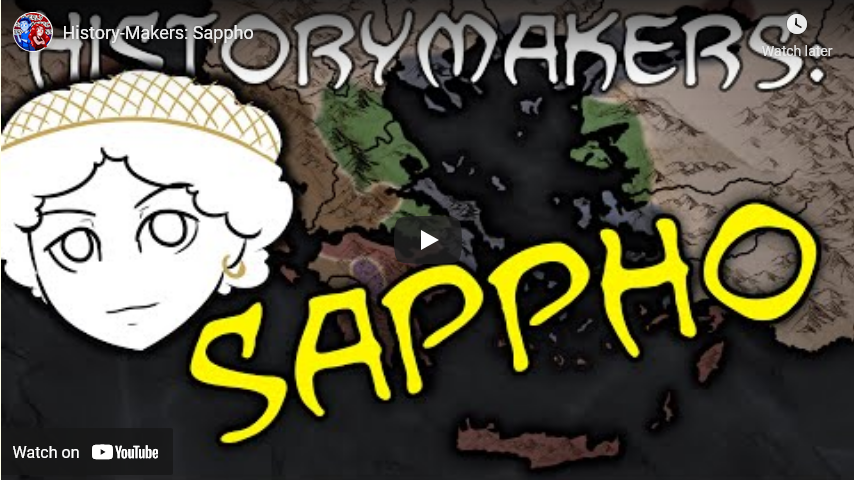
History-Makers: Sappho
Overly Sarcastic Productions
Published 5 Mar 2021It’s no use, dear algorithm, I cannot research, for Sappho has crushed me with longing for lost poetry!
SOURCES & Further Reading: Sappho: fragments by Jonathan Goldberg, “Girl, Interrupted: Who Was Sappho?” for The New Yorker by Daniel Mendelsohn (https://www.newyorker.com/magazine/20…), “Sappho” from The Poetry Foundation (https://www.poetryfoundation.org/poet…)
Our content is intended for teenage audiences and up.
PATREON: https://www.Patreon.com/OSP
PODCAST: https://overlysarcasticpodcast.transi…
DISCORD: https://discord.gg/osp
MERCH LINKS: http://rdbl.co/osp
OUR WEBSITE: https://www.OverlySarcasticProductions.com
Find us on Twitter https://www.Twitter.com/OSPYouTube
Find us on Reddit https://www.Reddit.com/r/OSP/
February 27, 2021
February 21, 2021
February 12, 2021
QotD: Repartee
Clever banter can only be called “repartee” if it’s from the Repartée region of France. Otherwise it’s just sparkling wit.
Daniel Hannan, Twitter, 2020-11-06.
January 21, 2021
January 18, 2021
QotD: Francis Bacon on what we now call “Confirmation Bias”
Man is a rational animal, as Aristotle put it. Not that he is always rational, but that he is capable of reason. Reason, trained, leads to happiness. Orwell wasn’t the first person to observe that this didn’t always work in practice.
“The human understanding when it has once adopted an opinion (either as being the received opinion or as being agreeable to itself) draws all things else to support and agree with it” wrote Francis Bacon in his 1620 Novum Organum, one of the major early works of the European Enlightenment and Scientific Revolution. Today, we call this confirmation bias. We don’t form opinions based on the evidence — we often shape the evidence to suit our opinions. We attribute importance to facts which back our preferred theory and dismiss as unimportant those which do not. “It is the peculiar and perpetual error of the human intellect to be more moved and excited by affirmatives than by negatives; whereas it ought properly to hold itself indifferently disposed towards both alike,” Bacon added. We continue to cling to ideas which have been discredited, a phenomenon called belief perseverance. Or worse, our faith in discredited ideas becomes even stronger when we are presented with contrary evidence — the backfire effect. Or we focus on successes and ignore failures, a phenomenon called survivorship bias. Bacon reminds us of the story of Diagoras of Melos, who was shown a picture of those who had escaped shipwreck after making vows to the gods hanging in a temple. Diagoras asked where he could find a picture of those who made vows to the gods but drowned anyway.
Bacon wrote that humans are afflicted with “idols of the mind,” and he identified four. The first are idols of the tribe, flaws in thinking common to all people that come from human nature itself. Second are idols of the cave, or den. All of us, Bacon argued, have a cave in our mind where the light of reason is dimmed, and this cave varies from person to person depending on his or her character, experiences, and environment. Third are idols of the marketplace, associated with the exchange of ideas. As language can never be perfectly precise, it’s possible for falsehoods to develop and spread as a concept as explained by one person to another. Finally come idols of the theatre, ideas which have been presented to us and taken root so deeply and firmly they’ve become hard to remove. In Bacon’s time, this was the philosophy of Aristotle, which had become so fundamental to Western thought that even parts of it which could easily be disproven remained unchallenged for centuries. To manage the effect of the idols, Bacon proposed “radical induction” — the forerunner to the modern scientific method.
Adam Wakeling, “George Orwell and the Struggle against Inevitable Bias”, Quillette, 2020-08-08.
January 3, 2021
QotD: Literary stasis in the Byzantine empire
Undoubtedly, the Mediaeval Romans – now exclusively Greek in their language – made little effort to be original in their literature. They had virtually the whole body of Classical Greek literature in their libraries and in their heads. For them, this was both a wonderful possession and a fetter on the imagination. It was in their language, and not in their language. Any educated person could understand it. But the language had moved on – changes of pronunciation and dynamics and vocabulary. The classics were the accepted model for composition. But to write like the ancients was furiously hard. Imagine a world in which we spoke Standard English, but felt compelled, for everything above a short e-mail, to write in the language of Shakespeare and the Authorised Version of the Bible. Some of us might manage a good pastiche. Most of us would simply memorise the whole of the Bible, and, overlooking its actual content, write by adapting and rearranging remembered clauses. It would encourage an original literature. Because Latin soon became a completely foreign language in the West – and because we in England were so barbarous, we had to write in our own language – Western Mediaeval literature is often a fine thing. The Mediaeval Romans never had a dark age in our sense. Their historians in the fifteenth century wrote up the fall of Constantinople to the Turks in the same language as Thucydides. Poor Greeks.
Sean Gabb, “The Mediaeval Roman Empire: An Unlikely Emergence and Survival”, SeanGabb.co.uk, 2018-09-14.
December 15, 2020
December 11, 2020
“Politically correct language … seemed like a nice, polite, and Canadian sort of thing to do”
Meaghie Champion discusses politically correct language in The Line:

Source: https://www.deviantart.com/blamethe1st/art/Statist-And-Anarchist-063-Political-Correctness-589944623
I grew up in the 1970s and ’80s. I have never lived in a world without what we now call “political correctness” — typically understood to mean using a kind of stilted and artificial language in order to atone for the disadvantages and slights suffered by marginalized groups and avoid inflicting new ones. Politically correct language required more effort to communicate, but it seemed like that effort was worth it to not offend people. It seemed like a nice, polite, and Canadian sort of thing to do.
I went along with political correctness out of a sincere desire to be accommodating to disadvantaged and dis-enfranchised groups. This became especially true after I learned about the “Sapir Whorf theory of psycho neurolinguistics.” The theory suggests that language shapes our perception of reality; that by altering the way we talk, we can shift the way we think — and, thus, collectively, we can shape reality itself. From this, it seemed logical to “de-gender” language or stop using stereotypes. It seemed like a small ask. Maybe I personally couldn’t solve big problems that concerned me as a good liberal … i.e. things like poverty or world hunger, but I could be nice in how I expressed myself and try to use language that everybody was using to be equitable and more fair.
What I didn’t understand, then, was that this precedent set a trap in which many good, well-intentioned liberals are finding themselves stuck. It’s no longer about ameliorating past sins: there is a project afoot to re-make the English language. The purpose of this project is to re-engineer how people think about certain subjects like gender, sex, and race, while skipping the necessary prerequisites of persuasion and logic. Conservative positions are declared off limits, even bigoted, simply by shaping the way we are allowed to talk about them.
Right now, even as I type this, there is a veritable army of academics hard at work on what they call “de-colonizing” and “de-gendering” language at many universities and colleges. There are tens of thousands of activists and academics in universities and online organizing and pushing for ever-changing rules to be enforced as it relates to the English language. It’s a multi-million-dollar industry in academia and woke corporatism. And it’s already starting to spill over into government regulations and enforcement.
I love the English language. I have been a voracious reader since childhood. I thrill at well-spoken and written prose and poetry. A finely turned witticism or fantastic mot juste can break my heart with its perfection. Further, I’m First Nations, and that love of the English language has also carried me into a love of the study of my tribal cradle tongue “Hul’qumi’num.” Shouldn’t I, as a First Nations person, be in favour of de-colonizing the English language? No. No, I do not think so. I have little patience or regard for any effort that makes language a less workable and functional tool of human endeavour. I identify strongly as a writer, and I take this assault upon the tool with which I conduct my craft very personally.
November 20, 2020
Quebec makes Canada’s politics really weird
J.J. McCullough
Published 2 Mar 2019Hypocrisies and blind spots stemming from the role played by French Canadians and the French language in Canada’s politics.
FOLLOW ME:
🇨🇦Support me on Patreon! https://www.patreon.com/jjmccullough
🤖Join my Discord! https://discord.gg/xQzjBRE
👾Watch me on Twitch! https://www.twitch.tv/jj_mccullough
🇺🇸Follow me on Instagram! https://www.instagram.com/jjmccullough/
🇨🇦Visit my Canada Website http://thecanadaguide.com
November 14, 2020
November 7, 2020
History Summarized: Wales
Overly Sarcastic Productions
Published 6 Nove 2020Wale, Wale, Wale(s), what have we here? I’ll tell you! A look at the oft-forgotten history of Britain’s secret third country Wales, where the population is about 50% bards just by sheer cultural osmosis.
SOURCES & Further Reading: A Concise History of Wales by Jenkins, A History of Wales by Davies
This video was edited by Sophia Ricciardi AKA “Indigo”. https://www.sophiakricci.com/
Our content is intended for teenage audiences and up.
PATREON: https://www.Patreon.com/OSP
PODCAST: https://overlysarcasticpodcast.transi…
DISCORD: https://discord.gg/osp
MERCH LINKS: http://rdbl.co/osp
OUR WEBSITE: https://www.OverlySarcasticProductions.com
Find us on Twitter https://www.Twitter.com/OSPYouTube
Find us on Reddit https://www.Reddit.com/r/OSP/