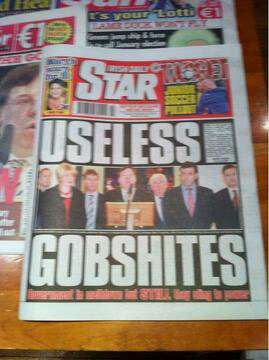
From Andrew Bloch’s Twitpic page and brought to my attention by Damian Penny.

From Andrew Bloch’s Twitpic page and brought to my attention by Damian Penny.
I’m in the middle of starting a new novel right now, and the bad thing about that strange phase of existence is that everything you see and hear somehow relates, in the wankmulch your brain has become, to that novel. Even a shopping list becomes a mass of notation and connective lines — because you’re convinced that the six things on it reveal something phenomenal about the world and your place in it, and there’s a place in the novel where you can shove all that in.
Deep down, there’s a little James Joyce homunculus in our hearts, presumably chatting up a saucy-looking ventricle and asking it if it shags, and also spreading the beautifully toxic notion that his book Ulysses actually contains all of Dublin in it and, should it ever be destroyed, a new Dublin could be generated from it like a backup copy, if needs be. And so we peer around at everything, to see if we can image it on a hard drive of a book, ghosting the real world.
Also it’s important to note that when writers — or at least I — get into this condition, we talk very fast and make not a lot of sense.
Warren Ellis, “Ghosting the real world”, Wired (UK), 2010-10-07
It’s not a good sign when the government has to intervene to prevent a run on a bank that is already owned by the government, but apparently, that’s what it’s doing with Anglo-Irish bank [. . .] One guesses that [. . .] the restructuring will cost a lot, and the “asset-recovery” bank will be worth very little. The Irish economy has a lot of fundamentals going for it — educated population, good corporate tax rates, and considerably fewer regulatory barriers to doing business than you find in Italy or Greece. But as a real economic boom, driven by European integration, brought increasing incomes, the Irish went on a borrowing binge even worse than our own, and inflated their boom into a bubble. One of my favorite stories of the period concerns a friend of mine, an Irish American who was married to an Irishman living in Galway. The level of status-competition that suddenly blossomed among her relatives and in-laws led her to consider opening a boutique that would literally specialize in ugly things which cost unreasonable sums of money.
Cleaning up after that consumer frenzy is going to be long and painful. As it will be for us, though less so.
Megan McArdle, “Ireland Moves to Shore Up State-Owned Bank”, The Atlantic, 2010-09-09
An interesting piece at The Register about that odd flying object, the autogyro:
Former British Army pilots, drawing on military experience carrying out covert surveillance with secret special-forces units, have decided to revive the autogyro — a long-lost aircraft design of the 1930s, probably most famous for its use in the James Bond movies.
British startup firm Gyrojet is exhibiting its planned designs at the Farnborough airshow this week, and the Reg whirlycraft and spook surveillance desk got the chance to chat with company executives.
Gyrojet’s marketing material makes use of several key phrases which ring bells for those familiar with the history of the secret British Army unit formerly known as “14 Intelligence Company”, aka “the Det(s)” during its time carrying out clandestine surveillance in the hard areas of Northern Ireland during the long troubles there.
The operators of 14 Int were selected from across the armed forces in much the same way as the SAS recruits, but far less well known even today. Unlike the SAS and SBS, 14 Int recruited women — for the simple and practical reason that it’s difficult for an all-male covert ops team not to attract notice among a normal local population.
The autogyro has interesting abilities that neither fixed-wing aircraft nor true helicopters can duplicate — abilities of great interest to those needing to conduct surveillance operations.
By way of Kathy Shaidle, a debunking of the notorious “No Irish Need Apply” era of labour:
Irish Catholics in America have a vibrant memory of humiliating job discrimination, which featured omnipresent signs proclaiming “Help Wanted — No Irish Need Apply!” No one has ever seen one of these NINA signs because they were extremely rare or nonexistent. The market for female household workers occasionally specified religion or nationality. Newspaper ads for women sometimes did include NINA, but Irish women nevertheless dominated the market for domestics because they provided a reliable supply of an essential service. Newspaper ads for men with NINA were exceedingly rare. The slogan was commonplace in upper class London by 1820; in 1862 in London there was a song, “No Irish Need Apply,” purportedly by a maid looking for work. The song reached America and was modified to depict a man recently arrived in America who sees a NINA ad and confronts and beats up the culprit. The song was an immediate hit, and is the source of the myth. Evidence from the job market shows no significant discrimination against the Irish — on the contrary, employers eagerly sought them out. Some Americans feared the Irish because of their religion, their use of violence, and their threat to democratic elections. By the Civil War these fears had subsided and there were no efforts to exclude Irish immigrants. The Irish worked in gangs in job sites they could control by force. The NINA slogan told them they had to stick together against the Protestant Enemy, in terms of jobs and politics. The NINA myth justified physical assaults, and persisted because it aided ethnic solidarity. After 1940 the solidarity faded away, yet NINA remained as a powerful memory.
Victor sent me this link with the comment “Thought you might find this interesting… Worrisome, even.” He was right, I do find it quite disturbing:
As part of a revision to defamation legislation, the Dail (Irish Parliament) passed legislation creating a new crime of blasphemy. Update: The bill went to the Seanad on Friday, July 10, passing by a single vote. This attack on free speech, debated for several months in Europe, has gone largely unnoticed in the American press.
[. . .] How does this impact free speech? Just don’t be rude.
- Atheists can be prosecuted for saying that God is imaginary. That causes outrage.
- Pagans can be prosecuted for saying they left Christianity because God is violent and bloodthirsty, promotes genocide, and permits slavery.
- Christians can be prosecuted for saying that Allah is a moon god, or for drawing a picture of Mohammed, or for saying that Islam is a violent religion which breeds terrorists.
- Jews can be prosecuted for saying Jesus isn’t the Messiah.
At risk of being too flippant, it’s really just a codification of the kind of thought pattern exemplified by Canada’s various “Human Rights” commissions, focusing on religion, rather than other forms of free thought and free expression.
The actual text of the new legislation goes a long way to convert the police into uniformed Revolutionary Guards:
36. Publication or utterance of blasphemous matter.
(1) A person who publishes or utters blasphemous matter shall be guilty of an offence and shall be liable upon conviction on indictment to a fine not exceeding €100,000. [Amended to €25,000]
2) For the purposes of this section, a person publishes or utters blasphemous matter if (a) he or she publishes or utters matter that is grossly abusive or insulting in relation to matters held sacred by any religion, thereby causing outrage among a substantial number of the adherents of that religion, and (b) he or she intends, by the publication or utterance of the matter concerned, to cause such outrage.
(3) It shall be a defence to proceedings for an offence under this section for the defendant to prove that a reasonable person would find genuine literary, artistic, political, scientific, or academic value in the matter to which the offence relates.
37. Seizure of copies of blasphemous statements.
(1) Where a person is convicted of an offence under section 36, the court may issue a warrant (a) authorising any member of the Garda Siochana to enter (if necessary by the use of reasonable force) at all reasonable times any premises (including a dwelling) at which he or she has reasonable grounds for believing that copies of the statement to which the offence related are to be found, and to search those premises and seize and remove all copies of the statement found therein, (b) directing the seizure and removal by any member of the Garda Siochana of all copies of the statement to which the offence related that are in the possession of any person, © specifying the manner in which copies so seized and removed shall be detained and stored by the Garda Siochana.
(2) A member of the Garda Siochana may (a) enter and search any premises, (b) seize, remove and detain any copy of a statement to which an offence under section 36 relates found therein or in the possession of any person, in accordance with a warrant under subsection (1).
(3) Upon final judgment being given in proceedings for an offence under section 36, anything seized and removed under subsection (2) shall be disposed of in accordance with such directions as the court may give upon an application by a member of the Garda Siochana in that behalf.
What’s the Gaelic for “Death to the infidel”? Expect to hear a lot of it in the future.
(Cross-posted to the old blog, http://bolditalic.com/quotulatiousness_archive/005573.html.)



Powered by WordPress