
The Korean War by Indy Neidell
Published 11 Aug 2026There’s heavy fighting in the field this week for a position the US Marines call Siberia. Behind the scenes there’s worry, though, as the US Army is more and more facing a manpower crisis. They are, however, training ever more South Korean troops to one day hopefully bring all their own troops home from the Korean peninsula, and leave it defended by the locals.
August 12, 2026
The Korean War Week 112 – The Chinese Take Siberia – August 11, 1952
Comments Off on The Korean War Week 112 – The Chinese Take Siberia – August 11, 1952
July 17, 2026
QotD: Catapults in pre-gunpowder armies
Cannon weren’t the first form of artillery used to batter fortifications, so before we get to gunpowder it is worth backing up and discussing catapults and the sort of “artillery threat” that catapults create. And here once again we need to clarify some terms: catapults are generally defined by the mechanism they use to store and then release energy, because that is fundamentally what a catapult is: a device for storing up some energy and then releasing it very suddenly to propel a large object.
The very oldest catapults, first invented by the Greeks were tension catapults (the gastrophetes and oxybeles), which functioned like large bows, with a bow-staff being bent backwards to store and then release the launching energy. This sort of design, common in pop-cultural depictions of catapults, is actually quite limited as with the materials available, there is a real limit to how much energy can be stored via tension. Fortunately for the Greeks, by the early fourth century, they had developed a better method.
Instead, the Greeks, Macedonians and Romans began using torsion catapults (where the energy is stored in wound-up sinews like a spring). While the devices used in field battles (and for city defense) were often smaller, arrow-launching devices, siege catapults could be very large; the standard engine for the purpose could fling a 1 talent stone (26.2kg) about 400m (though effectiveness was far higher if you could get closer to the wall, which as we’ll see will be a trend for most of this post); much larger engines did exist as well. That said, Roman catapults were mostly not for collapsing walls but for destroying towers and suppressing defenders in order to aid in escalade (usually by mole, rather than ladders or towers, though the Romans used those too).
And here once again the distinction between the “big army siege package” and the “small army siege package” matters quite a bit. Roman torsion artillery was complex, expensive and required lots of technical skill, and so sees far diminished use in the early Middle Ages where that technical skill is hard to come by. Vespasian, we are told, brought 160 torsion catapults to besiege Jotapata in 67 (Josephus BJ 3.166) while Titus brings a stunning 340 to besiege Jerusalem in 70 (Josephus BJ 5.356). By contrast, the construction of a single catapult is often a major event in a medieval siege (see Rogers, op. cit. 121-3 for some examples) and while later medieval catapults were often more powerful than the earlier Roman torsion devices, they were not that much more powerful.
Consequently, Hellenistic and Roman fortifications (especially city walls, like the Theodosian Walls we discussed last time) were designed with massed catapults in mind. As noted, the multiple walls ensured that the main curtain wall, the inner wall, was extremely difficult to target with catapults or indeed any kind of artillery: even if you knocked down the low wall and the outer wall, their rubble would mostly block shots at the base of the inner wall. Meanwhile, the inner wall was built to be practically immune to catapult fire anyway: up to 6m thick without any internal passages (the outer wall was much thinner, only 2m). That was more than enough to render the walls effectively immune to anything catapults can do; the walls in many places still stood up to Ottoman cannon in 1453. Finally, ancient city defenses were built assuming they’d often have their own stone and arrow throwing torsion artillery set up on the towers to return “counter-battery” fire. Not every city had the “complete package” that Constantinople, as the imperial capital head, of course, but some mix of thick walls, low out-walls and catapults designed for counter-battery fire were fairly standard defensive arrangements for Roman cities that could afford them and felt sufficiently threatened to invest the resources.
As we move into the Middle Ages, two paradoxical things happen. On the one hand, the ability for societies in Europe to deploy large numbers of finicky, high-tech torsion artillery decreases dramatically (and the machines that we do see tend to be the simpler, less accurate single-armed variety, what the Romans called the onager or “wild ass” because it kicked like one when it fired). On the other hand, by the sixth century, we start to see a clever new design of catapult, the traction trebuchet.
Originating in China in the 4th century BC, the traction catapult used muscle power directly to swing a long pole around a central frame. In terms of engineering complexity, it was a simpler device, and could be scaled up quite large so long as one could add more pullers (around 100 seems to have been normal for a large engine), but the range and power it offered as a result of the mechanical advantage offered by the long throwing arm were considerable. Given the number of pullers required, it is little surprise these were generally only used in small numbers in medieval Europe (again, often in reports it is merely a single device, described as a mangonel or a fenevol), but on the other hand, as I understand the physics, the range and striking power had the potential to be superior to a torsion catapult. Nevertheless, if we look at the kinds of fortifications emerging during this period, it certainly seems like in Europe, the concern that artillery might produce a breach in the wall (as opposed to merely degrading towers and the wall-walk) was fairly low.
Just to throw down a note here because we’ll come back to it, it is striking that while the small numbers of traction trebuchets in Europe seem to have represented a decline in the “catapult threat” to walls (recall last week’s contrast between castle walls and the much older Theodosian Walls), that was not the case in China, where walls continued to be made very thick – a design quirk that will matter quite a lot in a moment. I am not an expert on ancient and medieval Chinese siege tactics, alas, but my brief encounters with accounts of them often seem to describe traction catapults used en masse, in dozens or even hundreds, much more the way that the Romans used massed siege artillery. Likewise, Michael Fulton (Artillery in the Era of the Crusades (2018)) notes nearly a hundred Mamluk trebuchets (a mix of counter-weight and traction) at the Siege of Acre (1291); my sense is that such large siege trains were very rare within Europe. Presumably the ability to deploy so many engines was a consequence of greater state capacity in China and the Near East during this period as compared to fragmented, decentralized medieval Europe.
The late 12th century sees a major variation on the trebuchet design: the use of a counter-weight, instead of traction to provide the force; this innovation seems to have emerged in the West broadly defined, though it isn’t clear if that means in Europe or the Middle East (in any event both Christian and Muslim armies start using them at almost exactly the same time). This allows for much more energy to put into the shot, as the counter-weight can be very heavy and only slowly winched into place, allowing the work crew to spend more time “storing” energy in the counter-weight than they could with the quick pull of a traction trebuchet. Larger counter-weight trebuchets could also make use of animals to provide the power, or large wheels to make it easier to raise the counter-weight. The upper-limits on the size of projectiles were very high: Warwolf is thought to be the largest such trebuchet known, and threw a nearly 300lbs shot. That said, while counter-weight trebuchets hit harder (but fired slower), in function they do not seem to have been meaningfully different from traction trebuchets; they were used the same way in sieges.
What’s really striking is not the vast impact of catapults, but the muted impact of catapults. The counter-weight trebuchet was clearly good: the innovation makes its way all the way back to China, carried by the Mongols who presumably picked it up in the Middle East (ironically moving the opposite direction but at the same time as gunpowder, suggesting that at this point in the 13th century the two technologies were not considered mutually exclusive). Castle design does respond to catapults, but only in relatively modest ways: walls get somewhat thicker, but as Fulton (op cit.) notes, only by about half a meter or so (leaving even the newly thickened medieval castle walls somewhat thinner than the best old Roman defenses). In at least some areas, towers and keeps become more frequently rounded in shape, to resist catapult fire.
Certainly it was possible for catapults to open breaches in weaker walls to enable assault. The aforementioned Warwolf opened large breaches in the stone walls of Stirling Castle in 1304. But I note both Rogers (op. cit.) and Fulton (op. cit.) seem to confirm that while true breaches from trebuchets could happen, it was far more common that walls resisted trebuchet strikes and that the real work of the machines was degrading the wall defenses by striking off battlements and smashing towers, in order to enable escalade. Which is little surprise: that’s precisely what the Romans used catapults for too. While there is still some argument about the degree to which the counter-weight trebuchet was a revolutionary military technology, on the balance, the siege playbook changed only modestly to accommodate it, and castle design likewise shifted only in degrees.
And then Charles VIII of France (r. 1483-1498) decided to take a holiday on the Bay of Naples.
Bret Devereaux, “Collections: Fortification, Part IV: French Guns and Italian Lines”, A Collection of Unmitigated Pedantry, 2021-12-17.
Comments Off on QotD: Catapults in pre-gunpowder armies
July 11, 2026
QotD: Could airpower have broken the trench stalemate on the western front in WW1?
There are two directions to take airpower here: tactical and strategic. One wasn’t ready then (but would be by WWII), the other still hasn’t managed to accomplish its stated objectives yet, but continues to over-promise and under-deliver results.
Let’s deal with tactical airpower first. The first function aircraft were put to in WWI was reconnaissance. In 1914, that might mean locating the enemy in a fast-moving battlefield, but as soon as the trench stalemate set in, reconnaissance mostly meant identifying enemy buildups along the line and – still more importantly – serving as spotters for artillery. It wasn’t a huge cognitive leap to go from having aircraft which identified targets for the artillery to thinking that the aircraft could be the artillery. But as with tanks, the technical limitations of the platforms in use meant that actually meaningful close air support was still two decades away when the war ended. The rapid development of aircraft in these early days means that there is a truly bewildering array of aircraft designs in use during the war, but the Farman F.50 is a good sample for what the most advanced bombers in common use looked like towards the war’s end. It carried a maximum of eight 44kg bombs (352kg) under the wings, which were dropped unguided. With a maximum speed of less than 100mph and a service ceiling under 5000m, it was also an extremely vulnerable platform: fragile, slow and with a relatively low flight ceiling. The French mainly used bombers at night for this reason.
But how much airpower does it take to really move a division out of position? In 1944, at the start of Operation Cobra as part of the Normandy breakout, it was necessary for US forces to move the powerful armored division Panzer Lehr out of its prepared positions outside of St. Lo. Over the course of an hour and a half, the U.S. Eighth Air Force hit Panzer Lehr with approximately three thousand aircraft, including 1,800 heavy bombers (each of which might have had bomb-loads of c. 2-3,500kg; the attack would have been the equivalent of about 13,000 Farman F.50s (of which only a hundred or so were built!)). By this point, even medium bombers carried bomb loads in the thousands of pounds, like the B-25 Mitchell medium bomber, with a bomb load of 3000lbs (1360kg). This was followed by a hurricane artillery barrage! Despite this almost absurdly awesome amount of firepower (which, to be clear, inflicted tremendous damage; by the end of Operation Cobra, Panzer Lehr – the heaviest and most powerful Panzer division in the west – had effectively ceased to exist), Panzer Lehr, badly weakened was still very capable of resisting and had to be pushed out of position by ground attack over the next three days.
Needless to say, nothing on offer in 1918 or for a decade or more after, was prepared to offer that kind of offensive potential from the air. That kind of assault would have required many thousands of aircraft with capabilities far exceeding what even the best late-war WWI bombers could do. Once again, while close air support doctrine was developed with one eye on the trench stalemate and the role airpower could play in facilitating a breakthrough and restoring maneuver (either by blasting the breakthrough or – as in Soviet Deep Battle doctrine – engaging enemy rear echelon units to bog down reinforcements). But the technology wasn’t anywhere near the decisive point by 1918. Instead, the most important thing aircraft could do was spot for the artillery, which is mostly what aircraft continued to do, even in late 1918.
But that’s tactical bombing against military targets. What about strategic bombing against civilian targets?
The first efforts at strategic bombing were made in WWI, though once again the technology wasn’t ready. The range for fixed-wing aircraft was still very limited; the aforementioned Farman F.50 had a range of only 420km, nowhere near enough to really bring entire countries under the threat of bombing. Dirigibles – zeppelins – could manage much longer ranges and the Germans did attempt to bomb British cities with them starting in 1915. The problem was that once aircraft powerful enough to climb to the zeppelin’s altitude were developed, the slow and fragile zeppelins were sitting ducks: lighter than air airships could hardly be armored, after all. Moreover, the bomb loads of zeppelins had always been far too low to make effective strategic bombing possible beyond the initial shock of it.
What no one could have known in WWI was not merely that the technology for effective conventional strategic bombing wasn’t ready, but that it would probably never be ready. Interwar air-power theorists, seeing the potential of strategic airpower to bypass the trench stalemate by flying over it began to try to work out how this would be done. Giulio Douhet (1869-1930) argued that future wars would be fought and won in the air, with fleets of bombers using high explosives and chemical weapons to massacre enemy civilian centers, until civilians forced their governments to surrender. Douhet was not alone; his vision of airpower was shared, for instance, by the “father of the RAF”, Hugh Trenchard (1873-1956).
This concept, “morale bombing” as it is sometimes called, probably deserves its own post discussing its failures. But in brief, the concept was tested, with far larger amounts of bombs than Douhet or any other interwar theorist could have ever dreamed of, during WWII. The argument by air theorists that high altitude bombers could not be stopped was proved false when the British did exactly this, stopping German bombers over Britain in 1940. Moreover, terror bombing against civilian targets in Britain didn’t lead to surrender, but hardened resolve. Likewise, “morale” bombing against German targets by the allies didn’t lead to surrender, but hardened resolve. Later efforts to demoralize the North Vietnamese through a American bombing campaign in the Vietnam War didn’t lead to surrender, but hardened resolve. More recent efforts to demoralize or destroy terrorists and the Taliban through the use of airpower hasn’t lead to surrender, but rather hardened resolve. Likewise, efforts by the Syrian Regime to defeat various opposition groups in Syria through the use of chemical weapon-based terror bombing didn’t lead to surrender (siege-and-starve tactics did), but hardened resolve.
It turns out the fundamental premise of the entire idea of morale bombing – that being bombed will make people want to stop fighting – was flawed. Morale bombing has been, depending on how hard you squint at the US air campaign over Japan in WWII (including the use of nuclear weapons) successful either once (out of many attempts) or never. In most cases, the sustained bombing of civilian centers has been shown to increase a population’s willingness to resist, making the strategy worse than useless.
The case for strategic bombing against industrial targets is marginally better, but only marginally. While airpower advocates, particularly in the United States promised throughout WWII that bombing campaigns against German industry could lead to the collapse of the German war machine, in the end many historians posit that the real achievement of the campaign was to lure the Luftwaffe into the air where it could be destroyed, thus denying the German army of air cover and close air support, particularly on the Eastern Front. Some diminution of German industrial capabilities was accomplished (though it is not clear that this ever approached the vast resources poured into producing the large numbers of extremely expensive bombers used to do it, though the allies had such an industrial advantage over Germany, forcing the Germans to fight in expensive ways in the sky was a winning trade anyway), but the collapse of German industry never happened. As Richard Overy notes, German industrial output continued to rise during strategic bombing and only began to fall as a result of the loss of territory on the ground. Needless to say, “strategic bombing can sucker the enemy into wasting their close air support” was not the result that airpower advocates had promised, nor could it have broken the stalemate.
I don’t want to oversimplify the continued debate over the efficacy of strategic airpower here too much so let’s just say that the jury is still very much out as to if strategic airpower works even with modern technology; it certainly wouldn’t have worked with WWI era technology.
Bret Devereaux, “Collections: No Man’s Land, Part II: Breaking the Stalemate”, A Collection of Unmitigated Pedantry, 2021-09-24.
Comments Off on QotD: Could airpower have broken the trench stalemate on the western front in WW1?
July 4, 2026
The Dark Truth Behind America’s National Anthem
The Rest Is History
Published 8 Jun 2026How did the War of 1812 result in America’s national anthem, The Star Spangled Banner? Who came up with it? And, why does this origin story make the anthem so controversial?
Join Dominic and Tom as they launch into the first episode of their Football World Cup special, with the story behind America’s national anthem, and its secret story.
0:00 – Lloyd’s
01:21 – The Star-Spangled Banner
02:43 – A World Cup Series on National Anthems
04:08 – America’s Most Controversial Anthem
05:00 – The Forgotten War of 1812
09:10 – Britain Strikes Back
11:39 – Francis Scott Key Boards the British Fleet
15:27 – The Bombardment of Fort McHenry
18:14 – The Giant Flag That Inspired the Anthem
20:41 – Francis Scott Key Writes the Poem
23:28 – Why the Anthem Used an Old English Tune
26:13 – The Anacreontic Song
29:07 – How the Song Became a Hit
30:37 – The Times
31:48 – Is The Star-Spangled Banner About Slavery?
36:08 – Escaped Slaves and the British Army
40:55 – The People Who Found Freedom Under the Union Jack
42:29 – Francis Scott Key’s Complicated Legacy
47:06 – The Song Spreads Across America
51:39 – Why America Took So Long to Get a National Anthem
56:42 – How It Finally Became the Anthem
57:06 – Controversial Performances
1:00:17 – Colin Kaepernick and Taking the Knee
1:02:39 – Can You Separate the Anthem from the Author?
1:03:03 – The Abolitionist Version of the Anthem
1:04:13 – Coming Next: God Save the King
1:06:33 – The Rest Is History ClubVideo Editors: Jack Meek, Harry Swan + Adam Thornton
Social Producer: Harry Balden
Producers: Tabby Syrett & Aaliyah Akude
Senior Producer: Callum Hill
Executive Producer: Dom Johnson
Chief Digital Officer: Sam Oakley
Comments Off on The Dark Truth Behind America’s National Anthem
June 29, 2026
QotD: Roman Imperial frontiers and “defensive barbarism”
Here’s another one — why is Hadrian’s Wall where it is? There’s a much shorter and more defensible alternate location to the north, where the Firth of Forth and the Firth of Clyde create a natural bottleneck. In fact at one point the Romans did build a wall there and claimed all the intervening territory. On paper, the Antonine Wall looks better in every way than Hadrian’s Wall. [Image from original post] It’s shorter, so requires less military “output” to defend. And it encloses more area, so brings to the “inputs” of the machine of state both additional arable land and additional people who can be taxed and conscripted. But as it happened, the Antonine Wall was quickly abandoned, and the empire retreated to Hadrian’s Wall. Why?
It all had to do with the people living between the two walls. They were … hill people who had perfected the art of not being governed. They managed to be so thoroughly intractable, so impossible to control or corral, so very unpleasant to be around, that the Romans eventually threw up their hands in disgust and left them alone. It’s important to understand that this means they must have been true outliers, because the Roman Empire had “unit economics” like an enterprise SaaS business, where “customer acquisition costs” are financed on the assumption that they’ll be paid back in the distant future. Every Roman bureaucrat understood that newly conquered territories would be a drain on fiscal and military resources for a while, until a generations-long process of pacification and Romanization slowly made them net contributors in both departments. But in the case of the lands between the two walls, the payback timeline was so long, and the implied interest rates so high, that even a people as meticulous and relentless as the Romans decided there were better opportunities elsewhere. I count this as a serious victory for the theory of defensive barbarism.
John Psmith, “REVIEW: The Grand Strategy of the Roman Empire by Edward Luttwak”, Mr. and Mrs. Psmith’s Bookshelf, 2023-11-13.
Comments Off on QotD: Roman Imperial frontiers and “defensive barbarism”
June 16, 2026
QotD: Nitpicking the field fortifications in Gladiator (2000)
What we are shown is pretty clearly a prepared defense on a hillside, with a series of raised terraces, with a mix of abatis (sharpened wood obstacles, often crudely cut wood stakes set in an X pattern) and mantlets, with gaps in those defenses to allow units to move and a whole bunch of catapults positioned up on the hill. The terraces make for a layered, multi-stage fighting position at each level. On the one hand, the Romans were hardly averse to field fortifications and one wonders again if this set was a product of someone with an active imagination looking at the Column of Trajan [Wiki], which features a lot of scenes of Roman soldiers cutting trees and building bridges, roads and forts.
The problem isn’t that there are field fortifications, it is everything else about them: the style of field fortification, their position, layout and use. As we’ve noted before, Roman armies on campaign built fortified marching camps nightly, so we would expect Maximus’ army to have such a camp, but as we’ve discussed even more so, one of the classic, famous features of Roman armies is that they build the same layout of camp wherever they go, the famous Roman “playing card” forts, generally built on flat, open ground (rather than hillsides). That defense would not look like this, instead consisting of a ditch (the fossa) behind which would have been a earthwork rampart (the agger) topped with a wooden palisade (the vallum); thus rather than successive layers, you’d have a single clear fighting position (the vallum) on a mount with the ditch directly in front of it. And that would be a continuous line, with just four gates (at the center of each side), rather than this kind of checkerboard pattern of fortifications, because of course the purpose of this defense was to prohibit entry. Moreover, the line of field fortifications we see are not part of, nor connected to, a marching camp: it is simply a line of fortifications on the side of the hill with nothing on the flanks, rather than the distinctive “playing card shape”. We don’t see the camp sitting behind it either.
But the really immediate problem is that Maximus’ army has formed up within his troops strung through the field fortifications, with legionary soldiers mostly in front of them (but some are behind them) and the archers in between the stakes and mantlets. This may seem like a sensible way to form up a defense, but it is not the Roman way. Maximus is very intentionally “offering battle”, – inviting his opponent into an open field engagement. The way a Roman army did this was invariably forming up on the flat, open, unfortified ground in front of the camp, toward the enemy, signalling that they would fight in the open, outside of their walls (as Maximus does indeed intend to do).
So what we ought to see is Maximus’ army formed up outside in the open field, with the camp likely visible some distance behind them. That camp would be protected by very different fortifications: you’d be able to make out its “playing-card” shape, with watch-towers on the corners and the raised vallum running the exterior and the relatively neat grid of tents in the interior.
Finally, before we get to the battle plan, I want to note one more oddity here, which is the battlefield itself. The battlefield is a muddy field, which it looks to have been recently clear-cut, otherwise surrounded by dense forest. Of course part of the reason is that this is Bourne Wood, a coniferous tree plantation (and frequent filming location) in Surrey, England (which is why the trees are all the same species, so neatly spaced out) rather than the edge of an old-growth forest somewhere in southern Germany.
But the thing is, the Marcomanni, Quadi and other Germanic-language speaking peoples were an agrarian society, same as the Romans: their villages were surrounded by farm and pastureland. Of course a lot of the forest – old-growth forest, rather than tree-farms as here – remained, but if a Roman army wanted a flat, open space to offer battle in, they needn’t have cleared it themselves (and indeed probably couldn’t, at least not in the time frame they’d have to prepare for a pitched battle), but could simply march to the nearest village with its patches of farmland. Getting a Roman army to fight in dense, old-growth forest, after all, famously required clever ambushes, as a Teutoberg Forest (modern Kalkriese) in 9 AD. And if the enemy didn’t want to fight in the open, Roman armies were perfectly happy to burn villages and pillage crops as the standard way of attempting to force an enemy to accept an offer to battle or else vacate the area.
Bret Devereaux, “Collections: Nitpicking Gladiator’s Iconic Opening Battle, Part I”, A Collection of Unmitigated Pedantry, 2025-06-06.
Comments Off on QotD: Nitpicking the field fortifications in Gladiator (2000)
May 18, 2026
The American Civil War was “two armed mobs chasing each other around the country, from which nothing could be learned”
Ben Duval looks at the implications of the quote above (attributed to Moltke the Elder) and shows that there were indeed lessons to be learned from that conflict:
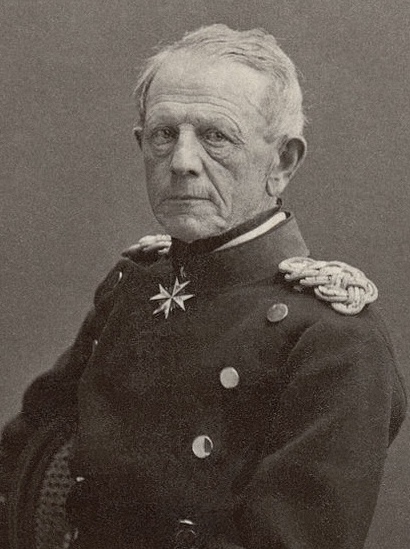
Chief of the Prussian General Staff Helmuth von Moltke the Elder (1800-1891).
Photo by Carl Günther via Wikimedia Commons.
A famous, if apocryphal, quote attributed to Moltke dismissed the American Civil War as “two armed mobs chasing each other around the country, from which nothing could be learned”. There were certainly lessons to be learned — it could hardly be otherwise in so long and intense a conflict. The war showcased many new technologies on a large scale, including rail and telegraph, while the growing accuracy of firearms showed the growing importance of field fortifications in pitched battle. It also gave witness to many expedients and innovations, including the first known employment of indirect fire (although that would take much longer to be appreciated).
Nevertheless, the readiness with which Moltke’s spurious quote was accepted is suggestive of fundamental differences between Europe’s large professional armies and the hastily-raised volunteers that fought for both North and South. The Civil War saw a mobilization of unprecedented scale, expanding from a pre-war regular army of 15,000 to a total of nearly 2 million at its peak.
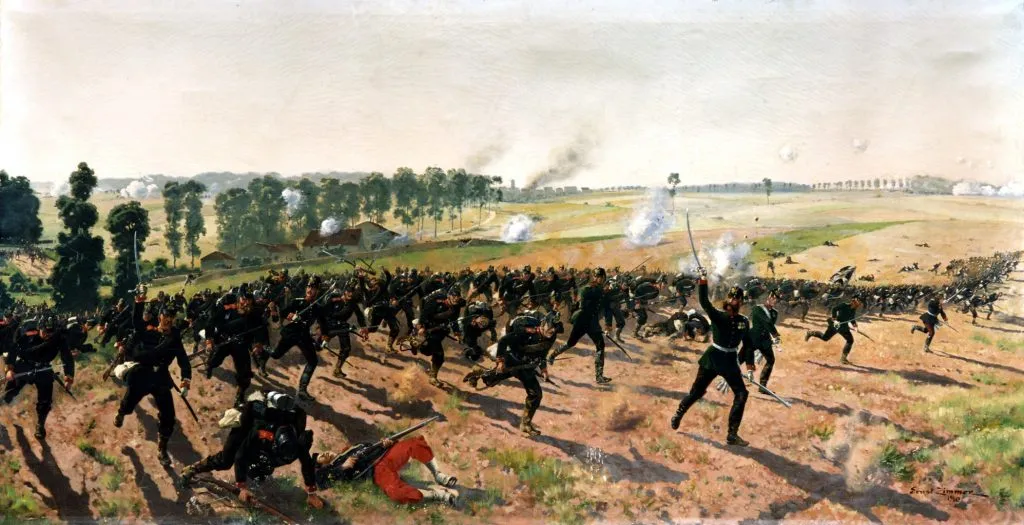
At some critical battles, like Antietam, many regiments had mustered bare weeks before. At best, these soldiers could handle their weapons reasonably well; large-scale maneuvers in the heat of combat were out of the question. Even long-serving formations did not have much of a chance to redress these deficiencies, as demonstrated by the disjointed conduct of Pickett’s Charge. What immediate lessons could the Prussian and French, efficiently maneuvering under fire at Gravelotte or Mars-la-Tour, have learned from Civil War armies?
Prussian attack at Gravelotte on 18 August 1870.
Lessons at the Right Level
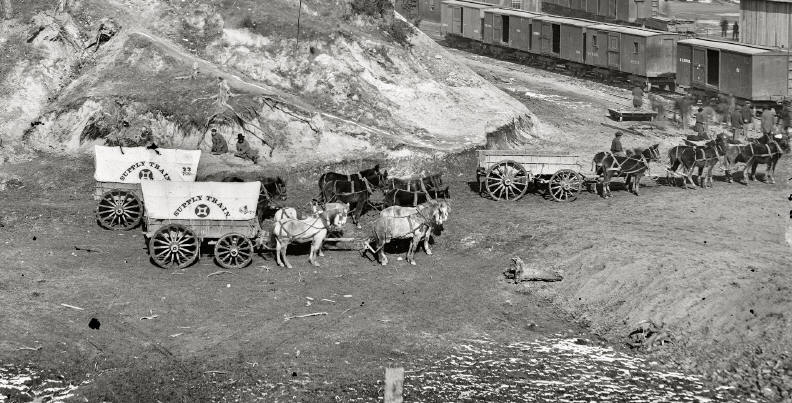
Perhaps not much at the tactical level, but there was plenty to be learned at the operational. Never before had railroads been employed at such scale to shift troops within and between theaters; nor the telegraph, which was used to coordinate such movements. Efficient logistical services allowed both sides to undertake bold maneuvers involving massive numbers of troops (it is noteworthy how many generals had previous experience working for railroad companies, and how many more went on to high management or board positions after the war).
Union supply wagons loading up at a railhead.
But the point also holds more broadly, beyond the particular technical specialties of 1860s America. Whenever tactics alone cannot suffice—either because both sides are extremely skilled, as in the First World War, or because organizational breakdowns rule out more complex maneuvers — decisive action can by default only occur at the operational level. This was an essential point in Saladin the Strategist. Muslim and Crusader armies, through long experience fighting each other, had developed unique fighting styles tailored to blunt each other’s edges: barring a fluke, decision could only be won through some higher-level maneuver.
In such cases, the fighting capabilities of an army matter less in any absolute sense than in their ability to effect a particular operational scheme. Tactical proficiency is but one variable among many, and not necessarily the most important. Whether a general is dealing with poorly-trained militia or long-serving professionals, it is above all their relative odds that factor into his calculations.
Comments Off on The American Civil War was “two armed mobs chasing each other around the country, from which nothing could be learned”
May 15, 2026
Bloodier Than Verdun? Winter Battles on the Eastern Front 1915
The Great War
Published 16 Jan 2026The first four months of 1915 witnessed a titanic struggle on the Eastern Front, in East Prussia, the Carpathians, Bukovina, and at Przemysl. Both sides suffered staggering casualties that surpass those of the Somme or Verdun the following year. Ironically, the Austro-Hungarians lost far more men trying to save Przemysl than there were in the fortress.
(more…)
Comments Off on Bloodier Than Verdun? Winter Battles on the Eastern Front 1915
April 8, 2026
The Korean War Week 94: Mines, Marines, and Mayhem – April 7, 1952
The Korean War by Indy Neidell
Published 7 Apr 2026In order to try and make some progress on the thorny issue of POW repatriation, the UN offers to screen all the POWs they hold to get an exact number of who refuses to be sent back. The Communists agree and the plans are put in motion. Plans in the field are finishing up, with the US 1st Marine Division having moved to new positions in the west, but they now have to deal with the unforeseen issue of thousands of landmines. They did not see that coming.
00:00 Intro
00:47 Recap
01:27 POW Issues
05:58 New Operations
07:18 Marine Defenses
10:53 Landmines
14:18 Summary
15:01 Conclusion
Comments Off on The Korean War Week 94: Mines, Marines, and Mayhem – April 7, 1952
February 23, 2026
Grand Strategy of the Roman Empire PART TWO
Adrian Goldsworthy. Historian and Novelist
Published 27 Aug 2025This should have posted earlier this morning, but for some reason did not.
This is the follow up to last week’s discussion of grand strategy, looking at the reactions and criticisms of Luttwak’s ideas, followed by some of my own thoughts.
Comments Off on Grand Strategy of the Roman Empire PART TWO
February 22, 2026
QotD: The shift from “motte-and-bailey” construction to stone castles
To talk about how these designs work, we need to clear some terminology. The (typically thin) wall that runs the circuit of the castle and encloses the bailey is called a “curtain wall“. In stone castles, there may be multiple curtain walls, arranged concentrically (a design that seems to emerge in the Near East and makes its way to Europe in the 13th century via the crusades); the outermost complete circuit (the primary wall, as it were) is called the enceinte. Increasingly, the keep in stone castles is moved into the bailey (that is, it sits at the center of the castle rather than off to one side), although of course stone versions of motte and bailey designs exist. In some castle design systems, with stone the keep itself drops away, since the stone walls and towers often provided themselves enough space to house the necessary peacetime functions; in Germany there often was no keep (that is, no core structure that contained the core of the fortified house), but there often was a bergfriede, a smaller but still tall “fighting tower” to serve the tactical role of the keep (an elevated, core position of last-resort in a defense-in-depth arrangement) without the peacetime role.
While the wooden palisade curtain walls of earlier motte and bailey castles often lacked many defensive features (though sometimes you’d have towers and gatehouses to provide fighting positions around the gates), stone castles tend to have lots of projecting towers which stick out from the curtain wall. The value of projecting towers is that soldiers up on those towers have clear lines of fire running down the walls, allowing them to target enemies at the base of the curtain wall (the term for this sort of fire is “enfilade” fire – when you are being hit in the side). Clearly what is being envisaged here is the ability to engage enemies doing things like undermining the base of walls or setting up ladders or other scaling devices.
The curtain walls themselves also become fighting positions. Whether on a tower or on the wall itself, the term for the fighting position at the top is a “battlement”. Battlements often have a jagged “tooth” pattern of gaps to provide firing positions; the term for the overall system is crenellation; the areas which have stone are merlons, while the gaps to fire through are crenals. The walkway behind both atop the wall is the chemin de ronde, allure or “wall-walk”. One problem with using the walls themselves as fighting positions is that it is very hard to engage enemies directly beneath the wall or along it without leaning out beyond the protection of the wall and exposing yourself to enemy fire. The older solution to this were wooden, shed-like projections from the wall called “hoarding”; these were temporary, built when a siege was expected. During the crusades, European armies encountered Near Eastern fortification design which instead used stone overhangs (with the merlons on the outside) with gaps through which one might fire (or just drop things) directly down at the base of the wall; these are called machicolations and were swiftly adopted to replace hoardings, since machicolations were safer from both literal fire (wood burns, stone does not) and catapult fire, and also permanent. All of this work on the walls and the towers is designed to allow a small number of defenders to exchange fire effectively with a large number of attackers, and in so doing to keep those attackers from being able to “set up shop” beneath the walls.
[I]t is worth noting something about the amount of fire being developed by these projecting towers: the goal is to prevent the enemy operating safely at the wall’s base, not to prohibit approaches to the wall. These defenses simply aren’t designed to support that much fire, which makes sense: castle garrisons were generally quite small, often dozens or a few hundred men. While Hollywood loves sieges where all of the walls of the castle are lined with soldiers multiple ranks deep, more often the problem for the defender was having enough soldiers just to watch the whole perimeter around the clock (recall the example at Antioch: Bohemond only needs one traitor to access Antioch because one of its defensive towers was regularly defended by only one guy at night). It is actually not hard to see that merely by looking at the battlements: notice in the images here so far often how spaced out the merlons of the crenellation are. The idea here isn’t maximizing fire for a given length of wall but protecting a relatively small number of combatants on the wall. As we’ll see, that is a significant design choice: castle design assumes the enemy will reach the walls and aims to prevent escalade once they are there; later in this series we’ll see defenses designed to prohibit effective approach itself.
As with the simpler motte and bailey, stone castles often employ a system of defense in depth to raise the cost of an attack. At minimum, generally, that system consists of a moat (either wet or dry), the main curtain walls (with their towers and gatehouses) and then a central keep. Larger castles, especially in the 13th century and beyond, adopting cues from castle design in the Levant (via the crusades) employed multiple concentric rings of walls. Generally these were set up so that the central ring was taller, either by dint of terrain (as with a castle set on a hill) or by building taller walls, than the outer ring. The idea here seems not to be stacking fire on approaching enemies, but ensuring that the inner ring could dominate the outer ring if the latter fell to attackers; defenders could fire down on attackers who would lack cover (since the merlons of the outer ring would face the other way). As an aside, the concern to be firing down is less about the energy imparted by a falling arrow (though this is more meaningful with javelins or thrown rocks) and more about a firing position that denies enemies cover by shooting down at them (think about attackers, for instance, crossing a dry moat – if your wall is the right height and the edges of the moat are carefully angled, you can set up a situation where the ditch never actually offers the attackers any usable cover, but you need to be high up to do it!).
Speaking of the moat, this is a common defensive element (essentially just a big ditch!) which often gets left out of pop culture depictions of castles and siege warfare, but it accomplishes so many things at such a low cost premium. Even assuming the moat is “dry”! For attackers on foot (say, with ladders) looking to approach the wall, the moat is an obstacle that slows them down without potentially providing any additional cover (it is also likely to disorder an attack). For sappers (attackers looking to tunnel under the walls and then collapse the tunnel to generate a breach), the depth of the ditch forces them to dig deeper, which in turn raises the demands in both labor and engineering to dig their tunnel. For any attack with siege engines (towers, rams, or covered protective housings made so that the wall can be approached safely), the moat is an obstruction that has to be filled in before those engines can move forward – a task which in turn broadcasts the intended route well in advance, giving the defenders a lot of time to prepare.
Well-built stone castles of this sort were stunningly resistant to assault, even with relatively small garrisons (dozens or a few hundred, not thousands). That said, building them was very expensive; maintaining them wasn’t cheap either. For both castles and fortified cities, one ubiquitous element in warfare of the period (and in the ancient period too, by the by) was the rush when war was in the offing to repair castle and town walls, dig out the moat and to clear buildings that during peace had been built int he firing lines of the castle or city walls.
Bret Devereaux, “Collections: Fortification, Part III: Castling”, A Collection of Unmitigated Pedantry, 2021-12-10.
Comments Off on QotD: The shift from “motte-and-bailey” construction to stone castles
February 18, 2026
Battle of Manila, 1945
Real Time History
Published 3 Oct 2025The Battle of Manila 1945 was the only urban battle in the American Pacific War comparable with Stalingrad, Berlin or other European battles. In gruelling weeks of fighting the 6th Army fought in house-to-house combat against entrenched Japanese.
(more…)
Comments Off on Battle of Manila, 1945
QotD: Defending the borders of the Roman Empire
The thing is, approximately none of this logic applied in the Roman situation. First of all, as we’ve already noted, a huge fraction of the threats the Romans faced were “low-intensity”: border skirmishes, slave raids, pirates and brigands, that sort of thing. Static fortifications, walls and towers, are often more than sufficient for dealing with these problems. Paradoxically, that actually increases the mobility and responsiveness of the main forces. If they aren’t constantly running back and forth along the border dealing with bandits, that means they can respond with short notice to “high-intensity” threats (like major invasions and rebellions) that pop up, and are probably better rested and better provisioned when the emergency arrives. So, far from diluting their strength, a lightly-manned series of linear fortifications actually enabled the Romans to concentrate it.
Secondly, those linear fortifications can also be very useful when that major invasion shows up, even if they are overrun. A defense system doesn’t have to be impenetrable in order to still be very, very useful. One thing it can do is buy time, either for the main army to arrive or for some other strategic purpose. The defenses can also act to channel opposing forces into particular well-scouted avenues of attack, or change the calculus of which invasion routes are more and less appealing. Finally, in the process of setting up those defenses, you probably got to know the terrain extremely well, such that when the battle comes you have a tactical advantage.
[…]
The third, and perhaps most important, reason why the Roman frontier fortifications were actually very smart is that they were carefully designed to double as a springboard for invasions into enemy territory. Luttwak coins the term “preclusive defense” to describe this approach. The basic idea is that an army can take bigger risks — pursue a retreating foe, seize a strategic opportunity that might be an ambush, etc. — if it knows that there are strong, prepared defensive lines that it can retreat to nearby. Roman armies were constantly taking advantage of this, and moreover taking advantage of the fact that the system of border fortifications was also a system of roads, supply lines, food and equipment storage depots, and so on. The limes were not a wall that the Romans huddled behind, they were a weapon pointed outwards, magnifying the power that the legions could project, helping them to do more with less.
John Psmith, “REVIEW: The Grand Strategy of the Roman Empire by Edward Luttwak”, Mr. and Mrs. Psmith’s Bookshelf, 2023-11-13.
- I, an ignoramus, assumed this was all downstream of the Maginot line’s bad reputation, but Luttwak says it’s actually the fault of Clausewitz.
Comments Off on QotD: Defending the borders of the Roman Empire
February 10, 2026
QotD: The (historical) walls of Jericho
The problem standing between that attacking army and access was, of course, walls (though as we will see, walls rarely stand alone as part of a defensive system). Even very early Neolithic settlements often show concerns for defense and signs of fortification. The oldest set of city walls belong to one of the oldest excavated cities (which should tell us how short the interval between the development of large population centers and the need to fortify those population centers was), Jericho in the West Bank. The site was inhabited beginning around 10,000 BC and the initial phase of construction on what appears to be a city wall reinforced with a defensive tower was c. 8000 BC. It is striking just how substantial the fortifications are, given how early they were constructed: initially the wall was a 3.6m stone perimeter wall, supported by a 8.5m tall tower, all in stone. That setup was eventually reinforced with a defensive ditch dug 2.7m deep and 8.2m wide cutting through the bedrock (that is a ditch even Roel Konijnendijk could be proud of!), by which point the main wall was enhanced to be some 1.5-2m thick and anywhere from 3.7-5.2m high. That is a serious wall and unlikely the first defensive system protecting the site; chances are there were older fortifications, perhaps in perishable materials, which do not survive. Simply put, no one starts by building a 4m by 2m stone wall reinforced by a massive stone tower and a huge ditch through the bedrock; clearly city walls [were] something people had already been thinking about for some time.
I want to stress just how deep into the past a site like Jericho is. At 8000 BC, Jericho’s wall and tower pre-date the earliest writing anywhere (the Kish tablet, c. 3200 BC) by c. 4,800 years. The tower of Jericho was more ancient to the Great Pyramid of Giza (c. 2600 BC), than the Great Pyramid is to us. In short, the problem of walled cities – and taking walled cities – was a very old problem, one which predated writing by thousands of years. By the time the arrival of writing allows us to see even a little more clearly, Egypt, Mesopotamia and the Levant are already filled with walled cities, often with stunningly impressive stone or brick walls. Gilgamesh (r. 2900-2700 BC) brags about the walls of Uruk in the Epic of Gilgamesh (composed c. 2100) as enclosing more than three square miles and being made of superior baked bricks (rather than inferior mudbrick); there is evidence to suggest, by the by, that the historical Gilgamesh (or Bilgames) did build Uruk’s walls and that they would have lived up to the poem’s billing. Meanwhile, in Egypt, we have artwork like the Towns Palette, which appears to commemorate the successful sieges of a number of walled towns
So a would-be agrarian conqueror in Egypt, Mesopotamia or the Levant, from well before the Bronze Age would have already had to contest with the problem of how to seize fortified towns. Of course depictions like these make it difficult to reconstruct siege tactics (the animals on the Towns Palette likely represent armies, rather than a strategy of “use a giant bird as a siege weapon”), so we’re going to jump ahead to the (Neo)Assyrian Empire (911-609 BC; note that we are jumping ahead thousands of years).
Bret Devereaux, “Collections: Fortification, Part I: The Besieger’s Playbook”, A Collection of Unmitigated Pedantry, 2021-10-29.
Comments Off on QotD: The (historical) walls of Jericho
February 9, 2026
Why This Is The Greatest Lord Of The Rings Scene Ever
The Critical Drinker
Published 6 Feb 2026Since its the 25th anniversary of the trilogy, I figured I’d reminisce about my favourite ever scene from all three movies. And explain why I’m objectively right about it.
Comments Off on Why This Is The Greatest Lord Of The Rings Scene Ever


