Quotulatiousness

January 15, 2024

Grave Error

Filed under: Books, Cancon, History, Media, Politics — Tags: , , , — Nicholas @ 03:00

In the latest SHuSH newsletter, Ken Whyte calls our attention to an important book on a major Canadian topic … that has been ignored by the Canadian media establishment (as one would expect if it contravenes the official narrative):

Have you read Grave Error? Have you seen it on the shelves in your local bookstore? At the library, perhaps? Did you notice coverage of it in the Globe or hear someone talking about it on CBC?

I’d bet ninety-eight out of a hundred SHuSH readers would answer “no” to all those questions.

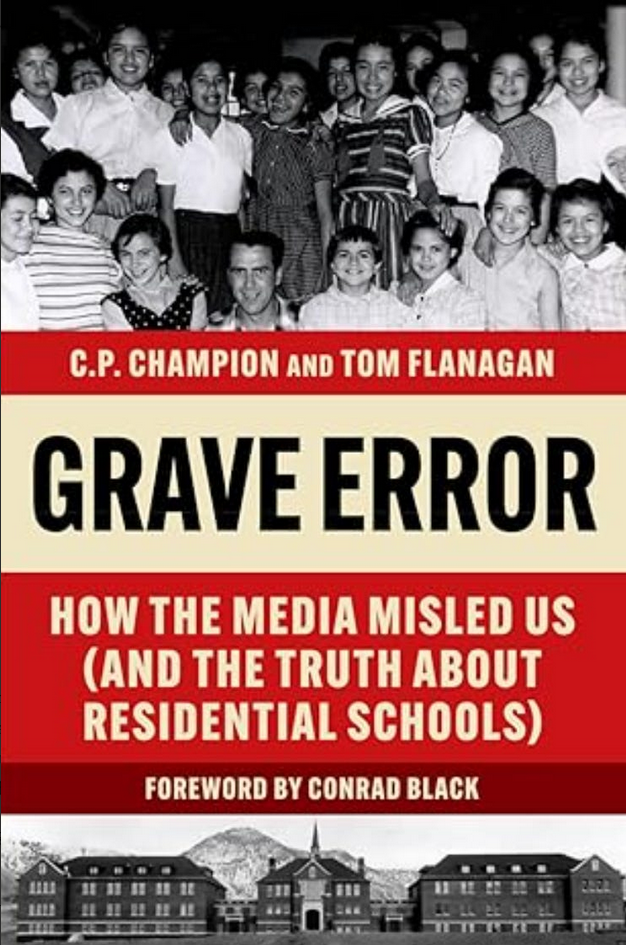
The full title of the book is Grave Error: How the Media Misled Us (and the Truth About Residential Schools). Its authors are former University of Calgary political scientist and Harper aide Tom Flanagan and Chris Champion, editor of the Dorchester Review. The book takes strong exception to commentary by media, politicians, and Indigenous leaders on the subject of unmarked graves at a former Kamloops Indian Residential School. I first noticed it over the holidays, several weeks after publication, when it was the overall #1 bestseller on Amazon.

It’s not easy to become the top-selling book on Amazon. You’re competing against Colleen Hoover and Prince Harry and the entire world of books, published and self-published. Grave Error was the only Canadian book, fiction or nonfiction, in Amazon’s top fifty when I came across it. It’s rare to see more than two or three Canadian books in Amazon’s top fifty at any given time.

You won’t have noticed Grave Error in your local bookstore because Amazon is the only outlet that’s selling the book. You won’t have seen coverage of it because no mainstream Canadian media outlet has paid attention to it. Nor does any public library stock it. It has not appeared on any conventional bestseller list, although it has to be a Canadian bestseller — Amazon sells well over half of all books in Canada. Most Amazon sales don’t register on our bestseller lists because Amazon doesn’t cooperate with the organizations that produce the lists.

Grave Error is published by True North, a conservative news website and public policy organization. It is run by Candace Malcolm, who founded True North with her husband, Kaz Nejatian, a former Jason Kenney staffer, now COO of Spotify. It’s published a half dozen hits in recent years, several written by Malcolm herself.

January 8, 2024

QotD: Nomadic cultures’ territorial needs

Filed under: Americas, Asia, History, Quotations — Tags: , , , — Nicholas @ 01:00

This bears little resemblance to the strategic concerns of historical nomads. As a direct consequence of failing to understand the subsistence systems that nomads relied on, [George R.R.] Martin [in his descriptions of the Dothraki nomad culture] has also rendered their patterns of warfare functionally unintelligible.

The chief thing that nomads, both Great Plains Native Americans and Eurasian Steppe Nomads used violence to secure control of is the one thing the Dothraki never do: territory. To agrarian elites (who write most of our sources) and modern viewers, the vast expanses of grassland that nomads live on often look “empty” and “unused” (and thus not requiring protection), but that’s not correct at all. Those “empty” grasslands are very much in use; the nomads know this and are abundantly willing to defend those expanses of grass with lethal force to keep out interlopers. Remember: the knife’s edge of subsistence for nomads is very thin indeed, so it takes only a small disruption of the subsistence system to push the community into privation.

For the Eurasian Steppe nomad, the grass that isn’t near their encampment is in the process of regrowth for the season or year when it will be near their encampment and need to support their herds. Allowing some rival nomadic group to move their sheep and their horses over your grassland – eating the essential grass along the way – means that grass won’t be there for your sheep and your horses when you need it; and when the sheep starve, so will you. So if you are stronger than the foreign interloper, you will gather up all of your warriors and confront them directly. If you are weaker, you will gather your warriors and raid the interloper, trying to catch members of their group when they’re alone, to steal horses and sheep (we’ll come back to that); you are trying to inflict a cost for being on your territory so that they will go away and not come back.

The calculus for nomadic hunters like the Great Plains Native Americans is actually fairly similar. Land supports bison, bison support tribal groupings, so tribal groups defend access to land with violent reprisals against groups that stray into their territory or hunt “their” bison. And of course the reverse is true – these groups aren’t merely looking to hold on to their own territory, but to expand their subsistence base by taking new territory. Remember: the large tribe is the safe tribe; becoming the large tribe means having a larger subsistence base. And on either the plains or the steppe, the subsistence base is fundamentally measured in grass and the animals – be they herded sheep or wild bison – that grass supports. Both Secoy and McGinnis (op. cit.) are full of wars of these sorts on the Great Plains, where one group, gaining a momentary advantage, violently pushes others to gain greater territory (and thus food) for itself. For instance, Secoy (op. cit., 6-32) discusses how access to horses allowed the Plains Apache to rapidly violently expand over the southern Plains in the late 17th century, before being swept off of them by the fully nomadic Ute and Comanche in the first third of the 18th. As McGinnis notes (op. cit., 16ff), on the Northern Plains, prior to 1800 it initially was the Shoshone who were dominant and expanding, but around 1800 began to be pushed out by the Blackfoot, who in turn would, decades later, be pushed by the expanding Sioux.

This kind of warfare is different from the way that settled, agrarian armies take territory. Generally, the armies of agrarian states seek to seize (farm-) land with its population of farmers mostly intact and exert control both over the land and the people subsequently in order to extract the agricultural surplus. But generally (obviously there are notable exceptions) nomads both lack the administrative structures to exert that kind of control and are also very able to effectively resist that sort of control themselves (it is hard for even nomads to tax nomads), making “empire building” along agrarian lines difficult or undesirable (unless you are the Mongols). So instead, polities are trying to inflict losses (typically more through raiding and ambush than battle). Since rivals will tend to avoid areas that become unsafe due to frequent raiding, the successful tribe can essentially push back an opposing tribe with frequent raids. In extreme circumstances, a group may feel threatened enough to get up and move entirely – which of course creates conflict wherever they go, since their plan is to disposess the next group along the way of their territory.

Within that security context, larger scale groupings – alliances, confederations, and super-tribal “nations” – are common. On the Eurasian Steppe, such alliances tended to be personal, although there was a broad expectation that a given ethnic grouping would work together against other ethnic groupings (an expectation that Chinggis actually worked very hard, once he became the Great Khan of a multi-ethnic “Mongol” army, to break up through the decimal organization system; this reorganization is part of what made the Mongol Empire so much more successful than previous Steppe confederations). Likewise, even a cursory look at the Native Americans of the Great Plains produces both a set of standard enmities (the Sioux and the Crow, for instance) but also webs of peace agreements, treaties, alliances, confederations and so on. The presence of British, French, Spanish and American forces (both traders and military forces) fit naturally into that system; the Plains Apache allied with the Spanish against the Comanche, the Crow with the United States against the Sioux and so on. Such allies might not only help out in a conflict, but also deter war and raiding because their strength and friendship made lethal retaliation likely (don’t attack someone allied to Chinggis Khan and expect to survive the experience …).

Exactly none of that complexity appears with the Dothraki, who have no alliances, no peace agreements, no confederations and no territory to attack or defend. Instead, the Dothraki simply sail around the grass sea, fighting whenever they should chance to meet.

Bret Devereaux, “Collections: That Dothraki Horde, Part IV: Screamers and Howlers”, A Collection of Unmitigated Pedantry, 2021-01-08.

December 29, 2023

Rubaboo – Pemmican Stew of Canadian Mounties

Filed under: Cancon, Food, History — Tags: , , , , , , — Nicholas @ 02:00

Tasting History with Max Miller
Published 12 Sept 2023
(more…)

November 14, 2023

Australian voters rejected “The Voice”, fearing “they were being sold a pig in a poke”

Theodore Dalrymple on the recent failure of the Austrialian government to install a nebulous and ill-defined advisory body for Australian Aboriginal and Torres Strait Islander representation to Parliament:

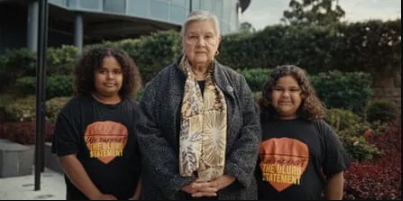
Uluru Dialogue co-chair Pat Anderson in an early ad for “The Voice” referendum.
Screen capture from YouTube.

Among my wife’s family papers dating from the Occupation of France are a couple of certificates of aryanité issued to her forebears, that they might continue to be employed and not deported. In Australia, people apply for certificates of aboriginality, in order that they might receive various advantages, subventions, etc.

The former is bad racism, the latter good, at least for those who believe in positive racial discrimination. Unfortunately, it is logically impossible to believe in positive racial discrimination without also believing in the negative kind, irrespective of one’s supposed good intentions.

Australia recently held a referendum on a proposed race-based amendment to the constitution. The amendment proposed something called “The Voice” to be inscribed in the constitution: an advisory body composed of Aborigines who would advise parliament on matters specifically affecting Aborigines. The details of the proposed body — how it was to be chosen or appointed, its purpose, its powers, its duties, its emoluments — were not specified, and those in favour of it, up to and including the Prime Minister, Anthony Albanese, were either unwilling or unable to specify further, relying entirely on the Australian emotional equivalent of Noel Coward’s famous song, “Don’t Let’s Be Beastly to the Germans”. The latter was not much of a policy.

Australian voters, initially favourable to the proposal, rejected it by a large majority, suspecting, rightly in my view, that they were being sold a pig in a poke. They also suspected, I surmise, that what was being proposed was a corrupt and corrupting bureaucratic pork barrel that would reward a small class of Aboriginal Al Sharptons. Far from improving the situation of Australian Aborigines, which is sometimes but not always tragic, the Voice would permanently raise the ideological temperature and prevent measured debate about practical improvements. Benefits would be received without gratitude and, would never, virtually by definition, be sufficient. And of course, the Voice would be the end of the ideal of racial equality. Australia would join the old South Africa in its inscription of race in its constitution.

The abysmal intellectual level of the proponents of the Voice was very well instantiated in an article by Thomas Keneally, the famous Australian novelist, in the Guardian newspaper. It began as follows:

    Last Sunday, many in Australia profoundly mourned the loss of the Indigenous voice to parliament referendum, the greatest kindly Amendment ever to be proposed for the Australian constitution, those dreary old articles of association by which our states and territories rub along together in far-flung federation.

I will overlook the use of the word profoundly in this context: I think the words superficially, self-satisfactorily, and exhibitionistically would have been better. But note that, even if the loss were deeply mourned, only the grossest of sentimentalists would claim that such mourning would have any bearing on the rightness or otherwise of the loss that was mourned. Many Nazis and many communists mourned the loss of Nazi Germany and Soviet Russia far more deeply than any Australian mourned the loss of the referendum, but no one, I think, would sympathise with them because of the depth of their sorrow.

November 13, 2023

Lessons for Canada from the Australian referendum on “The Voice”

Filed under: Australia, Cancon, Government, History, Media, Politics — Tags: , , — Nicholas @ 05:00

Conrad Black contrasts the experiences of First Nations in Australia and Canada after contact with European explorers and settlers and the recent attempt to create a formal role for Aboriginal representation in the Australian Parliament.

Uluru Dialogue co-chair Pat Anderson in an early ad for “The Voice” referendum.
Screen capture from YouTube.

Canadians should perhaps pay more attention than we have to the referendum in Australia on Oct. 14 on the subject of the Aboriginal peoples. There are just under one million designated Aboriginals in Australia, slightly below four per cent of Australia’s 25 million people. The roughly corresponding figures in Canada are that Indigenous Canadians, including in both countries a good number of mixed ancestry, are slightly under five per cent — just, at under two million in a population of 40 million. The issue in the referendum was a proposed amendment to the Australian Constitution by which a federal advisory body comprised of native people would be set up which would have only a consultative role. How this body would be selected and its recommendations presented would be dealt with later. The idea was just to give Aboriginal people, in the wording of the referendum, a “voice” in the politics of the country.

The history of the white settlers of Australia and the natives whom they encountered there is fairly parallel to the Canadian experience. Initial contact was friendly enough, but there was a native vulnerability to certain diseases to which the Australian natives had had no occasion to develop an immunity. Their lands were gradually encroached upon although the inconvenience to them was for a time not as great as it was in Canada where the conversion of huge tracts of arable land on the prairies into immensely productive grain producing farms made it steadily more difficult for our native people to maintain that part of their diet based on the buffalo. Australian Aboriginals had less difficulty, at least for some time, retreating to places that did not especially attract the settlers, and where it was comparatively possible to maintain a traditional life.

However, there was soon inevitably interaction, some of it successful intermarriage, and some of it outright racial friction with not infrequent outbursts of violence, though nothing on the scale of the Riel rebellions in this country, let alone the outright warfare of the American Indian Wars. But eventually, reservations were created for some Australian Aboriginals. In contrast to this country, there was practically no attempt to help formally educate them or to assist them in integrating into the larger Australian society. They were gradually pushed to the nether regions of the immense country, almost as large as Canada and with a greater habitable area, and the provision of health and education services to the natives was greatly less generous in the amounts of money and numbers of personnel involved than the corresponding efforts in Canada.

Gradually the theory developed and took hold in Australia that perhaps the early settlers and the autonomous government of Australia created by the British in 1901, could have been more generous and thoughtful. As these matters tend to do, the issue gnawed somewhat at the conscience of white Australia and finally in 2008, the government of Australia passed through both houses of its Parliament an apology and expression of regret for past injustices. There was nothing remotely like the orgy of self-defamatory penitence backed by stupefying amounts of money that has flowed in this country like the Niagara River onto the native people.

Shortly after the new Labor government in Australia was elected in 2022, it proceeded with its declared intention to hold a referendum on the issue of giving the Aboriginal peoples a “voice”. And soon after this campaign began, it became clear that the proposed measure was going to have a rocky ride with the country. The predominant opinion among Australians above the age of 45 was that the native had the opportunity to participate fully in Australian life and that there were some substantial gestures of assistance made to them that the more purposeful native people took up.

October 7, 2023

Wab Kinew, Manitoba’s incoming Premier

Filed under: Cancon, Media, Politics — Tags: , , — Nicholas @ 03:00

Colby Cosh profiles the first Canadian provincial premier of First Nations heritage, Wab Kinew of Manitoba:

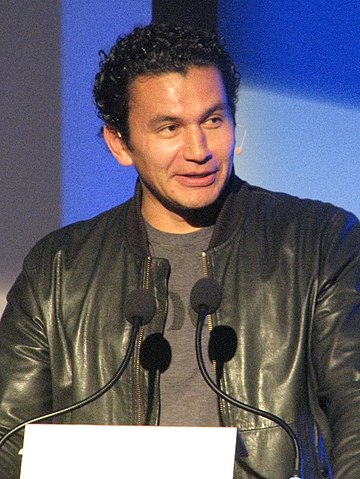
Wab Kinew, Manitoba NDP leader, 27 October 2015.
Photo by Dwight Williams via Wikimedia Commons.

My colleague Michael Higgins has an excellent column in Friday’s Post about incoming Manitoba premier Wab Kinew and the remarkable victory speech he gave late Tuesday after his New Democrats won the provincial election. Kinew tackled the usual priorities of the moment, giving love to his own partisans and talking about how his party’s victory means a brighter future for Manitobans. But he also added an unusual personal message with an obvious specific audience, knowing that Canadians ordinarily don’t notice most anything that happens in Manitoba and that he may never again be watched by so many eyeballs.

Kinew is the first-ever First Nations premier of a Canadian province, and that’s a “first” that we dare not dismiss as the usual box-checking diversity exercise. Twenty years ago, as a young and aimless alcoholic, Kinew amassed a brief track record of violence that would probably disqualify a white politician for high office forever. But he pulled himself together while there was still time, became a celebrated broadcaster and found his way into an unlikely political career, becoming leader of the Manitoba NDP in 2017.

So, yeah, Kinew’s diversity bona fides helped make this possible … and the incumbent Manitoba Conservatives did their bit to help, running a re-election campaign characterized by comically daft creepiness. Kinew has made a point of not underplaying his troubled background, although when it was brought up by Conservatives on social media during the campaign, the favourite NDP counter-tactic seems to have been to point out the killer premier next door in Saskatchewan. Yes, us western voters sure have to do a lot of forgiving.

As it turned out, however, all this ugliness led to Kinew’s victory address — which, in turn, became what can only be called a fine and hopeful small-c conservative moment. He told troubled youths still in his old predicament — “the party lifestyle” — to stop “making excuses” and join the wider community.

“To young people out there who want to change your life for the better: you can do it,” the premier-designate said. “But here’s the thing: you have to want it … If you want to join the workforce, get a new career, it has to be you that takes the first step. And if you are dealing with some kind of illness, and want to find healing, it has to be you to decide to move forward.

September 2, 2023

QotD: Ancient DNA

… you know I’m always up for the humiliation of a dominant scientific paradigm. I especially like examples where that paradigm in its heyday replaced some much older and unfashionable view that we now know to be correct. It’s important to remind people that knowledge gets lost and buried in addition to being discovered.

The wonderful thing about ancient DNA is it gives us an extreme case of this. Basically, the first serious attempt at creating a scientific field of archaeology was done by 19th century Germans, and they looked around and dug some stuff up and concluded that the prehistoric world looked like the world of Conan the Barbarian: lots of “population replacement”, which is a euphemism for genocide and/or systematic slavery and mass rape. This 19th century German theory then became popular with some 20th century Germans who … uh … made the whole thing fall out of fashion by trying to put it into practice.

After those 20th century Germans were squashed, any ideas they were even tangentially associated with them became very unfashionable, and so there was a scientific revolution in archaeology! I’m sure this was just crazy timing, and actually everybody rationally sat down and reexamined the evidence and came to the conclusion that the disgraced theory was wrong (lol, lmao). Whatever the case, the new view was that the prehistoric world was incredibly peaceful, and everybody was peacefully trading with one another, and this thing where sometimes in a geological stratum one kind of house totally disappears and is replaced by a different kind of house is just that everybody decided at once that the other kind of house was cooler. The high-water mark of this revisionist paradigm even had people saying that the Vikings were mostly peaceful traders who sailed around respecting the non-aggression principle.

And then people started sequencing ancient DNA and … it turns out the bad old 19th century Germans were correct about pretty much everything. The genetic record is one of whole peoples frequently disappearing or, even more commonly, all of the men disappearing and other men carrying off the dead men’s female relatives. There are some exceptions to this, but by and large the old theory wins.

I used to have a Bulgarian coworker, and I asked him one day how things were going in Bulgaria. He replied in that morose Slavic way with a long, sad disquisition about how the Bulgarian race was in its twilight, their land was being colonized by others, their sons and daughters flying off to strange lands and mixing their blood with that of alien peoples. I felt awkward at this point, and stammered something about that being very sad, at which point he came alive and declared: “it is not sad, it is not special, it is the Way Of The World”. He then launched into a lecture about how the Bulgarians weren’t even native to their land, but had been bribed into moving there by the Byzantines who used them as a blunt instrument to exterminate some other unruly tribes that were causing them trouble. “History is all the same,” he concluded, “we invaded and took their land, and now others invade us and take our land, it is the Way Of The World.”

Even a cursory study of history shows that my Bulgarian friend was correct about the Way Of The World. There’s a kind of guilty white liberal who believes that European colonization and enslavement of others is some unique historical horror, a view that has now graduated into official state ideology in America. But that belief is just a weird sort of inverted narcissism. I guess pretending white people are uniquely bad at least makes them feel special, but white people are not special. Mass migration, colonization, population replacement, genocide, and slavery are the Way Of The World, and ancient DNA teaches us that it’s been the Way Of The World far longer than writing or agriculture have existed. It wasn’t civilization that corrupted us, there are no noble savages, “history is all the same”, an infinite history of blood.

Land acknowledgments always struck me as especially funny and stupid: like you really think those people were the first ones there? What about acknowledging the people that they stole it from? Sure enough one of the coolest parts of Reich’s book is his recounting the discovery that there were probably unrelated peoples in the Americas before the ancestors of the American Indians arrived here, and that a tiny remnant of them might even remain deep in Amazonia. So: what does it actually mean to be “indigenous”? Is anybody anywhere actually “indigenous”?

Jane Psmith and John Psmith, “JOINT REVIEW: Who We Are and How We Got Here, by David Reich”, Mr. and Mrs. Psmith’s Bookshelf, 2023-05-29.

August 22, 2023

QotD: Megafauna extinction

Filed under: Americas, Environment, Europe, History, Pacific, Quotations — Tags: , , , — Nicholas @ 01:00

Another marker to put down about the extinction of the varied megafauna. A lot of which went extinct just as human beings – or varied ancestors of – turned up in the same area. The usual bit being that we eated it.

There is, sadly enough, a common misconception about our ancestors. Nature loving, that Rousseauesque fantasy of just drinking the clear water, munching on the acorns that fall unbidden. That humans don’t thrive on acorns matters not a whit to those who share this fantasy of an Elysian past. The truth being that humans – and proto- – were the most vicious beasts out there. That’s why we survived to thrive. It’s not just modern day humans who would scale down a cliff to throttle babbie seabirds for the pot after all.

So too with the bargain bucket meal on legs just found:

    Half-tonne birds may have roamed Europe at same time as humans

They roamed, we eated, they roamed no more. As with the arrival of the Maori in New Zealand and the exit of moas. The American horse disappearing about the same time Amerinds made it past the ice barriers into British Columbia and points south. Dodos and sailing ships and on and on around the globe. The major factor in megafauna going extinct being humans turning up to eat them.

Tim Worstall, “Crimea Fried Ostrich – And Then We Eated It”, Continental Telegraph, 2019-06-27.

July 19, 2023

Ever wonder where the term “two-spirit” came from?

Filed under: Americas, Cancon, History, Media, Politics, USA — Tags: , , , , — Nicholas @ 03:00

In Spiked, Malcolm Clark explains the origin of the now commonly used term as a portmanteau for many different words — with significant variation in meaning — in indiginous languages:

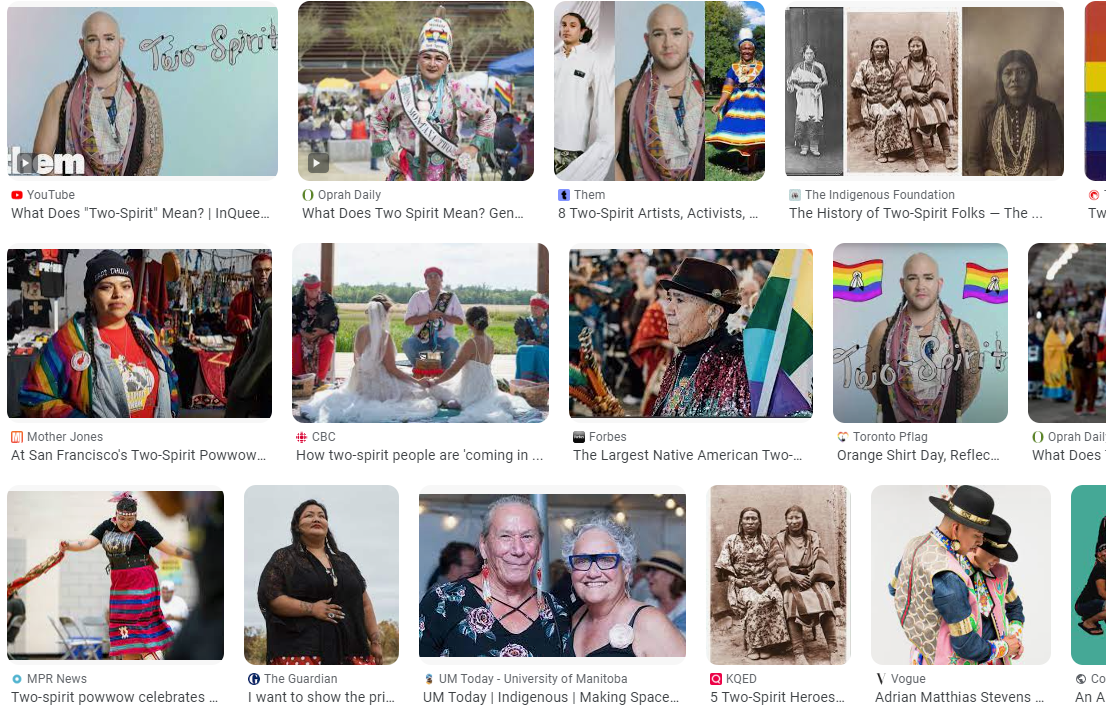
Typical media presentation of Two-spirit individuals

The term two-spirit was first formally endorsed at a conference of Native American gay activists in 1990 in Winnipeg in Canada. It is a catch-all term to cover over 150 different words used by the various Indian tribes to describe what we think of today as gay, trans or various forms of gender-bending, such as cross-dressing. Two-spirit people, the conference declared, combine the masculine and the feminine spirits in one.

From the start, the whole exercise reeked of mystical hooey. Myra Laramee, the woman who proposed the term in 1990, said it had been given to her by ancestor spirits who appeared to her in a dream. The spirits, she said, had both male and female faces.

Incredibly, three decades on, there are now celebrities and politicians who endorse the concept or even identify as two-spirit. The term has found its way into one of Joe Biden’s presidential proclamations and is a constant feature of Canadian premier Justin Trudeau’s doe-eyed bleating about “2SLGBTQQIA+ rights”.

The term’s success is no doubt due in part to white guilt. There is a tendency to associate anything Native American with a lost wisdom that is beyond whitey’s comprehension. Ever since Marlon Brando sent “Apache” activist Sacheen Littlefeather to collect his Oscar in 1973, nothing has signalled ethical superiority as much as someone wearing a feather headdress.

The problem is that too many will believe almost any old guff they are told about Native Americans. This is an open invitation to fakery. Ms Littlefeather, for example, may have built a career as a symbol of Native American womanhood. But after her death last year, she was exposed as a member of one of the fastest growing tribes in North America: the Pretendians. Her real name was Marie Louise Cruz. She was born to a white mother and a Mexican father, and her supposed Indian heritage had just been made up.

Much of the fashionable two-spirit shtick is just as fake. For one thing, it’s presented as an acknowledgment of the respect Indian tribes allegedly showed individuals who were gender non-conforming. Yet many of the words that two-spirit effectively replaces are derogatory terms.

In truth, there was a startling range of attitudes to the “two-spirited” among the more than 500 separate indigenous Native American tribes. Certain tribes may have been relaxed about, say, effeminate men. Others were not. In his history of homosexuality, The Construction of Homosexuality (1998), David Greenberg points out that those who are now being called “two spirit” were ridiculed by the Papago, held in contempt by the Choctaws, disliked by the Cocopa, treated by the Seven Nations with “the most sovereign contempt” and “derided” by the Sioux. In the case of the Yuma, who lived in what is now Colorado, the two-spirited were sometimes treated as rape objects for the young men of the tribe.

July 10, 2023

Barbara Kay – “[M]any Canadians [suffer] from highly contagious, patriotism-suppressive Post National Syndrome”

Canadians are deluged with messages that imply — or explicitly demand — that they should be ashamed of Canada and of being Canadians. That there is nothing to celebrate in our history or cultural achievements and instead we should humbly beseech forgiveness for our many, many, many sins. Barbara Kay disagrees:

On Canada Day, near St. Sauveur, Quebec, we were treated to torrential rain, hail, nearby tornado warnings, and continually flickering power. Not a day for fireworks. Just as well, since fireworks are the last thing one craves when one suffers, as many Canadians do, from highly contagious, patriotism-suppressive Post Nationalism Syndrome.

This scourge cannot yet be cured, since it was intentionally cultivated and released into the environment by the current government. Only herd immunity can end it. However, the symptoms of Post Nationalism Syndrome can be alleviated by certain traditional antivirals, like National Postism. Last Saturday’s NP featured several commentaries that buoyed my spirits, in particular Michael Higgins’s misery-loves-company column, “Stop shaming and start celebrating Canada”.

Higgins enumerates recent examples from a tiresome litany of complaints by our elites that “want to turn us into a nation of self-flagellating penitents”. The National Gallery of Canada insinuates that Canada’s iconic artists, the Group of Seven, are linked to white supremacy; a parliamentary motion endorses the residential school system as “genocide”; the attorney general actively considers legal sanctions against “denialism” — dissent from genocide as a proper descriptor (including me); and the erasure of Sir John A. Macdonald’s name from the eponymous Parkway.

In a nearby feature, the false claim that Macdonald was a guilty party in the alleged schools genocide was handily demolished by lawyer Greg Piasetzki, titled, “John A. Macdonald saved more indigenous lives than any other prime minister”. This evidence-based rejoinder to sticky defamatory myths about Macdonald is an excerpt from a new book of essays by 20 writers, The 1867 Project: Why Canada Should be Cherished — Not Cancelled, published by the Aristotle Foundation, and edited by its founder and president, Mark Milke. 

Piasetzki’s essay mirrors the 19 others in its forthright challenge of our culture’s reigning anti-western dogmas, which brand Canada as a failed nation. Every author encourages the pride in being Canadian that has not dared to speak its name since Justin Trudeau came to power. I highly recommend it. If enough Canadians read it, we might arrive at herd immunity to Post Nationalism Syndrome.

July 6, 2023

“Too many complaints? That’s racism. Too few complaints? Well, that’s racism, too.”

Filed under: Bureaucracy, Cancon, Health — Tags: , , , , — Nicholas @ 04:00

Amy Eileen Hamm reports on how the British Columbia College of Nurses and Midwives (BCCNM) acted on its concern that not enough complaints against their members were being lodged by First Nations people:

As regular readers of Quillette will know, many Canadian institutions have fervently adopted the cause of “decolonization” — a vaguely defined term that one university describes as the dismantling of “assumed Euro-western disciplinary constructs and traditions”. This can mean anything from abolishing musical scales (which “perpetuate and solidify the hegemony of [the] Euro-American repertoire”); to reimagining our scientific understanding of sunlight, so as to correct “the reproduction of colonialism” that has infected “physics and higher physics education”; to assailing the gender binary through a “decolonizing act of resistance”.

That’s the theory, anyway. In practice, institutional efforts at “decolonization” generally translate into affirmative-action hiring programs and policies to mandate symbolic (generally empty) gestures such as land acknowledgements. They’ve also created a cash cow for “specialist” administrators and third-party consultants in what is now known as the “equity, diversity, inclusion, and decolonization” sector. The premise is that decolonization is so difficult and complex that it can only be overseen by said (highly paid) professionals.

My own professional sector, nursing, provides a useful case study. In British Columbia, where I live and work, nurses are licenced by the British Columbia College of Nurses & Midwives (BCCNM), whose offices are located “on unceded Coast Salish territory, represented today by the Musquea?m, Squamish and Tsleil-Waututh Nations.” In other words, Vancouver.

If a patient feels that he or she has experienced “incompetent, unethical, or impaired nursing or midwifery practice”, he or she can complain to the BCCNM through its complaints portal. It’s not a complicated process. You send an email describing what the nurse allegedly did, when the incident occurred, and whether there were any witnesses. If you’ve already complained to someone else, you’re supposed to note that as well, along with your suggestions for resolving the complaint. That’s it.

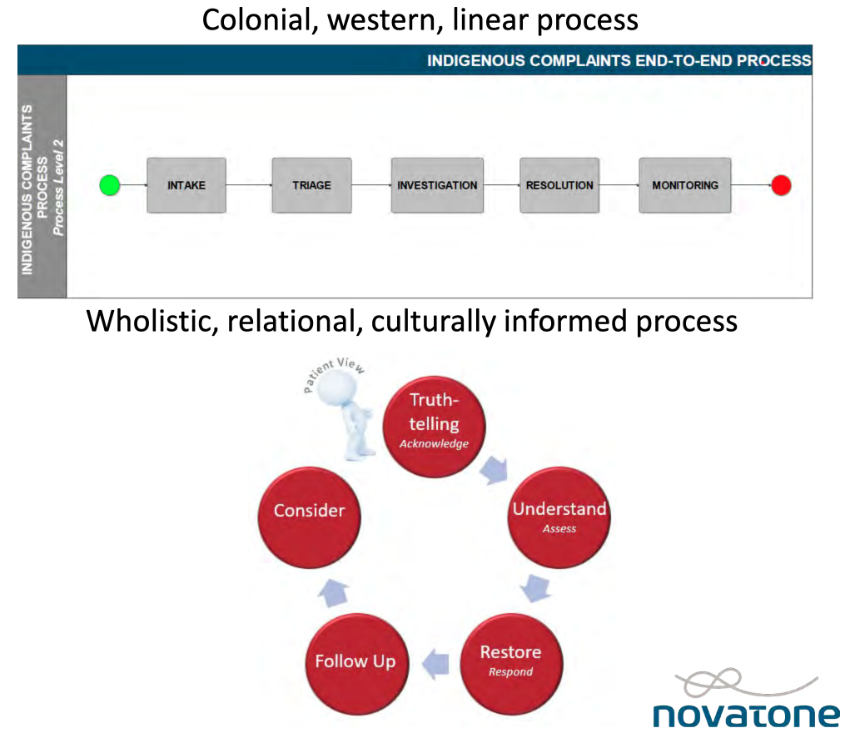
But apparently, this process is just too onerous — and even dangerous — for Indigenous people. And so the BCCNM has paid C$97,000 to a self-described “boutique business process management firm” called Novatone, which has duly produced a lengthy report on how to “make the BCCNM complaints process safer for Indigenous Peoples.” The same title — mantra might be a better word — appears at the top of all 50 pages: Looking Back to Look Forward: How Indigenous ways of being, knowing, and doing must inform the BCCNM feedback process and reflect the principles of cultural safety, cultural humility, and anti-racism.

(For the benefit of those outside Canada, the mystical-sounding phrase, “ways of knowing”, along with its “being” and “doing” variants, has now entered the official idiom as a means to signify the unfalsifiable shaman-like intuitions that supposedly guide the consciousness of Indigenous people throughout every facet of their existence — including, apparently, complaining about the care they receive from nurses.)

Juxtaposed images from the Novatone report, Looking Back to Look Forward, contrast the “colonial, western, linear” nature of existing BCCNM processes with a “wholistic, relational, culturally informed process” that would supposedly align with Indigenous values.

June 30, 2023

QotD: Changing patterns of combat on the Great Plains

The popular image of the Great Plains Native America is unarmored, of course, but that image fundamentally formed in the late 19th century, when – after centuries of the development of gunpowder weapons – everyone was unarmored. A longer view shows that Plains Native Americans were perfectly capable of both developing or adopting defensive measures which worked. And to get a full sense of that, we need to outline the major phases of the changing warfare on the Great Plains.

F.R. Secoy (op. cit.) essentially breaks warfare into four phases, which happen at different times in different places, based on if they have horses, guns, both or neither. Because horses entered the Great Plains from the South (via the Spanish) but firearms entered the region from the North (via the British and the French, the Spanish having prohibited gun-sales to Native Americans) and spread out from there, for a brief time many of these systems were active on the Plains at once, as both guns and horses diffused through the region.

In the pre-horse, pre-gun phase (described by McGinnis as well, op. cit., 8-9), battles consisted of long-range missile exchanges between warriors who stood behind large shields which protected their whole bodies. Native American warriors in this system also wore armor, heavy leather coats, laminated in multiple layers using thick hide with glue that was sometimes mixed with sand or gravel (one more example of how “leather armor” is almost always hardened leather armor, not modern clothing-leather). Some of this armor may have been effectively quilted leather as well. Clearly, there was plenty of concern about survivability here.

Both guns and horses were apt to disrupt this system. Horses allowed attackers to rapidly close the distance between the two opposing lines of shield-protected foot-missile-warriors, causing the shield-lines to drop away (though smaller shields, used on horseback to ward off arrows and blows were still used) and for both sides to seek instead the mobility of mounted fighting. That was not the end for armor though, because contact with a supply of horses meant contact with the Spanish, and the Apache at least swiftly adopted some of the Spanish methods of making leather “buff coats” into their own armor tradition and copied the shape and pattern of the buff coat itself (while often still making the material using their own tradition). As Secoy notes (op. cit., 18-20), our sources are quite clear that these forms of armor (both original and Spanish-influenced Native armors) were quite effective at resisting the archery fire that dominated both the pre-horse, pre-gun system and the post-horse, pre-gun system.

Meanwhile on the Northern Plains, while the horse had not yet arrived, firearms had, and these had different effects. Firearms spelled the end of the armor once they became common enough, since there was no protection which could resist bullets; some shield use survived, since arrows remained fairly common as well. But this didn’t lead to suicidal warfare. Instead – as had happened on the East Coast as well, Native Americans adapted their warfare to the increased lethality of firearms (on this, note Lee, op. cit. above) by mostly avoiding pitched battles as they became too lethal (which, by the by, the relatively low lethality of pitched battles pre-gunpowder is often taken to mean that Native North American warfare in general was low-lethality; this is wrong. As with most forms of non-state warfare, most of the killing happened in surprise raids and ambushes, which could be extremely lethal and were still quite common).

Once the horse and the firearm were both in wide use in an area, warfare shifted again. War parties became smaller, faster moving and more reliant on surprise (essentially an extension of the raiding-focus of the pre-horse, post-gun system to the high mobility horses supplied). Infantry battle dropped away entirely because it was too lethal and resulted in casualties that low-population density nomads could not sustain (the contrast with the much higher population-density agrarian United States, which was self-immolating in massively costly massed-infantry engagements during the American Civil War, 1861-1865, at exactly this time is striking). These are fairly big, noticeable changes in warfare patterns!

In short, the tactics used in all four of these systems were conditions by casualty aversion, which makes a lot of sense in the context of a low-population density society which simply cannot afford massive losses.

Bret Devereaux, “Collections: That Dothraki Horde, Part IV: Screamers and Howlers”, A Collection of Unmitigated Pedantry, 2021-01-08.

May 7, 2023

QotD: The long-term instability of bison hunting on the Great Plains

Unlike in Mongolia, where there were large numbers of wild horses available for capture, it seems that most Native Americans on the Plains were reliant on trade or horse-raiding (that is, stealing horses from their neighbors) to maintain good horse stocks initially. In the southern plains (particularly areas under the Comanches and Kiowas), the warm year-round temperature and relatively infrequent snowfall allowed those tribes to eventually raise large herds of their own horses for hunting and as a trade good. While Mongolian horses know to dig in the snow to get the grass underneath, western horses generally do not do this, meaning that they have to be stall-fed in the winter. Consequently in the northern plains, horses remained a valuable trade good and a frequently object of warfare. In both cases, horses were too valuable to be casually eating all of the time and instead Isenberg notes that guarding horses carefully against theft and raiding was one of the key and most time-demanding tasks of life for those tribes which had them.

So to be clear, the Great Plains Native Americans are not living off of their horses, they are using their horses to live off of the bison. The subsistence system isn’t horse based, but bison-based.

At the same time, as Isenberg (op. cit. 70ff) makes clear that this pure-hunting nomadism still existed in a narrow edge of subsistence. From his description, it is hard not to conclude that the margin or survival was quite a bit narrower than the Eurasian Steppe subsistence system and it is also clear that group-size and population density were quite a bit lower. It’s also not clear that this system was fully sustainable in the long run; Pekka Hämäläinen argues in The Comanche Empire (2008) that Comanche bison hunting was potentially already unsustainable in the very long term by the 1830s. It worked well enough in wet years, but an extended drought (which the Plains are subjected to every so often) could cause catastrophic decline in bison numbers, as seems to have happened the 1840s and 1850s. A sequence of such events might have created a receding wave phenomenon among bison numbers – recovering after each dry spell, but a little less each time. Isenberg (op. cit., 83ff) also hints at this, pointing out that once one factors for things like natural predators, illness and so on, estimates of Native American bison hunting look to come dangerously close to tipping over sustainability, although Isenberg does not offer an opinion as to if they did tip over that line. Remember: complete reliance on bison hunting was new, not a centuries tested form of subsistence – if there was an equilibrium to be reached, it had not yet been reached.

In any event, the arrival of commercial bison hunting along with increasing markets for bison goods drove the entire system into a tailspin much faster than the Plains population would have alone. Bison numbers begin to collapse in the 1860s, wrecking the entire system about a century and a half after it had started. I find myself wondering if, given a longer time frame to experiment and adapt the new horses to the Great Plains if Native American society on the plains would have increasingly resembled the pastoral societies of the Eurasian Steppe, perhaps even domesticating and herding bison (as is now sometimes done!) or other animals. In any event, the westward expansion of the United States did not leave time for that system to emerge.

Consequently, the Native Americans of the plains make a bad match for the Dothraki in a lot of ways. They don’t maintain population density of the necessary scale. Isenberg (op. cit., 59) presents a chart of this, to assess the impact of the 1780s smallpox epidemics, noting that even before the epidemic, most of the Plains Native American groups numbered in the single-digit thousands, with just a couple over 10,000 individuals. The largest, the Sioux at 20,000, far less than what we see on the Eurasian Steppe and also less than the 40,000 warriors – and presumably c. 120-150,000 individuals that implies – that Khal Drogo alone supposedly has [in Game of Thrones]. They haven’t had access to the horse for nearly as long or have access to the vast supply of them or live in a part of the world where there are simply large herds of wild horses available. They haven’t had long-term direct trade access to major settled cities and their market goods (which expresses itself particularly in relatively low access to metal products). It is also clear that the Dothraki Sea lacks large herds of animals for the Dothraki to hunt as the Native Americans could hunt bison; there are the rare large predators like the hrakkar, but that is it. Mostly importantly, the Plains Native American subsistence system was still sharply in flux and may not have been sustainable in the long term, whereas the Dothraki have been living as they do, apparently for many centuries.

Bret Devereaux, “That Dothraki Horde, Part II: Subsistence on the Hoof”, A Collection of Unmitigated Pedantry, 2020-12-11.

May 3, 2023

The virtue-signallers work hard to keep Canada’s First Nations people in poverty

Elizabeth Nickson touches one of the real third rails of Canadian politics — the plight of far too many Canadians who happen to be trapped in a historical bind that immiserates and impoverishes them yet somehow provides a lucrative and comfortable living for their self-appointed political advocates and the bureaucrats who work hard to keep them “on the rez”:

Today, if you protest the current catastrophic regime and have anything that can be taken away, it is taken away, and your family are labelled racists. Tenured professors who raise any objection are disgraced. Any journalist who asserts inconvenient facts is slimed. Any public intellectual who attempts to turn the tide is sent to the margins and silenced.

Many of the current activists for native rights are relatively new to the country, and have little grasp of history other than the straight-up Marxism taught in schools. Because Canada is so thoroughly anti-business, agitating for government money is pretty much the only growth industry, and Canada’s natives are a rich fat pie that seems unending in its ability to feed the bureaucracy and the advocacy outfits – there are hundreds – that seek more and more and more guilt money from the Canadian people.

Not one of them seemingly ventures into a native reserve to experience the results of fifty years of Trudeau Sr’s native policy and talks to the people there. Of the 700 or so Indian “nations” — this moniker a laughably Marxist ploy in itself — few of them even have vegetables. I have spent nights on a reserve up in the north where stodge is the only food. Potatoes fired in oil that has been in use for weeks. Gristly meat. Stale Wonderbread. Recently $8 billion was given to natives because despite the budgeted $200 Billion over five years given to Indian Affairs, in a country with more water than any other country on earth times ten, Indian reserves have no clean water.

Stories are told in my family, of Mohawk camping on the kitchen floor, leaving in full dress and full war cry in order to thrill the children. We have lost this connection to a great and fascinating people, marooned on rotting reserves, a crime caused by a vicious socialist government using vulnerable people to steal the nation’s wealth.

I have been on a reserve where the houses are rotting from the inside. Everyone is sick with mold illnesses. Because Canada’s socialists have deemed that natives have no property rights and are therefore not, in fact, fully people, they can’t even legally fix their own houses, not that they have any money but from whoring and working as check-out clerks. You cannot start a business. You have no equity to borrow even $1,000 to start a business. Canada’s socialists have decided that Canada’s natives are the ideal citizenry, passive, dependent, degraded.

Other reserves I’ve visited abut enormous wealth, from which Indians are constrained. Every activity they undertake requires a permission slip and money from whatever sleazy bureaucrat supervises them, owns them, farms them. Their reserves run to brush and fire fodder, while across the road, fields and forests produce incredible riches.

It is de rigueur for any visiting dignitary, like the current Marxist pope, to apologize for the legacy of the residential schools. Two summers ago a graduate student found what she claimed was evidence of 200 buried bodies near a decommissioned school and the news rocketed around the world. Her science was called into question. The native tribe near the school refused to exhume the “bodies”, largely because if the bodies did not exist, and finding nothing would stop the current shake-down. The actual legacy of the schools was mixed, but entire generations were educated, and there are many successful graduates, who attempt to moderate the madness. They are silenced.

Crime, alcoholism, prostitution, murders, child deaths abound on the reserves. Activists have seeded so much anger and hatred that virtually no clear path out of endemic poverty exists. An ersatz democracy means there are elections, but they are clan based, which means the biggest clan always wins and then it seeks to disempower its rivals. On reserves you can tell who the Chief is: he has the big house, the $100,000 truck. His people? Rotting shacks and bangers. If you aren’t in the right clan, you have to hitchhike to the city for cancer treatments, as the uncle of a Salish friend of mine did until he died.

There is, of course, a solution. I have spoken to native chiefs in the Oil Sands and in Alaska’s Prudhoe Bay, where the tribe or band has been woven into the oil extraction process. Success is immediate, and ongoing. These men are so enthusiastic, they are giddy, which, if you know a native, is … unusual. They crow about the young people on their reserves that go on to serious graduate degrees, to hope, to family formation, to their own houses. There are such success stories across the continent, depending on an enlightened chief, a non-vulture enlightened capitalist enterprise. And courage to face down the blight of government.

April 17, 2023

“… capitalism is a ‘virus’ composed of ‘systems that oppress’ …”

Filed under: Cancon, Government, Politics — Tags: , , , , — Nicholas @ 05:00

In Quillette, Jonathan Kay tells the story of a civil servant in British Columbia who objected to the content of a “Gender Workshop”:

If you’re a white-collar Canadian, chances are good that you’ve received workplace lectures on the subject of “decolonization” — a vaguely defined project aimed at “deconstructing colonial ideologies of the superiority and privilege of Western thought”. It’s a decidedly cultish pedagogical genre that I’ve come to know well, because exasperated workers often send me screenshots and recordings from their training sessions. Since raising complaints about these materials internally would risk career-threatening accusations of “white fragility” and such, leaking them to journalists is seen by many employees as the only viable option.

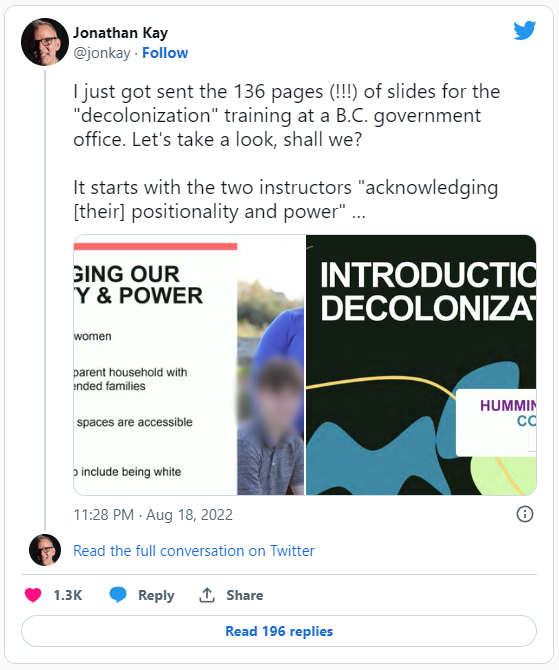
One notable specimen I received last year was a 136-page module titled Introduction to Decolonization, which had been presented earlier that year by the Hummingbirds Rising consultancy to staff at British Columbia’s Office of the Ombudsperson (an entity self-described as “B.C.’s independent voice for fairness and accountability, [working] to make sure public sector organizations are treating people fairly and following the rules”). The roughly 100 attendees were told by the trainers that this would be a “brave space”, in which those who had concerns about decolonization could “be bold and brave [with their] questions and comments”. (According to a Deputy Ombudsperson, attendance at the organization’s all-staff Diversity & Inclusion events is typically listed as optional. In practice, staff told me, almost everyone feels that they are expected to attend.)

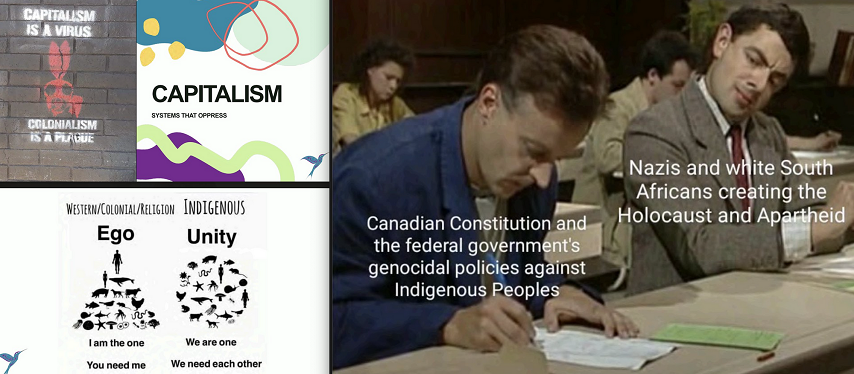
Much of the historical material presented in that session was perfectly accurate — including descriptions of the injustices associated with Canada’s system of Indigenous reserves. But as the presentation wore on, the content began to raise eyebrows. A section on economics declared flatly that capitalism is a “virus” composed of “systems that oppress”. A capsule lesson on spirituality presented Western values as inherently narcissistic, in contradistinction to Indigenous peoples’ quest for universal harmony. An array of listed terms that the presenters evidently associate with “white supremacy” included “being on time”, “manners”, and “perfectionism”. Most scandalously (as it would turn out), one slide indicated that the Nazi slaughter of six million European Jews had been directly inspired by the Canadian Constitution. Even more bizarrely, the slide was illustrated with a screen grab from an episode of Mr. Bean, a madcap 1990s-era British comedy show.

(When asked about the presentation, the Office of the Ombudsperson’s Communications Lead told Quillette that Hummingbirds Rising had been listed on the BC Public Service’s public pre-qualified supply list, and that prior vetting of the presentation had not been conducted by office staff. The Communications Lead added that the training was part of the Office’s “commitment to reconciliation with Indigenous people. Staff knowledge of cultural safety and the impacts of colonization on Indigenous people is an important component of the office’s Indigenous Communities Services Plan. We recognize that there may be some people who find some of the content of the Hummingbirds presentation controversial. We want to underscore, however, the value for our staff to fully understand the plurality of Indigenous perspectives in our province.”)

Slides from Introduction to Decolonization

After sharing these images on Twitter, I was contacted by the Vancouver office of a prominent Jewish organization, whose leadership (understandably) found the Mr. Bean/Holocaust slide to be in extremely poor taste. Thanks to their efforts, the issue was reportedly taken up internally by BC’s provincial government. And in the months that followed, I later learned, managers at the Office of the Ombudsperson took pains to find out who’d leaked the materials.

If the goal was to prevent more leaks, it didn’t work: Earlier this year, I received more documents pertaining to the Office of the Ombudsperson, the most interesting of which involved another over-the-top all-staff Diversity and Inclusion (D&I) workshop—this one on the topic of “challenges facing transgender and gender non-conforming people.” The presenter, Vancouver lawyer Adrienne Smith, is a well-known activist in this area, having helped lead the campaign to strip public funding from a local women’s shelter on the basis of its refusal to let biological males work as rape-crisis counsellors.

« Newer Posts — Older Posts »

Powered by WordPress