Quotulatiousness

October 16, 2025

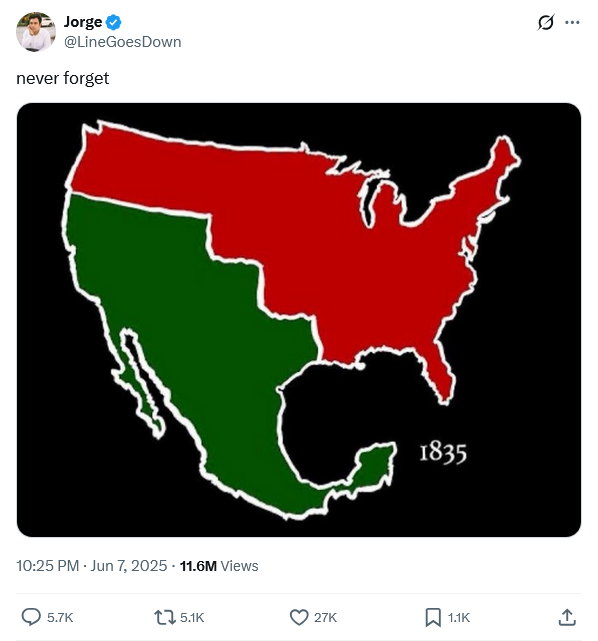
The Mexican-American War 1846-48

Filed under: Americas, Government, History, Military, USA, Weapons — Tags: , , , , , , — Nicholas @ 02:00

Real Time History
Published 16 May 2025

In the early 19th century, the United States and Mexico share a massive cross-continental border, but US settlement in Mexico, expansionist ideals and religious differences put the young republics on a collision course. As tensions boil over into bloodshed, the tiny, inexperienced US army marches to a war which will forge the modern United States.

Chapters:
00:00 Texas Republic
05:06 Declaration of War
07:03 The US Army
09:26 British Muskets in the Mexican Army
16:19 The Mexican Army
18:24 The Battles of Palo Alto and Resaca de la Palma
21:38 California and New Mexico
25:11 US Volunteers
28:40 Battle of Monterrey
33:03 Expanding the War
36:59 The Pedregal Battles
40:18 Battles for Mexico City
43:42 Treaty of Guadalupe Hidalgo
45:14 Legacy
(more…)

October 11, 2025

Toddler politics – don’t discuss, just shriek and cry and hit

Filed under: Cancon, History, Media, Politics — Tags: , , , , , , , — Nicholas @ 05:00

At Woke Watch Canada, T.G. Kelemen illustrates the difficulty of trying to have a logical discussion with someone who refuses to engage intellectually as an adult and instead pours everything into the kind of emotional incontinence toddlers indulge in:

Source: Frances Widdowson, Facebook

It’s 2025.

Ask a question, get a tantrum. Make a point, get a protest.

And if you’re unlucky enough to be a calm, middle-aged academic like Frances Widdowson, who dared to speak plainly about a hoax everyone else is pretending is holy scripture, you don’t get debate.

You get a mob.

You get walls pounded. Doors blocked. Students shrieking like toddlers in a sugar crash. And who’s leading it?

Not war-hardened political activists. Not deep-thinking men of conscience.

No — it’s women. Grown women. Educated. Empowered. Enraged.

But not enlightened.

Welcome to the “regressive” West, where a large and growing portion of womanhood has been educated not to argue, but to erupt. To scream instead of speak. To censor instead of counter. To “feel”, and then enforce those feelings on everyone else.

What used to be a bad breakup is now a political position.

What used to be a mood swing is now being proposed as legislation.

Kamloops: Hysteria and Mass Psychosis

Let’s rewind. Canada. 2021. The Kamloops Indian Residential School story breaks. “Unmarked mass graves”, they say. “215 children”, they whisper. Every outlet repeats it. Politicians take a knee. Flags at half-mast. Even the Pope apologizes, having already formally done so twice, with countless statements of regret.

No bodies are found. No evidence. No excavation. One inconclusive radar scan and a theory.

And still: nothing.

But the narrative’s already set. When Frances Widdowson says, when she suggests maybe we need evidence before enshrining national guilt into law, she’s hounded. Not with counter-arguments. Not with facts.

With a toddler’s unhinged rage.

The women who confronted Widdowson aren’t showing the understandable, righteous anger mature people show in response to obvious injustice. No. What we have is full-grown girl-children who aren’t getting their way throwing their emotional and psychological scat in her face. Why? Simply for disagreeing with them.

In February 2023, invited to speak at the University of Lethbridge, Widdowson faced similar militant protest. The lecture was shut down. Protesters, mostly female, banged on walls, wailed through the halls, and demanded she be de-platformed. One group called her a “residential school denier”. Another called her “unsafe”. Some students cried in interviews, claiming trauma.

Trauma? From a talk you didn’t even attend?

That’s the playbook now. You don’t have to hear the words. Just say you were harmed. The more you feel, the more you’re right. Welcome to emotional absolutism where logic is violence and hysteria is virtue.

Can modern women handle the responsibility their suffrage and freedom demands? Judging their own behavior, the answer is a resounding no.

October 6, 2025

“Hate speech” bans work perfectly to eliminate mean words and mean thoughts … and the rivers will run uphill

Filed under: Cancon, Government, History, Law, Liberty, Media, Politics — Tags: , , , — Nicholas @ 03:00

I have to assume that the headline captures the mentality of the people who call for more “hate speech” legislation, because the real world evidence clearly fails to support the notion. Many well-meaning people want the government to have the power to suppress speech they don’t like, never thinking that a different government could use the same laws to quash opinions they support. In the National Post, Chris Selley argues that the last way to achieve reconciliation with First Nations would be to ban “residential school denial”:

Two years ago, I ruefully predicted that Canada’s new law purporting to outlaw Holocaust denial would likely lead to a law purporting to outlaw “denying” the impact of the residential school system. That hasn’t happened yet, but we are well on our way.

The Liberals recently announced plans to table legislation that would purportedly outlaw displaying the Nazi or Hamas flags or symbols of other hate movements, and that has only intensified calls for that law outlawing “residential school denialism”, or indeed denying Canada’s “genocide” against Indigenous peoples.

“What is the difference between Holocaust Denialism and Residential School Denialism? I suggest there is no difference at all,” author Michelle Good wrote in the Toronto Star Tuesday on the occasion of the National Day for Truth and Reconciliation. “The inclusion of Holocaust Denialism in the criminal code is obviously to prevent the denial of the Jewish genocide of World War II. Therefore, after clearly illustrating that the residential school system was genocidal in nature and intent, it is difficult to find any reason whatever that Residential School Denialism should not be criminalized as well.”

I say these two new and proposed new laws would “purportedly outlaw” atrocity-denialism and hate symbols because they aren’t outright bans on the speech in question. Rather, to fall foul of them, you have to use your argument, flag or symbol to “wilfully promote hatred” against the group in question. It was and is already illegal to wilfully promote hatred against a religious or ethnic group — albeit with some huge caveats, more on which in a moment.

At some point in the future, should the Liberals remain in power — and perhaps even if they don’t — the government is likely to knuckle under to the calls for censorship of certain residential-school opinions. It’s just not worth the political blowback to object, or so one can imagine a backroom strategist reasoning. They would probably introduce the new law just in time for the National Day for Truth and Reconciliation. If police are willing to enforce these laws, there’s little reason to believe Crown prosecutors would be interested in pursuing the cases. That, in turn, would only frustrate the people who see value in this censorship, and would likely lead to ever-stronger laws … that themselves likely wouldn’t be enforced.

This is not good lawmaking, and it’s a chilling argument when the simple act of pointing out how many bodies have actually been discovered on former residential school sites is widely considered a form of “denialism”.

October 2, 2025

The ritual humiliation of ordinary Canadians through “land acknowledgements”

Filed under: Cancon, Government, History, Politics — Tags: , , — Nicholas @ 03:00

On the social media site formerly known as Twitter, Tom Marazzo explains his objections to the ever-expanding use of “land acknowledgements”:

Let me break this down clearly so you can better understand why these mandated Land Acknowledgements are offensive to me.

They imply inherited guilt
A Land Acknowledgement usually frames the land I live and work on as “stolen”. Even if it does not say the words directly, the message is that I am benefiting from a theft. I served my country for 25 years, I have paid my taxes, raised my family responsibly, and built a life honestly. It cuts against my sense of fairness and justice to be told I must carry guilt for actions taken by people hundreds of years ago. I will not accept accountability for the past when I had no part in it.

They ignore my contribution
I have invested decades of service in the military, in my education, in my community, and in my family. These acknowledgements do not recognize those sacrifices, nor those of my ancestors who also built and defended this country. Instead, they imply my very presence is illegitimate. That denies the legitimacy of my life’s work and my family’s role in helping build this nation.

They make reconciliation into a ritual of shame
A healthy society should face the past with honesty. But what I see is not dialogue or shared responsibility. It is a scripted performance that demands I accept a label like “colonizer”, whether or not it reflects who I am. Rather than bringing people together, it divides by assigning one group permanent guilt and another permanent victimhood. That is not reconciliation. It is coerced shame.

They erase complexity
History in Canada is complicated. Many settlers and Indigenous peoples lived, worked, and fought together. There were injustices, but also cooperation, intermarriage, and shared struggles. Long before Europeans arrived, Indigenous groups also fought among themselves, sometimes brutally, with violence and cruelty toward rival tribes. No group in history is free from wrongdoing. Yet the Land Acknowledgement format reduces this reality to a one-sided story of “oppressors vs. oppressed”, which is neither fair nor accurate.

They are being mandated
Perhaps the strongest reason I find them offensive is that these acknowledgements are not voluntary. They are imposed in workplaces, schools, and public events as if they were civic duties or loyalty oaths. Refusing to participate often brings social or professional penalties. That strips away personal agency and turns what could have been a gesture of respect into a forced confession.

So my reaction is not irrational. These acknowledgements conflict with my principles of fairness, personal responsibility, and earned legitimacy. They demand I accept guilt I do not bear, while ignoring the contributions my family and I have made. They also erase the truth that no people, Indigenous or otherwise, lived without conflict or wrongdoing in the past.

The first time I encountered a “land acknowledgement” in person was at my son’s university graduation ceremony. I assumed, as the university had a major First Nations study program, that this was something only done there … but now it’s hard to find any public gathering in Canada that doesn’t have the opening cultural cringe and ritual humiliation ceremony to start the event.

September 18, 2025

Stop calling it “Turtle Island”

Filed under: Americas, Cancon, History, Media, Politics, USA — Tags: , , , , , — Nicholas @ 05:00

At Woke Watch Canada, Igor Stravinsky strenuously objects to calling North America “Turtle Island” and all the other woke shibboleths of the modern progressive cant:

As another school year rolls out, we can hope a more honest and realistic portrait of Canadian history will start to take shape in our schools. Students have been brainwashed into believing that Canada was a racist state bent on the extermination of Indigenous people, who were peaceful and wise, living in harmony with nature and each other. But reconciliation between Indigenous and non-Indigenous people is only possible if we base policy and action on the truth, not fairy tales, hearsay, anecdotes, or ideologies. We need facts, evidence, and reasoned debate. A good start would be for people to stop referring to North America as “Turtle Island”.

Calling it that is essentially to call the current geopolitical organization of the world invalid. If Canada, the United States, and other Western countries are in fact illegitimate, then that means national and international laws are also null and void. So, unless you are the direct descendent of an aboriginal person who was alive before first contact with Europeans, you are just a guest here — a second-class citizen at best. Non-Indigenous Canadians will simply never accept that. Nor should they.

In any case, “Turtle Island” is a nonsensical name on several levels. Firstly, North America is a continent, not an island. It is connected to South America by the Isthmus of Panama, which means it is not even surrounded by water. In any case an island is defined as a land mass surrounded by water that is part of a tectonic plate such as Greenland which is part of the North American Plate, thus is not a continent.

Then there is the fact that Indigenous North Americans were oblivious to the geography of the vast continent on which they lived. Like people everywhere in the distant past, they only knew the area they lived in, which could be substantial in the case of nomads, but was still a tiny fraction of North America’s 20+ million square kilometers. Of course, they knew nothing about the geography of the world with its 7 continents and 5 oceans.

Most importantly, the Turtle Island creation story is a myth believed by a particular cultural group. There is nothing wrong with believing in myths: I personally believe in the myth of human rights, as most Canadians do (pre-contact Indigenous people certainly did not). Myths are powerful: Our common belief in human rights has helped to make the Western world contain the safest and most prosperous societies ever. But when our institutions subscribe to myths not shared by the majority of Canadians, they are choosing to elevate one culture’s belief system above all others.

In the past, the Christian religion was regarded as the one true religion in Canada by most people, and the spiritual beliefs of Indigenous people were often denigrated as primitive superstition. But elevating Indigenous spirituality in our secularized 21st century world by treating it as a knowledge acquisition system equivalent to (or superior to) the scientific method is an attempt to correct for that past ethnocentrism. This is Critical Theory in action: It always strives to alleviate past wrongs with present wrongs, a formula for social disaster if ever there was one.

August 24, 2025

The Supreme Court of British Columbia has detonated a legal mine under all of Canada’s established property titles

Filed under: Cancon, History, Law, Politics — Tags: , , , — Nicholas @ 05:00

Conrad Black discusses just how much the Supreme Court of British Columbia’s decision on First Nations land claims in BC will undermine established property rights across the entire country:

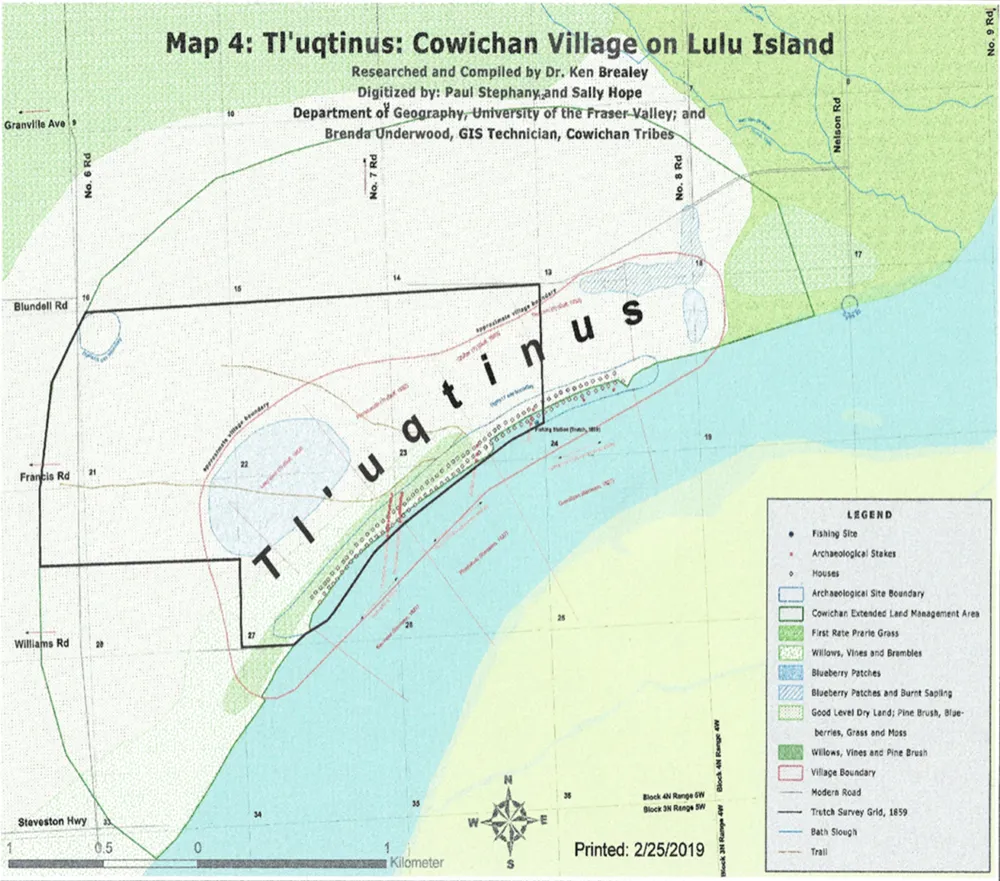
A map shows the Cowichan title lands outlined in black. (B.C. Supreme Court) Photo by B.C. Supreme Court

The decision earlier this month by the Supreme Court of British Columbia that the Cowichan tribes hold title over federal, city, and private land in Richmond B.C. that enjoys a higher legal status than the fee simple ownership of the current proprietors is outrageous but may have some positive consequences. The decades and $7 billion that have been spent or pledged for what is called the “reconciliation” process, has finally hit a stone wall. The almost universal desire to be fair to Indigenous people and where appropriate to compensate them for inequitable treatment, has finally collided with the entrenched economic rights and interests of every owner of real property in Canada, including those of Indigenous ancestry.

Inexplicable latitude has been granted to the thickening population of crusaders for indigenous rights. Even the NDP government of British Columbia, which has been pathologically addicted to prostrating itself at the feet of anyone or anything purporting to champion any definition of the Indigenous interest, was reduced to monosyllabic waffling by the court decision brought down by Justice Barbara Young. Premier David Eby’s office declared an ambition to continue seeking a negotiated resolution of the conflict between Aboriginal rights and common law rights of affected property owners, (including the municipal, provincial, and federal governments-of $100 billion of property in Richmond B.C. that is directly affected by the decision).

This is an understandable ambition, but in the circumstances, his government might have pressed the negotiations over the six years that this case has been litigated. Our judiciary has been addicted to truckling to almost any Indigenous claim, on the restricted occasions when the federal and provincial governments have even had the temerity to conduct a defense against them. Now the taxpayers’ negotiating position has been tanked by this ludicrous decision, which is being appealed.

If courts with authority for the whole country were to come to similar judgments, and we cannot doubt that activists will continue to push on an open door and quite rightly take all they can get, then every property title deed in the country is compromised, including the Houses of Parliament. There were only approximately 200,000 native people in all of what is now Canada when the French and British explorers and settlers came here starting at the end of the 15th century. Yet the implication of this ruling is that they legitimately owned all of Canada and that in the patchwork of numbered treaties and other agreements following absorption of the politically organized parts of Canada into the British Empire at the end of the Seven Years War in 1763, ancient and undocumented Aboriginal rights took precedence over any subsequent real estate law allocations of property rights under the common or civil law systems that gradually spread across Canada.

Given the activist preferences of courts across the country, we can expect to see similar cases pop up everywhere, as First Nations sensibly try to strike while the iron is hot and lay claim to as much of the real estate of Canada as the courts will let them … which might well be the entire land mass plus fishing rights.

August 13, 2025

“[A]ll those land acknowledgments weren’t just symbolic: they [were] advance notice”

Filed under: Cancon, Government, History, Law, Politics — Tags: , , , , , — Nicholas @ 03:00

In The Free Press, Rupa Subramanya discusses the — in my opinion, insane — court ruling in British Columbia that invalidated existing land titles in part of the Vancouver area, handing the titles to the properties over to the Cowichan First Nation:

A B.C. Supreme Court judge has granted several First Nations a portion of a 1,846-acre land claim on Lulu Island. B.C. Supreme Court

It turns out that all those land acknowledgments weren’t just symbolic. They may have been advance notice.

When Canada adopted its constitution in 1982, Prime Minister Pierre Trudeau slipped in a ticking time bomb: an explicit recognition of indigenous land rights without constitutional protection for property rights for other Canadians. That constitutional clause has fueled decades of lawsuits from First Nations — Canada’s indigenous people — asserting claims to huge portions of their ancestral territories.

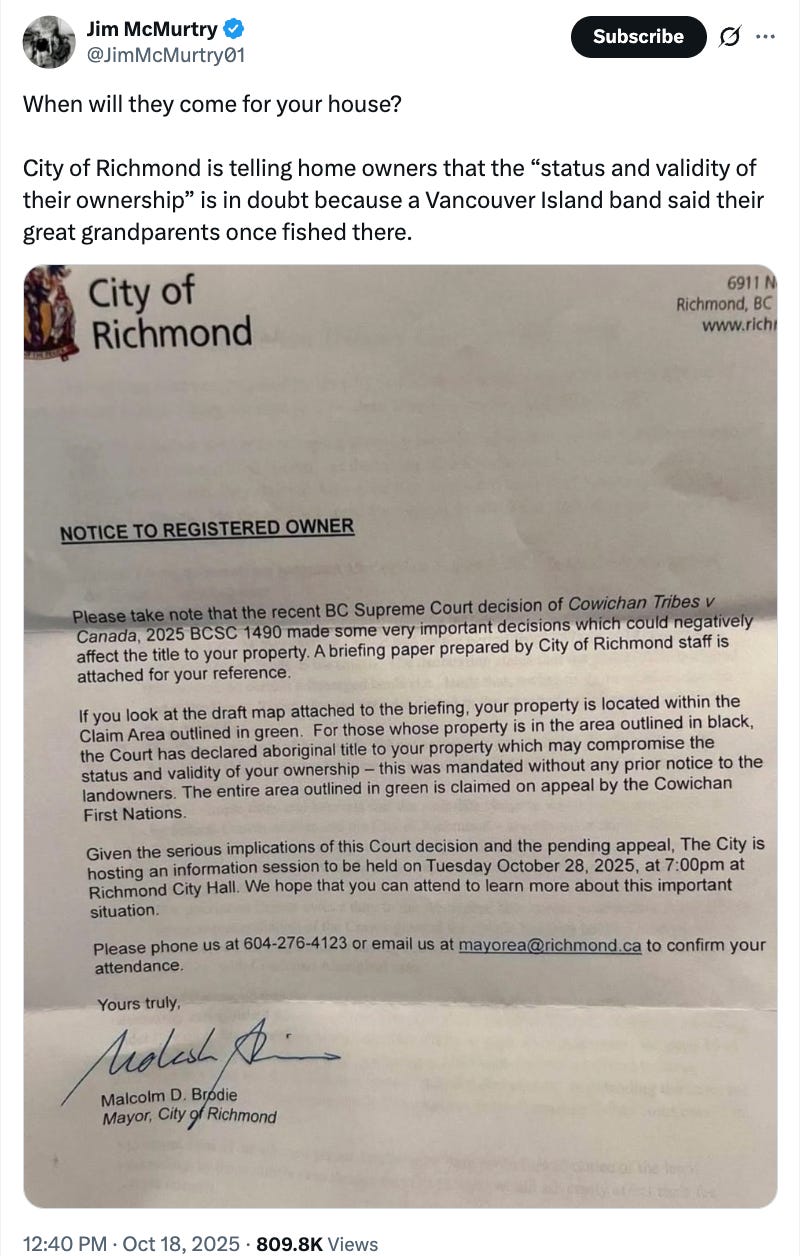
Last Thursday, the British Columbia Supreme Court ruled that the Cowichan Nation holds “Aboriginal title” to about 1,846 acres of land on the south shore of Lulu Island in Richmond, and constitutionally protected rights to fish in the south arm of the Fraser River.

This 275,000-word judgment doesn’t just affect government-owned lands. It also includes private property now owned by third parties. So if you’re a Canadian who is a property owner in British Columbia and not indigenous, your claim on what you think you own has just been superseded by indigenous claims, called a “senior” claim in legalese. Down the road, your land or house could be expropriated by the federal government and turned over to an indigenous group that claims ownership.

That has already happened in Ontario, where three northern Ontario First Nations claimed in a lawsuit last month that a 14-acre public park in Kenora called Anicinabe Park is actually unceded territory and should be returned.

“In constitutional terms, aboriginal rights trump private property rights,” Bruce Pardy, a professor of constitutional law at Queen’s University in Kingston, Ontario, told me. He pointed to last November’s ruling by a New Brunswick judge that the court might be in position to order the government to seize private property and turn it over to an indigenous group making a claim on it.

As Prime Minister Mark Carney tries to fast-track major infrastructure projects — roads, bridges, pipelines, power plants, and more — all part of his plan to boost Canada’s global competitiveness and reduce reliance on the U.S., some of those ambitions might be snarled by indigenous land claims that take years to resolve. The British Columbia case began in 2019 and is considered to be the longest trial in Canadian history.

The day before the Cowichan Nation ruling in British Columbia, a Yukon First Nation announced that it would oppose all new mining claims on its traditional territory while a regional land-use plan is developed. Yukon First Nations leaders said that new claims are “unwelcome” and “unlawful”, and that they plan to challenge the mining industry to protect the land from further industrial activity.

Stefan Labbé in BIV last week:

A B.C. court has handed the Cowichan Tribes and other First Nations title over a chunk of federal and city land in Richmond that for centuries was used as a winter fishing village, before colonial administrators evicted the people who lived there.

The landmark Aug. 7 ruling was handed down after more than 500 days of litigation before the B.C. Supreme Court.

It gives the Cowichan Tribes, the Stz’uminus First Nation, Penelakut Tribe, Halalt First Nation — as well as the Lyackson First Nation in a supporting role — Aboriginal title over the Tribes’ historic Tl’uqtinus village on the southeast side of Lulu Island.

The ruling also gives the First Nations fishing rights at the mouth of the Fraser River.

In a joint statement, the First Nation plaintiffs said: “We raise our hands to the generations of leaders” who fought for the return of the Tl’uqtinus village lands and their fishing rights in the Fraser River.

B.C. Supreme Court Justice Barbara Young suspended her decision for 18 months “to allow for an orderly transition of the lands” in keeping with the principle of reconciliation.

“Now that this multi-year journey has concluded, it is my sincere hope that the parties have the answers they need to return to negotiations and reconcile the outstanding issues,” she wrote.

Jamie Sarkonak in the National Post wrote on Monday:

This case of “land back” in action (Cowichan Tribes v. Canada) casts a shadow over the country’s property system. It jeopardizes the default means of owning land in Canada — the estate in fee simple, where owners have exclusive rights to sell land — wherever Aboriginal title is found to exist.

Aboriginal title is the right of an Indigenous group to use, control and reap benefits from the land. It’s granted to claimant groups that can prove they are descended from the sole occupants of an area at the time the British asserted sovereignty. Unlike regular fee simple ownership, it’s enshrined in Section 35 of the 1982 Constitution and impossible to sell to anyone but the Crown.

The Cowichan claim covered the site of their summer village near the mouth of the Fraser River, where they had established continuous, exclusive seasonal occupancy dating back to European contact in the 1790s.

In 1846, the British Crown asserted sovereignty over that land and the rest of what would become B.C. The following years would see property being surveyed and auctioned off to public and private buyers — but not the Cowichan summer village. Instead, it was set aside in 1860 and continued to be used as a settlement for the group. Colonial officials considered the possibility of making it into a reserve, and took initial steps to do so. After B.C. joined Canada in 1871, however, the summer village was carved into parcels and sold over the years until 1914. Purchasers included private parties (including “well-placed men” in the colony) and even the municipality itself; some of the land purchased privately would eventually be sold back to the Crown. Today, about half of these lots are held by public bodies, with the other half falling under private ownership.

A map shows the Cowichan title lands outlined in black. (B.C. Supreme Court) Photo by B.C. Supreme Court

The question before the B.C. Supreme Court was whether the taking of those village lands was legal to begin with. Justice Barbara Young (a Harper appointee, by the way) concluded it was not.

July 31, 2025

“You can see what a monster this very dangerous person is”

Filed under: Cancon, Government, History, Media, Politics — Tags: , , , , — Nicholas @ 04:00

Chris Bray looks north to the Dysfunctional Dominion and our governments’ inability to deal with the narrative of the Residential Schools and the lack of actual evidence to support that narrative:

Kamloops Indian Residential School, 1930.
Photo from Archives Deschâtelets-NDC, Richelieu via Wikimedia Commons.

Frances Widdowson is a cantankerous career academic, an evidence-first Canadian scholar who doesn’t suffer fools. Her personal disregard for sanctimonious performativity has gotten her in some trouble, and now she’s a former professor, though her termination was found to be improper. A few months ago, the CBC interviewed her for a story about how mean she is, because Widdowson has questioned the much-chanted sacred story about the dead children at Kamloops.

If you don’t know the Kamloops story, an anthropologist used ground-penetrating radar to supposedly identify the location of a secret burial ground for 215 dead children near the site of the long-defunct Kamloops Indian Residential School, uncovering evidence of what has been constantly called a hidden genocide. But no human remains have ever been recovered at the site, and the radar evidence of disturbed earth aligns well with the path of an old septic trench. More detailed background here.

Widdowson recorded the entire interview, so we can hear the inner workings of the sausage factory.

Throughout the discussion, CBC reporter Jordan Tucker, speaking with the obligatory vocal fry and upspeak, keeps warning Widdowson to stop shouting at her, which Widdowson obviously isn’t doing, and to watch her tone. She’s presumptively pre-outraged by the existence of a Very Bad Person, conducting an outrage-performance in the form of asking questions.

But then Widdowson flips the script. You can hear this excerpted two-minute high point here. Tucker argues that government officials say there are bodies buried in the apple orchard at Kamloops, so is Widdowson somehow making the outrageous claim that government officials might be wrong? “Are all those different governments lying? Are all those different people just not telling the truth, or they’re going along with these stories imagined by people, by indigenous people?”

Government says, but still Widdowson doesn’t concede. You can see what a monster this very dangerous person is. “How is it that all these government officials have been so connived?” Tucker asks, obviously flabbergasted.

Widdowson responds with an argument about evidence, and about the standards of evidence for the claim. What do we know? What have we seen? What would we need to see to prove a claim of this type? Who has the burden of proof?

And then: “As a journalist, are you satisfied with the evidence?”

The response to this question — just past the 1:30 mark in the excerpted video linked above — is remarkably telling. It produces, first, a short silence, and then a long burst of stammering and high-pitched incredulity: “I am. Of course I am.”

Widdowson, sharpening the direct question: “You think there’s 215 children buried in the apple orchard at Kamloops?”

Listen to Tucker’s shaking voice. This question is a threat. It makes her extremely nervous. “I think that, at this point, there has been enough documentation, there have been enough — there’s enough social and archaeological consensus to say that, to say that, we can just believe indigenous people, and move on with trying to do our best by them as a society.”

So two people are arguing about truth. What is true? How can we know what is true? One person keeps asking what is the evidence. The other person keeps deflecting to identity, authority, and social status. The government says so, there is social consensus, “believe indigenous people”. No human remains have been found, but there are human remains, because government officials and indigenous people say so, and other people with the status to matter say that they agree. Truth is consensus. Defaulting to evidence is cruel. Why would you do such a horrible thing?

  • What’s the evidence?
  • Are you refusing to submit to the narrative consensus?
  • Yes, what’s the evidence?
  • (shocked gasping and trembling voice)

This is the mechanism of woke narrative control: It has been said that this is true. The people who say it possess authority — they are officials — or they possess privileged identities. It is now disinformation to say that government plus indigenous people might not be correct, and an act of dangerous extremism to mention questions of evidence.

July 4, 2025

Another military procurement cock-up … this time it’s the C-19 rifles of the Canadian Rangers

Filed under: Bureaucracy, Cancon, Military, Weapons — Tags: , , , , , — Nicholas @ 03:00

The Canadian Rangers, one of the least-known parts of the Canadian Armed Forces, are a mainly Inuit reserve force operating in the Canadian north. They’d been equipped with WW2-era Lee Enfield rifles since the 1940s and the weapons were getting too old to perform the task so the CAF’s procurement folks settled on a Finnish rifle manufactured under license by Colt Canada. The Rangers, operating primarily as small patrols or as individuals, didn’t need the high firepower of a modern infantry rifle and the harsh climate they work in meant that a bolt-action rifle was desired. Bolt-action rifles are not new technology, so you’d think the CAF procurement would have been pretty straightforward, but no, they managed to miss something critical in the specifications they issued for the contract. And because the rifles met the published specifications, it’s on the CAF rather than the manufacturer to make sure that the weapons are safe to operate by the Canadian Rangers:

A Canadian Ranger handles the military’s new C-19 rifle. Shortly after the rifles were sent to Ranger units, red dye from the stocks started appearing on the hands of the soldiers when the weapons were exposed to wet conditions. (Credit: Canadian Armed Forces)

Canadian Rangers who use their new rifles in the rain are finding their hands covered in red dye because the stocks on the weapons can’t handle moisture, according to newly released military records.

The problem was discovered in May 2018 as the new C-19 rifles were initially being distributed to Canadian Ranger units as part of a $32.8-million contract with Colt Canada. The .308 C-19, which is equipped with a red stock, replaced the Lee Enfield .303 rifle that had been used by Canadian Rangers since 1947.

Under the contract, the new rifles were required to withstand extremely cold temperatures in the Arctic as well as moderate-to-high humidity in the coastal and forested regions of the country.

“Obviously from a health and safety perspective having dye released onto the skin is not a good situation,” Arthur Hall, who is with the Department of National Defence’s small arms program, noted in a May 9, 2018 email regarding the C-19.

Further complaints continued to come in from Ranger units who also found the stocks were cracking.

“The issue is that when exposed to moisture the red dye in the stock will run, and will discolour the hands of the user,” Luke Foster of the Directorate of Soldier Systems Program Management, pointed out in a July 3, 2018 email. “This is also an indication that the stocks are not properly protected from the elements.”

One report from an officer assigned to the Rangers noted he took his new rifle outside in the rain for only five minutes before returning indoors. Once back inside he noticed the weapon was dripping red dye. “I held the weapon for approximately 5-10 mins and it stated to stain my hand,” Captain T.M. Collier wrote in a May 9, 2018 email.

The documents, acquired by the Ottawa Citizen, were released under the Access to Information Act.

Department of National Defence officials, however, say it will be up to taxpayers to cover the costs of replacing the stocks on the 6,800 new rifles. That cost is estimated to be up to $10 million.

July 2, 2025

“In short order, Trudeau was describing his own country with the kind of apocalyptic rhetoric one typically associates with, say, the Holocaust, Holodomor, or Rwandan Genocide”

Filed under: Cancon, History, Media, Politics — Tags: , , , , — Nicholas @ 03:00

In Quillette, Tristin Hopper provides some excerpts from his book Don’t Be Canada: How One Country Did Everything Wrong All At Once, published earlier this year:

Prime Minister Justin Trudeau holding a teddy bear in the proximity of a soil disturbance in a field at the site of a former residential school in Cowessess First Nation, Saskatchewan.
July 6, 2021.

This is the story of how, in 2019, Canada became the first (and, to this day, only) country to declare itself guilty of committing an ongoing genocide against its own citizens.

To outsiders, who (correctly) view Canada as a humane democracy, the tale will seem bizarre. But to Canadians, there was a certain twisted political logic to it — at the time, at least.

In the late 2010s and early 2020s, back when my country was still ruled by Justin Trudeau, Canada’s progressive elites bought into then-ascendant social-justice manias with a born-again fervour that was arguably unmatched in any other nation. This was a time, readers will recall, when college students were busily confessing their internalised white supremacy and racist thought crimes to one another on social media. Seeking to ingratiate his Liberal Party with this young demographic, Trudeau extrapolated their cultish movement on a national scale.

His rhetorical style became increasingly manic, as one social-justice slogan led to another; with each being rapturously liked and retweeted on social media. In short order, Trudeau was describing his own country with the kind of apocalyptic rhetoric one typically associates with, say, the Holocaust, Holodomor, or Rwandan Genocide.

In this regard, Trudeau’s first truly epic act of national self-incrimination took place at a 2019 women’s conference in Vancouver. The PM had just been handed the final report of the National Inquiry into Missing and Murdered Indigenous Women and Girls (MMIWG), a probe he’d authorised as a means to investigate the high rates of homicide committed against Canada’s female Indigenous population.

As it turned out, however, the MMIWG report authors’ most prominent demand had nothing to do with the technical details of criminal investigation. Instead, they were focused on language: They wanted homicides targeting Indigenous women and girls to be described as an ongoing “race-based genocide” perpetrated by Canadian society at large.

Murder wasn’t the government’s only instrument of genocide, the authors claimed. Higher rates of Indigenous heart disease and suicide attempts were also described as foreseeable results of Canadian policies that are “explicitly genocidal”.

Canadians tend to feel guilty about the genuinely shameful way their country treated Indigenous peoples at many historical junctures (more on this below). Because of this high baseline guilt level, it is often seen as taboo (especially among journalists) to push back against even the most obviously counterfactual claims made on behalf of Indigenous peoples. And the MMIWG report was a case in point: the inquiry’s insistence that Canada was in the midst of an active genocide was reported uncritically by most media outlets.

Some public figures did speak out against this hyperbolic use of language — such as Roméo Dallaire, the retired general who’d been in Rwanda during that country’s (actual) genocide in 1994. Yet Canada’s most important public figure — Trudeau himself — accepted the inquiry’s conclusions without reservation; even if this meant that he was now signalling his status as leader of a nation that, day in, day out, under his own watch, was committing a genocide against its own population.

“Earlier this morning, the national inquiry formally presented their final report, in which they found that the tragic violence that Indigenous women and girls experienced amounts to genocide,” he told his Vancouver audience. Trudeau then paused for nine seconds to accommodate his desired reaction — which consisted of cheers and applause.

June 14, 2025

Mere disagreement on a political point does not rise to the level of “causing harm” … even in Canada

Filed under: Cancon, Education, Media, Politics — Tags: , , , , — Nicholas @ 04:00

In The Free Press, Rupa Subramanya reports on a Canadian school board’s attempt to paint a parent’s (valid) objection to the forced speech of modern-day “land acknowledgements” as causing “harm” and not acceptable:

Late last month, a Canadian school board informed Catherine Kronas, a parent serving on her child’s local school council in Ontario, that her role was being “paused” for allegedly causing “harm” and violating board policy.

Her offense? “Respectfully” requesting during an April 9 council meeting that her objection to the land acknowledgment be recorded in the meeting minutes. Kronas argued that the Hamilton-Wentworth District School Board lacks an official mandate to require land acknowledgments at school council meetings and that such statements “undermine the democratic process”, amount to “compelled speech”, and are “divisive” and “inappropriate”.

Kronas, who has served on the board for the past year and like all board members is a volunteer, has since been barred from attending upcoming meetings, including virtual ones, while the board reviews the allegations.

“They’ve ostracized me and painted me as someone who harms others,” Kronos told me, pointing to the letter she received in May.

Parents who once expressed similar concerns about land acknowledgments privately have all “slunk away” and “gone silent”, she said. She is convinced that if even one other parent had publicly backed her objection, she wouldn’t have been suspended.

“I have no support,” Kronas says.

But Kronas is far from alone in her views. A new poll shows that a majority of Canadians — 52 percent — reject the idea that they live on “stolen” indigenous land. In Kronas’s own region, Hamilton-Niagara, a suburb just outside Toronto, 50 percent said “no” to the concept.

There’s also a political shift underway that reflects this: New legislation from Ontario premier Doug Ford that is widely viewed as effectively anti–diversity, equity, and inclusion (DEI) aims to roll back some of the ideological activism that has spread through school boards. The bill will, among other things, ban the renaming of schools based on the belief that historical figures are linked to “systems of oppression” and mandate the return of school resource officers, a form of law enforcement, in jurisdictions where police services provide them. In recent years, many Ontario school boards have removed police from schools on the grounds that their presence causes harm to “racialized” groups — a peculiarly Canadian euphemism for non-white people that casts them as perpetual victims in need of saving — and makes at least this brown Canadian feel like something is inherently wrong with us.

May 31, 2025

Depending on how you read the tea leaves, are all the signed treaties now to be ignored?

Filed under: Cancon, Government, History — Tags: , , , , , — Nicholas @ 04:00

In The Free Press Rupa Subramanya discusses King Charles’s land acknowledgement at the start of the Throne Speech earlier this week:

Mark Carney joins our visiting King in the traditional Making of the Small Talk.
Photo by Paul Wells from his Substack

Canadians have a fondness for land acknowledgments, [NR: while some of us think they’re merely virtue signalling on steriods which will end up causing more mischief in the long run] which have now become common at police press conferences, on Air Canada flights, at hockey games, and even at a Taylor Swift concert.

But nothing has caused more commotion than the spectacle of King Charles III opening the 45th legislative session of Parliament on May 27 with a land acknowledgment, when he declared from his throne: “I would like to acknowledge that we are gathered on the unceded territory of the Algonquin Anishinabe people. This land acknowledgment is a recognition of shared history as a nation.”

People will point out that King Charles’s speech was written by Canadian prime minister Mark Carney’s government (true) and that as the monarch he was being respectful to Canadian traditions (fine). But there is something deeply funny about the literal King of England talking about the lands his predecessors brutally conquered centuries ago like they’re still up grabs.

Kicking off Parliament with a speech is a time-honored tradition, but it’s rare for the monarch to deliver it in person, and is normally delivered by the governor general, Canada’s official stand-in for the king. The reason the king was there was to push back against the idea that Canada is for sale.

“There is no better way to assert Canada’s sovereignty than by inviting the sovereign,” said Philippe Lagassé, a constitutional expert at Carleton University in Ottawa, Ontario. “Carney invited the king as part of his renewed emphasis on Canadian nationalism rooted in our institutions and history.” (Unlike the U.S., which broke from Britain in 1776, Canada remained a colony until 1867, when it became a constitutional monarchy with a British-style parliamentary system and the UK monarch as head of state.)

Lagassé added that Carney’s invite to Charles was also likely done to “leverage President Trump’s affection for the king in Canada’s favor.”

Trump may love the monarchy, but Canadians have traditionally been indifferent towards it. But that’s changing, thanks to Trump’s “51st state” rhetoric.

According to a recent poll, 66 percent of Canadians now believe the monarchy helps set the country apart from the United States, up from 54 percent in April 2023. In 2023, 67 percent thought the royal family should have no formal role in Canadian society; today, that number has dropped to 56 percent.

In his speech, King Charles didn’t mention Trump by name, but the subtext was hard to miss: “Canada faces another critical moment. Democracy, pluralism, the rule of law, self-determination, and freedom are values which Canadians hold dear, and ones which the government is determined to protect.”

May 27, 2025

Four years on, and the media still haven’t been honest about the Residential Schools claims

At The Rewrite, Peter Menzies looks back to the bombshell claims that horrified the nation, yet went unquestioned by pretty much all of the mainstream media:

Kamloops Indian Residential School, 1930.
Photo from Archives Deschâtelets-NDC, Richelieu via Wikimedia Commons.

This week marks the fourth anniversary of the day Canada’s media broke faith with the public that funds it.

May 27, 2021, was when the Tk’emlúps te Secwépemc First Nation announced the “confirmation of the remains of 215 children” discovered at the former Kamloops Residential School site. Most, if not all, media reported this statement, which was based on anomalies shown on ground penetrating radar, without challenging its veracity.

Not long after, the Cowessess First Nation in Saskatchewan announced that ground penetrating radar had located 751 unmarked graves in a community cemetery adjacent to the former location of a residential school.

Talk of “mass graves” ricocheted across the country and the world. Prime Minister Justin Trudeau was in Saskatchewan in a flash on bended knee with teddy bears. It didn’t matter that the markers in the cemetery had been removed decades ago by a rogue priest; Anderson Cooper and a 60 Minutes crew were already flying in to Regina. The impression left by the coverage was that children had been murdered en masse. Statues were toppled or put in storage and close to 200 churches were burned — many to the ground — or vandalized in the months and years that followed. Pope Francis visited Canada in 2022 to atone once again for the Roman Catholic church’s role in operating many of the schools.

All because no one had the courage to ask: “This is a very serious allegation – how can you be certain?” and then, in the immortal words of the City News Bureau of Chicago, check it out.

The coverage at the time showed little evidence journalists looked for proof beyond the Tk’emlúps te Secwépemc allegation or gave sufficient play to Cowessess Chief Cadmus Delorme’s efforts to establish context.

Since then, the Tk’emlúps te Secwépemc have revised their confirmation of bodies so that they now maintain the radar showed anomalies that possibly could be graves. No bodies have been found or, for that matter, searched for. The band has received millions of dollars to assist it with its investigation and the school is now a national historic site.

The original stories remain online and, in many cases, uncorrected, leaving the public’s understanding of the matter unchanged. Here’s one example from CTV/Canadian Press. The headline — “Remains of 215 children found buried at former B.C. residential school” — is still there. CBC has made an effort to update its stories, but its original headlines remain and recent incidents suggest staff still believe the initial version.

As Marco Navarro-Genie of the Frontier Centre for Public Policy recently wrote, media may even have been enlisted as allies to ensure the allegations went unchallenged:

    “According to The Knowing by Tanya Talaga, “select journalists” were given embargoed details to ensure “sensitive and impactful” coverage. CBC journalist Angela Sterritt admitted she was in contact with the Tk’emlúps te Secwépemc the day before the announcement and was one of only a few journalists granted access to the June 4, 2021, video conference, where live-streaming was prohibited. This raises serious questions about whether the CBC acted as a passive reporter or an active participant in promoting an unverified claim.”

Shamed domestically and internationally, the nation’s flags went to half mast for months before being raised only in deference to Remembrance Day. A new holiday was declared for federal employees and the Prime Minister took advantage of the first one to go surfing.

There is no question that children died at residential schools. I have stood by and honoured the once unmarked graves — including those belonging to children of the school’s principal — at the reclaimed site of the Indian Industrial School outside Regina. Nor is there doubt that many students suffered from cultural dislocation, shaming and abuse. But that is no excuse for media not reporting the original Tk’emlúps te Secwépemc claim and the Cowessess news professionally and instead wildly and widely misinforming the public, raising the spectre of mass murders and traumatizing many. It’s one thing to make a mistake, quite another to leave it uncorrected because you prefer the impression it made.

March 16, 2025

Sir Wilfred Laurier is apparently the next designated target for the decolonialization mobs

Filed under: Cancon, History, Media, Politics — Tags: , , , , , — Nicholas @ 03:00

Having run out of ways to desecrate the memory of our founding prime minister, the shrieking harpies seem to have designated the best Liberal prime minister in Canadian history to be unpersoned this time:

Sir Wilfrid Laurier, Prime Minister of Canada (1896-1911)

The so-called “Laurier Legacy Project” began in 2022 when the eponymous post-secondary institution in Kitchener-Waterloo, Ontario, decided to conduct a “scholarly examination of the legacy and times” of Canada’s seventh prime minister (1896-1911). The academic investigation was launched in the wake of the murder of George Floyd in the U.S. and the suspected but unconfirmed discovery of unknown graves near the site of a former residential school in Kamloops, B.C. Institutions were facing pressure to publicly demonstrate they were taking immediate action against colonial legacies.

But was the school really committed to “conducting a scholarly examination” of Laurier? One that would weigh evidence, consider context, and arrive at a conclusion? Spoiler alert: of course not.

The university’s own website is a dead giveaway. A page titled “Who was Wilfrid Laurier?” begins with a single paragraph summarizing the former prime minister’s accomplishments, noting his ability to forge compromise, his participation in the construction of a second transcontinental railway, and the addition of two provinces, Saskatchewan and Alberta.

The rest of the answer to the question “Who is Wilfrid Laurier?” is four negative paragraphs detailing his record on Indigenous relations, restrictive immigration policies, and his role in “actively support[ing] the expansion of British imperialism on the African continent through his involvement in the South African War”. The page offers no hint of balance or objectivity. Perhaps this is what we have come to expect when institutions engage in historical investigations: the judgement has already been made. It’s just the path to get there that remains.

While the Laurier Legacy Project began in 2022, it is relevant today because the university quietly published its conclusion last fall. The report, written by post-doctoral fellow Katelyn Arac, called for 17 recommendations, most of which relate to the university and its extensive DEI policies. These included creating scholarships for communities “marginalized by Laurier” as well as building “artistic displays … in equity-deserving communities”. But few of the recommendations had to do with the actual legacy of the former prime minister.

Much like the school’s website, however, the language of the report made its bias known. Dr. Arac admitted her focus was on policy decisions related to “immigration and relations with Indigenous peoples”. She went on: “These policies were designed with two objectives in mind — assimilation and/or erasure; in other words, the eradication of Indigenous peoples in the land we now call Canada through policies of settler-colonialism”.

The report is part of an unfortunate trend in history today: measuring historical figures by a process of selective evidence. Rather than look objectively at the legacy of Canada’s first francophone prime minister, the project set out to investigate only where Laurier could be seen to have failed. And there were failures. That is part of history and governing.

March 6, 2025

Passionate belief in historical untruths

Filed under: Britain, Cancon, History — Tags: , , , , , , — Nicholas @ 05:00

As mentioned in earlier posts, one of the most toxic exports from Australia to the rest of the Anglosphere has been the academic indulgence in believing that “settler colonialism” explains everything about the history of Canada, Australia, New Zealand and anywhere else the British diaspora touched:

Welby in Zanzibar

Throughout the English-speaking world elites are falling over themselves to believe the very worst of their own countries.

In Britain, the Church of England has committed itself to spend an initial £100 million on slavery-reparations in response to the discovery that its endowment had “links” with African enslavement. “The immense wealth accrued by the Church … has always been interwoven with the history of African chattel enslavement”, a document explains. “African chattel enslavement was central to the growth of the British economy of the 18th and 19th centuries and the nation’s wealth thereafter”. And this has “continuing toxic consequences”.

Yet almost none of this is true. The evidence shows that the Church’s endowment fund was hardly involved in the evil of slave-trading at all. Most economic historians reckon the contribution of slave-trading and slavery to Britain’s economic development as somewhere between marginal and modest. And between abolition in 1834 and the present, multiple causes have intervened to diminish slavery’s effects.

Consonant with his church’s policy, the (then) Archbishop of Canterbury, Justin Welby preached a sermon in Christ Church Cathedral, Zanzibar last year, in which he criticised Christian missionaries for treating Africans as inferior and confessed that “we [British] must repent and look at what we did in Zanzibar”.

Really? What the British did in Zanzibar during the second half of the 19th century was to force the Sultan to end the slave-trade. Indeed, the cathedral in which the archbishop was preaching was built over the former slave-market. And here’s what the pioneering missionary David Livingstone wrote about black Africans in 1871: “I have no prejudice against [the Africans’] colour; indeed, anyone who lives long among them forgets they are black and feels that they are just fellow men…. If a comparison were instituted, … I should like to take my place among [them], on the principle of preferring the company of my betters”.

[…]

St. John Baptiste church was one of many local churches to go up in flames during Justin Trudeau’s performative national guilt trip over “unmarked mass graves” at former Residential Schools across Canada.

Which bring us to Canada. The May 2021 claim by a Kamloops Indian band to have discovered the remains of 215 “missing children” of an Indian Residential School was quickly sexed up by the media into a story ‘mass graves’, with all its connotation of murderous atrocity. The Toronto Globe and Mail published an article under the title, “The discovery of a mass gravesite at a former residential school in Kamloops is just the tip of the iceberg”, in which a professor of law at UBC wrote: “It is horrific … a too-common unearthing of the legacy, and enduring reality, of colonialism in Canada”. Prime Minister Justin Trudeau ordered Canadian flags to be flown at half-mast on all federal buildings to honour the murdered children. Because the Kamloops school had been run by Roman Catholics, some zealous citizens took to burning and vandalising churches, 112 of them to date. The dreadful tale was eagerly broadcast worldwide by Al Jazeera.

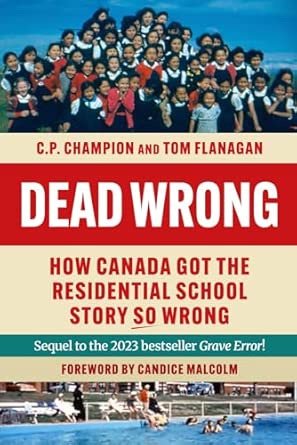
Yet, four years later, not a single set of remains of a murdered Indian child in an unmarked grave has been found anywhere in Canada. Judging by the evidence collected by Chris Champion and Tom Flanagan in their best-selling 2023 book, Grave Error: How the Media Misled us (and the Truth about the Residential Schools), it looks increasingly probable that the whole, incendiary story is a myth.

So, prime ministers, archbishops, academics, editors, and public broadcasters are all in the business of exaggerating the colonial sins of their own countries against noble (not-so-very) savages — from London to Sydney to Toronto. Why?

« Newer PostsOlder Posts »

Powered by WordPress